

Build the Future Podcast
Zach Dwiel of Terran Robotics — AI, Drones and Construction
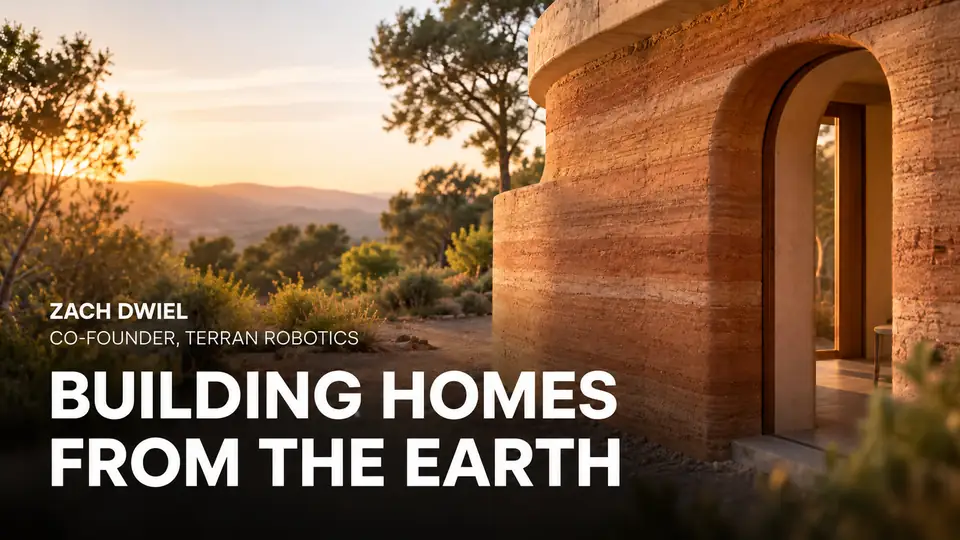
Zach Dwiel describes Terran Robotics’ early work on tethered drones and learning systems for building clay-based walls.
May 4, 2021 · 32 min



About the episode
In this conversation, we talk with Zach Dwiel, the CEO of Terran Robotics. At Terran Robotics, they're developing drones and artificial intelligence to 3D print homes. We talk about the future of construction, teaching drones to learn, and building new cities.
Links
Chapters
Times follow the podcast audio. The video’s timeline may be slightly different.
- 00:00Introducing Zach Dwiel and Terran Robotics
- 01:29Rethinking construction around material costs
- 03:31Clay, thermal mass and building traditions
- 05:09Moving beyond human construction constraints
- 06:31Building walls with high-lift drones
- 07:34Why choose drones over gantries?
- 09:30Tethers, power and energy use
- 11:12Design models and adaptive construction
- 13:33Learning to control a particular machine
- 16:27Why construction needs different flight control
- 18:40Precision and industrial drone applications
- 20:00Shaping clay with vibration and tamping
- 21:34Prototype plans and building codes
- 22:57Adoption, price goals and design freedom
- 25:46What more affordable housing could unlock
- 27:03Funding early work through an NSF grant
- 29:17Different paths to research funding
- 30:26Finding Terran and closing thoughts
Read the conversation
Open the full transcript
CAMERON WIESE: Welcome to the Build the Future podcast. My name is Cameron Wiese and I'm your host. I've always been fascinated by the ideas and sentiment that drove American culture in the 1960s with the space race. A culture galvanized to dream about the possibilities of tomorrow, whether it's food, transportation, cities, biology, or anything else. It was this cultural mindset rooted in optimism that the world tomorrow would be better than the world today. A mindset where people were compelled to build things, and I quote JFK, not because they were easy, but because they were hard. It's this desire to build and to dream that seems to have been lost, and something we're here to bring back. With Build the Future, we're here to promote the ideas and stories of those who see how the future can be better and promote their plans to get us there. It's our mission to get you to dream about the possibilities of tomorrow, to dream about the future that you want to live in, and inspire you to go build. Today, we're talking with Zach Dwiel, the founder of Terran Robotics at Terran, using
CAMERON WIESE: AI and drones to reduce the cost of housing construction by 10X. In doing so, they're working to ultimately automate the construction process so we can build better homes faster. Let's jump right in. Why don't you tell me about the the feature you're building?
ZACH DWIEL: As more and more of the processes get automated, the cost of labor, essentially, or the cost of machines drops significantly and you're left with the cost of materials. So a lot of the construction techniques now have actually been optimized for the opposite. So you have stick frame where the size of the wood is cut precisely to optimize the laborer. 4 by 8 sheets of plywood are designed to be the largest that a human can carry. The goal is to optimize the human labor, not the material cost. And so you end up with something like 50% labor, 50% material costs. And that's just because there's so much processing that's happening behind the scenes to get those materials into a ready to use state. And so if instead you look at like what's the lowest possible material cost material and then figure out of those materials that are very low cost, how can we or any of them amenable to automation? So that's where we ended up with clay. So something like a third of the world lives in a house made of clay. The problem is it's generally the poorest third of the population of the world
ZACH DWIEL: because it's a very highly labor intensive process. And so only in places where labor is extremely cheap is it affordable to build in this way. So even in the Southwest of the United States, there was as recent as 100 years ago, 80 years ago somewhere in there, there was a large fraction of homes that were being built and occupied that were adobe, one kind of clay structure. And just as the cost of labor has increased, that's dropped dramatically. And now it's basically just a construction tech use only used by wealthy people. But as the cost of the automation drops, that no longer becomes an issue. And now you have low cost of labor or low cost of machines and then also low cost of materials. So that's where you can get the extremely affordable house. And the walls are just one part of it, but we're kind of looking at the entire process from that lens.
CAMERON WIESE: I didn't know that, that it's actually more like the clay houses are more associated with like, you know, higher quality, you know, more expensive on like the upper upper end, because like generally think like, okay, people are building houses out of clay in like third world countries, because that's those the materials that they have. But that doesn't seem to be, that doesn't seem to be true.
ZACH DWIEL: So in the southwest is I think probably the place where in the US that's that's got kind of like the most recent culture around building with clay. And yeah, there it's the adobe is a luxury. I mean, and people, everyone understands that there, right? So they're much nicer houses, they're the temperature is really steady because there's so much mass. So the thermal mass of the walls acts as sort of a battery. So the temperature inside is very stable, the humidity is very stable, it also regulates humidity. In the desert, it's particularly helpful in that way, because the the outdoor temperature fluctuates so wildly during the day and night, but that happens in the Midwest as well. And there's also, there's quite a long culture of clay houses in Northern England and in Germany. And there's plenty of places that are not deserts that have built with clay. It's not restrained only to the Southwest and desert. People also think of like the Middle East and stuff like this, but it can be made to work quite well in temperate climates as well. It's a bit different, so you do have to build it
ZACH DWIEL: in a different way than you would in the Southwest, but it definitely works, and it's definitely very comfortable and a luxurious house compared to kind of standard stick frame.
CAMERON WIESE: Definitely, you said those interesting things, like the materials being processed so that humans can go assemble them. Or like you walk into Home Depot, and it's like they have all the boards cut so that you can put them on the dolly or whatever, and then you can go check out, you can put them in your truck and take them back to go build versus like, what do you actually need to build a house?
SPEAKER UNCLEAR: Bunch of those.
ZACH DWIEL: Yeah, and that also kind of encourages the homogeneity of construction, like stick frame construction. I mean, if you go to the box stores, the lumber yard, you know, you can get say two by fours that are eight foot, 10 foot, 12 foot, like these regular intervals, but there's like, specifically there's the board that's exactly the right height to make it so that you have an eight foot ceiling. And it's not an even eight foot, 10 foot, right? It's like, it's down to the, you know, sixteenth of an inch to make the eight foot ceiling. Yeah, there's just so much that's going into getting everything ready for a particular kind of construction and also for human ergonomics, right? And I think that's why as more automation takes over in construction industry, it's not going to be purely just automating what humans currently do. I mean, that's almost never how automation works in any industry. You don't have mechanical horses, you don't have, right? You come up with new ways to do solve the problem. You don't, you don't just
SPEAKER UNCLEAR: kind of automate the previous solution. Let's jump into how y'all are thinking about that.
CAMERON WIESE: What does your kind of step change look like here in terms of evolving us past the human labor?
ZACH DWIEL: So the first step that we're working on now is building the walls. We're using high lift drones. So these are the current drone that we're working on is two and a half meter diameter. This is quite a large drone. This is not the drone you buy from Walmart for your kids to play with. This is not the drone that you might even see taking pictures at a wedding or part of a movie set or something like that as a construction drone. Yeah, so that will basically be able to pick up pickup clay from that has been mixed and prepared on site and putting it in the walls. And then there's another step that's basically sculpting. So it's kind of an extremely viscous material in that state. If not, it's not flowing. There's no forms. So it's basically picking place and then from there shaping and getting into the shape that you want, you know, straight walls or benches or whatever you're looking for. So yeah, those are kind of like two different tools that were attached to the same machine. And one of the questions we often get is why drones? I mean it seems like,
ZACH DWIEL: especially when you're picking up something as heavy as clay, it seems kind of counterintuitive that you would want to fly this stuff around. But we looked at a bunch of different delivery mechanisms because the basic idea is we just need to move material from point A to point B, we need to move tools from point A to point B. And I think gantries are quite popular. This is already quite popular in construction sites. You might have like rovers or like these like dog type things like Boston Dynamics. And the drone kind of just gets us, it's relatively small. So it's actually relatively cheap and it can scale much larger. So like a gantry, the bigger your gantry gets, the harder it is to be precise about where your gantry position is. And this is the same problem with industrial robots, generally, like these big robot arms that you see in a car factory.
ZACH DWIEL: there's kind of this escalating size where you want to be precise at the tip and so you need to have like precise motors and the precise motors weigh a bit more and so now like the end of your arm weighs a bit more and so then like the shoulder joint has to weigh a bit more and then the elbow joint has to be a bit more and it kind of just escalates into this like really big thing. Some of the concrete 3D printers, which is another thing, kind of another route for automation, construction automation, they have, as the size of that printer gets bigger, the price does not increase linearly. Having a printer that is 100 foot by 100 foot is a harder problem than having a printer that's 20 foot by 20 foot, even just logistically on the site. So having a drone, this is a tethered drone, it's not being run by batteries. So we're not swapping, we're not doing battery swaps or anything like that. There's a tether that's supplying power. And so it can go 100 feet from the power source. And it doesn't matter if there's hills, it doesn't matter if the ground is flat nearby,
ZACH DWIEL: it doesn't matter any of that stuff. It can kind of get from point A to point B quite easily.
CAMERON WIESE: I guess, yeah, the battery thing is kind of what we all assume that drones are operating like. I don't think I've ever seen a tethered drone.
ZACH DWIEL: Yeah, yeah, they're starting to be more used for like surveillance or like monitoring and stuff. Like, so there's some that'll send up to monitor like a fire or something like that, like a forest fire or a house fire or things like this where you're basically just, you need to quickly put something up in the air to be able to get a new perspective. But yeah, I mean, batteries are still quite expensive. Even if you have pretty good charge time or like cycle times, you're still like replacing the batteries fairly often. So I think, you know, maybe it's possible in the future, battery tech will improve fast enough, you know, well enough that we could switch to that. But having a tether really, it simplifies things significantly. It's like much lighter. We can apply a huge amount of power. And I guess that's another question that we get a lot is like the energy use that seems like quite inefficient to be flying around. But like the cost of energy, even when we talk about getting down to like 10 times cheaper than conventional construction, the fraction of that price that is energy
ZACH DWIEL: is still quite low. It's like less than 10% of the cost, likely much less even than that. And also like these 3D printers, for the concrete 3D printers, the ones that I've seen, their specs are actually fairly similar to ours and they're in the energy consumption because they're pumping concrete, right? So like a concrete pump is not like that, requires a bit of energy. There's quite a bit of friction pump and there's like a lot of mass you're moving. So yeah, and then like the motors on that gantry are like quite large. And so it's actually kind of in the same ballpark as the energy use of a large 3D printer.
CAMERON WIESE: What's your design process look like? Where the drone goes, how you play stuff? Like, at some point you have to design the house and then you have to kind of transit that design into
SPEAKER UNCLEAR: like the physical model. So how do you guys think about doing that? The basic idea is similar to
ZACH DWIEL: 3D printing, you know, people are used to with printing plastic or you end up with a 3D model and instead of actually going to G-code, which is basically translating that model into precise motions of the printer head into like very precise positions. So we actually don't have that because COB is so malleable and kind of because it's flexible, you're not actually putting it in a precise location and then expecting it to be there. You kind of put it in a general area and then you kind of sculpt it and shape it and adapt, right? And there's computer vision involved in doing this. So with 3D printed concrete, for example, or 3D printers with plastic, you'll have a print going and something will go slightly off and the whole thing gets ruined. It seemed like videos of people with 3D printed concrete and there's a guy with a trowel that jumps out and catches the, you know, that goes off in the wrong area. It can be catastrophic if it's not in the precise millimeter. So instead of coming from that perspective, where you expect full control over everything and kind of do it blindly,
ZACH DWIEL: it's actually kind of got a model of what the house should look like. It's got a model of what the house looks like presently. And then it's using artificial intelligence, computer vision, and reinforcement learning to figure out what action should I be taking next in order to make the model that represents current reality more match the model. That is the goal. And so it's a much more fluid process than kind of you're used to with, with 3d printed plastic and that kind of thing.
CAMERON WIESE: Primarily again, it's the result of like kind of doing it in two steps where you're like laying the groundwork and then you're shaping it.
SPEAKER UNCLEAR: Yeah.
ZACH DWIEL: And willing to willing to kind of adapt as, as you go, instead of kind of just expecting that everything you do happens perfectly. That actually like simplifies in many ways the mechanical side of things, right? Because you're no longer required to maintain, you know, submillimeter precision on the positioning system if you don't need it to get that precise
SPEAKER UNCLEAR: every single time without fail. That has to be very, very, very precise. If you're off by like
CAMERON WIESE: a fraction of a millimeter like came over, right?
ZACH DWIEL: Right, same with like screwing a screw in a car in a factory. Like if you're off by millimeter or a 10th of a millimeter, like that's enough to mess up the whole thing. So you really need that repeatability. And actually in using reinforcement learning and AI to solve the kind of control problem here, it's actually simplified a lot of the other processes that would typically be quite difficult. So for example, you know, people are familiar with Boston Dynamics and like the kind of robots they make and they're also like the dancing, like humanoid robot they released recently was incredible. That's kind of like the classical robotics solution where you model everything super precisely and you make sure like your motors, when you ask them to do something, they do exactly that and you know exactly how they're gonna act. And then you can control it and you can do those kind of amazing feats. But what we're working on is more flexible in that it learns how the machine is operating. And then the AI learns to control that particular machine. So one example I like to tell is how
ZACH DWIEL: this is maybe a year ago or something. I was training at How to Fly just as kind of a test harness here. So it actually learns on its own how to fly. It's not just being told. And so I was training it at night and I got it working.
SPEAKER UNCLEAR: I was pretty excited. I go in the next morning
ZACH DWIEL: and it's no longer providing enough thrust. I forget if it was not providing enough thrust or providing too much thrust, but it was like no longer working exactly right. And it took a little bit to figure out what was going on, but basically the temperature had changed and the temperature of air and the humidity of air both combined to specify kind of the density of that air and that if it's more dense air, then you can push against it more easily. And so it changes the flight dynamics. And so kind of like the traditional approach to do this would be to actually measure the linearity, like try to model that relationship of temperature and humidity or to kind of just the standard drone approaches to kind of just call that error, detect a little bit of that error and kind of adapt on the fly and basically never be actually tuned to the particular, like people actually tune their drones to a particular temperature or humidity and they'll like retune them in different conditions instead of just having it sense that and adapting. So what we were able to do
ZACH DWIEL: was add a temperature sensor, add a humidity sensor, and let it learn what that relationship was and how that affected the flight. And so without actually having to model any of that ourselves and like model the physics of flight, we just give it a temperature sensor, humidity sensor, and now it knows how to fly in both, you know, in different weather conditions. So yeah, that was a nice example where like that learning really made the process much simpler and it kind solved like, yeah, it made it so we didn't have to solve certain software problems, we could simplify the hardware, we could simplify the software and just let it learn how to deal with
SPEAKER UNCLEAR: these variations. There's software and there's libraries that like enable you to do this. Are
CAMERON WIESE: you guys like reinventing the wheel on this stuff or is this like, why go through and like have it learn how to learn? Like, you know, the temperature controls and all that versus like there's like
SPEAKER UNCLEAR: out of the box stuff, right? Yeah, so there's there's definitely some out of the box stuff,
ZACH DWIEL: But like this example here of the temperature and humidity change, the kind of out of the box solution is to retune in different weather conditions, not to actually adapt, right? So there are probably some that actually adapt or someone has actually gone through and measured the the court you know that they've modeled the temperature and humidity and the air density and all this, but it gets complex quite fast. I mean, you have different colors that have different reactions to the density. I'm not sure there's really even a general solution that's going to work perfectly in every situation. But yeah, your point about learning to fly is a little bit over the top. You don't really need to learn how to fly. It's more of just a one, it's a good test for us to just make sure that everything is working. That's one thing. And then the other thing is that learning to fly also means that we can learn to fly in conditions where it's exerting forces on its environment. So with a current drone, like if you, they're all basically assuming that they're flying, they're free-flying, maybe there's
ZACH DWIEL: wind, and maybe there's a load, you know, maybe they pick something up or drop something, so there's, you know, a change in its weight and its payload, but they're not assuming changes in rotational inertia. Like they're not, they're not assuming that, they're also not assuming that the drone is going to be applying forces to a wall. So if it's like tamping a wall or pushing on a wall, that's going to change the place significantly. And while you then could change the control software to handle that and to do things in a way, like kind of think ahead how you want it to react to forces pushing up on it or forces pushing to the side. And you could code that all out. But that would definitely be a manual process. That would no longer just be an off-the-shelf drone software that's going to handle those situations.
CAMERON WIESE: I think the issue, or at least in my mind, the mental model that I was like around the consumer drones, because I know you're doing what's much bigger, but it's not a DJI phantom. You get off Amazon, you get Walmart, where you're flying around to take photos. This is like an industrial application where there's lots of different pieces, different parts. So that actually makes way more sense.
ZACH DWIEL: Also in a lot of cases, the current drone software, even for kind of professional use, you either have a human operator, like a highly skilled human operator, like in the case of shooting a movie, there's even sometimes multiple people flying that one drone. Like there's someone flying the drone, there's someone flying the camera under the drone and point in different directions, right? So it's a highly manual process, or in kind of, say there's like crop spraying, it's like another case where drones are surveying. And there, if you set a path and you want it to fly and survey your mining operation or something, If it's off by a few feet, when it looks at this huge pile of gravel, it doesn't really matter. You definitely don't need centimeter level or millimeter level position accuracy, position hold in that scenario. That's what we're talking about. We really do need that very high accuracy positioning. It doesn't have to be perfect, but it definitely has to be better than generic GPS, rough, plus or minus a meter type thing.
CAMERON WIESE: I want to get some clarity around like the shaping piece. So you have the tether drones going, it's like kind of laying the foundation, it's kind of laying stuff for the walls. And the shaping part where it comes in, it's like actually molding it. Like how are you guys doing that? What does that look like?
ZACH DWIEL: That looks, I mean, the manual process of building with clay often has the same kind of process. So you basically put it in there and when people are doing it by hand, they'll kind to just like push it and poke it, you know, sculpting by hand, right. One of the things that we found when we tried to replicate those kinds of actions mechanically was that, especially with the drone, right, it's not grounded. So it can't like push off the ground to push the wall, right. If it's in the air and any of the forces that's applying to the wall, it has to create by pushing the air, you know, in the opposite direction. And so humans actually put quite a bit of force on there, whereas it's much harder for us to do that. So we actually found that that like vibrating or like tamping these kinds of forces temporarily put the clay. I mean, it's not just clay, but this is like clay mixture, clay composite into a more fluid state. And so we can shape it much more easily. It is like common in like tamping the ground to make it smooth or, you know, people do similar things on concrete.
ZACH DWIEL: There's kind of a mechanic, like a vibration, tamping type force. and we're still experimenting with exactly what those forces should be and how they should be applied and this sort of thing. Yeah, we don't know exactly how it's going to play out yet, but we've got kind of the first the first experiments seem to be going well.
CAMERON WIESE: What's kind of the time line looking like? What are you guys hoping to hit? Like when are you hoping to kind of get the first building kind of constructed?
ZACH DWIEL: Yeah, we're hoping to get kind of first walls constructed this summer, potentially first first building this summer, somewhere in that range. And then it really should move quickly from there. We're working with structural engineer out of California that helped write the code for the kind of construction that we're working with. That's another thing that comes up frequently with alternative construction techniques. There's questions about how do you meet code and regulations and all of this. But yeah, we've got the guy who wrote the code on our team, essentially. So that's been a huge help. Yes, I think I think we should and one of the co founder has, he's been in construction in the past and you know, is with part way through an architecture degree, he's like, got one semester left, I convinced him to take a leave of absence. So he's more on this, but he's like almost an architect. So we've got like, we've got the architecture side, like also, we've been thinking a lot from that perspective as well. You know, so so really getting we've got like, details
ZACH DWIEL: of how how windows are going to go in, how doors are going to go in, how it's going to connect to a top plate, how it connects to the foundation. Like there's a lot, there's a lot of these other details that aren't AI, you know, drone tech side that, that are quite important that we've been, we've been able to make progress on in parallel.
CAMERON WIESE: One of the other pieces that seems to be kind of critical here is like consumer adoption and having people be like, okay, or comfortable with like houses being made out of clay versus, you know, traditional stick.
ZACH DWIEL: I think they're, you know, like in the Southwest, it's actually more common to build with clay and it's seen as a luxury. So if you start there then you're in a pretty good spot. Yeah so I mean that's one easy path is just that yeah they already know that it's a luxury there but I think also while our first house that we build and sell we're not going to be able to hit 10x cheaper than conventional construction we are going to be significantly cheaper than conventional construction out of the box and I think you know while some people want a granite countertop and white picket fence, and they have their preferences of what their house is gonna look like. I think most people don't really care what their walls are made out of. I think most people actually don't have any idea what their walls are made out of, especially people who are renting or people who, they don't care. Is it, is there concrete block behind there? A lot of people have no idea and don't really care. So I think that's one part of it, is you get something, a product that is, when they go into it and experience it,
ZACH DWIEL: like they can tell it's a nice product and it's a luxurious product. And I think when it's half the price or 10 times cheaper eventually, I don't think that's gonna be too big of a concern. And we've already got, when we talk to people, people are quite excited to have significantly cheaper
SPEAKER UNCLEAR: housing and like they understand
ZACH DWIEL: what that unlocks for them, right? And I think too, like we're hoping to release some renderings in some visuals of what we're thinking about. But I think there's a lot of homogeneity in the construction industry now and kind of in the styles and aesthetics. And I don't think people necessarily realize how constrained we are right now and how everything looks so similar just because everyone is operating with these same constraints. And once you kind of open up these constraints, the things that are quite expensive, if you're doing it by hand, become quite trivial if you're automating it. So even simple things like having a split level in your house where you step down a step or two to get into your living room, or your entryway is a little bit lower and you step up into your, just like really basic stuff like this, or like building benches, like bench seating right under your windows, or there's a lot of things like this that we can do for basically free, at no additional cost. Whereas if you're gonna do those kinds of things with conventional construction,
SPEAKER UNCLEAR: it's a huge pain.
ZACH DWIEL: And it's going to cost a lot more. So I think there's a lot of features that we can include that would typically be considered luxury features, but we can do them for free essentially, or for no marginal additional cost.
CAMERON WIESE: Yeah. What else gets you excited about, or what else is unlocked through this process that gets you really excited?
ZACH DWIEL: I mean, I think primarily I'm almost excited about the societal effects that are unlocked, or the social effects that are unlocked. There's so many people who spend a significant fraction of their income on housing. It's something like half of people's income. Something like half of the US is spending half of their income on housing. It's a huge amount of money. And I think it just, it makes it so that people can't pursue the things that they want to pursue, right? They just, they have to, they have to grind, they have to hustle in order to maintain just the minimum level of living. So being able to unlock that I think is extremely exciting. I think that the most vibrant places that people think of, like New York in the 80s or like San Francisco in the past and Oakland recently, or these are the places where people are excited to live. And these are places that are not expensive to live. I mean, that's kind of like how gentrification typically happens, but the exciting places to live are places where people can work a part-time job and do whatever else they want to be doing,
ZACH DWIEL: exploring whatever other ideas or whatever projects or art or startups or whatever it is they want to be doing, it's unlocking more of that potential that I'm most excited about.
CAMERON WIESE: One thing I want to have you touch on briefly is like the financing side of things. Because like you guys did something cool as you applied for NSF grant and that like seemed to seed, that's like seed capital to go test and expose idea. Can you like briefly tell me about why that was a good, why you thought that was kind of the approach to take versus, you know, going to raise money, which is like, go, go sell equity. Cause like that's what most people associate. And then, uh, how that's, how that's worked out and like how other people can kind of pursue that path or like, it could be like why it may be a good fit for other people to go do that.
SPEAKER UNCLEAR: Yeah. Yeah.
ZACH DWIEL: So the grant that we got last year was from national science foundation. Um, and they like to call it their seed fund. It's like a SBIR grant is the, is the technical, technical name for it. It's been incredibly helpful to just have that like non-dilutive $256,000. And then the state of Indiana also has a matching program. So they had like $50,000 of matching. So it was like just a touch over $300,000 of undiluted funding, which is incredible. There was definitely some risk going into it of like spending the time to write up this grant and put all the details in there and then you just, you know, either you get it or you don't, so there's some risk at that side, but it's been a huge plus to have that. And also, it kind of gives a lot of credibility to you. I think a lot of people here like, oh, you're funded by the National Science Foundation, it opens up doors. So that's been helpful, even at that kind of like relatively small amount of money as far as equity, you know, VC funding $300,000 is not that much money, but it's still been quite helpful. And we are planning
ZACH DWIEL: on raising more money soon in the next few months and more kind of standard VC route. But there's also a phase two grant that's possible from the National Science Foundation that's a million dollars plus $500,000 of matching money. So yeah, so they're definitely looking into that. And there are other like, they've funded other like, yeah, cool companies. Like there was one Blue River technology, like they were SBIR funded. They do autonomous weeding. I was watching before I knew about SBIR and all this stuff. And it's like, oh yeah, they're also funded that way. But yeah, I think it's definitely cool. And the SBIR grant in particular from NSF is quite open-ended. So, you know, the one that we were under was an AI, but it's a very, very general topic. There are other departments, like there's Department of Defense and Department of Energy and those ones tend to be quite a bit more specific. They have kind of a big list of all the things they're looking to fund. And if you're doing one of those very specific things, then then you can work something out. I think
ZACH DWIEL: it can work well. But but the NSF is a lot more open ended
CAMERON WIESE: about what what kind of projects you can be pursuing. That's something a lot more people should know about and should consider is like, there's money, there's money out there to like do cool things. People want to support innovation, they want to support new technologies, they want to give people the resource to go build stuff.
ZACH DWIEL: Definitely. Yeah. It's been really good. And I, yeah, I agree. Like I also was not previously aware that this kind of thing was going on. It's definitely, I'm glad that tax dollars are being spent on like helping companies like this. It just seems like a really, really good system. I'm glad that it's going.
CAMERON WIESE: Where can people find you and how can they support Terran?
ZACH DWIEL: Yeah. So right now we've got a very minimal website up at, at terranrobotics.ai. We're hoping to put up a lot more there soon in the next month or two with more renderings and kind of plans for what, what we're working on. And around that time, we're also planning on opening up a pre-sales waitlist. We've already made, we've already made a few pre-sales to be on the waitlist just from organic interest from the very little media we've gotten so far. we've even tried to get so far. But yeah, I mean, if people are interested in this kind of construction, like definitely the wait list is like very low risk, like a hundred dollars refundable whenever you want, but just to kind of get on the wait list and that helps prove some of these questions you were asking earlier about, how many people are interested in this? Like, do people actually want this kind of house? Like if that's something that you're interested in, definitely sign up for that and that will help significantly. And then also, we're starting to work with developers and real estate investors and so anyone who's interested
ZACH DWIEL: in that direction, definitely get in touch. We've got some local developers here in Indiana that are interested and that we're starting to work with, but the more the merrier, definitely like to hear from other people, other crazy projects people are working on or interested in working on. And then are you guys hiring as well or not yet? Close, so hopefully next, we're definitely hiring in the next month or two, three, somewhere in that range, soon.
CAMERON WIESE: Thanks for joining us for this episode of the Build the Future podcast. If you're building and want to get support, want to hear about certain topics, or hear from certain people, shoot us over an email to hello at buildthefuturepodcast.com or follow me Cameron on Twitter at camwheezy and we'll see what we can make happen. That's it from us. Until next time, go build.
SPEAKER UNCLEAR: Thank you.
More episodes
All episodes Dryden Brown — Cities, Herofuturism and ImmortalityDryden Brown describes the vision behind Bluebook Cities and Praxis, connecting urban design to shared values and social trust.
 Patri Friedman — Charter Cities, Law as Code and Governance ExperimentsPatri Friedman lays out his vision for charter cities that experiment with laws and services while competing to attract residents.
 Adrian Fenty — Building Better Cities Through Policy and TechnologyAdrian Fenty connects his work in city government and venture investing through education and accountability.