

Build the Future Podcast
Dryden Brown — Cities, Herofuturism and Immortality
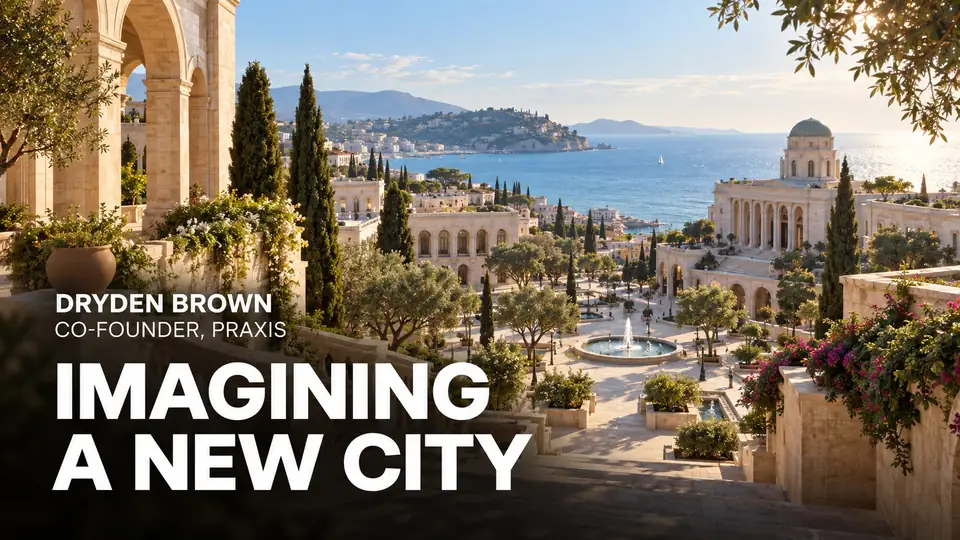
Dryden Brown describes the vision behind Bluebook Cities and Praxis, connecting urban design to shared values and social trust.
January 5, 2021 · 35 min



About the episode
In this conversation, we talk with Dryden Brown, CEO & Founder of Bluebook Cities. At Bluebook, they're building the city of the future for Praxis which is a society of founders, engineers, artists, researchers, and young aspirants building towards a shared vision for the future through the pursuit of heroic projects.
We cover the future of cities, herofuturism, college campuses & trailer parks, David Bowie's pool, and more.
Links
Chapters
Times follow the podcast audio. The video’s timeline may be slightly different.
- 00:00Welcome and introducing Bluebook Cities
- 01:42The vision for a different kind of city
- 02:43Heroic projects and symbolic immortality
- 04:13College campuses, trailer parks and social fabric
- 06:19Designing for spontaneous encounters
- 17:26Choosing a different path
- 27:50The practical challenge of building a city
- 31:20What a new community could make possible
Read the conversation
Open the full transcript
CAMERON WIESE: Welcome to the Build the Future podcast. My name is Cameron Wiese and I'm your host. I've always been fascinated by the ideas and the sentiment that drove American culture in the 1960s with the space race. A culture galvanized to dream about the possibilities of tomorrow. Whether it's food, transportation, cities, biology, or anything else, it was this cultural mindset rooted in optimism, that the world tomorrow would be better than the world today. A mindset where people were compelled to build things, and I quote JFK, not because they were easy, but because they were hard. It's this desire to build and to dream that seems to have been lost, and it's something we're here to bring back. With Build the Future, we're here to promote the ideas and stories of those who see how the future can be better, and promote their plans to get us there.
CAMERON WIESE: It's our mission to get you to dream about the possibilities of tomorrow. To dream about the future that you want to live in, and inspire you to go build. Today, we're talking with Dryden Brown, the CEO of Bluebook Cities. At Blue Book Cities, they're building a new city for Praxis, which is a society of founders, engineers, artists, researchers, and young aspirants building towards a shared vision for the future through the pursuit of heroic projects. Let's jump right in. Dryden, thank you so much for being here. It's nice to have you talk about Blue Book today.
DRYDEN BROWN: Yeah, man. Thank you for having me. Glad to be here.
CAMERON WIESE: So I want to start with the basics. Tell me about the future you're building with Blue Book. What's the vision?
DRYDEN BROWN: Yeah. Yeah, I think that cities are a bit broken in a few ways. One is that there's just very weak social fabric in cities. There's a high degree of loneliness and they really exist only as labor markets. They only exist to help people coordinate towards like finding jobs, dating markets, and so forth. But people in cities don't sort of share the same value systems. They don't have shared notions of good and evil and things like this. And it almost sounds kind of archaic, but I think this is actually quite important because people in the tech community talk a lot about technological progress and lack thereof stagnation. And I think the core, the problem of tech stagnation is actually a function of our weak social fabric, our lack of shared values, because your values imply your vision for the future.
DRYDEN BROWN: And if you're on a boat and you have a number of different people trying to steer the boat, but all of your compass is pointing in different directions, it's quite hard to get anywhere good. If we all come together around shared values, our values imply our vision for the future, and we can start to build towards it.
CAMERON WIESE: So what do you work on at Blue Book? Are you kind of working to progress that shared vision of the future?
DRYDEN BROWN: Yeah, so we have developed a value system for building a community around that value system. So the core idea is something we call heroism. And the highest value in this system is the pursuit of immortality, but not just sort of physical immortality, also symbolic immortality. So symbolic immortality is eternal memory in the minds of men, it's heroism. So we think a lot about sort of finding our heroic project, like a way that we can work on something that's quite meaningful, it's removed society in a positive direction, towards this sort of goal of personal symbolic immortality, civilizational immortality and so forth. And so yeah, our community is called Praxis, it's a group of people working on heroic projects. And right now we all come together online and through some sort of in-person events, but eventually we're going to all come together in a new city that we're building.
CAMERON WIESE: Can you give me some examples of some of those kind of immortality projects that you've drawn inspiration from?
DRYDEN BROWN: Well, I mean, I guess like within our community There are people who are working on a number of different things So we have one of our friends is working on building a new African Renaissance He's working on sort of cultural revitalization on a continent We have a few people that are working on projects that I can't talk about yet in detail But they're oriented around some fixing the health care system in the United States So yeah, I mean so the core idea is you know working on something bold something that takes, you know Perhaps a bit of courage but they can just reveal tremendous benefit to society and really humanities more broadly
CAMERON WIESE: Yeah, I want to I want to take a step back and get your take more on the current state of of cities Like what's going on in in US cities right now? What are we missing or kind of what are the mechanisms of change that you think are necessary in existing cities or? perhaps in a new city.
DRYDEN BROWN: Yeah, I mean, I think the only quasi cities that are actually functioning that have some real social fabric are sort of college campuses and trailer parks. So college campuses, we sort of all come together around drinking and sort of not knowing what we're going to do with the rest of our lives. And this is sort of like the bonding glue. I don't think that's like very good. It's kind of hard to build a specific future if you're not sure what you want to build and so forth. Great for short-term, like interpersonal bonding stuff, but it's not actually great for sort of doing anything as a group. Trailer parks are great because you're watching a movie in your RV and someone walks by and hears the movie and you know Rick and you invite Rick in and you eat popcorn and watch the movie together. And that's totally lacking. Even in my apartment building, I have no idea who any of my neighbors are. I don't think they care to know who I am. And that's a little bit disappointing. I think we can aspire to more than this.
CAMERON WIESE: Yeah. So on that note, quality of community is an important facet of future cities. What that you're taking this first principles approach to design a city. So can you elaborate on again, what a city should look like and what some of those first principles are that you're basing that
SPEAKER UNCLEAR: thought process off of? Yeah, I mean, so I think about architecture in terms of sort of like the feelings that it creates. And I mean, sort of physically, I really like parametric architecture, I like actually being able to optimize, particularly public spaces for the number of sort of random collisions that occur between people walking through these spaces, you know, just sort of why do we go into sort of public space? Often it's for these spontaneous interactions. This is why we come to cities to meet new people and so forth. But this only really works if the city is a high trust environment. If you share values with people in the city, you think they're probably good people, they sort of share sort of similar notions as to what it means to like be a sort of good person. You don't want to be bumping into people who, you know, might not like you, might not be the kind of people that get along with you or would like to get along with you.
CAMERON WIESE: So again, you touched on the serendipitous interactions, the kind of community feeling, that the trust, can you kind of like paint me a picture though? Like are painting a picture for like the listener of what, what might this futuristic city look like? What are the activities? Like, what are things being worked on?
DRYDEN BROWN: I mean, so we want to live in a city that like makes us feel heroic. That is architecture that's exalting, that encourages us to meet new people, sort of get out into the public square. That really is like designed engineered to cause like these spontaneous interactions, these collisions with people that we want to meet. If you're in a community that's super high trust, you're with a ton of people that are like totally fascinating and you may not have met, you want to meet them. It's sort of like in college, you want to meet everyone during welcome week. We want to have this sort of energy all the time. Of course, it has to be on the beach. You have to be able to wake up and go swim in the morning.
DRYDEN BROWN: You have to have the gym on the beach, the library on the beach, many things, many good things on the beach. But yeah, I mean, sort of the core idea is creating a community with an insanely sort of like unique and specific vibe, sort of as created by the group of people that choose to move there. I think cities are social networks fundamentally. Sort of like the layout of Instagram doesn't affect your experience as much as the people who you follow on your feed. And similarly in new cities, the notion is, hey, we no longer have to move to a city because there are jobs there. The jobs are all in the cloud, follows us wherever we go. We don't need to move to cities because of jobs.
DRYDEN BROWN: So why might we move to a new city, right? We might move to a new city because we want to live in sort of a beautiful place. We have some preferences to what the weather should look like, but fundamentally like cities or social networks, and we're going to move to plug into a specific social network. And for us, we're working on cultivating this heroic environment where people can work on their heroic projects, take their hero's journey and live in a sort of social setting that's like highly, highly supportive of that. And that's what's super exciting to me. And that's what's exciting to our community. So that's what we're building.
CAMERON WIESE: Yeah, I want to kind of talk about the community and the value set that you've been building the community off of, because if I understand correctly, they'll both work to shape the eventual migration to the city where everyone there has that sort of trust, has those relationships and has those shared values that they can bond over. What is this value set, this hero futurism?
DRYDEN BROWN: Yeah, so hero futurism, the core idea is that we should be pursuing immortality. And this is really the purpose of life. So immortality is actually like a really fascinating notion in some sense, sort of like superficially, it seems to be, you know, perhaps it's selfish. It doesn't seem that generative sort of like, what do we do with all this time we have, we may have left, but really I think sort of immortality lies at the core of like what it means to be a living being. Sort of like any living creature, sort of their sort of core drive is to propagate their genetic materials sort of through time, through space to avoid death. And sort of the inversion of this is the pursuit of immortality.
DRYDEN BROWN: And we live in this highly symbolic world that we've created for ourselves. And the way that we cash out immortality in this world of symbols is this heroism. We wanna create this imprint on the world. We wanna leave a legacy. We wanna have eternal memory in the minds of men. And this is how the ancients reckoned with the fact that they were going to die. And I think it's a tremendous concept that we've lost and it can give people an enormous sense of purpose, at least part of the meaning of life. it's part of what we should be doing here is, you know, trying to do things that are sort of worthy of to society, to humanity of this sort of like eternal glory and heroism and so forth. I think also immortality is a remarkably generative concept. So it's like the proximate thing is like just living forever. That's super cool. Secondarily, you have this symbolic, you know, personal immortality, it's sort of like eternal glory or something to this effect. But also at the sort of societal level, or even at the level of our species, you know, we want physical immortality, we want existential security, we want to get onto other planets, go out into the stars so that if a meteor strikes Earth, we're not all gone.
SPEAKER UNCLEAR: Consciousness isn't extinguished from the universe. And we also want to do this symbolic immortality thing at the civilizational scale. We want to create art and generate knowledge that we can transmit through time and that's useful to other civilizations and so forth.
CAMERON WIESE: Yeah, one of the cool things that the Herat community is working on is the idea of the Praxis Brain. You can have a little bit more about what that is and how that works to propagate that
SPEAKER UNCLEAR: knowledge throughout the community. Yeah, so every society has a distinct tradition of knowledge. They transmit sort of through generations. And the way that we think about sort of bootstrapping this, I think Wikipedia is like an amazing project, but it's one distinct tradition of knowledge that's moderated by a community that may or may not have a tremendous number of things in common with you. And certainly like any glimpse of reality is always going to be sort of two-dimensional, and all sort of if reality is like a cube, it's like you're only glimpsing the cube from one angle, you see this sort of two-dimensional like cut of it, maybe a square or something like this. So fundamentally like all these sort of knowledge projects are incomplete, but they can frame knowledge in sort of the terms of your values and sort of through your lens and so forth.
DRYDEN BROWN: So I think it's really important for societies to generate and sort of codify a tradition of knowledge, certainly that should be updated and so forth. But so the way we do this within Praxis and Praxis Brain is by building this like enormous and enormous Rome graph, sort of like an internal open source project that basically begins with a really simple external shell that's sort of our narrative as to how the world might be. You know, the world is a way, and if we do X, if we like sort of step up to the plate, take on this heroic task, we can make a world that's like Y. And this sort of world of the future is, you know, we're a space-faring civilization, we, you know, ended aging, and we found a sort of like spiritual transcendence that sort of imbues our life with purpose and, you know, can go into much greater detail on all these things. But for the purposes of explaining the Rome brand, we start with these simple premises in the form of a narrative and then support all of our assumptions and conclusions and outline the fringe technologies that will be developed and so forth. And it descends all the way down to, perhaps, physics at the bottom of the graph. And it's the intellectual scaffolding
SPEAKER UNCLEAR: for building the future. There are a couple of different directions to go in here. The whole narrative in the Valley is like, oh, San Francisco, Silicon Valley is dead. We're going to the cloud. Going to the cloud, we're going to the cloud, going to the cloud. And it doesn't quite, in my opinion, I haven't seen anyone other than what you guys are doing at Bluebook translate that into, into the real world. Like, what do you think everyone else is missing? Why is it important that we get off the internet and into real, tangible, like physical communities?
DRYDEN BROWN: Yeah, I mean, I think there's a lot left to explore in the world. I think there's a lot that we really sort of fundamentally do not understand, you know, particularly as it pertains to consciousness and perhaps God. And I was reading this interesting story the other day about, I was trying to sort of explain this notion as I was trying to motivate this intuition in some of my friends at a dinner party in San Francisco. And I read a story last night about David Bowie. He was just moving to a new house in LA. This was in the early 70s, just after the Manson murders. And he was sort of experimenting with the occult. He found this stuff to be quite interesting. He thought that demons were chasing him around or something to this effect.
DRYDEN BROWN: And I think his wife thought he was like, something of a lunatic, they move into this new house that has this giant indoor pool and his wife is saying like indoor pools are always a problem, like these things are never good, they're always a hassle to maintain and so forth, but so they move into the house anyway. And so the first night that they're there, Bowie goes out to the pool and he's sitting by the pool and sort of staring at it and he gets sort of like bad feeling from it, he's not really sure and goes back into the house, goes to sleep. The next night he goes out to the pool again and the water starts like bubbling, bubbling and he just sort of like stares at it. He's kind of freaking out, you know, presumably he'd been on like something of a, you know, kind of long bender. So maybe his like, you know, reports are somewhat questionable in this case.
DRYDEN BROWN: But he claims that he saw like Satan rise out of the pool, and he freaked out and ran back into his house and told his wife and all these things. And so they went out and they were visiting with these pastors and trying to get these sort of like, you know, spiritual implements, like all these occult objects and like druidic texts and things like this. And so the next night they go back out to the pool together, Bowie and his wife sets up this sort of like lectern with all the objects that he's collected from around town, from all the exorcists, presumably. And he starts reading and he's just reading in this droning voice, this monotone. His wife is looking at him like, what is going on?
DRYDEN BROWN: Like trying to sort of humor him. And she says, the pool started to bubble, then it started to thrash. and they saw like this big gargoyle shadow at the bottom of the pool, and they weren't sure what it was, and they weren't sure what it was, and he kept reading, and it just disappears, and it's gone, and they moved out of the house, and they've tried to stay in touch with every tenant since to figure out like, hey, were we just like out of our minds? And everyone has said, yeah, there's this big weird stain shadow at the bottom of the pool, we've repainted it, we can't figure it out, it keeps coming back, we have no idea what's going on. And it's sort of made it click to me that like, VR is a total waste of time, if there's no sort of Satan potentially at the bottom of the VR pool. It's like our understanding of physics does not allow us to create a pool where this is like an emergent property of the water moving right. Like there's something to this effect, right? And sort of the question is until we like fully understand the nature of our reality, why are we moving into realities that we construct? Like they're just fundamentally going to be less interesting than anything that's been created sort of by nature. We're sort of like, you know, bottlenecks by our creativity, or understanding of reality and sort of, you know, maybe some derivatives thereof. But still, I think there are sort of everything that's interesting that's left to sort of explore in the world is out here. It's in the virtual reality that we already inhabit. It's not sort of in there.
DRYDEN BROWN: Yeah, you can sort of while away your hours, you know, in VR or something like this. And I have VR, I think doing meetings in VR is great. I think, you know, a ton of like great educational applications. I think, you know, being the sort of avatar for some robot that's sick and so forth. And there are a lot of cool things we can do with it, but living in this wholly virtual world with no sort of touch points, external reality, living in the metaverse and the sort of ready player one world that seems like deeply undesirable. And I think we should be trying to construct a better world world, not, not sort of tinkering around with these video games.
CAMERON WIESE: Well, yeah, cause it's the world around us, the physical world, at least the VR that we are currently inhabiting is, is uncertain. We haven't figured it out. So there's lots of challenge and it's uncomfortable and getting answers may not be the most pleasant experience. So it's almost more comfortable to just say oh, let's go plug into another another reality that we have figured out
SPEAKER UNCLEAR: That we think we figured out, you know you like, you know of all people the Goggins guy, you know It's like being comfortable is not it's not good. It doesn't make you feel good long-term. You feel you feel bad about yourself It's bad for your self-esteem. You don't want to be comfortable. You want to be uncomfortable You want to push yourself and that's what's exciting and you know, just sort of sidebar I don't I don't mean this is like a criticism of people who are working on new VR I have an Oculus and love it and so forth. But still we need, maybe the human capital transfer should not be from Oculus to, you know, building hardware or something to this effect. Maybe it should be from McKinsey to working on hardware or something like this.
DRYDEN BROWN: And I think, I think that's definitely true. I think, you know, sort of a lot less people should be sort of tinkering around in spreadsheets, you know, for, for sort of the vampire squid or, or, you know, doing consulting for whatever the Sackler family, you know, at McKinsey and that would be good. You know, more people should be working on rockets and so forth.
CAMERON WIESE: Yeah, how are you thinking about getting more people to step away from the vampire squid and go pursue something else?
DRYDEN BROWN: So I think it's a fairly straightforward case to make. It's basically like, in college, there's this sort of mirage of prestige and happiness that will come from this, of working at a name brand firm, big tech, like Facebook, Google, and so forth. And it tends to dissipate within a week of arriving. And then you know you're not doing something that's particularly purposeful. You know you're not doing something that's particularly intellectually challenging. And I think, you know, there are tremendous amount of entrepreneurs that leave these places, you know, to work on their own thing. And I think, you know, taking it one step further is sort of this, this sort of second question of could the thing that I'm working on be something that's like tremendously meaningful to the world?
DRYDEN BROWN: And would that give my life a sort of deeper sense of meaning? And that's what we're all looking for. We're looking for purpose and meaning and belonging. And what we're trying to do at Praxis is help people find, we're trying to help them character max, like sort of be the most extreme version of their character, find the biggest project they could work on and give them the sort of the network. And, you know, to some extent, the sort of like, you know, support system that gives them the confidence to actually do these sorts of these kinds of audacious projects. And it's just deeply desirable, I think, to most people who are highly ambitious to work on something that's really big. And you can make a lot more money doing that too, by the way, you know, it's like, if you're working on something that's like really big, you know, frighteningly big, you'll have less competition and you know, if it works, you'll, you'll be a billionaire and that's really great. But fundamentally, I think to take the leap of faith, it can't be about being a billionaire. It has to be about sort of finding a deeper sense of meaning and purpose.
DRYDEN BROWN: And that's why people join. It's, it's because they, there's sort of a project that they want to pursue that's deeply, deeply meaningful to them. And they join, they want to join a community of other people who are sort of doing the same thing, going through the same sort of shared struggle of working on these big, challenging projects. And yeah, it's
CAMERON WIESE: community you've created. I mean, even if even if like the projects don't work out, people are going to learn and grow so much more, they'll be in such a better place as a result of having gone on that journey than they would have if they stayed playing spreadsheets all day. What's not been addressed about Praxis that you think people would get really excited about? Or why should someone like come join Praxis? Like what's the situation that they found themselves in that or that they may be in that you found yourself in that compelled you to go pursue Bluebook, which is your own manifestation of a heroic project. What was that headspace like for you? What might other people who were in that position, what could they glean from your thought process and this hero futurism to go join Praxis and go build something?
DRYDEN BROWN: Yeah, two years ago, I was working at a hedge fund in New York. It was an intellectually satisfying job. It was quite challenging, but I wanted to go out on my own. I wanted to go out onto the metaphorical frontier and work on something that was deeply meaningful to me. I'd been obsessed about this idea of building new communities, building a new society, really for my whole life. Because growing up, I told the story about my dad and my grandparents and so forth about our ancestor James Piper who came over from Ireland in the early 18th century, and built a life for his family, built a better life for his family because Europe was ossifying, it was economically stagnating. So he came over to the United States, built a better life for his family.
DRYDEN BROWN: And ultimately his son, his son fought in the Revolutionary War. And it's this sort of remarkable story of starting a new society and then fighting to protect what's yours and so forth. And so sort of through my whole life, you know, I sort of carried with me this notion that as society start to stagnate, sometimes you have to build something new. And I always sort of, you know, frame this for myself, you know, in terms of startups, it's like you're working at a big company and you're working at a big company and things start to ossify the sort of ability for you to sort of scale the ranks quickly, starts to, you know, dissipate and you need to leave and go out into the frontier and start something sort of on your own.
DRYDEN BROWN: So I was possessed by this idea of entrepreneurship and also this notion of building communities on the frontier. So I decided to leave my job at the hedge fund and to work on building a new community for people who are tired of San Francisco, who think it's run really poorly because it's run really, really poorly and build something for themselves and sort of architect it from zero for themselves. So we founded Praxis to build the community of people who are also sort of like going through the same thing. They want to work on something really big. They're excited about sort of changing the world, going out on the frontier. These ideas are insanely energizing to them, but they're not 100% sure sort of what their project's going to be, or if they are sure what their project's going to be.
DRYDEN BROWN: They want to be with people who are also working on these sorts of projects. So anyone who's working on a heroic project, you know, I would love to speak with because, you know, we've built this amazing community of, you know, sort of supportive people who going through the same thing, we're trying to find their heroic project or sort of on the heroic new the hero's journey. And we have just an amazing network and in great events is, is camp can attest to and yeah, and then we're all gonna live together in, in a new city that's sort of built for us. And so yeah, I mean, you know, you should definitely you should definitely check out our site bluebookcities.com. We have all the information about our community practice there and you know, definitely apply or just reach out to me directly. If you're if you're working on something big, or if you want to work on something big, because, you know, we'd love to support you and help make it happen.
CAMERON WIESE: I want to jump back and actually weave in this, like the hero's, hero's journey. Tell me about what the process or the thought process around starting a heroic project looks like.
DRYDEN BROWN: Typically it starts with a problem in the world that is sort of like deeply personal to you. It's a problem that like you've sort of experienced, at least sort of aesthetically, it doesn't necessarily have to be a specific pain point that you've had in doing a thing. But I mean, for me, walking around these incredibly lonely cities, these incredibly high densities of lonely cities, sort of clicked with me that, you know, things don't actually have to be this way. Sort of Eric Clapton stopped touring for a while because he'd go to different cities and he felt like he was performing sort of in front of the same audience every time. And I think, yeah, a lot of the world feels like it's been put in a blender and it's kind of like all the same.
DRYDEN BROWN: And we've annihilated so many interesting cultures and so much of like the texture sort of that we that we see in the world. And this is sort of deeply connected to this problem of loneliness because we sort of spread the world thin, everyone sort of spread out everywhere. And yeah, it's just deeply sad when you travel and you go to these places that you know 30, 50, 100 years ago would have had a really distinct culture and they sort of feel like a sort of weird version of America. And you know that the local culture, that was not something that they were super happy about but I was talking to a friend last night who is dating a girl in New Zealand and she sort of has disdain for the United States, presumably because of the political division, which to totally fair, it's a tumultuous time here, but had no interest in going to United States was totally opposed to this notion of going to the United States and visiting.
DRYDEN BROWN: But every day she's consuming like, you know, basically American food, listening to American music, watching American movies, you don't have to go to the United States, you already live in the United States and New Zealand to some extent. And that's a sad thing. That's a bad thing. Like there are great things that we've produced. We make awesome movies. I love American movies. But this sort of notion that all cultures should be equally spread thin throughout, you know, different cities is one that's led to an enormous amount of loneliness because then you sort of lose the local culture, the sort of shared bonds that you just like instinctively we feel with the other people that grew up in the same environment as you and so forth.
DRYDEN BROWN: So yeah, I mean, so I'm also working on this other project with a bunch of other city entrepreneurs, many of whom are in Nigeria, Ghana, Zambia and so forth to develop sort of like a concept that people can sort of like simply understand around this. And the notion is the sort of ideas affinity cities, we're building cities around shared affinities now that people are no longer going to move to cities, you know, because of the labor market primarily, maybe that secondary or tertiary for knowledge workers. I think people are going to move to cities on the basis of the affinities that they feel with people that sort of, they may meet in online groups, you know, some like Praxis and so forth, but I think that would be a tremendously good thing for the world. If we were able to sort of scale small town, like warmness, small town, sort of like charitable feeling, you know, to the scale of a city, maybe not 10 million, maybe, maybe a hundred thousand, but still, I think that would be, it would just sort of do wonders for public life and in most cities.
SPEAKER UNCLEAR: So, paint me a little picture of what the future of cities looks like. Is it just a couple major metropolitan hubs and then dozens or hundreds of affinity cities? How do people move between them? Are you primarily living in one or do you have affiliations in a couple of different ones? How are you imagining this playing out? Well, certainly as the cost of transportation decreases, people are going to be bouncing
DRYDEN BROWN: around from city to city more often. The weather's not the same everywhere and almost anywhere about around the equator. And, you know, for me personally, I don't want to live in a tropical environment. I think I love spending a week or two in a tropical environment, but I was just in Aruba. It was brutal getting work done all day because it's like, you know, just this like palatial, like amazing sort of beach front and like sipping a mimosa and like, you know, talking to the other people that are out there sounded, you know, pretty nice, but that was not what had to be done. We were inside all day working and that's almost torturous. I don't think you really want to be in like tropical bliss in your sort of work environment.
DRYDEN BROWN: And so I think basically people are going to live in these sort of Mediterranean climates that are amazing for say three months out of the year. They're great for like three seasons out of the year. They're not so great for the fourth. And I think people will, yeah, they'll tend to like, flip to the other side of the equator to sort of Mediterranean climates on the other side, during the winter, perhaps they'll go skiing or something like this. But just given that the cost of transportation is decreasing tremendously, There's no reason why you couldn't spend much of the year bouncing around, living the nomadic life, being the sort of Neo-Mongolian tribe with like your friends and sort of bouncing around from continent to continent and so forth.
DRYDEN BROWN: I think the benefit of being in one city for a really long period of time is the length of relationships. Like I think like the one piece of hiring advice that I've heard recently that I thought was quite good is know the person for a long time, right? Just know the person for a really long time and you'll avoid like 90% of the headaches that may or may not come up in spending a lot of time with this person in an intense environment. So I think when I think about cities, I like being sort of like nomadic for like a week a month or something like that, but I definitely like having a home base, not even just because you keep all your stuff in your home base, but because you want to cultivate these relationships with the same people over a very long period of time. And you don't want to spread yourself too thin. You want to have a bunch of close, like super high trust relationships. And so I think this is sort of the bull case for the not totally nomadic lifestyle, the quasi-nomadic, partially nomadic lifestyle.
CAMERON WIESE: One thing that would be nice to cover is how do we go about getting to that point where we do have those cities and what are some of the challenges in our way to get there?
DRYDEN BROWN: Yeah, so it's interesting. Building a city sounds completely insane and it is completely insane. It's a really big idea. It takes a lot of money. It takes a lot of human capital quite hard in a number of different ways because you have to be a master of your craft in a bunch of different areas while doing something fundamentally new. It's like putting these sort of old crafts together in this sort of fundamentally new combination, at least in the context of the sort of new modality of city building that we are pursuing. For us, basically, yeah, the notion is that typically what you do when you want to build a new city is you buy a piece of land that has some geographic characteristics that lend it to economic activity.
DRYDEN BROWN: You're buying a harbor and you develop a port. and you're bidding against Temasek or something like the Singapore Sovereign Wealth Fund. They basically know where ports should be. They have a sense of how much they can reasonably pay for this land and still earn the sort of like, you know, minimum viable return. And so you're going to have a lot of trouble sort of competing in this arena, this sort of modality of city building. Whereas, you know, just like fundamentally like coronavirus unlock this totally new mode of cities that I've been describing this affinity city, these cities that are based on sort of shared values because our jobs now follow us wherever we go. We can move wherever we want with whoever we want. We no longer have to move to cities because they have these labor markets.
DRYDEN BROWN: And what this means fundamentally is that you're moving to a new city, you know, not because of the geographic characteristics specifically, but you're moving because you want to move with the other people who are moving to the community with you. You're moving because of the social network. Coronavirus, again, the last nine months, there's been this sort of new modality of city building that's been unlocked, you know, whereby you build 90% of the network value prior to even raising a single dollar or laying a single brick, for the real estate project. It's like you can build the city from the cloud. You create this super high quality social graph. You work on developing relationships between nodes in the graph. And then you agree upon a location that maybe has some attributes that are preferred by most of the people in the community, perhaps on the beach and in a Mediterranean climate, as I've been alluding to.
DRYDEN BROWN: But you're basically geognostic. And what this means is that you can pick between a number of different places that did not have priced into the land the expectation that a city was even possible there. So there's this amazing value creation opportunity whereby you can sort of, you know, find a piece of land that's tremendously cheap because maybe there is the expectation that you can build a few houses, a few villas there, but certainly not a city. And you can pull this whole social graph out of the cloud and plant it there and people move because other people are moving. It's a collective action problem that we've been working on solving. And it's tremendously hard to do. It's tremendously hard to build a social network that or a community or anything like this that can actually turn into a city.
DRYDEN BROWN: But fundamentally this is sort of like the way in which one does these projects. So if you aggregate the demand in the cloud, or at least this is not the way that one does these projects. This is the way that we are attempting to do this project that I think makes sense and that I, you know, and I think it's going to be sort of a new way that people do these things, but hasn't been done before. But yeah, the notion is aggregate the demand in the cloud, find a suitable piece of land that's underpriced, acquire that land, and then partner with the local community and the host government and so forth to develop a mutually beneficial relationship whereby we're bringing them a slice of Silicon Valley in exchange for their wonderful hosting demeanor and so forth. And we get along with the local townspeople and so forth and create a ton of jobs and bring a ton of investment into the community.
CAMERON WIESE: And this is the mode in which we do this. So one of the last things I want to talk about is like, what might be possible in that city that's not possible today?
DRYDEN BROWN: The greatness of a city has sort of nothing to do with its population and everything to do with its populace. So the question here is what new aggregation of talent is possible using the internet that was not possible, you know, before we had access to these means of coordination. And this is the fundamental idea. It's if we get a group of people together that are totally aligned in terms of their values, in terms of their vision for the future, and in terms of their willingness to sort of iterate on them and sort of get towards a better version of whatever future we might ultimately build. Like what might be possible, right? You know, doing a startup at the scale of a city. If you have people that are aligned towards the same objective, you know, but you have tens of thousands of them all working on their own projects with their own incentive structures, you know, that are all sort of mutually aligned towards this vision for the future, but they have tremendous ownership in their own projects.
DRYDEN BROWN: You know, what can we create? It's sort of unclear. I mean, so our vision for the future is one in which We're traveling to the stars. We've solved the aging problem. We're doing tremendously beautiful art. We're generating new knowledge. We understand what's at the bottom of Bowie's pool and so forth. And we understand consciousness and there's still a lot left to explore. There's a lot left to, there's a lot of like frontier left to explore. And we wanna cultivate a society that sort of collectively even has this heroic spirit and wants to sort of voyage out on the frontier, wants to do new things. And I think we're going to unlock a tremendous amount of technological progress purely as a consequence of the human capital aggregation.
DRYDEN BROWN: Now, there are things that can kill this kind of spirit. So San Francisco, like 10 years ago, 15 years ago, something like this had a version of the spirit. There were a lot of people who didn't share in it. There are a lot of people who would vote for measures that would dampen the spirit. And those people can stay in San Francisco. And I hope that sort of the pain that was caused by these tech companies, I hope they're alleviated. I hope that they are so happy to pay the full tax bill and no longer have to worry about Zuckerberg, because we're going to build the future on a new frontier and we're not going to have policies that diminish our ability to build the future. We're not going to have regulations that stifle innovation. We're going to build buildings. We're going to build houses.
DRYDEN BROWN: We're going to build places for people to live. And that's radical in the context of San Francisco. And so, yeah, I mean, we're excited to write a lot of the wrongs that were sort of perpetrated on the tech community by San Francisco in an environment that we have a little bit more ownership over than we did in sort of the day. We're like just tremendously, tremendously excited to partner with a country that's super excited about technological progress, that's super excited about being like the shelling point for super ambitious, you know, contrarian, intelligent people, talented people, creative people, and to build the future there with them. I mean, that's like fundamentally incredibly, incredibly exciting to us. And so it's just been like such a blessing and such a fun time that we've spent meeting with these countries and meeting with these local communities and talking to them about jobs, the jobs that together we could create and the knowledge, the logos and so forth.
CAMERON WIESE: If you want to learn more about Praxis or apply to join the community to help build the future, head on over to bluebookcities.com. If you want to follow Dryden, you can find him on Twitter at DrydenWtBrown. Thanks for joining us for another episode of the Build the Future podcast. Lastly, if you're building and want to get support, want to hear about certain topics or from certain people, or just want to get involved in helping Build the Future, shoot us over an email at hello at buildthefuturepodcast.com or follow me, Cameron, on Twitter at camweecie and we'll see what we can make happen. That's it from us. Until next time, go build.
SPEAKER UNCLEAR: You
More episodes
All episodes Patri Friedman — Charter Cities, Law as Code and Governance ExperimentsPatri Friedman lays out his vision for charter cities that experiment with laws and services while competing to attract residents.
 Adrian Fenty — Building Better Cities Through Policy and TechnologyAdrian Fenty connects his work in city government and venture investing through education and accountability.
 Nick Donahue of Atmos — The Future of Homes, Building, and Community LivingNick Donahue explains Atmos’s approach to designing and building custom homes online.