

Build the Future Podcast
Nick Donahue of Atmos — The Future of Homes, Building, and Community Living
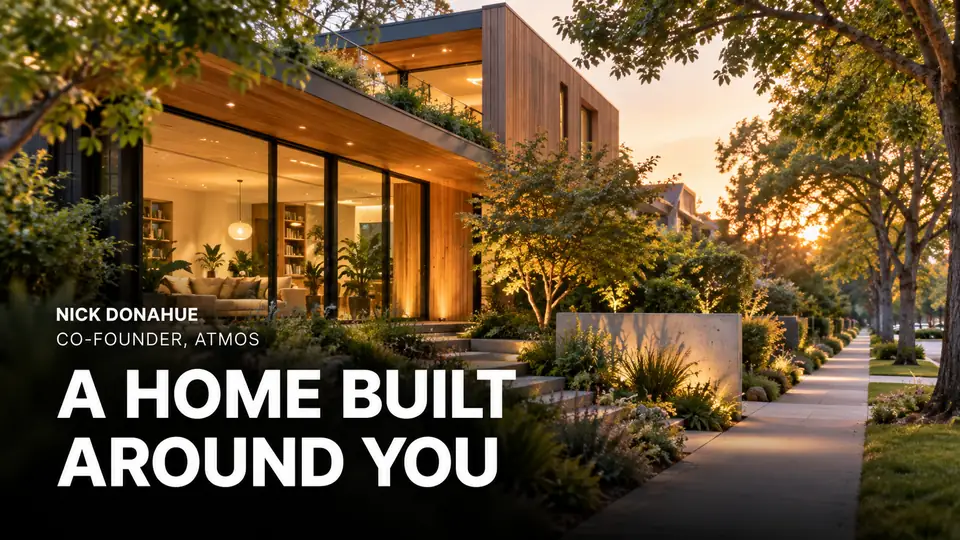
Nick Donahue explains Atmos’s approach to designing and building custom homes online.
May 11, 2021 · 27 min



About the episode
In this conversation, we talk with Nick Donahue, the CEO of Atmos. At Atmos they help people design, buy, and build custom homes online. In doing so, they are literally helping build the future where building a home you love is as simple as buying one.
We cover the future of home building (and buying!), Miami (kinda), community living, and how we build.
Links
Chapters
Times follow the podcast audio. The video’s timeline may be slightly different.
- 00:00Introducing Nick Donahue and Atmos
- 01:31Bringing home design online
- 02:22The gap in custom home building
- 04:06Design templates and personalization
- 05:54What a home means to its owner
- 07:15Housing incentives and changing cities
- 08:54Shared ownership and networked living
- 11:55Taking bigger swings in the physical world
- 13:55Capital, ambition and a time to build
- 16:53Sharing resources across a community
- 18:33EPCOT and imagining new cities
- 20:44Walking through the first Atmos home
- 22:02Earning early customer trust
- 22:51How customers customize their homes
- 24:04Private spaces and common ground
- 25:50Finding Nick and closing thoughts
Read the conversation
Open the full transcript
CAMERON WIESE: Welcome to the Build the Future podcast. My name is Cameron Wiese and I'm your host. I've always been fascinated by the ideas and sentiment that drove American culture in the 1960s with the space race. A culture galvanized to dream about the possibilities of tomorrow, whether it's food, transportation, cities, biology, or anything else. It was this cultural mindset rooted in optimism that the world tomorrow would be better than the world today. A mindset where people were compelled to build things, and I quote JFK, not because they were easy, but because they were hard. It's this desire to build and to dream that seems to have been lost, and something we're here to bring back. With Build the Future, we're here to promote the ideas and stories of those who see how the future can be better and promote their plans to get us there. It's our mission to get you to dream about the possibilities of tomorrow, to dream about the future that you want to live in, and inspire you to go build. Today, we're talking with Nick Donahue, the CEO of Atmos.
CAMERON WIESE: At Atmos, they help people design, buy, and build custom homes online. In doing so, they're literally helping build a future where building a home you love is as simple as buying one. Let's jump right in. Tell me about the future of building at Atmos.
SPEAKER UNCLEAR: What's the high-level vision?
NICK DONAHUE: We want to make changing the physical world as easy as changing a web app. So right now, we're basically creating a platform that allows you to design and build home online. But what we're really doing is giving the internet understanding of the physical world like land itself and lots that allows you to say which homes work where, for how much and by who, and then taking in the understanding of the space or the home or design that you want to add to that land and kind of merging those two things together so that you understand what you you can build. And hopefully in the future, imagine different types of homes or entire communities or cities and entire ecosystems that you wouldn't be able to right now unless you went through long processes to do that.
CAMERON WIESE: What's the process look like for custom home building? What's that look like right now? Why was that the starting point? There's lots of innovation being done in the housing and construction space. There's like the modular stuff, people are keen on 3D printing, but the custom home building is like a unique angle.
NICK DONAHUE: So there's kind of a few segments for building specifically. There's custom on the higher end. You have these localized custom builders that'll do like five to 10 homes a year, make a few hundred thousand dollars each, but they'll do super high touch. They'll be able to help you through every little detail. And then on the lower end, you have the track builders who give you the cookie cutter neighborhoods. You don't really get much optionality, but you'll get a quality home. And then there's this weird in between where there isn't much offerings. So like 500k to a million where most track builders or spec builders custom builders don't like going because they end up doubling the amount of work they have to do. And it's the same amount of work for a smaller home to customize that is higher end because you're still going through the same processes. You show up to talk to them the same amount of times, same little level of detail. And then track builders don't like going up to that point because people want more customization and they just don't meet that criteria. And so you get
NICK DONAHUE: this weird realm where a lot of the buyer market exists. And a lot of people will do spec building. So they'll buy land themselves, build a home that they think that will be successful and then sell it to the market. So they don't have to worry about customer interactions or anything of the sort. And so we basically come in and offer the same level of customization as like a higher end custom builder, but leveraging technology to be that medium in between what would have been the architect, the interior designer, your realtor, the builder, or in these other pieces to kind of show you what you would have built and then allow you to customize it live from the site itself.
CAMERON WIESE: So people can go on to build that most and they can kind of, it's like you're assembling the house like you're doing like Legos, right? It's just like, I want this sort of floor, I want this sort of, I want like an island in the kitchen, I want these like walls here, walls there.
NICK DONAHUE: Yeah, it doesn't go to that little detail yet, but actually there's, we basically offer a bunch of different templates of like starting points because people don't really know what they're looking for. And so it's like kind of finding that right place where you're like, oh, this feels right. Like this is close. And then being able to customize on top of that. So whether that's removing a floor, changing the layout, changing the materials, getting more into the granular details there, but not having to move every little wall because most people don't care to go that level of detail. That's where you're getting into the realm of a Figma board. And you're just kind of like, okay, where do I begin? And most people don't care to extend their time doing that. There is obviously like the like power users who would love just sitting there designing 24 seven, but that's not most.
CAMERON WIESE: It also helps to get people constraints too. If you're like, you can build anything, people end up building nothing. You're like, okay, you have here, here are the things you can choose from. And then, then like everyone feels empowered in their side, like, Oh, I can make my home
SPEAKER UNCLEAR: suit me. To touch on that point real quick. One of the things people don't realize too,
NICK DONAHUE: is like when even just making minor adjustments, like the roof type, so like changing it from a pitched roof to a sloped roof, instantly it looks like a completely different home. Like it goes from being a farmhouse to a contemporary style house, but the actual look of it is like, even though it's the exact same shell, is like, this is not the same house whatsoever. It's like a little minor things like that completely change someone's perception of
SPEAKER UNCLEAR: what they're looking at. It's just like the style of like the externals of the house, right? Because
CAMERON WIESE: like then all the stuff on the inside is generally the same. It's just like, yeah, ceiling heights and like everyone wants their windows and their doors and their walls, but like the outside changes like
SPEAKER UNCLEAR: emotional connection people have with the house. Yeah, exactly. Why do you think it's important
CAMERON WIESE: that we can make it easier for you to build their own custom homes? What's your relationship with
NICK DONAHUE: our homes be? There's this interesting dynamic. I think your home is you at the end of the day, this space that is supposed to be yours where you feel more of yourself than anywhere else. And that empowers you to be like the best you you can be. And obviously, that's become more and more important as COVID has become a thing. And people are like, well, I really hate where I live and I'm stuck in this place 24 seven now and I'm now realizing why, like, why did I ever choose this in the first place? And so I think we will see a culture shift in that direction where people want more personalization, they want more customization, especially as the internet is allowing for it. And you already see this in other places. Like what's really interesting is to look at Japan or Tokyo specifically, where they've created a culture where it's actually frowned upon to live in someone else's house. So it's this like ever evolving city where you actually have more construction happening and new homes being built in one year that all of California combined. It's insane.
NICK DONAHUE: And so they've created this culture and I think that's what gives it this mentality of like, the future is literally always here because it's ever changing with the people that are here as well.
CAMERON WIESE: Well, that's sweet. Because then it also helps shape the city and the community if everyone is constantly upgrading and building new things. So you don't end up with these older houses that have issues. If we have the infrastructure and the tools to be able to enable everyone to build their own custom home that fits them, that makes them feel like they can become the best version themselves for them, their family. And when they move, they get to go do it again. We just eliminate the friction to all this stuff. Cities can like return to be like living thriving organisms. They're like growing constantly evolving.
NICK DONAHUE: Yeah, and I feel like a big piece of that is like, we've gotten to the point where we've outgrown our infrastructure and we don't know how to keep up with it anymore. Like growth is happening much more rapidly than ever before and more rapidly than what cities are prepared to handle. And so rather than actually figuring out how to deal with it, they just deter people through like prices skyrocketing. But hopefully we get to a point where every, I know a lot of people would hate this, especially a lot of people live in places, but I actually think it's a problem that prices move. Like I feel like your home should be a relatively good store of value, not an appreciating asset that you're betting on. And that if we created a culture or aligned incentives around that, then cities would change much more rapidly because of it, rather than right now where it's like value skyrockets and people don't want building or anything else to happen because they get more value from it, not happening. Like it's in their favor to resist change. And so that's like, we should flip that on its head.
CAMERON WIESE: How do you think we shift that?
NICK DONAHUE: I think it's having more shared ownership. So getting rid of, and maybe there's a way that appreciation can happen across a larger group rather than individualized assets themselves. And this is like the whole network to living idea that I really like talking about.
SPEAKER UNCLEAR: Jump right in.
NICK DONAHUE: It's just trying to get to the point where you're betting more on the ecosystem than on your place within it. And I think because of that, an example would be like, if you could bet on San Francisco as an entire city, the value would grow much more rapidly, the more people that move here in a can move here, which means you actually want prices to decrease much more rapidly so that more people can contribute to the ecosystem's growth. Rather than like me being the individual person here, I'm like, I don't really want everyone to grow. I just want myself to grow. So like, forget about you. I'm not selling my house.
CAMERON WIESE: So this is working like tokenization of like the cities as like a thing.
NICK DONAHUE: Like it definitely be a medium means to which it happens. There's other means like an example would be zero down. So obviously everyone likes pushing things towards crypto. I 100% am a proponent of crypto and I think it will be extremely helpful for especially when you're leveraging data to understand value and determining what value is based on data. I think that's where crypto really will thrive in the future. Right now, it's not a necessity for certain things like to do this collective living, there's a company called Zero Down, which which is already taking an approach out or stab at it, where they basically, you wanna purchase a home, they'll purchase it on behalf of you, but you pay no down payment, you just pay a higher monthly rent or subscription, quote unquote, and then you get equity in the REIT. So they place the home in the REIT with every other home in the network, and you're getting equity in the entire REIT rather than the individual home itself. And I think their goals currently is to get it where you can easily make real estate value
NICK DONAHUE: more fluid. So like you can pull your equity out of your home freely as you need almost like taking cash out of your bank account and then transfer it between homes if you don't want to take money out. So my equity never, I never sell a home and then buy a new home. It's just like I go to another home in the network and my equity transfers.
CAMERON WIESE: That's a more practical solution. Like, oh, how do we make this happen now versus, oh, let's get the city of, you know, San Francisco to adopt some crypto model where we give equity
NICK DONAHUE: The funny thing is, so it's a bunch of the old Zenefits founding team, and it's almost all of them I think actually. And they basically, from talking to lawyers, they wanted to ICO, one of them wanted to ICO his house and sort of fundraise to get his house. And they were like, okay, this is like too complicated right now. Like it's not even really possible. So let's just like figure out how to actually do this. And like, oh shit, this is actually kind of cool. Let's just keep going.
CAMERON WIESE: It's cool to see people trying their hand at solving physical world problems. The world can be absolutely gorgeous and incredible and prosperous. We can stop worrying about optimizing buttons or building more SaaS to make enterprise more productive. That's important too, but we can get more of this, what's it like, enable us to build more and make cities exciting again.
NICK DONAHUE: Yeah, I think a big piece of it is We're just reaching that critical mass where there's just so much innovation that has happened already in SaaS. And finally, you're like, okay, it's getting kind of old. We're not really seeing anything new at this point. So we should probably start taking a different bet. And so you're seeing this emergence of hard tech again. And people are trying to push for bigger swings to catalyze at a greater rate. And then at the same time, I think you have these SaaS founders who have been successful outcomes. And a great past example would be Elon, who are now like getting into the second or third startup and they're like, I wanna go bigger. I wanna dream bigger and like, what is that thing? And on top of that, Elon is setting a great example of like what hard tech looks like and that it's possible and that you can actually change the world in a much more drastic way than you ever could have imagined. And so everyone's willing to take a bigger swing
SPEAKER UNCLEAR: than they were before.
CAMERON WIESE: Yeah, it's super cool. And then any stack, not to weave crypto back in, but like stack the kind of just absurd amount of money that people have made like in Ethereum and Bitcoin, etc. It's like capital is available. Like from, from people like us, like our friends making, disgusting amounts of money with like, you know, their, their crypto, their ICR or whatever. And like, I don't know what I'm going to do with this. Like what I do with a hundred million dollars. It's like, oh, I should probably go build like some cool stuff. Everyone knows now that like all this money is just fake. It's just like, it's meaningless.
SPEAKER UNCLEAR: Let's deploy it. Let's build cool things.
CAMERON WIESE: And so, yeah, we're getting to that point where people are just like, yeah, let's go. Let's go do like physical world things, even though it's harder, maybe take more time.
NICK DONAHUE: I feel like if we don't swing hard enough, then like, because there's so much capital being created right now, we may not catch up to what our expectation is. Like, we're basically like the US government as a whole, it's basically been like a venture fund like okay the US you are now worth suddenly 30% more than you were yesterday because we're just gonna print that capital and either you have to prove it or you're gonna crash really hard and so it's like we're playing like a venture game in world like global economics right now or macroeconomics and so I feel like we really do have to step up to the plate and I loved the Andreessen, it’s time to build, stepping out to start the show.
CAMERON WIESE: Yeah, that's a funny way to frame it. It's like we're, we raised our series A at a hundred million dollar valuation. And now like we have to like hit it so that we can raise it a billion dollar valuation. Otherwise we're gonna fall.
NICK DONAHUE: I mean, it's true, right? Like the reality of it is inflation is not bad if it actually fuels growth. And, but that's the problem is like, most people are not swinging for the fences, right? They're not thinking about doing a startup. And so like most of where the capital is flowing is not into where value is going to be created. And so it's like either how do you, I mean, a few things should probably happen. It's like, one, how do you get more people to transfer into that startup mentality or a creator mentality, or two, you need people who are creating to swing bigger. And I think it seems like both are probably happening.
CAMERON WIESE: It definitely, like it definitely feels different. I think COVID served as a wake up call. It prompted Mark and Driessen to write that it's time to build peace. I think everyone was kind of like looking around and realizing, oh wait, the world is not what we thought it was, we actually need to go solve these problems, take some responsibility. And now we have people who are doing lots of, lots of cool things.
NICK DONAHUE: Yeah, I think also it led to a lot of just introspection because you're stuck inside 24 seven and you're like, okay, I don't have some party to distract me or whatever the thing might be. Like I actually have to see the world around me and see myself within it. And now like, what am I doing every day? Like what the heck was I doing every day? Uh, and it's just like, like you said, it's just like a huge wake up call for everyone.
CAMERON WIESE: Yeah. I like that. That forced introspection is important too. Cause it, cause I get, you can look like you actually, you couldn't avoid the problems that were going on. You're like, Oh yeah, What am I doing sitting here in my living room playing cod? So, I mean that's that's partially why I'm super bullish on you know, 2030 We have a little bit of ways to go but like the people who are starting companies now who work in cool projects like things take time But there's there's movement happening. I see it I'm like you're living with people who are kind of buying the seat does right like all like the Gen Z Crowd was like let's do some stuff. Let's make it happen I want to have you elaborate a little bit more on the network living concepts. What are some of the things that get you really excited about that idea space that other people probably don't often think about?
NICK DONAHUE: How much inefficiency exists because of individuality? So there's just on a very simple and probably bad example, because I feel a need to have my own Xbox, even though I don't use it 90% of the time. And someone else next to me right next door also has their own Xbox and doesn't use it 90% of the time. There's just so much like inefficiency in the system and overproduction because of our individuality. I think we, and I think it's already happening with the internet as a whole, but as we get like more connected and we start seeing information more clearly, we are able to create more of a sharing economy and one that works for the system as a whole, rather than just the individuals that are part of it.
CAMERON WIESE: You know Garrett Scott, it's super cool. The concept like, hey, I need a screwdriver or I need like, you know, some baking soda. Like instead of having a whole jar, you just like, you can order it and it shows up your house in 30 seconds. If you can plan your meals or plan your like social media, like, you know the times of the day where you like are generally playing Xbox or you are, you know, working or needing X, Y or Z, just imagine a system that just like has everything you need that just like shows up when you need it. And so you don't actually have to worry about owning too much. And like the sort of flexibility that would enable to move to new cities or like just travel around, everything becomes a lot more like fluid.
NICK DONAHUE: Definitely from a dreaming perspective, I think the vision is there. and even just on like an initial being able to transfer goods. Like I know, I don't know how much you've looked at like Walt Disney or the original Epcot plans, but how they had like the layered systems where like the semi-trucks would be on one layer kind of transferring cargo between different places. And I think that makes sense. like separate medium for just like there he talks about in the back like information instead of just information transfer with the internet and cabling and wires having the same for goods and having its own transportation system separate from needing a car or a human-led vehicle it just it makes so
CAMERON WIESE: much sense like yeah I think the thing is like we just we need like when I mean obviously I'm a fan of Disney. That’s my Disney hat on, you know? Like, but I think the thing that Disney did that, at least I find fastest, he created the media that showed people what was possible. Right? Like now we have science fiction, like I think it's this, unfortunately, I'm more or less like dystopian, skewed vision of the future. But like Disney was like the last living person to really promote like, hey, here's what an exciting city could look like, and I'm building it.
NICK DONAHUE: He's a true visionary. Like he's probably the most forgotten visionary. no one really talks about them. And it's insane. To be thinking about these things and doing them in 1963 or 1964 is just absurd.
CAMERON WIESE: Yeah, there's so much on discuss, Disney is really, one of the drivers of the space race was Disney himself, because he had Warner Von Braun and they did the Man in Space television program that tens of millions of people watched. And that pushed, I mean, and Eisenhower had a video and brought it into like his team and that shaped how Kennedy was viewing the space race and like what he was talking about. So it's like Disney was the man. He made all this stuff feasible. We may not have gone to the moon. We didn't have Disney kind of creating the media in the context. Even Tomorrowland and Disneyland was about space and about the future. I gave people something to anchor on to. I want to hear what it felt like for you when you guys broke ground on the first Atmos property.
NICK DONAHUE: The real big moment was walking through the house when the framing was all up. It was just like this holy crap, like it's actually happening. Like the physical world is changing. Like this is crazy because we were walking through it with the customer as well and and seeing his excitement and just talking through it, it was just like, wow, this is crazy. There's really nothing else I could say beyond that.
CAMERON WIESE: I just get excited hearing about it. This thing that did not exist before, I can now walk through and construct.
NICK DONAHUE: And that we'll be here for the next, what, 30, 40 years, if not more, in the physical world. that many families may live in throughout its lifetime. It was kind of wild.
CAMERON WIESE: If we don't shift the culture such that people like deconstruct and build something new.
NICK DONAHUE: Yeah, exactly. What even more so gets interesting is now, okay, like that was definitely the first big moment of like, wow, because it took us like probably a year to get to that point. We got first, even to get our first customer took like three or four months because all of us were between 20 and 22. And to have this new startup with some really young founders building your house was not a very enticing thing to most people. And it wasn't until we, I mean, we got our first customer before that, but then we raised our round, got some press, and that gave us our initial boost of like, okay, maybe we can trust that not only will this startup be around past the point of when my home is supposed to be done, but also maybe they know what they're doing. I think that really was a big piece. There were plenty of people who asked what happens because you're a startup if you fail, what happens to my house being constructed because this is not a short
SPEAKER UNCLEAR: time scale thing and most startups fail in the first year. So at a high level, what are some of
CAMERON WIESE: the things within homes? Like I said, so somebody mentioned this idea of the house is a sandbox And I want to just have you quickly riff on some of the things that you're excited to see people to do with their custom built homes and the customization. Like Alex Edelman on Twitter, especially a bunch of conversation pits. Why don't we have these step down conversation lounge areas with the fireplace in the middle, the 50s retro style? What's exciting for you?
NICK DONAHUE: Yeah. I mean, we have customers doing some interesting things from, well, this is a very small one, but very popular for some reason, but almost everyone is like doggy showers, like having a doggy shower in your bedroom. But we have people doing like hidden bookshelves that open up to their office. We have like half court basketball court. We have pools. We have a Buddhist temple. Like there's some quite absurd, but some very much like predictable things that people are starting to do. So it's exciting to see and hopefully we're excited to share when it comes along.
CAMERON WIESE: But are there, is there anything like kind of further out? Like, you know, I don't want to provide a timeline, but you know, in the near distant future, you're excited to be able to help people do that that's like not possible today.
NICK DONAHUE: Well, I think it's going to become much more popular. I'm not sure if it'll be the entire community that changes in this form, right? Whether it's individual houses or what exactly, but it's this almost like compound-like structure or villa-like structure that you see in a lot of Eastern Asia, where you have one main area for the living and the common space that everyone comes to. The bedrooms are separate units, almost like ADUs, but not. They're off, not that far away, and people have their own living space within each of those, but there's this common ground that you come to. I think that'll become much more popularized. it's just hard to do a single family living and permitting of today where these things are separate dwelling units and they're considered like weird things but like imagine where like your plot of land is actually like distributed and maybe you have a fence around the outside and some sort of experience in the middle with like a pond or whatever it might
SPEAKER UNCLEAR: be.
SPEAKER UNCLEAR: Yeah, sweet. I think that it's everyone's dream is like, hey,
CAMERON WIESE: I just want to live with my friends and like have people nearby like we're not gonna all go by a, you know, we're gonna going on a four or five bedroom house, because then it's like, then just gets complicated. Everyone's living spaces get muddy, and then just a bit of a hassle, but you can have your own spot.
SPEAKER UNCLEAR: Yeah, yeah.
NICK DONAHUE: And there's just something that happens when you have to walk between the spaces. Like there's, it just feels like its own place. You know, it might, it's not, it's like there's no difference. You're walking maybe five more feet. It's like psychologically, yeah.
CAMERON WIESE: Where can Bill find you and how can you support Atmos?
NICK DONAHUE: You can go to buildatmos.com or follow us on Twitter at buildatmos. And then me personally, you can follow me at primal nick on Twitter.
CAMERON WIESE: Any other closing thoughts, closing ideas?
NICK DONAHUE: We're looking for a wide amount of roles from founding designer to graphics engineer, data engineer, product engineer, and the list goes on. So if you go check out our jobs page on our website, you'll find them if
SPEAKER UNCLEAR: you're interested.
CAMERON WIESE: So people literally want to go build, go build stuff. They will
SPEAKER UNCLEAR: power the future.
CAMERON WIESE: How are the future exactly? Love it, man. Well, hey, thanks so much for for coming on cloud we were able to make this work. Stoked for for you and everything that's that's coming down the pipeline. Like lots of lots of exciting activity.
NICK DONAHUE: Yeah, thanks. I'm excited as well for the world fair. So excited to hear more about
SPEAKER UNCLEAR: that as it comes along.
CAMERON WIESE: Thanks for joining us for this episode of the build the future podcast. If you're building and want to get support, want to hear about certain topics or hear from certain people, shoot us over an email to hello at build the future podcast.com or follow me Cameron on Twitter at camwheezy and we'll see what we can make happen. That's it from us. Until next time, go build!
More episodes
All episodes Alexis Rivas — Building Homes Like Products at CoverAlexis Rivas describes Cover’s panel-based construction system, software-assisted design and backyard-home starting market.
 Anna Cheniuntai — 3D-Printed Buildings on Earth and MarsAnna Cheniuntai explains what it means to 3D print a building, from depositing walls to developing suitable materials.
 Jon Dishotsky — Co-Living, Community and the Future of CitiesJon Dishotsky discusses Starcity’s approach to shared living spaces and the role of cities in providing opportunity and community.