

Build the Future Podcast
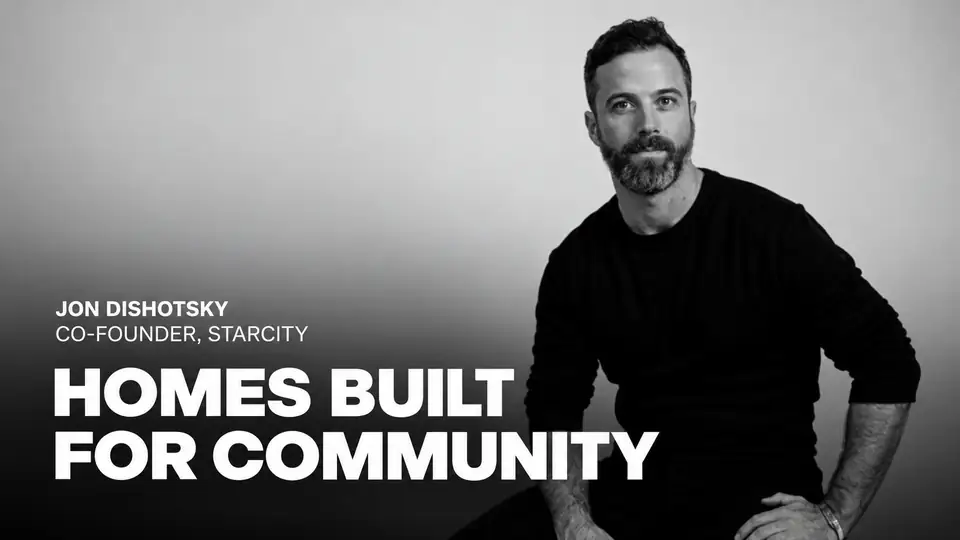
Jon Dishotsky — Co-Living, Community and the Future of Cities
Jon Dishotsky discusses Starcity’s approach to shared living spaces and the role of cities in providing opportunity and community.
June 23, 2020 · 41 min



About the episode
"To make cities affordable for everyone, it's a ridiculous mission. But it’s ridiculous on purpose, because it should drive us to work on this for the next 50 years."
In this conversation, we talk with Jon Dishotsky the CEO of Starcity.
Starcity builds intentional and sustainable co-living communities to help people find a place to call home in today's cities. In pursuit of their mission to make cities more accessible to everyone, Starcity is shaping the future of urban living, community, and sustainable development.
In this conversation, we talk about the trends around city living, the challenges of our individualism, and the role that cities can play in providing opportunity and community.
Links
- Starcity — Y Combinator company profile
- Raj Chetty
- The Opportunity Atlas
- Schlep Blindness — Paul Graham
- Jon Dishotsky
- Jerry Seinfeld: 23 Hours to Kill
- Study: 48% of people have < 1 close friend
- What people regret on their deathbeds
- The Israeli Kibbutz
- The Japanese Ryokan
- US Communes
- Conversation between Elon Musk and Joe Rogan on Space X
- Y Combinator
- Winning as a team
- winning solo
Chapters
Times follow the podcast audio. The video’s timeline may be slightly different.
- 00:00Welcome to Build The Future
- 00:55Making cities more accessible through co-living
- 03:41Proximity to opportunity
- 05:31Remote work and the enduring appeal of cities
- 10:57Social isolation and the need for community
- 15:38Designing buildings for everyday connection
- 19:21Individualism and the myth of doing it alone
- 24:22Building with a team and co-founders
- 28:22Choosing a problem worth decades of work
- 33:46Encouraging people to build
- 37:46What makes a city meaningful?
Read the conversation
Open the full transcript
CAMERON WIESE: Welcome to the Build a Future podcast, where we share compelling visions for what the future might look like. Visions that inspire you, instill a sense of wonder, and get you thinking about the possibilities of tomorrow. I'm your host, Cameron Wiese, and today we're talking with John Deschatsky, the CEO of Star City. Star City builds intentional and sustainable co-living communities to help people find a place to call home in today's cities. In pursuit of their mission to make cities more accessible to everyone, Star City is shaping the future of urban living, community, and sustainable development, which is why we're excited to have John with us today.
SPEAKER UNCLEAR: John, welcome to the show. Thanks for having me. I'm excited to be here.
CAMERON WIESE: So John, on the Build the Future podcast, we're aiming to share compelling visions of the future from those like you who are building it. Can you tell us a little bit about what you're building
SPEAKER UNCLEAR: at Star City and the future you're trying to create? Absolutely. So we started the company, as you mentioned, with the mission to make cities accessible to everyone. Right now, when you think about the cities with the most opportunity, they are full of job growth, full of culture, full of arts, nightlife, entertainment, all these things. But they're also extraordinarily expensive. And what that means is only a select set of the population can access these places. And everybody else is pushed out to the vast sort of expanse of the area surrounding it. And so what that does is that reduces the likelihood that they're going to be able to access that opportunity. So part of our mission is to create these highly dense, highly community driven places for people to live that A, reduces the cost of living and B, reduces social isolation.
JON DISHOTSKY: So on reducing the cost of living, we will fit two to three times more people into a community, a building than we otherwise would. And we do that by reducing a lot of the excess space. So if you take a modern high-rise that has 40 units in it, there's 40 kitchens, there's 40 living rooms, there's a bunch of wasted hallway space, and that format has not changed in 100 years. And that's ridiculous. So when we started the company, we retooled the floor plate to work for people in a way that would reduce the cost of living. Number two is reduce social isolation. We do that through a whole host of things, right? So everything from events to our mobile app that allows you to learn about who lives in your buildings to serendipitous interactions that we encourage and open town halls and things like that where we get people together to sort of talk about what's on their mind.
JON DISHOTSKY: And it's been a pretty exciting ride. I mean, we started the company in early 2016. Lots of ups and downs along the way. But today we stand at about 500 live beds. We have another 2,500 under development. We just launched our first expansion outside of the United States into Europe in Barcelona. And we're expanding across the United States as well. And so, you know, it has been a wild ride, but we're only just beginning. And in the future, the way that I see this looking is that Star City is in every major city where the cost of living is very high. There's tons of job growth, tons of opportunity. but now people all across the world have a brand that they can trust and rely to getting their foot
SPEAKER UNCLEAR: in the door to these locations of opportunity. So the idea is that these previously unaccessible areas for a large number of people become more accessible. That's right. That's right. So Raj
JON DISHOTSKY: Chetty of Stanford University put together an amazing research publication. I encourage everybody to take a look at it. You can just Google Raj Chetty. And what it showed was just being close to opportunity increases the likelihood that you'll raise your income level or move to sort of the next income class by an order of magnitude. So what that says is, and I think we all know it, is if you're just happening to hang out or you're a barista or a bartender or work in hospitality, if you're interacting with people who are already sort of on in the upper echelons of that location, the more you interact with those people, the higher likelihood if you're eager enough and earnest enough that you're going to be able to get a job at some cool startup or be able to pass your script to a producer and little things like that versus, you know, more rural and more, more sort of, you know, far off locations where there's just a lack of job growth. And cities, for the most part, in the last, you know, 500 years have experienced this amazing growth.
JON DISHOTSKY: But again, it's because of the cost of living, because of the way that we build buildings, because of a whole set of bureaucratic political factors, that opportunity in the last 50 years has really only been allowed to be captured by a select set of people. And we believe that that's not going to push humanity forward at a pace that we really needed to.
CAMERON WIESE: Yeah. One of the things that there's this narrative right now going on that people are going to, because of COVID and the ability to work remotely, people are talking about leaving cities. And I guess in a way that it does mean those people who have the ability to work remotely can go. they've kind of in a way they've made it and then they can go leave the city to a place where there's like a lower cost of living and have a higher quality of life um how do you see that that kind
SPEAKER UNCLEAR: of dynamic playing out in the future yeah it's a great question and one that i've been debating vehemently on twitter for the last couple months um the long-term trend and i say 500 year trend is that density and cities continue to accelerate at a phenomenal rate and rural areas continue to decrease as far as population growth and things like that. And over that 500 years, there's been a ton of pandemics. There's been a ton of catastrophic things that have occurred, world wars, 9-11, all things like that. And what has been shown is that cities continue to be resilient. Now, cities are really just a, I guess I would say, a conceptual placeholder for community. And when I think about that, I think about if you want to meet a diverse set of people, if you want to learn new things, if you want to try new things, the probability that you will be able to do that in a city is significantly higher because, well, there's more people living in that space. And they all come from different places. Because we're living in a very interconnected and global place, people can move pretty easily. And so what I would say is that I understand that desire. I also believe that we're somebody to be moving to a new city
JON DISHOTSKY: based on purely a job, and they then decide to depart because now their job will allow them to live anywhere. That's certainly a, I would say what I would call a short-term trend that we'll probably see. Anybody who's built roots and a community and friends and family and things like that, the barrier to movement is significantly higher. If you've also built a community of friends and a community of, you know, sort of a placeholder family of friends as well, then it just makes it much harder to move because those are sticky relationships. And we can do as many Zoom calls and video calls as we want, but there's nothing that will replace that human connection. I think you talked a little bit about your podcast and how you eventually want to go back to hosting events. And I think there's always going to be this appetite. It's part of human nature to be social and to interact and rely on each other and to have arguments and and drink wine over long dinners and have conversations about politics and outer space and all these things.
JON DISHOTSKY: And it becomes a little bit more difficult if we become an entirely remote society. One of the things that I always, again, I have Twitter arguments about is this was talked about when autonomous vehicles started to become really, really popular. As far as like, hey, this is happening. the conversation was well I could live anywhere now because if I can autonomously drive to my office for two hours I can also work on the way there this concept has been put forth if you read the headlines and I go to microfiche and I go to archives and look this stuff up since the automobile since the telephone since broadband internet, since mobile phones. And the reality is, is again, you look at that 500 year curve, density has only increased in cities, people's desire to move to cities has only increased. And so I don't want to be, you know, I'm incredibly biased, I'll just say that. But what I would say is that the long term data would implicate a very dense reality. Now, Now, the other thing is what we have working for us is the land mass is not changing and the amount of people continues to increase.
SPEAKER UNCLEAR: And so as life expectancy increases, if child death rates decrease, if we're eradicating things like malaria, you know, the human population could survive longer. And again, we're going to just need more space. I always think about like Manhattan as such a like an interesting, like on Jerry Seinfeld's recent Netflix comedy special, he was talking about how, like, why do humans do this? There's like all this beautiful green space around Manhattan, but we want to just live on top of each other. And like, why do we decide to do that? I mean, it's just, I think it's just human nature. So I, you know, I think it was a long winded way of saying, I understand the current push to remote. I get it. And I think that there's, there's an opportunity today to, to think critically about how we live in cities and why we live in cities, but also to understand that the long-term trend is still in cities' favors. Yeah. I think one of the things that's been
CAMERON WIESE: revealed to me during this pandemic is just how painful the social isolation can be. There's no dinners with friends. There's no kind of hanging out, grabbing lunch. It's Zoom, Zoom, zoom and honestly it's it's really isolating lonely and painful and so i think the the role that cities do play is the ability for you to go find your group of people the internet's enabled that in some in some fashion right you can go online and you can find a community of people who are obsessed with like halo halo or yeah or like performance sports car racing right whatever of your thing is you can find people online. Yeah. But what's missing is that in person connection. So cities, in a way, they provide that shell where you can go in, you can find your find your crowd.
JON DISHOTSKY: I'm really glad I'm really glad that you use the word pain. Because I think that that is, it's a very important realization that first of all, is scientifically proven. If people live in isolated communities, or they live away from communities, and they're isolated, their life expectancy dropped significantly. The rates of depression by living isolated increased significantly. Furthermore, our current society now has N less than one of close friends that we can rely on to talk about our deepest, darkest stuff. That means the average adult in the United States has less than one friend that they can count on to, as I mentioned, reveal and discuss the hardest parts that are going on in life. And that means that the pain that you have inside, it stays inside, right? And I think that the best part about humanity is that we are able to communicate in low bandwidth format, but as best as we possibly can, everything that's great in our life, but everything that's also not great in our life.
JON DISHOTSKY: And that helps us to normalize pain and suffering, to work through those challenges, and then have support in solving those things. Without that, again, life can be pretty dire. And I think that that's been proven scientifically over and over again.
CAMERON WIESE: Yeah, I think everyone may be betting on this exodus from major cities. And then we may see a regression back because everyone realizes that, oh, having a big house in the middle of the suburbs sounds great. It's affordable, but I don't have any friends. I don't have any community.
JON DISHOTSKY: Yeah. Well, we've run this experiment once before, right? So there was a huge exodus in cities in the 1970s and 80s. Cities still thrived during those times, but they were, in some cases, higher crime rates and mostly sort of working class or blue collar. and the reality was exactly what you said. A whole generation of, let's call it baby boomers and before, prioritized buying things, accumulating space, and Generation X and millennials started to understand that, well, first of all, they got wiped out by a series of recessions so they couldn't afford the things that baby boomers could afford. but secondarily we found that human connection and experiences were actually what when you're on your deathbed you miss or you talk about or you say i wish i had done more of this it's not
SPEAKER UNCLEAR: like oh i had a boat you know what i mean like it's no i had a boat but then i was able to bring all my friends out and we were able to kind of go catch fish and kind of drink wine and beer on the
SPEAKER UNCLEAR: the back of it. Yeah, that's right. And so I think that, you know, I do agree with your perspective on that. And, you know, unless we find a way to create more collaborative and community-based rural and sort of semi-rural societies, and I think that experiment has been done once before, and it's primarily been based off of kibbutzim in Israel, ryokans in Japan, where samurai would live together and focus on their craft, communes in the United States. And largely, if they became too intentional, based off of a certain, you know, religious practice or cultish cult style practice, they obviously didn't have longevity. Yeah, there's clearly a need for for humans to have
CAMERON WIESE: that sense of tribe, that community, and it either manifests itself through closeness in cities or through those rural communes. And then you have everyone in the middle ground, which where things, yeah, maybe they have their local jujitsu gym, or they have their rock climbing buddies, but there's not that feeling of closeness that I think a lot of young people have when they're in college, or when they're in that sort of environment, and they move to the cities, and they try and keep it, and they slowly forget about how important that was in their lives. Right. And that brings up the question is, how do we, how do we build that into our cities? How do we build the sense of community?
JON DISHOTSKY: Well, I'm glad you asked that question next, because I think it's one of the most important considerations. I think if you look at a modern high res today, we all know the scene where you walk into the lobby with maybe a guard to the side who maybe you know their name, but you only really give them the Christmas gift, if at all. you walk into the elevator and everybody's crowded in they're staring in their phone you go up to your floor you go down this long hallway to your shiny glass box in the sky and you watch netflix and you look at the skyline and you're like hmm i wonder why i'm so lonely and so a lot of the spaces that we've built have been more predicated off of financial pro formas and how can we create this amenity race for people to like have a vision of how they want to live, but don't actually use that amenity space. Instead, what we should be doing, and this is what Star City does, is we design with a more sort of human-centric approach. So a lot of our lobby spaces are very wide open with places to sit and talk and hang out. And when you walk up onto your floor, you enter a communal kitchen and living room and the rooms are along the outside. So that way you can, you know, decide whether or not you want to have an introverted moment or an extroverted moment. It's sort of up to you, but we have sort of casually hacked your experience
JON DISHOTSKY: in a way that requires you to see and hang out with more people. And what a lot of, you know, what sort of the long view of humans for millennia have known is that gathering and being together and being around other people actually increases your happiness and things like that. What the sort of modern society has been pushed into is this achieving that glass box in the sky by yourself is somehow more advantageous than spending time with other people. And so by hacking the experience in a way that requires you to interact with more people along the way. We're sort of nudging people ever so delicately to a place where they say, I'm going to put my phone down and have a glass of wine with Tiffany and talk to her about how her day was. And so that's one big thing. And I think it also takes a builder who is doing it for the right reasons, right? Like you're not sort of taking advantage of densifying the city in a way that is purely for some financial reason, if you care about getting humanity back to a place where we actually have conversations and we, you know, conversations, arguments, whatever it might be, that that yields a better society versus us doing all of it on the phone, then, you know, then that encouragement comes from a place where it's authentic, it's believable, it's part of the ethos of that builder, whoever that builder is.
JON DISHOTSKY: So I think that that's super important.
SPEAKER UNCLEAR: Yeah, the idea is that we kind of give everyone a choice to engage socially versus it not even being an option. That's right. I want to tangent briefly. Go for it. How do you think we ended up in this state where everyone, it's so individualistic and everyone is trying to get that, yeah, the glass box in the sky?
JON DISHOTSKY: I'd say, yeah, death by a thousand cuts, full stop. And I think that we've viewed things like, you know, you take the current conversation around democratic socialism, right? And like, I'm not sort of on one side or the other. I'm pretty straight when it comes to politics. But the concept of socialism and concept of community, you know, even communism, right? That elicits this fear that like by living in a sort of communal society, there is some inherent negative about it. And that is generations of, you know, obviously the political concerns around those types of society. But it's also not what we're talking about, right? We're talking about two different things. One is where there's a sort of a government controlled mandate that everybody shares everything.
JON DISHOTSKY: and the other is a I'm deciding to live in a community because it's my god-given right and I'm still a capitalist at heart yeah I want to go out and earn money or build a company and be an entrepreneur or create a movie and all that kind of stuff but living in a more communal society allows me to meet a lot of people share in all those concepts so that's one part is sort of the I guess the negative hue on that. The second would be America is one of the best brands of all time. If you look at the evolution of brands, it's kind of like you ask anybody around the planet, like what does America stand for? And it's freedom and individualism. Now there's also some negative connotations in some places of the world, and that's understandable. But the reality is that we've championed an individualistic society that says you can lift your own self up by your bootstraps. And if you really put in that hard work, then you can achieve anything.
JON DISHOTSKY: Ask any entrepreneur who's made it to the top and they will tell you, it was a community of people, my family, my friends, my employees, my investors, the customer, the press, all of these constituents which create a community, which got them to where they are today. And so the narrative has always been about this hero who has created everything from scratch, right? Like, I think even somebody like Elon, we were talking about SpaceX, he talked recently on the Joe Rogan podcast about SpaceX is 8,000 employees. Like I would never have been able to do what we do, was it not for these 8,000 employees. And so there's a narrative that I think is told in the sort of public sphere around these hero individuals, when in reality, all of them had to have, must have gotten there through a community of people. And so I think it's something that we, and I don't know if that's just ingrained in how humans work as they want to create these hero narratives. But I think a lot of that has made it into people's day to day in thinking, well, I've just got to do this on my own. And that means living on my own. That means trying painstakingly to do everything by myself. That means not asking for help.
JON DISHOTSKY: That means ordering everything on my phone, having somebody deliver stuff to me versus asking my neighbor, like, hey, do you have some eggs? You said you get a Postmate to deliver it to you. It costs like 20 bucks for some eggs. When you could just knock on your neighbor's door and be like, hey, can I borrow two eggs? So if I say that like death by a thousand cuts, I don't mean that with like a dark hue. I also think there's some huge benefits to that brand that is the United States, which gives people hope that like, hey, if I really want to make it, I can move here. And so I think it's just an artifact of the legacy of the United States.
CAMERON WIESE: I think you're spot on. I haven't thought about it that way. The idea that the brand of America is the individual, Oh, I thought about the individual component, but the brand of America is, Hey, you can do it. You can pick yourself up by your bootstraps and you can go build the thing, start the company, do whatever it is you want to do. However, the reality of it is that it's a team effort. You need people to support you all, all the way around. And I wonder if there's, if the idea that you have to do it alone stops people from starting. They're like, Oh man, I can't, that's a lot of work. And all it takes is just someone say, Oh, okay, I want to go try this. And then they pick up the support along the way. And then the momentum really kicks in.
JON DISHOTSKY: Yeah, I have two stories on that, because I think it's a very important point. And one that I would say, if anybody's listening, I am happy to help email me john at star city.com if you need help building whatever it is that you're building. And hopefully I can either help or connect you with somebody that can help. But there's a great YouTube video, two YouTube videos of Michael Phelps in one of the Olympic swimming meets where he won the free, I think it was a freestyle race by himself, won the gold medal. And I think it was a world record or an Olympic record. He finishes the race, he puts his hand on the side of the pool and he was just like, does like a little bit of a fist pump, but like nothing major. Then there's sort of diametrically opposed to that is when he did the relay with three other swimmers and they won the I'm getting the chills just thinking about right now they won the gold medal they won together they all he jumps out of the pool or the last guy jumps out of the pool and they're jumping up and down in celebration just like so stoked and like I think that that like it was a beautiful example of that winning as a team and building as a team is like one of the most fun things to do and it's the most exciting and invigorating.
JON DISHOTSKY: The other story is actually my personal story. I built a website. I did an economics degree at UC Davis and then I also moonlighted in CS and I built a website called collegedorm.com and this was in early 2000s and the concept was that you would take photos of yourself in your dorm room and you would share that and it would be social in nature and you would be able to get interior design advice and then people could like comment on it, right?
SPEAKER UNCLEAR: Oh, neat.
JON DISHOTSKY: Yeah, and I built this thing all by myself. And every day I was like toiling and toiling and toiling on the design and all these things. And it was like a very lonely experience. And like I had a lot of people started to sign up and then like got some traction, but my school work and all these other things started to get in the way. and I was just so like lonely in that entrepreneurial adventure that I was like, I don't really want to do this anymore. And it was kind of a bummer because if I had only just like met the right person or had the, you know, the gumption to like ask for help at that time, I like what you're saying, the character that we're talking about, who's an entrepreneur who wants to be an entrepreneur, thinks they have to do it by themselves. Like I was that person, But it wasn't until I started to learn from my friends who had joined Y Combinator.
JON DISHOTSKY: Like Y Combinator in the early days, it was like mandatory that you have a co-founder. Because Paul Graham knew in his heart that the biggest challenge in starting a company is psychology, is your psychological, mental health. And having that Michael Phelps relay team to take you through the training, to take you through the race day. you know that's like building the company and then demo day and all that kind of stuff like that is so much more a enjoyable and sustainable if you do that as a collective and so it took me some time to learn that and when i chose my co-founders for star city i was very intentional about it i had invested in mo jesse and josh's previous startup i had known them for a long period of time jesse and mo had been best friends for almost a decade and so i was like these are the guys that I know that I could build something with for the rest of my life. And it's proven out.
JON DISHOTSKY: I mean, we're still the closest of friends and we've been through quite a bit together. And there's always been arguments and disagreements along the way, but we know each other so well that they know when I'm having a bad day, they can lean on me and help me. I know when they're having difficulty on a problem and we can work on it together. And there's so much value in that
SPEAKER UNCLEAR: relationship. That's definitely important to make sure that you find people who share the passion, especially when you're working on something like what you guys are doing, which has a very, very long time scale. So in a world, we kind of live in a world where people are looking for immediate gratification, not everybody, but it seems to be a trend. And so it's unique when you find people who are taking a long view on things. Can you tell me how you think about your relationship with work and the stuff you're doing at Star City and how the 10, 20-year
SPEAKER UNCLEAR: rest of your lifetime scale factors into that? I firmly believe that if your heart is in the right place and you're doing the right thing and your goal is to help other people have a better life, that will always succeed. And you just need to spend the time and the hard work to do it. and there's again i'll go back to paul graham because he's a really brilliant writer he has a great blog post called schlep blindness which is like there's these problems that are right in front of our faces that we just don't work on because there's a giant schlep associated with it and schlep is a yiddish word for like hard work yeah and like not even hard work like mundane and crappy work like you schlep a bag up a flight of stairs right like that's the same the same same way to think about it. And so the way that I think about it is when I, when I resigned from my previous career, because I knew I was unhappy doing what I was doing, I thought to myself, what can I work on for the rest of my life that will be infinitely challenging, will provide a benefit to society, and will make other people's lives better? What's that thing that I can do?
SPEAKER UNCLEAR: and it was always sort of coming back to this concept. That was my feeling, right? And so I was like, let me validate that. And all that we've been trying to do over the years and years that we've been building this and what we're trying to do is continue to test and validate that assumption. Are we building something that people really need? Are we making their lives better? And is it generally better for society than if it were not there, right? And what happens when people, so the word passion I think is thrown around quite a bit and I actually don't think of passion when starting a company I think of if you're going to get punched in the face about a hundred times a month are you willing to get back up right right continue to work on that thing over and over and over again that means that it has to come from a place of like really really deeply caring about it and if you do really deeply care about it it will give you that longevity to get through all of those challenges. And if you really, really work on a big, big problem, then that means it will necessarily take a long time to solve because again, it's a big problem, right? Like to make cities affordable for everyone. I mean, that's like a ridiculous mission and it's ridiculous on purpose because it should drive us to work on this for the next 50 years. And so that's sort of my underlying statement on that. And hopefully that makes sense. No, that makes perfect sense.
SPEAKER UNCLEAR: It's in a way you don't really want to find that you are fueled up or passionate about something. It's more, you see the world and, or you see something that needs to exist and recognizing, hey, this is going to take some time, but there's nothing else I'd rather be doing. I'm going to kind of step away from the, some of the other games that are being played, the status game, the money game, the promotion game. Instead, try and just put myself in a position where I can work on a problem that I think is going to ultimately affect some change in the world, whether it's your local community or in a city on a global scale. Yeah, very, very well said. I have a,
JON DISHOTSKY: I have a shortcut, which is that if something makes you angry over and over and over again, and it keeps pissing you off and you don't see anybody working on it, that's like a great thing to spend your time on as an entrepreneur. I grew up in the Bay Area. I grew up down in Palo Alto. My parents ran a miniature commune with Stanford students. So we had anytime 10 people under one roof. And it was a wonderful experience. My parents had cheap childcare. The students had a cheap place to live. And we had engineers from Stanford that helped us win every science fair project. So that was really cool. But then once I got into moving into San Francisco after college, and I spent a lot of time working with startups and just seeing a lot of my friends get pushed out of the city and then seeing the headlines about like ah San Francisco's unaffordable it's never going to become affordable like those headlines just started to piss me off and I was like oh someone needs to fix this and then even more I started to talk to all these guys who were building housing I'm like why are you doing this and do you care about this problem about affordability and all this other stuff. And the majority of them were just like, I'm just trying to buy another Maserati dude. And I'm like, fuck, that pisses me off. Pardon my French.
JON DISHOTSKY: Why don't you want to build a better widget? And so that's my advice to entrepreneurs is if there's something that keeps coming up for you that is nagging on you and it kind of pisses you
SPEAKER UNCLEAR: that it doesn't exist in the world, then build it. Yeah. This is a very broad question. Why do you think people don't do that? So you got the Maserati chasing crowd. Yeah. Bad parenting,
SPEAKER UNCLEAR: bad parenting. You think so? Yeah. And I can tell you, cause I know from experience, I'm, I'm a father of two kids. I have a three-year-old daughter and a five-month-old son, and it's very hard to be a good dad. It's very hard to be a good mom. And a great example of this is we're sitting down to dinner and my wife and I have this beautiful dinner being set up and we have something for our daughter and she just wants to run around and play. And she asks us, why can't she just play right now? and there's all those I said death by a thousand cuts earlier and I think there's death by a thousand cuts in parenting which is like we do this now because that's the way it is but in reality it's like do we really need her to sit down and eat right now why do we care so much about that like if she's playing and she's happy and she's working on something she really loves like let her play yeah yeah eat when she's hungry and so my wife and I have disagreements about this sometimes because some structure is really good for kids to learn manners and learn how to be well-behaved and all that kind of stuff. And so if you extrapolate that out over a young kid's life from zero to 18, there's so many, and I don't say this, that like bad parenting is something that is easy to solve for because being a parent is one of the most challenging things and you're tired and you're also working and you're trying to put food on the table. And there's always these
JON DISHOTSKY: short-term hacks that says like, stop doing that because you don't have a reason for it, but you just want them to stop so they behave. And so if a kid constantly hears this and then they say, I need you to get good grades because that will get you into a good college, which will then get you a good job. When really what they're just trying to say is I love you and I want you to be happy, right? That's, again, we've created this track in people's minds that here's what success looks like. And then we put them on this track and they get ingratiated with this mentality of, I just have to do this and I have to do this and I have to do this. And I better not fail because when I used to drop the milk on the floor, my dad would yell at me, right? Or if I used to like scratch the wall with crayons, my dad would yell at me. And that's like a minor version of failure. You doing something you didn't know was wrong and then you get in trouble for it.
JON DISHOTSKY: And so it takes very open-minded parents to, I'd say, to cultivate an entrepreneurial spirit. Now, the alternative to that is if you had very closed-minded parents who push you on this track and you're interested in entrepreneurship, you have to relearn those muscles and it's not impossible. And their parents are going to tell you like, why are you doing this? Like, you have an amazing career and you have, oh, you have a roof over your head. And you're like, but I really want to work on this. So you have to, as an entrepreneur, go against what those people who have been parented horribly and or who have been put on this track who are going to tell you, like, why are you getting off this track?
JON DISHOTSKY: And that, again, that takes a lot of gusto. But it also doesn't. Because then once you do it and it really is the right thing and it feels right, then that feeling, passion, which we called it earlier, will help you tell everybody like, hey guys, I really care about this thing. And here's why you should too. Here's why you should get on my train. And here's why you should give me money. Yeah. To go build this thing out. To go build this thing. If you really want me to not fail, then give me some money.
CAMERON WIESE: Come support. Be my community. Come help me out here. Invest. Invest. John, I have one more
SPEAKER UNCLEAR: question. What's your favorite city and why? Well, I mean, I live in San Francisco, so that means I love it a lot. And I think it's one of those beautiful, like there's so much noise about San Francisco, but then when you actually like think about it, it's one of the most amazing places. It's got these beautiful hills. It's got crazy different architecture. It's got people from all around the world. You're close to snow. You're close to wine. You're close to the ocean. It has major challenges around homelessness and diversity, but also has these very optimistic things like you build the future here. And whenever anybody talks very passionately, either in the positive or negative about something, that usually means that it's very cool in certain ways. So San Francisco is probably at the top of my list, but I would say outside of that, when I first fell in love with cities, I went to New York, Manhattan when I was a little kid.
JON DISHOTSKY: And I remember specifically, we were staying in this hotel. This is when we could rarely afford hotels. We actually, all of our trips were camping because we couldn't afford hotels. The first time I'd ever been to a major city. And I just remember looking at the skyline, it was like thunder and lightning. I could still see the rain on the window to this day. And I was just staring at the city skyline. My parents had to like, pull me away from the window. And after that, all of my drawings were just city skylines.
CAMERON WIESE: Oh man, that's great.
JON DISHOTSKY: Yeah. And so Manhattan, I think, is one of the ultimate cities just because of everything that it represents. You can come from absolutely nothing and make it in that city. There's Broadway and Wall Street and now there's a tech hub and there's amazing restaurants. But then there's also challenges as well. And I think that the more a city is a city, the more it is society, the more it is human.
CAMERON WIESE: Thanks for joining us for this episode of the Build the Future podcast. If you want to learn more about Star City, head on over to StarCity.com. If you want to learn more about John, you can follow him on Twitter at John Deschotsky, where he frequently tweets about the challenges and opportunities in this space. Furthermore, if you're curious to learn more about the future of our cities and our communities, sign up for our weekly newsletter at BuildTheFuturePodcast.com, where you'll get announcements on new episodes and an opportunity to join in on discussions about how we build the future. Lastly, if you like the show, please, please leave us a review on iTunes. And if you have recommendations for guests, message us on Twitter at buildd underscore future or send us an email at hello at buildthefuture.com. That's it from us. Until next time, go build.
SPEAKER UNCLEAR: Thank you.
More episodes
All episodes Zach Dwiel of Terran Robotics — AI, Drones and ConstructionZach Dwiel describes Terran Robotics’ early work on tethered drones and learning systems for building clay-based walls.
 Dryden Brown — Cities, Herofuturism and ImmortalityDryden Brown describes the vision behind Bluebook Cities and Praxis, connecting urban design to shared values and social trust.
 Patri Friedman — Charter Cities, Law as Code and Governance ExperimentsPatri Friedman lays out his vision for charter cities that experiment with laws and services while competing to attract residents.