

Build the Future Podcast
Alexis Rivas — Building Homes Like Products at Cover
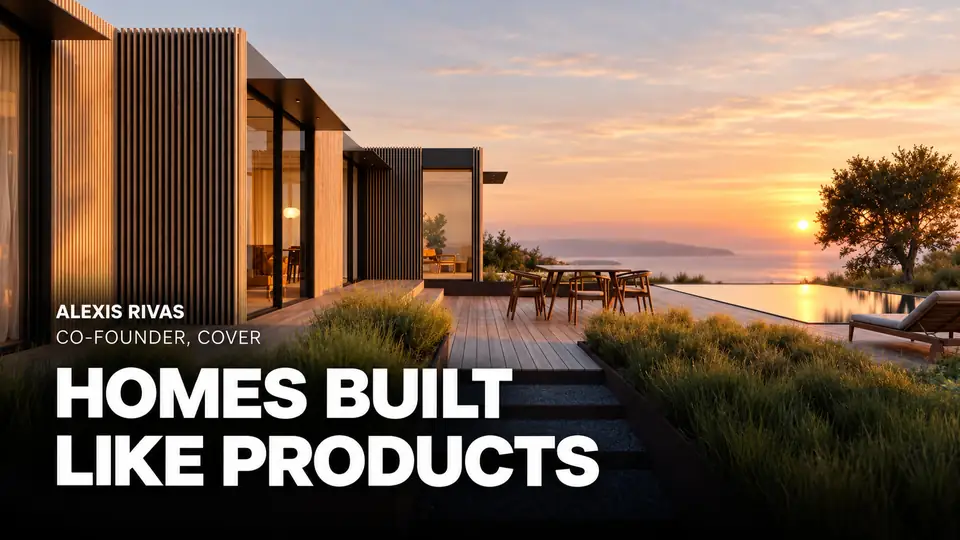
Alexis Rivas describes Cover’s panel-based construction system, software-assisted design and backyard-home starting market.
October 6, 2020 · 29 min



About the episode
"Imagine having to, every time you want to service your car, take a hacksaw to the body panels, make a hole, and then have to patch it up. That's what you're doing with home construction today. And so what we've done is we've made it so that you can actually unclip our ceiling and wall panels, access everything, and then just put them back up."
In this conversation, we talk with Alexis Rivas the CEO of Cover where they're building ultra-high quality homes using algorithms and production lines to get us to a future where homes are beautiful, abundant, well-built, and improve the environment.
We talk with Alexis about literally building the future of homes, their Tesla-esque go-to-market strategy, and how our relationships with the home may evolve.
Links
Chapters
Times follow the podcast audio. The video’s timeline may be slightly different.
- 00:00Welcome and introducing Cover
- 01:10Rebuilding the home-construction process
- 02:55Manufacturing with a system of panels
- 04:43Software, customization and permitting
- 09:25Why people build backyard homes
- 12:07A Tesla-inspired path to a wider market
- 15:38Housing supply and cities that can adapt
- 17:48Designing homes for service and reuse
- 25:11How architecture shaped the approach
Read the conversation
Open the full transcript
CAMERON WIESE: Welcome to the Build the Future podcast. My name is Cameron Wiese, and I'm your host. I've always been fascinated by the ideas and sentiment that drove American culture in the 1960s with the space race. A culture of possibility with a mission to build things, and I quote JFK, not because they are easy, but because they are hard. It's this culture that seems to have been lost, and it's something that we want to bring back. With Build the Future, we're here to promote the ideas of those who not only see how the world can be better, but those who have plans to get there. It's our hope that these plans inspire you to think about the future you want to live in and create plans to go build. Today, we're talking with Alexis Rivas, the founder and CEO of Cover. At Cover, they're taking a first principles approach to ask, what should our homes look like? In doing so, they're working to literally build a future where everyone is living in thoughtful, well-designed, and affordable homes. Alexis, welcome to the show.
SPEAKER UNCLEAR: Thanks for having me here.
CAMERON WIESE: I want to start with the basics. Can you tell me about the future you're building with Cover? What's the vision?
ALEXIS RIVAS: Yeah, so at Cover, what we do is we design, we permit, we engineer, we manufacture, and we install backyard homes. That's what we're doing today. What we're really doing behind the scenes is redesigning the entire home building process from the ground up to be geared towards manufacturability and geared towards rapid assembly from the start. And what that looks like, in a world where cover has succeeded, homes are much easier to build. They're faster. It's a predictable process. They're abundantly available. There's no more housing shortages. but even more than all that the bar for the quality of homes and the quality of the spaces that people live in has been raised right so um if you think about it right it's crazy how much time we spend indoors we spend you know more than 90 of our time indoors a lot of that at home and and at the same time like it's actually one of those products that has relatively little engineering that's gone into it in the last hundred years and has such a huge impact on our physical and mental well-being, right? Like the quality of life in a space, the air quality, the temperature control, like all these things have a huge impact on people's quality of life.
ALEXIS RIVAS: And what we're working on is, you know, how do we bring that level up to the kind of quality that today you can't even imagine, right? So the kind of things that you might see in, you know, $20 million mansions in terms of thermal comfort, in terms of smart home, in terms of, you know, just quality being available to everyone and doing that by producing homes on a production line, like a product, and doing all the engineering design work and information management side of
SPEAKER UNCLEAR: that with software that we're building. Love it. Let's talk a little bit more about the, I want to dive into the tech. First, let's talk about the manufacturing process. How are y'all
SPEAKER UNCLEAR: going about building these homes? Yeah. So we've broken down the home into a set of basically life-size Lego blocks, right? So wall panels, floor panels, ceiling panels that already have the insulation, the electrical, the waterproofing installed from the factory. And then they're basically, they're flat packed on a truck, shipped onsite and installed quickly. So we're taking a lot of processes that normally would be done by even different subcontractors, right? You usually have the electrician doing the electrical and the drywall person doing the drywall. And then you've got the framing crew doing the framing. We've consolidated all of those in the factory and do that on a production line there. And then we ship out these parts. So yeah, that's the physical building system. And the way we're approaching that is really like a ground-up redesign, right? Prefab is not a new idea. Prefab has been tried for decades. I mean, ever since the Sears homes, we've had prefab. What's different about our approach is that most companies that have tried to solve this problem in the past have simply taken conventional construction and moved that same conventional process into a factory. What we're doing is we're actually redesigning the entire process from the ground up to be geared towards manufacturability right from the start, right? And so that's the big difference in terms of the physical production process and the physical parts. So just as a specific example, you know, we don't use any drywall. None at all? No, no, we don't use any drywall, which is, you know, the problem,
ALEXIS RIVAS: the most common building material in North America, at least for sure.
CAMERON WIESE: Yeah, we haven't seen any innovation in the process of building homes the last 100 years. What's changed that's enabled this sort of thing to really be able to be executed on?
ALEXIS RIVAS: Yeah, it's really a couple of things. On the one hand, you know, mass customization is now possible because of software. So unlike cars where you can build the same car, you know, a hundred thousand times, 500,000 times, and people will buy that. That's just not true for homes. People want something that's tailored to their specific property that's tailored to their specific needs. I mean, even large real estate developers who are building, you know, fairly cookie cutter communities actually make quite a few tweaks to eat between communities, between homes, just because of, you know, the property sizes that they're dealing with and the orientation towards the sun and these really basic things. And so there's a big component of this problem, which is actually a software problem. And the technology to innovate in that space,
SPEAKER UNCLEAR: that's really something recent. Yeah, let's talk about that a little bit. Because one of the things that excites me most about what you guys are doing is this possible future where you can almost algorithmically generate just a handful of homes so that anyone can kind of plug in, hey, I want two bedrooms, I want two bathrooms, I want a sink, I want an island kitchen sort of set up, and then get their floor plans and everything ready to go. Talk me through the software and
ALEXIS RIVAS: the technology side. Yeah. Today, if you wanted to go through and do a custom home, you'd have to work with an architect, an engineer, and then work with a subcontractor and the general contractor in this slow moving and expensive, the charging you usually by the hour feedback loop. And you You might settle on the design that you love with your architect and then take that to your structural engineer and they're going to say, oh, you know, it doesn't actually work. And then you're back to the drawing board. And that's actually the norm, right? So what we've done is we've turned a lot of these processes into software so that you can create custom designs that we know exactly how we will build down to the screw before we even show you it.
ALEXIS RIVAS: We know that it's buildable with our system and we simply, you know, present you a design. it's like this works right we know how to build this without even doing any any custom engineering you know like per project engineering work i mean that's really linking everything from you know understanding how exactly it's going to be made in the production line through to you know the initial design and understanding things like you know your zoning restrictions on your property and all of this initial data so one specific example right like it's a tiny snippet of the process but it's part it's part that anyone can actually check out today on our website and it's the zoning research process, right? Like the first step, if you're trying to build something is understanding what can I even build, right?
ALEXIS RIVAS: So we're starting off by building backyard homes. So these are, you know, units that have a kitchen and bathroom in someone's backyard. So if you're looking at, you know, what am I allowed to build in my backyard? Normally, what you would have to do is you'd have to either hire an architect or a zoning consultant. And then, you know, they would do a bunch of research on your property and look up, you know, the rules, look up all the exceptions to the rules because there were amendments to the zoning code over the decades that it's been in place. And finally come up with an answer that is likely correct, but they'll always preface it with, well, we haven't done all the research and we'd have to go to the city and really talk to them most of the time.
ALEXIS RIVAS: The other alternative you could do is try to do it yourself by reading through like 60 pages of zoning code and going and talking to the city. And even the city, it's actually a very hard problem because what they're doing is they're just looking up the code and reading it, right? Because it's so long, no one understands the whole code on their own. It's just a really painful process. So just this first step, right? What can I even build in my backyard? We've answered that with software. So you can go in on our website. And our website is buildcover.com. You can go there. You can type in your address. So right now we're servicing the city of Los Angeles. So if you live in LA, this works.
SPEAKER UNCLEAR: You type in your address in the city of LA and tell us a little bit more about what you're looking for. Are you looking for a guest house? Are you looking for a kitchen and a bathroom? I mean, all of these details. And then we will show you, you know, where within your backyard you're allowed to build. And we'll tell you even, you know, hey, if you're allowed to build up to 833 square feet, whatever the number is, if you demolish your detached garage, you can now build 900 square feet, or maybe it doesn't even change how many square feet you build if you demolish it, right, depending on the specific zoning of that part of LA. So that normal process, which would take weeks and you know like dozens of hours of specialized expert time is something that our software does in five minutes and for free on our website oh my god it's such an obvious
CAMERON WIESE: win for anyone who's looking to go build or even like contemplate it's like oh i have extra space in my backyard like yeah let me look into this what what compels someone to go to go build one of these poems? What's driving people right now to use cover and what will be driving them in the
ALEXIS RIVAS: future? Yeah. So we're seeing it kind of falls into two broad buckets, right? Personal use and as an investment. And there's a lot of overlap between the two as well. As an investment, you're adding square footage to your property and you're adding value to your property. And you're also building something which has the potential to generate rental income, right? You can rent it out, you know, for depending on the neighborhood, you know, 2000 3000, even $5,000 a month, right? Like you can, you can rent out one of these for quite a lot. So that's one side of it. And then there's the other side, which is creating a space for family to live with you, right? So we're seeing a lot of people who maybe have a mother or father or in-laws that need some care, right? They want to be close to family and have that care, but they still want some independence, right? They don't want to live in one of the bedrooms of the home. And so the backyard homes, they're a really great way to do that, right? Because you've got the help there when you need it. You know, if the family has young kids, they can help with, you know, taking care of kids when parents are out. And likewise, you know, it's funny, because it's common to have multi-generational living in so many other cultures, right? But it's just not as common here in the US yet. And we're seeing a lot lot of interest on that front. And actually, we're seeing an even bigger interest there
SPEAKER UNCLEAR: because of COVID. Yeah. What else has COVID kind of revealed in this space for you and cover?
ALEXIS RIVAS: Yeah. I mean, really, that's a big one, right? There's people that were previously looking at retirement homes, retirement communities are really rethinking that. They're saying, how do I live somewhere where I don't have shared spaces? I've got outdoor space that I can use. But it's also, it still feels really nice, right? And it still has the community element to it. Because I think that's really important, right? And sometimes, you know, family can be a really great way to do that, right? Living with family, but in your own space, with your own entrance and your own kitchen, your own bathroom, that's really big.
CAMERON WIESE: Yeah. And then I'm sure there's also a component too of people wanting extra office space. Yes.
ALEXIS RIVAS: Yeah. And even thinking about it as like a hybrid space, we're seeing a lot of people that build this, you know, they'll want an office space, but they'll add a kitchen and a bathroom so that in the future, if they decide that they really don't need to work from home, they can rent it out or they can use it as a guest house, right? So it's very, it's very kind of flexible.
SPEAKER UNCLEAR: And that's so cool. I want to kind of go back to the approach y'all are taking. In previous conversations or interviews, you've, you've compared the cover model with, to Tesla in the sense that these backyard homes are your starting points, like the Tesla Roadster. I'm curious, why was that the starting point for you guys? Yeah. So, so there's a couple of reasons.
ALEXIS RIVAS: One is that they're kind of like the minimum viable product of construction, right? They still have a kitchen, they still have a bathroom, people still live in them, but they're small, right? And, and so they don't have elevators and common spaces and, you know, lobbies and all the complexity that comes with a multifamily building, for example. So part of it is that we can learn a lot more by building, you know, five, 500 square foot units than one 2,500 square foot home. So that's, that's part of it. But the other part is actually that there have been state laws across, you know, California state laws that have made it way easier to build backyard homes. They're often referred to as accessory dwelling unit laws. And it enables anyone who has the physical space in their backyard to build, build a backyard home in California, which is an incredible opportunity. It's a great way to add to the housing supply, which there's a massive shortage of. So the reason we started with backyard homes is both to high impact, which is a large market that's been enabled by this regulatory change, but also it's a great way to iterate and to get really, really good at that small scale product before going to single family homes.
ALEXIS RIVAS: And then from there, large scale multifamily apartment buildings and condos.
CAMERON WIESE: Okay. Okay. Got it. Now, now walk me through the strategy here.
ALEXIS RIVAS: Yeah. So, you know, like, like Tesla, right. We're entering a large market where many people have tried to solve this problem before, but haven't. Right. And that's, there were a lot of electric companies before Tesla. What Tesla did different was they started off with a high end car that, you know, that had performance, so exceeded that of a Ferrari. It was like super high performing, super awesome car. And they proved to the world with that car that electric cars could be better than gas powered cars. And we're taking a similar approach with our homes, right? Pre-fabricated homes are not a new idea. They've been tried many times before. But most, you know, when people think prefab today, most people don't think high quality. right? Most people associate prefabricated with, you know, manufactured homes, home communities, which is a lot of prefab companies have done that, right? And what we're doing is we're saying, you know, building homes in a factory can be better than conventional construction, because we have access to tooling, to precision, to processes that you just can't have on site, right? And that actually enables a better product. And we're going to take advantage of that.
ALEXIS RIVAS: and uh and so that's really what we're doing so from a starting point right we're similar in that we're starting off the high-end market in order to prove to the world that homes built in a factory can be better than homes built you know using conventional methods and from there what we do is you know we ramp up production we ramp up volume we reinvest into manufacturing and engineering and we continue to lower our costs to reach that mass market you know model three type product where we're building at under $100 a square foot, and we're installing these in less than a week.
CAMERON WIESE: Paint a picture for me of what that world looks like. How does this shape our communities in our cities when we're no longer encumbered by the traditional modes of construction?
ALEXIS RIVAS: Yeah, I mean, as a start, what it does is it enables a lot more development and an abundance of housing, right? There's no reason housing has to be so incredibly expensive. And so the first thing is like, cities can actually respond more quickly to changes, right? If there are reasons, you know, that there's shifts between different cities, right? People moving from one place to the next. Cities can respond to that quickly instead of right now, which is like over decades. So it really shortens the response time for cities to evolve to their needs and to the population's needs, right? I mean, even a simple example is that Within the American housing stock, there's a massive shortage of studios and one bedrooms. Because most homes were built in a time where larger families were the norm.
ALEXIS RIVAS: And so there's a massive shortage of one bedrooms and studios. And we still haven't caught up in terms of matching the supply of housing to what people actually want. Most people, if they have the option, would choose not to have roommates. right um but that's just not a reality for a lot of people so that's an example of of you know we can really match the housing supply at a faster pace to what people are really looking for but then the other big thing is again on the quality side of things right we don't have to look at cities as these very static things where we make very slow changes over time we can look at it and say okay we can build something use it take it apart and reuse parts of it right today when you demolish a building, it's, you know, I mean, you can recycle the raw materials, but you're losing a lot of money, right? And you're wasting a lot of energy and resources by demolishing buildings.
ALEXIS RIVAS: We can change that future, right? Just like the homes we're building can be assembled, in the future, they'll be able to be rapidly disassembled, right? And so what you could have is cities that kind of morph to their needs in a way that is far less wasteful.
CAMERON WIESE: So you can repurpose if, well, yes, you can repurpose all the materials, right? Is it literally as simple as assemble and then disassemble, and then you guys can reuse all
ALEXIS RIVAS: the components? So today it's not quite so easy. It's much easier than a conventional home, right? You can actually recover real value from it, right? Other than like scrap. So in that front, we're already way better, but there are parts of it where that's absolutely true. Like just as an example, we've designed our system to be geared towards maintenance and serviceability much, more than conventional homes. So if you have an issue with the plumbing or the electrical, or you just want to even maybe run new plumbing and run new electrical, you want to add a sink somewhere. With the conventional home, you'd have to drill holes and hammer out holes in the walls and run the plumbing that way. I mean, you'd really make a mess. I mean, imagine having, every time you wanted to service your car, take a hacksaw to the body panels and make a hole and then have to patch it up, right? That's what you're doing with home construction today.
ALEXIS RIVAS: And so what we've done is we've made it so that you can actually unclip our ceiling and wall panels access everything behind it and then just put them back up You don't need to repay. You don't need to you know remake it all And that's that's the direction that we're taking our building system and it's really, you know How do you make it quick to assemble but also quick to service and quick to disassemble?
CAMERON WIESE: Yeah, I can i'm visualizing in my head right now. Just like, okay, cool. We need uh Or or in the case of like a family that is needing to like have an emergency and like, oh, we need our grandparents or cousins or whomever to, we need a space for them. Right now, there's not, that option doesn't exist, but ideally in the future, it's like, oh, okay, well, let's,
SPEAKER UNCLEAR: let's get something spun up. Yeah, exactly. You, you, you would go onto your cover app and you'd go to like the upgrade section and you would, you know, select, okay, extra space, right? Like extra bedroom. And, and like instantly you would be presented with design options that work with your existing home, right? That we've, we've built for you and you would know exactly, okay, here's, here are the different places that we can connect to and here's what the cost would look like what each one would look like what the sun would look like how it would affect your energy usage and then you say okay i want to buy this room and instead of that being you know a six to you know even more than a year-long renovation process it's something that we shorten and we make it quick
CAMERON WIESE: yeah you said something interesting that i want to i want to dwell on a little bit that you can see the light and the find things that affect your energy which would suggest that You're thinking about home as something that's more integrated than the way we trade our homes today, that they should serve us. Can you tell me a little bit about how you think about our
SPEAKER UNCLEAR: relationships with the home? Yeah. I mean, this comes a little bit from like super high-end construction, right? If you're building, say, like a $20 million home or a museum or some structure where there's a real budget towards the design side of things, you would analyze where the sun is coming from and how the sun would move throughout the space in the day and what that looks like in the different seasons. This is a sun simulation that you would run. Unfortunately, the majority of homes built in, they don't have that kind of attention and thoughtful design that go into them. And so what we're doing is using software, analyzing things like, where does the sun come from and how is that going to impact both the amount of natural light that you get in the home throughout the day, but also the energy side of things, right?
ALEXIS RIVAS: And it's this balance between, you know, the energy efficiency, but also making it a bright space to be in.
CAMERON WIESE: Yeah, and then that doesn't even touch on the materials. Because I mean, I don't even know what the building I'm living right now is made of, but I'm sure there's stuff in the walls that are not good for me to be around or stuff in the vents. And because these buildings are so old, there's a lot of health problems that I imagine.
SPEAKER UNCLEAR: come from less modern construction? Yeah, homes can often cause a lot of health issues if they're not built correctly and not built with the right materials, with the right aeration, insulation, all of these things. So our homes are entirely steel. It's a steel structure. So we don't use any wood two by fours for the structure or anything like that. And the reason for that is with steel, we can get an incredible level of precision and it lends itself better to precise in factory manufacturing. But also it's just a much more durable material from the perspective that, you know, it doesn't, you know, with a simple coating, it's never going to rust. It's also far more lightweight considering its strength. So you actually need way less material to hold up a structure, which means it's also more lightweight. And it also performs much better in the event of a fire, right? So there's all of these really good properties that contribute to the safety of a home. And so we are like, by redesigning the home from the ground up, we're really looking at this problem as, okay, what materials can we use to do this most effectively, right? We're not just taking the conventional materials and then doing them in the factory, we're actually asking, you know, what materials achieve these goals best, right?
ALEXIS RIVAS: Goals around comfort, around safety, around long-term durability and longevity, but also just speed of assembly, right? All of those. And what materials kind of contribute to those best? And then looking at the incredible range of materials that are out there and applying them
SPEAKER UNCLEAR: in novel ways to achieve this. Yeah, definitely taking a first principles approach, like What is the outcome we want here instead of following the playbook that seems every other construction company or Firm is is doing which is kind of okay. What's the playbook? Okay, let's go run it and then it just kind of dwindles on why Why should the listener be? Excited about this future. Why should it be very optimistic about it?
ALEXIS RIVAS: Yeah, it's it's a future where the quality of the homes people live in in general has been raised, right? The bar has been raised. I mean, you're talking about homes that have fresher air, have heating and cooling systems that are more comfortable, homes that are just, you know, from a detailing standpoint and a design standpoint at a level that's, you know, today you'd only normally see multi-million dollar mansions, right? And that level becomes accessible to everyone, right? So the listeners should be excited because they'll probably be living in one of these, right? Or something that looks very similar. And then the other part of it is around cost, right? And really availability of housing. So many of our challenges today, especially on the West Coast, but really, you know, in a lot of cities across the world, come from the high cost of housing. And by making construction less expensive, more predictable and faster, it dramatically reduces the cost of construction and the cost of developing. And so what that also means is that our cities become more vibrant, right? We're able to attract all kinds of people to work in these cities to grow. And it really contributes massively to the economy and to just overall thriving of the cities.
CAMERON WIESE: I want to kind of anchor on your background a little bit. I know you studied architecture, and I'm curious, how did your background in architecture shape how you approach solving
SPEAKER UNCLEAR: this problem? So I think my background in architecture exposed me to the problem to begin with. I became aware that it was a problem, right? And, you know, really just learned by working in architecture firms, doing, you know, home construction and the design side of things and coordination side of things, just how painful and expensive and unpredictable the conventional processes. So I think, you know, my architecture background has made me painfully aware of all of the challenges or many of the challenges that the industry faces. As far as solving it, what's interesting is a lot of the technology that we're using is not really big in architecture. It's actually coming from other industries like automotive, you know, in terms of production lines and understanding what manufacturing at a high rate looks like. The technology that we're using is also coming from the software world in terms of, you know, how do you automate processes that normally would take weeks and tons of time, right?
ALEXIS RIVAS: So what my architecture background did was really help me identify what the problem is and what needs to be solved and what the right solution would look like.
CAMERON WIESE: Yeah. Outside of the work you're doing at Cover and in homes and this space, what excites you the most about the future?
SPEAKER UNCLEAR: That's a hard one. So much of what I do is focused around this, like I can find tangential things. I mean, I think really the secondary effects of this technology are really interesting, right? Like how will this change how people live together and how cities are developed? And what we're building is a fundamental technology on how to like make really high quality homes at scale effectively, right? And low cost. That's what we're building. The kind of, the second effects are, what does that change about city building? What does that change about cities? What does that change about home ownership models and the structures of living and even zoning, right? If you can respond so much faster to cities and you can now disassemble buildings, does that change the zoning?
ALEXIS RIVAS: Does that mean that buildings will be, yeah, you have a permit to build this building for the next 25 years and then it has to be disassembled, right? I think those secondary effects are really interesting. I don't know what they're going to look like, and I'm not entirely sure what they should look like, but I think they will change as a result of this technology, and that's fascinating to me.
CAMERON WIESE: How can people support you and cover?
ALEXIS RIVAS: Yeah, so this is a hard problem that we're trying to solve, and it's something that we're looking to grow our team with. So we're looking to hire really incredible software engineers, mechanical manufacturing engineers, folks from operations background, business background, finance, to really build this company with us and build this future together. So if you know someone or if any of the listeners know anyone or are interested in themselves and potentially working together on this problem, we'd love to hear from them. And then the other part is really just, the more support we have from the abroad community and what we're doing and the future that we're trying to build, that all really helps. So spreading the word on what we're doing with family, friends, neighbors, that all helps.
CAMERON WIESE: Thanks for joining us for another episode of the Build the Future podcast. If you're interested in learning more about Cover, you can head on over to buildcover.com. To learn more about Alexis, you can find him on Twitter at Alexis X Rebus. Lastly, if you're building and want to get support, want to hear about specific topics or hear from certain people, shoot us over an email at hello at builtthefuturepodcast.com and we'll see what we can make happen. That's it from us. Until next time, go build.
More episodes
All episodes Anna Cheniuntai — 3D-Printed Buildings on Earth and MarsAnna Cheniuntai explains what it means to 3D print a building, from depositing walls to developing suitable materials.
 Jon Dishotsky — Co-Living, Community and the Future of CitiesJon Dishotsky discusses Starcity’s approach to shared living spaces and the role of cities in providing opportunity and community.
 Zach Dwiel of Terran Robotics — AI, Drones and ConstructionZach Dwiel describes Terran Robotics’ early work on tethered drones and learning systems for building clay-based walls.