

Build the Future Podcast
Anna Cheniuntai — 3D-Printed Buildings on Earth and Mars
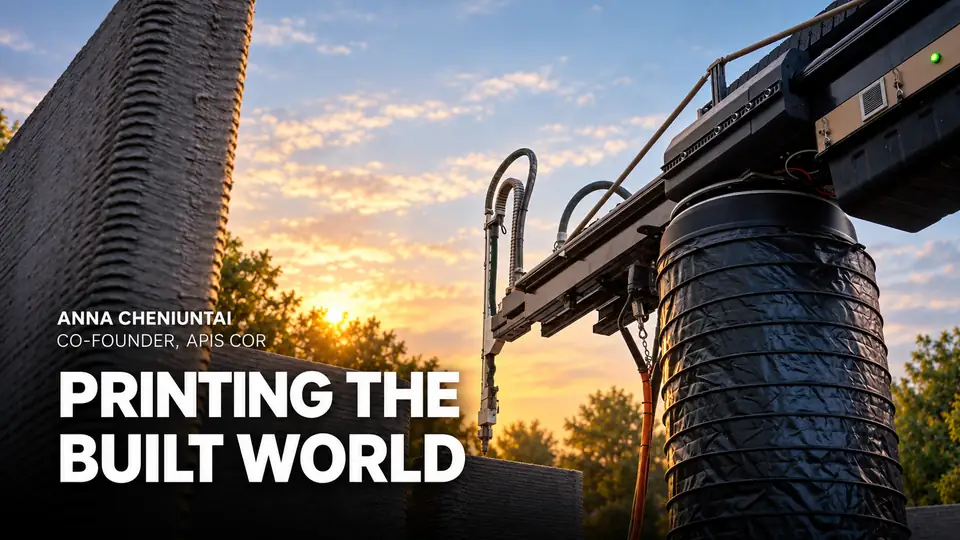
Anna Cheniuntai explains what it means to 3D print a building, from depositing walls to developing suitable materials.
March 2, 2021 · 41 min



About the episode
In this conversation, we talk with Anna Cheniuntai of Apis Cor. At Apis Cor, they're developing the robotics & materials technology to 3D print buildings both here on earth and eventually on Mars.
We cover the process of printing buildings, a little bit of the material science, the future of construction, and how 3D printed buildings are critical to our ability to inhabit Mars.
Links
Chapters
Times follow the podcast audio. The video’s timeline may be slightly different.
- 00:00Welcome and introducing Apis Cor
- 01:49Housing and the role of construction robots
- 06:57What a building printer actually prints
- 12:24Materials for printing walls
- 19:13Adoption and building codes
- 23:59From demonstrations to occupied homes
- 25:54Construction beyond Earth
- 32:31A longer-term vision for construction
Read the conversation
Open the full transcript
CAMERON WIESE: Welcome to the Build the Future podcast. My name is Cameron Wiese and I'm your host. I've always been fascinated by the ideas and sentiment that drove American culture in the 1960s with the space race. A culture galvanized to dream about the possibilities of tomorrow, whether it's food, transportation, cities, biology, or anything else. It was this cultural mindset rooted in optimism that the world tomorrow would be better than the world today. A mindset where people were compelled to build things, and I quote JFK, not because they were easy, but because they were hard. It's this desire to build and to dream that seems to have been lost, and something we're here to bring back. With Build the Future, we're here to promote the ideas and stories of those who see how the future can be better and promote their plans to get us there.
CAMERON WIESE: It's our mission to get you to dream about the possibilities of tomorrow, to dream about the future that you want to live in, and inspire you to go build. Today, start with Anna Cheniuntai, co-founder and CEO of Apis Cor. In Apis Cor, they're developing the robotics and materials technology to 3D print buildings both here on Earth and eventually on Mars. Let's jump right in. Thank you so much for being here. I'm very grateful to have you on to talk about the work you all are doing. I came across it on Twitter a few months ago. I'm like, oh, this is really sweet. I think it was around the NASA project. Oh, I have to talk to y'all. This will be cool. So thank you for being here.
ANNA CHENIUNTAI: Yeah, absolutely. Thank you for inviting me. It's a pleasure.
CAMERON WIESE: Can you tell me about the future you're building at Apis Cor? What's the vision?
ANNA CHENIUNTAI: So the future we're building at Apis Cor is the future where robots Twitter print houses, where robots build houses, let's say, and actually it lets the, it brings us to the future when the problem of affordable houses, it's no longer a problem because the, if we can bring the automation to the home building industry, the whole, the productivity of the process can be significantly increased. And actually, we will be able to 3D print to build more houses, right? Because today, it's the huge gap between how much we build houses and how many we need to actually bring to meet the growing demand. and having the traditional construction technologies and materials, and obviously that we're very behind to meeting the growing demand for new houses.
ANNA CHENIUNTAI: And if we can bring robots to do this, we can fill this gap by actually building more and more houses. So this is the philosophy behind the AP score that how we can bring automation and robotic solutions to the home building industry that which actually hasn't been changed since almost middle ages. So yeah, this is where we are today and what we want to bring to the world.
CAMERON WIESE: You're right. There's this huge gap in the availability of housing and or the need for housing and the availability for housing, especially in like emerging markets like Africa and South America where they just can't keep up with the demand for all the people who need houses.
SPEAKER UNCLEAR: right? Yeah, absolutely. So about the this problem with the affordable houses, it's very different from the country to country, from market to market. So for example, in the developing countries, like countries in Africa, the problem is that there is no enough skill labor there to meet the growing demand. So the 3D printing technology there solved the problem not how to build cheaper, but how to build houses at all, right? They need houses, but they just cannot meet this demand using the manpower, fortunately. And it's also the question about the predictability or repeatability and the quality of construction and actually about the scalability of the construction process. And the robotics and automation solutions help to scale this process and build more houses. In developed countries like the United States, for example, the problem is also about how to scale the process, but also how to build cheaper, because here the labor cost is very high. And so the 3D printing technology brings the value of how to reduce the costs. So in the United States, it's like the two problems that the technology solved, how to build cheaper and faster and more. And in the developing countries, it's more about how to bring houses, how to build houses at all. Right? So where are y'all starting with this? Because
CAMERON WIESE: it looks like you have your project in Louisiana, which is going to be the first kind of 3D printed major development, if I understand correctly. Why start in the US where you're tackling kind of those just those two problems where you go to an emerging market where they're simply just in need for housing and so you'd be able to kind of scale up perhaps a bit faster without all the industry kind of you know incumbent ways of doing things
ANNA CHENIUNTAI: Yeah, so be any new technology. It's also Always very expensive in the beginning, right? If we can have a look at their big innovations in our history They mostly were very expensive in the beginning. But then over the time, once we improve the technology, learn a lot and bring more development in the technology, then it becomes more affordable to use for the different markets and different applications. So today, the technology, I would say that it's not quite affordable for the developing countries, right? Because it's new technology. It needs some time to adopt this technology somewhere, prove how it works and the reality. And so the United States market is the best place to start this because here the construction industry is more advanced, right? And here the country of where the business is all the time, like a bit, make our life better, right?
ANNA CHENIUNTAI: So here we have opportunity to test the technology to figure out how we can develop this and how we can reduce the cost of the technology itself on the robotic solution, for example. Only then, that would make sense to bring it to the developing countries where the solution and the technology might be affordable for the other markets. We just start here to adapt the technology, develop the technology, and later scale it overseas.
CAMERON WIESE: Tell me a little bit more about the technology itself. What does it look like to 3D print buildings? I wonder what kind of processes that go into that.
ANNA CHENIUNTAI: Yeah, so typically when you say that we, through the print houses, people just immediately imagine that the whole house through the printed, including the roofing, the windows, the furniture, everything. But in reality, the 3D printing technology today is about 3D printing the wall structures, the shell of a house. And so the shell of a house, actually one of the most, I would say the most labor and material intensive part of construction. And it actually comprises almost 80% of overall materials needed to build a house. So this is the why we bring for the solution to build the wall structures. Because if we can identify what the process takes the most labor efforts, time and materials, and we can bring in the automation solution there, that would be a significant step forward how to increase the productivity for overall process.
ANNA CHENIUNTAI: So today, the 3D printing technology in the process where we construct the walls using the additive manufacturing process, basically we build the walls adding layer by layer the concrete like material, and basically we create the desired shape of a building directly on site. So, yeah, so this is what the 3D printing technology is about today.
CAMERON WIESE: So it's kind of, it's very similar to like, if you're going to 3D print like a little plastic toy in one of the desktop 3D printers, it's very similar to that where you have kind of the design on the computer, you model it out, and then you set the robot in the plot of land where you want to develop and it kind of moves around and like lays layer by layer building up the shell of the house, right?
ANNA CHENIUNTAI: Yeah, exactly. Basically, the idea of 3D printed houses came from the traditional plastic 3D printing technology. So it made such a huge revolution in the manufacturing process, how we can build small objects, right? Because basically, the additive manufacturing is the response to the subtractive manufacturing process, subtractive manufacturing process that existed like a hundred years before additive manufacturing. And it works in the way that we have a stock material, solid material, let's say. And then we remove the material like throughout cutting it away or grilling or grinding, something like this, to get the desired shape of an object, to get a part. And it obviously generates a lot of waste, right? So we actually waste a lot of material just to get the desired shape of an object.
ANNA CHENIUNTAI: And so the additive manufacturing is what the, like a response to that, how we can do differently. And additive manufacturing is about to create the object by adding the material, not to remove it away. And it also to how to create the desired shape, you know, adding the material, right? It's like a smarter way how to produce things and objects. And so later, and this approach actually brought a lot of innovations and changed the way how we can produce small parts. We used it in the medical industry and in prototyping. So it significantly helped us to reduce the cost of prototyping and also helped us to manufacture some things that used to be very expensive to manufacture with the substructive process before. And it's also about saving the time, how to produce things.
ANNA CHENIUNTAI: So the first innovators in 3D printing construction technology thought like, why we, what if we can apply the same approach to build something bigger, like houses, right? And so this is how the 3D printing technology whether they came to the world. So the first innovators start using bigger machine instead of the desktop through the printers. So if we want to through the print such a big object like a house, we need to have bigger machine and we need to have different material like a concrete like material. The layers also would be a little bit bigger rather than the traditional plastic layers. So it's like the larger version of the plastic through the printing technology, but the basic approach the same is how to create the shape, the object by adding the material and without generating waste, like without wasting the
SPEAKER UNCLEAR: material, cutting it away. Yeah. There's this funny cartoon that I, that comes to mind where it may have been a cartoon or some YouTube video, but it was like how to make a baseball bat. So they had a block of wood and they would like shave it down to get the shape of the baseball bat. And like the rest of that wood is just like scraps and it's wasted. We don't need to be doing things like that, we can be taking the additive approach. You mentioned the concrete-like substance. When I look at the demos and stuff on the website, it looks like it's just pouring concrete layer by layer. What's actually going on there? What is this concoction you guys are using to print these buildings?
ANNA CHENIUNTAI: It's a very interesting part about the technology, a very important part of the technology, because we say that it's concrete 3D printing technology. But basically the material that we use, it's not the same as the regular concrete. Because the regular concrete cannot be extruded, but for the concrete 3D printing technology, we need the material that would be possible to extrude. So basically it has to flow when it goes on the hoses and all of the system. But once it comes out of the extruder of the nozzle. It has to stop flowing and the material has to maintain the shape of a layer. So it's like a flowing but not flowing and regular concrete actually cannot do this because regular concrete is very liquid material.
CAMERON WIESE: So just like it would melt, right?
SPEAKER UNCLEAR: Yes, yes. It's like the puddle, you know, just like it or like an ice cream cone. Yeah. I think that even ice cream is more extrudable rather than the concrete. I would say the concrete is more like a juice, you know, when you just need to pour a lot of material, like very fast and fill the very big area immediately. So the extrudible concrete, let's say, it's the material that again can be extruded and doesn't became a puddle once it's coming out of the nozzle. And so this is where the material science arises to what the how to create this material. And so there is no one answer how to what the recipe for this material, because the material science allows us to create different recipes of extrudible material.
ANNA CHENIUNTAI: And basically today, the extrudible concrete consists on the of the cement Portland cement, because it's a binder that put together of the components. Sand, very fine sand, up to two millimeters. Particles have to have to be up to two millimeters. So it's very fine material. Regular concrete actually has a gravel inside, very big stones. So this is one of the differences between the materials. And so then the extrutable concrete also contains the additives. And the present like a 15% of the recipe. It might depends on the recipe again, but additives, if they have some chemicals that actually make possible to create the extrudible material that help us to have the material with this specific viscosity, actually the 3D printing material, very high viscosity material, and also to accelerate the setting time of the material and achieve a lot of other properties is needed to have the extrudible concrete.
ANNA CHENIUNTAI: So yeah, this is the science behind the 3D printing material. And actually, the cement, the Portland cement material, it's not the one component that might be used to create the extrudible concrete. Because of the 3D printing technology, it's very new type of construction and actually new technology, right? Because we never 3D printed houses before with the concrete-like materials. So this technology allows to open a huge room for the new materials, like eco-friendly materials or alternative materials. It just depends on the material science, what their composition of the recipe might be. And so one of the materials that we actually go into introducing future is called geopolymer material. So what's cool about this material is that this material does not contain cement at all. And it's very fire resistance material and waterproof material.
ANNA CHENIUNTAI: So and it perfectly works for the for the extrusion, you know, with the for the three different purposes. And so it's a, we believe that it's a very important to transition to the new materials because it will help us to reduce the negative impact in construction industry that cement generate, right? So the carbon foot is very huge in the construction industry. So let's imagine that we can 3D print million of houses. We use 3D printing technology allows us to build much more houses faster and quicker. So let's imagine that in future, we can build millions of houses with the material that doesn't contain cement at all. That would be a huge impact on the carbon positive impact on the construction industry in terms of the carbon footprint.
CAMERON WIESE: So this is a new material that y'all are creating that replaces a new for concrete.
ANNA CHENIUNTAI: Actually, geopolymer material existed before. So it also used in the construction industry before. So it's like the material that can be used for extrusion and it's better than cement. We plan to transition from cement like materials to the materials that does not contain cement at all because the nature of the concrete through the printing technology allows us to do this, allows to explore new materials.
CAMERON WIESE: I'm curious, what else has been made available through this technology that y'all are deploying that wasn't possible before. So you can now use the geo and polymers. What else has changed?
ANNA CHENIUNTAI: I think that the one biggest change that 3D printing technology brought is the freedom in design. So yeah, because we create the shape of a building, right? By adding this material. And so in this case, we can build shapes that before used to be very expensive to build with the traditional materials and traditional approaches. And for example, even what is not impossible to build at all. So the freedom in design, it's a very huge step forward how we can not just to build fancy houses, but also how we can build houses that more energy efficient and the climate resilient, for example. Because if we can build curved walls, the curved shapes actually is more resistant to the wind load or flood load. Yeah, because if you build the curved shapes, it sort of breaks the load on the surface. So yeah, that provides the opportunity to build houses that can be more resistant to the high wind load and flood loads, for example.
CAMERON WIESE: I want to take a step back and talk about why this is coming to market now. So we had a pretty big 3D printing revolution in probably 2010, 2012. It got really popular. What were some of the important things that were developed that have enabled you and your team to be able to go do this?
ANNA CHENIUNTAI: So I would say that the construction industry is not very easy industry to bring the innovations, right? It's very conservative, then it's also very highly regulated. Of course, because we have to build houses that safe and sound. So this is why it's a lot of regulations around this. But I would say that the 3D printing technology is a huge change, It's just changed almost everything, not just how we build houses, but also how we change the construction landscape, let's say, how we deliver the material, how people can work at the construction site. So obviously, they now have more safe place to work and they don't need to do a lot of hard physical work, because the robots can do this to build the walls together.
ANNA CHENIUNTAI: So it really brings a lot of changes. And when we want to change something in a big way, it also all the time take time, right? But what we have done so far to accelerate the adoption of the technology in the industry, is that we introduced the concept of the walls that can meet the building codes, international building codes. It's very important because the, It was one of the biggest problems so far. And I will explain why. Because the 3D printing technology, 3D printing process allows to build any shapes, right? You can pre-entwalls with any patterns and they structurally can be different. And it's good that we have a freedom of what exactly we can 3D print. But if you want to meet the building clothes, we have to build something consistent.
ANNA CHENIUNTAI: And we have to build houses in the same way all the time. So this is about what about the building fields. And so, yeah, and if we can come up with the idea, what would be the standard for the trigger printed structures that will significantly simplify the process of the building approvals and going through the regulations. So this is what we have been focused during the last year. we developed the concept of the 3D printed walls as comparable to concrete masonry unit wall. And basically we structurally mimic the concrete masonry unit wall. And in this case, we can do everything the same as for masonry. And we can apply the same reinforcement approach. For example, we can just have a look at the building code for masonry and just do the same for our walls. And this is our mission and I would say our plan, how to bring the technology for the commercial use and get it more understandable for the building codes and building officials. That will increase scalability of the technology.
CAMERON WIESE: Yeah, it seems like one of the challenges is how do you get the people who are responsible for the building codes and the building regulation to buy into this, especially when it's so new and it's so exciting, but it's change and it's new and it's scary and people are like, oh, I don't know if this is going to work. Is it going to be safe? Like what are some of the misconceptions that people have about like the way y'all are
ANNA CHENIUNTAI: approaching this? I think that the one thing is about the reinforcement. The companies that deal with the 3D printing technology, they try to reinforce the material itself, add in fiber or some continuous reinforcement, something like this. So for us, it's still not clear if it's really needed because the whole structure has to be reinforced, right? And so this is why we actually came to the idea of how the concrete masonry unit wall reinforced and we just can do the same. So, and we can meet the building codes and the requirements and we can be sure that the 3D printed house is safe and sound because we just did the same as it's already well accepted and well studied in the industry. So yeah, I would say that the most popular question is about is 3D printed house reinforced? How you do this?
SPEAKER UNCLEAR: So this is one of the popular questions. What's the time I'm looking like for when
CAMERON WIESE: people can expect to see 3D printed homes be commonplace?
ANNA CHENIUNTAI: I think that today, 3D printing technology is very actively developed. So we can see a lot of 3D printed houses across the world, in the United States, in Europe, for example. So now it already became the normal thing, right? If you talk to somebody four years ago about 3D printed houses, everybody would be like, what? What is it? No, it's nonsense. But today, if you say it's a three-bedroom house, people are like, oh yeah, I know this, I heard this, I know what you talked about. So at least it already became something familiar for people, because a lot of proof of concept today is delivered by many companies. And now I think it's the time when we have to show the, not like the demo houses, we have to show the houses that permitted and has the certificate of occupancy.
ANNA CHENIUNTAI: Because now we need to prove that the houses can be occupied by people. Because before everything that basically were truly printed in the industry, it was more to showcase the technology, showcase the opportunity of the technology. So I think that now it started the process, another chapter in the industry, where now we can say that we already know how to 3D print houses. Now we exploring and proving that the houses can be safe and sound and meet all of the existing regulations. I think that it will take two years, I think, couple of years, I think, just to deliver more and more case studies of the permitted houses with a certificate of occupancy. And then it will accelerate exponentially the application, the technology for the commercial use.
CAMERON WIESE: Yeah, because once people see that it's safe and sound and that it's certified for occupation, it seems like that it's going to be a no-brainer for folks in construction to shift because it is cheaper, it is more effective, and it does give them more flexibility with how they build homes. Where do we go from here? So 3D printing homes here on Earth. Can you tell me a little bit about how you see the future developing here and in the work that you all have done with the NASA design competition?
ANNA CHENIUNTAI: First, I think why we need to go to space. The Earth is the nice place. We can keep living this, right? And like why we need to go to space. A lot of people think about this. Yeah, it's a cozy place here where we are in a lot of oceans. But the population is growing, right? and basically every year it's more and more people living on Earth, and at the same time we live in a finite system, so we consume the limited amount of resources. And so we and the species, we just need more space, right, if you want to save us. This is the one of the reasons why we need to expand our presence beyond the Earth, right, because actually there are a lot of resources in space space. And we can also bring the some manufacturing process processes on the low orbit space across the around the earth. So this is how we can actually help our planets in terms of the manufacturing and all of this production on earth. And so the another reason why we also need to go to space is that that challenges all the time help us to improve our systems and create something that we would never invent without these big challenges.
ANNA CHENIUNTAI: For example, a lot of great inventions that we daily use today were initially invented for the purpose to use in space or international space station. Like a Teflon, for example, we just... Nobody can imagine cooking the breakfast without the Teflon. And even the brackets for our teeth that we use to have our smile looks beautiful. It also, this material with the shape memory property was invented for the, to use in the International Space Station. So a lot of inventions we created because we had the bigger goal and very huge challenge. And then we just immediately start using it on our daily life and improve our life on Earth. So this is why we all the time need to have the bigger goal, right? And the goal of how to bring our humanity on other planets, it's also something that will help to improve the technologies that we can immediately apply on Earth, right?
ANNA CHENIUNTAI: So yeah, so this is why the concept about the building houses, building shelters on Mars and Moon, it became like a very attractive and very, I would say, popular and promising direction in there for the NASA and for the scientists, the scientists community in general. And so the robot's actually going to be the first who will be there, right? Because it's very hard to build house on Mars, right? It's not so nice as here.
CAMERON WIESE: It's such a good point. Like, how does everyone think we're going to go build stuff on Mars? We're not going to show up with a bunch of like trees and concrete and bricks and hammers and nails. Like, we're going to need to come up with new solutions to be able to build and develop on the Moon. and on Mars and other planets.
ANNA CHENIUNTAI: Yeah, absolutely. Yeah, yeah. And so the robotic solution, that's actually the way how we're going to build first houses there. So first we will send robots there, they will 3D print shelters, and then first people will come there. So this is why the companies that are doing 3D printing technology on Earth, they actually have the potential application to apply these technologies on Mars and Moon. So, yeah, so this is why we all the time were interested in this and allocated some efforts and our ideas about that, how this technology can also be used on Moon and Mars. And NASA competition was about the exploration about what technologies is available today on Earth and actually to promote these technologies to bring more awareness for the designers and the engineers to this particular challenge.
ANNA CHENIUNTAI: And so the main task of the NASA competition was to 3D-print several samples, like scaled samples of the potential shelter, of potential habitat, let's say, in a fully autonomous way. because that's actually the most important task, how everything can be built by robots in autonomous way. Because robots will be on Mars or on Moon. We will be here on Earth. And so if something happens on Mars, nobody will be there to help robot to do something, right? And actually, remote control, it's also had about 30 minutes delay between Earth and Mars. So we just will know if something happens there in 30 minutes, right? So this is why the NASA competition was designed around the autonomous 3D printing process. And so this is what we successfully delivered.
ANNA CHENIUNTAI: So we 3D printed two samples. First it would be the slab, like a concrete slab. We 3D printed in an almost full autonomous way. And then we 3D printed another small element of habitat. that it's like a circle, big tank for water, I would say. So yeah, with 3D printing, then it's in a very high autonomous way as well. And then we filled it with water just to check the leakage. So it was actually behind the 3D printing process. It was also a lot of task to test the material, to test the 3D printing structure, to see how the material performs and how the 3D printing structure also structural performs.
CAMERON WIESE: When you think about the long-term future with like 3D printed buildings on earth and in space, what kind of world do you see?
ANNA CHENIUNTAI: Oh, it's a very good question. First, I would like to see the world when we don't have such a negative impact on our environment, right? Because today we can see how bad the situation is, right? And this actually mainly because of us, because how we manufactured our infrastructure, how we did things. So I would like to see the world when it's no longer even a question about if we hurt our nature or not, if we hurt our environment or not. And so the new technologies and the 3D printing technology, it's also there, can bring a very good impact on this because again, we generate less waste, right? And we can use the materials that eco-friendly without the cement involved in this. So yeah, I just see the world where we produce everything in a smart way and with the last impact on our Earth.
CAMERON WIESE: I'm curious to get your take on, after the kind of baseline structures are set up on Mars, what do you see like the next iteration of the 3D printing technology turning into? It's just like, call the scaffolding or the shell is going to be put up and then we need some other system to come in and fill it out. And like, how do you see that developing?
ANNA CHENIUNTAI: So the 3D printing the walls, it's like the first step, how we can change the way we build the houses. And so later on, more automation should be brought to the construction process. So for example, how we install the roofs, probably we will be able to 3D print the roofs in future. So it's still like the question of the research and development and figure out how we can do this. We as a company, we aim to bring as much solutions to the automation solutions as possible. And the 3D printing of the walls is just the first step for this. And that would be interesting to see what the level of automatization can be in future for the home building process. Yeah, so that will significantly change the construction industry as well.
CAMERON WIESE: Which would be really cool. Outside of the work you're doing at Apis Cor and the 3D printing and perhaps even kind of our ability to go travel at galaxies and strive for something bigger and more challenging, what excites you about the future?
ANNA CHENIUNTAI: I think the opportunity to travel beyond Earth, that's absolutely exciting things, things for me because yeah we live today in a very interesting and advanced world right so we have a lot of innovations we have a lot of technologies we didn't have it like 20 years ago right but I think that I'm very lucky that I can live in today in the more and more world so recently I saw the video of the Boston Dynamics, seeing their dancing robots. I actually didn't believe that it's true, right? Because it's really like that they remind me that movie called I robots, right? So I was like, I watched this video twice, just to really believe that it's true, because the way that they move, it's so advanced engineering and robotics. So I just thought that Oh, like maybe in a couple of years, we can connect neural link developed by Elon Musk to this robots and that would be completely new future.
ANNA CHENIUNTAI: It's actually something that we could imagine all the movies like at 20 years ago, but today we see how it becomes a reality. So for me, I believe that while I'm living during my lifetime, we definitely will be able to travel to moon and mars and it's really very excited for me like that I can be a part of this or at least
SPEAKER UNCLEAR: see how it happens right there's so many cool people who are who are working on incredible things right now the the cultural narrative is not shifted such that everyone is excited about the feature again but I think we're we're getting very close people are going to see all the stuff Elon's doing we're gonna someone will get back to go back to the moon it'll be like oh oh it's on and like, let's go, let's go develop all these new things. Like, let's be very excited about technology. The future looks bright, but we're not quite there yet. So where can people find you and how can they support you in Apis Cor?
SPEAKER UNCLEAR: So they can find us online on our website and they also can reach me out on LinkedIn if they want to talk to me personally. And so they help, I think that it's to promote that 3D printing technology, just talking about this and help us to bring it to reality, supporting us, I think, in a media space, just sharing our news and keeping on us, because very soon we're going to have a very exciting news and announcements. So yeah, that this kind of support is very important for us. And yeah, it really means a lot when people really share our vision and support what we do. Because what we do is pretty complicated, right? Because it's a huge thing and it takes a lot of efforts and belief in everything. So it's not like a very quick turn around and very big, very quick outcome. So yeah, it takes a lot of time and efforts and everything and supports by people. It's really inspiring and just help you keep moving, You know, absolutely.
CAMERON WIESE: Absolutely. Cool. Yeah. I'm, I'm a big fan of how do we just get more people excited about these things that take, take a long time. Cause it's not like software where it's just like, oh cool. You just hit command enter and you have a website up. It's to go through this long process of building everything.
ANNA CHENIUNTAI: Yeah. And basically because we build physical stuff, physical objects. It's not the software. Yeah, I agree. And, uh, hard tech is more like a challenge and complicated because you first need to build something, see how it works, then you figure out, oh, my God, something doesn't work as I expected. I need to rebuild it. It takes another cycle of the design and rebuilding fabricate and everything. And then you can see if this, again, is right direction and then you test it. And so the very good example of how hard it is, it's like the rocket manufacturing, for example. So when you test the rocket and something went wrong, it's just exploded and you just cannot investigate what is wrong. Right. So this is the challenges when you build the physical objects and when you do something for physical world.
CAMERON WIESE: Awesome. Cool. Hey, thank you for coming on. Excited about what y'all are doing and look forward to continuing to support and be a champion for Apis Cor for you and for FutureWare. All of our buildings are 3D printed and we're saving the environment and we're traveling the galaxies and we're building things because they're exciting and because we can. Yeah, Future looks bright.
ANNA CHENIUNTAI: Yeah, absolutely. Thank you very much. It was a pleasure and congratulations with your podcast. It's really good content that you create. Keep doing this.
CAMERON WIESE: Thank you. We'll do it. And likewise, take care. Bye.
SPEAKER UNCLEAR: Bye.
CAMERON WIESE: Thanks for joining us for this episode of the Build the Future podcast. If you're building and want to get support, want to hear about certain topics or hear from certain people, shoot us over an email to hello at build the future podcast.com or follow me Cameron on Twitter at cam. We see and we'll see what we can make happen. That's it from us. Until next time, go build!
More episodes
All episodes Jon Dishotsky — Co-Living, Community and the Future of CitiesJon Dishotsky discusses Starcity’s approach to shared living spaces and the role of cities in providing opportunity and community.
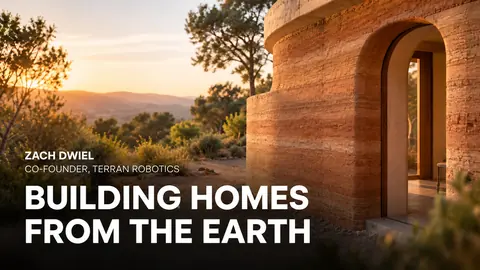 Zach Dwiel of Terran Robotics — AI, Drones and ConstructionZach Dwiel describes Terran Robotics’ early work on tethered drones and learning systems for building clay-based walls.
 Dryden Brown — Cities, Herofuturism and ImmortalityDryden Brown describes the vision behind Bluebook Cities and Praxis, connecting urban design to shared values and social trust.