

Build the Future Podcast
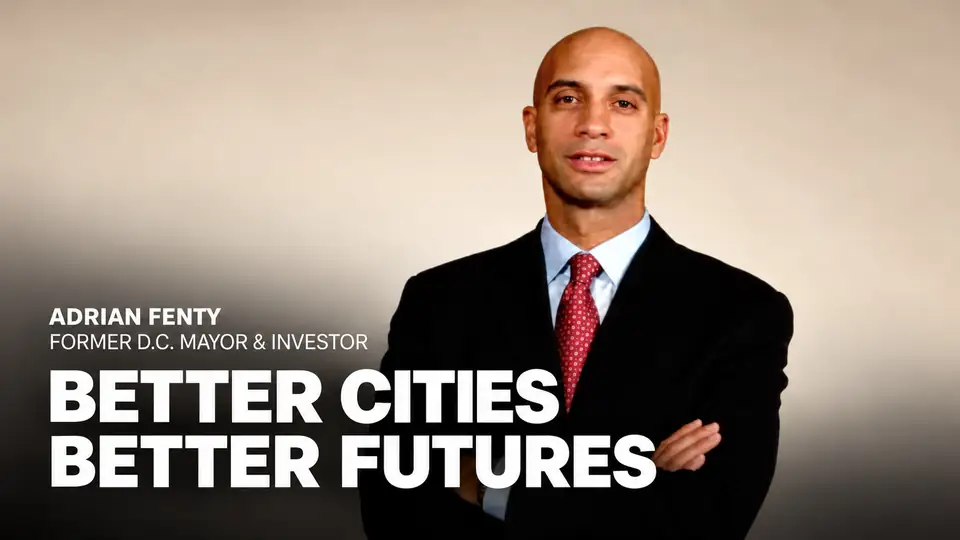
Adrian Fenty — Building Better Cities Through Policy and Technology
Adrian Fenty connects his work in city government and venture investing through education and accountability.
October 19, 2021 · 41 min



About the episode
In this conversation, we talk with Adrian Fenty, the founding managing partner at MaC Venture Capital and the former mayor of Washington DC. We cover everything from investing in the future, changing the landscape of education, the importance of local political involvement and the future that we hope to build.
Links
Chapters
Times follow the podcast audio. The video’s timeline may be slightly different.
- 00:00Introducing Adrian Fenty
- 00:35Parenthood and education
- 02:19Creativity and innovation in schools
- 04:12Scaling better education
- 07:23Education outcomes and accountability
- 08:52Local leadership and school governance
- 11:48New cities as places to experiment
- 14:07Choice, bike lanes and city life
- 16:06Urban technology and the space frontier
- 17:50Connectivity and satellite imagery
- 20:30Government and private enterprise in space
- 23:25What comes after a launch
- 25:03Food innovation and hands-on learning
- 28:05Exercise and working life
- 29:08Nuclear power and innovation cycles
- 31:52Environmental innovation and new business models
- 33:56Improving existing systems and telemedicine
- 36:38Transportation and reusable rockets
- 39:12Getting involved and demanding results
Read the conversation
Open the full transcript
CAMERON WIESE: Welcome to the Build the Future podcast where we promote exciting and positive visions of the future for those who are helping build it. Today we'll talk with Adrian Fenty, the founding managing partner at Mac Venture Capital and the former mayor of Washington DC. We cover everything from investing in the future, changing the lens of education, the importance of local political involvement and the future that we hope to build. So let's jump right in.
CAMERON WIESE: I'm curious, how did having kids change the way you viewed the world and particularly
SPEAKER UNCLEAR: the future?
ADRIAN FENTY: Kids really focus you around what's super important and basic. When I had kids, I really focused on education, which is a huge part of the past, the present, and the future. So like, you know, since my kids were like three years old, you know, I put them in school and I've tried to make sure that, you know, they got a great education. But along the way, you kind of realize that disparity is an education that exists in our country and different cities and states throughout the world. And so that's really hyper focused be on the need for this country in this world to do a much better job on education in general. And the longer I'm a parent, the more passionate and irate I get about it. You know, Michael Milken, once I went to speak and he was talking about two different countries. He was talking about Jamaica and Singapore, both countries, about 3 million people 20 years ago. And he said, both amazing countries, Jamaica, it shows the focus on tourism as their kind of lead industry. And Singapore chose to focus on education, on educating the people who work there.
ADRIAN FENTY: And what he said was that 20 years later, both countries are great, but Singapore has put together, you know, people who are more PhDs, more college graduates, more high school graduates. And what that's done is that's totally transformed their entire country and that they have people who are more engineers with more ideas about transportation and economic development, et cetera. So if I had to pick one thing that my kids are connecting me towards, they're looking at the future, it's the importance of just being maniacal about education.
CAMERON WIESE: Yeah, this is a big topic these days because like, there's kids are going to getting sent back to school or even over the past year, parents have had to kind of help shepherd their kids' educations from home. And a lot of the kind of ways it could have been being educated, it's like seemingly been broken, right? I'm curious to like, what do you see as kind of the path forward here? Like what should our education system look like? Right? When you think about the education you want your kids to have,
SPEAKER UNCLEAR: like what's working right now, what's not working? So I think two words, creativity and innovation.
SPEAKER UNCLEAR: So creativity is doing things differently. So someone once said to me,
ADRIAN FENTY: don't try to create an excellent school system, try to create a system of excellent schools. So almost by default, like the way it works now in public education, every school is supposed to kind of look the same. By default, it should be the opposite. Every school should look different with a different type of principle and a different way of thinking, different teachers. And that's the creativity. some schools should go to school 10 hours a day, some schools maybe six hours a day. It just depends on the curriculum and what we're doing. And there isn't that creativity in mass education in this country, and there should be. And then innovation. I'm privileged and lucky to live in Silicon Valley now. And in Silicon Valley, disruption is a word that is heralded. Disruption should be word that is heralded in education. It should be someone comes up with a crazy wacky idea. Let's try it. A lot of the kids are reading on grade level, on math on grade level, then let's try all these crazy ideas people come in. If we did that, education would probably be
ADRIAN FENTY: the number one thing that venture capital funds invest in in Silicon Valley. Instead, that it's probably the last thing that we invest in.
CAMERON WIESE: What happens when you turn the school into a place for play and for experimentation and you kind of foster that sort of possibility in the hearts and minds of young kids? Because right now they go sit down, listen to the same curriculum over and over and over again. And there's no variety. I mean, on a natural scale, there's not much variety. Everyone's kind of getting the same old repeated educations. It's like, how do we actually change this system? There's lots of people privately working on it. You've got Primer, you've got Synthesis School, you've got the Micro Schools Montessori, but that's a very small subset of the population. How I view the world is, we can't just create things for, pardon my, I don't know what any other word phrase is, like the Silicon Valley or the upper, or the elite. It's like, oh yeah, you can afford to send your kid into like a private Montessori school, great. But it doesn't solve the real problem, which is like education on a national and global scale.
ADRIAN FENTY: No, you're absolutely right. And there are people with great ideas in changing and disrupting education. Like you said, there are a school here, a school that just take KIPP, which is one of the biggest charter school groups in the country. They have amazing schools and they're usually in impoverished neighborhoods and they do very disruptive things. mainly like they kind of hire different types of people to be teachers and they have different lengths of school days and they probably have other things in the classroom that I'm not aware of. The problem we keep is, at the last I checked, there's only 150 schools in the whole country. I mean, that's a drop in the bucket. We have probably 150 schools in every city in this country or more. And so you need it to be, as they say, Silicon Valley, you need to scale the thing. In order to scale the thing, in order to scale innovative education, you need to get the government to buy along with it. And the government is very resistant on buying into innovative ways to do things in education
ADRIAN FENTY: because they have stakeholders who like the way it's done now, adults who like the way things are done now. It could be the textbook industry who still sell two textbooks by the millions to our kids when our kids are way more comfortable using cell phones or iPads. And then of course, there's restaurants just like unions, which get involved in political campaigns. And then we have this thing in the Western Hemisphere in North and South America where the left is pro-union and the right is not pro-union. And so what you have is, but then it's a political thing because the right is always going to say, well, we're open to change and we don't care what the union says. And the left says, well, we're not open to change because the union doesn't want it. And we're with the union. And in that whole debate, which already started boring and very adult centric, there's no talk about what's best for the kids.
CAMERON WIESE: It's like the adults are fighting over the toys. It's like, stop, you need to give the toys to the kids, let them play with the toys, like think about what's best for them rather than, you know.
SPEAKER UNCLEAR: And so you go back to your first question about like what have kids taught me about education.
ADRIAN FENTY: You know, every parent, I don't care if you're a Democrat or Republican, if someone says like, if you have a bad teacher in the classroom, and then your parent, you're like change the teacher immediately. You know, you're like, do whatever it takes to educate my kid. And then to your other point, when it's someone else's kids, particularly lower income kids who don't have people fighting for them as much, people don't care and they let the system persist as it is. So education and education to me is not only exciting part of the future, but it's like imperative part of the future.
CAMERON WIESE: Just on that textbooks note, I saw this thing that shocked me recently, which was these professors as part of the textbook company, kind of monopoly, were requiring students to purchase a packet, which was like their access code to the textbook. And so it was literally these people got like a novel, a mill envelope in the mail and it had digital codes for them to go onto their computer to type in to get access to the digital textbook. So they didn't even get a physical textbook. They had like pay hundreds of dollars for the access codes to these things. It's like, this is ridiculous.
ADRIAN FENTY: No, anyway, we could go on.
SPEAKER UNCLEAR: Yeah.
ADRIAN FENTY: But the answer is definitely in government and politicians and finding ways to hold them more
SPEAKER UNCLEAR: accountable for results in the schools.
CAMERON WIESE: That's a great, great segue that I want to make kind of your political life. So you're a former mayor of DC, and I'm curious kind of like, as someone who's kind of been inside that system, what sort of changes need to be made kind of on a national scale that could help lead to some of these changes in education? Or actually, is this even a national thing? Or is this going to come down to mayors in individual cities taking some leadership position saying, hey, we need our education system to look different, or we need our transportation system to look different. Like there's a lot of bureaucracy and red tape that's kind of impeding our ability to build a future that's bright and prosperous for everybody. And it seems like the bottleneck at this point is mostly political. Okay, it's gonna what you think about that.
ADRIAN FENTY: Yeah, every mayor should absolutely be in charge of the school system for one reason. One person has to be held accountable, right? Get rid of the school boards. There's too many people. Nothing has ever run well when you have 6, 8, 9, 13 people in charge of it. So just have one person in charge. And it should be very simple. Test scores, grade point averages, graduation rates, college acceptance, college graduation rates are either going up and you keep that mayor or governor around, or they're not going up and you get a new mayor. And it's that simple. And here's the other thing. But that also means that the general population has to say the only thing we care about is results. The only thing we care about is if our kids are learning more, graduating more, dropping out less, and if the government can figure out a way to do it. The means absolutely justify the ends because that's how I am about my kids. That's how everyone is about their kids. If your kids are getting a great education, fantastic.
ADRIAN FENTY: You know what I mean? I'm not answering any questions because we know that's going to prepare them for a great life. But the crazy thing is we have a lot of problems in our country. We have employment issues. We have incarceration issues. We have homeless issues. All of these are prevalent in San Francisco crime issues. But it's flabbergasting to me that both private sector, Twitter, public sector, city hall, we'll talk about every other problem. You know what I mean? But we won't address what is probably the only way to really address it in a long-term fashion. And that's making sure that everybody has a decent high quality education. You had a decent high quality education. I had a decent high quality education. We have all kinds of problems, but we don't have these community problems that happen when you don't graduate from high school or so many other problems and what have you. So it's a little bit baffling. is a little bit frustrating. The answer to me is actually more simple than people will talk about,
ADRIAN FENTY: but simple doesn't mean easy. There is a path to victory. We just have to have the courage and determination to hold people accountable to do it. So that's education in the city. There's a host of other things. I know you're huge on the future. One of the things that just has happened recently, and I'm tracking it as close as I can, is there's a number of groups that are starting to to think about building new cities or new neighborhoods. We invested in a company called Coldesac, which is a new city, but it's almost a big neighborhood, but it's the same. And then there's a couple of other groups. And at one point Google had Cyro the approach is that you're going to build a city from the ground up without any kind of restrictions that you can do it as you would, almost in a theoretical way. That means that if you want to go carless, you go carless. If you want to be like completely eco-friendly and everything recyclable or you know recyclable materials, you do that bikes, trolleys, whatever. And it could even mean schools
ADRIAN FENTY: and other types of things as well. Obviously these would just be a couple of cities here and there but I think what it will do is it will speed up innovation that can be then retrofitted to other cities and that may be stoplights and other things. So I'm excited about those types of
SPEAKER UNCLEAR: initiatives because I like both the hardware and software improvements that will come to
SPEAKER UNCLEAR: everyday living because of them. The new city movement is perhaps like one of the most exciting things happening right now because you know we all are idealistic about okay we want a blank
CAMERON WIESE: slide to start over. Everyone wants to say oh no why don't you just fix the existing systems but sometimes you have to try something new, you have to experiment. And what these new city projects enable is this experimentation on large enough scale where people in other cities can look to them, oh, wait, this is what they're doing in Touloosa or Starbase or a cul-de-sac or a Neom, or there's a handful of others. It's like, oh, this is really cool. Why don't we have this? Why don't we have software that allows you to report like a dangerous intersection or see how our local politicians are spending their capital.
SPEAKER UNCLEAR: Or-
SPEAKER UNCLEAR: You know, drones that look like flying cars,
ADRIAN FENTY: it's gonna be easier to do those in places
SPEAKER UNCLEAR: where you have just kind of started with a blank slate, and then you can take it to Los Angeles and San Francisco. Yeah.
CAMERON WIESE: Well, it's cool, because they're all opt-in, or ideally, right? You have, I think one of the exciting projects on this this week is Mark Lorre and Bjarke and Gols with TELOSA, cityoftelosa.com for anyone listening who wants to check it out. It's like they don't have to worry about autonomous vehicle policy and say, hey, this is the default here. Or a cul-de-sac, hey, you don't have a car. And people who don't want to live that lifestyle won't go there. And so we don't have this infighting around what policy decisions to make. Instead, people can choose, oh, hey, I want to go live in cul-de-sac because it's I can walk everywhere or I can go live in New York or I can go live in San Francisco. Like you get the choice. I think that one of the big challenges is like how do you actually get people to go move these cities? How do you kind of solve the demand problem?
SPEAKER UNCLEAR: You really can't appreciate how exciting
ADRIAN FENTY: those types of things are. So in DC, like some of my budget when I was mayor was like $11 billion. Like, and we would, and just some of my agencies, we, you know, we were, they were in the hundreds of millions of dollars, schools were like a billion, maybe health also. The number one thing that people used to come up to me and say that they were most excited about were bike lanes. And bike lanes cost like, to paint a bike lane, probably a few thousand dollars. But people were so excited about it. And we did like, I think we did 40 miles of bike lanes in Washington, DC. But it allowed people to more safely be on their bikes, which is obvious, which then allowed them to kind of be out in nature more and not be relying on their car and to be able to go short places. So those types of initiatives like you're talking about, we'll do that in space because there'll be all types of initiatives making people excited about living where they are. And we're excited to invest in companies and things like that. It's not just called a stack as the whole idea,
ADRIAN FENTY: but like you said, there will be new software initiatives, there'll be new hardware initiatives. It will drive new technology in general, so we're excited about it.
CAMERON WIESE: When you think about the second and third order effects of these projects, what comes to mind for you? When you guys are doing your brainstorming around whether or not to invest in companies in these spaces, when you play them out, what does that world look like? How does that shape the country as a whole? I think it's the things that we talked about.
ADRIAN FENTY: it would be like a hyper loop or an above ground trolley system or some types of bike sharing that you couldn't do in a traditional city or scooters. I like what you said about lighting, smart lighting and things of that nature, just lighting up sidewalks. You know, you've seen all kinds of advances in technology in crosswalks and things like that. There's obviously a lot more to do. It actually starts to remind me of what Laura and I are trying to do in some of our other investments around space and satellites and other investments we're making because that's a whole new burgeoning area for the private sector. Just as there's going to be new neighborhoods built and new cities built on Earth, there's going to just be a whole new innovation happening in space. and it feels like, you know, it's really like this is the time and place where it's no pun intended launching. We're really excited about some of the technology that's going to come out of more trips to the moon, future trips to Mars, or just putting more satellites on Earth by, you know, a factor of 10X every couple of years.
SPEAKER UNCLEAR: And so we're excited about that as well. And that's a big thing we're looking towards in the future.
CAMERON WIESE: Yeah, one of the exciting pieces of that is like just Starlink, right? Everyone's like, oh, they're just doing satellites.
SPEAKER UNCLEAR: They can view internet. No, no, no.
CAMERON WIESE: This is like the implications of this are profound because suddenly people who live in places, remote places that didn't have quality access to the internet, you know, where they can barely buffer a YouTube video can now do that. And they can communicate and they can do zoom calls and they can like chat with people online and they can share information in ways that they've never been able to before. And then they can take jobs online, like it's crazy to think about. How many positive benefits?
ADRIAN FENTY: And you're right, we've got a company called Udevate, which is an antenna company, and they will take more broadband down from the satellite. So the more innovation there, the better they will do. The more they will be able to help kind of the neighborhoods and cities and countries in the world that aren't as connected to the internet. We're super bullish on space as a new frontier. not just for humankind, but for business and for enterprise and investing.
CAMERON WIESE: What do you think about the space? What gets you and your team the most excited? What is this unlocking? How does the world change? Because I would be like, oh, we're just sending rockets
SPEAKER UNCLEAR: up to the moon. And that's the mainstream narrative, but it's always good to poke on,
SPEAKER UNCLEAR: what's actually going on here? So we start out like one of the biggest goals is if we can make improvements on earth that we could only find by exploring space or building technology that helps
ADRIAN FENTY: gets us to space. So we're looking at one company now that is kind of a dynamic satellite imagery company. And I mean, there's so many different farmers in the world who have acres and acres of land that it's impossible for them to know what is going on on their farm. Small farmers, big farmers, obviously everybody eats, so this is a huge issue for every person on earth. Knowing when to harvest the farm, knowing when to water it, knowing when to graze it, all these things are much better known with enhanced satellite
SPEAKER UNCLEAR: imagery. So you send more satellites up, you send better cells up, they send better
ADRIAN FENTY: images down with better data than the farmers here will be able to do a much better job feeding the seven half billion people on earth and it will be a a better system. Everybody knows farmers have struggled, so anything we can help them to be better in the industry is great. So that's just one example. There's all kinds of other examples about just how being in microgravity can help you just figure out, say, medical solutions to things. And so we're very bullish. It's funny for me, it's a real combination of kind of both of my life. So I was 10 years as an elected politician and now just over 10 years in private sector venture capital. So, you know, way before you were born, and even before I was born, like Jack Kennedy, the president said he wanted us to be the first country to send a man to the moon. And at the time we were getting our butt kicked. And so that was a really bold statement. And he really kind of like showed, he really like kind of confronted Russia and confronted the rest of the world and said, America is going to be a leader on that.
ADRIAN FENTY: At one point, he even tried to do a joint project with Khrushchev and we would boast, and we would jointly send people to the moon. But we ended up doing it, and he said we needed to have it done in that decade, and it happened in that decade. And what he did was he showed that, and he had the exact same priorities that you and I are talking about, that this would allow us to have more technological innovation, it would allow us to be able to solve better problems on Earth, and it would, you know, it would kind of take us into this kind of realm that we're in, Silicon Valley now, where nothing is impossible. But then the government got stagnant for decades. And it's just now, just in this decade, and a lot of it is due to Elon Musk and SpaceX and to other people who have said the private sector can actually do this better and cheaper, that now we're having all these initiatives like low-ride Epsilon-3 and some of the other companies we've invested in where the private sector has come up with all these great ideas to explore space.
ADRIAN FENTY: But for me, like I'm, this actually may be like the best example of the government and one of the best examples of government private sector working together, because NASA, from what I can tell, they may, I'm sure there were people who were resistant, but NASA has kind of now embraced the private sector. They're putting out bids, they're asking Congress for more money, not for themselves, but that they can do bids to SpaceX and Blue Origin and other companies. And honestly, it's a really good example of the public sector, private sector working together that hopefully will carry over to transportation and to education as a model for how we can do a better job doing things here for on Earth and in our country and etc.
CAMERON WIESE: around. Yeah, that's the beautiful thing about the space race, that like mission, that grand ambition imbued our culture, the sense of like optimism and possibility. And, and, you know, we've seen that kind of fade in the government and then in the in the culture at large, like, how do we get people excited about the future? And how do we showcase kind of all the wonderful possibilities that exist in the world of tomorrow, especially people like, Oh, this is what could be, I want to go to this, like new cities are so important. And why SpaceX and rocket launch are so important because they give people this. It's my view, they give people this like sense of hope and optimism. And that trickles down to education and so much of the other spaces.
ADRIAN FENTY: But there's all kinds of exciting things happening. You know, there's exciting things happening in mobile phones and cryptocurrency, health technology. I think space is just one of those examples. it's already on $300 billion per year industry and it's just going to keep growing. I know you like the physical excitement of things. I mean, when Bezos went up, I guess it was about a month ago, I mean, it kind of was almost like a sporting event. And I think that's going to continue for years to come. I mean, I think when we send humans back to Mars, back to the moon in a couple of years, I mean, everybody's going to be watching it. The difference this time is what happened when when we sent Apollo to the moon in 69 No one had like a plan on what else we would do in space It was you know, he had long been assassinated and the vision was gone now. That's not the case now Mentor and women to the moon is just one big part of sending more satellites up about bringing more information down about perhaps people standing people to Mars, perhaps people having extended living
ADRIAN FENTY: and staying in space on space stations. And all of that is going to just make the world a better place and more innovation and more information.
CAMERON WIESE: The thing about space, it's super relatable. People can see it like, oh yeah, we can go to the moon, we can go on to Mars. But there are other things that are happening like in the world of energy and food. I just want to get your quick take on kind of the future of food. There's a lot of advancements in like cultured meat and vertical farming that are happening around. People are not privy to this, but imagine when we can print high quality clean meat. No microplastics, no factory farming, just like quality protein.
SPEAKER UNCLEAR: Like what? What is it?
CAMERON WIESE: Like the world's going to be like, imagine that.
ADRIAN FENTY: No, I mean, it's amazing how many high-quality, you know, non-meat products there are. I mean, you have somebody who has a Beyond or Impossible burger. Everyone's always surprised at how good they are. And obviously, it's much more sustainable, etc. We invested in Nuggs, which is now called Stivi's, but Nuggs. Nuggs is founded by Ben Passenac. And he's, I mean, I think he's right now 21 years old. And he founded it, you know, a couple years ago. He's part of the future of this country where young people have amazing ideas about how to do things differently. And if you've ever followed him on Instagram or social media, he's very creative about selling and marketing the product also, which makes it fun. And so we don't make a a lot of food investments were mainly into software and some hardware. But it's part of the innovation of, uh, of living in 2021. And I'm, I'm excited about it and I'll try anything we should be tried. These are other things we should be trying in school, innovative, you know, partnerships with the nugs and impossible meats and beyond meat for the world.
CAMERON WIESE: And then like, if you expand that out, like what else should we do in schools? It's like I was talking with the founder of this kind of nuclear medical company. And it's like one of the best things that I ever did was I had to play with a nuclear reactor. I had to see like, I had to put like the uranium into it and then see kind of the reaction take place because I have visibility into the systems. It's like, oh, this is relatively harmless. Oh, this is super cool. And it's like, and then you take that, you pair that with like biology and And what sort of kind of CRISPR experiences can we like, can kids kind of experiment with in the classroom? Like instead of dissecting frogs in eighth grade, you know, biology class, you're able to kind of look and investigate like a strand of DNA. Think about the implications that it has on medicine and health and life. Just like there's so much, so much going on right now.
ADRIAN FENTY: No, you'll find that as long as you do two things, one like demand the basics, read on grade level or above grade level or above obviously. And then be creative. These teachers are gonna come up with amazing ideas. We just need people to let them run free with their ideas and principals who run through with the ideas. I mean, even in like exercise and nutrition, you know what I mean? You could literally have kids learning to bike and exercise in school and all kinds of better ideas
SPEAKER UNCLEAR: than that.
CAMERON WIESE: Well, this is the thing is like fitness and health are like so important. and they're often overlooked. I mean, I wanted to talk to you about kind of like the triathlon stuff that you, you seem like you were,
SPEAKER UNCLEAR: are you still doing that? Yeah, yeah, for sure.
SPEAKER UNCLEAR: It's like sound mind, sound body.
ADRIAN FENTY: I know that my head will normally explode. So, yeah, I mean, I'm such an exercise enthusiast. I don't know how to regiment it in any way towards the masses, but I do think, that workplaces that are just open and letting people work out at different times on the job before job after work. If there's any ideas people come up with, I think they're supportive because I think you'll be much more productive when you have gotten in your daily exercise and you've been able to reduce weight and stay more fit, etc. So other people have the ideas, I would just be in favor at every turn.
CAMERON WIESE: Just to tack back, one of the things I've been thinking about a lot recently is kind of like in the context of climate, there's a lot of, you know, focus on renewables and sustainability. And it seems like one of the conversations that no one wants to have is around like nuclear, right? And I'm curious, like from a political, like from your background in DC, like, why do you think this is something people are discussing, right? Everyone's like, oh, solar, oh, wind, oh, hydro. Like fossil fuels, coal, like we have to get off this stuff, but nuclear doesn't come up in the conversation. It's like very curious to me.
SPEAKER UNCLEAR: It's probably, you know, historic.
ADRIAN FENTY: And, you know, there's so much worry people have about it being used in the wrong way. And then it may be like space. I mean, you know, space 10 years ago, 15 years ago, everybody thought it was dead. and people will talk about it. And now it's, you know, every big venture capital fund has at least one big space investment. And like at Y Combinator, you know, that Silicon Valley's biggest incubator accelerator, there's so many space companies coming through every year. The same may be true with nuclear, you know, as long as we kind of get past the boogeyman part of it, and there probably will be a lot of innovation in the future and people will find positive ways to do it. And then you'll find startups So we're trying to innovate around it. That's obviously not happening right now, but hopefully it'll be part of the future.
SPEAKER UNCLEAR: Yeah.
CAMERON WIESE: I think, I think the comparison to that, to the space, like space race, space sector is, is a good one, right? Cause like, yeah, no one, everyone's like, Oh, this can't be done. Elon comes in and he's like, Hmm, I think we can build a rocket cheaper
SPEAKER UNCLEAR: than we can buy it. Okay.
CAMERON WIESE: Let's go spin this thing up. And it was like, you're nuts. But like, here we are 17 years later, or actually I think it was, it was 2001 or 2003, I don't, I don't recall. But almost 20 years later, and their shipping rockets up once a week now, and there's a whole industry that's popped up, it's happening. And so I think we'll see that in other areas.
ADRIAN FENTY: No, it's really interesting how really huge sectors of our world come up for innovation in cycles. Like the cryptocurrency movement, which is going to, and I'm a big believer in cryptocurrency currency and the blockchain, you know, that's going to completely transform, you know, how we deal with money and monetary policy and etc. And we're at the we're, we're at the beginning stages of that. And we're at another beginning stage of space and, and other things will come back. And new things will emerge. And it's just up to us to just keep an open mind and be supportive of change and be pro disruption, if you will.
CAMERON WIESE: Yeah, we've covered education, we've covered food, covered space. Outside the Silicon Valley sphere, what are some of the things that you think that would be beneficial for people around the country, around the world to kind of lean into when it comes to disruption? What else should we be disrupting? Should we just embrace it wholeheartedly? What are some of the things that people should be focusing on that aren't currently talked
SPEAKER UNCLEAR: about?
SPEAKER UNCLEAR: That's a good question.
ADRIAN FENTY: So, when I first started at Injuice in Horowitz 2012, everyone was still super excited about Mark's Wall Street Journal article where he talked about software eating. And I restate that because you really want to be of the notion that everything should continuously be disrupted. If you had to pick things at the top, certainly the environment is at the top. Innovations in transportation and fossil fuels and other ways that we can and improve the environment are paramount and important. And hopefully the government will do as we're doing in space. When I talk with NASA is just find lots of different ways to incentivize a private sector and partner with the private sector in doing this. Because I think, you know, we've made advances but it's just a drop in the bucket and we were heading in the wrong direction for so many years. So we've got, you know, a few investments to touch on. And we've got a really cool, like, We've got a really cool consumer company that we invested in called Goodfair, where it's
ADRIAN FENTY: secondhand clothing and it's really kind of Gen Z's who are kind of the leading customers. And it's trendy and it's really going against this whole negative trend of fast fashion and the mass production of clothes, which do not biodegrade and fill up landfills. And that's a great company and we're excited to invest in it, but that's obviously just a very small part. We need bigger, bolder, even more impactful versions of good fare in different industries.
CAMERON WIESE: What is no one building that you want to see? You're seeing lots of deal flow, lots of things on the frontiers. What's not being built? They're like, I want someone to go do this.
ADRIAN FENTY: That's a great question. The minute I send it to one of our engineers, we invest and have them start to put it together and we'll incubate that company. Most of the things that I like to do are actually manage things that already exist much, and find ways to do what we're already doing just in a better way. And some of that is with new technology, software hardware. Some of it is just actually just people working harder and doing their job better. And we've talked about some of the things, healthcare is a big, big area that is ripe for disruption on par with education. We're kind of in a transformative stage with telemedicine. It's gonna be interesting to see how comfortable human beings get, doing a video chat like you and I are doing now with their doctors. but it makes perfect sense to me. It makes perfect sense that you do everything you can to try to resolve the issue before you go to see a doctor. But we're not sure whether that's going to be like a transformation or a revolution or just something that just a few people use.
ADRIAN FENTY: But I'm hopeful that technology will impact the world of telemedicine, the world of healthcare and more.
CAMERON WIESE: Yeah, well, the telemedicine one is fascinating. One, it makes access to high quality care way more accessible to more people, and they don't have to spend the time going to the doctor's office or the hospital. It seems like it's kind of political at this point where it's like, oh, if you're in the state of California, can you see a doctor in the state of Colorado? Or you have to find a doctor who's in the same state? And this happens with psychologists and therapists and all sorts of other professions. You can't cross state lines with stuff. and just seems to be kind of a relic of a bygone era that needs to be revamped. Yeah, totally.
ADRIAN FENTY: So I'm optimistic about that and we've got some great investments in some health tech companies but we're always on the lookout for more and most of the ones that we invest in have some connection to kind of a telemedicine or new ways to engage your doctor or see your doctor which is cool because one, people don't see their primary doctors enough and two, to your point about exercise, if you do see your doctor, they're probably gonna give you advice long-term about how you don't have to go see them as much just by taking care of your body more and eating better.
CAMERON WIESE: Last question for you here. Again, we've talked about lots of things we're optimistic about. Is there anything that you are super excited about, the world, if you think about the world in 2030, what excites you the most about that future in a context that we haven't touched on yet?
SPEAKER UNCLEAR: If I had to take one thing that hasn't happened yet, but I won't pick one, but I'll start with
ADRIAN FENTY: Hyperloop. I'll start with underground rapid transportation, being able to go from New York to DC in a half hour or from LA to San Francisco in a half hour. I mean, that looks like there's no, like, we have that. We know how to do it. We have the space. It's just a matter of kind of the government, the private sector coming together and making it happen, which is why those new cities are exciting because then you have blank slates. But I know my friend Mayor Bowser in DC, and I know the mayor of Miami and other mayors have been really kind of pro these types of innovation. So that's one. We've invested in a company I have a mission called STO, which is a fully reusable rocket company. And this is the future. So the past was rockets that went up and you only used them once, which is amazing. I literally like you'll spend $500 million on a rocket and you'll never use it. And then where we got today is we're like at a partially reusable rocket. You can, you know, the first stage is reusable which has dramatically reduced the cost of launch.
ADRIAN FENTY: So you can take satellites and other things up into or much less. So now when you go to second stage reusability, to full reusability, we'll be able to take, in what Stokes' vision is, you can take satellites up on a daily basis. You can fly rockets into low Earth orbit at the same pace that you send normal airplanes from California to the East Coast. That will be, if you talked about Starlink and other things, that would be an amazing contributor and this whole kind of space race and new frontier and building the future that we all want to see. So I'm very excited about that. That's not 30 years. That's only a couple of years away. We're going to launch those rockets by the end of next year. And every couple of months, there's a new idea that comes across our desks and we're excited to look at it.
SPEAKER UNCLEAR: Love it.
CAMERON WIESE: Any kind of calls to action for listeners other than like, hey, if you're raising, go talk to y'all and then where can people find you?
SPEAKER UNCLEAR: Well, Twitter is super easy because that's just at Adrian Fenty.
ADRIAN FENTY: So that's probably the easiest way. But yeah, no, we're always looking for new ideas in the private sector. We invest in C-stage startups. You know, the other call to action is just to be as impatient with the government to make the type of change you know that they can make is humanly possible. I honestly think that people are too nice. People are too patient that they give politicians and government, they give them too many ways to make excuses. And so I want people to be a little bit more impatient and a little bit more honest and a little bit more demanding. And I think then we'll start to see better results, the same type of results in the government that we're seeing in some of these great private sector companies.
CAMERON WIESE: Thanks so much for coming on. This is fantastic.
SPEAKER UNCLEAR: Yeah, we'll see you soon. See you at the World Fair, right?
CAMERON WIESE: Yes, sir. Boom.
CAMERON WIESE: Thanks for joining us for another episode of the Build the Future podcast. If you want to support the show, please share your favorite episode with a friend. If you want to get updates on the events we're hosting, new podcast episodes, and follow along as we build the new World's Fair, you can follow me on Twitter at c-a-m-w-i-e-s-e. Until next time, go build.
SPEAKER UNCLEAR: Thank you.
More episodes
All episodes Nick Donahue of Atmos — The Future of Homes, Building, and Community LivingNick Donahue explains Atmos’s approach to designing and building custom homes online.
 Alexis Rivas — Building Homes Like Products at CoverAlexis Rivas describes Cover’s panel-based construction system, software-assisted design and backyard-home starting market.
 Anna Cheniuntai — 3D-Printed Buildings on Earth and MarsAnna Cheniuntai explains what it means to 3D print a building, from depositing walls to developing suitable materials.