

Build the Future Podcast
Tyler Shaddix of GoGuardian — Building the Future of Learning
Tyler Shaddix of GoGuardian explores classroom technology, student needs and how schools can build better learning experiences.
May 20, 2020 · 43 min



About the episode
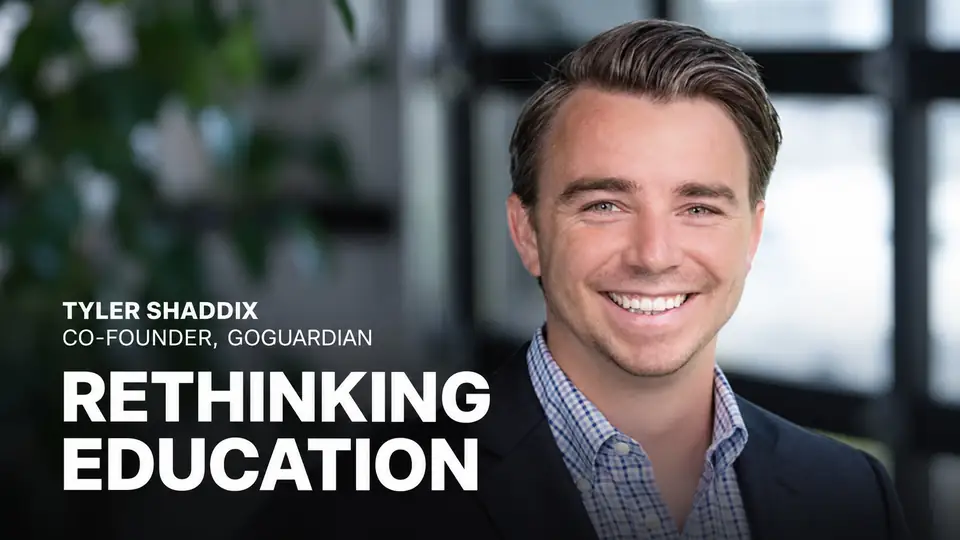
In this conversation, we talk with Tyler Shaddix the CPO of GoGuardian. They provide thousands of K-12 schools with the technology they need to create safe and effective digital learning environments.
We talk about how Tyler ended up at GoGuardian, the incentives in the K-12 system, digital learning technology, and how we can use data to create experiences that meet the needs of every student.
“Education is one of the best ways to change the world because you’re basically sculpting the next generation” - Tyler Shaddix
Links
- GoGuardian
- Tyler at GoGuardian
- Tyler on LinkedIn
- GoGuardian Beacon
- UC Merced
- American Foundation for Suicide Prevention
- American Association of Suicidology
- Tyler Shaddix
- Go Guardian products: classroom management tool, suicide prevention, and learning filter
- Build Bridges Before Kingdoms
- Elon Musk - Plan to colonize Mars
- Minimum Viable Product - MVP
- A Young Lady's Illustrated Primer
Chapters
Times follow the podcast audio. The video’s timeline may be slightly different.
- 00:00Welcome to Build the Future
- 02:12Introducing Tyler Shaddix and GoGuardian
- 03:01How Tyler joined GoGuardian
- 06:57Making the internet useful in classrooms
- 10:38School incentives and the risks of change
- 14:11Build the bridge before the kingdom
- 20:23The origins of GoGuardian Beacon
- 25:14Privacy, alerts and counselors’ time
- 27:34Supporting students and funding counselors
- 30:00When funding metrics miss progress
- 32:11Using data to improve learning
- 34:17What personalized learning could become
- 40:29Advice to Tyler’s younger self
- 41:50Where to find Tyler and GoGuardian
Read the conversation
Open the full transcript
CAMERON WIESE: Welcome to the Build the Future podcast. My name is Cameron Wiese and I'm your host. Before we kick off today's conversation, I want to tell you a little bit about this show and what you can expect. Over the last few years, I have always come back to the ideas and the sentiment that drove American culture in the 1960s with the Space Race. A culture of possibility and a pursuit of a mission much greater than ourselves. A mission to do things and to quote JFK, not because they are easy, but because they are hard. I've always asked myself, why have we stopped dreaming about this future? Why have we stopped pursuing the world of tomorrow? Well, I've decided to stop asking and instead start building. To start building a future where we're all dreaming about the possibilities of tomorrow and doing something about it. See, if we want to overcome the challenges that are facing our world today, challenges around healthcare, climate, education, technology, and culture, we must build. To drive forward innovation of frontier technologies like nuclear energy, artificial intelligence,
CAMERON WIESE: space exploration, and everything else that comes to mind when you think of tomorrow, we must build. And when I say we, I mean you, and me, and all of our friends. Whatever the issue or opportunity, we must refuse to sit idly by while some version of the future inevitably arrives. We must step up. We must challenge the status quo. And we must build the future that we want to live in. That's what Build the Future is all about. It's a place for optimism and a world of negativity. A place that stands up for the future we want to live in. We're starting with this podcast where we explore compelling visions for what the future might look like. Visions that inspire you, that instill a sense of wonder, that get you thinking about the possibilities of tomorrow. So with that, I want to welcome you, not only to the show, but to the future and to the possibilities that lie ahead. Today, one of the possibilities we're talking about is the future of education. We're talking with Tyler Shaddix, who is the chief product officer of GoGuardian.
CAMERON WIESE: GoGuardian is one of the fastest growing education companies in the US, providing thousands of K-12 schools with the technology they need to create safe and effective digital learning environments. In this conversation, you can look forward to hearing about how Tyler serendipitously ended up at GoGuardian and how he thinks about building the future of education. We also talk about how an experimental product they've launched called Beacon is helping prevent suicides and how technology is reshaping the classroom learning experience and battling the incentive structure of our schools across the country. Overall, I love this conversation with Tyler and the ideas it sparked about the future of education. So with that, thank you for joining us and let's jump right in.
CAMERON WIESE: But how did you end up at GoGuardian? Tell me that story.
TYLER SHADDIX: Yeah, it's a long story, but I can shorten the beginning parts. So my whole family's educators, My mom's a teacher currently. My grandparents were both educators. Many of my family members outside of that more direct scope are also educators. And something my parents always told me growing up was education is one of the best ways to change the world because you're basically sculpting the next generation. If you want to go and solve the world's biggest problems, you teach the next generation all the things they need to solve those problems and then they'll solve it. And you can feel like you really contributed to the world. But honestly, they always told me, that said, don't be a teacher because we don't get treated well. So growing up, did a lot of different things, was interested in a lot of careers. I started wanting to be a director for a while. I always thought like if you made movies, you could make people feel a certain way and then maybe change their opinion. And that got me into tech. And eventually I landed an internship as a software engineer my junior year of high school
TYLER SHADDIX: and fell in love with just what you can do with a computer. Like I had never experienced the feeling of having all you need being a computer and an idea and the rest of it was just Time in your own brain and you could change the world Right like that that's all that it really takes within the tech industry So I got really into that and my parents were like, yeah, you should totally pursue that you want to change the world like Doing it through tech is the future and they they were super right about that So I was growing up in this small rural mountain town called Mariposa, California It's right next to Yosemite Valley. I think total of 300 students in the high school, I think my graduating class was like 70 or 80. It's very small. And so there was no tech around there or anything like that. And just that one software company had gotten internships. So I ended up moving to Merced, which is another small city in the Central Valley, and went to UC Merced for computer science and engineering. There had a great time.
SPEAKER UNCLEAR: Merced was a great college. I absolutely loved it.
TYLER SHADDIX: People complained because it's small, but the opportunities there are just insane. So as Atmer said, and I started a few companies as you know, college students do, you start like five or six. And one of those companies was called Oocharts, O-O charts. And what Oocharts did is it basically allowed front end developers to embed a script on their website and display their Google Analytics data like in real time publicly. So if you wanted to have like a chart of like, here's all the visitors who have been on this site today, you can just copy and paste a script and it would do all that for you. And it started taking off around the end of college. Like Beats by Dre was using it, Toyota was using it, a bunch of like governments were using it. And I still don't know what they were using it for. I knew they were using it, but I didn't know like how they were applying it. So I still wonder like, where was it in like the Beats like website, either internal tools or external tools
SPEAKER UNCLEAR: where they were using it. So, so interesting.
TYLER SHADDIX: But anyway, one of the users was this little one two-person company called GoGuardian with this crazy energetic founder called Aiza Steele and his good friend, Advait Shinde, and his other friend, Nick Tyler. And so Aiza Steele reached out to me after I had graduated college and said, hey, you should come work for us. We're trying to change the way the internet's used in education. And I said, no way. Your name sounds like a spam name. Like Aiza Steele is not a real name. And secondly, I have a life here and I'm doing this thing. But over the course of about six months, and this was in 2014, they kind of wore me down. And I went and visited them down in Los Angeles, which is where they were located. And they started telling me about kind of their vision and why they were doing what
SPEAKER UNCLEAR: they were doing. And that just lured me in.
CAMERON WIESE: So I joined GoGuardian as a software engineer in December of 2014. Wow. Incredible how those events just naturally line up, right? Absolutely. Developing something and then someone's using it and they're like, Oh, hey, actually, come to us. And then it lines up perfectly with your ambitions for education. I'm curious, what was it about their courting process for you that sold it?
TYLER SHADDIX: Yeah, they just, they were looking at the world in such an objective and I had the best way to describe it is like just a true way. Like so much of it resonated with me. And essentially this was the, this was the original premise of GoGuardian before we even challenged ourselves to think bigger. It was kids suddenly have access to one of the most powerful and robust sets of tools to access human knowledge ever created, which is the internet. We've talked about before, one of the reasons that you're doing your work is to tell people stories that can change people's lives. Here's this tool where millions of people's stories and lives are being told every day. They said kids have access to this, but schools don't have the right tools to feel confident and using it in their classrooms, right? Like it's just as easy to look at harmful material or distracting material as it is to look at great material. And so as an educator, why would I allow my students to access the internet when so much harm can come of it? So our vision at the time, and it still is our vision,
TYLER SHADDIX: it's just gotten much larger, is how do we make the internet as safe as possible but as open as necessary? How do we like help schools actually feel confident adopting the internet as a real learning tool and use it in everyday life. And quite honestly, I think we've delivered on that mission at this point. I think Chromebooks and Windows devices and Apple devices, it's some absurd amount of penetration. It's in the tens of millions across the US. Many schools are one-to-one at this point, and GoGuardian itself is serving around 8 million students. So the internet and digital devices in the classroom from 2014 to now have completely changed in terms of they are totally present and schools are more and more confident every day to inject them into everyday teaching.
CAMERON WIESE: Which is so incredible. I mean, I remember in high school, that we were still using the overhead projectors. This was like 2010, like 2012. It was overhead projectors. It was a fear of technology. It was, we don't want these machines distracting our students. And I remember being a tech savvy kid. I'm like, but the internet can give us so much. There's so much good information out there. There's all these tools at our disposal, but the schools are very apprehensive to open the floodgates.
TYLER SHADDIX: Yeah, and to your point, yeah, I remember when I was leaving high school, smart boards were like the big next thing, which has changed pretty drastically since these devices were interested. And to your point, if you just gave kids computers in a classroom, and there's a bunch of other things involved with this, like costs of a computer per student and things like that. But outside of that, it creates this crazy information asymmetry between the educator and the student. Like if you go from a classroom where you can see that everyone is working on what they should be, or at least they look like they're working on what they should be, you can walk around, you know what everyone's doing to a world where everyone's behind a screen and they're all faced the opposite direction from you. The asymmetry, you know, the information asymmetry just gets insanely crazy. And so I totally understand where these educators are coming from, where it's like, I have no, I'm going from a world where I know for a fact my students are learning to like really I I don't I don't know for sure
CAMERON WIESE: Yeah, I mean, I think we all in our youth were guilty of that sort of thing, right? I mean teachers talking about Some boring lesson of history and it's like oh no, I'm gonna I'm gonna play like Donkey Kong exactly
SPEAKER UNCLEAR: Tetris emulator or whatever What are some of the challenges been in that rollout?
SPEAKER UNCLEAR: Yeah, that's an important question
TYLER SHADDIX: because the challenges that we've gone through, I think highlight a lot of the things that get in the way of some of these idealistic movements. Like it's easy to say that you want the world to work a certain way when you haven't been part of it. Like I've never been a teacher or an IT administrator. And so it's easy from the outside to say, like, I think it should work this way. But once you get in the weeds with your users, you start realizing all the challenges they run into. So one of the big challenges that we ran into is, so just for some context, our current products, we build a internet filter for schools that makes it safe for all of their devices to get on the internet and access educational stuff. And then we, one of our other key tools is a classroom management tool that allows teachers to see what the students are doing when they're in their classroom in real time, interact with them, control their devices. And a final key product is our suicide prevention product. It looks for behavior that may indicate that a student is considering harming themselves
TYLER SHADDIX: and notifies the counselor and make sure that student gets help. But anyway, one of the key things, especially with our filter, is when we were like, look, nobody's built a filter that's for learning. All the filters have been built from a corporate world where you're like, no social media, know anything and then kind of retrofitted to education where they put like it's also a K-12 filter. But has anybody actually built like a learning filter? And when you start from that kind of idea of like what is a filter for learning you come up with some really interesting ideas. Like let's never assume that an entire website is bad or good. That's like one of GoGuardian's core tenets. It's about the experience that you have within a website, the content that you interact with that makes it bad or good. Not all of reddit is bad. There's a lot of reddit that is the most amazing place ever And so you need to look at it that way and so we started building a lot of this AI that can kind of recognize the difference in this material and
TYLER SHADDIX: Actually in real time decide whether content can be filtered or not. Sounds great, right? The problem is is that our rollout of this this functionality hasn't been as quick as we may like because the incentive structures of schools are very risk averse. They get so little from, you know, recognition when it comes to like really opening the internet for their students or like taking these big leaps and risks, but if one student gets into one bad situation, the community, the media, etc., will just pounce on them. And so what I didn't realize, it's not, these schools aren't full of people who just don't want to take risks. That's not how it is at all. These people love their kids, they want to take risks, but the things at stake in terms of the school's reputation really de-incentivizes them from taking these risks. So part of our goal at GoGuardians has shifted a bit and we actually built an entire team called Impact Research for this where part of our goal is to actually prove that the decisions that teachers are
TYLER SHADDIX: making to take risks and allow the kids to be a little more exploratory, do things a little bit more creatively, actually benefit the student in the long run. And so we're trying to help our schools use data to prove that it's okay to take those risks and that it's worth the risks that come with these decisions.
SPEAKER UNCLEAR: Does that make sense?
SPEAKER UNCLEAR: Yeah.
CAMERON WIESE: You have to shift the culture too of how educators are thinking about their relationship with
SPEAKER UNCLEAR: technology.
SPEAKER UNCLEAR: Yeah.
CAMERON WIESE: Let's go into the vision component of that. You have this base layer. You have to slowly start to work to shift the incentive structures and to weave that with your kingdom versus bridges thing, which I'll have you kind of jump in on in a second. You have these different components that have to serve as the intermediate steps. You can't just go in and say, hey, K through 12 infrastructure. This is how things are done now because, yeah, the incentives aren't in place. So you kind of have to work your way in. So I want to talk about how Beacon has kind of done that. But first, would you mind telling me the story of how you came across that kingdoms versus bridges analogy? Yeah, sure.
TYLER SHADDIX: Absolutely. The story kind of starts. We were, this company reached out to us and I'm not going to name names, but this company reached out to us and they said, Hey, you know, we'd really like to talk about maybe, you know, folding under the GoGuardian umbrella. And this was like three or four years ago. I'm not, it was a bit ago. And so we met up in Manhattan beach and we had dinner with them and they, they told us all about their product. They even brought a computer and showed the demo and it was a really cool product. Like So many cool creative things you could do with their tool. And it was basically a teaching tool, like interactive lesson tool for the future. Like it was truly built on all the most modern technologies on the web. And yeah, so we were just blown away by how thoughtful they were and how good a job they did. But then of course, when we asked some of the critical questions like how many people are using it, how long have you been doing this? Turns out they had been doing it for, you know, a few years.
TYLER SHADDIX: and they only had like 10 schools that had been willing to stay on board. And it obviously wasn't because the product wasn't polished enough or anything like that. It was something more. And so I asked them like, why doesn't this work? Like why aren't people buying it? One of the guys said, and it's like stuck with me ever since just because of how regretful he was, but he said, we built a kingdom on an island, but we never built a bridge. with the idea being that they had spent so much time, because this was their first company out of college, thinking about what the future of education should be. And they had built in a beautiful, amazing thing. But the problem was, is their vision of the future of education was so many years ahead of where education was currently, that it didn't resonate with the current needs of their customers. And so at the end of the day, what he had really hoped is they had just built the first step of their bridge, and just reminded themselves, as they were building their company up, what their ultimate vision was, rather than building that first.
CAMERON WIESE: That's the challenge for everyone who is trying to build something impactful. I mean, Elon Musk can't, I mean, can just start with rockets to Mars, right? I mean, he still isn't doing that, but it's these incremental steps to get us there.
SPEAKER UNCLEAR: A hundred percent.
TYLER SHADDIX: And I think something that people have been confused by, sometimes when I've talked to him about this is, I'm not talking about an MVP, right? An MVP is you de-scoping features to try to get something out of the door. What I'm talking about is the first iteration of your actual company. And so it's actually scaling back your first product lines, your first years of work. I'm not saying your first month build something modest. I'm saying spend the first years of your company building something that solves current users' problems and then incrementally add value as the years go on. And to your point, Elon Musk didn't build Tesla in one year. It's been a very long process. Amazon, Uber, all of those companies, if you look at their origin stories, it was not like a have an idea and the company that you have on your smartphone today is the same company. And so yeah, that's a key thing to call out is we're not talking about MVPs. We're talking about a true pulling back a bit in solving a current customer need for years.
CAMERON WIESE: Yeah. We're so obsessed with the short-term fixes. It's like, hey, I want to go build the SaaS app and then I want to sell it for $15 million and like build, sell, build, sell, like immediate gratification. And when you look at all the successful companies and people who do end up changing their part of the world, it's a 10, 15, 20 year long journey. We look at, when I look, first person, when I look at people who are, who have been successful or have done something that I think is very powerful and changing the world, looking like, oh, we've been doing that for 25 years. And it's so easy to skip ahead. You're like, oh, I want to be like that person. It's like, yeah, but there's this timeline that you have to think about. So for, I think that's, I really love that lesson for anyone who is thinking long-term. It's like, build the first step, right?
TYLER SHADDIX: Yeah, it's it's you have to figure out a way to add value to your users lives today before you can even hope to You know if your goal is to have that exit and you know have that outcome You have to remember that the reason that you're receiving that outcome is because of the amount of value you've given first to your users into The world so focusing on delivering that value to users upfront and just trusting that the rest of it will come is is probably one of the things that has kept me the sanest in some of these longer term
CAMERON WIESE: flows. With that, there's also a certain change that only happens once you've built the underlying system. So to the point of the company that you were talking to who gave you this anecdote is, yeah, they were building for the 10-year out vision and all of that is great and would be ideal, but it requires an ecosystem to get there. There's the cultural change that has to take place, the mindset change has to take place, the supporting processes that help get a school from just starting to use technology to then be able to leverage it in new and new and creative ways.
TYLER SHADDIX: Absolutely. Yeah, you're shifting much more than the technical infrastructure in your product,
SPEAKER UNCLEAR: to your point.
CAMERON WIESE: Yeah. So obviously you guys are building lots of different bridges and one of which I would say would be the beacon, beacon product, this suicide prevention. Can you tell me a little bit about how that project came about and how it's how it's been gone?
TYLER SHADDIX: Sure. Absolutely. Yeah. So I'll do the origin story first. So as I mentioned, kind of one of our core tenants is like understand the content, understand the experience, and then make decisions about what's healthy for a student. Don't just assume that a website is bad or good. And so when we were first starting off on this, we were building some machine learning that was going to detect like high level, high level categories of content for websites, such as like, was it explicit material? Was it education, natural, etc. And so we were running these tests with this, this machine learning with schools. And one of the schools approached us and said, Hey, we've had three suicides in the last like couple months. I can't help but wonder, where, you know, is there a way that this technology you're using that's like in real time deciding like what we're trying to figure out what a student's doing? Is there a way that you could you could train a machine learning model to detect that, you know, that intent
TYLER SHADDIX: based on their behavior? And so we went back and we heard from a few other customers after we talked to some of them about this that they also had the need. And so we went back and we started kind of working on something and we came up with a very loose, very rough, just like alerting thing where if there was something that was very obvious, it would alert. And so we released that out to a bunch of beta customers. I think we only had like 900 schools on it. And just those 900 schools were generating something like 10,000, you know, highly concerning alerts every month, which was just insane. And so we saw that and we were just blown away. And to be honest, suicide prevention was not one of our core things we were thinking about at the time. Like we of course wanted to make sure the student was safe, but we didn't realize it was that large a problem, especially through online behavior. And so we partnered with the American Foundation for Suicide Prevention and the American Association of Suicidology and a bunch of our schools. And we said, let's actually build something together
TYLER SHADDIX: with experts, because we are technologists. We are not suicide prevention experts. That actually is built to help these students and built specifically to solve this problem. And so we worked on that for two years. We collected a bunch of data with our schools on what they wanted to see and what the experts deemed as reasonable and we built an entire product that was about student safety and student privacy because obviously one of the things that you have to think about so much is who sees which information about the student during these times. So we built a lot of that functionality and we released GoGuardian Beacon which is like the you know the first tool for like suicide prevention based on browsing on a school Chromebook or on a school device. And I think one of the kind of interesting things that came out of that entire experience was just how much we learned about the modern students avenues for expression. You know, when you and I went to school, schools had basically deployed these programs called
TYLER SHADDIX: See Something, Say Something programs, where it's basically reliant on students telling other students information or a teacher saying something and escalating it. It was all based on interactions in person, which makes sense. that was the way that we expressed ourselves. But now that students have access to the internet so readily, more and more of the students suffering and the expression of their unhappiness was happening through anonymous chat rooms and through like Google searches. And it turns out that like more and more of these indicators that we used to rely on were becoming hidden because students no longer were needing to express themselves to people in person. They were now doing it online. And so I think that was one of the most surprising thing we learned about this was like, it's It's not like we're just solving a very small problem for just a few students. This has actually become a very large norm for the next generation in terms of how they express themselves, which is through kind of how they act online.
CAMERON WIESE: It's really scary that a lot of kids don't have the resources or support to go get the help they need. And there's so much pressure that's put on kids. and all the social media and the academic expectations. It's very interesting that you guys were able to adapt the technology you had to solve a problem that didn't exist. Wasn't nearly as severe five years ago.
SPEAKER UNCLEAR: Sure. Absolutely.
CAMERON WIESE: Actually, I want to... Do you think that's fair to say? Do you think the change in the rise of technology being everywhere has contributed to this, sort of like the mental health crisis that we're seeing in schools?
TYLER SHADDIX: Yeah, I mean, I don't claim I'm an expert, but I will say that a majority of the people that I've talked to believe that's the case. And so if I was just to echo the majority of the experts I've talked to, yes, absolutely.
SPEAKER UNCLEAR: So how's it been working for you guys? So in terms of the product itself, it's been going well.
TYLER SHADDIX: I think something that we constantly have to think about, this is one of those ethical, like I think one of the core things to kind of bring up here is, When you start solving these extremely important, but like emotional high-stakes issues, there are going to be ethical dilemmas every single minute of every single day. And that was something that we as a company had to adapt to in terms of like how we handle ethical dilemma. But I think one of the key things that we recognize is when we were building out the first version of the product, we asked the question like, what do you want to be notified on? Do you want to be notified when someone's just reading a book about suicide or do you only want to be notified when someone's actively planning? Of course, what do we all say when someone asks us a question like that? We say we want to be notified whenever there's any sort of issue because that's what we want to do. That's how we built our model. It's extremely sensitive. Even the slightest change in tone on a Google Doc can trigger it if it's detecting depression.
TYLER SHADDIX: And but what we found is that in the real world setting the same customers who had asked us to make it this highly sensitive Thing they get overwhelmed. There's too many alerts. It turns out that we're constantly especially as when we become like more hormonal, you know as teenagers Testing kind of the waters of what we're happy about what we're sad about how we're talking about it and so they were just getting flooded with thousands and thousands of alerts and And what ended up being this really weird ethical dilemma is how many things do we miss to make sure that the most important ones are seen? How many things do we say, you know what? It's just not severe enough for us to escalate because our customers need the time back to actually look through the high ones. And as an ethical dilemma, that was very scary. And we think we've got into a place that's fair to both situations where we're really servicing any concerning incidents and making sure our users have the time it requires. But that's something that I think was a major challenge rolling it out, was just figuring
TYLER SHADDIX: out like what is the true limitations of our time and of a school's bandwidth.
SPEAKER UNCLEAR: Oh my, yeah.
CAMERON WIESE: I can imagine that easily overwhelming even the most organized school administrator. So what, I mean, is there another opportunity to provide resources to those kids instead of alerting the teachers or their parents. Because I mean, if you empathize with the student, right, if you're struggling with anything that's severe, the last thing you want is like parents or like a counselor come in and be like, oh, hey, let's sit down and talk about your feelings, right? Because like there's a disconnect between the student culture and like the administrative
SPEAKER UNCLEAR: culture.
TYLER SHADDIX: Yeah, that's a great question. That's honestly the question that we're looking at right now, is like, what are the additional avenues? And so the way that we want Beacon to be used right now is alerting counselors, because they're the only ones trained to handle it. Parents can be notified, but it's very general, because you never know if the reason that the student is looking for this information is due to parent relationships. But to your point, that's not always the best avenue. And so we are exploring other options. I can't say that we found something that's looking super promising. But the one thing that we do do is whenever we do detect that a student's in that compromised state, we do send them a message within their browser that reminds them that their school is there for them. Here's a number you can call. Here's a number you can text if you'd like to talk to someone. And just reminding them that there's someone there who cares about them and that they have avenues to have a discussion. But kind of also to your point, schools don't have enough counselors.
TYLER SHADDIX: They just don't have the funding for enough counselors. So one of the things we're also trying to do is we're building out the data tooling for schools to be able to prove to their states that they need more funding for counselors. Because if you can go to a state, because right now, you know, that sort of stuff, they look at it from like number of attempts or the number of office visits, which is a very bad metric to look at because the number of students suffering is actually much larger than the number of people who go into the office or attempt. And so what we're trying to do is actually put some loose metrics around What is the actual number of students who are in kind of a suffering state that require? You know some additional attention and we're hoping that schools can use that to go to their state and and ask for you know More resources and more funding. Yeah
CAMERON WIESE: That's another you know component of the incentive layer. It's because the schools can't operate independently, right? They require on one level up for funding or the school district requires one level up for funding. Then how do you make sure that that incentive structure is aligned too? It's not just the schools, but it's the schools to the students, schools to the state. What are some of the challenges you guys have seen in addition to schools not having counselors or not having the funding for counselors? Is there anything else that surprised you about the incentive structure between the schools and their higher ups?
TYLER SHADDIX: Yeah, I mean, like I said, it's all, you know, once you get to a certain level of abstraction, when it comes to a school's relation with like their funding source, it becomes all about some really basic data points, which are kind of like your attendance rates, your testing scores. And maybe in some cases, some states have done this cool thing where they kind of allow schools to define more of their own success metrics. But in a large number of cases, it's really just based on kind of those sort of things. And so I think something that's really interesting is these things are evaluated on a cadence. All of the work that teachers are doing and administrators are doing to be creative and do amazing things for their students, those, unless they show promise within the cadence of that report, it may not look like they're working and they may not get additional funds. Like you may be doing something that's gonna take some time to mature, but if you're not getting the support from your administration and the true belief that it's working, if you truly just resort
TYLER SHADDIX: to those basic numbers, you may see programs cut way prematurely simply because you aren't able to prove it in the cadence of whatever the report is. And that's something I think has been really interesting is just seeing people, you really start empathizing and sympathizing with these educators who are truly trying to do whatever they can. They're, in most cases, severely underpaid. They've dedicated their entire life to helping other humans change the world. and every time they try to get creative or do something a little bit outside of the box, they have to worry about the risks of being, you know, yell that, they have to worry about it looking like it's not working within a certain time period. It's a truly tough spot for them to be in. And I think that's been something that's really been eye-opening for me is just how many caring educators there are that aren't able to fully express what they wanna do simply because of the limitations and the structures above them.
CAMERON WIESE: I get the sense that's kind of where GoGuardian is heading though, is how do you provide those educators with the data and the resources to take that long-term view and to convince their higher-ups and then the higher-ups, higher-ups that there's a different way of doing things and that it works.
SPEAKER UNCLEAR: Absolutely.
TYLER SHADDIX: What we're trying to do at GoGuardian now, because it's become much bigger than just about keeping kids safe on the internet and making sure that schools are confident to deploy it is one of the most beautiful things about having a digital education where part of it is happening digitally is you leave all these amazing breadcrumbs for schools in terms of the data that shows how how much you're enjoying a lesson, where you're getting stuck, where things are going super well, which part of a teacher's lesson you really resonated with, like all of these things are starting to be captured through all these different digital tools for schools to utilize. And so I think this provides this amazing opportunity for schools to start referencing metrics that are a little bit more real-time and a little bit more descriptive than just a high level this is how many people attended my class. You can say like look I tried this program and I'm seeing students with 30% higher energy levels. You know after the day after that we do
TYLER SHADDIX: maybe our our weekly thought circle and you know I can't help but think that that's like driving some of that. And so suddenly you're arming these teachers and these educators and these school admins with data that says, no, really it's working. Here are the real time results. And when we tweak these variables, this is what happens. And it kind of creates this really interesting parallel to kind of our universe working in tech, where it's something we do all the time. We tweak variables, we run little tests and we see if it's working. And if it's not, we pull it and nobody's, nobody's the wiser. It never hurt anybody. And you could test it really quick and just make sure that it was actually something that was helping. And now schools suddenly have the same capability. And that's a really exciting possibility. And I think you're going to see more and more schools starting to hire data-oriented people who can support all these teachers and educators with running their experiments and proving that they're working or not working. That's an exciting place to be.
CAMERON WIESE: What are some of the other implications of that access to data in a positive way?
SPEAKER UNCLEAR: Cool.
TYLER SHADDIX: I was going to say there's plenty of negatives, which I can go and do also, but in a positive way. I think one of the the most amazing things is that you can start Personalizing like truly personalizing the full educational experience of a student right like most of the personalized educational apps nowadays They happen in a walled garden context They're like we're gonna show you eight questions and if you get one wrong We're gonna make the next six questions slightly easier like that's what personalized is But when you actually have all these attributes that show things like how a student's doing in terms of their leadership capabilities and how engaged they are in different parts of a teacher's lessons or what YouTube videos like they truly seem to really enjoy that sort of data with that fidelity allows all of these different content providers and these educators to truly craft personalized experiences for their students. That said that's a dream world most teachers don't even have time to grade all the papers
TYLER SHADDIX: that may have been turned in simply because they're so strapped for time and they end up doing it at night because they don't have the time to do it. So So there's a lot of other hurdles you have to get over. Like, you can't just say, like, now that you have the data, you can personalize every student's experience, because the main limiter is being able to personalize those experiences because they take time. So another side of this equation is going to be, how do content providers actually kind of help with that personalization based on all this diverse data that schools are starting to use to personalize student experiences? And how do you deliver that to educators in a digestible and quick enough way that allows them to still spend the majority of their time coaching and teaching without having to become like hyper data analysts and spending hours and hours just diving through data.
CAMERON WIESE: We kind of want everyone to focus on, on their area of expertise, right?
CAMERON WIESE: So for the, how do you envision that, that content kind of coming, coming about?
TYLER SHADDIX: I, and I think that's the big open experimental question right now. And I'm, I'm excited to see how many people are actually taking this on. Like GoGuardian is not the only one. And there's plenty of other companies. But the way we're approaching it at GoGuardian is we're working with a bunch of our schools and working with them to use their data to actually identify which learning experiences on the internet seem to actually have produced the most engaged and highest outcomes for different students. With the idea being that Google is really good at giving you the top search results in general for maybe a number of clicks. But something that Google or a bunch of other people who are curating content aren't taking into account is what is the actual desired outcome from the teacher to the student? Like what is the teacher hoping the student gets out of this experience? And how do you actually craft experiences for this student based on their age, their reading level, how they liked that lesson a few days ago, and also what the teacher's
TYLER SHADDIX: goals are for them, and how do you actually build dynamic internet experiences based on that information? So our goal is to kind of craft the curated internet personalized experience where we you can kind of be the student's coach based on what the teacher's learning goals are for the day or for the year.
CAMERON WIESE: That is, that is exciting. Yeah, we like to think so. My voice does not have the undertone of like, that's going to be incredible. Like imagine the like leverage that you'll be able to have when you can help get students So where you actually want them to go rather than losing them because they're not engaged with the way the teacher is presenting certain material or There are all these other other issues, right? Absolutely Do you think the is the content itself the bottleneck the content itself?
SPEAKER UNCLEAR: I you know
TYLER SHADDIX: I'm I'm not sure if if I'd claim one thing is the bottleneck or not I'd say the experience itself is the bottle And the experience is composed of so many different parts to your point content being a large part of it We're at this point our main goal like especially with our data science and research team is trying to parse out all of the different Parts of an experience that you can measure right so like part of it is course What is the content like what is the reading level? What are they actually talking about? You know, what are the colors on the page? Those are all like the con those are like facts about the content, but there's so much more in the experience Which is like what's the student energy level? There's research being done right now. One of the, some of the other stuff we do is we partner with universities to kind of work with them on the research they're doing, where you can guess how tired someone is based on how fast you're pushing down a key on your keyboard. And that information, of course, to somebody who's trying to produce experiences that actually
TYLER SHADDIX: engages students is really exciting because you can kind of tell what someone's energy level is before they enter, you know, an assessment and know like how tough or how challenging you should make it, how much more likely they are to be frustrated. So there's all these other variables in terms of the experience where content is a big part But these there's all these other ones that we're trying to measure and see what they mean
CAMERON WIESE: Yeah, it's in a way you just you can have to get a breakdown of the entire system, right? Okay, what are the what are all the subsystems and like the sub subsystems here? So that way you can pair metrics and then Kind of optimize them. So eventually they all work very seamlessly together. Yes
TYLER SHADDIX: and I think there's this even more exciting world where it's like the The content right now is you can consider it in a box that's delivered to you. You go on a website and you go to a webpage and that is a box that's being delivered to you with knowledge. But at the end of the day, what it's actually delivering you is facts and information presented. That's it. And so the future, future, future world is one where you can actually figure out the way that that content is presented and the facts that were presented in it and actually change that actual presentation within the box to fit the student's needs. So it's not just like curating the specific content, delivering the box. You're actually reorganizing, pulling things in, adding things in to the box itself before you deliver it to the student to make sure it's what's best for them. And so that's that really exciting possibility where you start asking the question, what is content? You know, it's just like it's a curation of information and it's presentation.
TYLER SHADDIX: And if you have enough information about all the other peripheral things that are going on, you can produce true personalized content. And that would be like the ultimate ultimate goal.
CAMERON WIESE: Dare I ask a follow-up on that? Man. Well, hey, we're coming up on time. What advice would you give to your younger self when you were trying to make the decision to go join GoGuardian or not?
TYLER SHADDIX: Oh, man. I don't know if I have it pre-packaged in like a really like quippy way, but I would say the thing that I was struggling with as a kid, especially growing up in a rural community was believing that I already was not special, that in order to be the kind of person who can go and change the world, you need to be, I don't know, born special, grow up in a special place. But me, just a kid in a 300 person high school who just likes to fiddle with technology, I did not feel special. I felt very like I'm not going to do very much with my life. I'll try, but I just don't have it. I don't have the special sauce. So the main advice that I would have told myself back then is like you have it. Everybody has it. The only thing to kind of that you really need to realize is there's nothing special or not special about each person. The only real thing is like your drive and your push to actually make it happen. And that's what's gonna change the world is that drive and that push. Not some weird genetic special trait or that special place you grew up. That's not that's not gonna be it.
TYLER SHADDIX: What's going to really be it is that drive. And I’d say that, that was the key thing that I could be here back then. Luckily, my parents continued to push that on me until I truly believed in myself.
CAMERON WIESE: Thanks again for joining us for this episode of the Build the Future podcast. If you want to learn more about GoGuardian, you can find them on the web at goguardian.com. If you want to learn more about Tyler, you can find him on Twitter at Tyler Shaddix. We've included additional links and articles discussed in the show notes. And if you're curious about the future of education and want to talk about it or any of the ideas we discussed in the show, you can sign up for our newsletter and participate in our weekly discussions at buildthefuturepodcast.com. Lastly, if you enjoyed this episode, we'd absolutely love it if you'd send it to just one friend to get them thinking about how they too can build the future. That's it from us. Until next time, go build.
More episodes
All episodes Indra Sofian — Rethinking High School at SoraIndra Sofian describes Sora’s project-based approach to meeting academic requirements while giving students more choice.
 Wes Wagner — Learning, Incentives and Outcomes-Based PaymentsWes Wagner explores education funding tied to outcomes, along with its practical trade-offs.
 Kelly Smith — Microschools, Mastery and Empowered LearnersKelly Smith describes his vision for small learning communities that build confidence, agency and the ability to learn.