

Build the Future Podcast
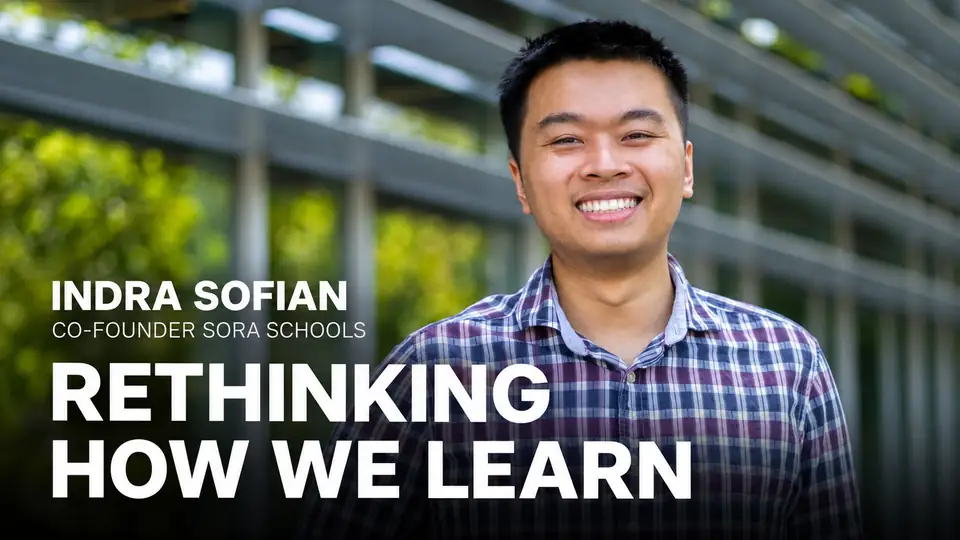
Indra Sofian — Rethinking High School at Sora
Indra Sofian describes Sora’s project-based approach to meeting academic requirements while giving students more choice.
September 15, 2020 · 37 min



About the episode
"We believe that every student should have a school and an education that's really designed for you, your learning style, your pace, your interests, and ultimately your goals and aspirations."
In this conversation, we talk with Indra Sofian, the co-founder of Sora Schools which is an online, project-based high school where students explore their interests and future careers.
We talk with Indra about the sham of standardized testing, the importance of project-based learning, and how we've opened Pandora's Box in education.
Links
Chapters
Times follow the podcast audio. The video’s timeline may be slightly different.
- 00:00Welcome and introducing Sora Schools
- 01:16A school designed around the student
- 05:16Why the traditional model persists
- 10:38Tests, incentives and Indra’s school experience
- 14:10How project-based learning works
- 20:42Teamwork and managing your own time
- 24:13Virtual schooling during the pandemic
- 28:27Growing without losing the purpose
- 29:46More choices in the future of education
Read the conversation
Open the full transcript
CAMERON WIESE: Welcome to the Build the Future podcast. My name is Cameron Wiese and I'm your host. I've always been fascinated by the ideas and sentiment that drove American culture in the 1960s with the space race. A culture of possibility with a mission to build things, and I quote JFK, not because they are easy, but because they are hard. It's this culture that seems to have been lost, and it's something that we want to bring back. With Build the Future, we're here to promote the ideas of those who not only see how the world can be better, but those who have plans to get there. It's our hope that these plans inspire you to think about the future you want to live in, and create plans to go build.
CAMERON WIESE: Today, we're talking with Indra Sofian, the co-founder of Sora Schools. Sora Schools is an online project-based high school, where students explore their interests and future careers. Through this work, they're helping provide an alternative education model that will help shape and build the future of both high schools and of learning across the globe. I'm excited to have Indra with us today to talk about the future of high school and of learning. Indra, welcome to the show.
SPEAKER UNCLEAR: Thank you for having me.
CAMERON WIESE: So I want to start with the basics. Can you tell me about the future you're building with Sora? What's the vision?
INDRA SOFIAN: Yeah. So the mission of Sora itself is ultimately a no compromises approach to building the best high school in the world. Everyone, I think, has a pretty vivid memory of what high school is like. And frankly speaking, it's pretty similar for most people across not just the United States, but across the world. Like you probably sat in a classroom in rows of desks with many of your peers listening to a teacher at a shock board, market board, white board, smart board, whatever. giving a lecture. And then you basically did that for eight hours a day for five days a week for many, many years. Every couple of months, you would take a test, you dump out everything you memorized in the lecture, then you forget everything and then you moved on. And that's pretty much the high school experience for many, many people. And like, there's the usual stuff.
INDRA SOFIAN: You have the lockers, the bell, the block period schedules, everything. So for us, like we see that as an extremely outdated approach to high school education. In our vision, like we want high school to be a place where learning is actually truly interesting and relevant to students. Like we want students to be truly fascinated by what they're learning and what they're doing and also learning things that will actually be useful and relevant and meaningful to them for the futures that they're building for themselves. Because for too many people, school is just more or less a factory of content that everyone sort of does in the exact same way, in the exact same schedule, in the exact same format for quite literally decades. And for us, like we want, like imagine a school, a high school where you're working on exciting projects that you care about because that's what you're interested in. You know, you could be coding video games you could be writing a fantasy novel on like a cool sort of fantastical mythical world you're building you could be doing conducting really interesting scientific research on like a specific substance you're interested in you could be going deep into the research of the history of jazz music and how it ties to modern music genres today like literally school could be exactly what you want to do. And for us, like, we think that's, that's ultimately something that we believe that every student should have, that a school and an education that's really
INDRA SOFIAN: designed for you, your learning style, your pace, your interests, and ultimately, your goals and aspirations. Because for us, we want school, the high school at Sora to be an environment where you're not just doing all these cool projects for fun, but you're exploring your interests, and you're learning about yourself personally and academically and ultimately professionally because for us, once students sort of do that exploration and sort of discover, oh, I'm super interested in engineering or law or music or fashion, like then we want to turn high school into a place where we help them build towards that goal, whether that's helping them get internships in certain areas or connecting them with industry mentors to help define that career path for them or like leveraging our connections to get them in front in certain programs that can help them achieve their goals. Also that when a student graduates from Sora, they can actually graduate and confidently say that they know what they want to do next. And they have spent that time exploring in high school what they wanted to do and that they're very intentional about the next step. They're actually ready to, you know, go to college or their first job or have a gap year, just really, you know, preparing students for that next step after graduation. And ultimately, I'd say like, education, you know, high school side, especially like, is an opportunity for people to really transform their lives by giving them access to new opportunities and knowledge.
INDRA SOFIAN: And frankly, for most people across the world, most schools don't do that. But we want to do
SPEAKER UNCLEAR: that at Sora. Beautiful. Yeah, no, most schools definitely do not support that sort of free flow and creativity to actually allow us to operate successfully. I want to dive a little bit deeper into the history before exploring what the structure of that might look like. How did we get to this point where our education systems no longer seem to serve us?
INDRA SOFIAN: Yeah, I think so the history of the education system, and of course, my answers will be generally US centric, just from my nature, my upbringing, and our initial research, But I would say generally is somewhat true, at least in the scope of several decades across other places in the U.S. But for most for most people, the sort of design of school, at least in sort of the modern cadence in which we recognize it, the format currently is, really started several decades, almost just actually just about around a century ago when the U.S. realized that illiteracy was rampant. frankly speaking most people across the country in the early 1900s or late 1800s couldn't read they knew their trades and that was about it and so the U.S. you know after the civil war and sending into the new century realized that it needed to really standardize education to sort of bring up literacy levels and so that people could actually start you know doing more than just what they've been taught by that local shop that they apprenticed at like they needed to actually learn more and aspire more. And ultimately, of course, they wanted to educate and upskill the population so the country itself could improve. So several rather old people basically came up with the system, which is more or less inspired by the Prussian system, which is basically a rote memorization, very didactic, very sort of authoritarian, you know, stage on the stage, you know, as any sort of school that you might imagine today, all those things tie back to
INDRA SOFIAN: that original system they created. Because at the time, it was a period of industrialization. We need people to be plugged into factories. We need people to do certain jobs within certain time periods and train people at a large scale, more so than the one-room schoolhouses that used to exist. They needed something that could do this and achieve their goals at scale. Because we were going into the first world wars, and there were a lot of demands on the economy to industrialize, to transfer from an agrarian economy to a more industrial economy. So we needed school to achieve that. And for a while, school did exactly that. Literacy levels increased. People learned exactly what they needed to learn at scale. And we achieved what the goal of that system was, which was create a scalable, measurable, standardized system of education.
CAMERON WIESE: But it seems we've almost come full circle where we moved from the agrarian to the industrial, And now we're moving from the industrial now to the information age or the knowledge age. I guess, can you paint the picture of how you're thinking about this next transition? So we had the system that was serving us in the industrial era, and we've kind of been stuck to it. And we have this new era that's going to require a different educational infrastructure.
INDRA SOFIAN: Yeah, I would say, really, of course, as anyone might expect, the internet really changed a lot for how we see education today, or at least started providing some, I guess, catalyst for change of how we think about education today. I would say like that primary difference that the internet caused, frankly speaking, was just the democratization of content and knowledge. Like before it was limited to geographies, like, oh, whatever your local town had in terms of resources for your school, your libraries, you know, what have you, whatever sort of industries you had there. If you lived in Detroit, everyone around you worked in maybe the auto industry, and everything was centric around that. You lived in the Bay Area, everything was microprocessors and hard tech at the time and so forth, pre-internet days. But moving into the information age, now content is everywhere, yet school itself is still based on memorizing content.
INDRA SOFIAN: like we still for example take tests take time-based tests which you know to most people seems like oh it's a demonstration and assessment of their knowledge why wouldn't we do that like how else do you determine knowledge or assess knowledge but think about just even this the time-based nature of tests it's like why do we need uh to know at least the speed at which you can memorize information and dump it out without access to a computer which most people have why do we need a time-based nature? Like what, what, what are we doing on a day-to-day basis that we, you know, I'm sitting on my computer thinking, huh, I really don't know for my job. I really don't know how Salesforce works. Oh no, I only have an hour to figure this out. And I've never, you know, studied this before. It's like, no, you can just go online and look it up. So like, there's all these relics of that age that still tie to this, at least, you know, given the system at the time, which was that like content wasn't widely available but now it is and also you know getting connected with certain with specific resources and people wasn't available for now it is so i guess yeah it's just a sort of proper propagation of like resources that otherwise
SPEAKER UNCLEAR: weren't available before yeah on the on standardized test piece i was i was reading you had this this moment where you were talking with your mom about the role of the sat and and how you realized that It was kind of a sham. Can you tell me that story?
INDRA SOFIAN: So my school that I went to back in middle school, we're talking like seventh grade or whatever. I think I was in seventh grade. Yeah, I think I was in seventh grade. And at the time, my school had us take the SAT just blind. Like we didn't prepare for anything. They just wanted to basically see how we would do. And also it's kind of like eventually we would, of course, take it again in high school and so forth to go to college and what have you. So they just had us take it blind just to kind of give us an understanding of like how we do. So we took the SAT. It was like a Saturday morning. It was very early as I would later learn that was a hallmark of all standardized tests that happened really early in the morning for some reason. So, you know, dew is fresh on the grass. It's crisp. I've got all my pencil, my wooden number two pencils ready. I walk in, you know, everyone's kind of hush. I have to write this really long paragraph in cursive for some reason on just, you know, I will not cheat that type of thing. And then I took the test, you know, four hours, what have you. And then once I took the test, I got back in the car. I was like, how, you know, how, how'd you do? And like, I was like, we'll find out. And I don't think I did that well. Then later I got the score and it was, I mean, I guess in hindsight for a seventh grader, it's actually not like that terrible by most standards. But at least for me, like it was well below the high score, you know, the highest the score you could get which at the time was 2400 on the SAT now it's 16 but i was still i was pretty devastated i was like oh no because i was at that time i was starting to clean up my act
INDRA SOFIAN: from elementary school i was a better student getting a's and all that i was very disruptive elementary school student because i was bored and restless but then i got better and i was shocked to see that i hadn't gotten such a low score i remember being very sad and like oh like you know you must be disappointed like i'm you know just because to me you know at the time grades tied to self-worth the usual and for my mom she was like look it doesn't matter like how well you do it on this test like that doesn't mean you're not smart you're smart but you just need to prepare better for the test and do well in the test this does not correlate to your intelligence you didn't use correlate but i use that to replace the to add to ad lib a little and for me it was just kind of you know a little sort of relaxing i was like oh cool like this didn't decide my fate like that's great. But then I was thinking, well, on the other hand, that's why that's cool. Why is this test, which is supposed to be an aptitude test or what have you, why does this not determine my intelligence or like my ability? Like what, like she just said, I just have to do well in the tests, but this doesn't determine how smart I am. Like what value does this test have? And for me, like I later learned, you know, going into high school, I started prepping for the, you know, stuff like that standardized tests more. And that's when I got into the whole like drone of like, prepping for tests, getting the honors and AP classes and things like that. When I realized that for me, like school just became sort of a game. Like it didn't really matter what I learned, like what happened in class. Like I just needed to memorize content, you know, make sure I remembered it all, you know, at least a couple of nights before and then dump it out on the test
INDRA SOFIAN: and then rinse and repeat basically for, you know, a few years. Yeah. It's funny because
CAMERON WIESE: I have a very similar sort of backstory there, but the incentive structure of the schools really forced you to work hard to just compile all of that knowledge. So you could perform on the test and like, yeah, test is done. Don't care about any of that anymore, right? It's just like out of the brain. I'm wondering if there's a similar sort of incentive structure that can be recreated now to get people to take that sort of very relentless focus and determination to learn things that are important to them and are actually going to stick with them and be useful. Can you talk about kind of the skills that you think students should be learning now and then how to set up that system to ensure that they're learning and enjoying it and actually be able to connect it to longer term outcomes versus the test on Friday?
INDRA SOFIAN: Yeah. So for us at SOAR, like what the curriculum and structure of the program looks like is that students at the very baseline, let's to be clear, like, because we're, because we're still sort of following a lot of high school academic requirements such that students can still go to university should, you know, we don't want to necessarily close off that option for the students that do want to go. Like, we still have, you know, at the baseline, students still have to learn the units of math, science, English history, and so forth. Like, they still learn the same things at Sora. Like, at least at baseline, of course, we have our own injected curriculum, like financial literacy skills, philosophy, and so forth. But like the baseline of all the academic units, they still learn. However, the part where it gets super interesting is the format. So in a normal situation, you go to school, you get sent in a class for about a semester or a year, whatever, depending on the institution you're at, and you learn the subjects, you take the tests, and then you have your grade at the end of the year. And that's pretty much determining, okay, I learned algebra one now, and I have a 85 or something. And so I'm okay at algebra, basically. So at Sora, we have our system at least using to use the exact words is technically an inquiry-based project-based model in the assessment itself as mastery-based so basically what that translates to is that students more or less have the autonomy within a structure and the given constraints to really choose what they want to do and how they fulfill those requirements so for us like we give them a few options so one they can start their own projects everything that i mentioned before right where students are you know like oh like i'm super interested in like architecture i
INDRA SOFIAN: want to like build like a mini house or like oh like i'm really interested in fashion or like i'm really interested in you know environmental conservation you know whatever it may be right like obviously interests vary diverge or diverge a lot person to person so for us like we love that because that for them like we want to help students achieve those goals and explore those interests so that's sort of like that may look like a student going oh i want to design a video game because i think that'd be cool. Then they work with our learning experts, which we call them learning experts. You can mentally think of them as teachers. They just don't lecture and teach in the classical sense. So they work with our learning experts to essentially create these projects.
INDRA SOFIAN: And they scope out the project plan, the timeline for the projects. Most projects, on average, tend to fall between two to three weeks. But of course, for larger projects, students can sort of break it up into those two to three weeks sprints, if you will, so that they're not just taking on a super large project from the get-go and then it's very paralyzing as you might imagine. So like students work on these projects and they say I want to build a very basic video game because maybe the student's just getting into coding or something like that. So they might work with learning experts and they might say okay cool so by the end of this two to three period you'll build this very basic platform scrolling Mario-esque video game to some extent and you'll do it in Python just because it's a very basic intro in CS language. So they might have the student take some basic courses to of course learn a language like python and then do a few practice projects baked into that particular project and then by the end of that two, three period they have you know the output is that initial goal which was design and build that very basic video game and of course in subsequent projects a student decides actually like i'm still super interested in like this whole video game design and programming thing i want to keep going then the projects of course get progressively more advanced but of course if a student does the project decide actually you know i thought i might be interested in video games but actually it's pretty boring like i don't i hate it then actually that's fine in our model then then after that initial two three period they work on another project they do something else that's really the sort of exploration piece that we allow for students is that you're not just locked into a project like oh like i'm gonna
INDRA SOFIAN: do video game design course for the whole year and then you do it and like six weeks in you're like this is awful i hate this so we allow students that flexibility to continue to go deep into those interest areas, but then we also allow them flexibility after an appropriate period of time to move on. And so, but I said there were a few options. So that's one option is that whole independent project piece that they can also even collaborate with other students on. But another thing we do to give students more optionality is that we also have our learning experts create what we call learning expeditions. These expeditions are also project-based sort of approaches to learning, usually some type of active learning experience where the session, like they'll have a couple sessions a week, sort of similar to a class structure, except they don't lecture. Of course, it's all active, whether it's a Socratic discussion or it's a lab or it's a sort of a game, you know, whatever it may be, it's very interactive and engaging. And most of these learning expeditions are based on some usually community level interests. So if a lot of students are like, actually, we're all super interested in like marine biology and conservationism or something like that or if a lot of students are generally interested in like you know math or something like a more general subject then the learning experts effectively just create these expeditions sort of in the similar timeline as the projects every few weeks and students can basically sign up for different expeditions like oh the life the life and death in math of socrates or oh like you know doing a marine biology where we have to sort of basically create your own sort
INDRA SOFIAN: marine biome like ecosystem i know i'm using obviously the wrong words because i'm not a marine biologist but that's to give you to give you an idea of what students may do and so in our model like we have we have students basically have a few different options as i said within sort of a constrained environment basically giving them autonomy within a structure and students we find that really thrive in that environment where they have this choice they have this ability to sort of choose their own path and sort of influence the direction of their education and learning and so forth, but all was sort of given the guardrails, so to speak.
CAMERON WIESE: Yes, the students really feel empowered to go explore and to learn the way that they want to learn. In all these projects and all these learning experiences, what are some of the skills that you think are important for students in this sort of learning mode to learn that are going to best serve them moving forward?
INDRA SOFIAN: Yep. So as far as skills they need to function in this environment and also skills that they, of course, develop by being in said environment. One course very important skill is project management. Students are quite literally, in the most true sense of the word, working on projects with each other. There's usually a project manager assigned in the group sessions and projects that students will work on. And generally, like, these students, of course, will have to learn how to function in a group and communicate effectively and all that, you know, given set of constraints. So that's an important skill that, you know, for many students, they don't develop that skill really early on. But for us, it's an emphasis, you know, we meet with the students and chat with them about how the group dynamics are going. And sort of, you know, obviously, as with many group projects, as I'm sure you're aware, a lot of them don't turn out well, in many cases, where like one person does all the work, and everyone else just sort of chilled and did nothing. So that's something we actively work on to build for students. But another thing as a function environment is that students actually develop pretty remarkable time management skills you know earlier on you know most people are used to a very rigid schedule right in high school where it's like you go from block period one at nine to ten to eleven to twelve and then you have lunch and then one and two and so forth the usual but for us like our schedule at Sora is not that is not structured like that it's more similar to college in a lot of ways where you know students may have the initial sort of accountability checkpoints in the morning and the afternoon and then of course they have say for example learning expeditions they signed up you
INDRA SOFIAN: know ones at tuesdays and thursdays from 10 30 to 11 15 or something like that and then uh 2 p.m to 3 p.m or you know whatever or they have like a group project meeting that day or whatever but like there's gaps and breaks between those schedules so for us it's about building that sort of time those time management skills and to some extent that feeling of sort of independence and being able to sort of manage your own schedule and like you're learning and keeping track of things that, you know, will generally serve students well, not just in life, but in other environments they might go into like university, you know, where it's a pretty well-documented phenomenon where the high school student, they graduate from high school. It's great. They go up to college and they bomb the first semester because they have no idea what to do with a more free schedule. Yeah. I remember my first, I actually remember my first weekend after graduating and I went to college that first weekend where I woke up at like 9am or something. I was like, okay, like I have to get up and do, and I was like, wait, do what? I was like, I guess nothing.
SPEAKER UNCLEAR: I was like, I guess I can decide that for myself. It's so weird to have this autonomy, but sure. And then I went to breakfast at like 1 p.m. or something. And that was, yes. But like, that's an important skill for our students to learn as well is generally time management. And then there's lots of other like cool, like soft skills, like conflict resolution. They work with other people, like students are in like a house system of sorts where they constantly interact with others. So they still get those social interactions with other students, you know, albeit over video and like Discord and so forth. But those are still important social skills for them to have. Like Sora is not like a self-paced virtual high school by any mean, very synchronous and live where it counts. Yeah. So let's, okay, let's dive into that,
SPEAKER UNCLEAR: which is this idea of virtual education. With COVID, we've kind of seen an acceleration into this alternative future where everything has to be done online. Can you tell me how COVID has accelerated or affected the work you guys are doing at Sora? And then how your perspective about the future of virtual education has shifted as a result? Yeah. At Sora, I remember when the
INDRA SOFIAN: lockdown really first started back in March. And when that happened, like that, you know, students in other schools, they went over on the weekend, the teachers and administrators told them, hey, like, you may take some stuff with you, you're gonna get your break early, and hopefully we'll come back. And then they just never did. They never came back. And for us, like the transition from lockdown to lockdown was, you know, school sort of ended on Friday, the last session, whatever, and students had their club meetings. And then they're like, Oh, bye, we'll see you. And then on Monday, they just restarted. And we kept going. It wasn't really a disruption. I mean, it was certainly an uptick in conversation around my friend's school lockdown or like, oh, no, this is a terrible thing that's happening in the world and so forth like that, like, you know, personally and mentally for the students.
INDRA SOFIAN: But like operationally, we just continued because there isn't like because it's all virtual anyways and nothing basically changed for the students in that regard anyways, regards to school. and a lot of parents at SOAR even like commented on it they're like actually you know with the whole with everything changing in our schedule and lives and so forth like it's actually nice to have something consistent it's like oh I don't have to like worry about my kids school or anything it's just they just keep going and then like further into the pandemic I think initially like people had this inclination and actually this is a real possibility mind you this is a more of a personal commentary but people have this inclination that oh like it could be resolved by August if we do things right and lock down and sort of like trace these cases and like figure out the points of points of spread and like make sure we're not doing random things like going to parties or the beach or whatever and then like spreading COVID everywhere basically this could all be fixed and that was actually true very true and very possible but unfortunately we didn't and then it got a whole lot worse over the summer and then it was about the summer when parents sort of realized like after the end of virtual school that people sort of realized wait this could go on for a very long time um and so they started preparing for the future and so that's when really like it's interest in Sora sort of soared where a lot of parents were talking like reaching out to us like filling out the contact forms blowing up our phone and just trying to like get see like if this is an option for their students so forth like virtual education notwithstanding
INDRA SOFIAN: like although we certainly fulfill that need like for uh for parents like we don't see ourselves as just like oh you do virtual school because it's necessary like for us it's a format which we're able to do all these cool exciting interesting things and it just happens to be virtual so for us like for example i lead admissions and do all the marketing and growth basically at sora and i spoke with a number of different parents who frankly speaking like we're just looking at temporary options like oh like i want to do this and then maybe a year later we can go back to public school or whatever else we were doing and i was basically very frank with it and said like if that was your plan then soar is not a good fit you should enroll at some like self-paced virtual high school or whatever like not us because for us like we don't see ourselves as a temporary solution we are a like end-to-end solution where you go to school and you're enjoying it not just because like you have to so like but we did of course grow a lot during that period and that's why right now like we're gearing up for a much larger uh cohort of students this upcoming fall you know we started off our initial like last year was our first day of school mind you like september 2019 and we had seven students just uh you know barely more than a handful and then now we have like 45 or whatever the enrollment number is like shaking out this week so like that itself is a pretty uh very uh big jump because of course in that like jump a lot of processes break down like suddenly you don't know every single project a student's working on or you don't know like generally where everyone is like you have to have very clear lines of communication you have to have
SPEAKER UNCLEAR: check-in meetings and we're also accommodating different time zones now it's like there's a lot that goes into it like operationally so it's uh even that's a big jump for us and for us like although it's really cool to keep growing and all that like it's also important for us to do it smartly as well, because we don't want to say, oh, we'll just accept all the students and, you know, we'll just make it all happen. Because for us, like we still need to, of course, at this time in our stage of our company, like make sure we're accepting students who would be successful at Sora, who would be a good fit for the program, and not just like sort of go into growth at all costs mode where we're just, you know, doing it because the numbers look good top of the line. But ultimately, what, you know, we don't want that to negatively impact the health of the school and the company itself at large. Yeah. When you're building something for the long
SPEAKER UNCLEAR: term, you need to be intentional about how you approach it. It's very easy to get swayed by hitting certain growth metrics, in my opinion, and lose sight of the longer term vision of what you're trying to build. Because doing the stuff that you guys are doing takes time. You're not going to suddenly shift the landscape of high school in 12 to 18 months, or even like three to five years, it's going to be a longer process. What does the world look like to you in 10 to 20 years? How do you see education in high school shifting and growing out? I would say first and
INDRA SOFIAN: foremost, education as a sort of space and K-12, of course, specifically, because that's where I generally operate, is a very slow moving beast. Of course, you have many complaints about it, like the pace of change in schools, education reformists, people selling to schools, I'll tell you that schools are very hard to change because they just are like structurally. Like that's just how they design from the unions to like how they're tied to property taxes to like everything about school takes a long time. Now, of course, that's not without benefits. Like these are students' lives and their futures. Education should not be treated as a fickle SaaS company. It's like, oh, you know, it didn't work out. I guess we're just going to shut this down.
INDRA SOFIAN: this is not something you want to be messing around with like it's like health care like you don't mess around lightly with this stuff you want to be very careful and intentional and deliberate now for us like what we see is the future 10 20 years down the line like in many ways like i see k-12 i'll be a little more slowly but more or less following a similar sort of path to really like what's happening in higher education where people are exploring different alternatives obviously people are doing that right now. They've gotten a very unique point in history where we've gotten a very close look at what our teachers do on a day-to-day basis and like what the jobs they have to manage. Basically, frankly speaking, the caregiving aspect of school that school provides for a lot of families that people didn't realize how, like at least many people, obviously some people always realized that that was one of the major values of like in-person school. But, you know, for many people, they got a pretty eye opening look at it. And so I think because of this moment in history, where we've sort of gotten to see school in a different light, like I think in 10 to 20 years, this is now like narrowing down more to high school, I think high school itself will start to change quite significantly as people sort of explore different options. You know, there's the homeschooling movement that's growing, growing, like it's always been growing, but the pace was pretty like linear. You know, obviously, this year, it's spiked up and obviously not everyone will just continue to do homeschooling but it's sort of like a pandora's box if you will where it's like oh like we we were always going to do this
INDRA SOFIAN: where more and more people were going to explore alternative options as as like high school graduation basically means nothing in the world of employers at this point anymore it's all about college and higher education and grad school and so forth and then of course higher education itself experienced disruption like i think people will continue to one explore different options like oh like this new virtual school that popped up or i'm just going to homeschool my kid and do it myself because of all these self-serve options and like resources i have access to me remember information age and then that uh that in itself will cause a lot of parents still to push at their schools and say like hey like we are starting to have other options and we don't want to do we don't want to do basically something foolish uh for my own like student who i care deeply about like what are we doing to sort of prepare our students for a future you know maybe college isn't the path. Maybe it's preparing, giving students opportunities for going into certain trades. Like maybe it's changing the format of high school, like in many different ways, like shortening the schedules or introducing other electives. I think right now, like the conversation is hot about what to do with our schools. And I think that will only continue in the next 10 to 20 years. I don't think that high school would just be, you know, in my eyes, like this totally, you know project-based cool like inquiry-based environment for most people i think soar itself will continue to grow of course and become a force and that we start to basically insert into more of a wider sort of national international conversation about what k-12 what high school education that's our focus like what it should look like and i think we'll be able to contribute that
INDRA SOFIAN: as opposed to the small sort of niche we operate in now i think that'll be true for us as we continue to expand domestically but then you know in the near future internationally as well so i I think high school itself will be a lot more diverse, at least in terms of offerings and how the programs are structured across different schools across the country and the world.
CAMERON WIESE: Totally. It's kind of funny if we look back at the purpose of what education looked like before the industrial revolution. It was all about preparing people for a trade or for a scale and helping them figure out what that thing is that they want to do and then preparing them for it. It's almost like we've come full circle where now it's like, hey, what do you want to do? let's kind of put the blinders on for all the other content and other possibilities are out there because there's an infinite number of them and help you really just double down and focus on
SPEAKER UNCLEAR: the lane you want to you want to swim in yeah i think giving consumers more options and it's like causing school not necessarily like making the market uh related mind you i think there's a fine line to walk there but at least generally giving consumers more options at least ways to at least influence how schools operate is almost always better.
CAMERON WIESE: Absolutely. Yeah, absolutely. Outside of the education space, what gets you the most excited about the future?
SPEAKER UNCLEAR: It gets me the most excited about the future. I would say what gets me super excited about the future is the ever increasing amount of civic engagement in young people. Because frankly speaking, there was a spike in civic engagement back in the 60s and so forth, you know, because people didn't want to go to Vietnam more. And so they realized they needed to vote. And then there's a lull. And I think the conversation around like civic engagement, voting, going to elections, picketing, it's all these like civic, all these civic activities. Like, I think the conversation has always been like, oh, like, does my vote even matter? Or like, does whatever party occupies the office or whoever I vote to my local municipality, like, will this actually make a real difference? Like, they just talk the talk and nothing ever happens. I think that's generally the conversation. But I think we've gotten a good look at what happens when there's an inaction. And I think now more than ever, people are realizing that actually, it really does matter. There's lots of really pressing issues now. There's climate change.
SPEAKER UNCLEAR: We're talking lightning storms in California and wildfires every couple months. There's the growing income inequality. And of course, again, US-centric, but I feel like that's generally applicable across the world, growing income equality. There's all these sort of big issues and you either have civic engagement or you have ultimately revolution. So, you know, if you had to choose between the two, some people, of course, would tell you, ah, change it all. But I think now people realize that it does matter and they should participate. And it's actually becoming more popular to participate, at least speaking about like Gen Z and younger people. I think we're going to have a very engaged citizenship moving forward the next five, ten years and so forth. And that's pretty exciting to see too. Thanks for joining us for this episode of the
CAMERON WIESE: Build the Future podcast. If you want to learn more about Sora Schools, you can head on over to sorascools.com. And if you want to learn more about Indra and follow along on his journey in the journey of Sora Schools, you can find him on Twitter at IndySovian. Lastly, if you're building and want to get support, want to hear about specific topics, or hear from certain people, shoot us over an email at hello at builtthefuturepodcast.com and we'll see what we can make happen. That's it from us. Until next time, go build.
More episodes
All episodes Wes Wagner — Learning, Incentives and Outcomes-Based PaymentsWes Wagner explores education funding tied to outcomes, along with its practical trade-offs.
 Kelly Smith — Microschools, Mastery and Empowered LearnersKelly Smith describes his vision for small learning communities that build confidence, agency and the ability to learn.
 Tyler Shaddix of GoGuardian — Building the Future of LearningTyler Shaddix of GoGuardian explores classroom technology, student needs and how schools can build better learning experiences.