

Build the Future Podcast
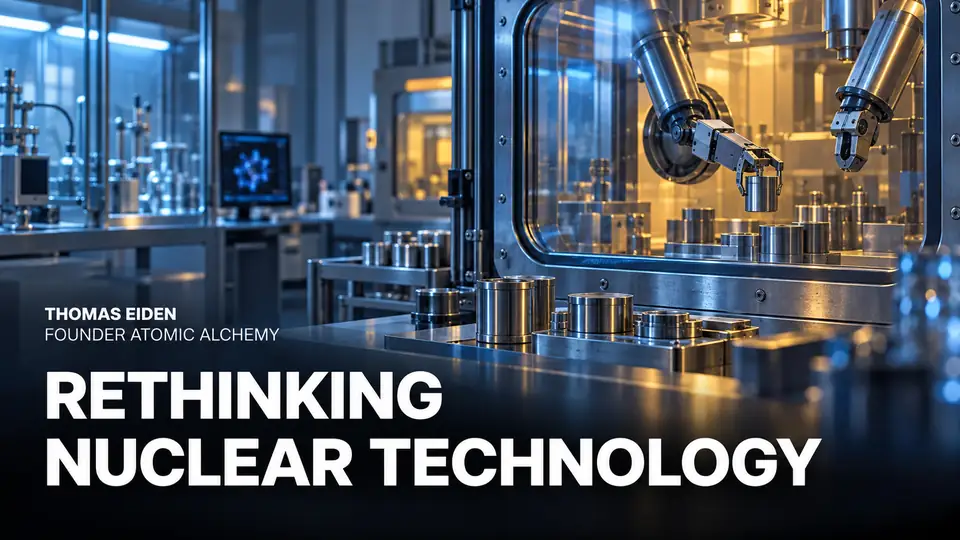
Thomas Eiden — Atomic Alchemy and Radioisotope Production
Thomas Eiden discusses how hands-on experiences could help people understand nuclear technology.
October 22, 2021 · 46 min



About the episode
In this conversation, we talk with Thomas Eiden, the founder of Atomic Alchemy who studied and researched nuclear engineering at the University of Wisconsin–Madison. Thomas is the expert of all things nuclear, so he gave us an awesome primer on the future of energy, nuclear space and the exciting future that might lie ahead with the clean and abundant nuclear energy.
Links
Chapters
Times follow the podcast audio. The video’s timeline may be slightly different.
- 00:00Introducing Thomas Eiden and Atomic Alchemy
- 00:36Making future technology tangible
- 02:41Telling technical stories to the public
- 06:24Technology and unintended consequences
- 09:03Nuclear optimism and public perception
- 11:30A renaissance beyond the hype
- 13:08Hands-on nuclear education
- 16:09Learning through demonstrations
- 18:32Radioisotopes beyond power generation
- 19:40Medical applications and research
- 22:10Radioisotope power in space
- 23:24Remote applications and material supply
- 24:30Industrial imaging and quality assurance
- 25:28Why these applications matter
- 28:30Nuclear energy and climate politics
- 30:58Licensing costs and regulatory incentives
- 36:49Supply chains and industry challenges
- 40:29New designs and a path forward
- 42:10Milestones before publicity
- 44:13Where to find Thomas and Atomic Alchemy
Read the conversation
Open the full transcript
CAMERON WIESE: Welcome to Build the Future podcast, where we promote exciting and positive visions of the future and those who are helping build it. Today, we're talking with Thomas Eiden, the founder of Atomic Alchemy and former nuclear engineer at the University of Wisconsin–Madison. Thomas is an expert in all things nuclear, so he gave us an awesome primer on the future of energy, nuclear space, and the exciting future that might lie ahead with clean and abundant nuclear energy. Let's jump right in.
CAMERON WIESE: What else would you be excited to see at a fair like this?
THOMAS EIDEN: Being sort of in the startup space, I am actually privy to what's kind of out there, what's being worked on. So there's a lot of really great things I think people would be really interested in personally, like there's a lot of work being done on like either cell cultured meats or 3d printed meats or things of that nature, where I can see the potential of there being some sort of very specific setup similar to your Mars explanation, where it's like, oh, this is actually how it works. And they can see something up close. I mean, I'm just super excited about what to boom supersonics doing kind of bringing back supersonic travel, Blake Schulte was an amazing individual who's I think would be a perfect fit for a thing like this in terms of an on stage presence. Yeah, I'm always jazzed about anything space related. Yeah, there's a lot of stuff in like some of those areas I can see where at least on the science front that just come to mind pretty quickly. Geez, infinite topics in biotech. My God, if you just go to like the YC companies page
THOMAS EIDEN: and just start looking through all the bio companies, they're all working on something that's really fascinating. And I'm sure any of those companies could have some sort of engaging presence. So yeah, I mean, that's just off the top of my head.
CAMERON WIESE: The interesting thing that we have, kind of being kind of tapped into these information streams is we get to see the future, right? It's like, oh, look at all the cool things all these YC companies are working on. It's like, oh, the future's bright. are people solving problems in biology and in space and transportation and super solid flight, that most other people, or the majority of people don't have any knowledge of. I think this is why there's such a cool opportunity here. How do we tell the stories of these futures that are being built right now to the people who aren't tapped into the same information streams?
THOMAS EIDEN: If you, as part of the project, are able to bring on people that help, I mean, certainly this is interesting, an interesting issue that I can see unfolding where, you know, as a founder of these companies, we have to be really good at storytelling too. It's like, you don't just raise tens of millions of dollars, hundreds of millions of dollars, not being able to tell a good story. But on one hand, too, those story, that storytelling is catered towards a specific audience. And so having sort of a quote on staff, if you're crafting a particular presentation or a particular way of telling, or have an idea of how you want these companies to tell their stories of making the future brighter, better place, having somebody there to help tailor the stories to the public, whom maybe there's plenty of non-technical investors out there, but there's also a lot of technical investors out there that maybe these, it's just, it's more of just kind of thinking aloud here where there could be the potential of making sure that these stories are
THOMAS EIDEN: crafted in a particular and maybe even consistent way so that delivery to the public is most effective. But I can, I can see the difference too, because I'm in the boat order. Yeah. I have a story to tell to investors and I have a slide deck for that. But as part of my voice being lost here, I did give a presentation to non-technical public members about what I'm working on. And it had to approach it from a different way than I would investors, money stuff aside, just because it's different level of sort of background information on all of
SPEAKER UNCLEAR: the stuff. So.
CAMERON WIESE: Yeah. I think the interesting thing is how do you figure out like what's actually exciting to people and how do we make this something that's relatable? Cause like if you get into the technical weeds that like the thing about a boom, for example, that's, that's super exciting. It's like, Oh, Like the world becomes like a smaller place. I can go visit family overseas. I can go, you know, like business meetings get like become a lot more accessible.
THOMAS EIDEN: It's very relatable.
SPEAKER UNCLEAR: It's really great.
CAMERON WIESE: Versus like a lot of the, like the biotech right now is not very relatable. And, and so I think the question is like, how do we make all these exciting features relatable to not just investors, not just like the Silicon Valley crowd, but to the public at large, because everybody wants the future to be great. Everybody wants to live in a clean, thriving, prosperous world. And we see it. We're like, oh, yeah, cool. This thing's happening. This thing's happening. The cultured meat, that might quite possibly solve the food crisis and the healthy food dynamic that we're that we're challenged with right now. But most people don't know that. They're like, you're printing meat in a lab? What? That's crazy.
SPEAKER UNCLEAR: It's like, no, it's happening. People are doing that. Yeah.
CAMERON WIESE: But imagine tasting it. You're like, oh, this is good. Oh, this came from a, this was printed? Oh, wow, this is so much better. We're like, oh, this is healthier for me. It doesn't have microplastics in it. I was speaking with Justin Callback, who's the founder of Wild Type, and they're doing cultivated salmon. And like, that's the thing is like the same you get from the grocery store. Most likely it's farmed. And if you're getting stuff from the ocean, you have to be concerned about mercury and microplastics and all these other things. We don't know what that, like the impact that's having on our bodies, but no one's talking about that. So it's interesting. Like how do we weave all this stuff together?
THOMAS EIDEN: Yeah, it's a complicated issue too. Cause I mean, just to kind of wax political a little bit here, wax philosophic, but like single use, single use plastics are getting a bad rap right now. You see a lot of crappy laws and stuff in California to ban things, but they have their purpose. People genuinely get sick using reusable grocery bags because they'll carry meat and other things around in it and not wash it and they get sick. Single use plastics are probably one of the biggest ways we fight pathogens and have a standard of hygiene in the Western world. I mean plastics is it does really great things for us. But then yeah, now we're discovering these issues so it's what's exciting about Something like this on this scale too is like gathers. We've got great things we're finding unintended consequences that we didn't know about before and Now we have ways in which we can solve these and still maybe not necessarily get rid of a good technology even though Politically, you know made they they're not on the favorable terms right now
THOMAS EIDEN: But, you know, this, it's, it's always in the lens of solving problems, solutions, their solutions. People are working on these things.
SPEAKER UNCLEAR: It's great.
CAMERON WIESE: So this is the data to Jason Crawford. He, his work kind of turned me, tuned me into David Deutsch's book, The Beginning of Infinity, which is, and this is, this is pretty much the thesis, which is technology and like innovation always creates new problems. Always. Like mostly unintended problems. But then that creates opportunities for people to take responsibility and go solve those problems. And it's just like this continued infinite cycle of like, okay, create something new, something amazing. Oh, it has these unintended consequences. Let's go solve those. And just like, you just keep going into infinity. And eventually all the problems that people are worried about get solved. Of course, new ones get created, but you know, like the plastics is a great example. It's like, how, okay, cool. We have this beautiful technology. we were able to kind of reduce disease transmission as a result of kind of single use plastics. Oh, now they are filling up our oceans. Okay, how do we go solve this problem? Or maybe we can have synthetic organisms
CAMERON WIESE: like decompose the plastic into something else. Amazing, okay, so let's not ban plastics. Let's put our foot on the pedal here and like step on the gas, be like, okay, what do we need to do? How do we solve this problem? And I think like that's our cultural shift that at least I'm hoping we can facilitate through the work that we're doing on this podcast, with the fair, and all of this. One of the things I'm most excited about was really keen to talk to you about how do we change, what is the story we should be telling about nuclear? What does the perception of it look like right now? And then how could we reframe it such that people are excited and seeing this as a solution to a problem rather than a problem in and of itself?
THOMAS EIDEN: This is the trillion dollar question. It's hard because, oh my God, it's a, might even take longer than the 40 minutes left. We have really suss that out. Yeah. So as I mentioned, as I indicated earlier, I'm really a sucker for the sort of almost naive optimism of the 1950s, because I really think people's hearts were in the right place with that sort of optimism. There was this new technology with this unfathomable energy density. Like, is you're probably possibly aware, like, okay, burn coal, natural gas, or anything. The energy that you're deriving there from combustion is really a chemical reaction. Combustion is a chemical reaction. But with nuclear, you're fundamentally harnessing energy from the nucleus of the atom, which which we're talking millions of times more energy dense, which is why you only have to refuel a nuclear plant once every 18 months, 24 months. It goes and it goes and it goes. People saw this possibility of what can we do with almost unlimited energy here. In fact, you actually saw a lot of opposition to nuclear power early on because some people
THOMAS EIDEN: Aaron is Lee think and we're talking like old school old guard environmentalists whom viewed humanity's impact on nature as a fundamental evil Saw that giving people the abundant almost limitless energy They they literally quote said it's like giving a machine gun to a monkey Which is not really a high view of humanity, but their concern was that well what now what can we do? Because everything we do in a sense, whether to improve our standard of living impacts nature in some way. So they're fundamentally opposed to this. But rightfully so, most people saw this as a means, as a technology that could near infinitely improve our standing amongst nature that is inherently always trying to kill us. And so lots of optimism, fantastic optimism. And then it's a long saga of, and there's some treatments on the history of this and Jason just put out a good primer that I think kind of covers the essence of why nuclear quote flopped. But there's a long saga of bad things that happened because of misusing or mishandling
THOMAS EIDEN: the technology plus regulatory considerations, et cetera, that ultimately after I think the 70s, you really don't see anything getting built. Now there is a resurgence, I think, today, finally. I was promised the nuclear renaissance 10 years ago when I was in college. And now I think it's actually finally happening because there are a number of companies out there that working on sort of quote advanced reactor concepts and One of them actually has a license into the NRC on the license application into the NRC so Stuff is happening. But how do we bring back sort of that excitement? Yeah, see and that's the interesting thing because There's a number of issues that I noticed myself growing up into the industry is that a lot of companies right now tend to chase government dollars. They have a hype train and then 10 years later when nothing happens, they just stop talking about it and people forget and the next hype train starts. I'm even jaded to the point where it's like, yes, believe it when I see it and then I see a company put in a license application. She's like, okay, cool.
THOMAS EIDEN: I can be excited about this now. But I think on a really basic level, and I'm just really stream of consciousness in here right now. I think in terms of the general public though, in terms of getting the general public excited about nuclear technology, I think it's more of a front and center. There has to be a show and tell, like a real, like something along the lines of what you're doing, that's why I'm excited about what you're doing, because I fundamentally think it needs to be a almost a hands-on thing. So, this is not really a public thing. I'm not really keeping it secret, but I just don't talk about it, because it's so far in the future. But, you know, when my company is established and we have revenue and the freedom to kind of wax poetic about this, I do want to actually create a facility that is open to the general public that they can come operate a nuclear reactor, a small like university scale type reactor. because universities have reactors that you can take a course, you can operate them, they exist.
THOMAS EIDEN: But I mean, you get like 12 students a semester, it's very limited. And the people who generally end up taking it are nuclear engineering students. I took a course or I operated a trigger reactor at University of Wisconsin Madison, it was fantastic. One of the most amazing experiences of my life. Because I was, you know, had my hand on a knob that was basically manipulating the forces of nature.
CAMERON WIESE: Oh, I bet that was wild.
THOMAS EIDEN: But I think in terms of getting people to accept something nebulous like nuclear power where there's a history There's a lot of baggage with it. You have to have something hands-on like that So the inspiration for this idea came from there's a theme park I was reading about a theme park in New Jersey called digger land where you basically take your kids and they operate scaled Heavy machinery. So if your kid is into construction equipment How freaking cool would it be for your seven year old to operate a backhoe? Like that's the ultimate experience of bringing in, you know, who needs Tonka trucks and you can do the real deal. And so I think it fundamentally puts on some level, if somebody gets to operate a reactor, it's hard for them to go, Oh, this is some existential threat to human life, meaning you can still talk about some of the third order effects where It's like the age old question, but what about the waste? Which is, I think purely a political problem at this point. But at least if you get to like actually do the thing and then your crotchety old
THOMAS EIDEN: environmentalist grandpa goes back in my day, we shut these things down. If you operated the thing, it's like, that wasn't scary. No, it was actually really cool. Like this technology is pretty sweet. So it's kind of, I think there needs to even be more hands-on way to fight or to at least get people excited about the technology. So yeah, one of my long term goals is to like actually build something that's specifically open to the public to get as many people using the technology and not being afraid of it as possible. And you know, it's a great teaching tool to be like, to talk about, you know, pros and cons of the technology as you're operating it. Like what better learning experience do you get? So that's, that's why like with the nuclear merit badge for like Boy Scouts, Back at the university because we had a reactor we had several fusion prototypes like tokamaks and stuff Etc. You know the I did a lot of Boy Scout volunteering because It was really neat for these kids to be able to see these facilities in person
THOMAS EIDEN: For them to learn about this at a young age and the thing I found fascinating was that the parents of these kids were actually more excited to learn about nuclear physics than the kids were because they were kids and they were like, I'm going to go play outside. And the parents were like, this is really cool. They teach me this in school. Right. It was like, you know, this is timeless information. I think there's a huge thirst and need for it. There's a demand to know more about the technology. I think even if the people, even if the public doesn't realize it, just based on my experiences with parents, kids being more excited and doing the homework themselves and be like, oh, this is cool. So there's boundless opportunities, like just even from Boy Scouts, like we built cloud chambers where you could put, it was basically created like an ethanol vapor. You, it was basically a box. You need some ethanol in there and you had dry ice and you cooled it down so that it would kind of form like a fog. You put like a chunk of uranium ore that was undergoing alpha decay and you could
THOMAS EIDEN: actually see the alpha particles flying around in the cloud. And so it was a way to visualize radioactive decay. You could see the trails being left by the particles being spewed out of the ore. There's a lot of things we did with Geiger counters and measuring things. People got to handle very lightly radioactive materials. But enough, you could detect them and look at time-distance shielding where you put stuff in between. Radiation goes down, move detector away, goes down. You should kind of visualize the one over our squared nature of radiation. So, I mean, there's countless, so many hands-on opportunities. And then my end game is kind of like, let's just do the ultimate thing, you know, manhandle a reactor. And then I would probably build this using the design of the reactor using for my company, just because it's like, well, we already got the plan, so we could just spawn more of these. Yeah, ultimately, I think it's like hands-on. So like, if I had a booth at the World's Fair, like heck yeah, it would be pretty awesome because we'd have a lot of hands-on activities.
THOMAS EIDEN: And going back to just sort of the parents being excited and knowing that there is a more fundamental need across all demographics of understanding nuclear, it's not just power. There's so many, so many applications of nuclear technology. Like even in my space alone, I'm doing non-power reactors to produce radioisotopes. Just another way of saying we make a lot of radioactive materials that are used for different things. Just the sheer number of applications for radioactive materials is mind boggling. Space exploration, power for space exploration. The main thrust, the main market that we're going to cover is medical. There's a lot of uses for radioactive materials in nuclear medicine. The big one is diagnostic imaging. You inject the radioactive material, you can basically take images as that material moves around or basically kind of, it's kind of like using an X-ray, but the different radioactive materials have different physical properties, radioactive properties that you can take different types of images, different resolutions, different fidelity, looking at different things.
THOMAS EIDEN: So diagnostic imaging is a big one. Mostly in clinical trials, I think there might be some application right now, but there's a new therapeutic coming out called targeted alpha therapy. So if you think of how much chemo sucks because you're basically spilling the body with radioactive or with a poison and you're hoping you kill more cancer than Yourself there's a lot to be desired, but it works and targeted off of therapy You basically take radioactive material either attach it to an antigen or to glucose or something That's going to preferentially attach itself to or be consumed by the cancer faster than other cells cancer This has a voracious appetite, multiplies quickly. And so like, you know, if you put a bunch of radioactive material, synthesize it inside of a glucose molecule, and that cancer will eat it, all that radioactive material accumulates into cancer, and it's getting all of the radiation dose. And then to the lesser extent that there's still stuff floating around in your bloodstream, the rest of your body, but it's on a scale that doesn't really harm you.
THOMAS EIDEN: And so you target that tumor. So it's chemo, but specifically accumulates in the tumor, whereas regular chemo right now can't preferentially coalesce inside that tumor. So really fascinating application for potential cancer therapies on the horizon. There are a lot of research applications for radioactive materials. Tracer is a big one. It's kind of hilarious. We are so good at measuring radiation. Detectors are so sensitive that it's something than that the anti-nukes actually use to their advantage because it's like, well, we've got detectable amounts of material. It's like, yeah, so what? It's like you're literally like, you can literally count the individual disintegrations. And so we use that to our advantage in medicine or research in general, because we can say follow how something's metabolized through the body. We can literally map how sand on a beach gets relocated because we could just kind of, we can radio label the sand with radioactive silicon and then track it as it moves around. So if you're interested in
THOMAS EIDEN: climate change or whether your beachfront property is being eroded away, doesn't matter, really matter what your motivation is, you can use radioactive materials to like have a high fidelity mapping of what's happening. How is the river affecting, how are things being transported down the river, etc. Let's space exploration is one of my favorites because we can directly convert the heat from radioactive decay into electricity. So, Mars Curiosity rover, Mars Perseverance rover, if you look at their selfies that they take on the back of the rover, there's this thin looking thing, thin cylinder, that's probably 10 kilograms of plutonium-238. If you've ever looked at a picture of Pluto, the Pluto New Horizons mission, solar panels less than useless out there. It's being powered by radioactive decay. Voyager probes are in interstellar space. Their plutonium batteries are still going. There are a lot of interesting applications for space. Granted, these radioisotope batteries are very low-powered. We're talking
THOMAS EIDEN: maybe at most hundreds of watts, but for very specific purposes, very invaluable. For commercial applications, emergency backup source, where your safety related instrumentation or your life support systems. Maybe you only need a couple hundred watts, you slap a couple of these bad boys on there, you have power that never turns off, that at your fingertips in case of the worst case scenario. There are also interesting terrestrial uses for radio isotope power sources. So if you are doing some sort of autonomous ocean cleanup and you just got this little thing paddling along and just stick a radioisotope battery on the back and it just propels itself for a couple of decades back and forth combing the oceans. A lot of remote applications, whether it's on the earth or in space use, can use the source and it's not used as much as it could because you can't actually buy any of the materials. Like plutonium-238, NASA's pretty much out of it. I was on a project to try to restart domestic production because basically the world's out of it.
THOMAS EIDEN: So future NASA missions are being jeopardized by lack of material access. And the second most usable material strung in 90, not a whole lot of it just hanging around either. So the Russians use some strung in 90 batteries for a while and nobody's really done much since. So there's a ton of potential applications, no real material access, which we're hoping as my company is hoping to resolve that so we can utilize this technology again. There are applications in industry, so whether it's space related aerospace in general, like boom supersonic type stuff, there's a technique called radiography. You basically can use x-rays, you can use gamma rays from radioactive materials, you can even use images taken using Neutron, Neutron Radiography to image entire pieces and parts for quality assurance. So you have a mission critical weld in your beryllium chunk that's going on your $10 billion satellite. You want to make sure that that weld's done correctly. You do extensive radiography because otherwise you have to destructively test it. You don't want to do that.
THOMAS EIDEN: So it's a non-destructive technique for imaging. Let's use a lot in steam turbine blades. steam turbine blades are phenomenal engineering. And you can use neutron radiography to make sure to really hone in on that quality control.
CAMERON WIESE: I wanna just gonna tack a little bit. There's quite a lot of applications that people aren't privy to. When it comes to the everyday person, what do you think is the most exciting component of this tire field for, again, Like the person who's not doing kind of the industrial manufacturing or the stuff in space, like every day person around the world.
THOMAS EIDEN: Specifically in relation to radioisotopes, I think the case can be made that the number one killer of Americans or essentially anyone with a Western lifestyle is heart disease. I think I just saw stat, like it's like 18 million people per year or something. I could be right. I just saw something today, literally today. I was like, Oh yeah, that's a big number. And one of the best ways of catching this or diagnosing and or figure out treatment is, are these radio, radio diagnostic techniques? In fact, like 80% of nuclear medicine procedures are basically for myocardial bifurcation. I think that's how you say it. Bifarction or something. It's basically imaging the heart specifically for these heart disease related issues. So I think to bring like say radioisotopes home to people like this is the number one gold standard diagnostic technique for diagnosing and fixing heart disease issues that are by far the number one killer people. It's really a longevity quality of life issue where maybe I could have another 10 years with grandpa if we would have found his heart issue earlier.
THOMAS EIDEN: And then I think there's a lot of imagination to be captured on sort of the space front where hey, these materials have some fascinating use cases in space exploration and other space power uses. You can actually find some Apollo pictures of some RTGs to chill on the moon too. But I think that's another easy way to capture the imagination. And then kind of moving outwards from that, I still think there's an easy case to make for power where it's like, hey, look at, within the context of one of the things you hear about pretty much on a daily basis is climate change. And so, hey, look here is literally base load capable source of power that could be a drop in replacement for fossil fuels. I mean, people are excited about windmills and solar panels as an engineer and now someone who has to look at the business side of things, it's not going to cut it. You have to have a base load capable always on base load source of energy and that's nuclear power. I think there's a very relatable thing there too where we're so bombarded on a daily basis
THOMAS EIDEN: with this issue that, hey, look, here's a power source that is capable of offering a solution. And look, here's actually some really interesting political things where you'd think these people People were worried about climate change, but they're not considering nuclear as an option. So what the hell?
SPEAKER UNCLEAR: Why do you think this is? Right?
CAMERON WIESE: There's this cultural shift, at least from where I'm sitting, climate is like now the conversation topic of the day, right?
SPEAKER UNCLEAR: It was COVID now. It's like, okay, climate.
CAMERON WIESE: Everyone's trying to figure out what is sustainable. How do we fix this crisis? How do we move forward? And I think one, there's this research and stuff like, wait, what about nuclear? And people are starting to ask this question. The people responsible for helping lead these things, like from the infrastructure level, are not talking about it.
SPEAKER UNCLEAR: What is going on?
THOMAS EIDEN: Actually, it's worse than that. There's a fight in the EU right now between politicians and other people and other politicians, because on one hand, and I'm not familiar with how this all works or how they do business over there, but they've got some sort of political document that outlines, okay, these are what we consider to be clean, renewable sources of energy, and therefore get like tax breaks or subsidies or whatever. And, you know, this is important to fight climate change. And very notably absent is nuclear and so that so there are other politicians and trade groups and companies making a stink about this because it's like well if you're this committed to solving this problem then why is this not on this particular box I think it's called the taxonomy or something some sort of taxonomy something but it's like why are you explicitly excluding nuclear then so there's there's some very explicit like not even just not talking about but like no we're not. And it boggles my mind. I don't know why, but yeah, you mentioned it's an interesting cultural shift because
THOMAS EIDEN: there is a whole wave of people now going, well, what about nuclear? And it's funny because 10 years ago, everyone was like, who cares if it costs 10 times the world's GDP to litter the planet with solar panels and windmills. We must solve this now. And now all of a sudden it's like, oh, nuclear is too expensive of an option. We can't totally, we totally can't entertain this. It's like, well, what happened to this same line of thinking for these other non-nuclear sources that you literally just said two years ago, we have to do this at all costs. And now it's like, now we can't entertain nuclear because it's too expensive. So, and it's too expensive for not technical reasons. So, right.
CAMERON WIESE: It's like, it's like, it becomes so bogged down with regulation. Like you had this tweet recently about kind of like the length of the application to the nuclear commission. Can you just talk about how absurd the state of affairs are, or is that, if that's something you can talk about? Cause I know like the FDA, you don't want to, you don't want to talk about their process if you're trying to get a drug developed.
THOMAS EIDEN: And there's, he's process is very public, but here's the funny thing. So I was talking about this with a friend of mine who runs a startup for, he runs the startup that just has, that has this one advanced reactor license under review right now. And he was talking about the NRC is probably going to be the most important regulatory body in relation to the issue of climate change in the foreseeable future because well, yeah, pretty much nothing in the last 40 years has been licensed and built under these guys. And if you're worried about, you know, we need power for a standard of living, but we also don't want that power source to make things more difficult for us with putting particulate matter into the air or if you're worried about carbon dioxide, carbon dioxide, it's like, well, okay, then the really the thing holding up new plant construction here is the regulatory body. And unlike any other regulatory agency, there's good and bad that come with this. So the NRC is an independent regulatory agency, which is good. Because
THOMAS EIDEN: historically, Democrats have been opposed to nuclear power historically. And you're of seeing a shift a little bit nowadays with climate change being such a pressing issue for Democrats where they can't avoid that question of what about nuclear? I mean, they have to address it now. So, but hypothetically speaking, let's just say Joe Biden really hates nuclear power. Let's just say he just loathes it and wants to ask my friend's application. He can't just issue an executive order. He can't make it hard because as an independent agency, the NRC is not beholden the president, whereas the EPA kind of is. The EPA falls under that executive branch, but the NRC kind of sits in a bubble outside of that and only changes its rules as an act of Congress. So that's good. My rules don't change unless Congress specifically orders the NRC to change them. And then the NRC has to implement a law change with new regulation. So that's kind of nice because it's stable, very stable. What kind of comes with that though, and this is more of a
THOMAS EIDEN: thing is that right now I pay for the privilege of being regulated. So if I have to write a thousand page document and I have to have these guys review it, I pay for every penny of their time and they charge about 300 bucks an hour. So if you've got five people for 300 bucks an hour, eight hours a day for two years reviewing a submission, I'm going to easily pay at least five million for the privilege of having an application reviewed to have this facility built. And so right now, as part of our application, we submitted something saying, hey, we want to use a quality assurance standard from 2017. And the most recently approved one by the NRC is 2015. Now there's some ways we're getting around that, but for a power reactor, if they wanted to use the most up-to-date guidance, which is actually 2019, The most up-to-date nuclear quality assurance standards, they would literally have to either have the NRC do probably take them five years to endorse and then update their guidance and sort of regulatory stuff on the back end.
THOMAS EIDEN: Or the company would have to foot the bill and basically pay the NRC to go line by line and update. So, no company is going to pay millions of dollars to pretty much bring the nuclear industry up to date on the latest quality assurance guidelines. So, you're in this weird paradox where the quality assurance standards that the NRC wants us to use are now six years old. And the most up-to-date ones are three years old.
SPEAKER UNCLEAR: Let's see, 2019. So, two years old. Sorry, two years old.
THOMAS EIDEN: There's guidance that's formally blessed or that's currently blessed by the NRC. That's as old as the 70s So you've got this weird thing where nobody wants to foot the bill the NRC is short-staffed. They don't have time or the money To do it themselves and it just kind of get by with what exists. So I mean, there's a lot of crap that's just like this old stuff from the 70s, that's the currently blessed version it's like well this sucks and And I'm not going to foot the bill so that everyone else can benefit because it's a competitive field. So if I want everyone else to pay for it with me. So right now, there's an issue too where we pay for the privilege of being regulated. There's a perverse structure where there really is no incentive for the NRC to approve applications. And there's all the incentives to not ever even bother because it costs a crap ton of money. It's not easy learning all the regs yourself, etc. And yeah, and so there's a perverse sense. So really going tying it back. The NRC is probably one of the most important regulatory agencies in the next several decades
THOMAS EIDEN: because we need more electricity, electrification of cars. We want to replace fossil fuels, old nuclear plants, etc, etc. era, we need to be able to have a regulatory structure that doesn't penalize us for trying to improve the world, but also kind of there is something in it so that stuff actually gets approved in a timely fashion. So changing that is going to be a big deal. And there's no, it's not as easy as you think.
CAMERON WIESE: The other thing, like the big bottleneck, is that the thing that is kind of holding back development here, outside of financing and the technology. A lot of the regulation is blocked by the NRC. So if we were to shift that.
THOMAS EIDEN: There's a weird paradigm where looking at a lot of the most recently failed nuclear projects and a lot of up and coming companies trying to do something, there are a couple of issues that are also specific to the industry as well. So certainly, to answer your question directly, the NRC is a huge bottleneck because it probably takes anywhere between four and six years of just approvals for me to build my facility. And I'm not actually using any fundamentally different technology that was used back in the 60s, 70s, and 80s, and 90s for doing the same thing. So there is that. That certainly doesn't help. But also, because the industry is in a bad way right now, a lot of suppliers for nuclear plants are consolidating. So if you want like a nuclear grade pump, because apparently there's something special about nuclear grade, which that's a regulatory issue. There's like two places you can buy a nuclear grade pump and the nuclear grade pump versus the same pump that's not nuclear grade is probably a hundred time markup. So there's a bunch of crap there that can be fixed.
THOMAS EIDEN: But as a consequence of kind of the entire baggage and history of the nuclear industry, so to speak, in the associated regulatory regime, the fundamental thinking on the company side is atrocious. A lot of, with very few exceptions, and I include myself in the exception, a lot of nuclear startups tend to actually be rich people right off. Terra Power is basically funded by Bill Gates. They've been around for 10 years. I haven't done Jack, really. I mean, they're one of those, I have to see it to believe it hype things because I was super excited about the traveling wave reactor in college and then it kind of just fizzled out. But these companies, these sort of wealthy investor backed companies that have a bunch of the old people from the industry that are at the helm, they chase the government, dollars, not the customers. They kind to do things the old way in the existing regulatory paradigm and not try to innovate the regulatory space in the regulatory space. Some of these, there are exceptions to that too. They're trying some new stuff, but fundamentally
THOMAS EIDEN: it's like kind of chasing the government dollars. Some of the recent failed nuclear plants like V.C. summer, there's a huge corruption scandal, but why are nuclear plants $10 billion, go over budget $5 billion, really crappy construction management, a lot of corruption in these very large projects. But a lot of that too is enabled by this inane super complex web of regulation that enables these projects to essentially become mega projects. and that require much more oversight and sort of self-regulation in terms of their management with the company themselves. So there's a lot of little crap on the inside too as well that sort of came to be as a consequence of necessity of how to do things under the regulatory regime in the context of lack of innovation. So most innovation in the nuclear space over the last couple of decades has been sort of this incremental. We got this technology that works right now. Let's just continue to incrementally improve what we got and squeeze every jewel out of our existing plants.
THOMAS EIDEN: And so you have a vanishing small number of startups that are working on nuclear power, but that uses fundamentally different technology that now doesn't fit under the current regulatory regime. And then by necessity, have to innovate, not only for their non-existing technology, but for the non-existent regulation that they have to now basically hold the hand of the NRC to come up with something that fits in the regulatory regime that allows their technology to be approved and allowed to be built. And so it's going to get worse before it gets better, honestly, because the supply chain issues are a huge deal. The consolidation of the supply chain is a huge cost burden. There's a lot of crappy rules that have to be rearranged by the industry to make the quality assurance part better because we don't need super-duper nuclear grade this or that. There are some ways to get around that too in certain applications. It's just it's going to get worse before it gets better. But when it does get better, I think it'll be a hockey stick resurgence because
THOMAS EIDEN: One or two companies that do do it right get their approvals and then start spamming new Facilities, they're just gonna lead the way and this you know They're gonna be able to build a ton of awesome stuff We'll be able to we'll be able to reap the benefits of that but it's gonna get worse before it gets better
CAMERON WIESE: Where can people find you and how can they how can they support your work and give people a follow-up? Oh
THOMAS EIDEN: That's a good question and I'm going to have a disappointing answer because I have really hated how the hype train in the nuclear industry has been over the course of my professional
SPEAKER UNCLEAR: career. I've actually opted.
THOMAS EIDEN: I'm not really in stealth mode, but I haven't done any press releases. You're probably the third person that has recorded me talking about this stuff. My website is a landing page with my logo and absolutely nothing on it because I basically want to get to a certain set of milestones on the regulatory front, in the business development front, before I actually talk about what we're doing publicly because like, I should say, like vocally public, like making a big splash and making headlines or whatever, because I don't want to have a bunch of stuff saying this is what we're doing. I want to say this is what we're doing. Here's what we've done. And what we've done, the point at which I'll start being more public about this will be when even the people in the industry can say, okay, they've gotten to this point. It's kind of like a matter of when, not if, because there are some of these internal regulatory milestones where it's like, if you did this, you clearly have the capital and the brain power to have made it that far.
THOMAS EIDEN: And it's kind of like a proof of viability where it's like, okay, you did that amount of work. Sure. It's not a hundred percent in the bag, but, um, cause there are bigger companies that have failed even getting to where I'm at at this point for various reasons, but it's kind of hard to say these guys aren't serious. So it separates the idea from the actual, okay, they're actually doing something. And so we're almost there, like we're gonna be there next spring. We're basically about to submit our construction permit next spring for building our facility. And so basically, I would say maybe next spring timeframe, you'll start seeing more of a splash from us and maybe I'll actually put together a website about what the heck we're doing. But right now it's disappointing. There's nothing on our website. You can follow us on Twitter for when we actually do make a post here or there. I believe it's, and see this is how little I use it right now, I think it's isotope factory for our Twitter. And so yeah, we occasionally do a
THOMAS EIDEN: thing here or there, but certainly there will be more intimate like you get to know the team, get to know what our facility is like, what we tend to do, what sort of cool things we can do with these materials. Next spring when it makes sense to kind of start making a splash because we're getting to the point where I won't be making the same thing. I won't be making the same mistakes I hated seeing other companies do in the past where it's like, oh, we're going to do all of this in the world. And then it just kind of fizzles out seven years later after the government money dries up. I want to show like, look, we've, we've got this, this, this, and this.
SPEAKER UNCLEAR: We're doing it now. Now get hyped, get hyped. Now we actually did the stuff.
THOMAS EIDEN: We actually did the work. And so atomic alchemy.us, if you want to go look at our pretty logo, I used to factory on Twitter. And, uh, um, I think, and if you type in atomic alchemy on Facebook, you'll find it. I don't remember at the URL. It's probably just atomic alchemy,
SPEAKER UNCLEAR: something, but yeah.
CAMERON WIESE: Thank you for coming on and excited to follow along. And for all,
THOMAS EIDEN: it's ahead. Appreciate it. Yeah, I look forward to talking to you again soon. Have a good one.
CAMERON WIESE: Thanks for joining us for another episode of the Build the Future podcast. If you want to support the show, please share your favorite episode with a friend. If you want to get updates on the events we're hosting, new podcast episodes, and follow along as we build the new world's fair, you can follow me on Twitter at CAMWIESE. Till next time, go build.
More episodes
All episodes Dan Grech of Global OTEC — Ocean Thermal Energy ConversionDan Grech explains how the temperature difference between surface and deep ocean water could generate electricity.
 Alex Trembath — Policy, Food, & EnergyAlex Trembath argues for climate stories that make resilient infrastructure and a more abundant future tangible.
 Isaiah Taylor of Valar Atomics — Nuclear Fission and Energy AbundanceIsaiah Taylor explores nuclear power, synthetic fuels and what abundant energy could make possible.