

Build the Future Podcast
Alex Trembath — Policy, Food, & Energy
Alex Trembath argues for climate stories that make resilient infrastructure and a more abundant future tangible.
October 26, 2021 · 39 min



About the episode
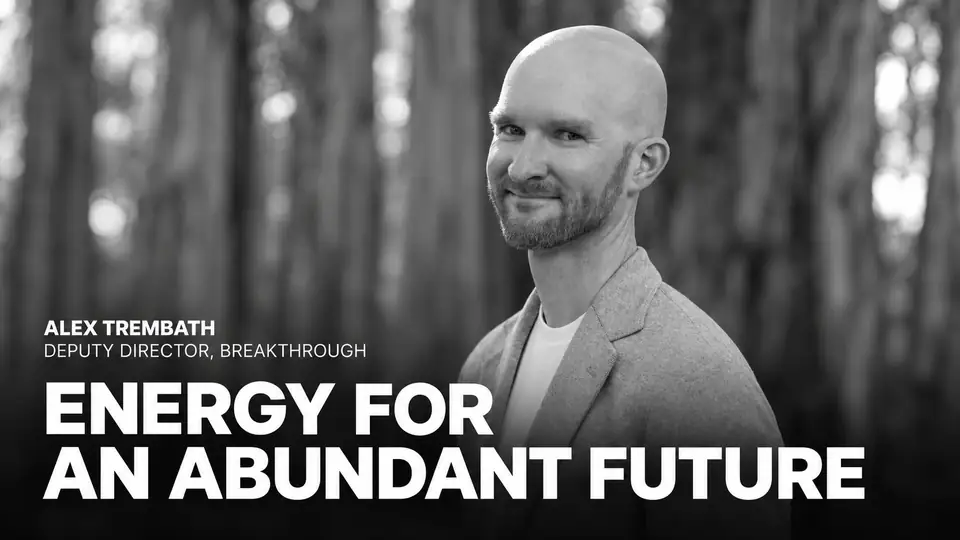
In this conversation, we talk with Alex Trembath, the deputy director of Breakthrough, a global research center focused on promoting technological solutions, environmental and human development challenges. Specifically, we touch on two facets of the future here - feeding our growing population and creating a high-energy planet but not at the expense of our climate.
Links
Chapters
Times follow the podcast audio. The video’s timeline may be slightly different.
- 00:00Introducing Alex Trembath and Breakthrough
- 00:35Imagining a positive climate future
- 02:23Solarpunk and resilient infrastructure
- 05:25Telling stories of progress
- 08:39Media, influence and new audiences
- 11:59The changing nuclear conversation
- 15:32Small is beautiful and environmental ideology
- 18:41Making new infrastructure tangible
- 19:39Expanding abundance
- 23:27Nuclear licensing and regulatory reform
- 26:28Regulation, demonstration and other bottlenecks
- 28:12The Simpsons and nuclear perceptions
- 31:07Growth, institutions and public preferences
- 33:53Stagnation and disillusionment with growth
- 35:41Extending the benefits of modernity
- 37:49Where to find Alex and Breakthrough
Read the conversation
Open the full transcript
CAMERON WIESE: Welcome to the Build a Future podcast, where we promote exciting and positive vision to the future and those who are helping build it. Today, I'm going to start with Alex Trambaugh, Deputy Director at Breakthrough, a global research center focused on promoting technological solutions, environmental and human development challenges. Specifically, we touched on two facets of the future here, feeding our growing population and creating a high-energy planet, but not at the expense of our climate. Let's jump right in.
CAMERON WIESE: How can we design one of those sort of like immersive traveling experiences that promotes like a climate story? Right? Because I think this is, this is something that's, that's missing. We don't have a centralized like source of information, like what a positive vision for climate and like energy could look like. I think if we did something immersive offline, what sort of story and picture can we paint from people?
ALEX TREMBATH: A couple of things come to mind. The first is this phenomenal project called Nuclear Reimagined that Susie Hobbs Baker, who was a co-founder of the Good Energy Collective, did when she was a third way with the design firm Gensler, who as I understand was like the biggest architecture firm in the country or something. And they took a bunch of the advanced reactor designs from companies like Oklo and NuScale and actually conceptualized and illustrated what those reactors would look like in the real world. So there's one in a sort of remote Alaskan town, there's one in sort of a central downtown urban hub. There's a whole bunch of different designs of what the reactors would look like in IRL in a sort of like clean, futuristic, inspiring way. Obviously, you know, sort of advanced reactors and enhanced geothermal and electric vehicles will all be deployed in all sorts of contexts. But especially for these technologies that we don't have yet, like advanced reactors, or like, you know, this week, you know, Iceland built the first Climeworks direct air capture, carbon removal machine
ALEX TREMBATH: in Iceland, which was cool to see. And it's just like, we need more of that. We need sort of both more inspiring visuals. And as you say, sort of more inspiring immersive experiences with these advanced sort of climate friendly next generation technologies, because most of what we think about when we think about climate change is like, like storms and drought and famine and things like that. The other thing that comes to mind is, and this is something that I sort of know less about, but I see like on Twitter is the solar punk genre is I think what it's called, right? You know, sort of like, I don't think you have to be like a solar power partisan or anything to appreciate these depictions of future cities with like both, you know, like solar and sort of plant life and sort of advanced transit technology. I think we need more of that, you know, both in our sort of science fiction and in our imaginaries and like you said, in our immersive experiences, the more we can have resilient infrastructure, sort of inspiring visions of technology associated with our climate discussions,
ALEX TREMBATH: I think the better we'll be.
CAMERON WIESE: This comes back to the constant thread, which is like media shapes how we view the world. And we found ourselves in a situation where a lot of the media is not focused on these things. It's pessimistic, it's gloomy. me. And no wonder we're like, damn, what's the future going to look like? Because we don't have on a broad scale, we don't have these anchors of possibility. Right?
ALEX TREMBATH: Yeah, yeah, I don't want to be like, overly optimistic about it. But I think an important sort of real world example of this is Hurricane Ida, which just sort of which has devastated many cities in the Gulf Coast and along the eastern seaboard, and was genuinely terrifying and painful. And you know, a bunch of residents in South Louisiana and New Orleans are still without power. That said, many, many, many, many fewer people died as a result of Hurricane Ida, then died as a result of Hurricane Katrina. And I am not a civil engineering expert, but as I understand it, that's a huge amount of that has chalked up to both better weather forecasting and early warning systems and evacuation protocols and significantly improved levee systems. Like if you're in New Orleans, I was in there, I was at New Orleans in January 2020, they've got these levies. You can walk on them. And it's not quite like solar punk, and it's not quite like advanced reactors or flying cars or anything like that. But it is both inspiring and very effective sort of climate resilient infrastructure.
ALEX TREMBATH: And I don't mean to say that that will solve all our problems. Obviously, Hurricane Ida was still devastating to New Orleans specifically and to Philadelphia and to New York and we're not sort of completely protected from extreme weather and natural disasters. But also we have these inspiring construction projects, these inspiring infrastructure that doesn't get mentioned. All of the coverage of Hurricane Ida was about this devastation as it should be to a degree, but a lot less of it, far less than I think is appropriate, was about all the lives saved by the tremendous amounts of resilience investments that were made over the last 15 years since Katrina in New Orleans that did not completely hermetically seal the city from devastation, but also saved, I mean, thousands of people died in Katrina, and many, many fewer than that died in Ida. I don't want to make light of it or shrug off the suffering, but it's a tremendous amount of suffering and harm that was prevented by that kind of thing.
CAMERON WIESE: It's almost like indicative of what maybe just like a broader cultural like challenge, which is the source of information. Again, like the media is like the things we see highlight the negative, but I think a lot more people are hopeful and optimistic and are actively working on solving problems. Like it took some people lots of money and they had to like think about, okay, how do we problem solve this again? Hurricane Katrina happened. This was really bad. How do we prevent this from happening again? How do we solve this problem? And then they got to work behind the scenes without the attention, without the kind of like, you know, rah, rah, like, look at us, we're doing good, they just got to work. And like, lots of lives were saved as a result. And yeah, these kind of like, so how do we tell these stories of like resilience and of like, technology and innovation being forces for good, because that's what that's what effectively happened here. It's like, hey, this thing was broken. How do we like build something better in its place?
ALEX TREMBATH: Yeah, versus, you know, sort of just focusing on the devastation and the risk and the liabilities and the deficits all the time. I think we're seeing more of that early in the non-profit sector. Obviously Breakthrough Institute where I work, it tries to be an exponent of highlighting the progress that we've made in infrastructure and technology in modernity. There's human progress at Cato, there's this new magazine called Works in Progress. There's a whole field of progress studies that Tyler Cowan is a big supporter of. But I think our world and data does a lot of not just again, sort of Pollyannaish focus on the positive, but telling stories of progress. To your question, though, I do feel like there's a little bit less of it in quote unquote, mainstream media. And I've had a lot of conversations with journalists about this. And I think very often what they say is, well, like, there's no story when nobody is suffering, you know, like no one writes about the deaths from a famine that didn't happen. The thing that happened was the hurricane.
ALEX TREMBATH: And the thing that happened was the basements that flooded and drowned people, and the people who were displaced and the power that was out. That's the literal news story, as opposed to the sort of regular running of human life, where things didn't break or where life went on, where no one suffered or died. And so I understand the sort of journalistic impulse to focus on the thing that happened, as opposed to the dog that didn't bark. But it is a problem and being able to tell stories about progress and resilience, I think would be, should be a major priority of whether it's nonprofit media or mainstream media or whatever. I feel like the closest it ever comes is in the sort of dying local news industry where you're writing sort of like human interest stories that don't get told anymore because all of our media has sort of migrated to nationalized mainstream media, whether it's like, you New York Times or Washington Post or Time or Fox News or MSNBC or something, where it is just both sound-bidy and hyper-focused on polarization and the negative, and the
ALEX TREMBATH: stories of resilience and progress, I think, very often get ignored. I don't know how to solve that.
SPEAKER UNCLEAR: I'm not a journalist. I'm not an editor.
ALEX TREMBATH: I'm not in media, but I would be interested in talking more to folks in media about how
SPEAKER UNCLEAR: to fix that problem.
CAMERON WIESE: This brings to mind something Eric Weinstein often talks about, just like the whole gated institutional narrative, which is like, what are the stories that are kind of being agreed on to be like shared and promoted and written about. But it was also, he tweeted something the other day, which is like the influence of like CNN is like far, far below, like most major YouTube channels, I think their reach was like 700,000 people watch like one of their prime time shows, which is wild, right? More people are watching some random influence on YouTube than they are CNN. And so it's like, there's still something that seems to be missing between kind of what people accept as zeitgeist knowledge, because it's not coming out of like the institutions that we've like, grown to trust. So like, there's this shift that's gonna need to take place.
ALEX TREMBATH: Yeah, and the demonstration of the appetite for it, right? You know, like, it might be that there's 10 million people watching a certain YouTube or as opposed to like less than a million people who regularly tune into Fox News on a given night, but like the elites are watching Fox News and reading the New York Times or whatever. So I feel like even if there's a broader reach to a bunch of sort of innovative social media, YouTube, you know, sort of TikTok, things like that, there's still sort of this negative feedback loop between our elites and our elite media. I feel like we need to find a way to filter, to filter up some of the more innovative storytelling that you see in places like social media in places like some of new verticals focused on progress and things like that.
CAMERON WIESE: Yeah, I'm reminded of just on that appetite piece, like there's that this nuclear energy influencer Isabelle Bomecki, and she just like does TikToks and like, people crave that content. And she's like, she went super viral for a bunch of videos she's posted. It's like, oh, there's an interest in this competition. And this gives me hope, right? There's like some thread here that we can pull on, which is, oh, people are asking these questions about the future. They're curious, they're wondering like why are we not doing certain things? They feel like things are broken, they feel like they're kind of compelled to like investigate solutions.
ALEX TREMBATH: Isabel's great. I feel like what makes Isabel so effective is that, you know, because I've been a nuclear proponent for over a decade, really interested in the conversations about public perception and opinion on nuclear energy. And a bunch of people have been talking for decades, really, about how to talk about nuclear, how to talk about nuclear risk, kind of talk about civilian nuclear power in ways that don't turn people off or that make people open to nuclear in their community or nuclear generally. And this has been this big fight. And then all of a sudden, within the last 18 months, here comes Isabelle Demaki, this nuclear TikToker. She comes with an understanding of how TikTok works, about just how to communicate ideas to her generation and to her culture, as opposed to starting as a nuclear engineer or a think tanker. And I feel like But she totally upended the whole conversation about how to talk about nuclear because she comes at it from a totally different perspective. And of course, if you talk to her, she knows a lot about nuclear.
ALEX TREMBATH: It's not like she is just like a fan girl of nuclear. She's deeply involved with the conversations and efforts to save Diablo Canyon. She knows all the startups and all that. But also, I feel like she's coming to it from a different perspective, and I feel like we
SPEAKER UNCLEAR: need more of that.
CAMERON WIESE: Yeah, I want to kind of have you riff on the narratives around nuclear. This is one of the big questions that I've been exploring recently, which is like, the culture seems to be shifting. I think Isabel is kind of one of the promoters of that. Like the zeitgeist is changing. People are starting to kind of have these conversations, but it seems like it's only in isolated pockets where people are able to openly talk about these things. But with all the climate stuff going on, you'd think that this would work its way up to the top and this would be part of the climate agenda, but it doesn't seem to be the case. I'm curious, if I dare ask, why is this not being discussed? Is this fear-based? Is this political? Is this like, Alex, what's going on?
ALEX TREMBATH: Well, I think it's better than it used to be. I would say it's fair to say that the Breakthrough Institute was the first ardently pro-nuclear environmental organization. When we came out as, I want to say aggressive, of, obviously, aggressively pro-nuclear, but certainly pro-nuclear about a decade ago. There was a lot of pushback to that, obviously, from major environmental movement, environmental nonprofits, but also from environmental and elite media. I think a lot of that has moved. You see organizations like Environmental Defense Fund in favor of keeping existing plants open. Even Union of Concerned Scientists, which remains pretty opposed to nuclear on a sort of nuts and bolts on the ground level has expressed concern about the threat and economics of nuclear power plants in the United States and the West. So I think the environmental ground is shifting in the movement on nuclear. And I think that we'll see more of that in this decade, especially, as we start to deploy, actually see a bunch of these advanced reactors
ALEX TREMBATH: build commercial civilian plants. I think part of the answer to your question is that The US has barely built any nuclear for over three decades. There's still strong associations in the public's mind between nuclear weapons and power plants. We really just need to see the long overdue renaissance and nuclear construction. We need to see Susie's nuclear reimagined campaign come to life. And I think in addition to the slow and incremental progress we've made in nuclear over the last decade, we'll see a bigger tide turn this decade if we actually get some of these plants online. The second thing I would say is that the sort of cultural conversation about nuclear is about roughly where you describe it, but I'm very pleased with the sort of policy conversation about it. Despite still quite a bit of opposition to nuclear on the sort of environmental left, you've got pretty strong consensus in Congress that we need to invest in keeping existing plants open, we need the Nuclear Energy Leadership Act and Nuclear Energy Innovation and Thinkability
ALEX TREMBATH: Act all passed during a Republican presidency. So there's bipartisan support for these advanced reactors who are sort of democratically elected policymaking level. There's a lot of support for innovation in the technology. I think, to wrap up, I think the reticence still comes from mostly small is beautiful sort of aesthetic environmentalist ideology. I think that remains far too strong a current in climate and environmental thinking. And I think that at root, that is what prevents a lot of our sort of elite institutions, whether in advocacy or media or whatever else, from more open mindedness to things like nuclear, but not just nuclear.
CAMERON WIESE: Can you elaborate on that? Like that small beautiful kind of like perspective? Because when you say that my mind thinks of the massive solar fields and the wind turbines and like the oil fields, like the Darix, like these just take up a lot of land versus when you contrast that with Oklo's concept for their reactor in that kind of cool teepee looking building. It's like, that's way smaller. That's way more beautiful than all the stuff we have right now.
SPEAKER UNCLEAR: Yeah.
ALEX TREMBATH: Yeah, your mileage may vary on the aesthetics, right? But to your point, it is all just like a jumble of ideology versus the sort of, again, IRL experience of what these technologies deployed at scale really look like. But fundamentally, I think that the modern environmental movement arose in the post-war era, mostly in the United States, 1970s Earth Day clean air act, clean water act, a bunch of good was done in the early environmental movement, But fundamentally, a bunch of elite environmental thinking was led by anti-mass consumption, anti-growth, anti-humanist figures like EF Schumacher, like William Vought, like Paul Ehrlich, like Emery Lovins, who create this whole ideology about small scale anti-consumption, renewable energy. So you're using renewable energy flows instead of stocks like coal or uranium or things like that. And that, despite, I think, quite a bit of protestation from the modern environmental movement, I think a lot of that sticks around in ways that create these crazy contradictions.
ALEX TREMBATH: You may think that solar power falls into your sort of small as beautiful ideology, but what we actually see is that the radical majority of solar energy comes from these solar farms in the desert or these wind farms in the hill and mountainside. Not to say that there's anything necessarily wrong with that, but it is to say that the ideology that sort of convinces our elites to subsidize renewables comes largely from sort of a small as beautiful background that doesn't actually manifest in reality. And on the flip side of that, you've got the sort of anti-abundance, anti-centralization, anti-non-renewable energy that keeps people stuck in opposition to things like nuclear power or carbon removal, or things like pipelines to sort of move fuels and carbon emissions around, capture carbon emissions around, even though those things might have a smaller impact on material consumption, on land use, on mining and things like that. And I feel like, again, despite the protestation to the contrary, we're getting these sort of archetypes mixed up as we scale them from how they live in our minds
SPEAKER UNCLEAR: to how they live in the real world. Yeah, it's like this giant clusterfuck of like,
CAMERON WIESE: what should we do? And everyone, all the narratives are mixing, all the concepts are mixing, and no one's able to kind of, it seems like there hasn't been a very clear consistent narrative like told in the way that people can simply latch onto, or that dives into the nuance. Because you talk to people about this, and they're like, oh, obviously we should do this. We're like, oh no, we obviously shouldn't do this. There's this layer underneath. And if we were able to dig up and reveal and talk about, we may actually be able to get on the same page about a lot of these things.
ALEX TREMBATH: Yeah, I think that's true. At Breakthrough, we're trying to crack open that Pandora's box of nuance to the best of our ability. One of the things, as you suggest, that's so exciting about this next generation of advanced nuclear reactors is that they're a lot smaller and that they are a lot more sort of accessible in people's cognition than these big huge mega projects that are 30 miles outside the city or whatever. If you can sort of imagine a nuclear plant the size of a shipping container that could be sort of, you know, buried under the railroad, you know, like in the rail yard in downtown Oakland or something, it becomes a lot more human, it becomes a lot more tactile, it becomes a lot more sort of easy to conceptualize in a way that sort of, again, gets at that nuance, or as we like to think of it, sort of like disrupts the cognitive frames that we have for these things, because the cognitive frames that we have for these things, mostly don't serve us that well, when you actually start translating those into real world infrastructure
ALEX TREMBATH: deployment into real world sort of energy, agricultural systems, whatever.
CAMERON WIESE: Yeah. Can you paint like the exciting vision that gets unlocked as a result of like, as we move into this future, because there's this whole anti-growth narrative. What's the inverse of that? Like, okay, oh, we should stop, we should conserve, we should minimize our consumption, this world scarcity. With nuclear and with all these other innovations, particularly in the food and the cultivated meat stuff, they actually shift into a world of abundance where all these things are available for most people, eventually all people and cheaply.
ALEX TREMBATH: We're expanding abundance is what we're doing. I mean, that's the funny thing is that I feel like in the 19th and 20th century, we figured out how to supply radical amounts of affordable energy and food and settlement. We've got high rises, we've got industrial agriculture, we've got nuclear plants, we've got coal plants, we've got hydro, we've got transmission lines that run for thousands of miles, we have canals, we have this whole modern industry. And at that moment, that a bunch of rich people in the industrialized world decided that that's all bad. But it doesn't bother me that much. I mean, a big part of breakthrough is sort of pushing back against that anti-industrial, anti-modern sort of anti-mass consumption, strain of environmentalism. But it doesn't bother me that much because it's fundamentally a small minority of humanity who sort of holds that anti-growth, anti-modern view. It's a powerful minority. You do have things like the European Union banning imports of genetically modified crops from Africa or multilateral finance organizations
ALEX TREMBATH: banning financing of natural gas systems in poor countries while they're still building new natural gas power lines in their own territory. So it's a small but powerful sort of minority of elites who are making a bunch of these decisions. But what's encouraging to me is that it's not a break towards abundance, it's just an expansion of abundance. We actually did industrialize agriculture, we did move to cities, the planet's over 50% urban right now, the sort of level of wealth on the planet has exploded in recent decades, as have abundance or have access to things like education and sort of sufficient nutrition and democracy and things like that. And so I feel like if you tell that story, if you tell the story as one of human progress over the broad sweep of modernity, then things like fake meat that can be grown in high fermented volumes and casks or things like advanced reactors or things like enhanced geothermal systems or big machines that suck carbon out of the air or very high productivity agriculture aided by
ALEX TREMBATH: sort of synthetic fertilizers and precision agriculture and GMOs, those things become Sort of just extensions of the way that we have extended progress over the last 200 or so years, not some break with the balance of nature that I think a bunch of mostly very privileged Western elites pretend it is.
CAMERON WIESE: I want to tack briefly. But before I do, like, I think it really is a good, I like that framing of how do we how do we tell like the story of progress up to this point? and then like kind of expand on that. Like, hey, here's where we can go. Here's where it kind of fell off. Because I think when you frame it in that light, it's something a lot more people can get excited about. It's like, hey, imagine living in 1900 and then living in like 1960 or 1969 when we land a man on the moon. Like that trajectory, like that Delta between 19, that over those 69 years, like is massive. And if we can continue to expand our abundance, imagine where we could go. Imagine what our planet could look like 20, 30, 40, 50 years down the road. I wanna get your take on how we actually go about rolling out some of the nuclear stuff in particular. I was talking with Thomas Iden, we were kind of jamming a bunch of ideas and he was telling me, he's like, yeah, like you have, I think Oklo is like the only company that has something in the NRC right now that's kind of being reviewed.
CAMERON WIESE: And then he was talking about how the NRC is almost just like blocker because it's this kind of bureaucratic organization that's kind of operating in old standards and seems to be the big bottleneck. I'm curious what your perspective is on how we go about rolling out these things and how we can get more innovation moving into the space because right now it seems like it's trickling and we want to open the sprocket.
ALEX TREMBATH: I think that's exactly right. I would encourage you to talk to Adam Stein, who's our senior nuclear analyst or somebody at Nuclear Innovation Alliance who are an ally of ours or folks of Third Way, who are pretty involved in these conversations about regulatory reform at the Nuclear Regulatory Commission. Because you're right, the NRC is, I think, historically moderately effective bottleneck in the best way. These are advanced, fundamentally dangerous technologies that should be well-regulated. The whole point of these advanced reactors is that they're a lot less dangerous and are a lot more modular and potentially a lot cheaper and a lot more commercially competitive. And not only in the abstract do these things, do these reactors need and deserve, I think, a more streamlined sort of practical regulatory pathway towards commercialization, but in fact Congress has mandated through a series of legislation over the last four or five years that the NRC does reform their regulatory and licensing pathways for advanced reactors. They're in the midst of doing so right now.
ALEX TREMBATH: I think what my colleague Adam Stein would say is that they're making sort of halting progress and efforts to streamline and modernize the licensing process. And I think that's actually a huge priority. That's a huge priority for Breakthrough. It's a huge priority for anyone who is hopeful or invested in an advanced nuclear future because, you know, sort of if left to, you know, sort of the union of concerned scientists and other folks who are, I'm sorry, just opposed to deployment of advanced nuclear reactors, then we might end up with a bunch of really innovative companies that have no pathway towards commercial reality because we're relying on an outdated regulatory process and regulatory body. And so that's something that I think more people should be paying attention to and more organizations who are in favor of sort of investing in advanced reactor innovation and investing in R&D, more people should be paying attention to these regulatory questions. And that's true for things like nuclear, It's true for things like fake meat and genetic modification of agriculture.
ALEX TREMBATH: I think that regulation can be an actual driver of innovation when it's done well. It can also be a bottleneck or a stifling impact. I think it's often overlooked and I think it deserves a lot more attention.
CAMERON WIESE: If like, you know, as a space or like concentrate efforts on like, on one war, if you will, would be kind of getting the regulation like modernized or for some reason advanced reactors such that companies can go implement an experiment and venture capitalists can like go fund these experiments and fund these companies. Like would you say this is like the thing to focus on?
ALEX TREMBATH: It's hard to say. I don't want to, I don't want to waffle away from your question, but it's certainly a major front of the war. If you know, it might be the principal bottleneck, And like, you know, there's other things like my colleagues, Adam Stein and Ted Nordhaus wrote in Op-Ed this week and The Hill urging Congress to put back in the money for the versatile test reactor at the Department of Energy, which would be a demonstration facility that would allow advanced nuclear companies to test fuel cycles and fuels and reactor designs and things like that, and sort of help demonstrate and commercialize these advanced reactor technologies. So that's one, that's another front. And then you get outside of nuclear, you know, there's a whole bunch of regulations in the space that I know the enhanced geothermal industry would like to see modernized as well to make it easier, especially in the West where we have a bunch of deep underground geothermal potential. So there's both sort of a lot of fronts where you can fight the regulatory battles.
ALEX TREMBATH: On nuclear, I do think that these NRC reform conversations are both, if not the front, then the first battle that we're facing this decade. And we've got obviously funding gap for R&D and demonstration, but fundamentally, you might have a really promising reactor design and nowhere to build it if the regulations stop you. So it's an important one for sure.
CAMERON WIESE: How influential do you think that The Simpsons has been on how people think about the space? Just when we're talking about what people think of when they think of nuclear plants, They're thinking the giant reactors, you know, and Homer Simpson and they're just like pushing random buttons, hoping things don't melt.
ALEX TREMBATH: I feel like in every presentation about good and bad nuclear communications I've ever seen Homer Simpson falling asleep at the control panel comes up. And it's sort of, I think, widely assumed that this is a major association that the public has with nuclear power. I think it's an association people have. But I think the fundamental finding in, you know, my former colleague Kenton D'Kirby has paper about this coming out in the next couple months. I think the fundamental finding in the sort of literature around perception and cognition and sort of cognitive frames about nuclear is that people don't think much about nuclear. It's not like health care. It's not like sports. It's not like political party. It's not like wearing masks. People for the most part don't think about nuclear energy. If you're asked as a sort of general public, are you in favor of nuclear energy? I'm going to get the numbers wrong, but a majority says yes, but not a strong majority, and they don't feel that strongly about it. If you ask them, are you in favor of nuclear energy for electricity?
ALEX TREMBATH: Just add those two words. The affirmative response rate dumps by double digits. People are in favor of civilian nuclear power and producing electricity. We just don't know that because the question is often not asked right. And because people just don't think about it very much in the same way that outside of like conversations like these, people don't think about where their energy or their food comes from very often, which is a blessing, by the way, not I think a problem with society. The fewer people that have to think about where their food and energy comes from, the healthier society more or less, I think. Which is, again, I think the reverse of how a lot of people are thinking about our modern industrial systems these days. So yeah, Simpsons, I'm sure, has an effect. But fundamentally, I think that we and these conversations overstate both the positive and the negative associations people have with nuclear. I think it's something people don't think very much about and I think that with the sort of right framing and the right, you know, both like,
ALEX TREMBATH: you know, safe and commercially competitive and sort of inspiring designs, this could be a very
SPEAKER UNCLEAR: popular sort of industry and technology in the coming decades. See, I'm getting goosebumps for
CAMERON WIESE: next. When I'm thinking about this, like, there appears to be this grandswell of interest, right, especially as the conversations are just a touch back on what we were talking about earlier, it's like, people are having conversations about climate, they're having conversation with energy. And I don't think it's broken through the mainstream yet, but if you ask people to your point, like, what do you think about nuclear energy for power or for electricity? It's like people are generally in support. So it's like, if we can capture that somehow and channel it into policy and into innovation, we can actually break through to get to this next level of operating with abundance.
ALEX TREMBATH: And it's happening to some degree, right? There's obviously lots of skepticism or opposition to things like nuclear in popular culture or an environmentalist culture. But again, Congress is authorizing regulatory reform and investment in advanced nuclear so that our actual democratic institutions are already representative of people's general feelings about something like nuclear, which is to say they don't think about very much and they're generally in favor of investment and innovation. I think that's even more true at a sort of higher level. You know, like in environmental circles, we're having all these conversations about how sort of mass production, mass consumption, sort of economic growth are this sort of culprit behind all of our environmental and social alienation ills, and that what we need to be doing is de-growing the economy or consuming less. But if, again, if you look at our actual democratically accountable institutions, then the far left is talking about a Green New Deal, which is fundamentally a growth-oriented program
ALEX TREMBATH: for investment and job creation, not a de-growth agenda. And obviously, whatever you think of a Green New Deal, and I have some qualms with the specifics of the various programs, again, I think we can get all of it bogged down in the sort of academic and sort of elitist discourses about de-growth or about anti-consumption or about technophobia when the mass public as represented by the people we vote for to represent us are not touching that. They're not touching de-growth. They're not touching scaling back sort of consumption or like anti-natalism and let's all stop having kids. We see these discourses and I think they're sort of radically overrepresented again by the fact that it's a bunch of privileged elite Westerners who are having these conversations and that's who's in charge of a lot of our institutions.
CAMERON WIESE: Yeah. So we hear, hear about these things a lot more, but they're not necessarily representative of what's happening policy-wise, what's happening culturally. Because like, I think our country has been built on the basis of growth. And so the whole idea, like the challenges we're having now are partially a result of like this lack of growth. And so the only way out is through. We have to, we have to get how we can continue to grow and like, as problems arise, we solve them and we continue to like move piece by piece. Okay. Hey, this like new thing created this new problem. Okay. Let's solve it instead of like, Hey, we got to this point. All right, we're all good now. Let's stop like, you know, let's stop drinking plastic water bottles because uploading our oceans instead of the conversation, how do we actually solve this problem? Like can we innovate on materials? Is there some synthetic biology we can kind of organize and we can create that will decompose this plastic? Like what are our options here versus like just accepting the status quo?
SPEAKER UNCLEAR: Yeah.
ALEX TREMBATH: You know, to some extent you understand it. You know, I think it's, I think it's sort of misplaced disappointment, But you mentioned the moon landing earlier. If you were sort of a middle-aged person at the time of the moon landing, and you're sort of cultural memory, you remember the Wright brothers, you remember the Great Depression. You remember pre World War II, you remember pre-television, you were also around for the moon landing, for the personal computer revolution, for the rise of the automobile and television and radios and dishwashers and things like that. That wasn't a lifetime. A lifetime ago, we didn't have smartphones or the internet, you know, painting with a broad brush, everything else kind of looks the same. So you know this is like the great stagnation or the decadent society or Robert Gordon, you know all of these I think fairly well-founded views that innovation both technological and cultural have stagnated over the last sort of 30 years. I think that there's a possibility that clean energy and agricultural innovation and AI and material science, space
ALEX TREMBATH: flight things like that might turn that around in the coming decades and hopefully they will. But I do think that's partially behind the sort of disillusionment with growth. Like what has growth done for you lately if you're like a middle-class family in a rich country? Not a whole lot. You know, incomes haven't grown nearly as much as they did in previous generations. Income inequality is still very large. So you and people don't compare their lives to their great grandparents' lives. They compare them to their neighbors' lives and, you know, to the Joneses and and things like that. Unfortunately, I think what happens to a sect of a bunch of those, again, sort of empirically privileged people, is that they decide that growth isn't worth it, or that growth is the cause of the problem, as opposed to a lack of growth, and a lack of dynamism, a lack of innovation, being the cause of the problem.
SPEAKER UNCLEAR: Love it.
CAMERON WIESE: What excites you the most about the future?
ALEX TREMBATH: What excites me the most about the future is that the benefits of modernity that say Americans or people in Europe or Japan or Korea enjoy today will spread around the world. A majority of the planet still lives on less than $10 a day. A billion people around the world still have no access to electricity. Many many of our fellow humans don't have adequate food and nutrition. It's something like 85% of the planet has never been on an airplane. Again, the things that we take for granted in these conversations about the great stagnation or lack of innovation. These are fundamentally sort of privileged tensions to have on a planet that is still largely impoverished. We've seen a radical sort of reduction in both the sort of technological economic and cultural poverty that our fellow humans experience around the world. We see more sort of international travel, more sort of trade in both goods and services and ideas, more deployment of advanced infrastructure and advanced technology that both keep societies resilient from things like natural disasters and extremes, but also
ALEX TREMBATH: allow more humans to do more things that aren't just feeding themselves in subsistence agriculture and not just keeping themselves alive. So obviously I'm really excited about cell-based meat. I'm going to taste some cellular-produced meat this afternoon. I'm very excited. I'm really excited about this next generation of reactors. I'm excited about this direct air capture plant that was deployed in Iceland this week. I'm excited about these sort of next generation technologies that I think will help us create a more stable climate, help make humans more resilient to climate change, help to expand the abundance we've already created that is an overwhelmingly positive force for humanity. But the thing that I'm most excited about is that more of the people who have nothing like the access that we do, you and me, Cameron, to this type of comfort and abundance today, we'll have something at least much closer to that level of comfort and freedom and abundance in the
CAMERON WIESE: future. Hell yeah, love it. Alex, where can people kind of find you and how can they get involved?
SPEAKER UNCLEAR: Any calls to action for people listening? Yeah, check out www.thebreakthrough.org. That's the
ALEX TREMBATH: website of the Breakthrough Institute, you can find me at ATREMBATH on Twitter, at the BTI, is our institutional account. If there's any sort of young people, young students, young entrepreneurs interested in spending a summer with us, we have a summer fellowship called Breakthrough Generation. Applications will open for that. I don't know when this episode will air, but sometime this fall, we have events, we have webinars, so check us out on Twitter, on the web, and feel free to DM me
SPEAKER UNCLEAR: or reach out to me on Twitter if you're interested in learning more. Amazing. Alex, thanks for the time. Thanks for coming on. Thanks for having me, Cameron.
CAMERON WIESE: Thanks for joining us for another episode of the Build the Future podcast. If you want to support the show, please share your favorite episode with a friend. If you want to get updates on the events we're hosting, new podcast episodes, and follow along as we build the new World's Fair, you can follow me on Twitter at c-a-m-w-i-e-s-e. Until next time, go build.
SPEAKER UNCLEAR: you
More episodes
All episodes Isaiah Taylor of Valar Atomics — Nuclear Fission and Energy AbundanceIsaiah Taylor explores nuclear power, synthetic fuels and what abundant energy could make possible.
 Thomas Eiden — Atomic Alchemy and Radioisotope ProductionThomas Eiden discusses how hands-on experiences could help people understand nuclear technology.
 Dan Grech of Global OTEC — Ocean Thermal Energy ConversionDan Grech explains how the temperature difference between surface and deep ocean water could generate electricity.