

Build the Future Podcast
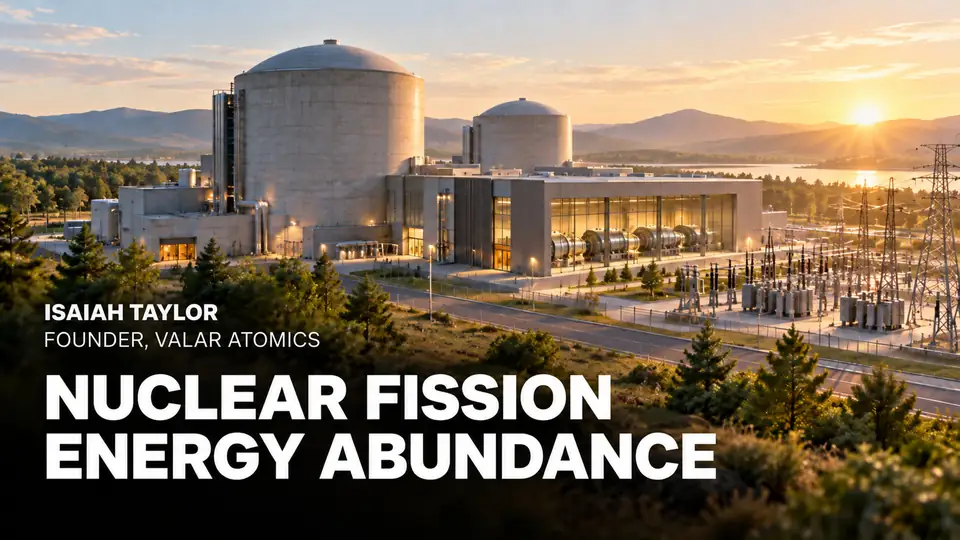
Isaiah Taylor of Valar Atomics — Nuclear Fission and Energy Abundance
Isaiah Taylor explores nuclear power, synthetic fuels and what abundant energy could make possible.
December 8, 2023 · 51 min



About the episode
In this conversation, we talk with Isaiah Taylor the founder of Valar Atomics — a new energy startup using nuclear fission to create oil & gas from thin air. At Valar, their goal is to bring the cost of energy down 10-100x and unlock a new era of superabundance.
Enjoy!
Links
Chapters
Times follow the podcast audio. The video’s timeline may be slightly different.
- 00:00Welcome to Build the Future
- 01:11Introducing Isaiah Taylor and Valar Atomics
- 01:53Nuclear energy and the regulatory environment
- 04:38Why use more energy?
- 08:53Energy efficiency, cars and incentives
- 10:40The Kardashev scale and planetary ambition
- 12:45Recovering the confidence to build
- 18:29Valar’s nuclear-to-fuel proposal
- 22:49Moving energy through existing fuel infrastructure
- 29:12Rethinking the starting assumptions
- 30:16Hydrocarbon synthesis, explained
- 33:28Comparing approaches to fuel production
- 35:44What cheaper energy could enable
- 40:53Beauty, energy and the frontier
- 45:21Intelligence, energy and dexterity
- 48:11Sources of conviction and inspiration
- 50:43Where to find Isaiah and Valar
Read the conversation
Open the full transcript
CAMERON WIESE: Welcome to the Build the Future Podcast. My name is Cameron Wiese and I'm your host. I've always been fascinated by the ideas and the sentiment that drove American culture in the 1960s with the Space Race. A culture galvanized to dream about the possibilities of tomorrow. Whether it's food, transportation, cities, biology, or anything else, it was this cultural mindset rooted in optimism. That the world tomorrow would be better than the world today. A mindset where people were compelled to build things, and I quote JFK, not because they were easy, but because they were hard. It's this desire to build and to dream that seems to have been lost, and something we're here to bring back. With Build the Future, we're here to promote the ideas and stories of those who see how the future can be better and promote their plans to get us there. It's our mission to get you to dream about the possibilities of tomorrow, to dream about the future that you want to live in, and inspire you to go build. Hey everybody, welcome to another episode of the Build the Future podcast.
CAMERON WIESE: Today we're talking with the founder of Valar Atomics, Isaiah Taylor. At Valar, they're building the future of energy using nuclear fission to sequester carbon and turn it into hydrocarbons. So creating oil and gas out of thin air. I get super hyped up every time I'm talking to a founder of something this ambitious and this world changing. And I hope you'll feel that energy coming through in the conversation. We cover Energy culture, which is a recurring theme on the podcast here and what the world looks like when we bring the cost of energy down to 10 to 100x. So phenomenal conversation. I hope you enjoy. Let's jump right in. All right, we're here in the build the future podcast talking with Isaiah Taylor today about energy, our future and Valar Atomics. Isaiah before, you know, I sort of kicked you off on a thread here about how lovely our energy environment is here in the US. You're team something up. So tell me how much you love our regulatory environment.
ISAIAH TAYLOR: I was just saying, like, it just fills me with just a great deal of anger to read about our energy environment today in the United States. And the problem is you have a lot of like good intention people who sit at various places within this industry. But if you actually ever step back and look at the physics and the engineering of what's going on in energy, it will make you truly angry as an engineer, and a lover of science and manufacturing and really just like a lover of people and wanting people to have good things, it will make you angry and it should. And what I mean by that is like, if you just look at the energy that's out there, that's like latent in the universe that's created here. There's so much, it's so abundant. And it's also really easy to capture like nuclear reactors are not that hard. It sounds insane to say that, but it's so true. They're not that hard. Like when I say that, people like, Oh my gosh, they just spent $30 billion turning on the Vogel plant in Georgia. And you start to dig into the vocal plan in Georgia and understand why did that take $30 billion.
ISAIAH TAYLOR: It's like this insane tree of decisions. And every individual line of that decision-making process makes sense in a local frame, but it's an irrational structure that's built on a few bad premises. And once you have those few bad premises at the top and a few bad inputs at the top, everything after that becomes worse and worse and worse and more irrational and more expensive and It takes longer. And so it's really difficult for people to look at that and have the conviction to say, this machine is broken because any level of that, you can find good people who are acting rationally within their frame. You actually do kind of have to be crazy enough to like look at the entire picture and say like, guys, like listen, uranium is basically free heat.
SPEAKER UNCLEAR: It's free heat. Uranium is free heat.
ISAIAH TAYLOR: Okay, can we get that far? Right, so then we've gotten that far. Or can we say also you can build it in such a way that it's fundamentally safe? Right? So right now we spend a ton of engineering effort and cost on trying to make a pressurized water reactors safe. And nobody, very few people are willing to say, well, actually we could maybe spend like hundreds of billions of dollars less and not use pressurized water reactors because pressurized water is like fundamentally not very safe. Right? But you have to reach a certain level of crazy and a certain level of angry, which I have, in order to step back and make a statement like that.
CAMERON WIESE: Totally. What really got me really just like a aggravate on this was when someone was telling the story about how they, like there's a sidewalk by one of these plants and it was not the right distance. And so they spent like six months and millions of dollars or something and like tearing up the sidewalk to move it like six inches to the right. It's like, what are we doing? Right? And everyone does obviously freak out like, oh, it's so expensive. It's so dangerous. You have all these sort of myths that now people started to dispel, but culturally we haven't really fallen in love with the idea of energy consumption. I think that's part of the problem because people are like, oh, more energy is good for humanity. So I want to, in your, it's sort of one of the I wanted to jump right into the front run is in your your ex formerly known as Twitter bio you have cardish of scale climber mouthless disrespecter age of man enjoyer asking what energy is good and Let's start there. So what do people not understand about energy Isaiah? Like what what is this sort of like?
CAMERON WIESE: Seeing people don't understand broadly and wise energy and more energy good
ISAIAH TAYLOR: Yeah, so I'll start by just kind of trying to set the table stakes here every second, the sun releases more energy, which will never be used, just into the blackness of space than all of humanity has ever consumed. So I'll say that again, more energy than humanity has ever consumed is being released by the sun every second, just into the into the void, right? Never ever going to be utilized. Yeah. So like we are so, so far off from actually using the energy that we could, it's laughable. It's almost accurate to say that humans don't consume energy compared to even just the frame of our Earth, I would even say. There are literally billions of years worth of nuclear isotopes in the Earth's crust, billions of years of energy at current human consumption rates. Then you look at solar energy, and then you look at the energy stored or another planet, look at energy in the asteroids. And then if you are able to even step outside to further rings, there's so much energy, it's almost more accurate to say that humanity doesn't really consume any energy in our reference frame.
ISAIAH TAYLOR: It's a decimal point of a decimal point. So that's one thing, just to set the reference frame, we don't really use much energy. The second thing is we should, we should use energy. And the reason for that is I like to say if you're using energy, what you're doing is you're accelerating a process that was going to happen without you. So we know because of the laws of thermodynamics that like everything is going from the state of lower entropy to higher entropy. That's just the history, that's the story of matter and of energy. Things are getting further apart, they're getting diffuse, they're seeking thermodynamic equilibriums. If you are consuming energy, quote, consuming energy, you're really actually just like redirecting energy to a different pathway, right? Because it's going to be consumed in, I would say, a wasteful manner without you. I would call, for instance, just the sun beaming energy off into the blackness. I would call that wasted in the sense that it is happening whether we do anything
ISAIAH TAYLOR: about it or not. And it is not serving our ends as mankind. And so that's, that's the second piece is like, one, we're not really using that much energy to anything that we do use was going to be depleted. Anyway, we might as well redirect it toward our own ends
SPEAKER UNCLEAR: and our goals as mankind. Especially when you've viewed in that frame, the idea of like, Oh,
CAMERON WIESE: make sure you turn your lights off. It's like, it's whole, it's hilarious. It's like, it's pitiful. It's like, why are we having this sort of low level conversation? No one should ever have to worry about whether the lights are on or not, or whether or not their washing machine is more efficient. Like, we're focused on the wrong problems. The language of efficiency probably shouldn't exist in this frame. It's like efficiency for what?
ISAIAH TAYLOR: Yeah, I think the energy efficiency framing has destroyed a lot of really beautiful things. So I love cars. Cars are just really, really near and dear to my heart. I love how they look.
SPEAKER UNCLEAR: I love how they move. I love driving them.
ISAIAH TAYLOR: And something really sad happened in the 70s when we suddenly cared about fuel efficiency. And that is that cars basically just started becoming a function of two things. One is regulation and the other is fuel efficiency. You can kind of solve for what a car looks like as a function of those two things. And the regulations obviously tie into the energy efficiency thing too. It's like cafe standards. One of the things that I always laugh about is like, there's all these people on Twitter who are like, Americans and your gigantic cars, you're so wasteful. This cars should not be this big. And I always laugh because I'm like, do you know why cars are that big in the US? It's cafe standards. So the way that the federal government regulates the shape of vehicles, they have to have a certain power consumption for a certain footprint of the vehicle. The power setting of the vehicle, it's not based on the passenger count, it's not based on the weight, it's literally the displacement, like the 2D displacement of the vehicle. So if you were to take a picture of like an SUV from above
ISAIAH TAYLOR: and you were to outline all of the visual contours, that sets your baseline for what you're allowed to consume as far as fuel. So the natural incentive there is for automakers to just make cars a little bit bigger and fatter and meatier because then they get more budget as far as like fuel consumption. And there's like 50 different things like this that we have built into our incentive structures around not consuming energy, which are quite silly.
SPEAKER UNCLEAR: What does the world look like
CAMERON WIESE: if we are consuming more energy? And then also can you for the unacquainted explain the Kardashev scale?
ISAIAH TAYLOR: Yeah, Kardashev scale is all about what category of energy are you using? So a type one society is characterized by a couple of things. One is like using the latent chemical and nuclear energy on that planet. So that'd be type one. And it's also characterized by other things like terraforming and ecological control, some extent of like, we're not constantly worrying about hurricanes and we're not constantly worrying about the temperature of the atmosphere and the ice caps melting, we kind of have those things managed the way that we want them. And the downstream impact of that is that we also can make sure that various species of animals are not dying out because we have some measure of influence over the environments that these animals live in. But we sort of have the latent energy of a planet captured. So that's a type one civilization. And I like to say there's a category of companies that are type one companies. So I would say Valar is a Kardashev type one company. We are focused on allowing humanity to actually utilize the latent energy that is in the earth's
ISAIAH TAYLOR: crust. Another example of a type one company would be Rainmaker Augustus' company. So he's working on controlling the weather. That's characteristic of type one. The one that's missing and like let me know if you know who's working on this is like the actual physical terraforming that's that's another thing about type one societies is they they generally can control the topography of things and maximize you know human living for an animal species and you know whatever it is that our goals are for the actual topography of things.
CAMERON WIESE: I think a mutual friend of ours think nazjack was really excited about terraforming the salt and sea at one point. It's sort of starting that project, but.
ISAIAH TAYLOR: Okay, let's go Jack, let's get on it.
CAMERON WIESE: We used to dream about like, we used to have these big bold grand ambitious plans. Like you say, oh, what's Terraform this thing today? Everyone's like, that's crazy. You wanna do what? Oh, you wanna control, like you can utilize the energy of the planet. You wanna like make it rain. You wanna build mile high skyscrapers or anything. It's just sort of the boundary of people's imagination is capped and I can't figure out what happened like There's the you know, you read those reports from the the 50s in the 60s when you know The post-war era and I was like, hey Let's go like let's dream as big as we can and the archives are full of vision to the future that are compelling And they're all worked out and like we're sitting here today. Like what should we go build? What problem should we solve how to solve them? All the work has already been done It's just like you have to go to the Library of Congress or you'd go on eBay and you buy one of these like manuals that sort of is printed out on a spiral bound thing like, you know, like this,
CAMERON WIESE: and you just say, okay, what were they planning? And then you sort of you go from there.
ISAIAH TAYLOR: That's so true. That's so true on like on a million different technology sets. So much work has been done for us already. All of the not just like the theoretical science, but even like prototyping and testing has been done. Like you can find, yeah, just like hundreds hundreds and thousands of pages of actual tests that were done in America, in Antarctica and all these different places that we were looking at, like how could you actually build the best possible nuclear plant? Could we actually control the weather? So yeah, I totally agree. It's very disappointing. Speaking of like these bound notebooks, this is just a call to whoever's listening request for startup. I really want somebody to make a printing company that basically just takes some of really aspirational, like awesome old government reports and binds them into like a really nice binding. Like I would buy those and just like put them on my shelf. I'd pay a lot of money for those. They're so, so inspiring. The aesthetics are incredible. You'd want to kind of like make
ISAIAH TAYLOR: them make them look nice. But yeah, request for startup. Somebody please do that.
SPEAKER UNCLEAR: That's a great idea. Yeah. But like, but like why we got demoralized as a nation,
ISAIAH TAYLOR: we became demoralized. And I think one of the, so that that word demoralized is interesting. What does it mean for a group of people to be moralized? Well, one of the things it means is that you believe that what you're doing is moral. What you're doing is right. And we stopped believing that what we were doing is right. I would say technological development and climbing the Kardashev scale and these things that we're talking about are like really uniquely American. It's not that other countries haven't, other countries have worked on some really, really incredible technologies and lots to admire, but there is a distinctly American spirit of innovation that I think was perfectly exemplified by the Apollo missions. Just guys hanging out in Florida and in Texas just deciding to go to the moon. We're going to the moon. If you read Jules Verne in the early 1900s, he's a Frenchman, right, but he has this like visceral understanding of like the American spirit. That's like we are in the swamps of Florida, but we are going to the moon. And I think a huge part of that was that
ISAIAH TAYLOR: we believed what we were doing was right. And at some point we just lost our confidence that what
SPEAKER UNCLEAR: we're doing is the right thing to do. There's a beautiful scene from one of Jules Verne's books from the Earth to the Moon. You have the gun club and they're-
CAMERON WIESE: Yeah. And do you remember that scene where everyone was getting all riled up, everyone was excited, you know, people were in the streets, they were like, we're going to the moon, we're going to the moon. And then you had that, there's this one end of the chapters, this British play right was like doing a tour to the US for much ado about nothing, Shakespeare's play. And people were so like, again, they're like, what do you they thought it was sort of a commentary on like, their mission and their enthusiasm. So on opening night, people ran into the theater
SPEAKER UNCLEAR: and they ripped up the seats and they tore me down.
CAMERON WIESE: They're like, don't you dare bring that attitude over here. Like, much to do about everything. Like, we're not tolerating this. And that is certainly not the sort of the zeitgeist today. Getting back to the future. It's like, how do we tap into that spirit?
ISAIAH TAYLOR: Yeah, well, one of the most important things to do, I think is like to remoralize and that means gaining conviction again that what we're doing is right. I think that the mission of Valar Atomics, which is to provide abundant energy to mankind is morally right. It's not just that there's nothing wrong with this. Environmentalists would try to say that there's something wrong about consuming energy. I wholeheartedly reject that, but I also think that it's a specific positive good. It's a specific positive good to lift people out of poverty with energy. That's one of the things that giving people energy does is that it allows them to do a lot more with less. If you look at energetic societies and societies that have high standards of living, those things are really, really highly correlated. And especially, I think, as AI and robotics start to take off, energy is gonna, again, become a really, really important leverage point for people being able to eat food and see their loved ones and get cheap houses and all these sorts of things.
CAMERON WIESE: Yeah, that's the thing I think people fail. All the good things that everyone has access to now is directly tied to energy that was put into making it. And the cost is, I mean, the cost for most of these things is constrained by energy. Okay, so let's like, I wanna sort of be a little expansive on all the things that energy can enable, but before we do that, tell us about Valar. It's sort of like how you're going about making energy abundant for everyone.
ISAIAH TAYLOR: Yeah. So Valar is something that I have been thinking about for a long time. It's sort of a five or six year problem that I was trying to solve in my head and with research and having conversations. I recognized from pretty early on that nuclear energy, the physics of nuclear energy is just this unbelievable boon to mankind. Uranium is free heat. It really is. This tiny, tiny little amount of substance can power homes for years. They can power transportation for years. But we've gotten really, really divorced from that in the nuclear industry. So we've gotten very, very far from the base physics for a variety of reasons. The biggest is really regulatory, but there's also risk-taking and lack of belief and other problems, but the core of it is really regulatory. So I started thinking about how can we get around this, this, you know, chicken and egg problem we have here where like nobody, the regulators aren't going to change what they're doing, because there's no real pressure to do that. The American public perceives nuclear
ISAIAH TAYLOR: as being very dangerous. Nobody really understands how cheap we could do this, if we really wanted to. And because of that, like, there's not really a big incentive for regulations to get better. We have to jumpstart the system. We've got to apply the leads to the terminals and actually jumpstart this engine. The way that I want to do that is really interesting and you might find it extremely unorthodox, but it's quite beautiful when you come to see the whole picture. What we want to do is we want to mass manufacture nuclear reactors, but we want to do that in a way that will look very, very different from any other nuclear that you see today because we're going to start from the physics and we're going to from the engineering, we're just going to build reactors the way that they really ought to be built. And you might say, well, okay, why is nobody doing that? And the short answer is because it's illegal. It's illegal to do that. Right? So, okay, it's illegal. How do we do it? Well, the answer is we do it outside of normal operating environments where you would normally operate
ISAIAH TAYLOR: nuclear. We're talking about other countries, we're talking about audit C, we're talking about places that the NRC is not used to regulating and maybe is going to, you know, make exceptions for or will simply be outside of their jurisdiction. Okay, great. So you've got mass deployed nuclear out in the middle of nowhere. Well, what do you do with that? You've got a terawatt of energy out in the desert or out at sea, what do you actually do with that? Well, one thing you could do is you could try to string like long range, high voltage direct current lines into local grids. That's actually, that was my first idea about five years ago, I wanted to do that. There are other startups that are actually wanting wanted to do that in Indonesia. But the problem with that is it's still a regulatory problem. It's actually still a civil infrastructure problem. So the problem with that is grids can't support that much energy. And even if they could, you still have to get this regulatory approval to stretch lines across the ocean. You have to get regulatory approval to tie
ISAIAH TAYLOR: into these grids. They don't really have the capacitance for it anyway. There's all these issues with that. So what do you do? What do you do with this infinite free energy that you have out in the middle of the water. Well, what we do is we actually synthesize fuel. So we create oil and gas. And that sounds crazy, but it's not nearly as hard as it sounds. You basically just pull carbon dioxide out of the air. And you can also pull water out of the air or you can pull out of the ocean or wherever you have access to water. And you split the water apart into hydrogen and oxygen, and then you bond the hydrogen with the CO2. And that makes a very simple hydrocarbon called methane. Methane is natural gas. It's how 40% of electricity is generated in the US and 30% of electricity globally. So it's a really good place to start. Once you have methane, you can also make a variety of hydrocarbons on top of that, you know, jet A and diesel and, you know, basically the kerosene type fuels are just longer chains of these hydrocarbons, right? And you all you really need to do that
ISAIAH TAYLOR: is the sort of physical structure to allow those reactions to take place and a lot of energy, a lot of energy. And so that's what we're going to harness nuclear for.
CAMERON WIESE: So when you have the hydrocarbons, like since you have the methane out in the middle of the ocean, like, don't you run into the same problem of like, transferring the electricity, like piping, like grid lines? Like, where, how do you, how do you move from point A to
SPEAKER UNCLEAR: point B?
ISAIAH TAYLOR: Yeah, that's a really good question. So it turns out that moving hydrocarbons around the world is a lot easier than moving electricity. It's a little bit counterintuitive. But one One way to think about it is hydrocarbons are their own battery. If you have a battery that's made of lithium ion and it's supposed to take a charge, the chemical reality of that thing is different than the charge that it's holding. You have a ton of weight that's basically disassociated from the energy itself. Hydrocarbons are very different. The battery with a hydrocarbon is actually just like the metal container. The energetic substance itself is poured into that container. So I would say like today, before we have like a sort of a very robust global infrastructure of direct like high voltage lines, it's actually far easier to move lots of energy around the world by putting it into tanks. So like there are massive tanker ships that transport LNG all around the world. Europe right now is actually significantly its greatest significantly powered by LNG that's coming from Texas.
ISAIAH TAYLOR: So yeah, we're liquefying methane in Texas and we're loading it into these like massive LNG ships and shipping across the ocean to Europe because they used to be getting it from Russia and they don't want to do that anymore. So now they're getting it from the US. So yeah, there's a lot of different ways. The other nice thing about hydrocarbons is just there's this massive, massive industry around moving hydrocarbons around. It's really one of the most incredible industries in the world. We've got a lot of friends who work in hydrocarbon, I would just say transportation, right? So you're getting it from point A to point B. And really, some of the most incredible technology and incredible people work on that. Yeah, all the time.
CAMERON WIESE: That's part of that's what I wanted to tee up because I think there's this existing infrastructure for oil and gas all over the world we move. What's the total sort of total annual volume we're moving and oil like the tens of tens of billions of gallons like
ISAIAH TAYLOR: I don't know the barrel count. I know that like it's on the order of one it's around $1.5 trillion of methane alone. And then you've got separate trillions for various grades of liquid hydrocarbons after that.
CAMERON WIESE: So as long as you set up the you produce it, and you can like load it into one of these tankers, you're pretty much good. And then like, because it because at the end destination, whether they're going to the you know, port at Houston or port in, you know, Great Britain, like, or port in, you know, somewhere in the in Asia, like the infrastructure is already in place. It's like, cool, you're just here a lot of here, we're going to suck it out. And it's gonna be already piped in versus like, how do we, yeah, I think that's a very sort of underrated component of all
SPEAKER UNCLEAR: this.
ISAIAH TAYLOR: Yeah, yeah, I think absolutely. Like we're, what I'm trying to do is I'm trying to energize like some existing rails, right? So we have trillions of dollars of normal energy rails, which today is almost entirely hydrocarbons. That includes like coal, by the way. So like coal is a hydrocarbon. It just has a lot of like oxygen and sulfur and other things in it, which makes it like particularly weird to burn and it's exists in kind of varying grades of purity as well. But coal is also a hydrocarbon. And it's also one of the big ways that energy gets around the world tends to be on trains, right? So you can sort of pour it into an open train and move it to your your power generation station. But yeah, like this is currently how we get power to people. And I would say it's a beautiful system. I really love it. Like there there's there's some real beauty to that system today. Also, pipelines themselves are a lot easier, counterintuitively, they're actually a lot easier to lay than high voltage lines. The interference, it has
ISAIAH TAYLOR: to do with the interference of the electrical current with the ground. So if you're putting a pole like an electrical line high up in the air, you don't have to worry about ground interference, but then you're paying the cost of actually stringing a line above ground. So there's always this trade off with electrical transfer. And I'm sure like in, let's say 20, 30 years, our inner connectivity of our grids will be way better. But there's also this like completely separate problem with which is capacitance. So like even if you have perfect connectivity all over these grids, if one area like has a sudden demand surge, and this other area has less, or if everybody has a demand surge or everybody has less, storing that energy and having capacitance for that is really expensive. We don't have cheap ways to store lots of power today. You're either looking at batteries, which are really expensive. Some places pump water from location to location. So if you have a lower pond and a higher pond, you could pump the water up,
SPEAKER UNCLEAR: and that's kind of like a battery, right? The things we do, man, to try and make this fit in a different system.
SPEAKER UNCLEAR: Yeah, yeah.
ISAIAH TAYLOR: Well, it's, you know, there's, like I said, a lot of this has to do with people that are acting rationally within a local frame. And I have a lot of respect for everybody who works in energy, because they really are working on some of the most important stuff in the world. Like getting gigawatts of power around to the people who need it is amazing. And you know, capitalism rewards people for doing that. But yeah, man, I just want to see it. I want to see it go 100x. Like I want to see us use a hundred times more energy. I want to see our Nat gas stations, you know, just peaking constantly and burning tons of methane and giving people tons of energy.
SPEAKER UNCLEAR: And yeah, that's where we're headed. In which way is, you know, using these,
CAMERON WIESE: like the infrastructure to do that with hydrocarbons is already there, right? More or less. Versus like, I think it's an often overlooked point. Like, well, we have to go build up this whole new electric grid with dandel storage with the transportation, like routing and all that. It's like there's other there are other solutions here. It's like I don't know why I'm super excited
SPEAKER UNCLEAR: What you guys buildings? Yeah, that's that's exactly right
ISAIAH TAYLOR: like people are talking about spending trillions of dollars on like trying to Retrofit, you know Nat gas systems to use hydrogen for example And that's very expensive because you have to like you have to rework all of those pipelines You have to retrofit all of these turbines to burn hydrogen It's like guys like what if we actually just made gas cheaper? Like what if we just made the gas ourselves and made it really cheap? I like that better
CAMERON WIESE: What do you think is again, is this just like a frame thing, or most people aren't looking like the higher order of the system, they're like, okay, like, what is actually necessary here, and everyone's sort of incentivized to, you know, focus on their own their own piece. Because if like, rationally, it's like, okay, how do we have all this infrastructure? What's actually going to lead to better energy production consumption?
ISAIAH TAYLOR: One of the issues here is just that, again, we've stopped really innovating, and we've stopped looking at the base properties of physics and thinking about how we can apply them. I would say the energy industry, how it is today, is just really focused on efficiency and optimization because the base level is basically understood, or at least everyone thinks it's understood. Everyone thinks like, okay, these are the base prices, these are the regions where gas comes from, this is what they'll cost, and it's all priced in. And then everything after that is trying to solve for those base conditions. And we just forgot that the base conditions aren't true. So like energy, base energy really can be a thousand times cheaper if you utilize some of these properties of physics that are underutilized.
CAMERON WIESE: Can you do a quick like explain like I'm five on hydrocarbon synthesis?
ISAIAH TAYLOR: So actually let me just start from like energetic chemistry. So when you're talking about chemistry and getting energy from chemical fuels, you're really talking about like the difference in bond energies. So, if you have a free-floating molecule like H2, that wants to be bonded with something else. It has low bond energy in that state. So, you have a bunch of free-floating H2. Now compare that, and actually let's say you have sort of three buckets. In one of them, you have free-floating hydrogen, you have another bucket with free-floating carbon atoms, and then another bucket with free-floating oxygen molecules. So you've got hydrogen in a bucket, oxygen in a bucket, and carbon in a bucket. All of those things have relatively low bond energies amongst them, bond strength, I should say. If you were to reconfigure all of those into water and CO2, what will have happened between those two states is that you suddenly now have extremely tight, high strength bonds between those things. So water is a very high strength bond, CO2 is a high strength bond.
ISAIAH TAYLOR: And so going from these buckets of separate elements to this bucket of water and CO2, a lot of energy was released in the formation of those high strength bonds. And that right there is like the basis of all chemical fuels. We're really talking about taking things that are loosely bonded and getting to tight bonds and the release of energy in that process. So a hydrocarbon specifically is actually a little bit down that process. So if you think of like completely free-floating hydrogen to completely bonded water and CO2, a hydrocarbon is like 10 steps down that path, which is actually if you think about a little bit of a waste of energy, because if you started out with that bond that was like free-floating and you got to a loose bond, you used up a bit of energy in that process. But the reason we do it is because hydrogen itself is a really difficult thing to work with. It permeates through metal and in brittles metal, it's very, very volumetrically not dense. When you add a carbon atom in there though, it actually becomes a very beautiful and tractable chemical. It's like not toxic.
ISAIAH TAYLOR: That's a huge thing. It doesn't in brittle metal. It doesn't seep through things. You could pack a ton of it in a very small space. So the presence of the carbon in there is really, it's just something that makes it tractable. It makes it useful to us in engineering. But yes, as far as the practicality of that, there's a variety of catalysts that will perform that bond to various groups. So the simplest one is methane. It's CH4. We've known about the process to create methane from hydrogen and CO2 for a long time. It's very simple. It's called the sabbatia process. There are a variety of processes to make stuff out of longer chain, like Fischer-Tropsch synthesis. But yeah, like all this stuff has been known for a long time. And honestly, we've just been sleeping on it.
SPEAKER UNCLEAR: What's old is new again. Yeah, exactly. Sweet. Thanks for that little primer, not
CAMERON WIESE: to date the conversation, but the fun sort of like battle that's happening online, where Palmer sort of jumped to your defense, your defense, but he had this sort of like statement that he made, and I'm curious what your take on, which was, so my personal bet is on large scale GMO macroalgae cultivation in the Pacific desert, but the fusion fission powered
SPEAKER UNCLEAR: stuff has a place. Yeah. What are your thoughts?
ISAIAH TAYLOR: This is something I have interacted with a few times. It's interesting. People are looking at biosynthesis for a lot of different things. The problem with that is your energy source for that is still solar. That just means you're going to be working with low densities. There are other people working on, like Terraform Industries is working on solar to fuel, Prometheus, is, fuels is doing that as well. I would class the algae stuff generally into the same category, which is you're trying to... You basically are worried about the actual synthesis part rather than the energy source part. And if you're doing algae, your energy source is sunlight. So it's similar to like, oh, could we just do what Terraform is doing, but without the solar panels and without the generation equipment. So it's an interesting concept. I would just say, The hardest part of doing this is actually getting the energy. That's the hard part. We've known for a long time how to synthesize hydrocarbons. And great, amoebas can do it. But they're still going to need to get their energy from the sun.
ISAIAH TAYLOR: That means it's always going to use up a lot more space, a lot more land. It's going to be just less dense. And density is really, really important if you want things to get cheap.
CAMERON WIESE: With either outcome, I mean, also it's good that we have more people just taking bets and working on this space. It's like, I think there are a lot of people get lost in the dialogue like, oh, it's like, this approach is that approach. The fact that we have to be taking multiple approaches to all these things.
SPEAKER UNCLEAR: Yeah, yeah, absolutely.
ISAIAH TAYLOR: And everyone who's working in this space, I absolutely love. If you are trying to figure out how to get more energy into people's hands, you are my friend hands down. That's true about people who are trying to solar max. I've got a lot of friends who are solar maxis. And I'm like, dude, power to you. I'm going to beat you, but power to you.
SPEAKER UNCLEAR: keep going. No pun intended, of course. Yeah, exactly. So what is sort of, you know,
CAMERON WIESE: what sort of things we're doing 10, 20 years from now, when we have sort of abundant energy, like abundant energy, at what point does Valar sort of cash out into not like financially, but in terms of like, this sort of changing the landscape? Because is it all just like, all sort of like hydrocarbons, ultimately, sort of being synthesized through carbon sequestration?
SPEAKER UNCLEAR: through this process powered by nuclear. Yeah, I think so. I think it absolutely will be because
ISAIAH TAYLOR: I think in the terminal frame, it's the cheapest way you can possibly do it. So I don't see like gas drilling going away anytime soon because it's going to be a long time before Valar is producing trillions of dollars of hydrocarbons. Hopefully, it won't be that long. I want to be producing trillions of dollars of hydrocarbons in like 15 years. But until then, and even maybe at that point, it's still going to make sense for them to operate existing wells and that kind of stuff. I don't think the hydrocarbon, the drilling industry is going anywhere anytime soon. But yeah, in the long frame, if we do nuclear right, it is going to be the cheapest source of energy without the slightest comparison. It won't even be funny. Actually, that is how it is today. That is how it is if you actually look at the uranium itself, right? You're pulling uranium out of the ground and how much energy is in that stuff is incomparable. Like it's just simply not even comparable to any other energy source that we know. The problem is that all of the other infrastructure around that consumption is
ISAIAH TAYLOR: like irrationally expensive today. And that's, that's what we need to fix. That's what Valorant's, you know, needs to fix. But yeah, to answer your question of like, what kind of stuff are we doing? For one thing, we're going to be using a lot more inference, like AI inference. So like energy is already starting to be the bottleneck on AI. Microsoft is trying to get some nuclear stuff spun up to run their data centers. You know, hit me up, hit me up Microsoft. We'll figure some out.
CAMERON WIESE: We'll call Satya. We'll be like, hey, get on this.
ISAIAH TAYLOR: He just needs to be able, he needs to be willing to do something a little bit more unorthodox in other places. But yeah, so like long-term, that's one big thing is like, there's going to be a lot more compute applied to every aspects of our lives, which is going to be awesome because you will basically have a supercomputer that's actually consuming a lot of power, thinking about your everyday life and optimizing things for you, which will be super fun. But in the physical world, we'll also do things like the basis of transportation will drop. So right now, energy is I think like 40% of transportation costs. So if we significantly drop that, that's just like transportation getting 40% cheaper overnight. So we're talking about, you know, flying to visit your grandma is suddenly 40% cheaper. That's fantastic. There are other I would say another class of things is just like automation and manufacturing, all like materials that have that have energy in as an input are going to get cheaper, which will have cascading effects into into
ISAIAH TAYLOR: other things. And then, you know, if, if like the robotics and AI industry kind of figure their aspects out, like what Optimus is doing and what Figure is doing, then that just really amplifies it. Then, you know, cheap energy translates directly to
SPEAKER UNCLEAR: cheap consumer goods. Yeah. So, like, and then you think about how this links to food production,
CAMERON WIESE: so, you know, if they're doing any sort of vertical farming, you know.
ISAIAH TAYLOR: Yeah. It's not just vertical farming, but like, how much does it cost to get the phosphate you need? Like, how much does your potash cost? How much does your, you know, ammonia, like, Those are, there's a significant component of our food, which is just like how much does your energy cost? So yeah, it's almost hard to find a sector that's not going to be directly affected by energy getting cheaper. Also this is kind of hard to imagine right now, but like, you know, Starship launches with methylox. So Starship is methane and liquid oxygen. And I think I read like the Falcon 9 is about $250,000 worth of methane fuel per launch. So yeah, I would like to see that go down to like 50K, right? Like let's launch five times cheaper Elon, let's go.
SPEAKER UNCLEAR: Yeah.
CAMERON WIESE: And like, you know, it's the cost of energy, the cost of compute, the cost of, or cost of intelligence and the cost of like going to space. And all of the, I mean, pretty much all of these things are linked to our energy consumption. And we drive that cost down and like the world is going to be very, very different as a result. Right now we're playing in a sort of, you know, restricted frame. It's like, oh, this is, we have all these limitations. People are talking about erroneously like, oh, we should probably limit the number of flights people are gonna take every year. It's like, no, other direction, 10 exit, you should be able to like, today, be like, you know, I wanna go see my cousin, to my grandmother, get on a plane and go do that. And everybody should have access for 50 bucks.
SPEAKER UNCLEAR: Here's another thing,
ISAIAH TAYLOR: like we should be able to do those things frequently, but also the aesthetics of our world should be less shaped by energy consumption. So going back to what cars look like, if you go back and see what cars looked like in the 60s, they were beautiful works of art. What they weren't is energy efficient. You have these wings coming out that look beautiful and don't actually work great in a wind tunnel, but we have them because they looked great and they looked beautiful. And that's how cars should be. The purpose of wind tunneling should be limited to safety and order of magnitude, energy costs. difference, not optimizing the shape of this thing to the perfect decimal to make sure it's optimally energy efficient. I want the car to be a work of art. In fact, there are many things in the human experience that should be a work of art. Apple gets to do this because energy doesn't really have much to do with this thing. They get to make this beautiful because the energy input is not something you think about on a phone.
ISAIAH TAYLOR: But in areas of the human experience where energy is a large factor, things tend to be ugly because we optimize our own energy and the constraints of energy efficiency and the constraints of beauty are two very different things. And I would like to see humanity curve back toward making things more power hungry and more beautiful.
CAMERON WIESE: What's the aesthetic of the future that most resonates with you that you think should guide and shape the things we build?
ISAIAH TAYLOR: I like future Rome. So like I like this concept of like future Roman. I think that Heinlein, Robert Heinlein did a really good job of portraying that. So he has like his concept of I think it's new Rome on Mars is really, really intriguing. Like it's it's he has this he has this idea that as you sort of go out to new planets, you have this like colonization filter. So if you think of the people came to America, there's this really strong filter and like the character of who those people were, they had huge risk tolerance and they had gusto and they had agency and all these things and a certain amount of intelligence too, although that wasn't the main thing, which I think is important by the way. Yeah, Heinlein has this idea that one of the ways that humanity excels is we keep going to new places, which keeps introducing this filter of people that are increasingly high agency. Yeah, I think that's very coupled with the Roman aesthetic. So I would say like future Roman makes a lot of sense.
CAMERON WIESE: Like the preservation of the agency or the sort of, it's like, I remember where it was like, having the frontier, having a frontier to pursue, like always allows sort of people to be like, Hey, you know, I'm comfortable and excited about what it is. But for those people, you know, like you and I share this sort of like, afterwards, like, no, like what is new? What is like, what is out there to explore? How do we create it? I think like, that's, that's, you know, Two sorts of things that can be very disconcerting to people is like, I like my day to day life in Paris. You know, like, let's keep it the same. It's like, yeah, we should also be building new things. Like, let's preserve this sort of historical and be creating the new.
ISAIAH TAYLOR: Yeah, I think that actually the coupling between those things is really important. Like I'm actually not aesthetically attracted to some of the like EX stuff you see where it's just like purple lights and metal everywhere. There actually is objective beauty and it's not actually just whatever is most technologically efficient. But on the other hand, we should be maximally on the frontier pursuing technological excellence. We should have a cohesive home, we should have a cohesive society and nation. That's the Roman aspect. But then, yeah, we should also be at the frontier pursuing things as hard and as fast as we can. So I'm EAC on the frontier, I'll say that.
SPEAKER UNCLEAR: Totally, totally.
CAMERON WIESE: Yeah, it's so funny how the discourse sort of gets modeled online. It's like, let's just build cool things. I like the future. Let's create it. There's this interesting idea of, with digital pre-visualization, we'd sort of visualize and imagine these things and give people the sort of reignite their wonder and their awe and be like, oh, that's what we should be doing. We should, in theory, actually in practice, be able to design a gigantic skyscraper that is literally made out of wood. It's like a tree. It's like you sort of growing or something or it's like it's like not feasible today Like that should be the sort of world where it's like, oh cool. Like let's build this let's try and geo engineer that or
SPEAKER UNCLEAR: You know innovate on this. So well, we have the ingredients
ISAIAH TAYLOR: So the like the three pillars of basically everything man-made are intelligence energy and dexterity and We have all three of those ingredients like we have intelligence from our own minds but we're also starting to teach microchips to be intelligent. Dexterity is a long battle that's mostly, I would say, hampered on how intelligent are your systems. As soon as we have AGI, I think that robotics will quickly follow. And then energy is what Valar is working on. Once we have all three of those ingredients in our hands, there's actually nothing stopping us from converting the asteroids into O'Neill cylinders. And we should, we absolutely should.
SPEAKER UNCLEAR: Yeah.
CAMERON WIESE: I said that on my favorite sort of visions of the future. It's like they planned the whole thing out. They solved all the technical, they're like, well, how's this gonna work? How's that gonna work? Oh, we need, you know, lunar launchers or like, lunar modules to be able to like, extract materials and then ship them out into lower, or like into, you know, L5. And then, you know, have these robotics to be able to construct and it's like, you have all these studies from NASA, you know, back in the 70s and 80s.
SPEAKER UNCLEAR: It's just like...
ISAIAH TAYLOR: I toured the other day, some of those illustrations of the O'Neill colonies. Those were so, so cool.
CAMERON WIESE: Yeah. Yeah. It's like one of those things where like we're able to stand on the shoulders of giants is like Rick Guidus, Don Davis, and Gerardo O'Neill sort of like, I mean, Gerardo O'Neill sort of put forth the idea and that it was visually brought to life by Don and Rick and Sydney and a few others. And like, that's what you and I resonate with. Like, oh, we see the aesthetic. We're like, oh, that's what could be possible. And that's what resonates with larger swaths of people who's not everyone's going to read the NASA settlement design study. But they will see the art and be like, oh, I want that.
SPEAKER UNCLEAR: Yeah.
ISAIAH TAYLOR: But in order to make these things possible, I'm going to go back to like, we have to be remoralized as a nation, especially amongst the young men. We need to have no guilt about what we're doing. And it's kind of hard because most media, like if you look at Wired or you look at like any of like the media publications that talk about tech, they will like default try to convince you that tech is bad. Like that tech is morally wrong, that money is morally wrong. Like they will try to make you think that if you are a tech billionaire or trying to become a tech billionaire, that you are a bad person. We need to throw that back in their face strongly. We need to say like, No, this is morally good. It's actually good that we're doing this. It's bad that you're trying to stop it actually. And yeah, like we need to take back like the moral narrative from them. So like that's actually something I think that is important for podcasts like this and other aesthetic projects because yeah, like we have to believe it again.
CAMERON WIESE: What was the, if you were to point anyone to any resources or like books or movies and things like, where do you go to sort of like feel that sort of more like re-invigorate your spirit with that moral imperative?
ISAIAH TAYLOR: That's a really good question. For me, personally, the moral imperative is explicitly Christian. So I'm a Christian and I think that God created the universe to be fundamentally abundant and he also gave mankind authority over it. So for me, it's actually quite simple. I'm directed by God to take authority over the Earth and over the universe and to shepherd it. So it's pretty simple. But as far as the aesthetics go, I actually find just a lot of inspiration in the past. I need to start consuming some of the futurist stuff, but the past is very inspiring to me, even just as it was. Apollo 13 will never not be just an incredible aesthetic experience of like resolve and grit and just prowess in the face of adversity. Like we need that mentality again. Like everyone in that building was like absolutely convinced that what they were doing is the best possible thing that they could be doing with their time. And that showed up in the competence and the prowess and in the ambition.
CAMERON WIESE: Yeah, one person that I wanna throw on your radar is Sombard, Kingdom, Brunel. It's sort of this like guy who is sort of mandate from having like building tunnels, building bridges And he just like, like this one guy, like wasn't Robert Moses in New York. He was like one guy's like, I'm on this mission. How do we build things?
SPEAKER UNCLEAR: He just did it.
CAMERON WIESE: He's like, everyone sort of like had the mandate like, okay, this is good. We need to like elevate people from poverty, you know, bring sort of the world to, you know, increase energy consumption, like build the future that we want to live in. So, I mean, that's the whole point, man. It's like, how do we get people to dream again? Feel that like doing these things is good and can be good. and then sort of getting like, okay, well, what can I do? How do I step up and take some responsibility for building the future that I want to live in?
SPEAKER UNCLEAR: Life is what it's all about.
ISAIAH TAYLOR: We also need to embrace the cowboy a little bit more. So like when societies grow rich, they become slowly less cowboy and they become more risk averse. But like great things are really built by cowboys. They're built by frontiersmen. If you want to read a book that I think really encapsulates that really well, The Right Stuff by Tom Wolf, absolute classic of just American dudes being guys. It's fantastic and we need that attitude again for sure.
SPEAKER UNCLEAR: Sweet man.
CAMERON WIESE: Where can we find you, get involved? No, obviously you're hiring. So where can people, where can we channel people?
SPEAKER UNCLEAR: Yeah.
ISAIAH TAYLOR: I mean, we're building the future of energy. We want all of mankind to have abundant energy and specifically abundant hydrocarbons today. So if you are a world-class engineer, world-class operator, or investor, you can find me on x.com, Isaiah underscore P underscore Taylor, or just search Isaiah Taylor and scroll through tweets until you see somebody genuinely unhinged to saying that nuclear should be basically free.
SPEAKER UNCLEAR: And yeah, give me a follow and apply. I do. This has been a blast. Thanks so much for coming on.
SPEAKER UNCLEAR: Thanks so much. Yeah, good talk to you. Thanks for joining us for this episode of the Build the Future
CAMERON WIESE: podcast. If you loved it, we'd be really grateful if you share it with a friend or post a review on whatever wherever you're watching or listening to this. That's it from us. We'll see you next time. Until then, go build.
More episodes
All episodes Thomas Eiden — Atomic Alchemy and Radioisotope ProductionThomas Eiden discusses how hands-on experiences could help people understand nuclear technology.
 Dan Grech of Global OTEC — Ocean Thermal Energy ConversionDan Grech explains how the temperature difference between surface and deep ocean water could generate electricity.
 Alex Trembath — Policy, Food, & EnergyAlex Trembath argues for climate stories that make resilient infrastructure and a more abundant future tangible.