

Build the Future Podcast
Dan Grech of Global OTEC — Ocean Thermal Energy Conversion
Dan Grech explains how the temperature difference between surface and deep ocean water could generate electricity.
June 29, 2021 · 31 min



About the episode
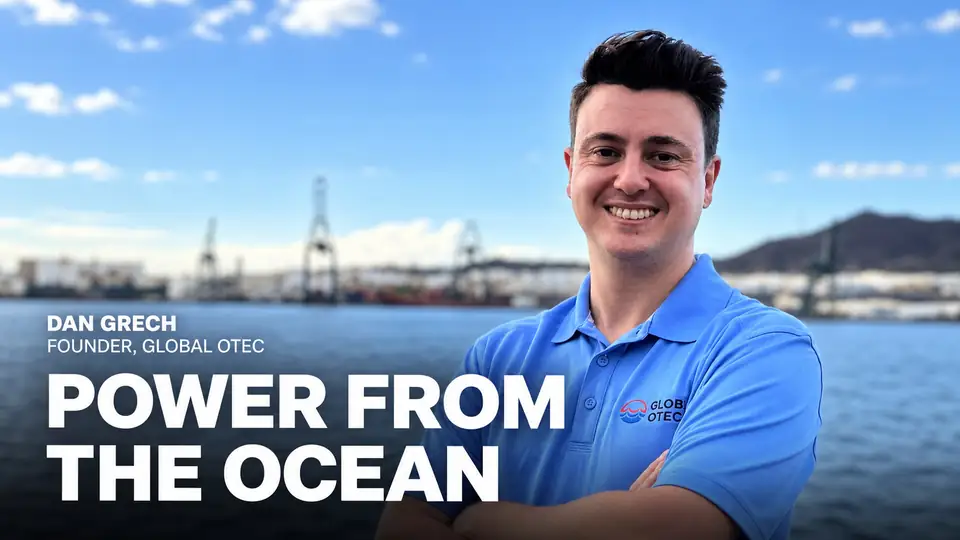
In this conversation, we talk with Dan Grech the founder and CEO of Global OTEC. At Global OTEC they're deploying OTEC (ocean thermal energy conversion) technology to advance an underutilized path to clean energy production!
Links
Chapters
Times follow the podcast audio. The video’s timeline may be slightly different.
- 00:00Introducing Dan Grech and Global OTEC
- 01:39Disney and thoughtful experiences
- 04:38The spirit of Disneyland
- 05:38How ocean thermal energy conversion works
- 07:24Why put the system offshore?
- 08:45Delivering power to shore
- 09:22Island energy needs and a renewable mix
- 11:54Why OTEC has remained underused
- 14:19The challenge of commercial deployment
- 17:33From demonstrations to commercial plants
- 20:44Starting at a manageable scale
- 22:28Working with oil and gas expertise
- 23:51Curiosity, persistence and a shared mission
- 25:13From resorts to island states
- 26:16Global problems and local partnerships
- 29:10Where to learn more
Read the conversation
Open the full transcript
CAMERON WIESE: Welcome to the Build the Future podcast. My name is Cameron Wiese and I'm your host. I've always been fascinated by the ideas and sentiment that drove American culture in the 1960s with the space race. A culture galvanized to dream about the possibilities of tomorrow, whether it's food, transportation, cities, biology, or anything else. It was this cultural mindset rooted in optimism that the world tomorrow would be better than the world today. A mindset where people were compelled to build things and I quote JFK, not because they were easy, but because they were hard. It's this desire to build and to dream that seems to have been lost and something we're here to bring back. With Build the Future, we're here to promote the ideas and stories of those who see how the future can be better and promote their plans to get us there. It's our mission to get you to dream about the possibilities of tomorrow. Dream about the future that you want to live in and inspire you to go build. Today we're talking with Daniel Grech, the CEO of Global OTEC.
CAMERON WIESE: At Global OTEC, they take advantage of OTEC, or Ocean Thermal Energy Conversion Technology, to create clean, renewable energy from ocean water, providing this with a new sustainable energy option. In doing this, starting with Tropical Islands, Dan and his team are paving the way for OTEC technology to be further deployed around the world, thus giving us another energy alternative
SPEAKER UNCLEAR: to fossil fuels. Let's jump right in.
CAMERON WIESE: I'm some real-time Disney fans.
SPEAKER UNCLEAR: Oh yeah. Yeah. Yeah.
CAMERON WIESE: What's your favorite part about the parks? Like, Disney, Disneyland, Disney World,
SPEAKER UNCLEAR: like, what do you love the most?
DAN GRECH: The food, the restaurants. My girlfriend was kind of a Disney nerd for years. It was always her dream to work at Disney World. She'd been going two or three times a year before she met me. And I was a little skeptical when we first met. I was like, oh, yeah, you know, I kind of, I like Star Wars and Toy Story, and Disney was part of my childhood. but am I gonna be an adult Disney fan? And I took the leap. We went out to Walt Disney World in Orlando for 10 days and I was completely converted. It's not just the food. It's how thoughtful the experience is from interactions with the cast members through to the details as you're walking down Main Street or walking through Pandora in Animal Kingdom. You know, it's everything. It's absolutely amazing.
CAMERON WIESE: You feel like you step into a different world and everything is so intentionally designed. Like in Pandora, the plants light up and they have like these native Navi species that they've like created that are like in the brush. If you're not paying attention, you totally miss that. Have you been on flight of passage? Have you got to go? Yes, I went back in December. What an experience. Yeah, it was wild and they did a great job managing the health stuff. It's also Florida, so they operated it, which is cool and interesting. The thought of the Pandora blew my mind. I was in awe of just how unique that experience was and not to spoil it for anyone who's listening but just the feeling, the breath of the Dragon and the...
DAN GRECH: Yeah, it was kind of like... because soaring is one of our favorite rides in Walt Disney World. And it feels like there's elements of what soaring is mechanically. But the way they've kind of gone to engage every all of your different senses is just absolutely amazing.
CAMERON WIESE: And then on top of that, you have the whole Q experience. You're like outside in the jungle, then, you know, you're you kind of move through and you're in the lab and you see Jake from Pandora, like in that floating that and he's like moving and you have like all the research on the walls and then it's like it's so thoughtful. Yo you probably haven't been to the new star wars. Oh okay. Not yet. Yeah no
DAN GRECH: spoilers please. We were meant to go September 2020 it was booked in so now that's kind of
SPEAKER UNCLEAR: May 2022 so fingers crossed. If you make it out to Disneyland by then they'll also have the Marvel
CAMERON WIESE: experience that just opened up.
DAN GRECH: I've never been to Disneyland, California, by the way. I've been to the Paris one. California's next on the list.
CAMERON WIESE: So there's something magical about, literally magical about Disneyland. Because I don't know if you remember, but when you walk into the Magic Kingdom, you have the plaques on both sides. So here you leave today and into the world of yesterday, tomorrow and fantasy. And that's very real in the Magic Kingdom. but at Disneyland there's something else there because it's like actually Walt's vision like you know the history of the thing like 1955 let it open all the way through to now like this bricks have not been most of them have not been changed and so there's like a different different energy different spirit to it you know Disney World is amazing because it was to do but just like something nostalgic about Disneyland we'll get there soon exactly yeah Yeah, if you do, if you end up in LA, hit me up.
SPEAKER UNCLEAR: I should be here. That was great.
CAMERON WIESE: I'm definitely gonna like weave that in.
DAN GRECH: My girlfriend will be so proud if you can hear that.
SPEAKER UNCLEAR: Yes.
CAMERON WIESE: The Disney conversion process is a good one. So you can switch gears. Tell me about the future of building it at Global OTEC.
DAN GRECH: The future we're building is really one that recognizes the huge ocean thermal resource that's located about 20 degrees north and 20 degrees south of the equator. So we're building a system which can harness this resource and convert the thermal energy into clean renewable baseload power. Now, not everyone has heard of ocean thermal energy conversion or OTEC, despite it being a hundred years old and a technology which even Jimmy Carter passed an entire act to support during his presidency in the late 70s. The principle was relatively simple. We use a temperature difference located in that tropical area in the sea between the warm surface sea water and the cold deep water to run a heat engine cycle. It's similar to a conventional power plant in that we're creating steam and condensing it and that steam is turning a turbine which we export for electricity. So what's novel is that's a cycle that can run 24 hours a day 365 days a year and it solves the problem which conventional renewables face in terms of availability without the need for big bulky battery storage. So that
DAN GRECH: arrow tech barge will be the first permanently installed mass-produced system which can run
SPEAKER UNCLEAR: that cycle economically. That's the future that we're building. So the barge that's doing this
CAMERON WIESE: conversion process sits outside like on the shoreline kind of in this window is creating energy based on the delta of the temperature at the top of the surface of the water which the sun heats up if I
SPEAKER UNCLEAR: understand correctly versus underneath. Yeah we're a little further offshore than near shore and
DAN GRECH: there's a very good reason for that. If you'll let's use the OTEC plant in Hawaii for example. There's a 100 kilowatt facility there really pioneering research center because it's an on land facility they have to run a cold deep water pipe all the way down the shoreline it has to cut through coral navigate any tricky rock formations and that comes at an incredible cost. you have to get maybe three, four kilometres offshore where the water is deep enough to get that resource and you have to pump it inland. Our barge reduces the length of that pipe. So instead of having four kilometres of pipe going down the seabed, you have a barge which has just about 800 metres of pipe below it to upwell that cold water. So massive cost saving on the most technically challenging component. And then we're using a standard subsea cable, which has really been de-risked in the offshore and floating wind sector to send that energy to shore.
CAMERON WIESE: Can you break that down for me a little bit more? Like how does the energy get from the barge to the island, to the city?
DAN GRECH: Yeah, so the cycle as I described is that we're condensing and we're evaporating condensing this working fluid. And that vapor is turning a mechanical shaft to a turbine. Got a subsea cable attached to that outlet. And we're sending power in the same way that a wind turbine would, to shore, to either plug into a mini grid or a much larger grid. And there'll be like a junction box there.
CAMERON WIESE: Oh, so it's a subsea cable. This is cool because it provides these islands the ability to kind of generate power effectively without dedicating a lot of their landmass to solar panels, right? Because that's one of the challenges. Like, how do you generate energy on smaller landmasses? Like, solar panels take about space. And then the other thing with like wind, if I recall, it's like, it's not always windy, right? Or it's like very, it's very expensive, very like capital intensive, and also not gorgeous
SPEAKER UNCLEAR: to look at, right?
DAN GRECH: You've basically summarised our whole kind of problem statement slide from our pitch deck really quickly, so that's really nice. You're right, these small island developing states are so reliant on diesel imports for their electricity, yet they have such a... they govern a huge part of our oceans. I think 30% of all our oceans and seas are governed by these small island developing states. On average, they have 28 times more blue space in their exclusive economic zones they have on their land. That land is providing agriculture, commercial space, housing, public infrastructure works, the biospheres, the jungles and rainforests. Yet, all that blue space is used for some scuba diving for tourists or some fishing. And that is an untapped battery of solar heat energy sat on their doorstep. There's been there since the end of the last ice age. And they simply don't have the technology de-risked to a point where they can get that funded and deployed to provide them with base load power. Now, I'm not by any means saying that there's no room
DAN GRECH: for soda or there's no room for wind in these markets. On the contrary, there has to be a mix. So if we take Kumajima Island in the Okinawa Prefecture of Japan, which has one of the other OTEC plants, they just announced a vision on how they're going to get to 100% renewable energy. And OTEC is going to provide 50% of that mix. That's their base load power, 5 megawatts floating, 1 megawatt on land. And the rest is going to be a mix of biogas, solar, and there's some other smart new technologies that are going to be in there too. But O-Tech, because of its high availability, lack of intermittency, it is able to supply that base load power. So I think over the next 10 to 20 years, you're going to see a lot of these islands have a mix of renewable energy. And I think 50% of it on average will come from O-Tech.
SPEAKER UNCLEAR: That's awesome.
CAMERON WIESE: I'll be honest, like before, kind of we connected or I came across here, I had no idea what O-Tech was. I'm like, oh, this is wild. What? Why is this not more widely discussed? Right? You have solar, you have nuclear, you have wind, but no one's talking about this. I'm curious kind of like, why is that? Why is this like the unnamed, undiscussed like energy source?
DAN GRECH: That's the question that I asked myself when I first found out about OTEC in like 2015 that set me on this journey. I have a couple of theories. The first theory is that the resource is really highly concentrated in areas that you've got more developing countries than developed ones. So there's some resource to the United States, certainly, you know, Hawaii, Southern California, Florida, maybe even Georgia, you know, could be utilizing OTEC. But, you know, it was never going to power New York or Silicon Valley, and Europe really doesn't have any OTEC resource either. And this is really where the R&D funding has been concentrated in energy innovation. I think the other reason why is OTEC was, like I say, championed by Jimmy Carter in the late 70s. And Ronald Reagan came in and switched it all up. I think the investment in energy innovation, dollar for dollar, still hasn't recovered to what Reagan cut back in the early 80s. So, yeah, I think OTIC was kind of seemed as a bit of a hype at the time, and then it fizzled away and people kind of just thought,
DAN GRECH: oh, well, you know, that was just a flash in a pan thing. It was never going to go anywhere. But what actually happened was at that time, the cycles, the efficient cycles for energy production using ocean thermals was defined, but the technology, the components weren't there to make that commercial. So some private companies and research institutions continue to work on that problem from Japan to the USA, University of Hawaii, and in France too. They continue to work on that. And we got to a point in around 2015 where we actually had two OTEC demonstration plants online, kind of de-risking the heat exchangers, the turbines, and the cycle, essentially, for OTEC. Now to scale that and get to a commercial system is really capital intensive. So I feel like for the last few years since those OTEC demo plants came online, solar and wind was really like the low-hanging fruit to be able to invest into, less risky to get a return on and start to decarbonize some of the grid. It's going to come to a point where there's only so much solar wind
DAN GRECH: and batteries you can put in a grid to decarbonize it. You're going to need something else. And that tipping point for OTEC where the capital is going to come in is very soon. And the reason we start with the small island developing states is because two reasons. One, they have some of the highest energy costs in the world. So a more nascent first of a kind system or early stage system is going to be more economical when you're cutting out diesel that has to travel across the ocean to power them. The second point is the sustainable development angle in that the world is waking up to the challenges that these islands are facing as sea levels rise. I think there's something I hope I haven't got this wrong, I think around 100 million people live across a small island developing states. If all of those people are displaced by sea level rises you're going to find a huge refugee crisis in our future years. So by the sustainable development angle is that we use OTEC to give these islands clean, reliable, affordable power so they can then focus on
DAN GRECH: how they protect their islands against those sea level rises.
CAMERON WIESE: It's so absurd to think that we're shipping billions of gallons of diesel fuel to these island nations so that they can operate. That's crazy. That's such a waste.
DAN GRECH: I mean, for context, one island resort in the Maldives burned 7,000 litres of diesel
SPEAKER UNCLEAR: every day.
CAMERON WIESE: Okay, so that's two and a half million a year. So we're talking hundreds of millions of gallons per every year. Yes. On the Reagan thing, something happened with the administration. I didn't go read a book about this. If you have any recommendations, let me know. But in addition to the cutting the sustainable energy funding and renewables funding, like Reagan also withdrew the US from like the international world's fair org. And so it's like that just got cut and there wasn't a stakeholder in the government.
SPEAKER UNCLEAR: I was like, oh, no, no, this is important.
CAMERON WIESE: This is good for like soft power diplomacy. We need to keep this. And so just done. Right. And then like no one fought for it.
DAN GRECH: I really don't know as much as I'd like to about the history of US politics outside of Alexander Hamilton.
SPEAKER UNCLEAR: I still haven't seen that movie.
DAN GRECH: I'll watch the Cosmos episode on the World Fair. You get yourself onto Hamilton.
CAMERON WIESE: Alright, deal. Deal. I will. Yes, we can pull Disney thread there and talk more about how amazing Disney is and how important it is that we create spaces for people to dream. But I want to kind of get some clarity on the state of OTEC. So you mentioned there's two facilities. You have the one in Hawaii and in Japan, right? People landscape. So those are working. There's one that's onshore. It's the one in Japan offshore. What's that look like right now in the context of like, okay, well, that's where we're at now. That's the state of things. And then how we're crowded through line to like where we're going.
DAN GRECH: So both those plants are onshore. They came online, I think, in 2013 and 2015. More recently, we had an offshore demonstration of a 1.5 megawatt system in South Korea. That was another step, but it was a temporary demonstration. They plan to export that to one of the Pacific Islands, I think as a diplomatic aid gesture. Where we're at, we're waiting for a big investment to come from probably a combination of public and private sources to recognize the global opportunity for OTEC and realize that investing into the first commercial pilot plants is going to be a catalyst for development and deployment of these plants all over the world. There's going to be a high risk attached to that. It's the first of a kind marine technology. But I think it'll be similar to what we saw with offshore wind. Originally offshore wind was really only economical in a limited geography, say like the North Sea area and through deployment led innovation you saw the efficiency of those turbines increase, the efficiency of the supply chain improve as you have more players coming
DAN GRECH: in trying to get involved. I think something like that will happen with OTEC. It may be the Caribbean, which has a relatively tight geography between markets than say the Pacific, you could start to see OTEC PPAs be signed for maybe 20, 25 cents per kilowatt hour, which is relatively high in comparison with wind and solar. But if you consider the need for baseload power on your grid, you're still going to be needing to buy diesel, so that is costing considerably more. And as we increase the size of those systems and those projects, I think we get to a point where OTEC will be around 10 cents, maybe even less per kilowatt hour. So I appreciate you did ask me, you know, what's the state of play? And I've given you more of a vision. But you know, it's difficult, I think, at the moment, given the global pandemic, we've had one of the Netherlands or Dutch based OTEC companies acquired by a bigger company that seemed really optimistic and then they closed down the OTEC research. We've had a I think a French company, maybe even two of the French companies have run into financial issues
DAN GRECH: I think as a result of the pandemic. So you know we're here, we're very lean and dynamic and nimble. You know we're just hoping that we can get on with with leading the way very soon.
CAMERON WIESE: How are y'all going about doing this that you say is different from the approach that other people are taking?
DAN GRECH: The approach that we're taking is that we're really focusing on these offshore systems. So, granted that the South Koreans were looking at an offshore system, that's a research institute. Our goal is to really build the first commercial O-Tech plant, commercial level. Our French competitors, they were really focused on onshore deployments. They had tried planning an offshore project and they've aimed way too high. They were trying to scale from the 100 kilowatt facilities we have up to 10 megawatts, which is a huge leap. It required a lot of capital. Some components weren't quite well known how they'd operated that scale. I think we're taking more of a reasonable approach to what is the smallest possible system which can be economical for a wide market and we've answered that to be around 1.5 megawatts. So it's not a significant scale up and a lot of the components are sort of off the shelf. They're operating in oil and gas but haven't been used in renewables. A lot of our supply chain works in oil and gas and we're trying to convince them to come around to the merits of this new
DAN GRECH: OTEC sector, which, you know, whatever happens to your oil and gas sector, I don't know, I don't have a crystal ball. But there's this whole new offshore OTEC sector, which your components and a lot of your technical knowledge and skill set could really be used. So you know, why don't you get in early, cut us a good deal, and, you know, and decarbonize some some islands.
CAMERON WIESE: You think that like, one of the challenges here is like, kind of the narratives being promoted by like the oil and gas companies. Does that seem like an impediment, like they're trying to maintain their market share and they're propagating against some of this other tech or these other renewables?
DAN GRECH: I don't know that they are. I think the narrative is that they're actually really green and really open to all of these new technologies. And we're engaged with one of these oil and gas supermages who are looking into how they can make certain elements of their operations net zero. I know you've got some bad players out there, maybe particularly more the American players without, I don't want to get any lawsuits, so I'm not going to say any names. I'm very cynical about any of their intentions, but I don't believe they're necessarily harming the narrative. I think the bull has left the pen, so to speak. You've got these decisions being made at a very high level now about what can be funded, So I'm actually quite optimistic.
CAMERON WIESE: We now live in a world where like people are realizing the need for this sort of thing. And there's capital available to go like invest in it and to go work on it. And so, you know, five, 10 years ago, definitely not. No one is like funding kind of hardware moonshots, but today like the ecosystem has changed. And I'm curious kind of like on a personal, like what's kept you going since, you know, your epiphany in 2015? Also, is that true? You're watching the Frozen Planet, you're like, oh, shit, gotta go do this now.
SPEAKER UNCLEAR: Absolutely. I remember it vividly. I remember. I remember being in my little apartment watching the
DAN GRECH: documentary and I had it on DVD. And then, yeah, going into the next day at work saying I quit and then trying to, you know, jump off a plane and build an airplane on the way down. But I think it said I I crashed on the floor and then had to build a car instead of an aeroplane which is obviously a lot slower. It's hard to answer exactly what has kept me going. I think I've got really innate sense of curiosity and asking questions so you know it's very unusual that a setback in my life would be a showstopper for anything. I think one of the most valuable things has been and building a team of both the advisors and employees that all get the shared mission in what we're trying to do. The power of people, the kind of network effects, that's been so important, especially going through 2020. I think it's all about people.
CAMERON WIESE: So, hey, you're spending lots of money and time getting like energy, clean energy here for your resort, for your org, like here's another option. And so then the barge, the OTEC barges are like a bit more, they're smaller than, you know, perhaps I was envisioning at the start, which like, oh, this is powering a city. So no, this is powering a single resort, right? A community, yeah.
SPEAKER UNCLEAR: No, absolutely.
DAN GRECH: And yeah, that was the approach at the beginning, because you had Greta Thunberg making people feel guilty about flying. So I guess part of our pitch was that, you know, if you can save your islands powered by the ocean and completely decarbonized, wouldn't that be a great sell? But again, we've sort of abandoned or should I say, paused that route to market because we see a much more powerful and impactful one going to work through the small line of developing states.
SPEAKER UNCLEAR: Love it.
CAMERON WIESE: Especially, yeah, blessing in disguise. COVID kind of shifted that narrative.
SPEAKER UNCLEAR: It's like, OK, cool. What's the other option?
CAMERON WIESE: Oh, there's this angle that we may not have considered. Let's give it a shot and then, you know, here we are. Zooming out broadly outside of the outside of the work you're doing at Global Attack, what excites you the most about the future?
DAN GRECH: On one hand, you see people like Stephen Pinkner who published how well we've done over the last few hundred years in eradicating poverty and we should all feel super good about it. I sort of that the job isn't finished in that you still have millions of people in poverty. You've got billions of people, more people coming in that's going to create a real challenge globally. There's a lot of problems still to be solved there. So you know, the thing that excites me the most is problem solving on a global scale. And I just think this is the most exciting time possible
SPEAKER UNCLEAR: to be alive. Yeah, I go that 100%. Like, there's so much opportunity in the world,
CAMERON WIESE: Like there's so many problems to go be solved. And like everyone's coming online. The internet has unlocked like resources and access for millions of people, bringing people out of poverty, educating them. Like we got a bright future ahead. Yeah, we got some problems, damn, but we got people solving them. Like we have people who care.
SPEAKER UNCLEAR: I mean, 30, 40 years ago,
DAN GRECH: mobilizing a global workforce of creative brains to be aware of these problems, to be able to collaborate with others in solving these problems and to be implementing and deploying their solutions. I just don't know how that could have happened without the internet facilitating all of this.
CAMERON WIESE: And now we're in a place where we can have conversations like this, we can connect each other to the resources, and we can kind of collaborate on the future.
SPEAKER UNCLEAR: It's like you're right here in my office.
CAMERON WIESE: Yeah. Oh, you see that new Google visualization? So they have like this mirrored thing where you sit down in like a phone booth, and then there's like this glass panel, and they have real time and visualization and 3D modeling of someone who's on the other side. you have two of these pods anywhere in the world and it's like you're there, right? So you see the
SPEAKER UNCLEAR: depths of people's faces and the facial expressions. That's cool. But is it the same as having that
DAN GRECH: human there opposite you and are those products only reserved for the richest people that can afford them? I'm coming from the lens of the developing world where we need regional partners, We need local people. We need to not just solve the decarbonisation challenges, but also the equality, diversity, gender and social inclusion there, all of those things. Personally, I can't wait to get on a plane again and get out to our entry markets and meet those people. I don't think
SPEAKER UNCLEAR: any technology could truly replace that. I don't know what it is. There's something like,
CAMERON WIESE: some embodiment in like the physical spaces. Maybe we can translate energy through intonation and through facial expressions.
DAN GRECH: It's presence. It's the presence that you, you know, you are there.
CAMERON WIESE: Yeah, yeah. Love it. It's just going to come to a close here. Where can people find you and how can they support global tech and support this movement?
DAN GRECH: So I'd encourage the first place for anyone to go would be our website, globalotech.co. That's global, O-T-E-C dot co, not dot com, dot co dot UK. Because I think that's a brilliant showcase of our technology, the problem that we're solving, some of the testimonials that we've had. And then you'll be able to find other links there to places like Twitter and LinkedIn. I mean, I'm pretty active on Twitter, at Dan Grek, that's D-A-N-G-R-E-C-H. But it isn't just all about global OTEC. it's a colorful personality all blended in with the OTEC development stuff. So depending on what you've got the appetite for. But really anyone that wants to contact me, whether it's Twitter or the email address that you'll find on our website, I want more people talking about this, having more conversations about this. I have students at universities that will reach out to me and I'm trying to convince them to do their thesis on the opportunity for sustainable development that OTEC presents in the small island developing states.
DAN GRECH: I'm really quite proactive on any platform if people want to talk to me about this, people want to learn about this, if people have challenging questions or critiques about this, I want to know and I want to have that conversation.
CAMERON WIESE: Dan, that's amazing. Thank you for coming on and thank you for the work you're doing. And I'm excited to see what's ahead.
SPEAKER UNCLEAR: No problem. My pleasure.
CAMERON WIESE: Thanks for joining us for this episode of the Build the Future podcast. If you're building and want to get support, want to hear about certain topics or hear from certain people, shoot us over an email to hello at build the future podcast.com or follow me Cameron on Twitter at camwheezy and we'll see what we can make happen. That's it from us. Until next time, go build!
More episodes
All episodes Alex Trembath — Policy, Food, & EnergyAlex Trembath argues for climate stories that make resilient infrastructure and a more abundant future tangible.
 Isaiah Taylor of Valar Atomics — Nuclear Fission and Energy AbundanceIsaiah Taylor explores nuclear power, synthetic fuels and what abundant energy could make possible.
 Thomas Eiden — Atomic Alchemy and Radioisotope ProductionThomas Eiden discusses how hands-on experiences could help people understand nuclear technology.