

Build the Future Podcast
Sri Kosuri — Engineering Biology for Complex Diseases
Sri Kosuri explains Octant’s approach to high-throughput biological experiments and drug discovery.
January 26, 2021 · 39 min
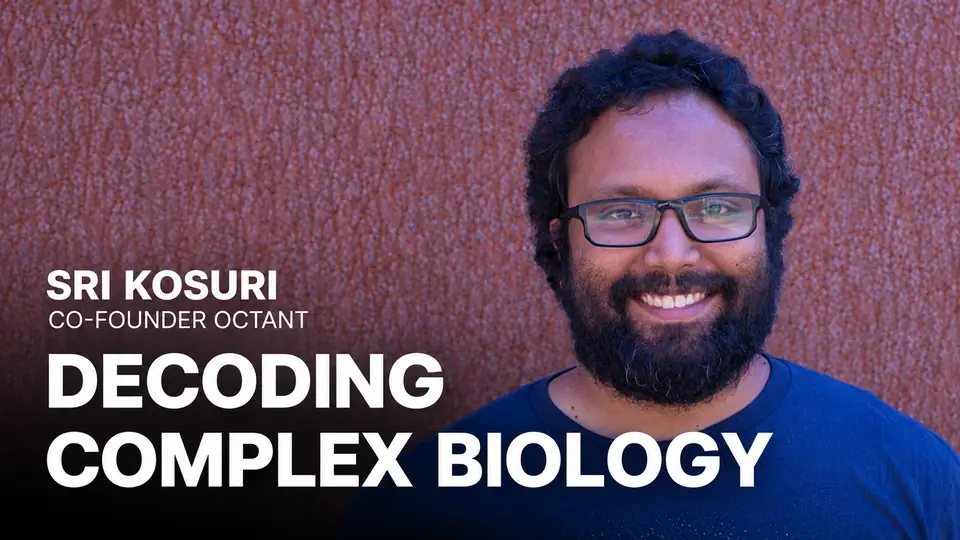



About the episode
In this conversation, we talk with Sri Kosuri, CEO & co-founder of Octant. At Octant they engineer biology to design multi-targeted small molecule drug leads to transform the treatment of society’s most complex diseases. We talk about their drug discovery engine, engineering biology, genetics, advances in biotech, and much more!
Links
Chapters
Times follow the podcast audio. The video’s timeline may be slightly different.
- 00:00Welcome and introducing Octant
- 01:56New tools for engineering biology
- 07:48Genetics and complex disease
- 16:13Measuring many biological responses at once
- 21:03From a platform to drug programs
- 29:04What the next stage of biology could enable
- 35:58Finding Octant and closing
Read the conversation
Open the full transcript
CAMERON WIESE: Welcome to the Build the Future podcast. My name is Cameron Wiese and I'm your host. I've always been fascinated by the ideas and the sentiment that drove American culture in the 1960s with the space race. A culture galvanized to dream about the possibilities of tomorrow. Whether it's food, transportation, cities, biology, or anything else, it was this cultural mindset rooted in optimism, that the world tomorrow would be better than the world today. A mindset where people were compelled to build things, and I quote JFK, not because they were easy, but because they were hard. It's this desire to build and to dream that seems to have been lost, and something we're here to bring back. With Build the Future, we're here to promote the ideas and stories of those who see how the future can be better and promote their plans to get us there. It's our mission to get you to dream about the possibilities of tomorrow, to dream about the future that you want to live in, and inspire you to go build. Today, we're talking about Sri Kosuri, the founder and CEO of Octant Bio.
CAMERON WIESE: At Octant, they're working on a multiplex technology that uses synthetic biology, genome engineering, next generation sequencing, and computational tools to simultaneously measure the activity of thousands of receptor pathways in human cells. In doing so, they're paving the way for a new modality of the drug discovery and the treatment of complex diseases. In this conversation, we cover the work they're doing at Octant, the difference between disease types, the future of biology and much more. So let's jump right in. Sree, obviously, again, thank you. Thank you for coming on. I appreciate the time, appreciate you and look forward to talking about Octant.
SPEAKER UNCLEAR: Yeah, excited to do this.
CAMERON WIESE: Let's start with the basics. Tell me about the future you're building with Octant. What's the vision?
SRI KOSURI: Yeah, I mean, the vision comes from a lot of work that's taken place over the last, I'd say really five to 10 years, where there's been these really big changes in our abilities in engineering biology and understanding biology, that I think put us into a very different world of like what we might be able to understand and therefore like really manipulate and intervene when it comes to disease. But those technologies are basically technologies around DNA sequencing. So our ability to read DNA, that is you probably like 20 years, we just hit the 20 year human genome project with billions of dollars. we've been progressing since then, especially since about 2007 to 2008, at a pace that was on order in about five to seven years. In that time, we hit about 35 years of Moore's Law.
SRI KOSURI: So Moore's Law is this process of computers getting faster and faster, or using more and more computation than equivalent price points. And that pace is just super dizzying. So imagine computers in 1985 and then showing up today with computers of today, but just five years later, What does that mean? What would you do? You would probably try to make Pong faster. You wouldn't make Facebook. And so that's in sequencing and in genetic engineering, things like CRISPR and the ability to edit DNA, the ability to write DNA, DNA synthesis, this reading, writing, and editing of genomic information combined with a lot of what Octant does too, which is measurement, the ability to measure biological phenomena through the processes of sequencing, all of a sudden form this synergy that lets you do things that were never possible before. That even five years ago would have been impossible at the world's largest pharma company. So like just to give you an example, like one of the types of things we do at Octant is this kind of experiment we call, that's called deep mutational scanning. That all that that means is you take a gene, so you could pick a gene. We've done this with a bunch of genes now internally and also publicly, but you can take a gene like we published one a couple of weeks ago called on the beta 2 adrenergic receptor. This is a gene in your body.
SRI KOSURI: It's a target of albuterol. It's also a target of beta blockers and anxiety. So same gene, same protein that sits at the surface of the cell. And so people have mutations in this. So like the question is like, what's the effect of that mutation? Right. So there's a couple of ways to think about that. Right. So one big way that people are excited about now is like AI somehow, like, and so this could be like understanding the basic physics. So there's been a huge result recently by the Alpha Fold team at in DeepMind where they show that they can start building structural information from just pure sequence information alone. And that's been like this protein folding problem. But you can understand all of that and understand the impact of mutations and understand the impact of mutations on the structure on like signaling. So you could maybe build models that could use AI or other things based on that. Usually there's not enough data, but maybe there is now. That's one way to think about it. Another way to think about is because of all these technologies, this ability to edit, manipulate, right, and measure, you could do the following, which is what we did, which is make all possible mutations that might ever exist. So like all single nucleotide mutations to this receptor, just make them all, introduce them into human cell lines, and then actually measure the consequences of all of those against multiple drugs, right? So that sounds crazy, right? Like there's like eight, like it's a 400 amino acid protein. So at each position, you can change like 20, you know, 64 different codons or different amino acids. So you're talking about like tens of thousands of experiments done across multiple drugs, done across like in human cell lines. So maybe you
SRI KOSURI: automate the world of that, but like what's changed in the last couple of years is that one person, like one grad student in my lab experimentally did all that work, right? And they did it during the course of their PhD, right? And why that is, is because all of a sudden this ability to manipulate cells has gotten us in this like what we call multiplex way. What that means is in a single dish, there might be a billion cells. So one way to think about that is like, I'm gonna do an experiment in a dish. Another way to think about that is if I can control these things in pooled ways, that's a billion experiment. And if I have a way to talk to the cells and get them to talk back to me, then I can do biology at scale.
SRI KOSURI: And I don't even have to, so I don't even have to measure everything. Like I don't have to like understand the world, I just have to understand the inputs and outputs in ways that are relevant to physiology. And so to give you an example, So this is like a physical model. So there are these very famous things in right after World War II, where the Army Corps of Engineers made a full, like a one to 200 scale model, the Mississippi River Delta in Iowa or something, right? And with German prisoners of war, they made this huge things and then they simulated floods, right? And then what they were able to do is say, why don't I put an intervention here, like a dam here or a dam there?
SRI KOSURI: And so they could physically model this thing. So a model is like this, instead of a computational model, you can build a physical model, and you can simulate it by doing different things. We do the same thing, but in biology. And this takes advantage of a lot of the powers of biology. So the basic point is that we can do things like the cell is our physical model. The inputs to that model are synthetic DNA that we put into the cell. And the outputs are like things that we've engineered called clicic acid barcodes or DNA barcodes that if they get activated, they get expressed into RNA. And we can read that by next-gen sequencing. And you can do that millions of times because like sequencing has gotten so powerful that it's almost this universal tool for measurement. And so like, that's what we do. We do high throughput biology, but in ways that are multiplex, this ability to do hundreds, thousands, millions of experiments in ways that were just never possible before. And we use that as a way to interpret the complexity of biology.
CAMERON WIESE: Lots, lots of impact there. Let's connect it to the implications of that work and how it relates to drug discovery. You kind of talked me through the different types of diseases and then how often is approaching and I guess how complex diseases kind of send out from the...
SRI KOSURI: Think of the world through the lens of genetics, right? Genetics is this really powerful thing that exists in really no other physical field, right? Like there's no replication by and self-replication and descent through mutation in any other like physical instantiation. So like biology is very different, but genetics is very powerful if you understand it. And so if we think about disease through the lens of genetics, there's a lot of different ways to think about that. So there's infectious diseases that we're facing now. So like foreign genetic material coming into our body and taking over and replicating themselves for their own purposes, we just serve as a vector and we're constantly fighting that, right? So that's infectious diseases. There's cancer. These are like what we call somatic mutations for the most part, not always, but like where mutations are cries over the course of your life, usually knock out something like what's called tumor suppressor or activate something causes cancer and those are usually just happening through mutations that just occur over time, right? The second thing is this whole class of diseases called rare diseases and these are kind of syndromic diseases. They're all super rare, very severe often and there's like thousands if not tens of thousands if not hundreds of thousands of such diseases and these kinds of diseases are usually caused by an inherited mutation that has a very gigantic effect, it kills the function of a gene.
SRI KOSURI: And there's a lot of excitement in this world because all of a sudden we can identify those mutations through sequencing and we can maybe fix them with CRISPR or SARNA or these. And because we know the genetic cause, you just have to go fix that one thing, right? And so that's exciting. And what we have to do is build this way to identify those mutations and fix them, right? And so there's a lot of different ways that do that. And we're thinking about some of that too, but there's a huge push towards that field partially because there's a new way to charge in this way. You can charge in this orphan disease way, so you can actually charge hundreds of thousands of dollars per patient in this world. So even though these diseases are rare, so maybe only one person has this disease in the world, there are hundreds of people, or maybe even thousands, the biggest rare diseases are things that you've probably heard of, things like cystic fibrosis and mesoalemia, but most of them you've never heard of.
SRI KOSURI: And so, but collectively they add up to, you know, some decent proportion of disease out there. But the last form of like diseases are these kind of areas called complex diseases. And they're called complex diseases because genetically they don't come from like a single mutation, but usually hundreds to thousands to even hundreds of thousands of small effect mutations that slowly drive a process or a cell type or something like that into a disease state, combined with the environment and things like that. And those are all common diseases, right? Those are like everything that you know, like all psychiatric diseases, all like all these kind of autoimmunity, like almost everything out there that's prevalent is a complex disease. And it's because rare diseases are rare because they have rare mutations, whereas the common things are common because it's common mutations.
SRI KOSURI: And so the problem with such diseases is that you can't just go fix all those mutations. That's clear. And then the bigger issue is that there might not be a single target that is the most super, you know, like if it were, it would be a rare disease. It's not clear, like how do you actually isolate and solve it. It might be the case that there might not be a single target that's the best in the world to like solve that. And in fact, like in a lot of these disease classes, the best in class drugs hit not one protein, but like five, 10, 15, 20 proteins, and we don't sometimes often don't know how the best in class drugs work. And they kind of in the same way, hit these kind of nodes in our own physiology that affect many other things, right?
SRI KOSURI: So like one classic class of receptors that we study a lot in Octant are called G protein coupled receptors. There's 800 of them in the human genome. There's only 20,000 genes of 800. It's a big portion. But they're responsible. They sit at the surface of cells and they sense the outside world of the cell and then transmit that to the intracellular pathways that happen inside the body. And because of that, there are amazing ways to change physiology because that's what they're meant to do. They're meant to sense the world and make the cell decide on something. And so the beta 2 adrenergic receptor I mentioned before that we did this project with, that is a GPCR. It sits at the surface of your smooth muscle cells in your lungs and once agonized or turned on, normally it responds to adrenaline.
SRI KOSURI: But if it gets turned on by albuterol, what it does is cause a coordinated set of actions that open up the smooth muscle cells in your lungs. Good luck finding another target that does that easily. The problem with such targets is that they exist everywhere else. So that same receptor is the same receptor in your heart that controls heartbeat and why it's the target of beta blockers. That same receptor exists in your brain, we don't know what it does. And so, like, the logic biology is not like the logic of machines. It's not like every part has its place and that's its only place, right? Everything gets reused. And biology is this, like, mess. We don't even know how it works, really, on all these fronts.
SRI KOSURI: And so, yeah, I might be able to, like, target the things in the lungs by using an inhaler. But, like, even individual cells, like, your brain is not, like, one cell type or two cells. It's not like there's a brain cell and there's a lung cell. there's hundreds of different cell types each in these things in different ways, and the logic is different. And so what it might be doing something in one cell type might be doing something completely different in another. And so that's the hard part. And there's no simple way around that. And so a lot of what we've been thinking about at Optin is that these ideas of what's called polypharmacy or dirty drugs, this ability to hit multiple, and what's also called functional selectivity or this ability to turn on particular pathways one way versus another from one of these receptors is that every cell type, for instance, might express 10 to 20, 30 GPCR. So a lot of these complex diseases aren't a single gene going wrong, but a process going wrong, or a cell type going, like beta cells and diabetes or things like that. In those kinds of cases, maybe you can achieve specificity on the problem, not by the action of a single gene, but by the combinations which are now becoming illuminated because of these maps that are being built of like every cell type of the human body. There's this whole project called human cell atlas that's trying to do this. And then because we now know those repertoires, can we start building out the profile of vector, the vector of targets that you want to hit and the ways you want to hit them, be rational about that, what that decision is. And if that's the case, then you also have to build molecules that can do that. So Optin is trying to solve those two problems. Like how do I identify the set of vectors that I really need to hit effectively?
SRI KOSURI: That's a hard problem. And then the second hard problem is like, how do we build molecules that go do that in natural oils.
CAMERON WIESE: So they do the building the molecules is that you can kind of package them and then insert them into the body and then they go target the different cells that are related to these processes, and they alleviate or they fix whatever error was happening, right?
SRI KOSURI: Yeah. And so like, I think I think it's a little bit, it's also a little bit more subtle than that, in the sense that like, what we're not saying is like, there's these two random targets that we're gonna go hit. What we're often faced with in polypharmacy and bias is that all of these receptors are actually trying to bind the same molecules internally, bind the dopamine molecule in your body. Serotonin receptors, same thing like the adrenaline, the peptide receptors, opioid receptors, these are endogenous signaling molecules that we're trying to hijack. And so because of that, when you build a drug to hijack that, it often looks like the thing you're trying to hide. And so there's a lot of the off-target effects don't happen by accident. It's not like they weren't smart enough. It's that it's actually like this is part and parcel of their function. And so what we're often trying to do is like, you know, I'm trying to hit this dopamine receptor, but not this other dopamine receptor.
SRI KOSURI: And I'm trying to hit this pathway off of that one and this pathway off of that one. How do I do that in a rational way? Right? And so it's like a multi-factorial optimization problem where data and turning the crank is something that we're now able to build. And so like a lot of what we've been trying to do is building that. Like how do I build a high throughput assessment way? Or like how do I take all of those receptors and put them in a single well of these kind of high throughput plates and run chemical screens on them so that I individually get like all those data points at once. And then the second part of that is like, how do I high throughput build molecules that modify these molecules in like subtle ways in order to like dial in the right knobs of polypharmacy and functional selectivity that we're trying to achieve.
CAMERON WIESE: So for the first one, that connects back to the multiplexing and barcodes concept. Can you elaborate on it a little bit?
SRI KOSURI: Yeah. So we have a couple of big platforms at Aak. And I mentioned the first type of experiment where we can make all types of mutations to a particular receptor and then simulate those inside the cells, essentially. By simulate, I mean, actually run the experiments on all of them. The way that works is like each cell. So say let's just use that beta-2-adendritic receptor as an example. I am interested in how a particular mutation to the beta-atternergic receptor affects its function. Its function is to take an extracellular signal inside the body that's adrenaline or noradrenaline, noradrenaline, like take adrenaline and like sense it outside the cell and then turn on an intracellular pathway called the GS pathway. So this is a G protein that's called S, but it turns on cyclic AMP production in the body. So cyclic AMP is a signaling molecule in the body. You might remember it from high school biology, but it basically takes ATP and sicklyzes it a little and then gets rid of a couple phosphates to make it into AMP.
SRI KOSURI: So they have the cyclic AMP molecule, that's what gets turned on, and that turns on a bunch of different things in the cell. It's slightly more complex than that, but that's basically what we're trying to measure. What we do is take a protein that measures the cyclic AMP and turns on what call expression of a gene. What expression is, is turning the DNA code into RNA, which eventually gets turned into protein. So we express an RNA, often in drug development what we'll do is express an RNA that encodes a gene called luciferase. So this is called the classic luciferase assay, and that basically shot, like luciferase, like lights it up, but lights it up. You'll see it in these kind of high throughput multi-well plates. This is what like classic drug discovery is. It have like a plate that's like this big 384 wells or 1536 wells. There's like different high throughput capacities there. Light it up. So you drop in a drug, if it would turn on, it would light up. Instead of lighting it up, what we do, instead of making luciferase, what we do is express a barcode that could be like ATCG or GCTA or some set of letters that we know in order what it is. That produces RNA in that well. What we've done and often is like do that in a way that in every one of those wells, we have hundreds of these barcodes, and we can use a small sequencing reaction in that well to ask which barcodes that we see and how much of each of those barcodes that we see.
SRI KOSURI: And that tells us for each one of those things, it's like if it was just a single barcode, then we just done one experiment. But you put hundreds of barcodes, you can put hundreds of different engineered cell phones in that well. And then all of a sudden you can do tens of thousands of wells where you're looking at the interaction with a chemical against hundreds of different things that you're interested in, right? And you can do that, we do that week in, week out. like every week we can, like it's not like a hard experiment. That's one person running that process internally at Octant, right? So, and that, you know, this guy, Zach, he started as a synthetic biology apprentice, like he was an undergraduate at the University of Utah, graduated and came to Octant, now is running that process pretty much. I mean, there are like some help and robots and stuff like that, but like, it's a pretty automated process at this point. So that's super exciting.
SRI KOSURI: So we can, we can now look at the interaction of like a chemical or chemical library or something like that against all of these receptors at once and build those maps and push that to data scientists on our teams. And so that's a lot of what one side of the platform is. And what you're measuring are these kind of RNA molecules. And in fact, internally at Octant, and you might know some of this and maybe how we got in touch, is we open sourced that process because we've been, when we shut down due to the COVID stuff in March, we said, we know this work, we know it's cheap, we know it's like, simple to operate, you don't need a lot of machinery to do this.
SRI KOSURI: And COVID-19 is caused by SARS-CoV-2, which is an RNA virus. And since this is basically a multiplex RNA detection platform, we could turn this into a testing platform, right? And so we open sourced that in April, and that's kind of done its own thing. So we signed a partnership recently with Kinko Bioworks. That process is operational at UCLA, which is testing like health care workers and Caltech and a couple other universities. and where they're testing thousands of people a day on said platform for really cheap.
CAMERON WIESE: But it's cool because then that open source technology or like that information is then available for other people who want to go raw and somewhat types of experience, not necessarily COVID related, but there's this whole gambit of things that they can go do with that.
SRI KOSURI: Yeah, I mean, that was one of the risks that we were a little bit worried about, but like, I think it was A, the right thing to do, but B, like, I think there's lots of problems like this. We're not like the only ones in the world that are thinking like this, But it's this combination of computation, a bunch of new technologies in reading, writing and editing DNA, all of a sudden just let you do these things that were once impossible or took like factories to do that you can do individually or even small footprints in the lab. And it just opens up a lot of these types of applications.
CAMERON WIESE: I want to, I want to zoom, zoom into the future a little bit. The ultimate goal is to start to develop drugs that help alleviate some of these complex diseases. How do we get to that point?
SRI KOSURI: Yeah. So that's, it's a really good question. So we have internal drug programs, so like one of them, so I mentioned these two parts of it. So you can imagine how this platform does the first part, like how do we take chemicals out there in the world? Like there's tons of drugs that affect these receptors. So like GPCRs alone are the target of like 60% of all prescriptions. So like what we can often do is use the platform itself to map how the phenotypes of all these chemicals that have been through humans impact like this receptor pharmacology or like what it's hitting when it's not. And so the big thing that's trying ask is like how do we find the vectors of polypharmacy and bias that we really want to hit, right? So here are these 20, 35 receptors, for instance, which ones do I want to hit in which ways? So I build this like kind of design. This is called like a target profile. And we work with like complex target profiles, like we're trying to solve hard problems there. And then the second side of that is like, how do I go build a molecule to do that, which is kind of the drug development process. So a lot of what we've been doing kind of more quietly over the last year is building a high throughput and automated chemical synthesis platform that takes things with some activity, but then modulates them in subtle ways using fragments of molecules and just adding them to other molecules and using this in a way to build data sets around.
SRI KOSURI: If I modulate this molecule here, how does that change the polypharmacy and bias? And if I do that 1,000 fragments at a time or 10,000 fragments at a time, can I start building the data sets I need to build those complex target profiles? So it's like this combination, it's this new kind of platform that sits on top of that assay platform that like can build and modify drugs at scale using basically simple, you know, single or multi-step chemical synthesis in an automated way. And so kind of layer that on top and this lets us like modulate chemicals in order to achieve the target profiles we want to achieve. And so that's a lot of what we do internally. We have like a program that's kind of going right now that we're excited, hopefully moving into preclinical in the next few months of inobesity.
SRI KOSURI: And what we see kind of more broadly is like the purpose of this these two platforms that often is to identify complex like polypharmacy and the signals that we want to go after and then the second part of build those molecules and kind of go through the classic clinical trials. But we think many of those in a lot of instances can be be able to do things that like in a lot of exciting ways can target some of these big complexes, these areas like hunger or obesity and things like that.
CAMERON WIESE: Hunger. What do you mean by that? How do you target hunger?
SRI KOSURI: Yeah. So, you know, we've been somewhat open about this, but like we've been working on a class of receptors called the melanocortins for the past year and a little bit. It's against class of GPCRs and melanocortin 4 is a gene that has been known for a very obesity because it controls a hunger circuit in the hypothalamus. If you lose that function in humans, like you tend to be obese because you tend to be more hungry all the time. You eat more. In theory, targeting that could be a really good way to control hunger. There was a drug just approved to do this called set melanotide. There's a longer story here, but it has a lot of off-target effects too because it hits a lot of these other receptors.
SRI KOSURI: Can we build better drugs around targeting the polypharmacy and bias profiles that we think are actually enabling this drug, but doing that with like a small molecule that has less side effects. And so including less side effects in some of the things that killed a lot of the drugs in this class. So a lot of how we think about the world is finding these places where, you know, there's good genetic validation, or there's really good hypotheses for why a complex target profile might want to exist and building the drugs towards those profiles. So yeah, so hunger is a physiological response to things. It's controlled by genes in your body. In theory, they should be drugable. And And I think people are getting closer and closer to do stuff like that.
CAMERON WIESE: The idea is to do it without all the potential side effects.
SRI KOSURI: These receptors do lots of things besides control hunger to control. In fact, some of the big ones early on were to control blood pressure, which killed a lot of the early trials because it like affected your blood pressure while trying to affect your hunger, which is a no-go. How do we be more specific on the types of things that we want versus not? And I think we think that engineering of polypharmacy and functional selectivity are ways to go do that in like big complexes these areas.
CAMERON WIESE: How do you think this changes the way drugs are developed and rolled out? I know like the FDA has historically been very slow to help cover or like in the process of bringing new drugs to market, but it seems like with a more complex targeting process with, you know, minimal side effects, that there may be less testing to get done or it may just change
SRI KOSURI: the process. So I think one, there's like really big questions in complex diseases, right? Like, Is the complex disease one disease, or is it hundreds of different diseases that we just don't separate them yet? Or it's the same clinical manifestation, but it can happen in 100 different ways, and each one of those will be treated in a different way? I don't think anyone knows the answer to those. That's one big question. And so there's a lot of interest in, can we identify the subpopulations that might respond to single drugs? And can we do that through maybe genetics or biomarkers? That's one area of excitement that you know, everyone is aligned with. And then the second part of that is like, what happens if that's not true? Why would it is this complex disease and we just don't we need to like these, there's no single target that's out there. And then that's actually really interesting too, from the standpoint of like, one way to think about targeting that is like really combinations of drugs that are all targeted. But that's actually traditionally really hard to do through the FDA, right? Like you can't, like in order to do a clinical trial of a fixed dose combination, both of those drugs basically have had to have gone through clinical trials, right? Because otherwise, we'd have to run like three clinical trials. Just to give you an example, there's this really, really clever company, I think called Karuna Biosciences. And what they did was, there was this drug that worked really well in the brain. And I think it was, might have been major depression, but I don't remember now what those trials were. But like, like the idea was a really efficacious for a neuropsychiatric after condition, but it had really off-target side effects and it was really bad.
SRI KOSURI: And so most of the people took themselves off the trial. It just failed. It was another drug. And so basically what that was is the targets in your brain, it works well, but it also hits all these other things, including your inner GI. So what they did was made a fixed dose combination with another drug that's peripherally restricted, meaning it doesn't get into your central nervous system because it's bigger or whatever it is. And it acts as an antagonist to that same drug. So like basically you have the drug action and the anti-drug in your body, but only one can get into your brain and the other can't. And so like this drug is now in phase three and it's like very exciting new drug with companies called Coruna.
SRI KOSURI: Like I think we're going to see more and more stuff like that. So I think for both of those things, like the second side, I don't think we quite understand what that means, right? Like what is it like? What does a cocktail of drugs look like? And we know this implicitly, like a smell or a taste, which are also done by GPCRs, for instance. It's not like one molecule for one receptor. It's like this complex profile. There's these bouquets, like natural products, same way, like a caffeine pill is very different than this coffee I'm drinking, right? And so like, how do you think about that from drug ability? How do you do that in rational ways? I think we're gonna start answering those questions, but like there is a regulatory hurdle around like how does that get into the people, right?
SRI KOSURI: So those are, I think there's a lot of work to do before like it's worth solving the regulatory issues, but I think it's definitely on the horizon. I think from the genetic side, I think the FDA is already on board. I think there's going to be a lot more of that unbundling of even complex and rare diseases where like they might be, there might be drugs that are very specific to genotypes. And that's becoming, that's already, I think, everyone's on board with that. And that's kind
SPEAKER UNCLEAR: of something that's happened over the last five years. regulatory stuff aside, what are you looking forward to in development space? Five years, 10 years out? Like, what's what's keeping you up in [unclear]? What's exciting you?
SRI KOSURI: Yeah, I mean, like here, like an Octant, the ultimate vision is the following, which is like, look, we are excited to do biology, especially as it relates to human medicine at scale. And what, and in particular, an Octant, like looking at this relationship between chemicals, which affect like nutrition, every, like a ton of different things, right? Like not just disease, but like, you know, proteins in the body. And we think that like, look in each well of these, these like tiny 384 well plates, there's like tens of thousands of cells, there's only 20,000 genes, right? Like, at its most manifest, we think that like, we can be comprehensive about that. And what does that mean? Like, our receptors aren't changing on a daily basis, right? Like, that means we can start getting ahead of that complexity in ways that let us be rational about like all sorts of things, whether that be medicines or health or biomarkers, or even like flavors and fragrances, like, those are things that we can start bringing rationality to in a place that's never been that rational about these kinds of things.
SRI KOSURI: I think the second point is more broad, and it's kind of this area of synthetic biology, which is like, look, biology is manufacturing at scale, and we now have these tools that are coming online that really just completely change the way we think, and what does that mean for the future of manufacturing? What does that mean, the future of how we interact with the natural world? What does that mean for all sorts of things? And I think that's really exciting, right? I think in my past lives, I've like, we started a company called Jewel, like right after grad school, which was like the not the cigarette company, but like the unit of energy company, which is about engineering algae for biofuels. And maybe that made sense or didn't make sense. But like, I think this general idea of biology is in some ways a technology that's not quite digital, but it spans this like world of like chemicals and hard stuff, and like physical stuff at scale to kind of a digital world of DNA and RNA and protein.
SRI KOSURI: If we figure out how to like really think about that language and like be able to write narratives in that language, then all of a sudden we have an ability that is pretty amazing. Cause we already know that like, you know, our brains are crazy, right? They operate on like whatever, 20 Watts and like just sit around one of them is if I can make a brain the size of my this hallway, like what could it do? Like what's the thing? And I think we can do things like that. It's just like, we're just at the very beginning of that. So that's a really exciting, like very far future. I don't know if that's like 10 years away or 100 years away, but it's getting there and it's getting to be very exciting in our abilities to like at least explore. And we're still at the very cusp of being excited,
CAMERON WIESE: getting there. My understanding is that biology is more or less a black box that we're trying to understand.
SRI KOSURI: Even the most basic questions, right? Like we're still, I mean, the way I, I don't know if you ever, you might be too young for this movie, but like this movie called Independence Day came out like in probably when you were like five or something, but like Will Smith, like aliens are attacking the world and like it gets resolved. It's like Will Smith flies up to this crazy advanced technology and uploads a virus and everything dies, right? Like and so how like that actually happened is totally unclear, but imagine, but that's like kind of where we are, right? we're just like quitching these things that like and just being like oh maybe maybe this will help like depression, it'll help depression and like we're still at the that's where we are right like and even like very simple things of like what does why does this beer taste different than that beer right why does why does this tree uh why is this tree harder than that one why when we age it in this way is it like that's where we are right like it's so early and we you know synthetic biology as a field has been around for a long time and it's been called various things, but we're just like even at the protein folding, this protein folding problem, huge success.
SRI KOSURI: And like this thing that the field has been going after forever, right? Like so exciting that we're going to get like, what can we do with that tool? There's a million things, but like it's just like touching the surface because proteins interact with these complexes. These complexes do like amazing machinery and convert electricity to chemical signals. We're nowhere close to getting there, but there's no reason why we won't over time give stability in society and levels of investment that will happen. I think that's the most exciting thing over time. I think it just comes back to this other idea of visions are easy in a lot of ways. It's hard to, how do I, as a get from here to some future where we existed to continue to take advance in that future vision. And that's the hard part. I think people get that it would be amazing to grow a tree into a house and like just be able to grow houses that way, right? Like, but like there's no steps from here to there that makes sense. And so I think, I think when you see these kind of visionary come, like Elon Musk and like Tesla, like a lot of the challenge is not this vision that we want to be on Mars. Like people get that vision. It's like the vision of like do I get from here to there in a way that makes money that I can continue to pour resources into?
SRI KOSURI: That's a hard thing. In biology right now, that's in medicine more than anything else is probably the case. All the companies, you know, Ginkgo Bioworks and Zymergen and the kind of biomanufacturing companies that have looked in that area. People are looking at materials, places like bulk threads and others, food. So any place that biology touches now, we can make better. And so that's kind of what we imagined. But imagine the world in the future of how does biology change computing?
SPEAKER UNCLEAR: I don't think we know yet. Probably. That's probably a fair assumption. Yeah. And it's
SPEAKER UNCLEAR: so hard to fathom right now. Yeah. And I don't think we know yet. And there are people working on neural implants and stuff. Maybe that's the way, but maybe it's different. Maybe it's like I grow a brain the size of New York City. So I think there's a lot of excitement, but those are very long road questions and no one's figured out how to get from what are the steps of getting
CAMERON WIESE: from here to there. I think there's, as we're saying, kind of more interest in the space, more investment kind of fun into it. We're getting more people who decide to go work at companies pursuing these things and are pursuing kind of the steps that will eventually get us there. Yeah,
SRI KOSURI: as someone that's been around in the field for a while, like, you know, only in the last five years would they let someone like me run a company like Octant. It never used to be like that, just like it never used to be that entrepreneurs could create an internet company from scratch within in your back room, right? Like that is also changing, right? And so that's an exciting thing is when you start unleashing individual creativity and like small teams to go after like big problems, I think that gets you to an exciting time. And then so yeah, I think the cool part is that there's like lots of seeds blooming right now, right? And lots of people taking
SPEAKER UNCLEAR: different chances on different approaches. Where can people find you? How can they support Octant? Any call to action or parting words you want to play with people?
SRI KOSURI: Yeah. So at Octant, we try to be pretty open with a lot of what we do because people are not taking the same approaches to the same problems and we want to enable a future that's more broad. We definitely do open source things and we've been trying to help. I think broadly at Octant, we are hiring right now and in the future. So if you want to just come to Octant.Bio, we also run this program called the Synthetic Biology Apprentice program where undergrads usually the idea is they're taking a gap year or you're trying to switch to something and we train you extensively in the first several months across like the different platforms and often then we kind of unleash you on the teams. And that's been awesome.
SRI KOSURI: And usually the idea is like, you spend a couple of years doing that. One year is what we ask, but like it's been amazing. Like we thought it'd be more of a service to the community and like it turned into something that's like, oh my God, you know what? A 22 year old can do a ton of work at a biotech company and have big impacts in ways that we didn't even anticipate. I think I mentioned Zach earlier in the earlier discussion around, you know, I was like 23 years old, just stayed on after his SBA and is running our whole platform. And that's like a huge, huge win for everybody, right? And so we've been really impressed by like the new age of people, young people can come in and make big positive impact.
SRI KOSURI: We had like a software intern come in and revamp a bunch of chemistries in our platform for our high-throughput chemical synthesis platform. So yeah, I'd say if you want to find out more, com.com.com. There was a blog where there was, I think, a big blog release today on a bunch of multiplexing ideas that we've been working on and doing. So come check us out and just more broadly, I think, we're on Twitter and other things. So it's always easy to contact us. I think that's how we met.
CAMERON WIESE: Twitter is an incredible thing. Well, Sri, thank you so much for coming on. If you want to know more about Octant, you can head on over to octin.bio. If you want to follow Sri, you can find him on Twitter at Sree Kasturi. right.
CAMERON WIESE: Thanks for joining us for another episode of the Build the Future podcast. Lastly, if you're building and want to get support, want to hear about certain topics or from certain people, or just want to get involved in helping build the future, shoot us over an email at hello at buildthefuturepodcast.com or follow me, Cameron, on Twitter at [unclear handle], and we'll see what we can make happen. That's it from us. Until next time, go build!
SPEAKER UNCLEAR: Thank you.
More episodes
All episodes Michael Levin — Regeneration, Xenobots and the Software of LifeMichael Levin discusses regeneration and the idea that biological systems can be understood partly through information, goals and control.
 Derek Morris of United Therapeutics — 3D Printing OrgansDerek Morris explores the science and engineering behind growing and 3D printing replacement organs.
 Celine Halioua — Helping Dogs Live LongerCeline Halioua discusses the reasoning behind Loyal, the challenges of building a biotech company and why dogs are central to her approach.