

Build the Future Podcast
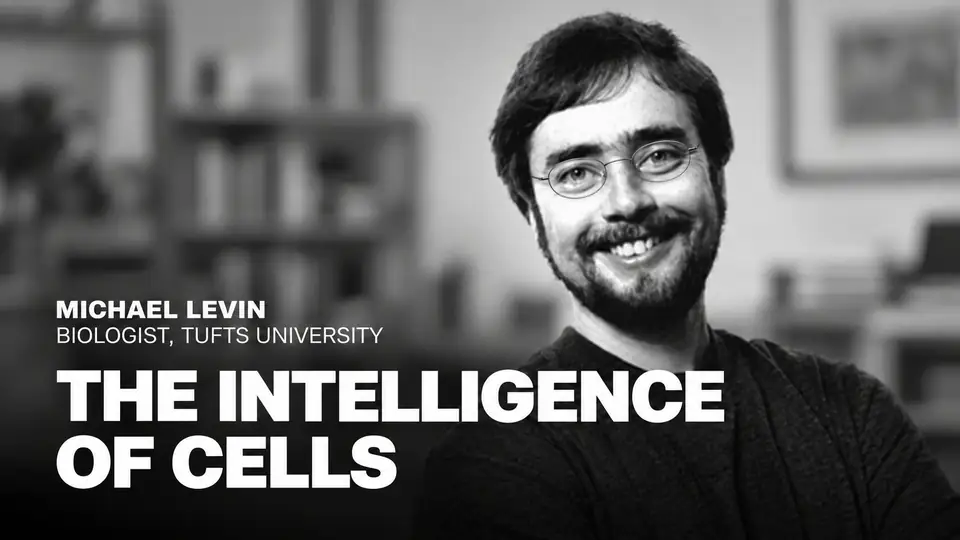
Michael Levin — Regeneration, Xenobots and the Software of Life
Michael Levin discusses regeneration and the idea that biological systems can be understood partly through information, goals and control.
December 8, 2020 · 42 min



About the episode
In this conversation, we talk with Dr. Michael Levin, Principal Investigator at The Levin Lab, where their goal is to "understand how individual cell behaviors are orchestrated towards appropriate large-scale outcomes despite unpredictable environmental perturbations."
We cover his research and insights on:
Links
Chapters
Times follow the podcast audio. The video’s timeline may be slightly different.
- 00:00Welcome and introducing the Levin Lab
- 05:29Regeneration and anatomical goals
- 09:59Xenobots and cells in new arrangements
- 14:09Practical and conceptual implications
- 21:24Memory through regeneration and metamorphosis
- 25:37Mind, cognition and ethical questions
- 28:52Challenging established ideas in research
- 32:45Advice for pursuing new directions
- 35:49Models and tools for scientific discovery
Read the conversation
Open the full transcript
CAMERON WIESE: Welcome to the Build the Future podcast. My name is Cameron Wiese, and I'm your host. I've always been fascinated by the ideas and the sentiment that drove American culture in the 1960s with the space race. A culture galvanized to dream about the possibilities of tomorrow. Whether it's food, transportation, cities, biology, or anything else. It was this cultural mindset rooted in optimism, that the world tomorrow would be better than the world today. A mindset where people were compelled to build things, and I quote JFK, not because they were easy, but because they were hard. It's this desire to build and to dream that seems to have been lost, and something we're here to bring back. With Build the Future, we're here to promote the ideas and stories of those who see how the future can be better and promote their plans to get us there. It's our mission to get you to dream about the possibilities of tomorrow, to dream about the future that you want to live in, and inspire you to go build.
SPEAKER UNCLEAR: Today, we're talking with Dr. Michael Levin of the Levin Lab at Tufts University. The Levin Lab, they're doing research and development on cellular communication and exploring the overlap between biology, computer science, and cognitive science. In their research, they've demonstrated the ability to form new organs, regenerate limbs, reprogram tumors, and more without editing the human genome. It's extremely exciting stuff and is leading us to a feature where not only can we regenerate limbs, but we have the ability to program cells and develop an anatomical compiler. This conversation was extremely fascinating and technical, but it was a ton of fun. So let's jump right in. Dr. Levin, thank you so much for coming on the show. I'm absurdly excited to have you here to talk about the fantastic research you've been working on. That's very kind. Thank you. I'm happy to be here. I want to start with the basics. And I know that may not be the right term, because there's a lot here. Can you tell me about the future you're working towards with your research? What's the grand vision for what you hope it becomes? Well, the grand vision of what
MICHAEL LEVIN: I think we're working towards has to do with understanding meaning in biology. So understanding not just the mechanism, because there's a lot of work and of course, biology, chemistry, genetics have made massive inroads into understanding the mechanisms, the molecular mechanisms that are required for some of the things that life does. But what is still really very poorly understood are the information processing aspect. So how living tissues and cells and organs and so on, how they make decisions and how they know what to do. So not just how do they accomplish what they need to do, but how do they know what to do? And I use these words like knowledge and goals and various other words like this very, very specifically. I mean them. And I think that our future, all the promises of regenerative medicine, adaptive robotics, all of these kinds of things hang on our ability to understand how cognition, how the ability to solve problems flexibly scales up in biology from the most humble living systems all the way up to very advanced ones.
MICHAEL LEVIN: And I think the future is going to be amazing in terms of what we can accomplish in terms of public health and well-being and extending the health span and robotic exploration and all of that if we can crack this really important problem. And I'll just give you a simple example. So in computer science, and I've got a great visual of this, a picture that I show when like it talks about this is what programming looked like in the 40s and 50s. And there's this black and white picture of a woman programming a computer. And what she's doing is she's moving wires back and forth. So she's physically rewiring it to get the computer to do something new. And originally, we had the program at the level of hardware.
MICHAEL LEVIN: But one of the most amazing things about the journey that computer science took is that they realized that if your hardware was good enough, and I'm going to claim that biological hardware is absolutely good enough, then you don't need to rewire it to get it to do something different. You can operate at the level of software. You can give it inputs or stimuli, let's say the keyboard or anything else, and take advantage of the built-in software without having to rewire it. So when you on your laptop want to switch from Microsoft Word to Photoshop, you don't get out your soldering and start rewiring, right? Because the hardware makes it easy for you to do what you need to do at the software level. And so making that transition, moving from hardware to understanding reprogrammability and focusing on information and algorithms and computation led to this remarkable information technology revolution that we have today and all of the things that have come from it.
MICHAEL LEVIN: Biology, on the other hand, is still largely at the hardware stage. So all of the most exciting advances today people think about are molecular types of things, so DNA editing and single molecule approaches and protein pathways. is we are still in biology and medicine, we are still largely focused on the hardware. And I think an extremely exciting future will be unlocked for us. All of the things that we see in science fiction in terms of regenerating healthy body parts, avoiding all of the sort of economically unviable health spirals where these costs at the end of life are just enormous, being able to fix birth defects, normalized tumors, all of these kinds of things will be possible once we understand
SPEAKER UNCLEAR: the software of life. Super exciting feature. There's a lot, a lot to unpack there. The work you're doing right now around regeneration, which seems to be the starting point that is allowing you and your team to understand some of these other mechanisms that are at play, correct?
MICHAEL LEVIN: Yeah. I mean, the thing, so regeneration, and when I say regeneration, let's just make clear what I mean. So first of all, there are some animals like salamanders that will regrow a limb If it's amputated, they regrow their eyes, their jaws, their hearts, their spinal cords, their ovaries, and so on. So one type of regeneration that we're familiar with is things like this, like salamanders. Another type, even mammals can do. So for example, if you think about where monozygotic twins come from, right? So an early mammalian embryo gets split in half, and each half knows exactly what's missing. It fills in the missing portion, and you get two perfectly normal individuals. You don't get two half embryos. you get two full ones. So that type of ability, more broadly than regeneration, what we're really talking about is the ability to reach a correct anatomical outcome, meaning having all these complex organs at the right shape in the right place, despite various perturbations, despite things that might go wrong, you know, all kinds of stresses and things like this. It's a system that's able to reach that same outcome from different starting configurations. So whether the limb is normal or whether it got amputated if you're a salamander up at the shoulder or down with the finger. Nevertheless, you still get a correct limb. So already you get this feeling for a system that is intelligent in the sense that intelligent systems, in the sense that we mean by for robotics and so on, are systems that can achieve their objective in novel environments, and they can take what they know to adapt to new challenging situations. So from that definition, already you see that there's a lot of intelligence in here.
MICHAEL LEVIN: And the important thing about regeneration, of course, it's very exciting that these things go back and everybody wants to understand how it works. But the thing that doesn't get a lot of play is what I think is actually the most important portion, which is how does it know when to stop? So when the salamander gets injured or any of these other creatures, lots of cellular activity takes place, cells proliferate, they move around, all this stuff happens, the genes go up and down in levels and so on. And then when a correct salamander arm is formed, everything stops. How do these cells, especially individual cells whose radius is very small, so they can't really measure how many fingers you have or anything like that directly. How does this thing know when to stop?
MICHAEL LEVIN: Because in order to stop when you have a correct salamander arm, it helps to have some representation of what a correct salamander arm looks like. So how's that possible? So that type of question is what drives most of the things in our lab. And it's the key to most problems in biomedicine, because if we understood how cells get together, specifically how cells form collectives, that a kind of collective intelligence, where cells get together to form these collectives with a pretty clear idea of what they should be building, if we understood that, then you could respecify the target that they're trying to build. And we call this the target morphology. And if you could re-specify the target morphology without having to change the cells. So our conjecture that we've been working on is this idea that the software is separate. So you don't have to rewire the cells. You don't have to edit the cells in order to get them to build something else. You edit the plan.
MICHAEL LEVIN: And so if you could change the encoding of this plan, you could get them to build anything you want. And so if you think about that, it addresses almost all of the problems of biomedicine. So other than infectious disease, everything else, birth defects, cancer, aging, degeneration, trauma, all of these kinds of things could be addressed if we had the power to tell cells what to build. So that gets back to this anatomical compiler idea that you mentioned, where we would like to get to a feature where you can sit down at the computer and draw at the level of anatomy what you want. So the way we do now with parts and devices and so on, like computer-aided drawing and computer-aided design, you would be able to sit down and you would be able to draw the type of the anatomical structure you want. And what the code would do is compile that down to a set of stimuli that would have to be given to cells that would cause them to build whatever you just drew. And that would be absolutely transformative to all kinds of applications in biology and computer
SPEAKER UNCLEAR: science. Yeah. So that's for the anatomical compiler. It seems like the starting point, though, is with these xenobots that you've been working on. Can you tell me a little bit about that research and kind of how that plays out? Sure. So the starting point actually for the
MICHAEL LEVIN: work was well before the xenobots, was trying to understand how cells and tissues encode these goal states, these target morphologies. You know, they have these basically, long story short, compressing like 20 years of research into one sentence, it turns out that the tissues basically store a bioelectrical pattern memory, very similar to how brains store memories, that allows them to work towards these specific anatomical outcomes. And so trying to crack that, and we've cracked a bit of it is the first step. And then the second step is to say, okay, if that's true, and if cells are in an cell collectives are in an important sense, like universal constructors, meaning they could build all kinds of things given the right instructions, then the key is, can we rewrite these instructions to rebuild limbs and eyes and damage organs? But then we're getting into the whole xenobot idea. Can we take it further and ask these cells to build something that's completely different than anything that came before. So something that's totally distinct from the default anatomy that forms from that genome. Can we get those cells with a standard genetics to build something totally different? And so that's how the Xenobots came about. We asked this question, if we take some cells from a frog embryo, they happen to be skin cells, and we liberate them from the body of the frog and we put them in a new environment, And what will they do?
MICHAEL LEVIN: And do they have the ability to get together and cooperate towards some kind of new goal? And it turns out that they do. They make a tiny little novel organism. We call them xenobots or xenophys labus is the Latin name for the frog that we use. And bot is from biobot. This idea of a synthetic living machine that has predictable structure and function based on what goes in, like any designed machine. So what we were able to do is to say that, well, first of all, we noticed that these cells absolutely tried to come together and build a workable body. And they build these xenobots that run around the dish of liquid medium and do various interesting things. And then we found out that we could put this together with, so we have collaborators at the University of Vermont.
MICHAEL LEVIN: This is Joshua Bongard and his PhD student, Sam Friedman, and their group. Together, we basically established a, they made this virtual world in which various designs of Xenobots could be evolved and tested and so on. And then the output of that is fed to us for our experiments. And these experiments will then take these Xenobot cells and manipulate them in various ways. You might remove some or add some or do various things. And so you've got this amazing scenario where, to my knowledge, for the first time in the world, you have these creatures whose evolutionary past was not had on Earth. They don't have an evolution. The bots themselves, the cells do. They were part of the frog, and they were sort of evolutionarily selected to sit quietly on the outside of the frog and keep up the pathogens.
MICHAEL LEVIN: But the new body that they form was not evolved on Earth. It was evolved, if anywhere, it was evolved in the virtual world. of the computer at the University of Vermont. And yet, despite the fact that they're in this completely novel configuration, they have adaptive structure, function, behavior, they do interesting things. So this is telling us hugely important things, I think, about the intersection of biology and computer science, about the role of evolution and design and how they can cooperate together, about where bodies come from in the first place, and how much novelty and plasticity cell collectives can muster. And of course, it's helping us to understand the morphogenetic code. Because if we understand how to get these cells to, and this is only, by the way, the very first baby steps here, if we're able to understand how to tell these cells to build specific things, that knowledge will go directly into regenerative medicine, where we will be
SPEAKER UNCLEAR: building organs for people. Tell me about some more of the implications of being able to do this.
MICHAEL LEVIN: Oh, boy, there are a lot of implications. Well, let's divide them in half. There are are practical implications and then there are sort of deep conceptual implications. The easy ones, the practical implications, what we are going to be able to do is roughly two things. We can make useful synthetic living machines. And so we're talking about biocompatible little biological robots that do various useful things. So maybe they go out in the environment and they clean up toxins out of waterways. Maybe they do sensing. Maybe they do useful things in the body. They're delivering pro-regenerative molecules and chasing down cancer cells and things like that. So those are kind of useful synthetic living machines. And then the other practical implication is for regenerative medicine, because if we understand how to tell cells what to do, we could solve a lot of these problems.
MICHAEL LEVIN: This is actually really critical because we're going to, if we don't do this, we're going to have a real issue here with regenerative medicine in the sense that the workforce techniques of this field, which are genomic editing and stem cell biology, both of those things are very firmly rooted in the hardware approach. And when we are able to cleanly edit DNA, which we soon will, then the answer will become, yeah, but what part of the DNA do you want to edit to give back somebody their arm or an eye? It's completely unclear. The same thing with stem cells. Once the problems of stem cell biology are solved and you can make all the different cell types that go into an arm. How do you actually produce that arm or a foot and what's the difference between them? And we're not going to be micro positioning cells to make a whole eye or a whole hand. So all of these things, just the complexity of it precludes any kind of micromanagement. Trying to do it from the bottom up at the hardware level is not going to happen in our lifetime, if ever. So we need to understand the top-down control structure of biology and the intelligence that these cellular swarms have to be able to convince them to do things they already know how to do, like during embryonic development to build all this thing. So this will be a new approach. So the implication will be that there's a new approach to regenerative medicine where you don't focus on micromanaging all of the parts and trying to get all the cells and all the pathways in the right place, but you actually provide informational inputs.
MICHAEL LEVIN: And this is one of the things we've discovered in our lab is how to do this, provide simple informational inputs that trigger very complex downstream anatomical outcomes. And then the third sort of practical implication will be for swarm robotics and machine learning. Because once we understand how to scale the very sort of small scale intelligence of individual cells into a much larger scale intelligence of organs, tissues, and whole bodies, that kind of knowledge is going to give rise to a whole area of artificial intelligence, not based on trying to emulate brain architectures. So right now, a lot of AI is all about trying to emulate the structure of the brain. And I think that leaves a lot on the table in terms of much more ancient general principles of intelligence that we hear long before brains actually showed up. So those are all kind of practical applications for engineering and biomedicine and computer science. The philosophical slash conceptual implications are also many. One thing to think about is the role of the genome in producing a body. So a lot of people think about the genome as the software of the cell, and I think that's somewhere between not true and just incomplete. What the genome actually encodes are the proteins. It doesn't say directly anything about anatomy. What it specifically encodes are proteins. So it basically tells each cell what is the hardware that that cell gets to have. So the genetics are a specification of the hardware. Now, once you
MICHAEL LEVIN: have this hardware, what evolution has made sure of is that the hardware is really good. So the hardware is such that it takes advantage of the laws of physics, especially the laws of electricity, but also, of course, biomechanics and diffusion and things like that. And the laws of computation and it accomplishes some really remarkable, really remarkable things. So that gives us the opportunity to intervene in systems at the level of the software. And that's very important. It tells us something profound about what, and then we get to, we can dive into this more if you want, but what actually is the role of the genome in determining anatomical plasticity? The other thing that this is telling us is really the kind of broad ability of cells to cooperate in novel environments. And this idea that perhaps you can get cells to build all sorts of things, not just the things that there's, you know, fish eggs make fish and frog eggs make frog. But it sounds like if we understood what we were doing with these destructive patterns, we could actually get these cells to build whatever we wanted. And so that plasticity, that capacity is still, we're only scratching the surface. And the final thing, which I think is very profound in all of this is what this is telling us about agency and what really are memories, what really are goals. And I've actually, the last six months, I've written a number of papers on this more than probably the rest of my career put together on this topic of agency and what it means to think about cells and tissues having goals and having memories and having purpose and
MICHAEL LEVIN: and acting this way. And a lot of people are very uncomfortable with that kind of talk with things that aren't humans. And then some people think it's okay for higher animals. And some people don't think it's okay even to talk that way about, let's say, great apes. And then some people actually don't think we should even be talking about humans that way. It's a whole behaviors tradition. But the reality is that evolution, we have to take evolution seriously. And we have to understand that humans aren't magic. We got here by a slow process of gradual improvement across a very long tree of life. And the capacities that we have are fancy versions of much simpler kinds of information processing and computation. And we are all made of parts.
MICHAEL LEVIN: So you feel as an integrated individual that has goals and you're a person that has centralized goals that reach out for the future and so on, but actually we're all bags of cells, right? I mean, really in between our ears is a huge number of individual cells that used to be unicellular organisms long ago, but they've gotten together and they've gotten together to do two big things. They've gotten together to form a body and then to work together to have goals that none of the individual cells themselves have. So they store memories, they have goals and programs of behavior that don't belong to any individual cell. So how does that work? What, I think these synthetic platforms, when we make these things from scratch, like Xenobots and other types of firebots, are letting us build minds and bodies from scratch in completely novel configurations. And when you do that, you discover some really deep things about both sides of the equation, the mind and the body, how they interact.
CAMERON WIESE: I noticed in some of the research y'all were doing around the butterflies in the planaria, through the metamorphosis process for the butterflies and through just kind of the regenerative process for the planaria, it seems like the memories get stored and transfer. And I'm curious, how does that work? How are memories actually encoded if they kind of make it through this kind of regenerative process or this kind of metamorphosis process, specifically in the butterflies in planaria? But also, I mean, I would assume if we draw this out, like in humans, you mentioned some of your talks that in the future, we'll have people who are getting parts of their brain never placed, but the memories may still be around. Like, can you kind of talk me through that process?
MICHAEL LEVIN: Yeah. Well, how does it work? If I knew how it worked, I would be on the Stockholm to pick up the Nobel Prize. So I don't know how it works, but I can tell you a few things about it. Just so that people know the phenomenon we're talking about, it appears that memories are very robust to remodeling of their substrate. So if a caterpillar learns a particular effect, it then becomes a moth or a butterfly. During that process, their brain gets largely liquefied, completely taken apart, put back together in a new form that's more suitable for a flying, a completely different type of flying body. And the memories still remain. And in the case of the planarian, the flatworm learns a particular thing. We then amputate the head.
MICHAEL LEVIN: The tail piece just kind of sits there for a while. Then it grows back a new brain. And when it grows back a new brain, it still remembers the original information. So in some fashion, that information is stored throughout the body and then is imprinted on the new brain. So a couple of things to be said about that. First of all, people are very sort of weirded out that information can be stored outside the brain. But actually, we don't really understand how information can be stored in the brain either. And there are lots of people who study memory. But the fact is the molecular mechanisms that are required for memory, that's great. And we need to know those. But we are a very long way from asking how things are encoded.
MICHAEL LEVIN: So your memory of the Pythagorean theorem, what does that mean that you're able to remember this decades later? and the cells in your brain access some sort of molecular structure and look at it and say, oh, I know what this is. This is about triangles. And this is what it, you know, this is about the size of the triangle and kind of decode. So that whole issue of encoding, decoding is completely unclear how any of that works. It's important to think about all of the kind of experiments with brain transplants and memory transplants and things like this to understand that, yeah, memories in some fashion can be moved around from tissue to tissue. And it's still really not understood what they are, but we really need to build some of these systems that, well, first of all, I mean, memories in general can exist in non-neural systems to begin with. So there are plants and single cell organisms that learn and so on. All of this is an emerging field called basal cognition. And so people like us who work in slime molds and so on, think about how learning and memory works in all kinds of organisms.
MICHAEL LEVIN: And I think it will have major implications for biomedicine. I mean, there isn't much data on this yet, but for sure we're going to have patients with degenerative brain disease who are going to get some sort of stem cell therapy in their brains. And no doubt somebody will finally get that to work. And then there'll be some interesting questions about what happens to those patients if a good chunk of their brain gets replaced by the progeny of stem cells in some regenerative therapy, do they retain their personality, their personal identity, their memories? And what does it mean that we have this unified center of gravity, so to speak? I think that's Dan Dennett's term. It seems like we're a unified mind or a unified consciousness, and yet we really are a bag of cards, and we can be divided into, you know, your brain, the hemispheres can be divided into pieces, and new things can be added on, and so on. this really gets to very profound issues of what is personal identity, what is memory, what does it mean to be a unified cognitive agent that's fundamentally made of other parts.
CAMERON WIESE: Yeah, gets my head spinning thinking about it. And I think it definitely may make some people uncomfortable thinking about the implications of our brains or consciousness not necessarily being tied to, or our consciousness not necessarily being tied to the brain.
MICHAEL LEVIN: I mean, look, I didn't say too much about consciousness per se. Consciousness is a tough problem. It's easy to talk about behavior or even cognition. Saying anything profound about real consciousness as opposed to sort of correlates of consciousness is very hard. And I don't spend a lot of time talking about consciousness per se. But a lot of these things make people uncomfortable, as well they should, because discomfort is a sign of cognitive dissonance. It means that we are learning things that don't fit our preconceived categories. And that's very important because that's the only way you improve going into the future. And one thing that I've learned that's maybe one of the most valuable things about these xenobots and things like them is how clearly they indicate to us that all of our categories, simple things like words like animal, body, organism, machine, living, all of these things that we sort of thought we knew what they were, we really don't. And in having arguments with people about whether these things are organisms, whether they're machines, all these kinds of things, basically you find out very quickly that the problem is that we don't have a decent definition for any of this. So I think people are right to be uncomfortable because it's a sign that technology has gotten us to a point where now problems that used to be a province of pure philosophy can now be addressed at the bench. I mean, that's not to say that you can do away with philosophy. I think philosophy is very important, but things that used to be pure philosophy, like, you know, those, those, those old experiments that you would talk about in
MICHAEL LEVIN: philosophy 101, like philosophy of mind or something where, well, what if I take a, you know, a hemisphere out of a person and I put it in a brand new body and what now do you have two people and that kind of, all of that stuff is actually possible. Okay. Bioengineering and biotechnology says that those are not crazy, you know, kind of things that are never going to happen. They're actually real experiments that we can do in model systems. And we need to have a philosophy and a conceptual framework that can handle them. And the same thing for our ethics. And this is where you get to really important questions of bioethics, because we really need to start to develop a more mature understanding of what we owe to various kinds of creatures, Not just the standard animals that you see around us, but this incredible zoo that I think most people aren't even envisioning yet that we are all going to be surrounded by.
MICHAEL LEVIN: That are every combination of unusual body that's partially evolved, partially designed, partially biological, partially technological, of various types of intellectual sophistication from extremely simple things to actually fairly complex ones. There's no turning back on this. We are going to be surrounded by all sorts of novel bodies and novel minds. And we need to get our house in order as far as the philosophy of mind and the ethics of it to understand what we owe to a lot of these creatures that we're going to be creating.
CAMERON WIESE: If I may, I'm curious, what is it like to be working on something within an academic environment where you're essentially challenging the status quo? And there are probably lots of people who, as we mentioned, are not necessarily comfortable with some of these challenges. How do you think about that, like your relationship in the academic environment? Because I know there's, according to folks like Eric Weinstein, in physics departments, people not challenging string theory. It's just kind of people are operating on what they've been operating on for a while. But you are taking a very novel approach to something that can fundamentally change how we view biology in our own evolution.
MICHAEL LEVIN: Yeah, well, I think the first thing to say is that as academics, we have it very easy in the grand scheme of things. So I think as much as we can complain about how hard it is to be on the minority view in an academic environment, I think we have to acknowledge that in the grand scope of human experience, we've got it pretty easy. None of us, no matter what everybody thinks of your latest idea in the academic world, nobody's actually going to hang you for it. I think academic research is the best job in the world. You get to think about interesting things and talk to really brilliant people. And if some of them think you're completely wrong, that's great. That's an opportunity to learn and to improve your ideas.
MICHAEL LEVIN: all, you know, so I think we shouldn't complain too much. Having said all of that, the reality is that, yeah, I've sort of been involved in a bunch of things that were counterparalleled. So for the last 25 years or so of my career, I drove a theory of left-right asymmetry in terms of where the laterality of your body comes from that was completely opposite to what was in the textbooks and what was kind of the mainstream accepted thing. our work in bioelectricity. So we developed the first molecular tools to be able to listen in on and write the electrical information in tissues. I mean, obviously, a lot of people have been talking about bioelectricity for years. We developed the first molecular tools to really work on this. That was and still is considered a very unusual thing to work on. Most people are into genetics, biochemistry, and now biomechanics more, but that is really considered an unusual area. And then the latest thing is this merger of cognitive science concepts into developmental biology. I dare say that I think most of my colleagues would think this is, at least in the biology field, would think that this is a total mistake. You know, how do I feel about it? I think a couple of things. I think that first of all, life is short. It requires a lot of effort.
MICHAEL LEVIN: And I, for one, would like to be working on something that I think is important and potentially impactful. So I would rather be wrong with a really interesting idea than to be working on something that's boring and controversial and sort of filling in tiny pieces to an edifice that's already there. So I like being on the edge of things. I like putting out ideas that other people either haven't thought of or hadn't thought of as good ideas and trying to see what we can make out of them both conceptually and in the lab. I try to tell my students that if you get criticized, I say that this is good. It's not personal. Nobody has anything against you. Specifically, this is either, it's on you to either come up with a better way to explain it, to convince people, or to learn from the experience and adjust your theory and get it to the point where it is so compelling and so empirically useful that nobody in their right mind could ignoring. And for us, that means having it be very conceptually clean and also tying it to lab work so that you have actual experiments that it drove. It's not just philosophical discussions. It really drove new work and it just speaks for itself in the value of the ideas. And so I enjoy that whole process. I enjoy picking ideas around with people who don't come from the same perspective.
CAMERON WIESE: You mentioned that you love talking with younger graduate students because their minds are still moldable and formidable. I'm curious, you mentioned a couple of things you encourage your graduate students to do. But if we have listeners who are excited about your work, excited about pursuing research, maybe not in the biology field, but just in general, what advice would you have for them on how they should approach research? And two, what are some of the big and exciting questions that you have that you would love to see other
MICHAEL LEVIN: people working on? The advice I have, I think if I had to boil it down, the most general advice that I give to my students is the following, at least for the ones that are interested in going in very novel directions. I think that one of the things that happens is that people in this field who are successful tend to give advice to junior people, as they should. But oftentimes, the folks who are very successful in something or were pioneers in one area are often not very well calibrated on other areas. So what I tell my students is, look, if somebody is giving you a critique of a particular experiment, something very specific, you should be all ears. Take it in completely, learn everything you can from it, polish your work till it's better so that you make it completely convincing. Listen to everything that anybody who's experienced has to say about the specific thing that you're trying to show with your experiment.
MICHAEL LEVIN: However, when people give you overall advice about what you should or shouldn't be researching or ways in which you should or shouldn't be thinking about this problem or general career advice, I generally tell people you shouldn't be listening to any of that from anybody. Because oftentimes that kind of advice is, you know, even not always, but mostly it's very well-intentioned. Oftentimes these people are just not well calibrated on your particular thing. So your job as a junior scientist is to hone your intuition. First of all, to know what you're talking about, to really do your homework and know the field and know exactly what's been done before and why it hasn't and hasn't worked and to read widely and understand the broader context of things and then develop your own path.
SPEAKER UNCLEAR: And no one is really going to be able to tell you what is and isn't worth doing because people don't know, especially about frontier things. No one has a crystal ball. We have no idea. being discouraged because somebody who's, you know, who's a famous name says, oh, my God, that's never going to work. Don't do that. If you do this, you know, it's career suicide, you know, that kind of stuff. I have heard that my entire life. And frankly, all of the interesting things that we've done at one point or another, people said absolutely don't do this. And so I think that, you know, it's on each one of us to have the responsibility to sort of sharpen your own intuition about what is and is not worth spending your blood, sweat and tears on, because I don't think anybody else is going to be able to tell you what to do in a way that makes your own life feel worthwhile at the end. Yeah. And then the second part is kind of
CAMERON WIESE: what are some of the big exciting questions? It's called like maybe two or three that you would love
SPEAKER UNCLEAR: to see people go work on researching. Yeah. So I think some of the bigger directions that are really important are, I would love to see more what we call modeling that is constructivist, meaning if you make a model of something, it has to not only have the pieces that are necessary for it to happen, but you should try to figure out the algorithm that is actually sufficient for it to happen. So nowadays, when you pick up a nice paper in cell or something like this, figure seven is always a model, but it's usually some sort of arrow model. And then if you are a computer scientists and you say, okay, this looks pretty cool. I'm going to make a robot that does this. Let's take a look at this algorithm and see if I can implement it. You've got no hope because the model is usually not a constructive model. It's kind of a list of things that you need and kind of how they might affect each other, but it's nowhere near specified enough to make an actual simulated version. So I think, and obviously this is very hard, which is why it's not all over the place. But I would love to see in the coming decades, more of a link between biology and robotics and engineering and computer science so that these things that we figure out are more easily ported to those fields. So if you're a biologist and you crack an important problem, what I would love to see beyond the biology paper, talking to biologists about, hey, this is protein number 72 that does this and that. What I would love to do to have more of is a companion
MICHAEL LEVIN: paper for the engineering sciences that say, look, never mind all those irrelevant details. Here's the basic principle. And here's why it's cool. And here's how you would use it. And here's what you could implement the same thing in a completely different medium. And so we try to do some of that. And we try to write reviews that are simultaneously for engineers and for biologists and computer scientists that abstract away from some of the unnecessary details and get the principles. And I think I'm really excited about those kind of efforts. I'm also really excited about this thing called the robot scientist field, which is this idea that we need a lot of help. I mean, the number of, I forget the exact statistics, but the doubling of the number of papers is astronomical.
MICHAEL LEVIN: We're bombarded with massive amounts of new data. And I don't just mean like deep data sets, like profiling data sets. I mean, actual just papers with functional results, right? We did this and then this happened. Already, I would say that information is way beyond the ability of a single human to sort of hold it all in your head and use it to come up with great things. So we need artificial intelligence help. We need machine learning help to not just with a number crunching, but to actually help us with the most creative part of the scientific enterprise, which is hypothesis generation. And there have been some interesting advances in this field. We had one, I think, in 2014. we had a model of planarian regeneration that was the first model in this field that didn't come from a human scientist.
MICHAEL LEVIN: We had a, yeah, a machine learning instance that was like a thing to generate hypotheses and test them against papers that existed in the literature. And it not only came up with a really neat model of planarian regeneration, but it was able to predict using that model, predict a bunch of results that hadn't been done yet and predict new experiments. So it was just, you know, just baby stuff. But this idea of developing tools to help us think and to help manage the information, not just data structure, but to actually extract knowledge and then to extract wisdom from that is the future. And we have to work really hard to make this because otherwise the data efforts are going to just outstrip our ability to make
CAMERON WIESE: use of all of this stuff. Last question for you. Outside of the field of biology and the work
SPEAKER UNCLEAR: you're doing, what excites you the most about the future? I think what excites me the most is the incipient opportunity to get answers to questions that were thought to be pure philosophy and beyond us. I think we're getting close to the point where we are going to be able to get real insight on what it means to be a unified mind. That's something that Plato and people probably thousands of years before him honored this, but they really had no ability to, they couldn't hope for an actual answer to this question. And they think that there's a consilience of technologies that are coming down the line to do with bioengineering and various other disciplines that I think are going to get us to answers to questions that previously were just the more profound questions of existence and that we had no hope of actually getting answers to. How can people support you and your research? Well, if you have questions or ideas or you want to talk, you can find me at drmikelelevin.org. That's our website. That's the lab website, drmikelelevin.org, one word. You can find me on Twitter at Dr. Mike Levin. And of course, if you are a potential funder or a potential investor, we can always use more partners to actually help us do some of this work, which is very expensive. The research is quite expensive. So we're happy to meet anybody who wants to physically support the work. And would that support also include perhaps
CAMERON WIESE: long-term potential commercialization, some of the research you guys are doing?
MICHAEL LEVIN: Yeah, yeah, absolutely. So we have some relationships with industry. We're looking for more. There's a ton of this technology that is commercially valuable and can be spun out for applications. So yeah, anybody that's interested in getting in very early into these things can get in touch with us. I think there's massive potential for creating new markets of opportunity,
SPEAKER UNCLEAR: not just exploiting these existing ones. If you want to learn more about the research Dr. Levin and his team are working on, you can head on over to drmichaellevin.org. And then if you want to follow along with Dr. Levin, you can find him on Twitter at Dr. Michael Levin. thanks for joining us for another episode of the build the future podcast lastly if you're building and want to get support want to hear about certain topics or from certain people or just want to get involved in helping build the future shoot us over an email at hello at build the future podcast.com or follow me cameron on twitter at cam we see and we'll see what we can make happen that's it from us until next time go build
SPEAKER UNCLEAR: Thank you.
More episodes
All episodes Derek Morris of United Therapeutics — 3D Printing OrgansDerek Morris explores the science and engineering behind growing and 3D printing replacement organs.
 Celine Halioua — Helping Dogs Live LongerCeline Halioua discusses the reasoning behind Loyal, the challenges of building a biotech company and why dogs are central to her approach.
 Tyler Hayes — Artificial Limbs and the Future of the Human BodyTyler Hayes discusses artificial arms, building Atom Limbs and the longer-term future of replacement body parts.