

Build the Future Podcast
Tyler Hayes — Artificial Limbs and the Future of the Human Body
Tyler Hayes discusses artificial arms, building Atom Limbs and the longer-term future of replacement body parts.
November 10, 2020 · 35 min



About the episode
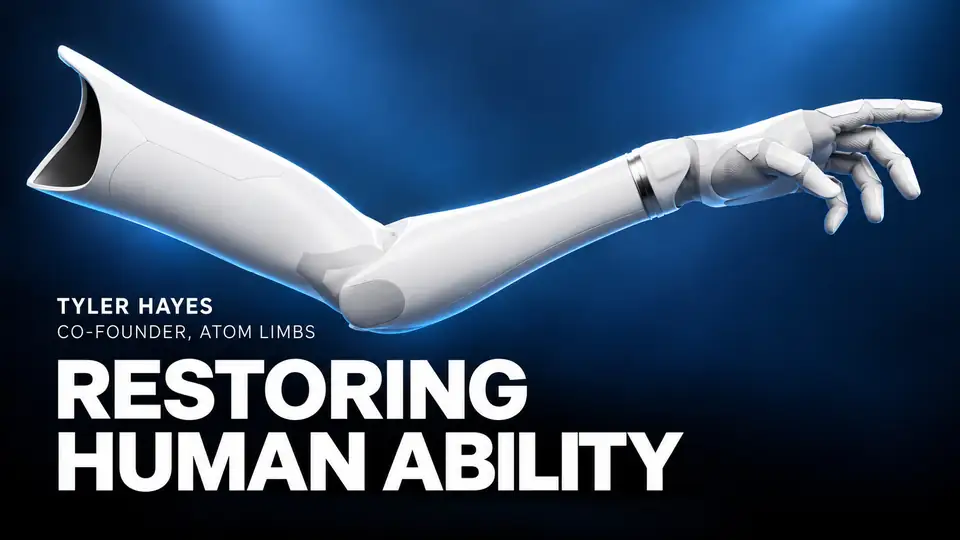
In this conversation, we talk with Tyler Hayes, CEO of Atom Limbs, about their highly anticipated mind controlled bionic arm. The bionic arm goes beyond a prosthetic arm and brings us into the new “Human Body 2.0.” We will cover the evolution of the bionic arm and how this is only the beginning of the creation of more bionic limbs and organs. Lastly, we will talk about Tyler’s reasons for being so open and why he is encouraging people to follow along as Atom Limbs creates their products.
Links
Chapters
Times follow the podcast audio. The video’s timeline may be slightly different.
- 00:00Welcome and introducing Atom Limbs
- 02:00Controlling an artificial arm
- 04:48Signals between the body and the device
- 06:37The longer-term vision for artificial bodies
- 10:08Identity and the meaning of being human
- 11:57What else should people build?
- 18:52Helping hard-tech and scientist founders
- 22:16Why publish a company’s plans?
- 27:40Advice for getting started
Read the conversation
Open the full transcript
CAMERON WIESE: Welcome to the Build the Future podcast. My name is Cameron Wiese, and I'm your host. I've always been fascinated by the ideas and the sentiment that drove American culture in the 1960s with the space race. A culture galvanized to dream about the possibilities of tomorrow. Whether it's food, transportation, cities, biology, or anything else. It was this cultural mindset rooted in optimism, that the world tomorrow would be better than the world today. A mindset where people were compelled to build things, and I quote JFK, not because they were easy, but because they were hard. It's this desire to build and to dream that seems to have been lost, and something we're here to bring back. With Build the Future, we're here to promote the ideas and stories of those who see how the future can be better and promote their plans to get us there. It's our mission to get you to dream about the possibilities of tomorrow, to dream about the future that you want to live in, and inspire you to go build.
CAMERON WIESE: Today, we're talking with Tyler Hayes, the founder and CEO of Atom Limbs. Atom Limbs, they're taking the research done through DARPA and Johns Hopkins University to build the first mind-controlled bionic arm called the Atom Touch. In doing so, they're building the future of not only artificial limbs, but the human body as a whole. Let's jump right in. Tyler, let's start with the basics. Tell me about the future you're building with Atom Limbs. What's the vision?
TYLER HAYES: The vision is to finally enter the era of human body 2.0. So literally to reverse engineer the human body and then make a version that we can create at will and then create an even better version after that. And we're starting with mind-controlled bionic arms. And they're real, right? They already exist. They've already been invented. That part does not need to be done on
CAMERON WIESE: the arms. Yeah. I think that's the first question everyone asks, right? Wait, what? You're building bionic arms? How does it work? So you have the Atom Touch, which is, I'll let you take it from
TYLER HAYES: there. Yes. The Atom Touch. So our first arm, the Atom Touch is basically an artificial arm is the best way to think about it. You control it just by thinking, like you control your normal arm. It doesn't, it's non-invasive. Like we don't have to put some electrode in your brain or something. It just listens on the surface of your skin and hears your nerve signals. It restores a sense of basic sense of touch. So with your fingers, when you're pressing on things, feeling pressure, feeling temperature, like we can restore some level of that. And it has all of the human motion. So all of the elbow and the wrist rotation and your finger movements and the side to side finger movements and the flexing and extending of them, it's all there. So you could literally play a piano with it. And actually 20 people have used it while it's been in clinical trials. And one of them took it home for a whole year. His name is Johnny. And Johnny did play the piano with it. He played Amazing Grace. And the full video of that is not out yet, but that's coming.
CAMERON WIESE: So it's an attachment you put like a band you put around the arm. Yeah. How did they attach it to their bodies?
TYLER HAYES: Yeah. The way that prosthetics work today is you use what's called like a socket. And it's like a vacuum suction socket. So it's like literally you just have a mold molded to your stump, your residual limb stump, and then you just kind of push it on and then it sort of suctions on. Not a great experience. It's super, it rubs against your skin. It can cause like bruises and wounds and all sorts of bad stuff. This is uncomfortable. You get sweat stuck in it. It's really gross. So like technically you could use a socket with our artificial arm. When we do call it an artificial arm, not a prosthetic arm, we use way more than I think just a prosthetic. in that sense. And so you could use a socket, but there's also this new integration that's called osseointegration that we're really trying to push. And some people have already gotten, which is, so osseo means bone. So literally what happens is you drill a titanium rod into the bone of your residual limb arm. And then that sticks out of your arm through your skin. It's totally safe, that you're not like bleeding out of it or anything like that. And then that just acts as an attachment point for our arm to attach to your body. And most surgeons actually are trying to get more amputees to do this because it's stronger, it's safer. And really the only risk you run with that is if you fall and you hit it the wrong way, you might hurt yourself, but you already run that risk anyway if you don't have a whole arm. So the integration with your body is different than the interface. So the interface is the band that we put around your stump that listens using EMG
TYLER HAYES: to the nerve signals. And so those are actually two different things.
CAMERON WIESE: Can you dive into the details of that a little bit? How does the arm band communicate with the
SPEAKER UNCLEAR: atom lemon? Sure. Yeah. I actually think I have, listeners obviously can't see this, but basically, okay, so here's the band. It looks flexible bracelet, basically. You slide it onto your arm. And then when you think, the signals travel from your brain through your nerves into your muscles, just normally, you and me, that's how it works already. Just electrical signals running through wires in your body. And those wires happen to be called nerves. And then those signals make your muscles move a little bit. And when that happens, those signals emanate from your body. And so when we put this band on your skin, it uses EMG, just like your doctor would use to listen to your muscle signals. And then those signals could send wirelessly over to the robotic arm, which then uses AI to move like you. So what's going to change in the state of,
CAMERON WIESE: so you're calling the atom artificial and previously it was prosthetics. What's the difference and what has changed to enable some of the technology that you guys are implementing
SPEAKER UNCLEAR: in these devices? Yeah, there were really two big changes that happened while this was in R&D at Johns Hopkins. One was you had to miniaturize robotics to a point where they could fit inside of a human hand, right? Like the central problem of robotics for most of the last 50 or a hundred years has basically been getting it small enough to a human scale. That's just really hard. It takes a lot of time, takes a lot of money. And then the second thing after the successful miniaturization of those robotics was the machine learning and the AI that can correctly interpret the signals quickly enough, accurately enough to move just like you would. So both of those had to happen in tandem for this to get to where it was.
TYLER HAYES: You couldn't just do the robotics. You couldn't just do the machine learning. And so it's the integration of both. It's the marriage of both. They both unlocked big progress, but them together has basically now put us, I would say five to 10 years ahead of the competition because of that.
CAMERON WIESE: Yeah. And where do you see it going from here?
TYLER HAYES: We're very outspoken about wanting to build human body 2.0 and curing death and ending permanent injury and like dead serious. Like I live forever. Yeah. We want to end permanent injury and disability. And so the next step is make the arm, then make a leg, then make an eye and an ear and a spine and everything you need to stop being disabled. And then after we've helped people who are disabled get their abilities back, then it's just make the rest of the human body. So that's phase one is ending disability. Phase two is just make the rest of the human body. And then phase three is make a better human body. The same way that self-driving or AI have like tiers that they're measured by very mechanically, same concept here is basically phase one, phase two, phase three, and how you get to human body 2.0.
CAMERON WIESE: What sort of things might we be able to do with this human body 2.0?
TYLER HAYES: I think the biggest thing is you don't have to worry about injury anymore. Imagine that, right? Imagine anything short of destroying your brain is no longer life-threatening.
CAMERON WIESE: Even in that case, because you'll probably have a protective shell around your brain, right? Totally.
TYLER HAYES: Yeah. And I do think for what it's worth, like, you know, I studied neuroscience. That was my, I wanted to be a neurosurgeon and ended up being an entrepreneur instead. And we do need to reverse engineer the brain. I think that's actually the ultimate goal, but short of that. Yeah. So like you could, if you were injured or if you had some sort of trauma, or if you got cancer, if you got diabetes and you have to get things amputated, or you have to get things, You have nerve damage from things. All of those today are permanent with you for the rest of your life. And it doesn't have to be that way anymore. And it shouldn't be that way. That's, I think, the first thing.
TYLER HAYES: I think the second thing is we could design our own bodies. Like, why are we just limited to this? This is basically what evolution has gotten us to over the past, let's call it 100,000 years. And that's fine. We descended from primates. And we could have descended from a ton of other animals and looked and acted very differently. Like we're not beholden to this one form factor. And especially if you want to do things that I'm interested in, and I think a lot of us are just like, go to Mars, see the rest of the galaxy in the universe. You can't do that in a human body. You can't do that in a meat sack. Like body is not going to last in those environments.
TYLER HAYES: And even if it did last, like it's not really conducive to those environments. We're spending millions of dollars right now via NASA to make sure that when astronauts come home from the ISS that they aren't atrophying, their muscles aren't atrophying, their bones aren't degrading. Like when we first sent people up to the International Space Station, they were encountering the same amount of bone degradation and loss in one month that someone with osteoporosis would get in one year. That is a crazy amount of degradation. And so fortunately, we've improved that. I think a lot of people think of like evolution as upgrade and evolution is not synonymous with upgrade. Like the process of evolution is adapting to your environment. It doesn't mean upgrade. This is why like X-Men, for example, is an actually outlandish concept.
TYLER HAYES: Like no one's ever going to develop laser vision or anything like that because it's that the environment doesn't require it. So evolution stops when you don't, when you're sufficiently adapted to your environment. Like that's why humans have stopped over the past 10,000 years. Even if we hadn't, we would just be adapting to the environment. We wouldn't be upgrading. We wouldn't be like getting stronger, You're a skin that lets us travel through space, for example. Like we, if we want that, we have to create it at this point. It's only going to happen if we create it.
CAMERON WIESE: To get a little philosophical, like at what point do we no longer become ourselves in this pursuit?
TYLER HAYES: I don't think that's the, I don't think it'll ever happen. I think we'll always be human. I think it's just, it's redefined over time. I think it has been redefined over time. So like how many times a day do we all check our phones? Like we know from studies, it's like hundreds of times a day.
CAMERON WIESE: Embarrassingly large amount. Yeah.
TYLER HAYES: Yeah. Yeah. And like you could you could arguably make the case that we're cyborgs already right now because you have it's basically attached to your body. You're just allowed to detach it from your body every now and then. And most of the time you're at a computer or you have a phone in your hand. So you've already augmented your body. It's just not inserted into you. So we didn't redefine humans when we invented smartphones and computers. We're still humans, but like humans from a thousand years ago would have thought we looked like cyborgs. and I'm wearing glasses right now. Maybe I'm wearing contacts. Maybe I get lasik surgery. Maybe I get a hip replacement. Maybe I have a pacemaker. Maybe I get an electrode grid implanted in my brain because I'm quadriplegic and I need to be able to control an arm or a leg remotely.
SPEAKER UNCLEAR: None of those would redefine what a human is. And it's because it happens over time. And so as long as it just happens as we can notice it and call it out over time, I think we just keep the definition. Like I don't expect that humans will ever not call ourselves humans, but we will look at ourselves from the past and go, wow,
SPEAKER UNCLEAR: what a primitive version of ourselves, basically.
CAMERON WIESE: Even now we're walking with AirPods in and that didn't happen four or five years ago. Everyone was all wired up. And now here we are just plugged in.
TYLER HAYES: I remember when Neil Tyson, it was like five or 10 years ago. He was like, someone asked him a similar question. And he was like, if you showed the iPhone to someone like 500 years ago, they would have burned you at the stake because they would have thought you were a witch. Right. They had no way to comprehend what an iPhone was at that point.
CAMERON WIESE: Yeah, everyone gets hung up over the arguments around stagnation and are we making progress? And I think there's some merit to it. But if you look at the world 20 years ago, we now have iPhones. We have all these technological innovations that are fundamentally reshaping how we experience life. What sort of things would you like to see other people building to help us move forward to a future that's prosperous? So you're doing the limbs. Like what are the things can people be working on that will really work us out of this period of stagnation and kind of help us advance?
TYLER HAYES: That's a good question. A lot. I think that if you even just look at, for example, do you know what the Universal Declaration of Human Rights is? Have you heard of this? Maybe you've heard of it or something. So in 1948, the UN, like basically all the countries of the UN signed this agreement. It's called the Universal Declaration of Human Rights or the UDHR. And the point of this document was basically to say, okay, we all as countries will ensure that even if our constitutions don't guarantee this stuff, or if we don't have some like legal recourse for it, we will basically still enforce these things at a country level across the world. And the things on that list, the human rights were exactly what you think they'd be.
TYLER HAYES: It was water, shelter, food, education, health care, lack of persecution, all this kind of stuff. And if you just even look at that list, just go down it. How much have we still just not solved? Not everyone has water. Not everyone has food. Not everyone can walk or can use their arms. Not everyone can see or can hear or can taste or can smell. I call these things the meaningful fundamentals. to me when I say meaningful fundamentals what I'm talking about is humanity progresses in my mind through checkpoints like in a video game like you have like when you're playing a video game like you're fighting through these enemies and these bosses and then once you beat a big boss you get a checkpoint and at that point even if you die in the video game after that you don't go back before that checkpoint you start again at that checkpoint and humanity has to like unlock these checkpoints over time so like at this point like what checkpoints what major checkpoints have we unlocked as a species. I would say that fire is definitely one. We'll never not have fire again.
TYLER HAYES: I think that we will never not have science again. It's just too pervasive at this point. Even if the internet went away, we would still have science. I also think that electricity and modern farming and agriculture, most of that is pretty much here to stay. We've unlocked these major checkpoints. And now, what major checkpoints are next? In the last hundred years, we've reached some major checkpoints with medicine and with science and with technology. Polio, gone. Black plague, gone. A little farther back, but technology, transistors, here, computers, here, internet, here. We're not going to go back before those things at this point. It would take an insane event in the world for that to happen because you'd literally have to shut off all electricity and all internet everywhere in the world for that to happen. If even one pocket stayed up, it would come back. So the next checkpoints we need are now that we have all these things, we need to get the next logical step of in medicine, get to reverse engineer the human body and the human brain. In science, we need to get to being able to engineer our own lifespans.
SPEAKER UNCLEAR: in technology we need to get to modularity in space travel and in public transit in cities and all sorts of just really important fundamental things and there's so many opportunities like this why would you work on anything else but i get why right like even i for the first 10-ish years of my entrepreneurial career i didn't work on that stuff like i invested in some stuff and advise some stuff but it was it's really hard it's hard to find projects that are compelling enough, that can get capital that's big enough, and the team that's talented and passionate enough. These things are hard for a reason. And I just don't think that even Silicon Valley is the bastion of innovation. It's really well set up for a lot of this stuff. So I know you asked a smaller question, but there's a lot in there for sure for me. Let's unravel how we
CAMERON WIESE: get people to go build this sort of stuff. Because I don't know, the narrative that I think has emerged over the last, I think it was probably two years ago when Sam Altman wrote that piece where it's easier to build a hard tech company than a software company because it's there's a compelling vision you can get people excited about it but i don't think that's pervaded like the broader narrative why do you think that is how do you think we can get more people to work on things that are going
SPEAKER UNCLEAR: to actually move the needle yeah i don't think people don't want to take big swings i think a lot of people want to take big swings and i know that like you and i talked about this before i get dms every day from people who are like thank you for working on something so ambitious this is so cool. And sometimes I help out. And it comes from people we could hire. It comes from investors. It comes from partners. Everyone wants more of this ambitious craziness, but yet they aren't doing it. So why? It's not for lack of passion and will. I think that Sam Altman, who I respect massively, does not have the correct answer there. I don't think it's easier to start a hard tech company. And that's not entirely what he was saying either. I know that he still gets the nuance of these things. That statement is just wrapped up in a ton of privilege, basically.
TYLER HAYES: And I think he sees that. It's not like he was trying to say, it's so easy. Why doesn't everyone do this? That's obviously not what he was trying to say. It is important how you frame this stuff. And I do think that the correct way to frame this is, no, it's way easier to make a software company logistically, mechanically. It's costless. It's easier to write code and ship it and iterate. It's easier to get to customers. There's just way more capital and team out there who knows how to do that stuff and is willing to do it, there's way less dollars in hard tech and frontier tech than there is in SaaS products and software products. And so I think until two things happen, this won't change. I think the first thing that needs to happen is the capital side does need to legitimately change, reframe their thinking. I do see a lot of venture capitalists and people in PE and institutional investors who, at no fault of their own, not to discredit them, share somewhat of the same idea as Sam, which is, oh, founders should be able to do this, create a compiling vision and people will come to you. That's not the reality of how it works.
TYLER HAYES: Like you probably have a job. You don't have a ton of time. Yes, you should make time. But like, it's incredibly difficult when you don't know also that the capital is there on the other side to do it. And that capital isn't there in the same degree as it is for software. So I think that needs to happen. I think investors need to start reframing. I think they need to basically in the same way that sort of like fighting racism or sexism, it doesn't just take people's not being racist, that it actually takes people being like anti-racist. Like you need to fight it basically. And I think it's the same with investors. Like they need to fight publicly and consciously, Hey, we are going to consciously take 20% of our fund and we were going to put it only towards frontier tech or hard tech or something like that. And you got to do that because otherwise it's not going to happen. And I know that because it's not happening right now.
TYLER HAYES: It would have happened if that was the case. The second thing, that's the first thing in the capital side. And the second thing is we do need better institutions or programs for people on the founder side. It took me 10 years of being an entrepreneur to get sharp enough at all the things I need to be able to do to get Atom Limbs off the ground. I don't think this would be easy for a first-time founder. trying to do tech transfer from Johns Hopkins, trying to put together a world-class team of people from NASA and Apple and Intuitive Surgical, trying to do the growth and the marketing correctly. Like it's, and then let alone trying to go through FDA approval and getting reimbursed by insurance.
TYLER HAYES: Like it's just a lot. And so how could you possibly expect that founders would know how to do that on their first ad back? Most founders failed their first software company. Like we need to be fostering this stuff more. And last thought on that, YC had this interesting concept But at one point with YC Bio, where they were like, oh, we're going to fund this kind of stuff. And it didn't work out for various reasons. But so now Sam's got his new thing, Apollo, me and Jack are doing. That looks great. That sounds great. Now, they only invested in five companies to start the fine. They need to figure out if it works or not, get the mold made. But we need basically 10 more of those. And then we need 100 more of those.
CAMERON WIESE: Yeah. What do you think is going to make the difference? I think a lot of people, even though look at YComodate and they'll try and replicate the model. Oh, we're just going to create a little incubator and give people money. But as we've seen, Ycommoner is the only accelerator that has really stayed standing. 500 startups and tech stars faded into the background and YC is really the only one. I mean, it's the power lot play. But what do you think that's going to look like in the future frontier tech space? What sort of institutional components are going to be necessary to really help founders get the skills and get the capital they need to actually go do these things?
TYLER HAYES: I think there are already people who are trying to make the YC for Frontier Tech. But first of all, it needs to be different than YC in many ways. And so they are doing it in different ways, but I still don't think they're doing it in the correct, different way. So you have Cyclotron Road or places that are trying to foster scientists or inventors who invent stuff. I think you just need to work backwards from the central problem, which is you either have a founder who knows how to do this stuff, but can't get the capital or the team super easily. So just help them do that. Give them the capital and give them the bandwidth to be able to go get their team and get things going.
SPEAKER UNCLEAR: Or you have a founder who doesn't know how to do this stuff, but they invented something or they're a scientist or whatever it is. And they probably could pull it off if they had some education and help with that. But that's just a lot of work. And so you need to offer both of those. So like rough sketch back a napkin. If you wanted to do YC for frontier tech, this isn't quite right. but it would not be 120,000 or whatever it is now they offer 120,000 in three months. And then a demo day, it would be like a couple million over, and maybe it's tranched over a year or two. You still can have the risk aversion on the investor side. And then it's not a demo day after three months. That's absurd. No one's going to have something they can show after three months. Even if they've like us already have something they are indeed for 15 years that Hopkins at R&D. It needs to be longer and progress-based, not just three months and then demo day. And maybe there's still a demo day after something, but we need to fit the form to the problem to start. I think there's something to that, the progress-based
CAMERON WIESE: narrative and showing the steps along the way. You've seen Boom do this. This is what you guys are doing. And even our canonical example of Elon and SpaceX and Tesla, it's like they're starting at one point and they're slowly working their way down. And they're like, hey, everybody, here's the grandmaster plan, but we are not there yet. But here's how we're going to get there. And you do the first step and you do the second step. And then eventually you get there and it's like, oh, wow, you did this thing. Really cool. And like, yeah, we told you this is where we were
TYLER HAYES: going. Yeah, exactly. I had an investor ask me a couple of weeks ago, right after we went public and we started building in public, they were like, why are you building in public? And so many other people who build like hardware, for example, that don't do that. And I was like, why not build in public, first of all. There's so much of an army you can build as you do that. But I get it. Sometimes you want to be a little bit more still. And there is value in surprise. But frankly, I think this stuff is just way too hard to not build in public. Unless you have $500 million in funding and a war chest, and you just know you're going to be able to be safe for 10 years, you need all the help you can get. And so you should just be going and getting it. It's weird to me that people don't feel that way, to be honest. And building in public doesn't mean give away all your secrets, right? Like to your point, yeah, we're building in public, but nobody's seen our machine learning and nobody's seen the actuators, but they see the progress and they see that we have hundreds of amputees on our wait list within a couple of weeks of even going public with what we're doing. And that this like WeFunder campaign that we started raised like $200,000 in a day, like the first day we had a couple hundred dollars coming. Why would you turn
SPEAKER UNCLEAR: that stuff down basically? Yeah. So that's, this is the trend that I've noticed with the people who are really pushing the boundaries of what other people would say is impossible or too hard. Is there, they're working in public, they're using Twitter and Facebook and whatever platforms they can, TikTok to get the word out and to build up an audience. And you've done an incredible job of doing this thus far. And I'd love to just have you elaborate on like, how have you been thinking about like the brand and marketing front, right? How have you approached this building in public mentality and what can other people learn, other people who are building the future, what can they learn from how you have gone about it that would help them build up a following, build up an audience and really get the support they need?
TYLER HAYES: We have a couple frameworks we use internally for this stuff that helps us make sure we stay on track. We focus, we don't drift and we get the goals we want. But even before I say those, just one thing, if you're asking, how do you do this? And why do you do this? at the highest level, it's because the reality is that we don't have a product in the market yet. And it's the same with Boom. And it's the same with Neuralink. Companies that do frontier tech inevitably take a couple of years before they can get into market. It's not a software product you can get out in a couple of weeks. So you either have one of two realities you can walk through. One is don't tell anyone what's happening and then just say, hey, we're here in a couple of years.
TYLER HAYES: And like, why do that? There's an easy win the whole time where you can just be pulling in people crazy want to fight alongside you and that's the other reality which is find people who share your crazy and so for us the frameworks that we use internally we have many but in terms of building in public we ask ourselves okay is this worth our time and the two frameworks i think we use the most around this are one super fans we call them like army recruits internally like super fans and like how can you get 10 000 super fans over to your side so kevin kelly had this really powerful concept he came up a long time ago just just get a thousand people who love you And Paul Graham would always talk about that then too. He would say, it's way better to have a thousand people who love you than a million people who like you. Because it's way easier to get people, get more people who love you than it is to get a bunch of people who like you to then love you. That's one thing. So how do you get super fans? How do you get 10,000 super fans? And then we just measure that literally like every day. That's what we start with at the beginning and ending of every day. And the other framework we have is, I guess the way I'm comfortable talking about it publicly is like input output. So what are you doing input? What are you doing output? Or was it Bill Walsh who wrote, like score takes care of itself. Same concept here. Every day people see us on TikTok and Instagram and YouTube and everywhere else. And like pretty quickly within a couple of weeks of publicly debuting what we're doing, we had thousands of people following us and rebroadcasting our message.
TYLER HAYES: And then folks like Nasjack on TikTok making videos about us and stuff like that. And then now we have 500,000 people seeing what we're doing. It's crazy. And the way that we do that is we just say it very simply at the beginning of every day, what's our output we're trying to get by the end of the day today. Just one big win. So that's the framework inside of that is we call them like the one big win.
SPEAKER UNCLEAR: Yeah, because the challenges with companies like this and ambitious plans, it just takes a long time. And so having a mindset of, okay, how can I get a win every day? How can I make sure this is moving forward every day? I think is probably one of the most useful heuristics for anyone who's trying to do this. What can I just do today to move this forward? Because the super sonic, like not going to snap your fingers and have all of these amputees with their artificial limbs like that, or you're not going to have the overture. Like you have to break it down. booms overture. You have to break it down and move forward. But man, some of these things are so vast in scope and it's like easily overwhelming. Yeah. You don't need to know every step of that
TYLER HAYES: process. You need to know ABC and then you need to know the goal is Z. You don't need to know DEF, GHI. You'll figure those out after you get to ABC and then DEF. And so like, just put in the work now and keep it consistent and you'll get there. You'll figure it out because you care to even figure it out. And that will take care of itself at that point. Yeah. Actually, one of the
SPEAKER UNCLEAR: other things that I would love to get your take on is a lot of the people who are emerging and this COVID, I'm tired of the world operating in a broken way. I'm going to go fix it. Like everyone in that space who we've seen on Twitter who want to go build, they're a lot of times like first time entrepreneurs or first time founders or they're very early on in their careers. You said you've took you 10 years to get to Atom Limbs and I'm curious, what advice would you give to the people who are just starting pursuing these future building projects? I would say lean in as hard as
TYLER HAYES: possible and just literally try doing what you want to do ultimately because two reasons. One, life is short. It's like brutally short. I talk about the 10,000 days thing all the time, but basically like when I was young, I just did the math of like, how much time do I have in life before I die. And if you assume that you live till 75 years old or 80 on average, then basically the moment you turn 30 years old, you have 10,000 waking days left in your life. And waking day is like 16 hours of one day plus eight hours in the next day because you sleep for eight hours. But 10,000 waking days, that's not that much. And it made it very real for me. Probably got to get some stuff done. So that's one reason. But I think also the second reason is just start now because there's literally nothing else that's going to teach you how to do this
CAMERON WIESE: stuff anyway. I want to take a step back or actually step back and step out. What excites
SPEAKER UNCLEAR: you the most about the future? For me, it's the Star Trek future. That's the future I want to move in. The Star Trek future to me is disease has been solved and poverty and hunger have been solved. We don't even need currency. We don't even have cryptocurrency. There's just no currency because everyone has their basic needs taken care of. And we found a way to do that through technology and advancement. And so then what do people do with their time? It's a really crazy thing to ask ourselves. If you didn't have to make money with a job and you knew that you were going to get all the food you needed and the shelter you needed, what would you do with your time? Because you can do anything. I think a lot of people would pursue the arts and they would pursue science and they would go do all the crazy things that they'd want to do. And we finally can now just barely squint and just barely see it. If you squint hard enough, you can see it.
TYLER HAYES: And that's incredibly exciting and humbling to me. But that also means that we're not there yet. We need to keep working super hard to get there. And that's exciting to me too. It's exciting to our teams, helping to unlock that future, the future of humanity in a meaningful way. Let's get to that checkpoint. And we will get there. I don't see why it's reasonable to think otherwise. Humans have progressed for thousands of years, and we have major setbacks for sure. But we seem to always somehow find a way to triumph through it. And I believe in progress, ultimately. so whether it's 100 years or 500 years or a thousand years that star trek future that's the
SPEAKER UNCLEAR: ultimate goal for me that's what's exciting yeah i think we're your point on if you look just far enough out you can start to see it but it's like what are the some of the things that give you that hope right some of the other companies other technologies that you're seeing other things that you're kind of that are happening now they're going to work to get us there i think it's honestly
TYLER HAYES: probably less about companies and it's more about just the general social markers that we see There's less war. There's less poverty. There's more health, more higher quality of life. We're not, again, there's still tons of issues. We have lots of problems. I think companies do their part for sure, but it's much bigger than any one company or even a series of companies. But a company is a great way to rally people around a cause. I think it's the best unit we have in terms of pushing meaningful progress forward right now. And sometimes that company has to partner with an academic institution or the government or something, But ultimately, it really still ends up being the company basically says, let's innovate and let's improve something about the world.
TYLER HAYES: If I had to limit it to companies and people working on projects, I think that the stuff that I see when I look around that excites me is, yeah, absolutely what we're doing. I would, of course, throw that out there. I think that's the whole point is human body 2.0. And I think it's one of the most fundamental things we can do. I also see like crazy things like Starlink with SpaceX. the ultimate goal of something like Starlink is to democratize access to the internet all over the globe and you can only run so many wires underground to get to places that's just a fundamentally better approach in the long run is to be above everything and just beam it and there's tons of you know places that don't have access to the internet that now will have it and the internet is a fundamental human right in my mind at this point and then I think if I had to put a third one I would just say again on the health side I think like all these organ printing and bioreactor companies are super interesting to me because we're working on the limb side. They're working on the organ side. So we're working on conscious control side. They're working on the autonomous side, which is it should just work on its own. We have pacemakers, but we don't have pacemakers for most of the other organs. Like we should have that. So that's really cool to see the
CAMERON WIESE: progress with those. Very, very much. Last thing for you, how can people support you and Atom Limbs?
TYLER HAYES: If it's a financial support that they are excited about getting involved with us on, then the best way to do that is to go to our current WeFunder campaign because we are letting outsiders invest in the company. And it's not a donation. It is an investment. You do get equity. So you're basically an angel investor. But the beauty is you don't have to be accredited. Anyone can invest a hundred dollars or more. And that's at WeFunder.com slash Atom Limbs. And then the next best thing to do, just like to keep sharing the crazy to get the drip from us. there's two best ways to do that one is if you want the exclusive access to stuff like you want the early access to look at the new updates of the concept arm and you maybe even want an invite to Atom HQ to come play with the arm but then the facebook group is the place to do that so facebook.com slash groups slash adam lens or just search adam lens on facebook and go to the group not the page the group and if you're just that lean back kind of person who's like oh man this really cool, I just kind of want to get a little bit of drip from these folks, but you don't need the exclusive access and you're not looking to invest, then Instagram or Twitter are going to be the best places. And we're just at Atom Limbs, A-T-O-M-L-I-M-B-S everywhere. And we're always showing off videos of what's going on. So it's still, it's a cool way to constantly get a little bit of like future and cyberpunk and bionics and stuff in your feed. You get some wholesome memes in there, you get some like dog memes, and then you get some bionic arms.
CAMERON WIESE: Thanks for joining us for this episode of the Build the Future podcast. If you want to learn more about Atom Limbs, you can head on over to atomlimbs.com. If you want to follow along as Tyler and his team build in public, you can follow him on Twitter at TheTylerHayes. Thanks for joining us for another episode of the Build the Future podcast. Lastly, if you're building and want to get support, want to hear about certain topics or from certain people, or just want to get involved in helping build the future, shoot us over an email at hello at buildthefuturepodcast.com or follow me, Cameron, on Twitter at Cam we see and we'll see what we can make happen. That's it from us. Until next time, go build.
More episodes
All episodes Goke Olubusi — Digital Healthcare Infrastructure and TelemedicineGoke Olubusi on replacing paper hospital records with accessible digital tools and expanding telemedicine.
 Dr. Yael Joffe of 3x4 Genetics — The Future of Genetics, Health, and BiologyDr. Yael Joffe reflects on the gap between the promise of genetic testing and the value people receive from a report.
 Noor Siddiqui of Orchid Health — The Future of Families, Conception, and GeneticsNoor Siddiqui discusses Orchid’s approach to preconception and embryo screening.