

Build the Future Podcast
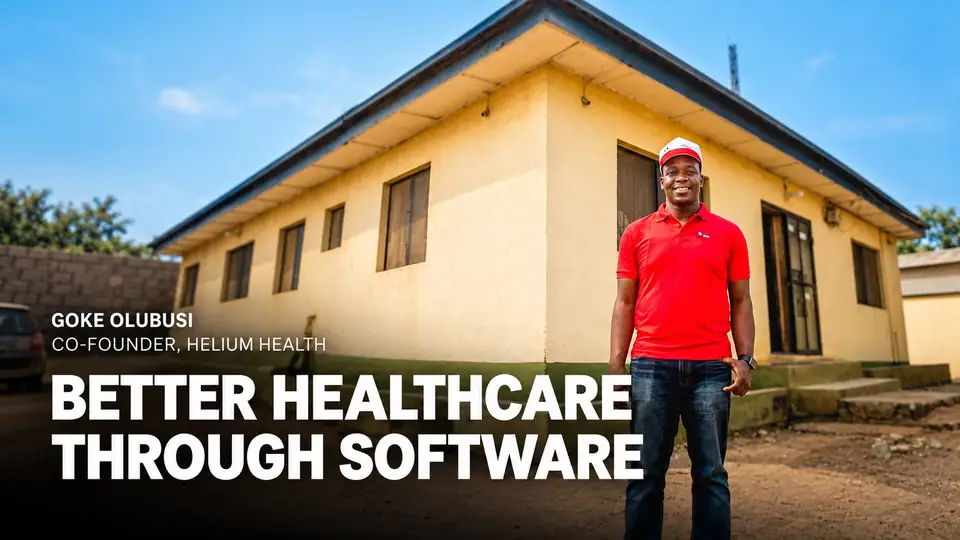
Goke Olubusi — Digital Healthcare Infrastructure and Telemedicine
Goke Olubusi on replacing paper hospital records with accessible digital tools and expanding telemedicine.
July 7, 2020 · 40 min



About the episode
We had a unique understanding and we said, okay, we're going to rebuild healthcare software, but we're not going to make it look like traditional healthcare software. We're going to make it feel like platforms these people already use. And more importantly, we're going to make it so easy and flexible and affordable for them that it just becomes a no brainer.
In this conversation, we talk with Goke Olubusi, the founder and CEO of Helium Health. Goke describes clinics where access to technology and familiarity with it are constraints, and how his team at Helium Health works within existing tools and behaviors to reshape healthcare.
The next question seems to be how?
Due to his extensive knowledge of the African market gathered from previous startups, Goke knew he had to work within people’s existing behaviors. While access to technology and the skills to use it are both constraints, he recognized that most people have a smartphone and are familiar with programs like Facebook, Twitter and Whatsapp. From there, Goke shares how he specifically developed a new healthcare software that can be used on a smartphone and has a similar interface to apps people already know.
Key Ideas
Links
Chapters
Times follow the podcast audio. The video’s timeline may be slightly different.
- 00:00Welcome to Build The Future
- 02:35A vision for data-driven healthcare
- 03:35Lessons from messaging and social platforms
- 07:16Designing software people want to use
- 10:00Flexible pricing, existing devices and offline access
- 12:23Turning records into useful operational insights
- 16:02Interoperability from the beginning
- 18:43Local care, investment and the impact of lockdowns
- 24:07Accelerating telemedicine and virtual care
- 30:20Building emergency response infrastructure
- 35:08Why more young people should build in healthcare
Read the conversation
Open the full transcript
CAMERON WIESE: Welcome to the Build the Future podcast. My name is Cameron Wiese and I'm your host. Before we kick off today's conversation, I want to tell you a little bit about the show and what you can expect. Over the last few years, I've always come back to the ideas and the sentiment that drove American culture in the 1960s with the space race. A culture of possibility and the pursuit of a mission much greater than ourselves. A mission to do things, to quote JFK, not because they are easy, but because they are hard. I've always asked myself, why have we stopped dreaming about this future? Why have we stopped pursuing the world of tomorrow? Well, I've decided to stop asking and instead start building.
CAMERON WIESE: To start building a future where we're all dreaming about the possibilities of tomorrow and creating plans to get there. See, if we want to overcome the challenges that are facing our world today, we must build. To drive forward innovation in frontier technologies, we must build. And when I say we, I mean you and me and all of our friends. Whatever the issue or opportunity, we must refuse to sit idly by while some version of the future inevitably arrives. We must step up. We must challenge the status quo. And we must build the future that we want to live in. That's what Build the Future is all about. It's a place for definite optimism in a world of negativity. A place that promotes the ideas of those who not only see how the world can be better, but those that have a plan to get there.
CAMERON WIESE: We're starting with this podcast where we share the visions of the future from those who are building it. Visions that inspire you. Visions that instill a sense of wonder. get you thinking about the possibilities of tomorrow in the hopes that you too will decide to take action and build the future you want to live in. So with that, I want to welcome you not only to the show, but to the future and the possibilities that lie ahead. Today we're talking with Gokke Alibusi, the CEO of Helium Health. Helium Health is building the infrastructure that enables hospitals and emerging markets to digitize their operations, operate efficiently, and provide high-quality healthcare to all. In pursuit of this mission, they're working to build the future of healthcare and support the 6 billion people in emerging markets around the globe. That's why today, I'm excited to have Goke with us. Goke, welcome to the show.
GOKE OLUBUSI: Thanks, Cameron. Very excited to share more.
CAMERON WIESE: So on the Build the Future podcast, we're aiming to share the compelling visions of the future from those like you who are building it. Can you tell us a little bit about the future you're building with Helium Health?
GOKE OLUBUSI: Absolutely. So what we envision at Helium Health is a future of healthcare in Africa and in emerging markets overall that is entirely technology and data driven. We would like to see where decisions in healthcare, both on a public health standpoint and even on a micro level at the provider, individual provider and care provision level is being made with data. And we know the only way to get there is to have technology. You'd be very surprised that more than 85 to 90% of the healthcare provision and providers across the African continent are still entirely on paper. And all the data and all the insights you need to actually improve the healthcare sector is lost in the files, in the millions of files that sit stored in these hospitals across the continent. And our job, our responsibility is to unlock that.
CAMERON WIESE: Can you tell me about the moment you realized that was the problem you wanted to go solve?
GOKE OLUBUSI: Absolutely. So I think, so before I started Helium, to give you more context, I previously started two companies, actually three companies before Helium, but two main ones before Helium. One of them was an enterprise messaging company that we sold to, I actually started with one of my co-founders at Helium and I, we sold it to our biggest client. This was like eight years ago. And then the one after ended up being one of the biggest social platforms, actually the biggest social platform in Africa at the time. It gained about 25 to 30 million users. This was way before WhatsApp and Facebook took over the market. So I had had a lot of time to learn and to understand the market and its unique nuances. We had built an enterprise messaging platform, which meant we had dealt B2B with businesses.
GOKE OLUBUSI: And also by providing a platform that's the biggest social platform on the continent, you then are solving direct consumer problems, B2C problems. And because we built a platform that had such insane engagements, we had a lot of understanding uniquely about what users, what it takes to get African user to adopt the product. Because they're very unique circumstances in the market. So off of that, building the initial company, which is a social platform, we got to understand how people think. And that actually led, that was the real segue into Helium Health. We realized that because when we started to, when I eventually got out of that company and we wanted to start Helium, we were thinking, myself and my co-founder were thinking, we need a problem.
SPEAKER UNCLEAR: We've already created multiple companies. We've been successful at it. We've invested in, at the time I think I'd already invested in like 50 different companies, 50 different startups. So we had a lot of experience. And we said, okay, we need to take on a problem that is a long-term problem that we could work on for the next 10 to 20 years. It's got to be worth our time. And what that looked like when you look at Africa was healthcare because every year we could see that the healthcare sector was just like almost entirely the same. You know, you watch finance, and FinTech companies get sprung up, and you watch agriculture. Everyone's innovating except healthcare. And we were very concerned about why that is. And the more we dug into it, the more we found really three core issues.
GOKE OLUBUSI: And this is what led to us starting the company. First was that the existing attempts that people were, the attempts people were taking to technology in the market weren't suitable. You cannot take a U.S. system like Epic or Cerner, which is the biggest EMR healthcare softwares in the U.S. and in, you know, sophisticated markets, You can't take that and try to import it into Africa. They don't have the same resources. They don't have the patience of time. You don't have the policy backing. You don't have any of those things. So we kept seeing people attempt and that failing. And we understood that you can redesign the experience of EMRs to match and to work for this market. And that's actually one of the core things that helped us scale.
GOKE OLUBUSI: We built a different experience with healthcare software, leveraging our knowledge of building social platforms before. So if you look at our medical records platform or our teleclinic platform, it all looks like Facebook or Twitter or WhatsApp, which is what people in the market already use every day. So we had that unique understanding and we said, okay, we're going to rebuild healthcare software, but we're not going to make it look like traditional healthcare software. We're going to make it feel like platforms these people already use. That's one of the core things we're going to do. And more importantly, we're going to make it so easy and flexible and affordable for them that it just becomes a no brainer. And that's been the experience so far. So we could see a complete stagnation in the market. And the real reason was because other people weren't able to get their technology to scale because they weren't approaching it correctly, both from the experience standpoint, but also with the pricing and a lot of other factors as well.
CAMERON WIESE: Yeah. Can you tell me a little bit more about the approach you guys took? Because it seems to me that I know you mentioned that you can't take the U.S. systems and drag and drop them into the African market. So you have to approach it differently. Right.
GOKE OLUBUSI: Absolutely. So to talk about some of those things, one of the core things is experience, is the user experience. And now, like, it sounds so simple. And sometimes people don't give enough credit to product designers and product, you know, product engineers.
SPEAKER UNCLEAR: Yeah, yeah.
SPEAKER UNCLEAR: But the experience you build is so important because it's the difference between a doctor seeing the system and going, oh, we can use this. Or seeing it and going, oh, God, my life is already stressful enough. This is going to make it even worse. And the worst part is medical record software has the worst reputation overall.
SPEAKER UNCLEAR: Oh, yeah.
GOKE OLUBUSI: Just across the market. An MPS score for EMRs on average are negative 75. No one likes them. If you go anywhere, I know the director of Harvard Medical School. All these people, they're all just like, we are just in pain with the software. And really because it's complicated. if you look at the u.s systems their legacy systems they were built in the late 80s early 90s but it's just like ibm oracle everyone still uses you can't get rid you can't get rid of any of these
SPEAKER UNCLEAR: systems right they're they're so deeply ingrained yeah exactly like how do you you can't like it's
GOKE OLUBUSI: like wall remember when i walked on wall street i always tried to get that like why don't we use max here why don't we use and everyone's just like dude the process of trying to do anything is just impossible because all the data and everything is stored in these old systems. So what you have across the world are legacy systems because people adopted medical software and healthcare software 20 years ago. You see what I mean? So if you try to take one of those solutions to a different market, you can't go through the same process. You can't try to train because one of the things Epic did in the US, and Epic is the biggest player in the US, is they started these modules, these training modules, and And people started paying for training courses.
GOKE OLUBUSI: And it became a whole industry of educating people on how to use their software. That's how complicated it is. You can't have that in a market where everything is so different. That's one core part. Another core thing is how we made it accessible, the accessibility. When you think about distribution, we understood that cost would be a barrier to entry because people would not want to pay commensurate value for it, when they don't know. They've never used an EMR before. Think about that. You're selling to a hospital owner who has never gone digital. He doesn't know. If you say it's $10,000, he doesn't really know if it's like, it's not what I should be paying. He has no context to it, right? So we had to figure that part out too and create a flexible pricing mechanism where people weren't paying large costs up front.
GOKE OLUBUSI: We're like, there's zero cost. All you have to do is pay per patient who comes to your hospital. You can use us for a week. And if you don't like us, you can kick us out. You don't have to trust us. We'll let you trust the product itself. We've done that for over four years now. and we have not lost a single client.
SPEAKER UNCLEAR: Dude, that's awesome.
GOKE OLUBUSI: It shows you that it works, right? And it means we don't have to, right, it's awesome. We don't have to convince you, you know, after that. We just want you to see it. We really just want you to have it work in your hospital for a day or two days. And then you're going to be like, wait, why did we not record the vital signs on, you know, the system when we could have done, like, on our phones? Because everyone in the hospitals, at first we thought the barriers to entry would be internet penetration, mobile phones. That's not true anymore. because Africa is significantly advanced when it comes to internet penetration and mobile phone usage. If you go to a hospital that's not digital, you find out that on average, the employees there have two smartphones on average. That's the number in Nigeria, two smartphones on average. So they're already on their phones tweeting all day. We're just trying to make them start to do other things, right? Especially the essential stuff with the same devices. They're on Facebook all day.
GOKE OLUBUSI: They're watching YouTube videos. Again, there's no curve. There's no learning curve in that standpoint, we just need to make it easy. So those were some of the core things we did. We made it extremely easy. We made it suitable for the market by making it offline first. Offline first is important here because power is not the same as it is in the US. So you got to make sure things can run offline and then sync back to the internet whenever Connection is reestablished. We made the pricing model affordable. And also, more importantly, we made the system smart. And I say smart because when you're really the first mover in a space, right? Think about this. If we digitize a hospital that sees a thousand patients a day, which is, these are things we've done. They see a thousand patients a day that we took them from on paper to being entirely digital. They don't really know what to look out for. Like they don't know the extent to what the computers to do. It's all new to them. The hospital has been around for 30 years, right? They've always been on paper. Now they don't really know what they can do. Now we sit down and we're like, oh yeah, right? You can know what the busiest times of the day is. So you can plan for that with resources. You can know what doctors are making your money and what's losing your money. You could know where you're losing money to people running tests outside your hospital instead of inside. All of these things, I don't want to have to train you on process management and hospital management to do that.
GOKE OLUBUSI: I just want the system to be smart enough to notify you of these things, right?
SPEAKER UNCLEAR: Totally.
GOKE OLUBUSI: So you can get a weekly email and an SMS update saying your revenues went down 20% because you had less pregnant women this week, right? Doing their, you know, typical antenatal checks than they typically would. So things like that are what we got to do by making the system smart. So by the time you check all those boxes, it just becomes inevitable that our product keeps scaling in the
CAMERON WIESE: market. Yeah. And you're, you're able to provide such a higher quality level of healthcare to,
SPEAKER UNCLEAR: to so many more people, right? Absolutely. Absolutely. And I think people don't understand how important these things are because, you know, in some parts of the world, it just makes sense. You can't imagine functioning without it, but in other parts of the world, it's never existed. And I can give you an example. There's simple things, simple mistakes people make. And I'll give you one of the biggest ones is prescriptions. I mean, if you've ever seen a doctor's handwriting, right, you know, it's like chicken scratch. Whenever they write a prescription, it's just like a signature. Who can read this? No one. Think about how many times, right? Right. But, you know, some way you always find the pharmacies. But think about how many times someone has misread a medication because it was written by hand.
SPEAKER UNCLEAR: Right. By a doctor. Yeah. Think about that. Think about how many times people have misread diagnosis. Think about how many times these simple things mean so much. And there are so many lives are lost every day because of this, especially when you're in a market where things aren't as efficient. And there are so many underlying challenges. So it's something as simple as taking a small clinic in the middle of an underserved area digital. It's so important because automatically you then have a trusted and accurate system for storing medical records. You can trust everything the doctor said, everything the system is saying. You then have an audited system for the care provided itself because you know everything that each person at the facility, each medical professional did to provide care to this person.
GOKE OLUBUSI: then you can start to understand on a deeper level, both in the provider hospital level, as well as more transparently to the patient, what the cost components are and start to drive towards how to provide more efficient, affordable care. Because now we have all this data and there's so much we can dig into with it. So yeah, it's definitely providing a lot of value. And that's just on the medical records, hospital management side. Now we do so many more things all the way from managing the government's COVID response tech to like health information exchanges and financing for hospitals. But it all came from that core foundation, which is digitizing care
SPEAKER UNCLEAR: provision itself. Yeah, it's such a, it's, it sounds so strange to anyone in the States who's so used to just going to a hospital and assuming their records are there, their doctors are sending them notes. It's all already exists. But in other markets, like that's not true. The fact that it's paper based, or was paper based, just like blows my mind. Oh, yeah. And you have hospitals that
GOKE OLUBUSI: see thousands of patients. I'm saying thousands. And also you think about it from, and I'll just, I'll highlight a different point to you here. You think about the inefficiencies of running a facility on paper. So the real reason the hospitals, again, healthcare sector hasn't really thrived in these countries as it should is really because people aren't running it efficiently because they're not running it based off of data because you can't have, how do you have any kind of aggregate data if you have a thousand patients physically, you physically move a thousand files, right? You can't, how do you know how many of those patients were from XYZ city? You know, it's not like, how do you, you can't, you can't do that. So all those things are lost forever. You can't build a more efficient business because of it. So now it's like, yeah, it's a whole different world because we're unlocking the next generation of what
SPEAKER UNCLEAR: healthcare would look like for everyone. So, so in that you kind of, it's cool. Cause you get to, you get to pretty much hit like the restart button on, okay, what is health? What should healthcare look like versus having to fit the mold of an existing system? It sounds like you guys have done that through all sorts of programs. Can you tell me a little bit more about that
SPEAKER UNCLEAR: approach you've taken? So one of the unique things we got to do is leapfrog the issues that the U.S. and other markets face on the road to digitization. Look at the U.S. now. It's been about, let's say, 10 to 20 years, I'd say 15 years really, has been the ramp to digitization in the healthcare sector. Yet you have so many issues. HIPAA itself is an issue, which is the privacy arm of healthcare. And no one seems to agree on how HIPAA should work. Let's do this. Let's do that. Yeah, it's a mess. You have heavy fragmentation of the technology space itself, where so much so that, I don't know if you know about the recent Trump administration or the government's recent push on making healthcare data more interoperable, mandating the healthcare data be really, the government's really pushing, the US government's really pushing for the data, the power of the data to be in the hands of the patients, right? You can't keep it siloed. But that's a big issue, right? Data was fragmented, so heavily fragmented, that people built entire companies off of just, you know, bringing data together across multiple systems. And we're thinking, now that we're at the start of our own journey in this part of the world, and I'm saying, you know, West Africa, Sub-Saharan Africa, North Africa, the Middle East, now that we're at the start of the journey, it means we can design everything to be interoperable from inception, it means we can solve a lot of these issues.
GOKE OLUBUSI: We can craft these countries, a lot of the countries we're operating in, they don't have any specific healthcare data laws anyways. We could craft their version of HIPAA for them, right? And make it better than HIPAA and learn from all the mistakes that were made in other parts of the world. So what we're saying is we can really, if it took the US 15 years, 20 years to really get digital, we can do things a lot faster because we can learn from all their mistakes and actually design a better system such that when you compare what the emerging markets look like in 15, 20 years time, it would be, you know, miles ahead of everywhere else because things are designed and engineered very specifically, you know, by us in partnership with lots of different parties. I mean, we engage lots of different organizations and we work with lots of different very, you know, smart people who care about public health. Also because healthcare care is a public it's a it's a public concern you know it's not really something for it's not a private industry it impacts everyone right so really you know there's there's that aspect to it as well so we're excited to see what that you know looks like in the next few years yeah tell
CAMERON WIESE: me how you think about the the role of of health care because in the states actually all over the world we're seeing with covid like lots of people don't can't afford to go get good health care they're avoiding hospitals because they're like i can't pay for it and so how how should we be thinking about this and for y'all you're rebuilding you get to design that future so like what does
SPEAKER UNCLEAR: that what does that look like to you sure thing so i can give you more more based off of like the background of how i use nigeria as a case study here so historically and you you can also see this as a trend for a lot actually most African countries and most of the margin markets overall Latin America, Southeast Asia, you see the same trend because we keep our eyes on all these places. The governments don't invest very heavily in healthcare. If you see their budget, it's ridiculous. They keep slashing the healthcare budget. You think year on year they'll increase. No, they keep reducing it because, again, they don't really understand what's going on. They don't have any clear metrics. Because of the lack of tech and visibility and data on that level, no one can really trust what was going on in the first place.
GOKE OLUBUSI: They're not really committed to it. So you had, what you have very heavily is a very underfunded healthcare sector. And you can say this in Nigeria, you can say this across different parts of the world. And then it got worse. It got worse because the wealthier part of the community of these countries decided, oh, we could just fly to other places to access care, right? If you, when one of my, you know, siblings had cancer, my mom took him to India and Germany, right? When, that's the trend. No one thinks, why do we, you know, let's build these things here. They're like, oh, you can just go somewhere else. So you have an underfunded sector that's also essentially abandoned because it's under, you know, under facilitated overall.
GOKE OLUBUSI: And now you then have COVID. And I'll tell you a very interesting change that happened. And I'm hoping this is going to be the start of a new future for everyone. Suddenly, there was a lockdown across all these countries. Airports got shut down. Airports in Nigeria has been shut down for like two, three months now. I myself haven't been able to leave every time because we do a lot of work for the government. Every time I need to fly somewhere, I literally need the minister of aviation approval. We need to get a private jet. It's like, you know, you can't just you can't. There's no mobility, pretty much. And then here's what you then have. You have a country where the entire population is dependent on health care being accessed outside the country.
SPEAKER UNCLEAR: And the local market is underfunded. So you don't have sophisticated hospitals or you don't have a lot of sophisticated hospitals. you have very few MRI machines, right? You have very few, very limited testing and all these things. And people are stuck there. You cannot imagine the number of people who have died in the last two months of lockdown or three months of lockdown. You know why? Because if they needed to have, you know, if they had cancer and they needed to get chemotherapy or they needed to have certain surgeries done, there's no way to do it locally, but there's no airport as well. So now we're paying for the sins of not improving our own healthcare sector. so finally because of the recent crisis and how travel and mobility has been impacted suddenly everyone who has abandoned all the you know government and private sector who've abandoned their health care sector for so long are having to live with that health care sector which is insane for them so now everyone's like oh crap we gotta we gotta actually invest in this because maybe we won't always be able to fly somewhere else yeah oh my god this is where i think right this is where I think there's going to be the start of what the future of healthcare looks like for the rest of the world.
GOKE OLUBUSI: Cause it's the first time I'm telling you for Nigeria, for example, maybe since military rule, post-colonial rule in the eighties or, you know, things like that, you haven't had a case where people couldn't just leave. And now that people cannot leave the country, everyone's forced to reinvest in healthcare sector. So underfunded was a huge issue. And the fact that people are having to deal with this and they're concerned that, Oh, will COVID come back? Will there be another pandemic? everyone's now starting to think about how we reinvest and rebuild our sector and i think that's a very important point to make about what i think how i think the future has been impacted by covid specifically and how i think the direction of the world is going especially with the margin markets because of a need to reinvest in the healthcare sector given the recent circumstances that's
CAMERON WIESE: crazy because yeah it's it's one of those things where oh yeah it's like oh this isn't my problem like oh i'm just gonna go to yeah germany or canada or the u.s to get healthcare yeah i was like oh wait oh this is not this system does not work oh we have to fix it oh yeah and people are
GOKE OLUBUSI: and people are dying and i i don't mean this in a you know real people are dying and i know i myself know several people who have died because of lack of proper care i don't yeah i don't i so many examples i could give you i'm i'm i'm trying not to drag this up no it's no it's important. People are dying from it because imagine if you can't get chemotherapy and you literally have nowhere to go. The person will die. Yeah. So a lot of people have been written off
CAMERON WIESE: because of that. Man. And I think the way you phrased it, which is like we're paying for these sins is probably the best. Because the only thing we can do right now is exactly what you guys are doing, which is trying to build out infrastructure to better support people and to get them the care
GOKE OLUBUSI: they need. Precisely. And we call this, you know, when we talk about the work we do, we say it's the digital infrastructure for healthcare. That's what we're doing. Digital infrastructure. That is what you need. Because again, people in a world where they've only thought traditionally without tech about life, everything they think is they think of it, everything is manna and analog. They're not thinking data, right? Data, machine learning. You know, if I brought, if I gave you a problem, Cameron, I'm pretty sure the, you know, the methods, the paths you'll take to a solution will be very progressive and more modern. But the people we deal with haven't ever, and they're, you know, a lot of people in healthcare sector are older. They've never had to interact with technology and see how it's useful to them. And we're now starting to open
CAMERON WIESE: their eyes to it. That's awesome. It sounds like one of the, one of those things is kind of the role that now telemedicine would play too, right? It's like, oh, I can actually talk to a doctor on
GOKE OLUBUSI: my phone. Absolutely, absolutely. You know, we had telemedicine on our roadmap to be, I think it was like later in this year or next year. And as soon as the COVID crisis started at the start of the year, we expedited that because we're like, haha, things are about to change very quickly. People thought, I mean, we first, I told a bunch of our investors and a bunch of other people first, and they're like, are you sure about this? But I'm like, when no one can move around, and it's different in Africa. It's different because you have the military on the streets, right? People literally cannot leave their house. But that is one part. People not, because they can't leave their house to go to the hospital. They're not even, you know, they're not, a lot of people are not even allowed to, because they're too afraid of the military on the streets so you can go to the hospital. So they're literally at home. So that's a big issue. And you, so it just, what happened was, as the crisis started, other parts of the world were like, okay, it's definitely going to get to Nigeria and to Africa and the countries we operate in Ghana, Liberia, Kenya.
GOKE OLUBUSI: So we need to speed up our teleclinic platform because of two reasons. First, we know the providers of hospitals, they've never had to deal with a world where people can't move around, right? They've never had to think about providing care virtually. They've never cared. If I tried to sell them telemedicine a year ago, they would have been like, I don't know about this. Maybe let that dude come over, right? Let him come to the hospital. But this time around, they're like, oh crap, they lost revenues on average 80 to 90%. Hospital revenues dropped between the months of March and April, 80 to 90. And we have, we have the data. Right. 80, 90% on average. They've never had, again, these hospitals have been around for decades, never had to deal with this before.
GOKE OLUBUSI: Now they're thinking, oh crap, how do we pay salaries? How do we pay our doctors? How do we keep this thing going? So we then said, okay, we came up with a virtual care suite, which enables them have virtual visits, video visits, voice visits, chat visits, whatever it is, help them collect payments for, you know, because again, they've never had to think about collecting payments remotely, because you can always swipe your card and pay at the facility. This time, it's got to be online. It's got to be with transfers, right? Being able to do that. And also being able to book the appointments and manage communication. Because again, because now their communication is no longer the patient came to me in person. For the first time, they're like, oh, crap, we got to have a virtual way to be able to remind them of their appointments, other procedures of the checklist, all these things, patient engagements, tele visits, and acceptance payments, all part of our virtual care suite. We started rolling that out in, I believe, March. And since I think the first week we launched it, we had about 200 hospitals sign up.
GOKE OLUBUSI: Since then, it's just been going up because people have no other options, but to need this, and we're already the brand they trust. And we're solving that problem for them. Yeah.
CAMERON WIESE: Dude, that's so cool. You're able to help solve that for people.
GOKE OLUBUSI: We're excited. We're excited that we're able to do this. And the COVID crisis really helped expedite that. And now we even have more, you know, with the IFC just gave us, I guess, just approved us to be part of a program. And it's called Tech Emerge in East Africa, where they're paying for more hospitals to go digital. So they're sponsoring this as well. So there's a lot of that happening. But yeah, it's been really, we've gotten zero to 60 in no time. And the unique thing about this, and I can say this also using data and, you know, Startup Health has a lot of data about this, is that once people go digital once, again, same experience using our EMR, right? Once you use it for a week, you're like, damn, how did we, like, you know, how did we, why were we so inefficient, you know?
GOKE OLUBUSI: And suddenly, let me, and I'll give you a quick example about that. But before we used to have, we thought when we first started, oh my God, we're going to need to have personnel in these hospitals helping them on board for weeks. And it's going to take forever. How are we going to make this work? If we ever have a person in the hospital, after the first two days of them using the system, they're like, why are you here? Because it becomes so obvious. And then whenever they have issues, they would rather talk to each other, right? And just figure out and solve it before they contact us. Or if one person doesn't know how something works, the other person does. They self-solve the problem, right?
GOKE OLUBUSI: And that's the same trend we're seeing. So in the same manner, with virtual care and tele visits, once the doctor and the patient have experienced it once, they're like, why did we have in-person visits in the first place? And it's even worse here because traffic in Nigeria, it takes an average of an hour to two hours for a big hospital, a tertiary facility or a teaching hospital to locate your file. Your appointment hasn't started. You have to show up an hour to two hours early because they've got to go find your file. You're one person out of hundreds of people who have showed up with millions of people in the last 40 years of running this hospital. All the files still exist in the file vault.
GOKE OLUBUSI: So they have teams called record teams who have to go look for your file. So you've got to show up two hours early because they have to spend, you know, they've got to find your name. Imagine how many Camerons have come to that hospital. Oh, my God. Right. So it's a whole it's a crazy process. So we're very, you know, we're very excited for the future it brings. And we've seen the same trend from the doctors and the patients. They're like, oh, crap. Why do we have follow-up visits in person? No more in-person follow-ups. Let's just have it virtually. Then we're not in traffic all day. You know, we don't have to deal with power issues. Really, it's going to be a change, a complete mindset shift. And we're very excited to be, you know, pioneering this and leading this from this part of the world.
CAMERON WIESE: Yeah, because essentially it's, there's probably some resistance before. but now that there's like kind of forced upon them like oh okay i guess this is what we have to do now they're like oh this was this is so much easier it's the people resisting change and then
SPEAKER UNCLEAR: being like oh i was being silly absolutely and really around the whole world we're all expecting that the covet crisis will be an i awake an awakening for everyone to start taking health care more seriously and it really it's put us 10 years ahead people are things that would have taken five, 10 years to accomplish. Markets are having to do it now because they have literally
CAMERON WIESE: no option. So yeah. What else are you seeing COVID accelerate or in particular, like in the
SPEAKER UNCLEAR: African market? I think that's... Sure thing. I think a good thing that, and this is one of the core things we worked on this year, which is now becoming one of our favorite products and one of our favorite things to do as an organization, it's emergency response. So when you look at emergency response preparedness across Africa, I mean, if the U.S. could be so bad, right? Now, imagine an African country with very limited resources and no one who cares. It's like, it's even a completely different world. So at least in the U.S. you have data, you have this infrastructure and you just know it's poor decision making. That's the reason emergency preparedness isn't better. It's less about like, you know, capacity and funding and ability to pay for things. But it's just people made poor choices, right? In this market, it's really not choices. People don't even have the capacity to pay for it. So there are all those problems.
GOKE OLUBUSI: So we said, here's what we're going to do. When the crisis started, we came to Lagos, which was the epicenter of COVID in the region, was the first, where the first case of the coronavirus happened. And we came in and we sat down with the governor and the commissioner of health and the entire COVID think tank team. And we said, let us digitize this entire emergency response. Let's make it a data-driven response. So for the first time, we're actually doing things properly. So we can drive the future we want. And we're able to do that. We worked several weeks when we built up this extensive platform that is now like the anchor or the core public health emergency response solution for the region. And it not just works for COVID, it works for Lassa fever, that's still a problem. It works for Ebola, it's still a problem. It works for all these other cases. And now we're in the position where we're like, okay, now that we can do this, we can scale this across, not just Lagos, but multiple states, and we can scale it across the continent as well. And we're talking to lots of different donors, World Bank and all these different entities to also sponsor it so we can strengthen overall emergency response. Again, because historically, people have only had to think about responding to emergencies in this part of the world traditionally. So what happened was when the COVID crisis happened, everyone was like, why don't we create isolation centers? So they built tens of millions of dollars building in all these isolation centers, they're all completely empty.
GOKE OLUBUSI: Oh my God. Completely empty. No one's in them, right? And the actual things they need, which is processes and data, right? And clear graphs that help you predict where these numbers are going and why and being able to track and trace everything. All of that with technology was forgotten. So now we're like, okay, now that you guys have squatted that cash, let's come back and let's do things properly and build proper processes and let's leverage tech. So I think a core component of what will be expedited in this period is just overall emergency response preparedness for epidemics and pandemics and disease surveillance in general across the African continent and emerging markets. Very important. The world has moved on from a lot of illnesses and a lot of like, the world has moved on from polio.
SPEAKER UNCLEAR: The world has moved on. I mean, right? You read about polio in books, right? You don't think polio is still a thing. Yeah, I know. Polio is still a thing. Polio. Right? Right, right? It's like Ebola. You know, the way you never have to think about Ebola, Cameron, there are people who are scared of Ebola every day. It's a real risk for them before they go out. You know, it's like it's a whole different world. So we're saying let's manage these pandemics and diseases better and let's work together to be able to drive a stronger structure for these countries. And that would be our that's one of the core things with our COVID response. One of the core things our organization is doing now. And the more we do that, and again, still the same style we always do, easy experience, super open, super interoperable, super transparent.
GOKE OLUBUSI: The more of that we have, the more we can drive towards the future we want. Because, yeah, I think pandemics and epidemics, I mean, they're new to the developed world. But in the markets we live in, there's another one every other week. So we look forward to having a better system to monitor and track this and potentially overall just eradicate things like this. you know i have just a such a strong response that we no longer have to worry about this
CAMERON WIESE: that's i'm like i'm getting i get chills thinking about that thank you i want to get kind of one one final question around what excites you the most about about the future and doesn't have to be related to to helium specific it could be more broad than
GOKE OLUBUSI: I will. So I think what excites me the most, and this is me speaking, you know, deeply from my heart now, I think what excites me the most is the opportunity we have as young people to design the future and the role we're supposed to play. And I'm saying this particularly for, you know, thinking about emerging markets in the developing world. There's so many problems to solve. And I have the biggest problem when I don't see young people solving those problems. And that's one of the reasons we started Helium Health and we decided to go after healthcare. Healthcare wasn't necessarily sexy. There are so many other industries that are very well funded, so many problems to solve there. You can make a lot more money.
GOKE OLUBUSI: People wondered why we picked healthcare. My parents wondered. They're like, okay, this does not seem like what you should be doing. But really, I feel there's a responsibility we have as young people to design the future we want. We're the ones who are going to live in this future. And the more we abandon it and keep quiet, you know, the more we'll have to suffer in the future. And we have very good responsibility there. And I'll make another comment. I remember being at the award ceremony for like, I think it was like the West Africa Medical Association Award or something. And everyone who was important in the healthcare sector in West Africa was at that meeting. We're all at the award ceremony. Everyone was dressed up in their suits and their, you know, their dresses.
GOKE OLUBUSI: And it was fantastic. And at some point, I had a table with some of my management team. And at some point, someone walked over and she said, huh, you guys stand out very remarkably here. And I'm like, why? And she's like, you guys are by far the youngest people here. I mean, and I was like, wait, really? And we looked around the room and we realized that on average, everyone else was 15 to 20 years older than we were. Because it's healthcare. It's not really, I mean, if you look at the U.S. as well. right it's not it's not really a sector that makes room for innovation with young people and that was you know heartbreaking for me because you cannot have real innovation real transformation real change in any industry until you have young people at the forefront of innovation it is you know it is the youth that gets to drive this and really gets to build the future and the fact that all you know young people were missing in the room was a concern for us I, for example, find that there is enough opportunity in Africa in solving these healthcare problems that they could be 100 billion helps.
GOKE OLUBUSI: You know, people get surprised when I transparently share company, you know, our company information and stats and numbers. Dude, we want competition, right? Because the more competition it is, there is the more, the faster it grows. There's only so much we can do, even if we have 10 times the funding we had. And I see the responsibility that young people have to do this. And I look forward to being able to enable that. That is, you know, that is at the core of everything I do. I think there's an important role that we all play in designing the future we want to live in. We cannot become complacent or we cannot be chill about this. It's very important. And I look forward to doing my part and us all doing our part and creating a more, I guess, enabling environment for young people to thrive in solving these problems.
CAMERON WIESE: Thanks for joining us for this episode of the Build a Future podcast. All of the links and things we discussed in this episode can be found in the show notes at buildthefuturepodcast.com. On the website, you can also sign up for our new episode announcements and our weekly newsletter. If you enjoyed this episode, we'd love it if you would send it to just one friend that you think would benefit from thinking about the possibilities of tomorrow. See, the best way for us to build the future together is to spread this idea of definite optimism, to start talking about the future we want to build and then creating concrete plans to get there. So if you're thinking about building, want to get support, or simply want to hear about specific topics, ideas, or from certain people, shoot us an email at hello at buildthefuturepodcast.com and we'll see what we can make happen. Thanks so much for listening. And that's it from us. Until next time, go build.
More episodes
All episodes Dr. Yael Joffe of 3x4 Genetics — The Future of Genetics, Health, and BiologyDr. Yael Joffe reflects on the gap between the promise of genetic testing and the value people receive from a report.
 Noor Siddiqui of Orchid Health — The Future of Families, Conception, and GeneticsNoor Siddiqui discusses Orchid’s approach to preconception and embryo screening.
 Sri Kosuri — Engineering Biology for Complex DiseasesSri Kosuri explains Octant’s approach to high-throughput biological experiments and drug discovery.