

Build the Future Podcast
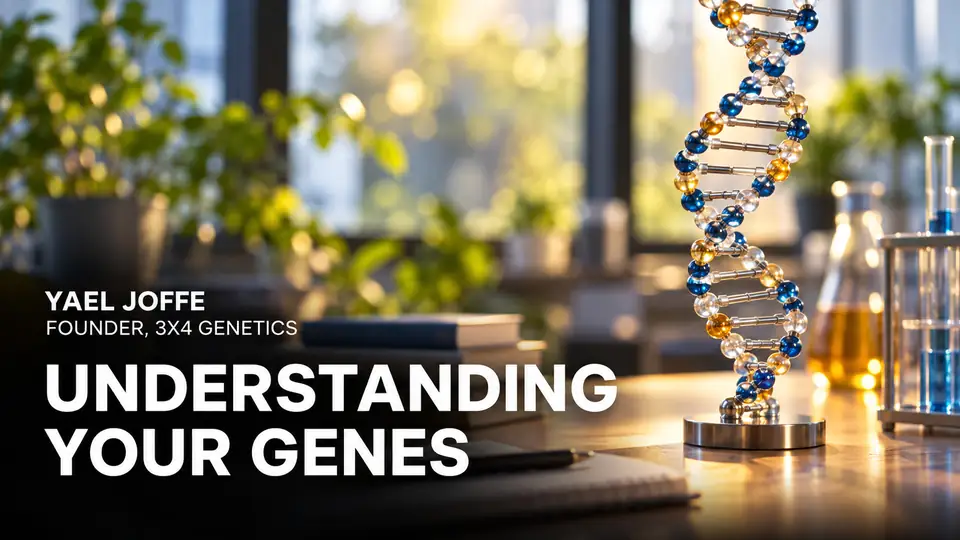
Dr. Yael Joffe of 3x4 Genetics — The Future of Genetics, Health, and Biology
Dr. Yael Joffe reflects on the gap between the promise of genetic testing and the value people receive from a report.
June 22, 2021 · 39 min



About the episode
In this conversation, we talk with Dr Yael Joffe, the founder and CSO of 3x4 Genetics. At 3x4 Genetics they’re taking a new approach to genetic testing to provide people with actionable insights based on their genes. In doing so, they’re helping build the future where people can make decisions that help them live longer, healthier, and better lives.
Links
Chapters
Times follow the podcast audio. The video’s timeline may be slightly different.
- 00:00Introducing Dr. Yael Joffe
- 01:36Genetic testing: promise and disappointment
- 04:23Education, community and scientific standards
- 06:09The vision for 3x4 Genetics
- 07:28Designing for the consumer
- 08:53Visual reports and scientific transparency
- 10:30Understanding what consumers need
- 12:24Discussing genetic variation
- 14:59From information to action
- 17:10Yael’s view of nutrition and gene expression
- 19:26Genetic sequence and epigenetic measurements
- 20:57Genetics as one piece of a larger picture
- 23:10A vision for integrated health data
- 26:02Personal agency and health information
- 28:51Food systems and the wider context of nutrition
- 31:00Gene editing and ethical boundaries
- 32:57Culture, eugenics and regulation
- 35:48Comparisons with stem cell research
- 36:52Finding 3x4 Genetics
Read the conversation
Open the full transcript
CAMERON WIESE: Welcome to the Build the Future podcast. My name is Cameron Wiese and I'm your host. I've always been fascinated by the ideas and sentiment that drove American culture in the 1960s with the space race. A culture galvanized to dream about the possibilities of tomorrow, whether it's food, transportation, cities, biology, or anything else. It was this cultural mindset rooted in optimism that the world tomorrow would be better than the world today. A mindset where people were compelled to build things, and I quote JFK, not because they were easy, but because they were hard. It's this desire to build and to dream that seems to have been lost, and something we're here to bring back. With Build the Future, we're here to promote the ideas and stories of those who see how the future can be better and promote their plans to get us there. It's our mission to get you to dream about the possibilities of tomorrow, to dream about the future that you want to live in, and inspire you to go build. Today, we're talking with Dr. Yael Joffee, the founder and CSO of 3x4Genetics.
CAMERON WIESE: At 3x4 Genetics, they're taking a new approach to genetic testing to provide people with actionable insights based on their genes. In doing so, they're helping drive forward a future where people can make decisions that help them live longer, healthier, and better lives. Let's jump right in. Tell me about the future of building it at 3x4.
SPEAKER UNCLEAR: What's the vision?
YAEL JOFFE: I do have to take a step back. So I've been working in the genetic testing industry for 20 years, 21 now. And over that time, I have been a part of multiple companies building genetic tests. What's been happening over the last like 10 years is what I call the kind of mushroom effect. Probably made that up myself, but anyway, it means that every time I wake up in the morning, there's a new genetic testing company in the marketplace. You know, we started out as genetics is the next big thing in 2003, when the human genome was drafted and kind of made available to the public. And so there was like this big, like, I just wanted a genetics company, and I'm going to make sure that I'm in the marketplace to take advantage. And what's happened is my kind of first 10 years of optimism that I saw in the industry of, wow, we have this amazing code, we can do amazing stuff for the human race, we can really achieve optimal health and wellness. My last, I would say, for like, well, up until recently for like five, six years was the complete opposite, which is genetics is not delivered.
YAEL JOFFE: What we have found is we have these multiple companies in the marketplace that are actually doing the opposite. What they're doing is undermining the value of genetics. And this happened for a couple of reasons, but mostly it happened because companies try to get very much the direct to consumer model where I'm going to get $50, $100, $200, or $300. I'm going to give you a genetic test and then I'm going to give you a report, which is going to give you information. But because of this direct to consumer phenomenon, you had to dumb down the sign. So you had to make it simple enough that an individual could understand and also that the company couldn't get sued for kind of breaking regulatory, you know, FDA stuff. So what happened was this great promise of personalization and knowing your genetics and really being able to make the best decisions whoever you are, landed up being an extremely underwhelming experience for most consumers. And so there was like this great hope and then there was like this
YAEL JOFFE: great disillusionment around genetics. There was questions around privacy and around safety of data around what are you doing with my DNA? But mostly it was this is this like you promised me the world and this is what I got. And I had a very similar experience in about four, five years ago, of having a look at the industry and saying, you know, 15 years I've been building genetic tests, we really haven't made an impact, we really are not changing people's lives in the way that we believe we would. It's a very long answer to your short question, but it is a big story. So what have we done wrong? So I started with like, what have we done wrong? And there was so much we'd failed at. So many things. We've found out everything actually. We failed at education. How do we educate individuals but also health practitioners that they would be able to use genetics to help you as their client or their patient. We failed at enabling the health professionals whether they were a dietician or a doctor or a psychiatrist or a psychologist or a
YAEL JOFFE: chiropractor to be able to understand the science to be able to bring it into who they were as a health professional. We failed at building community. Other than ancestry, which said, you know, let me find my cousin 12 removed, we never managed to build a community around health genetics around how do we whether you were a practitioner or whether you are a consumer, we never managed to connect you and say, you know what, genetics is changing my life. How did it affect your life? Let's connect and let's build something bigger. And mostly, we failed on the science of genetics. So the way that we built genetic tests. It was like the space race. It was like how quickly can we get a genetic test into the market rather than how can we ensure that the genetic tests in the marketplace have the best science, they're like really conservative, they're not just kind of data driven. If I put it into kind of a summary, it's like I realized that what we had been selling for like 16, 17 years in genetic tests was data, but not value. So get your DNA results, but you don't want to do it that way.
CAMERON WIESE: You go on Facebook and you see a Facebook ad for one of the major genetics companies. I don't even know, I haven't ordered one of those tests because it just seemed very gimmicky. It's like, am I actually going to get any value from this? So give me the scoop on what you all are doing and how you're thinking about providing
SPEAKER UNCLEAR: that like value side of the genetic test. So what are we doing at 3x4? The whole thing was how do we
YAEL JOFFE: fix it? So I wasn't quite ready to give up and turn my back on it and go find another profession. So I was like you know what, I know what's wrong and I've worked in all those places. I built an education company in genetics training health practitioners for like five years. I've built multiple genetic tests, I've been at university, I've built a small network in South Africa of practitioners that I've been toward every month for a couple of years. Like I've done all these individual things. What if we built a company that tried to address every single element of what was broken in the industry? And so that was the dream. And that was the vision for 3x4 Genetics was not just to put out another genetic report, but to tackle those what I call the four pillars, which is education, mentorship, community, and kind of science. but there was another huge part of it, which was engagement. So when you get a genetic test at the moment, it feels a lot like data. And you're like, I always say like, if you get a genetic test and you don't know what to eat for breakfast in the morning,
YAEL JOFFE: there's little value to you, right? It didn't change anything for you. So what I realized is that all the companies that I'd worked for, that I'd been a founder of, we had, I had always been led by scientists like myself. So it was science-led product development. And I went to this amazing conference in Seattle, and I realized that was like the first mistake. That when a scientist is trying to decide how to build a product, the consumer is not being thought of. So it's science first, but not consumer need first, if it makes sense, right? So I was like, okay, I need to take myself out the equation, and I need to find a business partner who can help me solve the riddle of how do we go from data to meaningful value? And so I found this amazing company called SeaMonster who were gamification company. And they built gamification, but they built it was behavioral gamification. So how do we use gamification to change people's behavior? So it wasn't like Candy Crush stuff, it wasn't Fortnite stuff. It was like, how do we get them to change the way they spend money?
YAEL JOFFE: how do we get them to change the way they connect with other humans? They did animation and VR and they had an amazing company. And I said to them, like, here's this amazing science. How do we build a genetic report that as an individual you actually want to engage with? That it's like something that excites you. And so we built this report, which was the first of its kind in the genetic industry, which was based on a couple of things. The first was color. So it has a language of color that isn't what I call the traffic light color, which almost every single genetic report has like green, yellow, orange, whatever there's green, red, orange, you know, like green is for good and red is bad and orange, you know. So we built a color language that practitioners could use to talk to their patients. It's called follow the purple. And then the other thing we did was we built what we called a visual conversation. So we built visual imagery to convey very difficult, what we call biochemical processes. So things
YAEL JOFFE: that happen in your body are kind of hard to understand when you're trying to explain to someone what is detoxification, like real detoxification, not juice fast detoxification. So we created these beautiful images and every individual gets a report with six images in. We call them infographics, but they match on that. And depending on your genetic results, your picture changes. So everyone's picture is different depending on the story of their DNA. And that was the other thing, you know, we wanted to build story into everything that we did. So these are like basic design thinking principles, you know, basic lessons, but no one ever told genetic testing companies like about storytelling and, you know, anyway, and then I've tackled the science. So we fix the science and in a lot of ways around making it more credible, transparent, we built methodologies that anyone can access that shows how we chose the genes that we put into our report and why we chose them and and why they're useful to you and why they'll change your life. So we try to fix it one caterpillar at a time.
CAMERON WIESE: Why do you think it took so long for the consumer side to catch up? Why was everyone focused on delivering the basic report? What was missing was just the fact that it was mostly science because like you have the science side then all these, you know, genetics companies that are out in the market right now, they've done a good job of like branding and running Facebook ads, But like, what do you think that gap was that was missing?
YAEL JOFFE: I think the gap is a consumer. I think it's been like a very almost paternalistic science in so many ways, which kind of grew out of that kind of, I guess the whole medical Western medicine, which is, you know, I'm the doctor with the white coat. I have the answers and you're the patient sitting on that side of the desk and you must just listen to me and I'll tell you. I don't think it's only genetics. I think it's a problem with science companies, biotech companies, not all. They're getting much better of this idea that we're the clever ones, we're pretty smart, and you must just be very happy for this information we're giving you. And I think that it's a real switch to think what does the consumer want, what do they need, what do they understand, how's this going to be meaningful for them in their life, what kind of problem is it solving? And I mean, it's bizarre, I was in like working in genetic testing companies for like 16 years before anyone explained to me that understanding consumers' as needs and what problem you're trying to solve for them is actually really important.
YAEL JOFFE: And I've been part of multiple, multiple genetic companies. So I think there was almost like an arrogance in genetics of this is the greatest thing that's happening in our century. We've got this amazing information about you. We can take a cheek swap, you know, take some cheek cells and code your DNA, you know, like but not thinking about so what, like who cares? So it was a huge awakening for me around, who cares? If it doesn't matter to you, Cameron, then it doesn't matter what I do.
CAMERON WIESE: What are some of the kind of the insights that people can claim from their genetics report? What are some of those value adds?
YAEL JOFFE: This is what genetics does. So we're 99.9% identical in our DNA. So our DNA is a code, it's a sequence, it's a code, which is made of letters, right? And our letters are 99.9% identical. But at 0.1%, you and I have a different code, OK? But 0.1 is like three to four million places in our DNA. So it's quite a lot, right? We're different from each other. So now, why does that matter? So it matters because those differences between us, what they do is they change how we respond to the world around us. By that, I mean they change how we respond to different foods, so whether it's gluten or caffeine or saturated fat or the ketogenic diet or drinking dairy, I'm thinking, you know, but it also, but that's not the whole story. It changes everything about how we respond to the world. So if you and I exposed the same stress, we have a car accident and we're in the car together and we have exactly the same car accident. How we respond to that trauma will be different. So when we think about the concept of resilience, it's genetically driven. When you and I go out for dinner
YAEL JOFFE: and we have this really big hamburger, cheeseburger with fries and a milkshake and a cup and a beer, how our body responds to that burger in terms of calories, how hungry we are when we eat it, how full we are after we eat it, how we use up the calories,
SPEAKER UNCLEAR: how we store the calories, how we burn up the calories.
YAEL JOFFE: So weight and weight management is all in those three to four million little changes that says, you know what, we do not respond to cheeseburgers in the same way. So when we go out and we like go to Beijing and we exposed to this huge like pollution, you and I do not respond to the pollution in the same way, right? So genetics gives us insight, and that's the keyword insight, into how we respond to the world. And I could carry on for hours, like when you go for a run, And when you climb a mountain, when you pick up weights in the gym, every decision that you do and make every minute of every day will be influenced by your genes being different from mine.
CAMERON WIESE: So right now we're at the point where we can kind of start to get insight into all of those things, which is kind of the point of the genetic testing, you kind of outline kind of, hey, here's how this is gonna affect your body based on your genetic code. But where does it go from here?
YAEL JOFFE: That's only 50% of the story, right? So 50% is what I just said, which is insight. I want to know more about you. I want to understand. Also, we talk about know yourself, self-knowledge. And now, what do we do with that information? So that's what you're asking. So where do we go from here? This is the really cool thing. So my first degree was as a dietician. Absolutely hated it. Very disappointing profession. it's got this like healthy guidelines for the whole world. So everyone should eat the same food like every day and everyone should eat the same amount of carbs and same amount of protein. And everyone responds to food in the same way, right? So I'm not a fan. And also it was based on disease thinking. So what diet do you give a diabetic? What diet do you give some of the Alzheimer's, right? But the reality is there are so many different ways a person gets diabetes. They don't get it in one way. So if I got diabetes because I was pregnant, or I got diabetes because I had a stressful trauma in my life, or I got diabetes from gaining weight, what was causing my diabetes?
YAEL JOFFE: What was the root cause is important, not the fact that I got diabetes, but when you study diabetics, it's condition-based. So it's like, oh, everyone's got heart disease, let's treat heart disease the same way. Everyone's got diabetes. But actually you want to go what we call upstream and treat the cause. So there were a lot of things about diabetics I didn't like that I didn't feel, and I didn't feel it gave me any insight into why people get sick, why you get lucky, why you may get sick and I don't. And also what do we do? Like I didn't feel like the solution was powerful. I felt like it was, I said, like recommendations were general guidelines, population based. So that's why I didn't like it. So dietetics has been, and not all of dietetics, there are some extraordinary dieticians in the marketplace, but they're generally dieticians who studied dietetics and then went on and studied something more. Functional medicine, functional nutrition, integrative, they're carried on learning to go more upstream. And there are some brilliant dieticians like that.
YAEL JOFFE: So the second part of the equation is knowing what I know about you, what can I do about it? And the true power of nutrition when they talk about food as being medicine, food is medicine, is that genes, our genes in our body are constantly being switched on and switched off, right? Every time we're exposed to something, stress, food, caffeine, sunlight, radiation, water, whatever it is, it sends a signal to switch genes, which on and off. And when you switch on a gene, it makes a protein, which is the enzyme or a hormone. And that's basically this kind of switching on and switching off is how our bodies work. Now, one of the greatest discoveries in nutrition for the last 10 years is that nutrients that we find in food are the most powerful way to switch genes on and off. So I'll give you an example of what I'm speaking about. So when we have inflammation in our body, not like I cut my arm or something, but I get COVID. And part of COVID is this chronic inflammatory response that our bodies, we get, obviously get a temperature and fever and chills and eggs.
YAEL JOFFE: That's a sign of gross inflammation in our body. Now, inflammation has a role to play in the short term, but when it stays in the body, which is what happens with COVID, it starts doing damage. That means that all the genes that cause inflammatory molecules are being on the up switch, you know, they switched on and they're not being switched off. So we need to try switching off. So we know that there's certain foods. An example of that is omega-3 fatty acids, which we find in our oily fish, have the ability to switch off the gene, one of the genes, many of the genes actually, that are causing inflammation. So we call this genomics, nutrigenomics, when nutrients can change gene expression or change gene behavior. Now we've gone from diabetics, which was population-based nutrition, to this incredibly powerful ability to use nutrition to change our genes' behavior. Now we've got answers, right? And that's what we want to do. So that, I call it insight and action. Insight, use genetics to know you are. Action, use nutrition to change gene behavior.
CAMERON WIESE: I'm trying to wrap my head around this. When we do the genetic tests, you're getting a snapshot of your genes at a certain moment in time, right? Because you're not able to tell whether it's, are you able to tell whether it's on or off
SPEAKER UNCLEAR: based on the test?
SPEAKER UNCLEAR: So they're two different tests.
YAEL JOFFE: So when we do a genetic test, It's sequence. We're reading your code. We're going A, C, T, G, and we're kind of reading your code. And that doesn't change in your lifetime. So if I do your genetic code when you're like born, or where you're 20, or 40, or 50, or 60, I'm going to get the same result. The code doesn't change because we're only measuring code. What we're not measuring is whether the gene is switched off. Now, there are a couple of companies in the marketplace at the moment that are called Epigenetic companies. So epigenetic means around genetics. So genetics is like the actual code epigenetics is around, which talk about being able to measure whether the genes are switched on or switched off. This is a science that has been in the kind of research domain for a very long time and it's starting to be commercialized. I am very interested in these companies, but I'm not 100% sure yet. It's a bit like where my genetic testing companies were 20 years ago, where we knew we could measure it, but we weren't sure how to interpret it and translate it.
YAEL JOFFE: So I think that's where epigenetics is now, where they can measure whether genes are switched on and off, but they're not 100% sure the translational value, but it'll come.
SPEAKER UNCLEAR: It's definitely on its way.
CAMERON WIESE: Yeah, this seems to be the trick to unlocking that really personalized, like healthcare and personalized nutrition. It is absurd that we treat everyone's health the same. Our bodies are all very, very different. Yet we can kind of sort of like bucket everyone into like, oh, you should do low carb, you should do keto, or you should do like something else. It's like everyone has to find what works for them. I think that's something that not enough people understand yet. Then the next phase is, okay, like how do we measure what it is that your body actually needs versus going through the trial and error of, okay, you should do this and do that and and see how you feel and see how your body reacts. So I think a lot of people just, they stick to something.
YAEL JOFFE: So traditional medicine and diet and nutrition is trial and error. You know, it's like, let me put, I'm gonna put you on keto and see if you lose weight. Oh, actually you didn't lose weight,
SPEAKER UNCLEAR: you actually gained weight. Let's try something else.
YAEL JOFFE: Oh, actually, so I hate trial and error. So one of the, it's very damaging to the body, but it's actually mostly extremely damaging to the mind as well. One of the great things about genetic testing is a short-circuit trial and error. Because as practitioners, we can ask you a whole lot of questions when you come and see us. We might even do some blood tests because we wanna know who you are. So genetics isn't like a holy grail. It doesn't mean that we never have to ask you any questions or never have to do any blood tests, that it gives us all the answers. It does not give us all the answers, but it gives us a whole lot of more answers that we knew to know about you than we knew before. So I said, it's like another tool in your toolbox or piece in a puzzle, but we building an understanding of you are and genetics is going to what we call a molecular level that is giving us insight. We're testing your gut and we're testing your blood and we're testing your genes. We're looking at your family history and you're made. And now we're starting to understand
YAEL JOFFE: so that when we do make decisions for you, we can minimize that trial and error which is really one of the most damaging things in the market. Even if we could see if your genes are searching out and off that would just be another piece of information for us. So we must never like think that we always know something, but it's about knowing you better and knowing you more to be able to help you make better decisions for yourself.
CAMERON WIESE: If we could have played this out, you know, five, 10, 20 years down the road, you take all the data that you're compiling and you start to run like machine learning models on it. At some point, will we get to a point where, where we do have all that information that's able to be kind of deduced from your genetics?
SPEAKER UNCLEAR: And not just genetics.
YAEL JOFFE: I think if I have to play forward, so we talk about kind of omics or systems biology, which is there's multiple levels of information in your body. So genetics is probably the easiest one to get in many ways and blood tests, which we like metabolomics, but we're getting better at your gut, your microbiome, right? Your and what we call your epigenome, which I spoke about earlier, your epigenetics. So there's like, then there's the proteome, which is your proteins. Now imagine we have all this amazing data and it's a lot of data, right? And then we have quantum computing. And now we're able to take all this information that's happening and we're able to connect with you in a way that we're monitoring you on a day-to-day basis. So it might be continuous glucose monitoring, it's wearables or or orings, right? We're capturing data about you, but we're also capturing continuous data about you. I believe very strongly that putting those pieces of information together. So the omics information with the wearable continuous data, we will be able to predict day by day
YAEL JOFFE: what decisions you should be making to be able to prevent whether it's an injury in sports or a heart attack or sparking your glucose that we will be able to give daily recommendations because all that data will be predictive. So we'll say like, we'll be able to test at birth and say, if you follow this journey, you will have coronary heart disease. And we can already change your decision making. Yeah. And because we can track the way your body adjusts to those recommendations, we can continuously improve it to be able to prevent that disease happening forward. So this is not a path dream. I mean, this is, this is already happening. We are really starting to integrate wearable data, continuous measuring. It's just, it's almost quantum computing and then obviously kind of figuring out what the algorithms are that we need to be, but it's well on its way.
CAMERON WIESE: I've had a couple of guests on who are kind of in the continuous monitoring space. You have Mateo, Franceschetti from 8Sleep, where they're doing kind of the sleep data. And they're on a very cool trajectory. Josh commented from levels, doing the continuous blood glucose. And we're kind of at a point where like, we're sold early days of this monitoring. So it's kind of high level, but as we kind of progress and the technology is better and can run models on the stuff and as we kind of make some more breakthroughs in the genetics and the gnomic space, we'll have more insight and compare all the stuff together. Can you kind of talk through some of the exciting implications of being able to do this high level,
SPEAKER UNCLEAR: like exciting stuff that comes out of this? I mean, I think the most important thing is about
YAEL JOFFE: the individual taking responsibility for their health. And I think this is where it changes. So before, you know, health and medicine has been institutionalized by governments and then by big insurance companies. And I think what is so amazing about being able to capture your own data, whether it's it's a sleeper app or or a ring or Garmin or continuous glucose, is the big change really is about the individual taking responsibility for their own health journey and being able to make the best decisions for their health and not having this paternalistic relationship with their MD who they go and see and says here's a staton for your high cholesterol level. Let's get it down. I mean a lot of people talk about it as kind of the democratization of health and that is really the most exciting thing. So whether it's you know genetics is just one component. It's obviously the journey I'm on, but we all need to be, we're all moving with it, you know, as you say, all the companies you're talking to, the data scientists, the biomedical engineers,
YAEL JOFFE: we're all heading to that point where, and we know that from biohacking, you know, the early adopters of biohacking who are trying to do just that. They're trying to gather their own data to be able to make better decisions. And we know that it's, Romney's successful. It's mostly successful. It's Once we get that kind of, we call it, I mean, I think they call it the internet of all medical things. I think it's called IOMT. That's my idea is that you don't go to one place for your sleep data and one place for your blood data like, you know, lab called for your blood data and one place that everything is sitting in a single data space and it's all talking to each other and integrated. And I think that that's a game changer. And I think it'll take power away from who runs medicine, which is pharmaceutical companies, predominantly, you know, I like drugs for diseases that need drugs, but they're running the medical establishment as well as big agriculture, big act. I mean, for me, it's pharmaceuticals and the big food companies are running medicine and nutrition, certainly.
YAEL JOFFE: So, you know, when we can take that power away and be able to make our own decisions that not make decisions from what we read on social media, but make decisions from what we read about ourselves. And I don't think that's so far away. I really don't think we're talking about
SPEAKER UNCLEAR: like a huge time here. It's a lot closer than everyone thinks. Do you riff on the relationship
CAMERON WIESE: between the like food companies and this internet of medical things and how those two play together?
YAEL JOFFE: It's more the food companies and good nutrition that's holding us back. So we have like big food companies who love processing food and then selling it to us at a really cheap price, but like low nutrition, right? So it's always cheaper to buy a Big Mac than it is to buy fruit and vegetables. So it's not very different from the pharmaceutical companies who don't want you to use fruits and vegetables to manage your health condition, they want you to take the supplements. So it's not in their interest, which is partly why we land up as such cheap, but they tied into regulation and health policy to be able to subsidize the companies that are processing food rather than the companies that are growing fresh, organic, non-moncentre. I now sound like a conspiracy theorist, but it's true, it's all true. You know, that this is the reality is if you look at the way the government subsidizes food production and farming, it's not going to the companies that are generating health. So it's the same that the power is sitting with the big companies.
YAEL JOFFE: And what happens is you get these amazing small companies that are like organic or, you know, whatever they're doing, looking after the soil, they're looking after this, they're looking after their labor, they're paying them well. And then the big companies buy them up. So it's sitting right at the top. And the only way we can take away the power is by supporting what's, first of all, is our own data. So driving our own decisions, not relying on the government to tell us what is healthy or not healthy for us, and then being able to support the industries that are driving that health. So it's a whole, it's going to be, and I always say like nutrition is not just genetic, nutrition is like biological nutrition, which is what I work in, which is kind of genetic and biochemical. Nutrition is biological, it's social and it's environmental, and we're not going to fix health if we don't fix all elements of nutrition.
CAMERON WIESE: One last topic I want to get your take on is the pairing of this technology like this, this insight and this action with some of the other technologies that are being developed on the modification side, so the CRISPR space. How do you think about the kind of combination of these things as we kind of move into the future?
YAEL JOFFE: Oh okay, never been asked that question before. All right, listen, CRISPR is just the most amazing technology. I mean, it's just extraordinary. The problem with CRISPR is just how powerful it is. So I'm glad that I'm working with CRISPR because the ethical boundaries of it are so extraordinary tough to navigate. It's going to be one of the greatest technologies of the century in terms of saving lives. But it also, it's like Star Wars, you know, it's going to be like, you're going to have good and evil sitting in the same place and depending on who's wielding it. And there's no doubt that we know that there are other countries in the world that are doing CRISPR and allowing for it. And it's not regulated in the way that it is in the US because of the power that it holds. So theoretically, if we can test someone's genes, and we find these kind of different code in a gene, and we're able to go in and change it, which actually the technology is quite simple. It's not a really complicated technology. Then theoretically, we're able to
YAEL JOFFE: go in and say like, well, I can't drink coffee because I can't sleep at night. I said, no problem. Let's just go in and kind of just sort that out for you. And you can like live up caffeine for the rest of your life. So, you know, I mean, that's a really poor excuse. But this is the possibilities, you know, let's think of something a little more meaningful. So I want my child to be an Olympian, I want them to go to the Olympics, and I want them to win the marathon at the Olympics. So we know, and we are learning every day, which are the genes that drive sports performance. And not only sports performance, but endurance sports performance, or power sports performance. You know, the idea that we can go in and fix humans and make them into a super race, didn't just start with the Nazis and Hitler. Eugenics actually came out of the US. Many, many years before Hitler, I think Hitler got picked up the idea, which is that we can either sterilize humans that we don't want to procreate so that they don't mess up our gene pool, or we can get people to marry. And so we couldn't do it
YAEL JOFFE: in a lab, but we could do it by making sure that the right people like Hitler did. So this is not a new story for us, Crisper. This is part of a journey we've been on for hundreds of years, which is how do we make superhumans in the way that we want to, depending on what country or which culture we are. So we got it, we, you know, there's a reckoning coming. And I don't know be part of our social fabric, it will be part of our medical fabric, there's an inevitability to CRISPR which is able to on one hand cure diseases and on the other hand improve humans. So I don't like to think about it too much, I'll be honest with you because it's just such an
SPEAKER UNCLEAR: ethical cesspit. Oh absolutely, well thank you for providing that insight. It just seems like
CAMERON WIESE: the logical progression of like, okay, we understand our genetic code. Okay. Then like, we can sort of take action to improve it and, you know, change what we're eating and figure out like what's activating our genes on it, turning them on and off. That's like managing it. Then there's the next level, which is like, okay, something's broken, or if we need like to optimize, fix it. But it does come with this whole swath of like ethical dilemmas and implications, particularly the one around like culture, we're gonna like modify humans based on like what our culture values at that point in time.
YAEL JOFFE: That's where eugenics has been always used is in culture. Came out of the Southern States of America where it seems like it's always kind of Caucasian, but it's always been driven back. It's like stepping to political space here, but it's always been driven by culture. And this is the danger and it will be again, because we just have to look at the politics in the US and we know that we know where it's going to come from. So you know, I'm very glad right now that a country like the US is regulating CRISPR and that it's not available. If I had a child who was suffering from a dreaded disease and I knew CRISPR could cure it, I might have a completely different opinion. So it's a really, really tough one because it is an extraordinary, extraordinary technology really. And I was delighted that the two women who invented it actually won the Nobel Prize this year. Yeah, very well deserved. And I don't think again, it's going to be long for you and I to watch how it plays out. I think in the next five to 10 years,
SPEAKER UNCLEAR: it's going to be front and center. We will wait and see. I mean, we've seen this play out in
YAEL JOFFE: multiple, stem cell research was exactly the same. Where stem cell research, I think you've done work, is amazing. Another technology that is just brilliant was so over-regulated when it first came out, even though it had the potential to save many, many lives. And I think it was Israel was one of the countries that opened it up and said, this is brilliant stuff. So people were traveling to Israel to go and have stem cell treatments because it was totally saving their life. And now we see it's kind of been more deregulated and we can be more accessible. But that's an example. I mean, it doesn't have the same ethical issues, but it also had a lot of And then we found these like little areas in the world where you could go to have stem cell treatment. And, you know, now we're like, oh, let's all gather our stem cells and keep them for later. But it wasn't always like that.
CAMERON WIESE: It's funny how the I was like very taboo and now it's commonplace and that happens with happens those things. To wrap us up here, where can people find you and how can they support the company?
YAEL JOFFE: We're at 3x4genetics.com. So it's literally a 3x4, just like X as in ex-boyfriend. We're at the moment only available in the US and South Africa. And if you just reach out to us at info at 3x4genetics.com, we actually don't sell direct to consumers. I'm currently on the belief that if we really want to get value from genetics, we need to have a very well-trained, educated and mentored health practitioner to make sure that you reduce your trial and error and you get the best value. So if you get a hold of us, we will make sure that we find you the best possible practitioner in the US who can help you really, you know, get proper value, real value from your genetics.
CAMERON WIESE: All right. That's what I got. Thank you so much for coming on. And yeah, excited to see what you all do and kind of how the future of genetics progresses.
YAEL JOFFE: Well, thanks so much, Cam. That was a fascinating conversation. Lots of things I haven't thought about for a long time. so really enjoyed it. Thank you very much.
CAMERON WIESE: Thanks for joining us for this episode of the Build the Future podcast. If you're building and want to get support, want to hear about certain topics or hear from certain people, shoot us over an email to hello at buildthefuturepodcast.com or follow me, Cameron, on Twitter at camwheezy and we'll see what we can make happen. That's it from us. Until next time, go build!
More episodes
All episodes Noor Siddiqui of Orchid Health — The Future of Families, Conception, and GeneticsNoor Siddiqui discusses Orchid’s approach to preconception and embryo screening.
 Sri Kosuri — Engineering Biology for Complex DiseasesSri Kosuri explains Octant’s approach to high-throughput biological experiments and drug discovery.
 Michael Levin — Regeneration, Xenobots and the Software of LifeMichael Levin discusses regeneration and the idea that biological systems can be understood partly through information, goals and control.