

Build the Future Podcast
Derek Morris of United Therapeutics — 3D Printing Organs
Derek Morris explores the science and engineering behind growing and 3D printing replacement organs.
May 18, 2021 · 40 min



About the episode
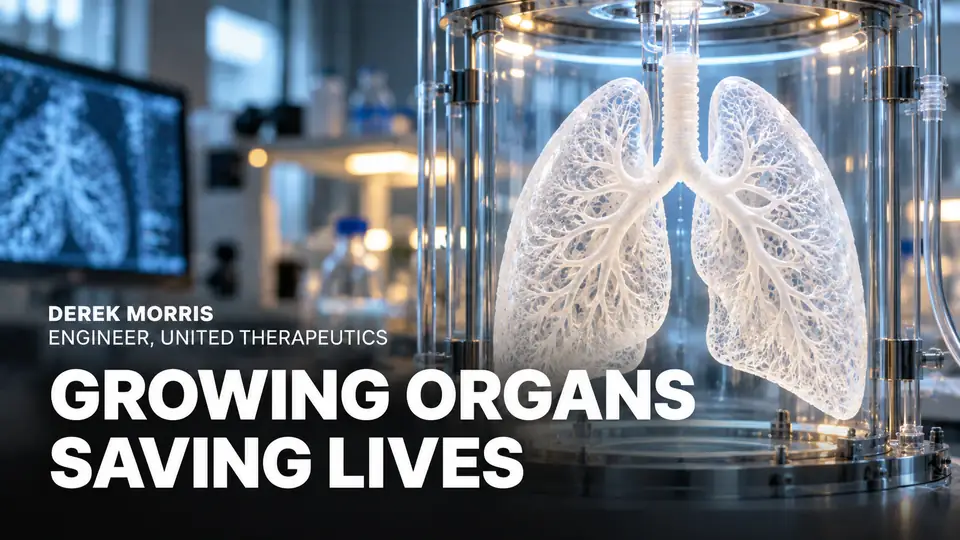
In this conversation, we talk with Derek Morris, a Director of Engineering at United Therapeutics. At United Therapeutics they’re on a mission to develop novel, life-extending technologies for patients battling with lung disease. In addition to developing medicine and transplant technology, they’re also leading cutting-edge research on organ manufacturing (3D printing of organs) which Derek leads.
This episode should be reclassified as a schedule 1 stimulant — full of energy and optimism, we go off track on a wild tangent adventure covering art, media, inputs, the future, the World's Fair, and of course the incredible work being done at UT to print 3D organs.
Links
Chapters
Times follow the podcast audio. The video’s timeline may be slightly different.
- 00:00Introducing Derek Morris
- 01:50Making progress tangible
- 03:58Healthspan and the possibilities of longer lives
- 06:26Passing knowledge between generations
- 08:05New frontiers and opportunity
- 10:52Sharing technological prosperity
- 13:33Art that helps us imagine the future
- 17:38Media, optimism and building
- 19:15The mission to expand organ supply
- 20:25Perfusion and other transplant approaches
- 21:59Computing meets organ manufacturing
- 23:38A collaboration across disciplines
- 25:39Blueprints, printers and materials
- 27:47The challenge of living cells
- 30:48Could the approach extend to other organs?
- 32:08Transport, storage and transplant logistics
- 34:42Electric aircraft and organ delivery
- 37:01Research milestones and expectations
- 37:58Finding Derek and closing thoughts
Read the conversation
Open the full transcript
CAMERON WIESE: Welcome to the Build the Future podcast. My name is Cameron Wiese and I'm your host. I've always been fascinated by the ideas and sentiment that drove American culture in the 1960s with the space race. A culture galvanized to dream about the possibilities of tomorrow, whether it's food, transportation, cities, biology, or anything else. It was this cultural mindset rooted in optimism that the world tomorrow would be better than the world today. A mindset where people were compelled to build things, and I quote JFK, not because they were easy, but because they were hard. It's this desire to build and to dream that seems to have been lost, and something we're here to bring back. With Build the Future, we're here to promote the ideas and stories of those who see how the future can be better and promote their plans to get us there. It's our mission to get you to dream about the possibilities of tomorrow, to dream about the future that you want to live in, and inspire you to go build. Today, we're talking with Derek Morris, a director of engineering at United Therapeutics.
CAMERON WIESE: At United Therapeutics, they're on a mission to develop novel, life-extending technologies for patients battling with lung disease. In addition to developing medicine and transplant technology, we're also leading cutting-edge research on organ manufacturing, or 3D printing of organs, which is the project Eric leads. This conversation was a ton of fun, but took a slightly different format than usual, and we decided to roll with it. So if you have any feedback, please send me a DM on Twitter, at kmwecie, otherwise, hope
SPEAKER UNCLEAR: Hope you enjoy. Let's jump right in.
DEREK MORRIS: The reality that people see on the web is not distinguishable from the reality that people see in movies, right? The CGI, the special effects that people see in movies are equivalent to just, you know, browsing a blog or a webpage or Twitter and seeing the same thing. It's hard to separate fiction from reality when you're browsing it and when you're seeing a video on YouTube, right? And there's something qualitatively different about experiencing in real life to your point. the first time you sit in an Uber, or you order and you sit in an Uber, the first time you sit in a cruise, actually more impactful of that, the first time you step out in front of a cruise car and have it stop and there's no one in the driver's seat. That for me is like a completely different level of reality experience. Like that is more real than any movie that you'll ever see. And like, that's the beauty of like physical places versus sitting in a movie theater with your eyes, you know, killed open, is that in the movie theater,
DEREK MORRIS: They're trying to convince you that it's real right their whole goal there is to get you to feel something, right? That's how you know You've seen a good movie when you're crying or you're laughing or you're scared or happy in the real world It is what it is. You can't fake it, right? You can't give special effects into the Into reality around you and that's why it's just it is qualitatively different into my own work You know, we print we can talk about it by I print one scaffolds And I can talk about to people over, you know, webcam or over a presentation or show them pictures of it or show them data of it. But none of that matters. They don't remember a single data point I present. I can show, you know, big graph going up to the right and we're saying, look, we're hitting all these targets. No one remembers any graph you will ever present in any goddamn PowerPoint in your entire life. The only thing that they'll remember is like a big freaking photo or the proof that it's real, right? So the big photo or touching or feeling it for themselves, right?
DEREK MORRIS: So sitting in the cockpit of a supersonic jet is the moment it becomes real for that person. Everything before that is just a dream, right? Whether it's a waking dream or a sleeping dream, it's just a dream. No different than a movie. And that's why we have to have a world fair.
SPEAKER UNCLEAR: Exactly.
CAMERON WIESE: This is a slight tangent, but I want to go here anyway. I think in your one of your bios, when you have like cure aging, It's like, how do we solve this problem of death or not permanently solved? But how do we eliminate death by aging? How are you thinking about these days connected to the work you're doing at United Therapeutics?
DEREK MORRIS: Some people come out of religious perspective, some people come out as a personal perspective, some thinking about themselves, thinking about their family. Some people think about God when they think about this, but they say, do you really want to cure death? And the first answer is yes. But what I want to do first is extend like health span, extend life. And I think that's the perspective to look at it. And whether or not people live the same age but have healthier younger lives, right? Or more spry or more thoughtful or more bright, enjoy more days, that for me is number one priority. Anything after that is so much more, I will be grateful for that. But I do want to extend people's lives, right? For me, it's not about necessarily ending aging forever, disrupting the cycle completely. It's about widening it out and making so much more possible in the time that we do have or extending that time. Imagine what we would be able to do if we could still talk to people that we admire. The best I can get today is to read their books, right? Or their autobiography, or watch their lectures,
DEREK MORRIS: or hear their poetry. But imagine if you could still talk to John Lennon. Imagine if you could still sit down with Albert Einstein. Imagine if you could still go to the Red Brothers bicycle shop and understand, you know, why would they even do this in the first place? Like what made them think they could build an airplane? And maybe to bring it more home, like imagine talking with your great grandmother, right? I don't know any of my great grandparents. And I feel in an age where people have kids later in life, it becomes harder and harder to know people in your extended family. And I would like to talk to them because I don't have recorded history from that time. A lot of people don't. And there's probably a lot of things that matter to my life that got me to this point that I would love to understand, you know, what were they experiencing? What were they feeling? What choices did they make? Should I replicate those choices in my life? And that sort of wisdom and experience only comes through passing it down. And my way of helping solve that problem is extending
SPEAKER UNCLEAR: and creating a better life for more people.
CAMERON WIESE: I reflect on my great grandmother who immigrated to the, to the US, like she's from Sweden, hopped on a boat and like came to the US in search of education and better luck, because like my understanding like women didn't go to school in Sweden in like the early 1900s. That's the other huge benefit of extending people's health spans is that the knowledge and the experience that accumulates over your life doesn't have to be so like snap gone when you pass away. If you live longer, you can share the stories, right? You can pass that information on instead of having it live in books or secondhand accounts.
DEREK MORRIS: Today, when you talk about things are passed down through death, it's property and money, right? What I would rather have be passed down over time is not through the act of death, but through the act of those people still being alive. And to your point, getting on a boat to cross the entire ocean for an education, that's almost unfathomable today for people living in the US. If you were serious about your education, what would you do for it? And that question isn't answered very often, right? Especially not in such a forceful manner as leaving your country for a completely different language for a completely different land for education. That sort of dedication, that sort of, you know, how did she get to that point in her life?
SPEAKER UNCLEAR: What drove her? What pulled her? Why didn't she say?
DEREK MORRIS: Like all those questions are, for me, like I can observe history happening, you can read about history, but that's different than experiencing it. And I cannot experience it. So the best way I can get at that is to have someone tell me what it was like for them.
CAMERON WIESE: That question of like, where do you go now? Is one that I don't think we appreciate enough. Like, I like love the American ideology. This is the place where people from around the world come to find opportunity and to pursue new paths. And I think it's more important than ever that we continue to embrace that. And we can figure out a way to reignite that idealism of the American system. Like, how do we continue to make this country and this world like something where people can thrive and they can prosper and they can find new opportunity.
DEREK MORRIS: I agree. And I think we're starting to see the resurgence on that. Right. So today, you know, May 15th, 2021, that question is being answered by some on Twitter by saying, you know, is it Texas or is it Florida? Right. And that's, that's one way to look at it. I don't think that's the way to look at it. I agree that it can be for some people, it can be Texas or Austin or Miami. Right. But I think I think I have subscribed more to the Bellagio version of it, which is the infinite frontier. And so the US was framed for many people, whether it was true or not on the frontier. So the Westford expansion. And that sort of ended when people got to California. And so when you talk about, you know, why did, uh, why the defense companies end up in California, which spawned the computer industry that we see today and everything that you see in San Francisco, well, that all came from the defense industry that was, pushing West out to West, right? They had great land there, they had great universities for different reasons, but it sort of ended there. Why didn't it continue in boats?
DEREK MORRIS: Why didn't it move to Hawaii? Is it moving to Asia? That's one of the questions that people say today is, oh, the frontier now is across the Pacific and is now in China. And the Bellagio answer to that is no, it started in California, it started in San Francisco, But it didn't continue in geography, it went to the web. And that is the final infinite frontier. The final frontier isn't space, it's the internet, it's everywhere. That is the true frontier.
CAMERON WIESE: I think that one thing that people don't appreciate enough or people aren't thinking about enough are like the implications of this kind of portal to the stars, right? Florida in Port Canaveral and then in Boca Chica in Texas. It's like all of the commerce for the galaxy is going to be channeled through those two areas, at least in the US. So the economic prosperity and the innovation that's going to come, those are going to be the hubs. It's not a matter if, it's a matter of when. And we start going back to the moon, we start bringing stuff back, that's going to drive all sorts of innovation
SPEAKER UNCLEAR: and progress and culture. You're absolutely right. People are past my students' days. And I think
DEREK MORRIS: One of the ways that manifests itself is Peter Thiel had this speech at the RNC where he says, back in those days, every city in the US was high tech. I think he was talking about Indiana, like area Indiana or something like that. And when we're talking about San Francisco earlier, that's only one of the places you'll see high technology in the US today. Every other city is sort of falsified. So I completely understand why people aren't optimistic about the future because they don't see it. Right. One of the good things that's happening now is that technology is being more evenly distributed so everyone can experience and use it and see it so that they can become optimist about the future and like that's the only way it's gonna happen is as we spread technology Not concentrated in only one city, right? Whether that was you know Microchips and software in the late 90s with San Francisco or that was cars in the industry in Detroit, Michigan when now there's distributed car manufacturers all over the US, right? US, Mexico and the world, instead of just one city.
DEREK MORRIS: And it wasn't necessarily good for that one city, but you could argue that it was good for the US as a whole because now there are car crackers in South Carolina, Tennessee, Georgia, Texas, like everything that you can imagine instead of in just one state. And so more people can experience the prosperity instead of just people that can afford to live in that one place. And as technology spreads, more people will be able to see the opportunity. It's not for just those people in California, it's for everybody.
SPEAKER UNCLEAR: That's the key.
CAMERON WIESE: It's like the future is not for the technologists. The future is not for the people in the US. The future is for everybody. We have the ability to give people the tools and the resources and the knowledge to level up and to thrive. We're not quite there yet, but we will get there. And I'm just so, so, so excited about what the, like the rest of this decade is going to hold because we've like through this, you know, over the past year with a pandemic, people have realized like, Oh, the system is not working the way we thought it was working. System is a bit broken. And if we want to continue to exist as a species, like we have to do something different. You had this tweet like from Peter Teal's essay for technologists. That means pursuing goals are difficult, but impossible. cures for cancer and Alzheimer's, compact nuclear reactors and fusion power, for statesmen that means deconstructing the corrupt institutions that are falsely claimed to pursue those goals on our behalf. That is what is happening right now, Derek.
CAMERON WIESE: And that's what's so exciting is we're just getting started and our cities are going to thrive. Our land is going to be beautiful. Our people are going to prosper. It's going to be incredible.
DEREK MORRIS: What's a positive vision for America? Paint it. Literally paint it for people. I grew up in an area that had like WPA projects from the Great Depression, and they would paint a vision of America that was positive, right? Whether that was the Western expansion and the bringing of electricity industry through there, you could literally see what their vision for a positive future looks like, even in the midst of a Great Depression, right? What does that look like today? What I see today in art is sort of a SimCity version of the future, right? where it's great glass spires coming up, right? If you played some say 2000 or whatever, you'd be able to choose a different archipope. They had different towers that were like the [unclear], right, full of glass and plants, or they had different ones. But what does that look like today? And for me that you can't see an art well then people can't see it in their own lives. And some people say, oh, movies are pessimistic where they have dark visions of the future. And that's true.
DEREK MORRIS: dark mirror is not something I want to watch because it's going to give me bad intuition, bad visions of what the future should look like instead of positive visions, right? Like what you view, what you consume affects how you think. And so if you want to see a positive vision of the future, you need to create art around that. And so if I were to talk with you about what a positive vision of the future would look like, it'd be like every city in the US should have clean sidewalks, should have clean water, right? And those are just the basis. Clean waters, clean sidewalks, no smog, streets where people are walking through it. For example, you're in LA right now, right? What annoys you about LA and what positive vision could you possibly see for it? Anything.
CAMERON WIESE: Traffic, right? My cortisol levels spiked like 15, 20%, just going from like one side of town to the other. I'm like, this is awful. And everyone's living with that stress and that strain. Imagine that like energy or that like that tension could be channeled in a different way.
DEREK MORRIS: That's what World's Fair is for or going and visiting the city of the future right? Oh, they have moving walkways that shuttle people around underground and where it's AC right? And there's no smog and the air is clean. There's no traffic in the streets when I'm walking. I can go shopping without getting hit by a car. My child isn't going to run out into the street, right? It's all pedestrian. in. And those are sort of the positive visions of the future that people used to travel for, right? Oh, we were going to visit San Francisco to look like, to see what it looks like. We'd go visit Europe to see what the cobblestone park would look like, or just street look like without cars. But that's going to start becoming more widespread. We're going to see that everywhere, right? Okay, there's going to be personal helicopter transports into the middle of the city that take you exactly where you want to go to go home or to the next city. Like all these things that existed in the past and it can exist again just in a different form. For example, with the helicopters,
DEREK MORRIS: you used to be able to fly from SFO by a helicopter into San Francisco or Oakland. And that was happening up until the 70s. And then it got shut down. Let's just revive that in the new version of it. You take a supersonic jet from New York City to San Francisco and it takes you two hours. Perfect. You get out of that jet and you get an electric EV helicopter that takes off vertically and lands you, you know, next to the whole foods near your condo, right, in San Francisco. And there's plenty of condos there and you can afford one because there's a giant density in the middle of the building and medium sized Paris level density in the rest of the building, right? Here's another positive vision of the future. If you took Treasure Island and you made it the same density as Paris, you could fit the entire population of San Francisco on Treasure Island, right? These things are relatively simple. It's simple to imagine, but people can't imagine it, right? And you have to have art and a vision to show that, right? That's the next closest thing to reality is art. And if your art is negative,
DEREK MORRIS: you're gonna have a negative reality too. So you need a positive vision of the future.
CAMERON WIESE: We've seen this, like people get heavily inspired by sci-fi, like, you know, Palmer Lucky with the Oculus. Oh yeah, I read that, sorry, it's a snow crash. And then people are like, oh, let's build the metaverse. It's like, we don't actually want the metaverse, right? We don't want to be living in the machine, but that's like a vision for the future that people can latch onto. And what you consume, not just food, but like media and conversations, shapes how you view the world. If you are consuming junk, if you are like consuming pessimism, you're consuming like divisiveness, like that's how you're going to view the world, right? We give people optimism and hope and show them what could be. We can actually go build it. That's how you do anything is you have vision.
DEREK MORRIS: The other side of that is that pessimists won't build a future, right? The only optimists will build the future because they're the only ones that actually think it's possible. I'm not saying all optimists are going to build the future, but I'm saying, yes, 100%, no pessimist will build the future. If you're consuming or reading Twitter every day, you're looking at the discourse or people battling each other or, you know, reading the normal news. Yeah, you're not going to be in the right mind frame or mindset to build the future to build anything That's a valid like a positive value to people right like if you're going to think about good and evil You're going to think about positive and negative in the world today if you're solely consuming things on the negative side It's easy to think that you're above that but you're not going to be able to escape it, right? It's like you're going to become part of that system part of that mindset part of that conversation instead of trying to rise above it or transcend it. You wouldn't have positive role models in the world, right?
DEREK MORRIS: You don't have negative role models in the world.
SPEAKER UNCLEAR: We've been riffing.
CAMERON WIESE: We've not talked about United Therapeutics at all, which like is fine.
SPEAKER UNCLEAR: I love this. I'm having a great time.
CAMERON WIESE: What is the future of building United Therapeutics? And then what does that look like? Just so we'll give people a teaser and then like, and they can go kind of follow you to learn more and do all that. But high level, kind of what's the vision
SPEAKER UNCLEAR: for what you're building there. United Therapeutics wants to build on a limited supply of
DEREK MORRIS: transplanted organs. For us, this is a very practical reality because when we look at the field today, there's like 100,000 people, 170,000 people on the transplant waiting list in just the US and that number is growing every single year. No matter how many people we get to sign up for the organ transplant list, there just won't be enough supply to meet the growing demand. And for us, the solution to this is to create organs as a manufacturing technology. So our company does every single thing we can to incrementally increase the number of organs available each year. So we do a couple things, and I kind of focus on the very last of those with the most impact in terms of total number of organs available. So at the top of the list, we're just trying to get as many organs out there in a good shape to be transplanted. So we take, we have an EVLP technology, ex vivo lung perfusion, which takes discarded or rejected organs and monitors them, flushes them out with fresh fluids, and actually assesses whether they
DEREK MORRIS: should have been thrown out or not. And then we offer them back to people. So we can increase the number of organs today with no new technology. We just have to basically refresh and recondition these organs to send them back out. And today, hundreds of people have already used those organs. So that's like, that's check mark. Hundreds of people are already saved. Let's go into thousands, right? So we want to do hundreds, thousands, tens of thousands, hundreds of thousands, and then millions, right? So on sort of the thousands levels, we have herd to genetically modified pigs, which strip the proteins off the surface so that your human body doesn't attack the organ as much,
SPEAKER UNCLEAR: right? So we do that.
DEREK MORRIS: There's another company called eGenesis out of Boston that does that, essentially harvesting these pig organs, which are tolerable by humans to transplant those. So you'll get to take less immunosuppressants because with an organ transplant you have to take immunosuppressants to prevent your body from rejecting it. If you take too much of the immunosuppressant you're going to come down with a cold or something or pneumonia and that's going to kill you. If you take too little your body's going to reject your organ. So it's a balancing game with immunosuppressants. So that still doesn't solve the problem, but it gets more organs out there with those pigs. Sort of how you get to millions of organs is you make it a manufacturing technology, right? Where you can make the same organ every time to your exact specifications. And that's what I do every day. You know, I'm a computer scientist. I'm not a biologist. But I saw this problem, and, you know, I'm inspired to help prolong people's health spans. And how could I contribute as a computer scientist? That was a question to myself.
DEREK MORRIS: And what I saw was that 3D printing technology was way more advanced than what people in biology were using before. People in the most advanced research lab in the world are using basically needle tips that they're extruding some gel out like cake frosting and trying to build organs out of that. And that's like on the, like the resolution is like millimeters to tens of millimeters, right? It's not gonna make anything that's living. it'll look like a heart, right? On the outside, it'll look like a liver. You can hold it in your hands, but the inside of it will be solid. It'll be made of plastic, right? It's not gonna work. And you saw a lot of that research over and over again. And I said, well, we already have chips in my computer right here that are being printed on the millions of levels at tens of nanometers or single nanometers, right? And if I need to make the fine capillaries and the baskets sure to keep these organs alive, I would just need single microns, 10 microns. That's like 1970s technology, right? In terms of microchips. Why hasn't anyone done this?
DEREK MORRIS: So I actually went out and asked that question. Why hasn't anyone done this? And people said they didn't think it was possible, blah, blah, blah. That's what the Biosciences said, or the Digital Engineers said. That's what everyone said. So I went and talked to Chuck Hull, who invented 3D printing in 1986. He's currently the, he's the founder of 3D Systems, which is the largest 3D printing company in the world. He's still the CTO there, you know, on the board. So I went and talked to him about this. I was like, hey, like I've been building this printer, you know, in my own lab on the side when I'm working at Max Loeschke's VC firm. And it's actually pretty good. Why isn't anyone doing this? And he was like, well, actually no one asked before, but there was one other person that asked. And that was Martine Rothblatt, the CEO of United Therapeutics. And so, you know, when I talk about making millions of organs per year, that was really Martine's vision. You know, Martine is a singular person. She invented and was the CEO of Sirius XM radio in the early 90s.
DEREK MORRIS: Her daughter came down with a lung disease. There was no cure for no drugs for that disease. So she pulled one off the shelf that every scientist told her would be impossible to administer to people. And she brought it to market. Her daughter takes those drugs to this day. But those drugs don't cure the disease. They just prolong it, right? First step, get those people healthy, prolong it. Second step, how do we cure them? And so Martine had gone to Chuck, the inventor of 3D printing, and asked him how to 3D print organs. He said, I don't know, but I'll get back to you. I talked to Chuck about the same thing and showed him what I'm building, what I had already built. And he's like, I need to connect you to. So Martine and I met at the top of Nog Hill in San Francisco at Forbes conference. you just called me up one day and we talked about what it would be, what we could do if we could print native resolution with 3D printers out of natural materials, right? So natural materials, not plastic like people are doing, native resolution, not cake frosting like what people
DEREK MORRIS: are doing today. And all this technology doesn't need to be invented and already exists. Just no one thought it was possible. No one had a use for it. As Chuck said, no one had ever asked him to build it before, but it was always possible. And so that's what we're doing is we're just literally taking all these different technologies that already existed in all these different fields, just no one had put them together because no one thought it was possible. So we're taking these extremely high resolution native resolution printers, about one micron of resolution over the volume of something besides the human volume. So about six liters. And we scanned in pieces of the lung using my friend's microscope that we're talking about. he was scanning the mouse brain. We used his microscopes to scan mouse lungs. We used that to build a digital model of the entire lung because no one had ever asked what does the lung look like before, right? Okay, problem solved. Checkmark. Next one. A lot of people
DEREK MORRIS: print with plastic today or slurries of materials. So we said, okay, let's go actually find the native proteins or peptides or bodies made out of and print with those. It's a very, very well-known chemistry to actually print with them, but no one had been doing it. So we, you know, scaled that up from, you know, microliters to massive 50 liter drum check mark.
SPEAKER UNCLEAR: Great. Next one. It's funny.
DEREK MORRIS: We, I interviewed someone not six months ago, three months ago to work as a scientist with us. And he was telling us about, you know, he'd worked with microliters of these materials before, and I said, stop, like, did anyone take you in a laboratory yet? He was like, no. I was like, okay, you need to see this first. So he's talking about microliters, and a microliter is like a drop of rain, right? That's a microliter, that's like 30 microliters. I went and showed him giant vats full of ink. And I was like, when you're talking about microliters, you're gonna need to do giant vats full of it, like 55 gallon plastic drums full. He's like, oh, now I know why you kept asking me
SPEAKER UNCLEAR: about scale up. And I was like, yeah,
DEREK MORRIS: because you'll be doing this every single day. We hired him a couple of weeks ago. He came back to me and said, you know, I've used more of this material in my first month year than I used in the last 10 years of research. Right. It's not because it didn't exist. He was doing it, but he was doing it on the size of a raindrop. No one had thought to scale it up before. So there we go. We got the material now, cells cells are the last component. So we talked about printer, right? We talked about the blueprint for the long. We talked about materials. What about the cells? So again, we went and looked. We have basically the world's largest supply of allogenic cells, which means other people's cells for specifically lung. No one had thought to build that before because no one needed it. So we built it ourselves. At the same time, there's been tons of work into induced pluripotent stem cells, tons of work, billions of dollars poured in, but no one's really scaled it up before. No one's ever really tried
DEREK MORRIS: because they didn't have a use. So literally what we're doing right now is, oh, well, these protocols already exist. Let's just scale it up, right? Because we finally have a use. And like, that's the beauty of this is we're not necessarily inventing drastically new technology. We're just doing systems integration, because no one knew you could do this before. But all the pieces already existed, we just had to assemble them. So today, one of my friends, Jordan Miller, and Bagrat Grigoryan, head of a company called Volumetric, they do 3D printing. They were on the front cover of science, right? So the two most important impactful journals in scientific literature are Science and Nature. Jordan was on the cover of Science about maybe 18 months ago, two years ago for 3D printing. He comes to our lab and sees what we're printing. He's printing something this big for his lab doing groundbreaking research, amazing stuff. We work with him. He's fantastic. He comes to our lab and we're printing things aside
DEREK MORRIS: of football. And it's just like, jaw drop. And Jordan knew this was possible, just hadn't gotten around to doing that, right? Jordan's fantastic. He's on the right path. But he just didn't do it yet. And like, I was like, Oh, yeah, I guess this is the world's like largest file print ever made. But like, we're just doing it every single day. And we as we were talking about before, where technology becomes like familiar, you know, the first time we did it, you know, is open that champagne, like crack the bottles. This is amazing world first, the world's largest organ scaffold ever printed. Okay, great. Then we do that every day now, right? So much so that we have to throw these scaffolds out because there's too many of them, right?
SPEAKER UNCLEAR: The old versions have to go
DEREK MORRIS: and the new versions have to come out because we keep making new blueprints, right? For me, that is on the path to making millions of these for patients, right? So we're integrating these technologies, Tweaking down to different formulations, tuning the printer, changing the design, finding new ways to seed cells inside this inert scaffold and get the cells into the right places and to survive and function the way we want. Because I don't care if it looks like a lung has to function like a lung. Our goal really is to have an unlimited supply of transplantable organs. And this is a very practical, reasonable goal today for many other people could be pursuing this, but they just don't think it's possible.
CAMERON WIESE: Something magical in that. Once you get the the lung down, you can replicate the process for virtually any other organ, right? It may be like some complications with like, you know, different pieces, but...
DEREK MORRIS: Yeah, right? Right, so that's the way to think about it. It's like, so we have now a recipe for organ design. The printer can print anything that you, any digital follow you put into it, right? So I just need now two things. I need the blueprint for the organ that you want to do, so design and the cells for it. And with those two things, we can make any organ, right? So you can imagine after we do the one first, because our entire company is focused, laser focused on lungs. You might do things like kidney or heart or liver or pancreas or things like this, right? As long as it fits inside the printer, we can print it. But yeah, Those are all next in line when you think about it for this technology is it's no longer a limit of can we print it? It's what do we print and how? What do we do with it? That's sort of like I imagine the Wright brothers after the first flight is like, okay, it's no longer can we fly. What do we do with it? Can we go across the ocean with it? Can we do travel between St. Louis and New York City? how are people going to use this technology for good?
CAMERON WIESE: What's the process look like once you have these manufactured to like get them integrated into a human body? Like what are the challenges there? Like how do we make that happen?
DEREK MORRIS: You just asked one of my favorite questions. So I just described how making organ scaffolds and putting human cells in them, your own cells back in them is very practical today, right? So let's put that aside for a moment. Let's say I'm making 10 scaffolds a day. How do I get that to someone? How do I implant that? Where do I implant that? So I have a factory somewhere. Right now my R&D facility is in New Hampshire. And if someone needs a lung in California or Hawaii or Indonesia, how do I get that to them? Well, today how it's done and what people think about is you put it in an ice bucket. You literally put it in a igloo, you know, thermos, little box that you take to the beach with you, wrap it in plastic, put it in a bike device, and you take it on a private jet or helicopter and you fly it to that person. The problem with that is the organs only survive for about four to six hours. So one of my favorite projects was that I worked with a company called TransMedics. They make a device that allows you to keep organs alive outside the pot.
DEREK MORRIS: So essentially what it does is it pumps it with warm blood and it pumps it full of oxygen just like it was inside the human body. It keeps that organ alive for more than four to six hours, right? So now you can do something like 12 hours or 24 hours, right? But what if you can do a week? If you could keep an organ alive for a week, you could just put it in a FedEx truck and ship it ground, right? So you go from a scenario where this person who is, you know, on the last on their last legs, right, they need an organ transplant, right, they're sick enough to get an organ transplant, but not too sick. And they have to say, Okay, we need an organ transplant, it's ready at 3am. Great going into the operating room right now. That's a horrible experience to give them more life right to something like, okay, well I can make 10 organs a day or 100 organs a week or whatever it is, and schedule you in ahead of time. So you can have that organ will be there at your appointment time instead of last minute. So this person can have a normal organ transplants are very invasive procedures,
DEREK MORRIS: but they can at least plan it out a week ahead of time or a month ahead of time. And have their family there with them, do it in the middle of the day so they have time to recuperate, have less pressure on them. And we can fly it there on a private jet. that we can ship at their ground, or because Martine is so ahead of everyone else, she's thinking about how do we solve these things practically. We've invested or worked with about three different electric helicopter companies or EV vertical takeoff companies to transplant these organs from our transplant centers, from our organ manufacturing centers to the transplant centers. So this is a very practical problem. When I talk about practicality of all this. This is all things not that we're envisioning. These are already things that we are doing, right? We're working with a company called Beta Technologies in Vermont that is making vertical takeoff airplanes. Those things exist and they already work today. You can go look at them on the internet. Go to beta.tech or Beta Technologies. Those already exist. We work
DEREK MORRIS: with Ehang out of China and those electric helicopters already exist, right? And we're designing them to fit the support equipment for our organs so that we can ship them quickly across the US or across the world with zero emissions, right? Because why not? Why would you rely on existing helicopters spewing out gas piloted by people that get tired, that have limited range and can only go to certain places? Well, why wouldn't we just build our own electric vehicle network to transport these highly valuable, life-saving organs across the US. Well, there's no reason you wouldn't. It just sort of makes sense. Once you start believing in the future and you have practical steps to do it, a lot of things start falling into place. Because you start thinking about your question, once I have organs, what do I do with them? I'm not going to things and have the chance that they could spoil or break down or not work by putting them in the ice bucket. No, I'm going to keep them alive. I'm going to honor them and I'm
DEREK MORRIS: going to fly them net zero energy across the US to the patient that needs them. Why wouldn't you do that? Of course you would.
CAMERON WIESE: Of course. It's so absurd. Yeah. When you start to believe in all that could be, yeah, you view things differently. How far out are we from a first patient?
DEREK MORRIS: It's closer than you would think. So before the end of the decade, we'll likely see first human. A lot of this technology is way, way more advanced than people think, way farther than people think. They just haven't seen it yet. For me, when people hear me talk, I can show them pictures, I can show them graphs. There's nothing like touching it, picking it up, holding a lung scaffold in your hands to believe it, right? Because you can see the intricate detail, you can feel it. And once you do that, people ask immediately the question you just asked, you know, my family member has kidney problems, or my family member has lung problems or liver problems. One third of the time, someone that comes to our facility and holds a scaffold will say, Oh my God, when is this available? Because I have a family member that has this organ that they need. We're way closer than you think it is. going to be available very soon.
CAMERON WIESE: Until then, Derek, where can people find you? Where can they learn more? And any plugs you want to kind of put in here for the listener?
DEREK MORRIS: Yeah, you can follow me on Twitter at Derek underscore J underscore Morris, being a show notes. And if you want to work with me or our team at the Oregon Manufacturing Group, we work at United Therapeutics. So just go Google United Therapeutics. We're a public pharmaceutical company. We have a jobs page up there. Anything in New Hampshire is a job working with me on 3D printing. We have a lot of other cool jobs available too. So if you're a chemist, a tissue engineer, a mechanical engineer, someone that likes to build printers, if you're awesome and you believe in the future, we can help find a home for you. Yeah, I mean, we're just really looking for like-minded people that really believe in something bigger than themselves, that it is possible to use things that they are the person to do it. That's what we really look for in the people that we recruit. So follow me on Twitter and apply for our jobs. We'd love to interview you.
CAMERON WIESE: Cool. Derek, this has been absolutely fantastic. Thank you so, so much.
SPEAKER UNCLEAR: Hopefully we'll talk again soon. I can't wait to come to your first World Fair and
DEREK MORRIS: bring some more friends with me.
CAMERON WIESE: Thanks for joining us for this episode of the Build the Future podcast. If you're building and want to get support, want to hear about certain topics or hear from certain people, shoot us over an email to hello at build the future podcast.com or follow me, Cameron, on Twitter at camwheezy and we'll see what we can make happen. That's it from us. Until next time, go build.
More episodes
All episodes Celine Halioua — Helping Dogs Live LongerCeline Halioua discusses the reasoning behind Loyal, the challenges of building a biotech company and why dogs are central to her approach.
 Tyler Hayes — Artificial Limbs and the Future of the Human BodyTyler Hayes discusses artificial arms, building Atom Limbs and the longer-term future of replacement body parts.
 Goke Olubusi — Digital Healthcare Infrastructure and TelemedicineGoke Olubusi on replacing paper hospital records with accessible digital tools and expanding telemedicine.