

Build the Future Podcast
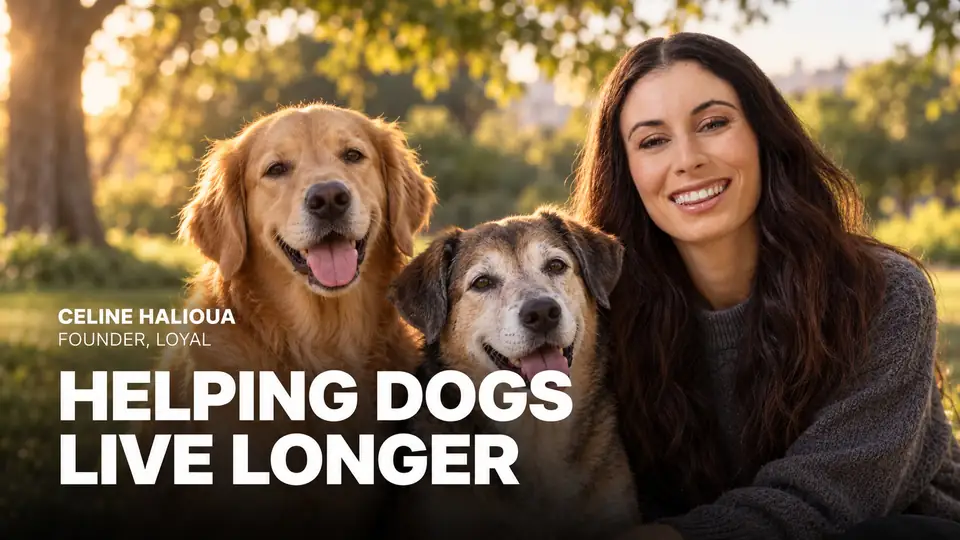
Celine Halioua — Helping Dogs Live Longer
Celine Halioua discusses the reasoning behind Loyal, the challenges of building a biotech company and why dogs are central to her approach.
January 13, 2021 · 33 min



About the episode
In this conversation, we talk with Celine Halioua CEO & Founder of Loyal. At Loyal, they're developing drugs intended to delay and reverse aging in dogs. We cover the aging in both humans and dogs, the longevity space, and building a biotech.
Links
Chapters
Times follow the podcast audio. The video’s timeline may be slightly different.
- 00:00Welcome and introducing Loyal
- 04:07Why start with dogs?
- 08:47Deciding to start a biotech
- 16:06Finding the first teammates
- 17:11The idea behind Loyal
- 20:25Misconceptions about longevity
- 24:11A new generation of biotech founders
- 30:27Supporting Loyal and the field
Read the conversation
Open the full transcript
CAMERON WIESE: Welcome to the Build the Future podcast. My name is Cameron Wiese and I'm your host. I've always been fascinated by the ideas and sentiment that drove American culture in the 1960s with the space race. A culture galvanized to dream about the possibilities of tomorrow. Whether it's food, transportation, cities, or anything else, it was this cultural mindset rooted in optimism. A mindset where people were compelled to build things. And I quote JFK, not because they are easy, but because they are hard. It's this desire to build and to dream that seems to have been lost and is something we're here to bring back. With Build the Future, we're here to promote the ideas and stories of those who see how the future can be better and promote their plans to get us there.
CAMERON WIESE: It's our mission to get you to dream about the possibilities of tomorrow, to dream about the future that you want to live in, and inspire you to go build. Today we're talking with Celine Halioua, the CEO of Loyal. At Loyal, they're developing drugs intended to delay and reverse aging in dogs. In doing so, they're building a future where our best friends have more healthy and happy years. Let's jump right in. I want to talk about what you're doing at Loyale. Tell me about the future you're building with Loyale. What's the vision?
CELINE HALIOUA: I want to feature a couple of things. One, we should tackle age-related diseases. So age-related diseases are diseases that increase an incidence of age, cancer, Alzheimer's, Parkinson's, osteoarthritis, sarcopenia, general loss of vitality. We should not tackle those when the symptoms emerge, we should tackle them before the symptoms emerge, because they are developing in us all the time. I mean, I am currently developing an age-related disease. And we define disease as a set of symptoms and biological markers. Disease, I think, can be defined as just what is optimal function, and then what is the derivation from the optimal function, and that derivation is the disease. And that's basically what the aging field is working on is tackling those things that start to go wrong that don't, you know, acutely cause some negative effect, but then lead to and compound over decades to a very challenging negative effect that is, let's just say Alzheimer's. It's very, very, very difficult to treat neurodegeneration, specifically, you've already lost a good portion of your neurons by the time you start having symptoms. That's very, very hard to, I will not say impossible, but I feel very confident. That's a very difficult problem to reverse post symptom accumulation.
CELINE HALIOUA: And so I want to build a world where the vaccine approach that's obviously been incredibly successful for us for infectious diseases, different modality, different underlying biology, but that idea of preventing the onset of these diseases so that people can live longer, healthier lives and not lose their free will or lose what they wanted to do with their life. because some cells decided to not behave.
CAMERON WIESE: Talk about how you're starting tackling that problem.
CELINE HALIOUA: So we're starting with dogs. So loyal developing drugs to extend dog lifespan. And we're doing this for a couple of reasons. I think the most important one is that we want to have a causation loop between what do you change early in a dog's life that then causes a later on prevention, delayance, amelioration of an age related disease or age related diseases, which then leads to a longer, healthier lifespan overall. And that causative loop from intervention early to improvement later is very difficult to almost impossible to do in humans right now because we live for 80 plus years, but in dogs, specifically dogs like Great Danes that have an average lifespan of eight years, aged dogs of any breed, that feedback loop is much shorter. So it allows us iterate and develop very ambitious products and a timeline that's relevant to venture. and relevant to company building as a whole.
CAMERON WIESE: Why are dogs an interesting model to start with, eventually to human longevity?
CELINE HALIOUA: Just for context, most drugs that are developed are initially tested in mouse models, by far the most common models. We use a poison or whatever to induce Alzheimer's symptoms or Parkinson's symptoms in a mouse, or we inject them with UV or carcinogenic or whatever it is to have them develop a tumor. And then you test the efficacy of the drug against that in that mouse model and hopefully bring forward something that has some degree of signal. And then it's a very long process from efficacy in a mouse model or another model to efficacy, aka it working in people, 7, 10, sometimes even 15 years later. But we have to do that. We obviously can't start from day one in humans. But dogs are a really interesting model of human disease for a couple of reasons.
CELINE HALIOUA: One is that they're longer-lived. So like us, they develop age-related diseases over time. The fundamental thing to understand about aging is that it's happening 24-7, and the processes that are happening in my 26-year-old body now are fundamental to any diseases that I might get when I'm 60, 70, or 80. So that's the process you want to intervene in. And it's the same process that happens in dogs. So we're able to replicate that and see that in a much shorter time scale, but it also still mimics a bit more the complexity of an age-related disease versus in a mouse where it's induced over a period of a week or two. And people do do aged mouse studies, but mice in general are just super inbred. They're in the wrong environment.
CELINE HALIOUA: They're phylogenetically closer to us, but genetically further away from us because of how fast They evolve while dogs are actually closer to us from a genetic similarity standpoint and importantly have shared an environment with us for the last 15, 20,000 years. So they have all the same environmental triggers and dogs also develop with the exception of cardiac disease, develop age-related diseases at the same, approximately same frequency and stages life as humans do.
SPEAKER UNCLEAR: Interesting.
CELINE HALIOUA: They don't do cardiac partially because I think dogs don't eat McDonald's all day every day, but it's not a portion of dogs that do that and they're quite active. I just want to clarify, I did not invent that thesis, the kind of the one health thesis has been something that cancer research especially have been banging the gavel about for a long time. But where we were working is, wait, this is the perfect model for testing and understanding aging as a whole, which is also not strictly my idea, but is much less, it's a much smaller field.
CAMERON WIESE: You got all the context by coming to Silicon Valley and being in the space. And then you wrote this great piece on how to build a biotech.
CELINE HALIOUA: I like to say I'm like biotech founders are like the vegans of the startup world. And I am queen vegan. I am always very skeptical of people who dedicate 15 years of their life to something that doesn't actually change the human condition. There's just so many tangible problems and I want more people to work into tangible problems and it's not actually that much harder, I think, than like trying to sell some software product. If you hire the right people, I have not successfully brought a drug to market yet. therefore I am probably not the best person to write these things, but I started writing because everyone asked me and at least I have more context than the average person who's interested in it. Biotech culture today can be pretty well paired to tech culture 20 years ago. It's just very conservative. It's very slow in some ways. It's very hierarchical. It's very secret networks.
CELINE HALIOUA: You can't learn about biotech. It's very, very difficult. You have to talk to people. You have to experience that. You have to live it. Part of the reason why you don't see founders like me that often is there's just this huge barrier to knowledge in bio. And there's good reasons for that. Building in bio is difficult. It's a huge responsibility developing things that go into a body that could hurt somebody if you do something wrong. But I think it's also unnecessarily dogmatic. And so I'm just hoping if nothing else, Maybe I'll put out a blog post and then some real biotech CEO will get annoyed. And then, you know, it'd be spurned to write their own thing.
SPEAKER UNCLEAR: Which would be a good thing though, right?
CELINE HALIOUA: Yeah, it'd be great thing. There's so many amazing leaders in biotech. The people who built the first gene therapies, the first Cartese, they have such amazing knowledge in their head. I love working with senior biotech talent. It's amazing. But there's not a culture of sharing that knowledge. There's not a culture of giving back to the youth because the youth are just kind of seen as just not being competent enough to understand. Like they just have to work 30 years before they'll understand. We have like somewhat true, but it's also doesn't have to be true.
CAMERON WIESE: You're serving as an example for people who do want to go pursue this. And I'm curious, how are you thinking about this starting a biotech company? What was going through your head? How did you think about diving into this?
CELINE HALIOUA: So I guess I give a little bit context of how I grew up. I grew up in the suburbs of Austin. My parents are both immigrants. They work very normal jobs. I didn't grow up knowing really anything about how the world works. The only investment as a word I understood was like, oh, some people invest in stocks. And that's all I knew about that world, right? I didn't even know what Silicon Valley was. So my whole thing is I wanted to figure out how I got activated in science. After I got activated, my whole thing is I wanted to figure out how to improve at that point human health as much as I could. And it was just an iteration path to figuring out what was the best thing to do.
CELINE HALIOUA: So I started super canonically, wanting to be a doctor, was a fantastic pre-med student. Then I wanted to be a researcher. I started a PhD, realized that wasn't the right environment for me. Then I went to venture capital because it's portfolio theory to impact, right? You know, you invest 10, 15, 20 companies, two or three of them get a drug on market. You're some part of that. And I then decided to start the company, not because I had any sexy connotations of going to be CEO, I promise it really was just like, I think this is a very smart way to tackle one of the big blockers in the aging and longevity field. I think a lot of other people have the skill set to be able to do it, but would not have the context to be able to do it or recognize that it should be done.
CELINE HALIOUA: Therefore, if I actually care about aging drugs, I should do it. So I did it, but it was difficult. Like I remember Laura and I, I was working for Laura's, she was at the staff at the time in the entire summer. She was like, you should do this. You should do this. This is amazing. This is amazing. Greg, who's at box group, Greg Rosen, he was working with me all summer and he's like, you should do this. This is amazing. You're going to be great. You're one of the smartest people I've ever met. And I was just really hesitant. I didn't actually truly make the decision until Greg gave me the term sheet for the series. And then I was like, fine. I guess I'm doing this. And it wasn't because I didn't want to. I just never saw myself as a founder. Now I I wouldn't want to do anything else.
CAMERON WIESE: What was this thing that Laura and Greg were encouraging you to do?
CELINE HALIOUA: The Genesis story is really funny. So I had been working on the biology that is behind one of the drugs we're working at at Loyal now, initially the human side. And I'd been working on that with Laura for about a year and a half. I'd written this massive memo about why the biology is super exciting, why the fun should invest in it. At that point, it was for a human drug. And I landed on the dog thing for a couple of reasons, partially because the biology was relevant, partially because of the regulatory barriers, which we can go into later. But I kind of thought the idea was totally crazy. That it was completely nuts. Like I remember calling Zoll from ReFactor and I was like, I'm kind of thinking about dog longevity, but that's way too crazy.
CELINE HALIOUA: He's like, no, this is great. You should go with that. This is so much better than anything else you've thought of. I was embarrassed to say the phrase dog longevity. I actually still kind of am. I was talking to somebody yesterday about how I don't like tell people this is what I'm working at when I just meet them on the street. Partially because I just don't want to get into it and partially because I still cringe a little bit saying it. It was not something I'd been primed to think about before. But then I was at a camping trip with the Embark Truck founders. I didn't invite bias and like random chain of people and I just showed up with my foster dog and me and I didn't know anybody. I of course got drunk because I didn't know anybody and I was at the campfire and I was joking about how I know how to make dogs live forever. I figured out this really cool pathway. I could totally extend dog lifespan like you want a long-lived great day and I got you totally messing around and there was an investor there who talked about this to another investor who then ran into Greg Rosen at YC demo day and told Greg about me and my idea.
CELINE HALIOUA: And Greg was like, Oh my God, I've been super excited with the pets genomics market for a while and asked to meet me. And I just kind of talked to him. I'll say, yeah, like, I think it's an interesting idea. Like, I don't know if I want to start it. And kind of over the summer, he worked with me and pretty mass really actually got me into starting a company, which then he obviously led the route and has been super supportive since.
SPEAKER UNCLEAR: There's all this mystery around the early days of founding some of these more ambitious or quote unquote like moonshot-esque projects. Everyone's like, oh cool, you can have an do an announcement, you have some research, people are really excited about it, but no one really talks about the idea inception phase to go from the zero to one or the zero to promoting it. What was that like for you that summer when you're working with Greg and Laura? The company that
CELINE HALIOUA: I pitched in, I think it was October of 2019 is very different from what we're doing now. I mean, we're doing dog longevity, but the strategy and everything else has changed quite a bit because I frankly didn't have enough context. I didn't have enough context about animal pharma. I didn't have enough context about the pathways we were hitting. I didn't have enough context about drug development. But the only thing that I think really mattered at that point was the idea and the thesis behind the idea, which is that developing longevity drugs would be a huge market, but also would facilitate the entire aging field and kind of fill in the gaps that we've just been running at headfirst and not hit, you know, able to jump over the human side. And then it was just about, frankly, me. I don't think I'd even lined up any of my key employees at that point. I had not. It was literally just me. I mean, this is the negative, right? Like I worked for like a year and a half to come off as what the Valley dictates as competent, smart, high potential could just make cool and crazy in a decade.
CELINE HALIOUA: And the idea is super viral. Like people got super excited about it. Like I literally people recognize me on the streets of San Francisco. It's absolutely hilarious. Like, Oh, you're the dog lady for a good month after I raised the seed that happened.
CAMERON WIESE: Which is super exciting. I imagine that rallied the support and helped you take it to the next level and go hire your early team, kind of kick things off.
SPEAKER UNCLEAR: So honestly, none of my early team came from the Valley network. So I think like one of my secret sauces, there was no kind of land grabby situation. My only motive was to find the absolute best person and give them as much responsibility as possible. And the money that I had just raised, I just see my job as like a facilitator basically, and set the big vision, like, you know, it's very easy to backtrack to a thing that'll definitely work, but isn't the crazy vision. And so my job is basically facilitate the team and be like, no, we're doing fucking longevity. We're not doing anything else. And that's what we're going to do. And we will die on this hill if we have to, but we will do this. That's been a very helpful framework for the company. It's been very attractive for hiring people in because they know I'm not going to metal.
SPEAKER UNCLEAR: That's particularly with people who are coming from the science background or coming from the research background versus the Silicon Valley background. Yep. There's basically nobody who
CELINE HALIOUA: comes from a traditional Silicon Valley background in the company. From what I can remember, it's all people who have strong scientific backgrounds or generally talented backgrounds and wanted a place to run on what they had learned. And I basically pitched, dog longevity is interesting. Here's why if you want to work on it, here's a little cool stuff you'll have to do. And that was a pretty good
CAMERON WIESE: sell. I just had to carry us. Where'd you find your first couple of teammates?
CELINE HALIOUA: My two most senior hires. One is Michael LaCroix Freilich. He's our VP of Aging Biology. He He founded Regeneron's aging group, and then I pulled him out of there. He honestly came by a recruiter. I always tell the funniest thing is I met him in February and it was this big drama because he was in New York and he couldn't move from New York. He had kids and I was like, Oh my God, can I have a remote VP? And thank God I decided, yes, we can have a remote VP. Cause a week I gave him the offers a week, New York shut down because I COVID. But yeah, so he joined from Regeneron. He's absolutely amazing. Karen's my other VP and she came out of really cool veterinary startup that just didn't make it. And we've pulled quite a few people out of there. And then the rest is just like traditional hiring, honestly. I mean, there's a lot of biotech startups, but they tend to look far my kind of fast. Yeah. It was an obvious place to pull from. It's more of like, who has a great technical background? And I think has the character personality traits to work in this environment. Well,
CAMERON WIESE: What got you initially excited about this?
CELINE HALIOUA: I was at Longevity Fund. So for context, the early stage of biotech, BC invests in biotech companies selling drugs for lifespan and healthspan and aging in general. And we saw the same pitch every single time. It was, we have this awesome drug, we have this awesome pathway. It's doing this crazy thing that increases healthspan and lifespan. Here's mouse data, we extended mouse lifespan, 30%. Great, what are you commercializing it for? Oh, well, you know, we can't go for health span or lifespan and people. So we're going to go for this disease first. We're going to go for this esoteric, pediatric indication that's not related to aging at all, but it's the same mutations that a drug should work. But don't worry. You know, after we do that, we'll go for the aging claim or watch the patients and then go for a secondary aging claim.
CELINE HALIOUA: But also like on slide 10, you look at the exit possibilities or whatever, and it shows, getting acquired by Pfizer in phase two or something like that. And I understand why, and it's not these companies' faults, but it just seemed illogical to me that everybody who's working on developing aging drugs was trying to find a drug for aging, but then putting it through a test for efficacy for a specific disease that's already developed. It's very different mechanisms, right? Like our drugs are not gonna cure Parkinson's Alzheimer's or cancer. They're not designed to cure Parkinson's Alzheimer's or cancer. because I theoretically potentially we will see if it works, delay the onset of the equivalence of those diseases in dogs. So there's no reason to expect why, it would just be a false fail if we tested it for an acute disease.
CELINE HALIOUA: And when we have seen some signal of that happening already in humans and I landed on dogs because I think fundamentally what we need to do is develop drugs against the aging process And then show in a period of time that's relevant to a clinical trial, that's relevant to a company, that's relevant to the iteration speed that you need to have in a biotech, that these drugs are not doing that. That specific markers or changes that are happening to dogs early are predictive and causative of the eventual health span and lifespan extension. And therefore you go for that basically directly out of the box.
SPEAKER UNCLEAR: Yeah, which is really exciting.
CELINE HALIOUA: I think it's super cool. There's the dog aging project that's an academic group that's doing a similar thing. So there, I think they have 70,000 dogs or something like that from all over the US who are giving data on their dogs, you know, behavior, various blood, stool, et cetera, samples to understand better how dogs age. And they're also doing a smaller rapamycin study, rapamycin being a drug that is shown multiple times over to give lifespan extension, healthspan extension of various types in mice and other models. And so they have a similar theory on the academic side. They're trying to understand that. We just want to do it in the commercial side because my thesis is that people will pay for that. You're developing a product that people really want for their dogs and then facilitating from a data, from a capital, from a company expertise perspective to be able to then do it in humans.
CAMERON WIESE: It's super awesome because everyone wants to have their dog's man's best friend, right? Everyone wants their dog to live longer. It's like the most terrifying, traumatic childhood experience, like lose a pet. I'm curious, what are some of the misconceptions about the space you're working in? What do people think when you, when you have those conversations, you're like, Oh, I'm working on dog longevity. And they give you that weird look.
CELINE HALIOUA: There is definitely a faction of people that are working on this to expressly cause people, dogs, whatever, to live much, much longer than what I would say is a natural lifespan, you know, 200 years old, 1000 years old. That's not how I landed in the field. The way I landed in the field actually was I was working in a group that was working on Parkinson's. And I wanted to understand a preventative mechanism because I basically became very pessimistic of the idea of developing a drug to reverse the severity of the disease. Halting it, yeah, but reversal just seemed very, very difficult. And that's kind of how I landed on aging and the thesis of slowing aging to delay or prevent that onset of horrible diseases like that.
CELINE HALIOUA: And that's basically what we're trying to do in dogs. Like the way to think about it is we're trying to make the dogs live a longer, healthier life to not develop age-related diseases as quickly as they normally would. and that leads to lifespan extension. But the outcome of the drug, the goal of the drug is to help the dogs from day one of treatment to their last day on earth to be above average healthier than they would have otherwise been because of the treatment. It's not to take some decrepit old dog and drag them out another two years. Actually that would also be more biologically challenging to dry out a crepit old dog than it would be to make a dog generally healthier who then happens to live longer. The whole goal of an Alzheimer's disease, of a cancer drug, of you know anything is to not let the disease cause an end of life and extend instead have the animal or human live a longer life at a healthier state than they were when they had the disease. It's the exact same thing. It's just the point of intervention is different.
CAMERON WIESE: Yeah. So ultimately, it's about helping the dogs live longer, but not just live longer live healthier.
CELINE HALIOUA: Yep. Basically, that that, you know, magical period where human equivalent here in your 20s, 30s, 40s, and your sprite and your, you know, you don't get hangovers and your back doesn't hurt in the morning. Take that and extend it out. You know, we don't know biologically what will happen. We don't know if there'll just be a compression of mortality. So people will still die around the same average age, but just be sicker for a smaller portion of that. Or if just the entire curve will shift out and people will have the same slope downwards, but it'll just happen 10 to 15 years later. We've seen both in mice. We don't know how it's going to work in people or dogs.
CAMERON WIESE: So that's kind of the big open question.
CELINE HALIOUA: I think it'll be relatively easy. Relatively, relatively is the key word there. Easy to extend a dog and a human's lifespan, probably from five to 20 percent, just like when we invented antibiotics, right? Average lifespan, much shorter. Same with vaccines, average lifespan, average health span, much shorter. Now, all of a sudden the average human lifespan has jumped quite a bit because of the invention of those two categories of drugs, we'll probably get a similar thing with this category of drug and it will hit some new barrier. It could be the CNS, like there could just be a natural limit on how long neurons and other permanent cell types like that can function. We don't really know.
CAMERON WIESE: But we will soon find out.
SPEAKER UNCLEAR: Yeah, I hope so.
CAMERON WIESE: Fingers crossed. I want to take one step out. In the core values of Loy You Champion, this idea of a new biotech founder. I'm curious, what does that mean? And how do you think we can go about helping develop more of those?
CELINE HALIOUA: A lot of biotech companies today are built in a venture incubation model where there's a series of partners who are incredibly experienced. They work with academics to pull an idea or a drug or a pathway or what have you. Academics usually don't want to start the company, so you know it's very symbiotic relationship. They install in a professional CEO and then they run. That's been a very fruitful model of biotech building. It's delivered us some amazing, amazing companies and that model should always exist because it's a very efficient way to get things out of academia. The negative is that it's kind of a cycle of the same people over and over again, and it's absolutely rate limited by the number of the funds that exist that do that and the number of people of capacity to do that.
CELINE HALIOUA: And usually you don't see the junior person becoming the CEO of the company. You see, honestly, the dude who has, you know, decades of experience become the CEO and is kind of, you know, professionally installed and maybe it cycles out a couple of times for the company IPOs or whatever. So again, very efficient. They know their shit. They are very good at what they do, but there's no feedback loop. So you don't see an acceleration of the amount of companies that are built versus in Silicon Valley. It's very different, right? Like you have a founder, you know, some portion of them are successful after they're successful, they give back to the rest of the field and help the next gen of founders that are starting up and figuring things out.
CELINE HALIOUA: We don't really see that in file. There aren't even that many bio angels. The model that I'm excited about is basically having a more West coast, Silicon Valley way or pathway or opportunity for starting companies for people who want to go down that path for somebody like me who has an idea and wants to start a biotech company or a postdoc who discovers something and wants to commercialize it and develop a company out of it and lead the company themselves and just making that a bit more normalized. I had a relatively easy time raising. And that's because what I was doing, I could sell it from a consumer angle. You know, a lot of funds invested in me who don't know bio, but are very well aware of the massive market size that is dogs and dog owner spending and pet parents spending.
CELINE HALIOUA: And that's why I was kind of able to tell that story. But if it had been something that was like super technical, somebody knows this, like you wouldn't understand it unless you were in the field. I don't think I would have been able to raise, or there's only a couple of funds that I could have been able to raise from. I think I have a lot to learn. I have not developed a drug yet. You know, we, we have a drug, but we haven't commercialized it yet. But I do think this model actually works decently well. Like the people who work for me, work with me are incredibly incredible experience. Not like we're a bunch of, you know, green behind the ears, you know, naive younglings.
CELINE HALIOUA: Like it just, I'm the excited person who fundraises and spearheads the company. And then I hire the best people in the world for all the different things that we have to figure out. But there's also now a model for younger people in the company to move up and learn about biotech entrepreneurship. It's very transparent about that because I frankly want them to start their own companies in five or eight or 10 years or whatever it is.
CAMERON WIESE: Love it. You're a couple of steps ahead. As you said, you're not, you haven't brought the drug to market, but I think that's downplaying the progress you've made so far. So what would you recommend to people who are excited and want to solve some, some challenge in the biotech space, but aren't sure where to start? What direction would you recommend? Other than you're phenomenal. how to build a biotech article, which I will link in the show notes.
CELINE HALIOUA: So it's a couple of things. The first thing is humbleness. It's like a very common pattern. You will don't know anything about science, but they learned something about science and then they think they understand science and then they get slapped in the face two times and they realize they don't understand anything at all. And every good scientist is in the, I realized I don't understand anything at all bucket. There is no scientist who thinks they understand biology. Yeah. Point blank. So just making sure you have a respect for that and the humbleness of the challenge and the responsibility. I mean, one thing I really emphasize to my team is we have a moral responsibility. We can't mess up. We can't be not truth-seeking because it's giving you blobs of social media company. What's the worst that happens? Like people lose their sword photos or whatever on your site. You know, we can kill people. And also the inverse is true. Like if we could have built something amazing, but didn't because of our incompetence, there's a certain amount of years of lives that could have been saved or improved that didn't and those have value too. So I think having a super strong understanding of that and you can't let it paralyze you, but just not getting lost. Because a lot of the dogmas in the valley are around things where frankly you can break everything and it doesn't really matter. There aren't that many consequences if you do break something besides somebody being late to their party because their Uber didn't show up on time.
CELINE HALIOUA: Not to downplay that the responsibility of those companies have too, but it's a little bit different when you're giving somebody a thing that goes into their body that fundamentally modifies how it works. Yeah. I think from a pure strategic standpoint, I would start by talking to scientists, like understand how good scientists think, understand the models they use, understand how they sound, understand the problems they're working on, understand why they've decided to spend seven to 10 years on that problem, and just become enamored by a problem. It doesn't really matter what the problem is. I don't remember where I started, but I started somewhere pretty different from where we landed. You just need to start in the rabbit hole. Reading papers is really difficult, you're probably not going to understand them and that's okay.
CELINE HALIOUA: You'll get there. You just have to keep on doing it. And you need to have some basal level of competence in that, in building the model, because otherwise scientists will never work with you because they'll realize that you don't know anything. You have to know enough to be dangerous and then not be dangerous because you're humble enough to recognize that you don't actually know that much. It's a really fine line to walk. Um, I think that's why we probably had some like kind of famous fails in bio is because walking that line is very, very, very hard. You can't will things into reality like you can in other fields.
CAMERON WIESE: How can people support you and loyal? What can they do for y'all and then any parting words for
CELINE HALIOUA: people? We're going to continue growing. You know, our scientists always work in aging. You know, for scientists, I actually almost fit more to hiring people who don't have an aging background because I find bringing that framework whatever field you came from is really helpful. So we have a lot of neuroscientists on the team. If you're not a scientist, we hire a lot of other types of people too, because what we were doing is not just science. It's fundamentally developing a product for a set of consumers and frankly, an area that I have a lot to learn in. So I'm just as excited to learn from people who have that context as I am to learn from scientists. I think the biggest thing is just enthusiasm around people like me and other people who are building cool stuff. Like space, for example, has become kind of normalized. Space is super difficult. It's probably as difficult as building a longevity drug, right? But it feels more accessible because more people are working on it and more people talk about it and more fun They're funding it. Biotas has this bad rap
SPEAKER UNCLEAR: So yeah
CELINE HALIOUA: I think just normalizing that people are working on these problems and that they're just as exciting and they're not some Totally out of world thing is super important
CAMERON WIESE: Cool and then website will be loyal calm
CELINE HALIOUA: Loyal for dogs calm unless we've gotten loyal calm We're working on it.
CAMERON WIESE: If you want to learn more about Loyal or view open roles, head on over to loyalfordogs.com. And if you want to follow Celine, you can find her on Twitter at CelineHolliwa. Thanks for joining us for this episode of the Build the Future podcast. If you're building and want to get support, want to hear about certain topics or hear from certain people, shoot us over an email to hello at buildtofuturopodcast.com or follow me, Cameron, on Twitter at camwheezy and we'll see what we can make happen. That's it from us. Until next time, go build.
More episodes
All episodes Tyler Hayes — Artificial Limbs and the Future of the Human BodyTyler Hayes discusses artificial arms, building Atom Limbs and the longer-term future of replacement body parts.
 Goke Olubusi — Digital Healthcare Infrastructure and TelemedicineGoke Olubusi on replacing paper hospital records with accessible digital tools and expanding telemedicine.
 Dr. Yael Joffe of 3x4 Genetics — The Future of Genetics, Health, and BiologyDr. Yael Joffe reflects on the gap between the promise of genetic testing and the value people receive from a report.