

Build the Future Podcast
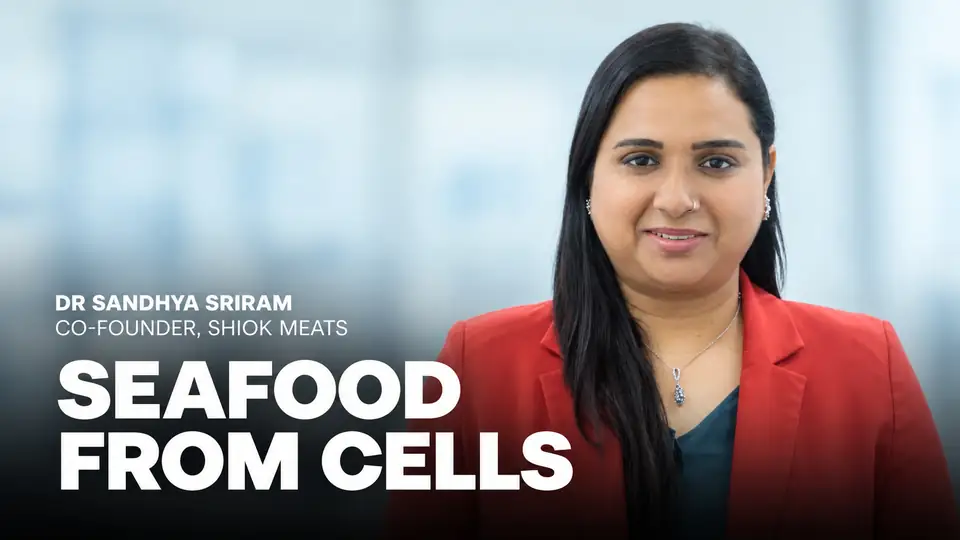
Dr. Sandhya Sriram — Growing Seafood from Cells
Sandhya Sriram explains how stem cells can be grown into seafood and why the culture medium matters.
November 17, 2020 · 35 min



About the episode
In this conversation, we talk with Dr. Sandhya Sriram, CEO & Co-founder of Shiok Meats & SciGlo, about the fascinating world of growing stem cell based meats. If you have ever worried about the future of our food sources and our inability to grow or raise enough food to feed the ever-growing population, this is the episode for you. Dr. Sriram will give us an inside view on the sustainable food industry of animal stem cell meat, with a concentration on crustaceans stem cell meat, and how this will allow us to grow meat without having to kill the animals to attain an alternative meat source.
Links
Chapters
Times follow the podcast audio. The video’s timeline may be slightly different.
- 00:00Welcome and introducing Shiok Meats
- 02:41How meat grows from cells
- 06:07Developing a food-grade growth medium
- 11:25Will consumers try cultivated seafood?
- 14:33Taste, price and returning customers
- 17:54Problems in the seafood industry
- 22:49Why start with crustaceans?
- 27:25From stem-cell research to a food company
- 30:29A future with more food choices
Read the conversation
Open the full transcript
CAMERON WIESE: Welcome to the Build the Future podcast. My name is Cameron Wiese, and I'm your host. I've always been fascinated by the ideas and the sentiment that drove American culture in the 1960s with the space race. A culture galvanized to dream about the possibilities of tomorrow. Whether it's food, transportation, cities, biology, or anything else. It was this cultural mindset rooted in optimism, that the world tomorrow would be better than the world today. A mindset where people were compelled to build things, and I quote JFK, not because they were easy, but because they were hard. It's this desire to build and to dream that seems to have been lost, and something we're here to bring back. With Build the Future, we're here to promote the ideas and stories of those who see how the future can be better and promote their plans to get us there. It's our mission to get you to dream about the possibilities of tomorrow, to dream about the future that you want to live in, and inspire you to go build.
CAMERON WIESE: Today, we're talking with Dr. Sandhya Sriram, the co-founder and CEO of Shiok Meats, the first cell-based clean meat company in Singapore and Southeast Asia. At Shiok, they're on a mission to build a future where clean, healthy, and delicious seafood is available to all by harvesting meat from cells instead of animals. Let's jump right in. Dr. Sriram, thank you so much for joining us today. I'm very excited to have you on to talk about the incredible future you're building at Sheok. I'd like to start with the basics. Can you tell me about the future you're building?
SPEAKER UNCLEAR: What's the vision? Thanks, Cameron. Pleasure being here, and thanks for inviting me on your podcast. But I think the future that I and at Shiok Meats, what we're building is a sustainable source of seafood for everybody to enjoy in the future. Delicious, tasty, nutritious, as well as safe and sustainable source. And these are all the words that keep buzzing around us on a day to day basis when we're doing work. So what we do at Shiok Meats is we grow cell based crustaceans like shrimp, crab and lobster using stem cells instead of the full animal. and what we always go back and talk to our people and as well as the team is we have to make sure everything that we use is sustainable, everything that we produce is delicious, tasty, as well as nutritious at the end of the day without harming animals and having the most ethical practices. So that's our vision and mission per se. Love it. Okay, there are a lot of different directions
CAMERON WIESE: we can go in, but I think let's start with you're growing them from cells. How does that work? What
SANDHYA SRIRAM: does that entail? Sure. So if you take a piece of meat or seafood that you eat on a daily basis right now, consumers eat right now, it's made up of muscle fat, blood cells, connective tissue, and a couple of other cells maybe. It is a part of an organ of an animal. So you do grow an animal, then you slaughter it and take out a part. Each part or each tissue of an animal has something you call stem cells, which is like the birth cell of every organ. So your muscle has muscle stem cells, your fat has fat stem cells, your hair has hair stem cells. Every animal, every human being has that. And stem cells have this amazing capability of growing outside of the animal's body, as long as you put them in a very conducive environment, as they would be inside of an animal.
SANDHYA SRIRAM: So you're tricking these cells to think that they're still inside the animal. So you give the right temperature, the right nutrients, the right pH, the right humidity and all of it, pressure and all of it, and you trick the cells to think that they're inside the animal. So what stem cells do inside of the animal is they start forming the organ. As you're growing from a baby to an adult, the stem cells start forming more organs and so on. So what we exploit in this technology in a good way is that we isolate the stem cells from an animal. And like I mentioned again, these stem cells have this amazing capability of growing on and on outside of the animal's body. So we take out stem cells once or twice from the animal and then we can grow a particular organ using those stem cells. We don't have to grow the entire animal. We don't have to have so much land to grow the animal. We don't have to have farms to grow the seafood.
SANDHYA SRIRAM: you don't need excess amounts of water you don't need to feed and then wait for a year or so for these animals to grow in full size and then you have to slaughter them to eat the meat and honestly we don't eat every part of the animal we only eat parts of it so the whole thought process behind cell-based meats is why use grains and pulses that humans can eat why use them to feed animals wait for a couple of years for them to grow in land that can be used for growing more crops and pulses for humans, vegetables and plants as well, and then wait for the animal to grow and then slaughter and only eat parts of it. Why do this entire energy inefficient process while you can grow a part of the animal using stem cells? So at the end of the day, the meat that we grow to the DNA level is exactly as similar to conventional meat and seafood, except that it doesn't come from a dead animal and it doesn't take years to grow. So in our case, we do salve shrimp, like I mentioned, and shrimp takes less than six weeks to grow in our facility, the shrimp meat, whereas it takes about six to 12 months if you want to grow a full-sized shrimp.
CAMERON WIESE: It seems like you're taking this terribly inefficient process. It doesn't seem like you definitely are, and in condensing it. But in order to do that, I get the sense that there's a lot of research that had to go into that on both the food and the bioscience side. How did you all get here?
SANDHYA SRIRAM: So the whole cell-based meat industry, including our company, is an offshoot from biomedical sciences where stem cells were used to understand human diseases, to treat them, diseases like cancer and diabetes and obesity and so on. we have to understand the human body in order to treat a disease. So we were using stem cells as this key to understand the human body. But then we realized that stem cells are being used to make organs, for example. So organs are right now being manufactured outside of the human's body, like for transplant. Like you can get a kidney with your own stem cells if you need a kidney, for example, during kidney failure or so on. So it's an offshoot from there. but when you think about growing an organ outside of human's body you need a functional organ that works right you want to transplant it into yourself whoever it is and then that organ has to work and do what it's supposed to do in the body but when you take a piece of meat you don't need it to be functional you don't need it to be working at the end of the day it's a dead piece of meat when it's on your plate. That's what it is. So we extrapolated from that. And we said, why not start using stem cells to make meat, which can be actually consumed, which is exactly what we do in an animal.
SANDHYA SRIRAM: We grow an animal, slaughter it, take a piece of meat, we cook it and eat it. So that's the biotech, biomedical side of things. But at the end of the day, it is a food product. It has to be delicious. it has to taste right it has to be safe it has to be edible in all its form so one thing that a lot of people don't understand is when we do this our when we do the r&d on these cells to make the meat a lot of the ingredients that we use is pharmaceutical grade or chemical grade because that's the only thing available right now there is no food grade nutrient solution that i can feed my stem cells because nobody ever thought of this five years back. Unfortunately, right now our meats are not ready for large-scale consumption because it's extremely expensive and it's not the most edible product on its whole form because we use chemicals to grow it. But the whole industry is working very hard, inclusive of our company, to swap out these chemical ingredients that in which we grow ourselves. So these are proteins, carbohydrates, vitamins, minerals, similar to what an animal would eat, but it's in a broken down form so that the self can absorb it directly.
SPEAKER UNCLEAR: We are swapping out each and every chemical ingredient with a food-based ingredient or a plant ingredient that humans have been eating for many years. So to give you an example, I can swap out sugars in this nutritional solution or carbohydrates. For example, we can use wheat carbohydrates or we can use carbohydrates from soy or pea instead of using a sugar source that was chemically synthesized in a laboratory. So that's exactly what we're doing. So at least for Shiok Meats, we're looking at launching our first product in about two years from now, so in 2022, and that's going to be cell-based shrimp. And we want this product to be completely safe, completely made up of plant-based and edible ingredients. And also the regulators won't approve it if it has too many chemicals in it. So we have to go towards a more food side of things. So we're right in the middle of biotech and food tech. So it does take a while for us to do R&D and get to the market, but we want to make sure that the product is the best before we actually get consumers to buy it. That's super exciting. I definitely think people
CAMERON WIESE: jump around oh why don't you have this yet so if i understand correctly it's the the chemical component that keeps it expensive and it makes it not as readily available to eat would you still
SPEAKER UNCLEAR: consume the stuff with the chemical solution yes we do and we know it's safe but honestly you don't know the long-term effects of it if you just do like random pastings once in a month once a week you're okay but what if somebody ends up eating cell-based meats every day for the rest of their lives. We don't know what's the after effect. And honestly, as a sustainable, ethical, no animal cruelty company, we don't want to do clinical trials where we feed these meats to animals to see what happens to them. So that's why we want to use all plant-based and already certified food ingredients that humans have been eating for many years. And we know that it's safe. So if we use those ingredients, you don't have to worry about what's going to happen at the end product if you end up eating cell-based meats on a daily basis for let's say 20 years of your life right 20 30 years of your life so that's where we want to you know go and also honestly it's so expensive the chemical components are so expensive they aren't available in the quantity that we require because here we're talking about meat and seafood which is in the trillions and billions of tons of meat and seafood per year so we need something that's accessible sustainable and
CAMERON WIESE: healthy so i want to talk a little bit more about how you think about rolling this out to the market. So you're currently working on getting different solutions that will bring the price down, make it more, it's not safer for the consumer, but in line with what you expected.
SANDHYA SRIRAM: Yeah. Inexpensive, food grade, tasty, delicious. Yeah.
CAMERON WIESE: Yeah. Then I guess like when you're thinking about taking it to market, I'm curious how you think about the reception from the consumer? Because it seems like something that people may, it sounds like they're excited about it, but when push comes to shove and they can actually go order it, play order cell-based alternatives to their meat options, right?
SANDHYA SRIRAM: So one thing that we've realized from various surveys that different organizations have done, and as well as us, we have done a couple of surveys as well. And we've spoken to a lot of consumers, future consumers, and we've realized that it's the younger population, the millennials and the Gen Z and so on that are super excited about this product. As you can imagine, it is a food for the future. It's not something that's going to be launched in the mass scale in the next one year or two. It is something that we're looking forward to in the next decade and decades after that. So it is the future food. So having seen that the youngsters are pretty excited, main concern for them is what the factory farming and fish farming industry is doing to the environment, to the animals, to the human health and so on.
SANDHYA SRIRAM: So we pick all the right boxes with cell-based meats. We are animal friendly because we don't kill animals. We are health friendly because we are really bothered about what goes in. And we are environment friendly because we use lesser energy, water and resources and space as well. So depending on all of this, we have realized the youngsters are very excited. At the same time, when we speak to slightly, I would say 30 plus years of age or even the youngsters, they want to know a lot more about this. so we are here doing a lot of consumer education it is crucial and i'd like to say that unfortunately in the last couple of decades the whole food industry has lost its transparency it's become very okay we get food from all over the world but we don't know where it comes from who makes it ask your grandparents where their beef came from they actually know the name of the animal probably because it was in their farm but right now it comes from a factory farm you have no clue how the animals were grown, how they were treated, what was injected into them and so on.
SANDHYA SRIRAM: So we want to bring back transparency to the food industry. We are happy to talk about our technology. We're happy for people to come over to our manufacturing site when it's open to see how things are done, where these cells are, how do they form the meat and so on. So I think the industry is very nascent. We are only five to six years old. We need to do a lot more consumer education and create awareness. but as far as we can see the excitement is already there and once we launch we're definitely going to have people come over and try it at least but i think the question is will they come back and try it but that question also has an answer where if you are not having access to conventional seaport because the sea animals are depleting the farms are not able to keep up with the demand if you see that happening, consumers need to have options to choose from. They need to have plan-based options. They need to have cell-based options. And then they can decide what's good
SPEAKER UNCLEAR: for them. And then they can go ahead and buy that. So you have consumers come in, they'll try it. And whether or not they come back is up in the air. Why would they not? What do you think the biggest kind of challenge is going to be to get consumers to come back? Right. So I think when
SANDHYA SRIRAM: it's food it's so emotionally connected to human beings that we connect food with taste and price a lot more than environmental concerns versus nutrition versus animal cruelty and so on at the end of the day the food has to taste it has to be a familiar flavor that you're used to eating let's say you love shrimps okay and you eat shrimps like maybe twice a week and then i give you this product that I say is healthier and nutritious and great for the environment and so on but when you put it in your mouth you feel like it doesn't taste like shrimp or it's it's just not right there it does not satisfy it's very rare that you would go back and try it unless there's a huge push for it but at the same time one thing that we always keep in mind is our products have to be delicious at the end of the day it has to be super delicious but at the same time what we want to pack into it It is nutrition, environment, sustainability, and all of it.
SANDHYA SRIRAM: When you do reformulation of any food product, when you want to make it healthier and nutritious, the taste does change. You can't expect the exact 100% same taste as the unhealthy product. So consumers also have to have an open mind that it cannot taste exactly the same. There might be some changes. So it's all about, again, it comes back to consumer education and telling consumers that, hey, we are reformulating. It is a different technology. It is a different process. We're trying to get as close to the real thing. But honestly, this is made in such a clean and sustainable way that this is probably how shrimps should taste and not the ones that you've been eating for these many years.
CAMERON WIESE: Yeah, I lost my stomach a little bit when I was doing research. I came across some article on the shrimp industry in Vietnam and Thailand. And I think it might have been related to some of the press y'all put out. But the farmers growing stuff in the sewage canals because it's cheaper and they don't have to use clean water, invest in food. And then they go serve those up in restaurants after washing them in antibiotics.
SANDHYA SRIRAM: See, the shrimp industry is trying very hard to get into the sustainable, clean, healthy shrimp farming industry. So it's not all the farms that do this, but there are farms that do that. And again, the question is where your shrimp came from, honestly. Is it from such a farm or is it from a sustainable aquaculture farm? At the end of the day, we enter a supermarket and buy these products. And how much time do we spend on seeing what's the certification, which country it's come from, how exactly it was made? First of all, is that information available on the packaging? You know, that's the biggest question. So, yes. And grocery shopping at this point, you want to do it quick, cook, eat, because we are all running against time. All of us are so busy that we don't have the time to think about all of that. So as long as you can put really good food on the shelves, people don't have to think about it anymore. They can just grab a pack. They know it's healthy. They know it's sustainable. They know it's nutritious. And that's exactly how the food industry should be at the end of the day.
CAMERON WIESE: No, absolutely. I'm curious to get your take on some or you mentioned some of the seafood companies and the shrimp companies are trying to move to sustainable practices. What are some of the other problems in the meat or seafood industry in particular that y'all are trying to address that most people probably aren't aware of?
SANDHYA SRIRAM: Sure. So there are two parts to the seafood industry. One is wild-caught seafood. So you go into the oceans and you cast your nets and so on. Where issues we see with wild-caught is the population is depleting at an alarming rate. So studies have shown that in the next eight to 10 years, or even lesser than that, we're not going to have enough seafood in the oceans which is super alarming and super surprising but comes back to climate change again and the way we are overfishing and unsustainable and so on what has happened over the years is currently just to give you some numbers about the shrimp consumption 70 to 80 percent of the shrimp that we consume globally and it's a 50 billion dollar market so it's a huge market 70 to 80 percent of the shrimps are actually farmed they are not ocean caught or wild caught because the numbers have depleted we are not allowing enough time for these animals to breed and produce unfortunately that's first thing second thing is the bycatch so bycatch is when you cast a huge net you intend to catch shrimps but what happens of course is other animals and other fish and other sea plants get caught in the net and what happens is by the time the farmers or the fishermen are able to take out the shrimp the rest of the animals actually dive and then they're dumped back into the ocean so that and the rate of bycatch for shrimp is one is to 20 so for every pound of shrimp there's 20 pounds of other animals that are caught because
SANDHYA SRIRAM: shrimps are extremely small in size so you need a net that is extremely tight in terms of the weaving and that means you can catch a lot of fish into it because it's and they can't escape easily So that's the problem. Next is the heavy metal accumulation, as you would have heard, mercury poisoning in fish and shrimp and so on, and in microplastics at the end of the day, which is all, unfortunately, man-made issues. It's part of what it is. So that's the wild card. On the farm side, most of the shrimp farms have to be set up near water sources because they need access to water. And what happens is, unfortunately, a lot of mangroves are being cleared out of that. and mangroves are actually natural barriers of floods if you remove the mangroves and you set up a farm there you're actually allowing floods to enter you know the water to enter into the the land space and that's leading to a lot of flash floods and issues drought versus flat floods both flash floods both are happening and then again the issue of overcrowding of these shrimps in the farms instead of growing thousand shrimps in an area that's meant for thousand shrimps you're growing 10,000 shrimps or even double the amount of that. So that's overcrowding, that's leading to viral diseases, bacterial diseases. Recently, along with COVID, unfortunately, China faced this whole issue of 400 shrimp farms having to shut down because of a viral disease. And there is no treatment or cure for this viral disease. So once the farm is affected, you basically have to
SANDHYA SRIRAM: wipe out everything and restart from scratch. So it is leading to a lot of economic issues. It's leading to people losing their jobs, losing their farms. So it's just not the food not being good. It's leading to a lot of economic and environmental and societal issues. So these are some of the issues that we've seen with both Wildcott and Farmshipping. So how we are addressing this is coming back and saying that we can grow our farms, you know, our production farms vertically. So our manufacturing unit will basically look like a brewery with these huge stainless steel tanks. But instead of beer, it's going to be seafood or meat inside of these tanks. And it's literally like yogurt or sourdough fermentation or production. So we have this tank filled with this medium, which is the nutritional broth that I was talking about.
SANDHYA SRIRAM: Similar to how you would do for yogurt, it's going to be milk. Then you take a small sample of the yogurt and you add it to the milk. In our case, we take a small sample of the stem cells and add it to the medium. And then it grows over four to six weeks. And what you get is meat. And then for your next batch, you just take a small sample from this batch and add it on to the new medium, similar to how you do yogurt. So it keeps going on and on. You don't have to go back to the animal ever again. So we're picking all the boxes of bycatch versus going to the oceans versus microplastics versus heavy metals versus overuse of antibiotics and so on. So we don't use antibiotics. We don't use animal products. We don't kill animals. And we can use lesser water, energy, and land.
CAMERON WIESE: In this space, a lot of companies that are working to manufacture cell-based alternatives. One, can you paint a picture of the landscape for me, what the industry looks like right now, and then why y'all specifically chose to pursue the crustacean and specifically the shrimp market?
SANDHYA SRIRAM: When we started off, there were about 25 to 30 cell-based meat companies around the world. Right now, there are 75 plus companies. So that's been boomed and grown exponentially in the last two years. The whole industry was born about five to six years ago. So there was Dr. Mark Post, the pioneer of cellular agriculture. He is a professor in the Netherlands. and he in I think 2014 if I'm not wrong showed that he could grow a hamburger or produce a hamburger using stem cells and he ate it he was a press event that happened in London he had some of the people tasted he was tasting it as well and that kind of brought over this entire revolution of cell-based meats then we saw the first ever cell-based meat company Memphis Meats being set up in the US. This was 2014-15 again and then soon after you saw slowly other companies coming up and like I mentioned we grew from 25 to 75 companies in less than two years. So when we started there were about like I mentioned 25 companies out of them 22 of them were doing red meat white meat most of them situated in US and Europe in Silicon Valley mostly and in other countries in Europe. Then what happened is two or three cell-based seafood companies came up, all in the U.S. again, and they were concentrating on very American species like bluefin tuna and salmon and so on. So we were sitting here in Singapore and Asia and we were thinking, what should we do? Which kind of animal should we work on? Which type of meat should we work on?
SANDHYA SRIRAM: And for us, sitting in Asia, where 60% of the world's population lives in, we consume a lot of seafood and meat. India and China, which are the two most populated countries in Asia, and we consume a lot of meat and seafood. To give you an average, a study shows that on an average, a person in Asia consumes about 60 kilograms of meat and seafood per year per person. Just multiply it by 5 billion in population and you can see how much we consume. Among the meat and seafood what we consume more is actually seafood and among seafood what we consume the most is crustaceans among crustaceans what we consume the most is shrimp so it trickled down to that we looked at numbers we looked at whether anybody else was working on crustaceans who else was working on shrimp there was no company doing that so we said okay then that's a good unique position to be in being the first ever cell-based meat company in Singapore in Southeast Asia that itself was unique for us but we wanted to work on a very unique protein not because we didn't want to work on something else that somebody else was working on but more because the industry was so nascent and new that we wanted to collaborate rather than compete like from day one we wanted to work with these companies learn from them have them as mentors and advisors they know what not to do because they've run these companies for a couple of years and we can learn a So Khaye and I, my co-founder Khaye and I decided that, okay, let's jump on shrimps and then let's do some academic research out there and figure out what's out there.
SANDHYA SRIRAM: And we realized there was absolutely no research on stem cells from shrimp, especially muscle stem cells. Most of the research that was done on shrimps was on breeding, reproduction, disease prevention and so on, because those are used for farming and aquaculture. So like I mentioned, the whole cell-based meat industry is an offshoot from pharmaceutical industry or biomedical industry. And all of the research that's done on stem cells, it's done on mammals and higher animals because those are closer to human beings. Nobody bothered to do stem cell research on fish or stem cell research on shrimp because these animals are very different from humans. So if you do research on them, you won't understand anything about the human body. So that, again, gave us a super enthusiastic idea that we could start off something very new and we could claim intellectual property and patent over it and we can actually enable the industry to learn further.
SANDHYA SRIRAM: So other than the numbers and the amount of problems of the shrimp industry, we also wanted to be unique. We wanted to be able to patent our technology. And those are some of the reasons that we headed towards the shrimp and crustacean needs.
CAMERON WIESE: So other than wanting to work on something new, something exciting, what was it about this future that got you and Kai excited to start the company?
SANDHYA SRIRAM: Of course, the numbers are right. The meat is great. Everybody loves it. But at the end of the day, it is a very technical process and it involves a lot of technology and knowledge. So we literally jumped into a deep well without knowing anything other than that Kai and I have 20 plus years of combined experience in stem cells. We were confident that we could get out stem cells from any animal that we were given, literally. And we entered with that and a lot of passion to work towards a sustainable food industry. So that's exactly what we stepped into. So when we first isolated our first ever muscled shrimp stem cells and it actually survived and lived and we looked under the microscope and it was working and so on.
SANDHYA SRIRAM: It was the most exciting period for us. And we were like, we actually did it. We actually were able to isolate stem cells, which nobody else has ever done before. And I think that just pushed us and kept us going. And it doubled up the passion and the enthusiasm that we had. But at the same time, we were like, there's so much unknown about these animals and so much unknown about these cells that all of the basic research had to be done within our company. Everything from how do we count these stem cells? What do they look like? are they dead versus alive do they survive outside of the shrimp's body for 10 days do they survive for 100 days those were all the questions so we had to go back look at our previous research look at papers that have been published and extrapolate information from that and learn a lot from insect cells versus invertebrate cells versus vertebrate cells so it was a lot it was like doing a phd within a year literally we did like a five-year PhD within less than a year but I think it was very exciting I should say that we were I think blessed to choose these animals and this type of meat and another thing that you know as in when we were reading about it and looking at these animals we realized that these animals are much less complex when you compare it to a cow or a pig where you get your beef and pork from so when you take a piece of beef it's a mix of muscle fat connective tissue blood all intercollated it's like interlinked and that's what gives you
SANDHYA SRIRAM: the juiciness the texture the flavor all of it but if you take a piece of shrimp and your d-shell it's 100% muscle that's it there's nothing else there so it's less complex in terms of technology and it's only one type of cell which keeps it you know simpler but as you go towards crab and lobster of course you have to work on fat and connective tissue but shrimp definitely is less complex. So it did accelerate our path to launching the first prototype versus the first tasting to being one of those companies that's very, very fast in terms of R&D and looking at commercializing within about four to five years of starting the company.
CAMERON WIESE: Incredible. Okay. Four to five years, commercialization. If we extend the timeline out 10, 15, 20 years, what does the future of food look like to you?
SANDHYA SRIRAM: So for me, the future of food looks like this. This is what I think. So I walk into a supermarket and I go to the frozen aisle where I want to buy my meats and seafood and so on. And I can see a huge shelf of cell-based meats. Next to that, a huge shelf of plant-based meats. And next to that, a really small shelf of conventional meats. Meats that come from your factory farms. So there will still be options. There will still be conventional meat on the shelves. because we don't see conventional meats completely going away, at least for the next decade or so. Maybe 30 years down the line, there won't be any conventional meats. There will be only plant-based and cell-based. That's exactly what I envision for the future. And consumers can walk in or even to a restaurant and they're like, hey, you know what? I want shiok shrimp versus whatever it is. Yeah, so that's exactly what it is. And you walk into a supermarket, you're able to choose. that are options for you other than just this one option where it comes from a factory farm.
CAMERON WIESE: Outside of the work you're doing at SHIAC, what excites you the most about the future?
SANDHYA SRIRAM: So I have been a person who's always been in love with biotech and what it can do for human beings, for animals, and for the environment. Let it be healthcare versus food versus now it's going into AI and thinking about if you can live longer and all of it. I think I'm very excited with the possibilities of science as long as it is used in the right way. And we don't want to play God. We've been asked this question, are you playing God by taking out stem cells and creating meat? Honestly, no, we're not. We're just using the stem cells' amazing capability to form these organs where you don't have to kill any animals. So we're not trying to play God. We're trying to see how we can be a sustainable source. So that gets me very excited. It's not only the food, but I think now I think eat, sleep, breathe food and sustainable food. So I'm very excited about the possibilities and that keeps me going.
CAMERON WIESE: Fantastic. How can the listeners support you and Shiok?
SANDHYA SRIRAM: so please reach out to us if you have questions we know that a lot of consumers want to know more about cell based meats and we want to educate you as much as we can we're happy to answer your questions we actually do have an faq page on our website so our website is yourpeats.com and they can go there and check it out if you think you have more pressing questions just contact us via the contact form and we're happy to like answer it we're happy to get back to you So yeah, and let us know. And then if you're an investor, please do support us and invest in us in the next couple of years. And if you're a consumer, please be excited for us. Wait for the launch. And if you eat, if you end up eating shiok shrimp, please do let us know what you think about it.
CAMERON WIESE: Is there anything else that I missed or that we didn't touch on that you want to weave in?
SANDHYA SRIRAM: I think I'd just like to tell to all the listeners that be a little bit patient. We will get there. We just need a couple of more, I would say less than two to three years to launch our products and then maybe about five years to get into the mass market where you are living currently or whoever is listening wherever you're from. So just give us a little bit of time to make sure that we can get the best product out to you and please support us until then. And I always leave with this sentence, let's take an extra 60 seconds to think about where our food comes from before we put into our foods.
CAMERON WIESE: if you want to learn more about Shiok Meats you can head over to shiak meets.com and then if you want to follow along dr sriram you can follow her on twitter at sriram t underscore sandhya thanks for joining us for another episode of the build the future podcast lastly if you're building and want to get support want to hear about certain topics or from certain people or just want to get involved in helping build the future shoot us over an email at hello at buildthefuturepodcast.com or follow me, Cameron, on Twitter at Cam Weesey and we'll see what we can make happen. That's it from us. Until next time, go build.
More episodes
All episodes Elliot Roth — Algae, Food and the Future of SpaceElliot Roth explores algae-based materials, synthetic biology and lessons from a simulated lunar mission.
 Courtney Boyd Myers — Akua & KelpCourtney Boyd Myers describes her path from journalism to co-founding AKUA and explains why she chose kelp as a food ingredient.
 Justin Kolbeck — Wildtype & Cultured SalmonJustin Kolbeck explains how Wildtype approached scaling cultivated salmon beyond its first pilot plant.