

Build the Future Podcast
Elliot Roth — Algae, Food and the Future of Space
Elliot Roth explores algae-based materials, synthetic biology and lessons from a simulated lunar mission.
February 16, 2021 · 35 min
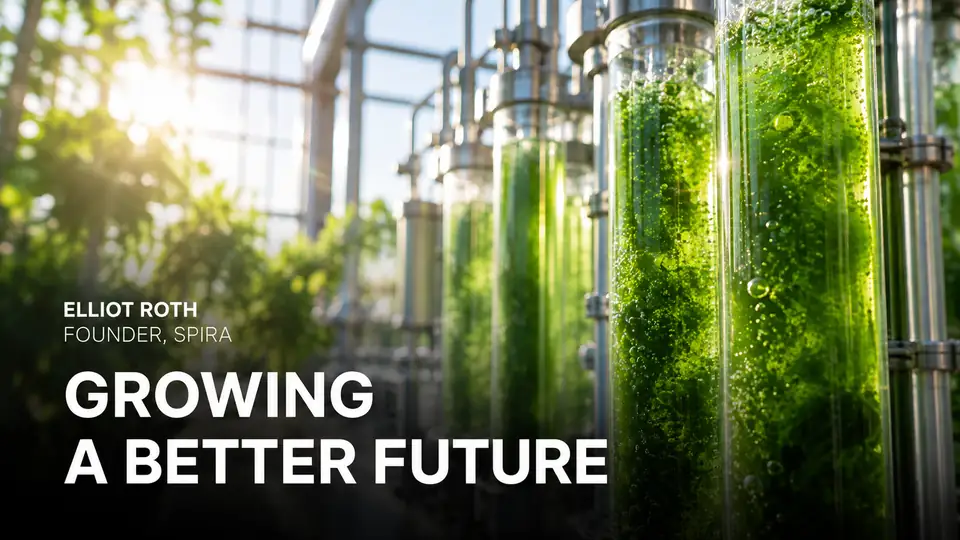



About the episode
In this conversation, we talk with Elliot Roth the CEO of Spira. At Spira, they are currently farming algae, with a goal to produce the basic materials and goods needed locally, to replace the many chemicals and animal compounds currently being used in our foods today. We cover the importance of algae as a sustainable food source, what the future of food looks like, Elliot's NASA simulation, and more.
Links
Chapters
Times follow the podcast audio. The video’s timeline may be slightly different.
- 00:00Welcome and introducing Spira
- 03:13What makes algae useful
- 04:13Starting with colors and blue pigment
- 09:21Using the protein as well as the pigment
- 13:02How algae is grown
- 17:14A lunar simulation and scarce resources
- 22:24Photosynthesis and the future of production
- 24:22Imagining other planetary environments
- 32:25Science fiction and finding inspiration
Read the conversation
Open the full transcript
CAMERON WIESE: Welcome to the Build the Future podcast. My name is Cameron Wiese and I'm your host. I've always been fascinated by the ideas and the sentiment that drove American culture in the 1960s with the space race. A culture galvanized to dream about the possibilities of tomorrow. Whether it's food, transportation, cities, biology, or anything else, it was this cultural mindset rooted in optimism, that the world tomorrow would be better than the world today. A mindset where people were compelled to build things, and I quote JFK, not because they were easy, but because they were hard. It's this desire to build and to dream that seems to have been lost, and it's something we're here to bring back. With Build the Future, we're here to promote the ideas and stories of those who see how the future can be better, and promote their plans to get us there.
CAMERON WIESE: It's our mission to get you to dream about the possibilities of tomorrow. Dream about the future that you want to live in, and inspire you to go build. Today, we're talking with Elliot Roth, the CEO of Spira. At Spira, they're sharing the future of food and agriculture by developing algae-based ingredients that can replace artificial and animal-derived food and beverage products. Let's jump right in. Elliot, thank you so much for being here today. I'm excited to have you on Build the Future to talk about Spira. I want to kick off with the basics. Can you tell me about the future you're building at Spira? What's the vision?
ELLIOT ROTH: Yeah, so at Spiro, we really envision a world in which you can produce the basic materials and ingredients that you need locally, effortlessly. And so that ranges from replacing anything that we make currently with petrochemicals, all the way to animal compounds and the plants that we end up using for the basic ingredients that we put in everything around us. And so we're building a biomanufacturing platform for the future, starting with colors and then moving into animal proteins and other things. And we do that by working with a network of farms globally. We have 32 farms in, I think, 11 different countries right now that produce the raw material ingredients that go into the foods we eat, the cosmetics we put on our skin, and the clothes we wear.
CAMERON WIESE: Sweet. So what are you farming?
ELLIOT ROTH: So we are farming algae. Algae is kind of the most basic organism and microbe that you probably farm four billion years ago, it actually gave rise to the first great extinction event in Earth's history where algae developed the ability to photosynthesize. And so you had all these cyanobacteria, these kind of green aquatic organisms start absorbing energy from the sun rather than absorbing chemistry like the chemicals in the ocean around them. And they started producing oxygen. That's actually what gave rise to the majority of the oxygen we breathe nowadays. And that's what power is the majority of what we use and consume in the world It comes from photosynthesis that giant nuclear ball of energy in this in the sky
SPEAKER UNCLEAR: So you're farming algae. What's so what's so cool about algae? Like what does this do for us today? Oh, yeah
ELLIOT ROTH: Yeah, tons. So algae is a industrial powerhouse really it's kind of you take these single-celled organisms and And using the coding script known as DNA, you can kind of tinker with them to get them to produce all sorts of different things. And what's incredible about them is that you can farm in these open pond systems out in the middle of nowhere. They require, you know, I think up to 50 times less the amount of land, energy and water than you would have something like soy, which is conventional common crop. and they double daily, really requiring only water, air, light, salt to grow. And so they're hugely densely packed with nutrition, with valuable materials and ingredients. And you can farm them in non-arable land in regions of the world where you receive like 350 plus days of sunlight and almost no water.
CAMERON WIESE: And so, okay, so then what are you able to use this for? All right, so what are you guys doing at SPIRA with the algae?
ELLIOT ROTH: So at SPIRA, what we're starting with are colors. So because algae is a photosynthetic organism, that means that it uses pigments to actually grow, it produces the things that it needs to survive in last. And so here I'll show you an example of one of the pigments we have. This is electric sky. There you go. And so electric sky is a natural blue pigment. It's produced as an extract of spirulina algae. So you can see it right there. It's also an edible pigment. It can be used in anything from Gatorade all the way to blue jeans. and it has no taste. So it can be combined in virtually any food product nowadays. Replacing blue dye number one and then blue dye number two is what we're working on.
ELLIOT ROTH: So that's a full range of any of the blue things that you see around you. Right now, it's currently made with petrochemicals and oil-based ingredients. And so those oil-based ingredients contribute to carbon pollution. They're carcinogenic, toxic. They're not great for your health or to the environment. So we're working to phase out any of those artificial colors, which are used in food, cosmetics, textiles, paints, pigments, dyes, using algae. And so we've been working on a blue in 2021. We're slated to release a red dye and then following up with a yellow dye and a brown dye to try to get the full spectrum of color.
CAMERON WIESE: Yeah, because right now they're carcinogenic, right? it's primarily what's used in any sort of food coloring for any sort of processed material, right? Give me a little bit more of a picture of the landscape of like where these dyes are used right now and kind of why that's problematic.
ELLIOT ROTH: Yeah, yeah, so the majority of food colorings and like they're generally recognized as safe by the FDA and been used for decades now, but that's also because we use like teeny, teeny, tiny amounts of dye in our food products, but they're in everything, right? And in particular where this is really prevalent are in children's foods. And so you see all these colorful food products for candy, for cereals, for beverages. And this is what kids are eating on a day-to-day basis. And the majority of them come from like benzene derivatives where they're actually like extracts and leftover oil gunk. And so when you walk around after it rains you see that rainbow shimmer on top of asphalt. A lot of that is like leftover oil gunk and oil spills that end up being used in the foods that we eat.
ELLIOT ROTH: And so very, one of the more pertinent things is most of the major multinational food companies claim that they're phasing out artificial colors. And you can get like red from beets and orange from carrots. But when you're looking for blue, there's practically nothing in nature that is actually blue that is like as a pigment is blue, like blue jays or butterflies or other things like that. Number one, it's really rare. And number two, it's just structural color. It isn't the actual pigment, pigmented color that goes into that.
CAMERON WIESE: Yeah. So how are they thinking about replacing it?
ELLIOT ROTH: Yeah. Yeah. So right now there's, there's very minimal option except for algae, which is part of the reason why we're pursuing algae as a replacement for blue dye.
CAMERON WIESE: Okay. So that's the, kind of the key starting point is all these, all these food companies there, they've made commitments to phase out their artificial dyes. Probably because of public, uh, perception. Backlash. Backlash, yeah. And so you found an opportunity to service BlueDye.
ELLIOT ROTH: Yeah, it's a very, it's a high value in low volume industry, right? And so as a synthetic biology company, we're already turning a profit. And that's something that not many synthetic biology companies, I think any of them can say right now. And so we're a really small team. I mean, there's only four people on my team, but we're working every single day to deliver ingredients to waiting customers. And that's been really rewarding seeing our products go up on the shelves and like grocery stores, supermarkets, direct consumer deliveries, other things like that. And constantly working on the back end of product innovation to figure out new ways to use our dye in products all the way from like sports drinks to denim and fabric dyes.
CAMERON WIESE: Can you talk about any of the products that people can go grab today that are using your blue dye?
ELLIOT ROTH: Yeah, some of them are, we're unable to say these are white labeled products, but we've done kombucha, we've done juice, we've done smoothie bowls, we've done all sorts of different beverage products, we've done alcoholic drinks. We're starting to work on cosmetic products like nail polish, eyeshadow, different kinds of eyeliners, lipsticks. We've started expanding into textiles, so cotton, wool, different kinds of dyes there. And so we're really building out the use case to use our algae based dyes for Virtually anything that you can think of in terms of product lines
CAMERON WIESE: This is sick because most people don't think that like there's anything like algae He's not for like blue dyes Like these are everywhere right there because they're in the shirts We the clothes we wear your shirt and I was red like from a red dye, right?
ELLIOT ROTH: Um, so it's it's spending on that though Like so here's the interesting bit like the pigments are just one part of the algae, right? Have you ever heard the phrase, like using all parts of the buffalo? So we're doing the same kind of thing. The majority of what we grow is protein. And so we came up with this new technique of gently extracting the pigment, and you're left with this alternative protein that's great as egg replacement, a cheese replacement, and meat replacement. So it's really great for the plant-based foods industry. And so any of our product lines, any of our algae, produces a particular color. And this is grown by farmers in developing countries. So we help support the farmers absorb tons of CO2 from the environment and then replace these artificial or animal based ingredients. And so for our first product line, it produces that blue color that you saw. And then we're working to produce more and more of this alternative protein ingredient should be really great for a cheese, egg and meat replacement.
SPEAKER UNCLEAR: As far as commercializing the protein stuff goes, is it similar to what you're doing with the dyes? you're just going, you're going to companies who are, who are leading charge manufacturing these things saying, Hey, we have a better solution for you. Or we have an option. Because like, I imagine all these companies that are doing the plant based meats, like they have their own sort of method for driving the protein. Like what's that look like? What's interesting right now is
ELLIOT ROTH: the landscape for plant based foods is all different companies do get out. So you have like beyond meeting possible foods, pretty much going head to head for branding. And it's all the branding and marketing exercise, like who can spend more on Google advertising or, um, you know, end caps at Safeway or something like that. Right. And so, um, at the end of the day, whoever is supplying them is really winning out. And so Impossible Foods right now is using, uh, soy protein and like a combination of other proteins. And then Beyond Meat is using key protein. And for the suppliers, the suppliers are really able to sell them huge amount of protein all at once. but the demand is really endless right now. So like Raquette is supplying in Beyond Meets S1, they had to declare who was supplying them and whether or not, and it was kind of a risk because they're spending maybe 50 to 70 percent of their unit economics on just protein, pea protein from Raquette, from one solitary supplier. And that's just because they have the scale. Now, when I'm talking about algae, algae can reach that scale in a very short amount of time. If you consider like a meter by meter by meter cubed, or like 1000 liters, maybe about the size of a kitchen table, if you take that volume of algae, over the course of three months, it'll double to be the size of the world's oceans. And that's that's in terms of volume metric and density and like protein content. And granted, like, this is not like, like slime that takes over the world. Well, maybe, fingers crossed. Yeah, but it grows in very specific conditions. And so we can grow that in areas like the
ELLIOT ROTH: Sahara desert or the Salton Sea in California, really in the middle of nowhere, and have that pull down tons of CO2 as a means of growing, and then turn it into something really useful like an alternative protein source. Oh, and it doubles every single day, meaning that it can out produce the kind of proteins that we use conventionally like. So that's the future that we're shooting for. And especially when considering local production, that's the kind of thing that I'm really interested in. So we have farms all over the world and we're really working towards enabling access to nutrition anywhere effortlessly to make it so that these local farms in places like Burkina Faso, Indonesia, India, rural regions of India, where they may not have access to like protein, especially, it's really hard to get, they're able to get access to local protein sources and produce the things that they need on the ground on site.
CAMERON WIESE: Yeah. So what does it look like to like for them to do this on the ground on site? What's the process from like taking this algae and turn it into consumable protein?
ELLIOT ROTH: Yeah, so it's produced in these like big open green ponds, right? So all it really takes is you dig a trench that's about it and then you line it with something so that it doesn't it doesn't like filter into the groundwater or anything like that and You then douse it with particular salt particularly baking soda in this case is one of the main components that goes in and it It grows at a pH of 10 to 11. So it's really resistant to any kind of contamination. You wanna make sure that it's covered in some kind of way so dust doesn't get in or other things don't get into the waterway. And then you just grow it. You just put it out in the sun and it grows.
ELLIOT ROTH: Kind of it, you gotta mix it or agitate it using like a little paddle wheel. But it's really, really dirt simple to grow. It's hard to grow in an expert level. And some of our farmers have been doing this for decades now. And so I think some of our farmers have had ponds growing continuously for over two years, easy, just constantly, and harvesting like a little bit every single day or every single week. And then this type of algae, spirulina, has been farmed for hundreds and hundreds of years. There's records going back all the way to the time of the Aztecs. When the Conchistadors wrote about the Aztecs farming, tequato is what they called it, but it was stone excrement is what they called it. But it was basically, is this green stuff that they were pulling off the lake, Lake Texcoco in Mexico City, and it helped form the largest city in the Western hemisphere during that time that the Aztecs had, because they didn't have to worry about access to protein.
SPEAKER UNCLEAR: They had this insanely protein dense resource right around them. In fact, even one of the Kenembu tribe, the Kenembu tribe right around Lake Chad, one of the only tribes in the region of Central Africa that doesn't suffer from micronutritional deficiencies because they're consistently consuming spirulina that they dry out into little cakes that they call it de-heat. Part of the reason why I came about it is that I was looking into ways of feeding myself and NASA was exploring the use of spirulina as means of feeding astronauts in space. Okay, tell me more about that. Well, yeah, I'm a giant space geek. And before the show, we were kind of talking a little bit about some of my space experiences. And when I was first getting started, I was doing some consulting work.
ELLIOT ROTH: I just graduated a degree in biomedical engineering and I didn't wanna move into my parents' basement, like so many of my millennial friends. And so I was doing consulting work, but I had some clients that never really paid me. And what I figured out was, I built a lab in undergrad with my co-founder, Serge, and we were playing around in the lab. And I read an article from NASA that had said that they were growing algae for astronauts because it's something you can grow in a tiny space for no resources and it can provide for most of your nutritional content. So it was like, okay, I grabbed a couple of aquarium tanks from friends that had them lying around and I started growing. And I survived on a diet of spirulina and whatever food waste I could find for like two and a half months. I was paying less than $30 a month. So less than a dollar a day. I was living on for two and a half months and it made up the majority of my protein content because it would take scoops of it out and eat that.
CAMERON WIESE: So you're just like dipping a spoon into this aquarium of algae that you've, I'm just trying to picture this.
ELLIOT ROTH: That's how you're more involved, right? So think like green bubbling tanks in a mad science garage laboratory. And what I would do is I would take a little nylon filter and I'd filter it out. I'd wash it a little bit to wash off all the remaining salts and then it would take a big spoonful and scrape that filter and just eat it like yogurt and it's kind of like blended avocado. It's got this like dark green nature to it but fresh algae has no taste whatsoever to it. It's only when we process it and break it down that starts having those like bad umami kind of like bitter notes to it. And so I realized that the main component of flavor after like a little bit of research was the pigment itself. So you pull out the pigment and you're left with this like neutral tasting protein extract.
ELLIOT ROTH: And so that's kind of what my company's been working on now. We pulled out the pigment, we're selling that as a replacement for blue dye. And we have this leftover protein that's really great as a replacement for animal proteins. Well, what's cool is it came full circle recently, right? So my family, I used to take winter trips down to Florida because my dad grew up on Space Coast. And so he and I would launch rockets as a kid, and I would hang out around Kennedy Space Center and things like that. So I was obsessed with space and more recently I got a chance to participate in a NASA affiliated experiment at HI-SEAS which is a lunar simulation mission. So I got to live for the thanks to like the International Moon Base Alliance and my fellow team there. Got to live on the side of a volcano in Hawaii where we were living in a simulated moon base. And so for two weeks I lived with five strangers and kind of experienced everything that the moon had to offer where we were having the weirdest quarantine experience. I was inside this 35-foot diameter dome and kind of growing algae as means of absorbing the CO2 and turning it into edible food and working with the team there as means of trying out different experiments. And then we would wear spacesuits anytime we went outside to investigate lava tubes in conjunction with NASA Goddard to investigate how people might live in these lava tubes on other planets. What surprised you the
SPEAKER UNCLEAR: most about that experience? What surprised me the most, and this is extended into my life when I got back, is the amount of resources we take for granted and the kind of scarcity that you have in an environment like that. And so not only was there scarce water, we only had 250 gallons of what we could bring with us. We also had composting toilets and no flush urinal and things like that. We had to be very, very conscious of water consumption, power consumption. We had a couple of days where there were dust storms and we had to go into low power mode and make sure that we turned off most everything. The other things that I was really surprised by is air. So the CO2 pump was caught on the fritz the first day we were there and the levels of CO2 got elevated up to 1,100, 1,200 PPM.
ELLIOT ROTH: And then in our rooms, because they were like these closets, basically, they were even higher than that. And so it got slightly dangerous with those elevated levels of CO2. And what's astounding is how much we take those sort of things for granted, you know, a food, especially the food up there, we only could have freeze dried food. And so we had a lot of pasta, we had a lot of like, freeze dried fruit, things like that. Yeah, it was that that was the challenging bit. But what was surprising was how well the team bonded and how cohesive we were. Because we really came together like a month before and nobody knew each other. So it's always surprising the interpersonal dynamics. And I think part of it is a testament to sort of team building and interactivity we had and how we got to know each other. And how each member had a specific role in the team itself too.
SPEAKER UNCLEAR: One of the, just commenting on the water scarcity, I was talking with Um, Samuelian Rosen who runs something called fine tap. And we're talking about how we in the developed world, like water is a commodity. We just take it for granted. It's like, Oh yeah, I just flush my toilet, make my shower running like whatever. But in other countries, like the relationship with water is not like that. It's not this free, abundant, unconstrained resource. And so it'll be interesting to see how that, that develops, but it is really, like that's just an important thing for people to realize too is like one of the, I ran
ELLIOT ROTH: 12 experiments while I was there. And one of the experiments was around water absorption. And so it was a condensation unit from a company called Spout, which is one of the other companies in Mars Bios portfolio, one of our investors. And Rubin, their CTO, ended up fixing it up for me. So it was low power for the moon-based environment. And it absorbs moisture from the environment by condensing it, right? And so there were certain days when the weather outside was like the temperature difference from the outside to the inside and made it so there was condensation on the walls and we had to have water dripping into our electronics. And so it's really good to reclaim all of the resources that you have in that kind of environment because they're so scarce.
CAMERON WIESE: Yeah, that would be great having water just leak into your electronics and a little, especially up there, far removed from the rest of society.
ELLIOT ROTH: That's what's kind of great about biology, biotechnology, synthetic biology to me, is that you have the ability to use microbes to reclaim, recycle, reuse, reduce, more effectively produce the basic things that we end up using. And it is astounding that you have these tiny self-replicating Von Neumann machines that are able to reproduce to massive amounts in a very short amount of time to harness that energy for the benefit of the world. And that's kind of what my thesis of work revolves around, is solving people's basic needs like food, water, shelter, using microbes and these tiny self-replicating machines, the nanotechnology that actually works.
CAMERON WIESE: Yeah. Tell me more about how you see the feature of the space evolving. What are we at now with
SPEAKER UNCLEAR: synthetic biology and where's it going? So synthetic biology has been kind of capitalizing on this trend from we've had animal-based production, moving to petrochemical-based production, and then finally, now we're moving to fermentation-based production. And I think that there's even a step further because fermentation based production still relies on sugar as a basic nutrient, as a basic material. And so when you look around the Midwest, you have Iowa has about 30% of the total area of Iowa is corn. And that corn then goes to feed like biofuel processes or feed animals. And it's a secondary process. And so I see us moving to using photosynthesis and trying to get as close to the energy of sunlight as possible to convert that into usable resources. And so right now you have a lot of synthetic biology companies setting up big fermentation plants.
ELLIOT ROTH: I see us eventually moving into using photosynthesis, reversing the effects of climate change, producing carbon negative ingredients, and doing that locally so that you have some sort of like at home bioreactor, photobioreactor on your desktop. It's able to produce the basic ingredients and basic materials you need. So we get into that post-scarcity Star Trek feature where you can press a button, say, Earl Grey Tea Hot, and have it show up for you.
CAMERON WIESE: Right. But instead of it being like an atomic assembler through some sort of mechanical means, it's an organic composition.
ELLIOT ROTH: Yeah, I think it is taking advantage and taking an eye towards using what biology has already created for us. Like when you look into the biological realm, there's tons of information and dense materials there to mine and kind of utilize to solve problems. And so you have all of this little nanomachinery that already does that for you. So when you're looking for like that molecular assembler or something like that, you have that existing in biology. Why not take advantage of that?
SPEAKER UNCLEAR: Absolutely. I want to kind of jump out a little bit. It seems like one of your interests, futuristic interests is terraforming. It's from my understanding. Tell me a little bit about why that's exciting to you. and when are we actually going to see any sort of terraforming happen? How do we get to that point or we're terraforming planets or our own environments? I've written about this a bit,
ELLIOT ROTH: and I'm a self-stylized synthetic astrobiologist. I really like thinking about ideas of molding planets and first understanding them and understanding what microbial life is there, and then working to change and adapt them so that they're more suitable to the life that we know, and potentially life that we end up creating. We're moving from, it's interesting, we had this idea of creation as an ethos where God created the world and then we moved into this evolutionary track and now we're getting into this Anthropocene where it's humans creating the world, right? So I see this ability of people of inducing panspermia, of spreading life to various regions of the universe by creating microbes that are able to go about stepwise, is going through this eco poetic method of evolving planets.
ELLIOT ROTH: And so in particular, I think what we're doing in terms of going to Mars is we're going the wrong way, to be honest, I'm a Venusian at heart. When you take a look, so when the news came out about the signature of like phosphine in the upper cloud cover of Venus, I was like vindicated because for the past couple of years, I've been rallying against the idea of going to Mars because there's nothing really there, it's cold. It's like if you wanted to go on a trip to Antarctica versus going to Miami, right? Like which one would you rather go to? Depends on the person, sure. But like you really want to kick back and enjoy a my time at beach in Miami rather than having to suffer the cold snowy depths of Antarctica in winter, which is what you would experience on Mars.
ELLIOT ROTH: And my background right now is like an NSF McMurdo base in Antarctica. And it's a place that I do want to go to eventually, and I'm working towards trying to figure out how to get there for discovering and bioprospecting rare species of algae. But I digress, I think Venus is one of those places in the solar system that 50 kilometers above the cloud cover is earth temperature and pressure normal. It's one of the only areas in the solar system that's like that. And then because the CO2 density is 95 atmospheres of CO2, a regular air mix can actually float on the clouds. And when you're in the polar regions, the air currents are such that you can actually like sit there for long periods of time in a balloon and enjoy eternal sunshine.
ELLIOT ROTH: And you have that CO2, which is great for plant growth, and then the hydrogen, the sulfuric acid in the atmosphere can be converted into water. And so it really is like a wonderful environment as a means of producing all the various components and necessary things that humans need. We just need to change our mindset about terraforming in the sense of making it earth-like. I think it's so much better for humans to adapt to the universe. It's just like in life, what you do is you, if you set out on doing a task and you're not well suited to that task initially, you adapt and learn and grow to that task. I think it's really wrong, wrong-minded to say, let's change the environment to adapt to us. Why don't we adapt
CAMERON WIESE: to the environment. So instead of dropping nukes on Mars to change the chemistry of the planet and
ELLIOT ROTH: heat it up and yeah to fly around in the internal sunshine and clouds of Venus sounds pretty good to
SPEAKER UNCLEAR: me. So what does that look like? Is that like airships or you know like international space station sort of things like the Stanford Taurus is kind of floating in the that part of the atmosphere in Venus.
ELLIOT ROTH: Yeah. Well, so NASA just released a couple of requests for proposals on airships for exploration of Venus, like long duration airship missions. And so stuff like that is on the horizon. Yeah, I can see a space station where it's easier to get to. It's a shorter, it's a longer launch window as well to get there, easier resupply. You don't have to land on any surface. You can aerobrake as well because there's more atmosphere there. It's a hell of a lot easier to get to and resupply and visit than a place like Mars. And initially, I do think that we are going back to the moon. It's really intriguing that we're going back to the moon. And a lot of our technology that we're working on at SPIRA and any genetic engineering of microbes, especially photosynthetic microbes, would be well-suited in these space-based contexts.
CAMERON WIESE: Two questions. Like, what excites you the most about the future of space? And then more broadly, what excites you about the future outside of the work you're doing at SPIRA? Yeah.
ELLIOT ROTH: So something that really excites me about the future of space is being able to find use for that environment, the microgravity of space for an earth-based context. I think that there is inherent value in different environmental contexts, not only tourism, but looking beyond that, like what are some things that you can do in space that is hugely valuable for life on earth, whether it's bioprinting organs, if it's electro spinning fibers for better fiber optic cables, things like that, that would enable life on earth to live much, much more effectively and better. I also see the movement of humanity to other places in the universe opening up doors in our perceptive ability and our evolutionary ability of looking beyond what our current human team is to be able to adapt to the different places in the universe. So what was your second question again?
CAMERON WIESE: The second one was outside of space and the work here in Spirit, what excites you the most about
ELLIOT ROTH: feature. Yeah, yeah, tons. I mean, there's, there's definitely, what's interesting is that chaos of the modern era breeds tons of opportunity, right? And the some of the things that I'm taking a look at are related to the work experience, the way that I see my work is a steady progression over the next like, couple of decades of being able to build a series of companies that tackle real global world problems. And all of them tie in together. So ranging from a couple of the explorations and ideas that I've been working on in the background on airships, working towards different sorts of launch systems for sending things up into space, seasteading, which is a community that I'm really involved in, enabling and opening up opportunity indoors to gene therapies through novel methods of gaining access to that kind of technology, working on mitochondrial engineering, and then trying to understand various elements and things that we can produce using photosynthetic microbes.
ELLIOT ROTH: All of these are organized in kind of like an ontology, sort of context and progression, where I'm very, very excited about the future that me and my teams are building. And I'm really excited about some of the things that I'm seeing evolve into the world and the communities that I'm involved in.
CAMERON WIESE: Is there any question that you don't often get asked that would trigger something you'd like to talk about?
ELLIOT ROTH: A question that I really enjoy that I don't think is asked enough. Like I go to a lot of networking events and it's always like, look at me, look at this thing that I'm building. It's amazing. And like a ton of like I and me statements and I don't really, like that's okay. But it's more so like, look at this cool thing that I'm building. I think a question that should be asked more often is what do you do that's only for you?
CAMERON WIESE: Let's roll with that then. What do you do that's only for you?
ELLIOT ROTH: I love writing. Oftentimes I end up writing and doing that as a means of gaining personal fulfillment and enjoyment. Some of the other things I do, just creative work ends up really fulfilling me. I moved to Los Angeles partly because there's a burgeoning biotech community here. There's this awesome connection to the space industry. But the creative aspect of me really finds fulfillment in coming up with stories and telling this kind of narrative of imagined worlds. And so I read a lot of science fiction, I write a lot of science fiction, and those are the kind of things that I do that's just for me.
CAMERON WIESE: What science fiction have you read that's kind of shaped your perception of the world the most?
ELLIOT ROTH: I would have to say Kurt Vonnegut is my favorite science fiction author, like hands down by far. His books, ranging from like Galapagos to the Cybrens of Titan to Sliderhouse Five, it is just like, it hits you really deep in the feels, you know? And it enables you to think outside of your own mind of what the world could be like. And something that I'm really trying to angle towards more often is a genre of fiction called biopunk. And it really helps resonate with the biohacker ethos that I'm really all about. I get involved in a lot of biohacker, DIY bio, community bio laboratories. And so being able to convey that in a really positive light as opposed to a negative light is awesome.
CAMERON WIESE: Love it. Where can people find you and how can they support you in the mission you're on?
ELLIOT ROTH: Yeah, yeah. So check us out at Spirit Inc. So on all social media platforms, S-P-I-R-A-I-M-C, you can reach out to us at info at spiritinc.com. Check out our websites. We have a number of products out there too, so be sure to order some, test it out. If you know somebody interested, hook us up and tell a company about us or a friend. If you want to get engaged further, just reach out to us. And for me personally, you can reach out to me at that Mr. E T H A T M R E all social media platforms and my email, Elliot E L L I O T at spirit, Inc.com. Cool. Elliot,
CAMERON WIESE: thank you so much for coming on. I'd love to have you and I'll talk to you soon. Thanks for joining us for another episode of the build the future podcast. Lastly, if you're building and want to get support, want to hear about certain topics or from certain people. We just want to get involved in helping Build the Future. Shoot us over an email at hello at buildthefuturepodcast.com or follow me, Cameron, on Twitter at camweecy and we'll see what we can make happen. That's it from us. Until next time, go build!
More episodes
All episodes Courtney Boyd Myers — Akua & KelpCourtney Boyd Myers describes her path from journalism to co-founding AKUA and explains why she chose kelp as a food ingredient.
 Justin Kolbeck — Wildtype & Cultured SalmonJustin Kolbeck explains how Wildtype approached scaling cultivated salmon beyond its first pilot plant.
 Jason Green — Vertical Farming & FoodJason Green describes Upward Farms’ approach to growing leafy greens and fish together, and makes the case for regional food production.