

Build the Future Podcast
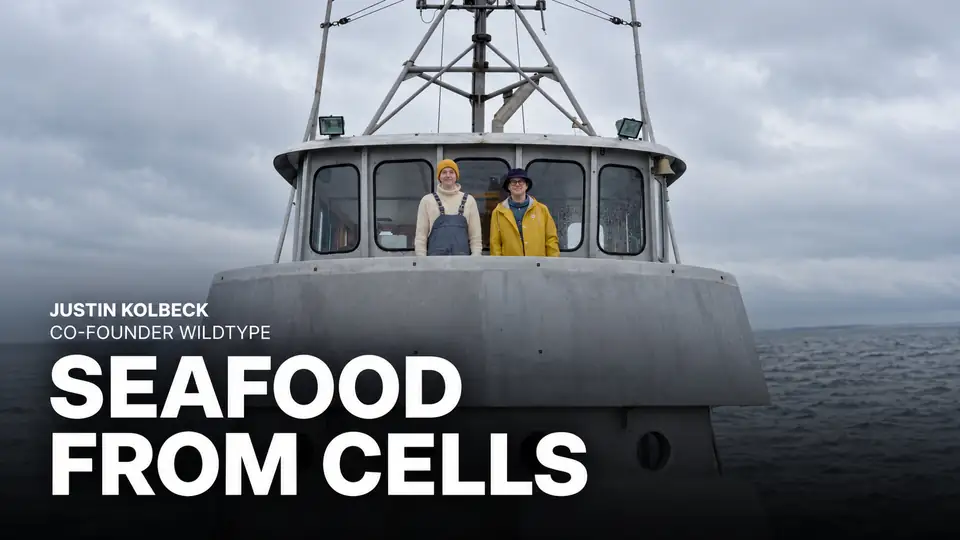
Justin Kolbeck — Wildtype & Cultured Salmon
Justin Kolbeck explains how Wildtype approached scaling cultivated salmon beyond its first pilot plant.
October 12, 2021 · 46 min



About the episode
In this conversation, we talk with Justin Kolbeck, the CEO of Wildtype. At Wildtype they're advancing the future of food with cellular agriculture, starting with Sushi Grade Salmon.
Links
Chapters
Times follow the podcast audio. The video’s timeline may be slightly different.
- 00:00Introducing Justin Kolbeck
- 00:33Building the team and planning production
- 02:31Inside the pilot plant
- 04:41Transparency and more seafood choices
- 07:52The early history of cultivated food
- 11:28Sustainability and affordability
- 12:54Taste, nutrition and realistic expectations
- 14:44What food can learn from electric vehicles
- 17:27Parenthood and the food system
- 19:50Alternatives and conventional farming
- 23:02Scaling production and lowering costs
- 26:56Local food production and food miles
- 29:44Food access and distributed production
- 31:16The regulatory conversation in 2021
- 32:53Cell-culture inputs and cost
- 35:25Possible feedback into biomedical research
- 37:44Reliable information and the next generation
- 40:27Technology, trust and shared goals
- 43:12Changing consumption choices
- 44:26Where to find Wildtype
Read the conversation
Open the full transcript
CAMERON WIESE: Welcome to the Build the Future podcast, where we host conversations that promote positive and exciting visions in the future. Today, we're talking with Justin Kolbeck, the CEO of WildTech. At WildTech, they're pioneering the future of food and cellular agriculture, starting with the development of sushi-grade salmon. Let's jump right in.
CAMERON WIESE: What was the most exciting or best thing that had happened to you the previous week? And I'm curious now since last week, what's been really exciting for you personally or with the company?
JUSTIN KOLBECK: It's funny how each week brings a new thing to get really excited about. So when we caught up last week, I think I was most pumped about a couple of folks that had said yes to joining us. Obviously, for any company that has any kind of technology, it's all about the people and what skills and inquisitive minds they bring to the job. And these couple of people that we were chatting about last week, I was super excited about. And one of them is starting in a couple of weeks, so I'm really pumped about that. Today, just before this one, I just got off a call with an engineering firm helping us plan out. So we built the first cultivated seafood pilot plant in the world, and we're on our fifth batch of Wildtype 7 coming out of there, which is exciting. And we're already planning for our next one. And I'm talking about very large scale, kind of right now where we are in the design phase is carte blanche. Like let's say that we could find the perfect building in this country in the US to build super large scale production for what we're doing. What would that look like? What's the
JUSTIN KOLBECK: power requirements? And basically laying out exactly sort of what 2015 wild type production looks like. So I think part of a founder's job is to live in the future many days of the week. Obviously, you've got to keep an eye on the present, execute and deliver on what you need to do today, but also I feel like we would be shortchanging ourselves if we just focused on this quarter's goals or this year's goals and weren't thinking several years in the future. And I think when the rubber hits the road on design and engineering for something that's that far down the track, in this case four years, it's just really exciting. So that's what's had me super pumped this morning.
CAMERON WIESE: So this is kind of expanding on the factory you'll have on the website. So people go to wildtypefoods.com, they can see the most recent announcement, the first cultivated pilot plant. So that's where you're looking to expand, to do multiple ones of these.
SPEAKER UNCLEAR: Is that right?
SPEAKER UNCLEAR: Yeah.
JUSTIN KOLBECK: So the one that we built in San Francisco on a microbrewery footprint, still work in progress obviously. We're working out of it now, we're creating Wild Type 7 there, but we're getting more capacity brought online over the next six to nine months, let's say, but that's going to cap us out. It's still an important, but I think a very, it's certainly in the scheme of seafood production globally, a very small amount of capacity. And that wasn't really the intent. We weren't trying to meet some large percentage of seafood demand from this little plant in San Francisco. The idea for this one was to show that, hey, in the middle of a city, a busy city like San Francisco, in an industrial building, in a place where you can find chocolate factories and other things in an actual food industrial building, we can build this next generation seafood production plant. And you can come try wild type salmon at our little tasting room, which is almost done. I'm excited to say. And then look through a glass door and see how it was made. And so it was intended to serve a couple purposes.
JUSTIN KOLBECK: One, give that level of transparency. I was just talking about let people literally see where their food comes from, which is something that's pretty hard to do these days, unless you live on a coastal town and are eating fish fresh off the boat. But also for us from a technological perspective to iterate and test things very quickly. So we designed the facility to allow super rapid iteration cycles because nobody's ever done this before. So it's not like we could just open up a textbook and say, Oh, here's how you grow cell culture seafood at a very large scale. And so we didn't want to build a really large production plant without having proven that it works at a medium scale, which is what we've done. So the next facility really is about large scale production, economies of scale, things like that.
CAMERON WIESE: One of the things I'm most excited about is the ability for people to walk into the plant and try the food and see what's going on behind the scenes. Because as you mentioned, we don't know where food is coming from. You go to the grocery store, and you're completely abstracted away from the entire supply chain that exists. And I think like the future is clearly moving away from that. If we play this out, how does this kind of scale manufacturing of cultured seafood like shift our like consumption landscape? Like what kind of world are we gonna be living in? Like what are the implications of this on, well, I will dive into like implications on cities or transportation or anything like that. But I guess let's kind of talk about the shift in like consumer behavior when people are able to see where the food is actually coming from and then how that scales up?
JUSTIN KOLBECK: Yeah, it's a great question. And I think at least the way in which we view the world is it's going to be a world of more choice. So today in seafood, you have the choice of either a wild-caught or farmed seafood. And as you pointed out, there are some real challenges with those. There's Ben's article after article written in The New York Times, The Guardian, et cetera, showing if you do a DNA test on a piece of random piece of sushi that you get in a New York sushi restaurant, let's say 45% of the time or 50% of the time or something or even greater than that, it's actually something else. So you're getting a mislabeled piece of seafood, which might be a problem if you have a specific seafood allergy, let's say, or at a minimum, why did that happen? Why is that the case that we're eating something that's mislabeled? That's not great. But I think the problems go a little bit deeper, which is certainly seafood is one of the only things where we just accept flaws in the food and it's about minimizing them. By flaws, I mean
JUSTIN KOLBECK: contaminants like mercury and microplastics and antibiotics and parasites, which by the way is why you have to flash freeze seafood in many states here in the United States for sushi purposes, just to make sure that those those get killed. And so not to mention the environmental and biodiversity implications of seafood consumption, which are massive. I'd be happy to talk about those if there's interest. But coming back to your question, I think in the future, not only will we have farmed and wild caught seafood, but we'll have plant based options, we'll have self cultivated options like what we're making. And I think in general, there's been a big consumer push toward more sustainable food practices. And most of the people in the fishing industry, both on the aquaculture and the wild catch side, are really interested in trying to protect populations of fish, protect biodiversity, keep our oceans healthy, because I think we all know that if we don't have a healthy ocean, we're certainly not going to have a healthy planet. We'll have a much warmer, much
JUSTIN KOLBECK: less hospitable one. And so I think in the future we'll have not only the new options that ourselves and some of our sister companies and certainly the plant-based folks as well are working hard to create, but also the conventional seafood options that are going to be on the menu will be more sustainable. And I think that's a really great reason to be hyper optimistic about the future of food.
CAMERON WIESE: Yeah, I think it's so cool to see kind of the landscape drawing and evolving, because this has been like quick history on the space like you guys started 2015 or 2016, right? 2016. Yep. 2016. Before that, what was the first big company trying to innovate in the space like Memphis meets?
JUSTIN KOLBECK: You know, it's an interesting history, this field. So it actually started, gosh, I'm gonna get the dates wrong, but in the mid 2000s, let's say 2007, maybe I'm guessing, I have to go back and look at the paper, but a researcher on a NASA grant actually grew a chunk of I think it was goldfish or some kind of domestic fish like that ex vivo. So outside of the animal. And the idea was for space crews on long distance, long-term space flights, obviously you can't just go fishing in space. So where are we going to get high quality protein for our astronauts? And so this researcher grew a piece of fish. They didn't eat it. They just sort of smelled it and looked at it and watched how it cooked. And they wrote a paper on it. You can go read that paper anytime. The researcher's name, if I'm not mistaken, was Benjaminson. And then around that same time, an artist actually in France did an art exhibit where he grew pieces of frog ex vivo, not for consumption. I think people ended up eating it. But it was just sort of to get people's minds expanded about what's possible.
JUSTIN KOLBECK: And obviously he was not interested in creating a company out of this. And then most of me in 2013, I believe, or maybe it was 15, again, and dates wrong, were the first now company to demonstrate that this technology works and they made a burger. And that was famously funded by Sergey Brin and other people. And it was very expensive. And the taste qualities were pretty good, but still had some work to do. So this idea has been with us for a really long time. I think people are fascinated with, can we use technology to deliver the same satisfactory, there's just the satisfaction that we get from eating meat and seafood in a way that is less deleterious to our planet. And I think it's that question that really has sat at the heart of this industry since it started. And people are really, really interested to try to make this work for all the reasons I mentioned. I just listened to a TED Talk yesterday where the speaker mentioned, cows alone are responsible for something like 9% of global greenhouse emissions. So how do we begin talking about
JUSTIN KOLBECK: turning the ship on the climate crisis without thinking about the food system? You just can't. Seafood is a massive part of that. Our oceans store 93% of the planet's carbon. We disturb that sediment when we deep sea trawl and release there is a study in Nature last year in March that showed that deep sea trawling contributes as much greenhouse gas emissions back into the environment as the aviation sector, all the planes on Earth. So maybe people should be thinking a little bit more about that trip to Cancun versus, you know, well, let's say, you know, they're thinking like, well, you know, I feel guilty about my vacation and carbon emissions on the plane. But you know, then they're tucking into some really good seafood and not thinking about the implications of that on the planet. So anyway, I think what we're looking for in the really long term history as we sort evolved from these spurts of innovation, let's call them dating back to the early 2000s, is sort of a very mature, very robust alternative to conventional animal agriculture.
CAMERON WIESE: I think it almost can go beyond that. So we think about 20, 30 years out, it's probably going to make a, like, I think the narrative is going to continue to shift and people are going to see that cell-based auctions, plant-based auctions are not only more sustainable, but they taste better and they're healthier for you. And I think like, I can imagine a world where everyone's like, you know what, Yeah, let's just have most of our protein consumption come from these kind of sustainable sources. I mean, and then like you paired it with like regenerative farming, but this whole like industry around big ag and grow it like factory farming is something I think a lot of people are going to look back on with a lot of disgust when we have other options that are that are
SPEAKER UNCLEAR: available.
SPEAKER UNCLEAR: Yeah.
JUSTIN KOLBECK: And I think what what makes this really exciting is that it doesn't have to be this versus that, right? There could be this world where rising tides lift all boats, pun intended, where everything becomes more sustainable. Now the trick is, how do we do that in a way that doesn't lead meat and seafood to be inaccessible to people, where prices and costs are so high that everyday people can't afford them anymore? Or the types of seafood that are most nutritious are out of reach to people. So an obvious answer is, well, let's just make people pay a little bit more for the animal products that they're eating. So they reflect all the costs to the world and to society. But I think there are some real challenges with that affordability and accessibility perspective.
CAMERON WIESE: When you think about kind of the creation of your salmon versus like salmon you get from some river lake and up in Alaska, Is there really that much of a difference in terms of the quality or the nutrients? We have this bias towards things that come from nature are inherently better than things that are manufactured, but I don't know if that's necessarily true in this case.
SPEAKER UNCLEAR: I don't know. What do you think?
SPEAKER UNCLEAR: Yeah.
JUSTIN KOLBECK: I would say getting to a perfect replica of what nature has done on every possible attribute that you could imagine is something at least that we haven't yet figured out. We care about the things that are most important to eaters. So for example, obviously, does it look good? Does it taste good? Do I get the same nutrition or a similar level of comparable level of nutrition as I would from eating conventionally produced seafood? And the answer to all those questions, at least for some of the products that we've made is yes, we're pretty close on most of those attributes, but we're not perfect yet. And I think maybe that's where some of the the media hype maybe has gotten ahead of reality on our field is that the first generation of these products are going to be perfect. There will be some shortcomings. They're not going to be that perfect Copper River salmon is still going to be probably the gold standard that most of us are eating. But let's say that you wanted... Well, first of all, let's say that it's April and it's not salmon season anymore.
JUSTIN KOLBECK: and you want to eat something that's fresh, you just can't get Copper River salmon. It's seasonal, right? So if you're in a sushi restaurant and you want a really high quality, fresh piece of nigiri, let's say salmon nigiri, we might be your best option for that, even if it's not 100% perfect. And I guess the way that I think about this over the long arc is just this year, there was a great Super Bowl ad about this with Will Ferrell. GM announced that by 2035, 100% of their car fleet is going to be electric. And just think about that. That's massive, right? That one of the world's largest automotive industries is going away from fossil fuels, full stop. And the thing is that might feel like a long time from now, it's 2021, but just in the country that has built a car culture, that's a colossal shift that most certainly is going to be very, very planet positive. And so I think that the important thing is that that journey didn't start in 2021 as, let's say, Teslas and other electric vehicles are becoming more ubiquitous. It started with hybrids
JUSTIN KOLBECK: back in 2000, well, let's just say the early 2000s, late 90s, right? I think the first Prius maybe came out in 1997, if I'm not mistaken. And those cars were pretty cool, right? Suddenly, you can get 50 plus miles per gallon when the average car was doing maybe 20. And that was the beginning of what is now, I think, a colossal revolution. The state of California, for example, is saying that 100% of its fleets are going to be fully electric by around the same year. And so I think we're at the very beginning of that journey with alternative proteins. And it might take half a century for us to see the full promise of what this can do. But I think when we look back, as you said, it's going to be impossible to think about our food system without these solutions for no other reason that we're going to have, let's say, 3 billion more people on the planet, all of whom want to eat a lot more meat and seafood. Where's that going to come from? Are we going to cut down more rainforests to graze the cattle necessary
JUSTIN KOLBECK: to get everybody their beef? Are we going to completely denude the ocean of all of its fish? And then what happens to the biodiversity and ecosystem in the ocean? Those just aren't tenable options. So we have to do this.
CAMERON WIESE: And I think like, not to mention, we want to be able to give people healthy and nutritious options as well. And like, if we continue the way we're going, even if we, you know, do end up cutting down more of the rainforest, or, you know, extracting more out of the oceans, like, that we're starting to have other problems that we have to deal with, they're gonna lead to like the foods that we're consuming, not being the best things for our bodies. And as you mentioned, like with the oceans, like microplastics and mercury, like, Those are huge deals that not a lot of people are talking about, which is concerning. We certainly have work to do there, but one way out is, okay, we have other options available that are healthier and then that puts some strain on that industry or on other industries like get their act together.
JUSTIN KOLBECK: I mean, just to make that story real for a second. So I have twins that just turned two yesterday and I remember one of their, I think it was or five month or their six month appointment, their doctor was asking, this is just when they had switched to eating solid foods. And the doctor was asking, hey, are they eating seafood? And I was like, oh, why do you ask? And she was like, well, it's one of the most nutritious things that kids can eat. We recommend that kids eat seafood.
SPEAKER UNCLEAR: And I was like, yeah, yeah, they are.
JUSTIN KOLBECK: Give them salmon and other things on a fairly regular basis. But then she asked me like, how much are you giving them? And I was like, well, this kind of portion. And she was like, well, make sure that they don't eat more than their fist size per meal, or that can only be done two or three times a week because of these contaminants. So on one hand, the doctor's saying like, hey, instead of giving your kids ground beef or sausage, consider giving them this lean healthy seafood protein that's very good for them and good for developmental reasons. But on the other hand, not too much because it's got all these downsides. And so I think that encapsulates the challenge with seafood supply as we find it in the year
SPEAKER UNCLEAR: 2021.
CAMERON WIESE: If we zoom out, what kind of world do you want your two daughters to be living in when they're in their 20s or 30s? If we play this thing out, what does that world look like? I think just kind of anchored in the food system. What should our food system holistically look like if we're looking 20, 30 years into the future? Where are we going with all this?
JUSTIN KOLBECK: Well I think for starters, when they have kids, they should never have that conversation with their kids' physician. that we've somehow at least removed these contaminants from our seafood supply. But going beyond that, I feel like for those of us who pay a lot of attention to the climate crisis and the environmental issues that we're facing down, it's really hard to have a hamburger without a big feeling of guilt. So I love Shake Shack. That's one of my favorite meals to get. I love burger. Danny Meyer's a wizard with his stuff. cheese fries, chocolate shake, but like I feel guilty and I like very purposely limit the amount of Shake Shack burgers I eat. It's like a once a month max kind of treat, right? And so I think it's gonna be really cool when we can have that same experience but feel completely guilt-free. And at that point I think, you know, because there's still a lot of open questions about, well plant-based is great but what about mono cropping and you know is it really is it really
JUSTIN KOLBECK: cleaner and greener. And you know, we're really in the early days. And I can tell you just because I know a lot of founders across both the plant based and the cultivated space, everybody's in this for the right reason, which is, you know, nobody wants to create another production system that repeats the issues that we currently find ourselves in the middle of. So I think there's a great deal of energy devoted to making sure that we're doing the right thing by the planet and by our health and and so on by our communities. And so I think by the time my kids are a little bit older, we will have sort of matured past that. And are we gonna be at the point where we're seeing big jurisdictions get away from conventional meat and seafood altogether? Like for example, a California announcement that there's not gonna be any more beef served at the governor's mansion in 2050, I don't know. Because I think there's a solution, if we can take the pressure off of the conventional agriculture system,
JUSTIN KOLBECK: so there's not this desire to continue to drive down costs to the rock bottom prices to meet ever growing demand, by coming up with alternatives like plant-based and cultivated, then maybe we'll have more ranchers like Neiman Ranch and others that are actually being very responsible stewards of the land and the planet. And those will still be on the menu. So I think, I don't know, it's just, even for me, somebody who spends a lot of time thinking about the future, it's really hard to imagine a world in which there's no conventional animals being raised. It's just, I think, part of our culture here in this country and it's part of our culture in a lot of places, but could that be done back toward way more sustainable practices that are just frankly more enjoyable for the animals and the people raising them? Yes, definitely.
CAMERON WIESE: I've been seeing a lot of cool stuff come out of that like green oak pastures, you know, butcher box, a couple of these like companies that are focused on like grass fed, grass finished beef. And they have kind of like the story of their small farm and there, they have like a supply cap. And so they're not, you know, trying to scale up and like get as much out of the land as it can. They're focused on kind of sustainability and like regenerative practices. And the following around that is mind blowing. People are like, oh, this is so much better than buying my unknown meat from Safeway or contributing to kind of this large factory farm system. Because like, I don't think there's anyone who would argue like what is going on right now? Factory farming on like the animal like treatment side paired with the climate side. Like I don't think anyone is like satisfied satisfied with the status quo right now or like something needs to change but we're not sure what. Yeah, now I think you're right. It seems like they're like the narrative starting to shift where people are getting,
CAMERON WIESE: are beginning to realize this they're seeing, you know, the climate impact and people trying to find ways to mitigate or support this transition to a more sustainable world. I'm curious to like in the, in this kind of like space you're operating in, like what still needs to happen? What are some of the big open questions around this production stuff that's going to enable this shift to happen a lot more quickly? Is this a matter of scale? Is it cost? What's the landscape looking like right now?
JUSTIN KOLBECK: So let's say those of us that are in the first wave of companies in the space, where we are right now, and at least I just speak for a while, like I said, we're kind of in the backend end of completing our first pilot plant production scale facility. Every day that goes by, we learn a bunch and improve a bunch of different things. Um, continue to improve our processes the way we think about scale, but nobody's done this yet, nobody's nobody's cranking out millions of pounds per year of cultivated animal protein anywhere in the world that's never been done. And so I think for now, the big question is how do we do this in a way that allows us to create high quality products at a cost that's not as astronomical. So as you might appreciate, it's not, this isn't the cheapest way to make animal protein. And we're competing with industries that are highly subsidized. So you know, we're already on an uneven playing field. There are no subsidies in our industry. So how do we create large scale production that's never
JUSTIN KOLBECK: been done before in a way that creates high quality products at a low cost. I think that is the big challenge for us for the next 10 years at least. The big things that were big questions when we started, so can this be done? Can someone make a replica of salmon sashimi, for example, that looks and tastes pretty good? Yes, we've done that. I think that the sort of proof of concept stage is behind us. And we know that this can work. But I think it's really about scale at this point. And then as I mentioned, there's a second element of this, which I think reflects as we think about the composition of our company going forward, the fact that we'll have still a very heavy R&D staff, is that, you know, we still need to make the next version, right? Where we've sort of made the first clunky Prius, which is great. And I it's a step in the right direction, kind of shines a light to the future of what the future could hold. But we still have to make the Tesla Roadster and then start working down the price curve of that
JUSTIN KOLBECK: Tesla Roadster to the point where, and we're not even there yet with electric vehicles, where these things are ubiquitous and everybody can buy them. And then eventually, the electric car should be the cheaper version, right? The internal combustion engine should be more expensive. So, you know, technological change, while it might feel like things are happening fast and furious, actually can take a while over, you know, over decades even to kind of play out and
SPEAKER UNCLEAR: lead to societal shifts and consumer preferences. This is like the real lesson of history, right?
CAMERON WIESE: It's like change happens. When you're in it, you're like, oh, this is too slow or things aren’t quite working. But when you zoom out, you see that problems get solved and like innovation occurs. And we live in a world now where people are working on these problems across the board and food just you know Because that's what we're talking about like People care people are figuring it out and they're showing up day in day out trying to figure out how we build something better and Right now it feels like oh are we there yet? Like just five years ago, this wasn't even a conversation that could be how like you're gonna grow salmon in a lab, like, are you okay? All right. And so, and then all the kind of, you know, ivory tower, like you can't do this and now here we are. And so this trend is just going to continue and continue. And then we'll be in a world where it's like, this is commonplace and most, and lots of people can afford it. And I don't know, Justin, I was thinking about this this morning, about how this kind of cellular culture meat is going to change,
CAMERON WIESE: it's going to change a lot more than we think it will. I think like our relationship with like cooking, right? Or kind of how we transport food. I could imagine a world where eventually we get to a point where people are able to, I guess maybe really far out, but people are to print this stuff or kind of, generally stuff like locally or perhaps in their homes. I mean, like that's probably a ways out, but like, could you imagine that world where that's a possibility where people are able to kind of get the raw materials and they're able to print their chicken breasts or their salmon in their homes? Is that something that's far out feasible?
JUSTIN KOLBECK: Yeah, it's not impossible, I would say. It's just a question of how big of a countertop kitchen appliance do you want? I don't know if just given at least the state of the technology today, you'd need a pretty big kitchen top appliance to be able to... It might be like the size of a washing machine, let's say. But yeah, I mean, it's not impossible. I think, I think at least in the near term future, what is very likely is hyper-local production. Where as we thought about our little pilot plant, which is not, again, it's all massive, at full tilt, high degrees of efficiency, we could supply just about all of the salmon sushi rolls sold in the city out of the place. So that means no food miles. And just to give you an appreciation for how different this is, and there's been good the New York Times article on this, you won't read about it. But a very large percentage of the fish that's pulled out of the waters in Alaska is shipped to China to be deboned, processed and so on, and then shipped back to the United States to be consumed. And so, if we're worried about food miles,
JUSTIN KOLBECK: well, seafood's a really good place to begin. Not to mention, if you're in the middle of the country, there's always this thing like, oh, I love sushi, but not if I'm in Chicago kind of a thing, you know what I mean? But so that goes away, obviously, Obviously, if we've got your neighborhood, fishery is what we're calling our production facilities. A lot of fishery to make whatever sushi is on the menu. And so I do think you can have a world in which every major population center has its meat production in city limits. That's completely doable. And so there may not ever be a need to have a kitchen top appliance. Maybe some people like Bill Gates and others would be interested in having that just because they've got super futuristic homes and so on. But I think for most of us that are worried about just having enough space to live in, maybe a little tough. But I do think this idea of food miles could potentially be a thing of the past, at least as it pertains to meat and seafood production.
CAMERON WIESE: This is like one of the opportunities we have in the world now, which is like, how do we feed everybody? How do we distribute the food that we have to feed everybody on the planet? Because right now, there's like a ton of waste. It's like, how do we get people in different countries fed? how do we alleviate kind of our wasteful habits and setting up fisheries in different cities and different countries would enable this sort of fed world, nutritionally as well. And so I'm thinking about developing nations and, you know, how do they kind of continue to accelerate their development, have access to high quality food, local fisheries. The world's changing so fast.
SPEAKER UNCLEAR: Yeah, exactly.
JUSTIN KOLBECK: I think I think that's, that's, that's really possible. And even developing countries, if they were to invest a little bit of money on these kinds of production methods, they could actually be a leader in this kind of technology, and not to do just in the future, which is kind of crazy because while the science and technology development is pretty heady and happens here at our HQ in San Francisco, once the processes are complete, everyday food workers should be able to kind of follow the instructions to make the stuff, Like this same kind of people that are working in breweries and wineries around the country could be making wild-type salmon. So I think it's very possible that these things could grow at certainly at the same pace as in developing countries as they do in developed
SPEAKER UNCLEAR: countries, which is kind of a cool idea. My understanding is like there's like heavy
CAMERON WIESE: regulation, a lot of like pushback on the space, at least here in the US, it's kind of running up against the existing incentive structures. But in other developing countries, like that doesn't quite exist and so they're a lot more flexible. Like, yeah, oh, it's like safe and it's delicious and it's healthy and you can scale this up. Like, please come, like we want this without a lot of the, I mean, that would probably drive costs down too,
SPEAKER UNCLEAR: I would imagine.
JUSTIN KOLBECK: On the regulatory front, I'd say the partnership conversations that we've had with FDA on our products have been really helpful and productive. And to be honest, we're excited to let them run their course because we want people to know that we went through, you know, we started conversations with them almost two years ago. So these have been long discussions, very lengthy discussions where we've given every single input that we use in our production to them for transparency purposes. And the output of this hopefully is the American public feeling pretty confident that our food regulators have done their due diligence to make sure that this these production methodologies are safe and contribute to what is definitely the most secure food system and supply in the world. And I think there's a real demonstration effect that happens after FDA begins to allow companies like ours to sell in the United States where, you know, it's good enough for the United States, maybe it's good enough for our country too.
CAMERON WIESE: That'll be the big tipping point. FDA is like, oh, hey, this is amazing. Thumbs up from us. and then people can go buy it in the stores.
JUSTIN KOLBECK: I think that may not be as far away as some people have thought.
CAMERON WIESE: I had a conversation with Sandhya Sriram from Shiok Meats where they're doing kind of cell-based shrimp and kind of how they came about that, at least in Southeast Asia, because the existing practice around like shrimp farming are wild, but one of the things that was interesting was kind of their process for developing. And she was mentioning that one of the bigger questions like the kind of chemical composition or like the materials that they use to actually culture the shrimp with some of their trying to figure out like how to scale because they can do it in they have like the certain like liquids and kind of compositions that they can use to to grow the shrimp but the question is like is that stuff going to be consumable at scale or manufacturable at scale is that a similar process that most companies in the space are going through where you have kind of like the research materials that you can use like kind of grow in a small scale, but in order to scale up, you have to kind of develop a different chemical composition.
JUSTIN KOLBECK: I think what Sandhya is probably referring to is, you know, we've been as a species growing cell cultures for decades for therapeutic purposes and another reason is mostly related to the biomedical sciences. The cost structure that's grown up around that industry reflects one in which you can charge whatever you need to to recoup your costs, right? Which is, I think, part of the reason why pharma products are often kind of expensive. We have this accessibility issue with a lot of drugs, but the fact is, if you can come up with this revolutionary health technology and it's very expensive to deliver, how do you put a price on human wellness, right? And so lots of people be willing to pay a lot of money for something even if it's still very expensive. And so I think there hasn't been the same downward pressure on costs as there is now in our field because we are creating a commodity product, something to eat, right? And there's a baseline cost that people are used to paying. And if we're way above that, while the
JUSTIN KOLBECK: product might solve all these environmental issues, it doesn't solve an affordability or an accessibility one. And so I think there's this real challenge to find alternative ways to source the raw materials that we need for our process in a way that allow us to produce these at large scale. So yeah, that's been I think a real big challenge and is definitely tied up in the sort of big next 10 year challenges that I was outlining earlier.
CAMERON WIESE: It does seem to like these are all solvable problems. And it's just a matter of, you know, time and resources. I think so. Real quick, I'd love to get your take on it. How do you think the innovations in the space may may kind of like connect back to some of the other cultured work that people are doing on the medical side? Is there like any sort of relationship between the technology that's being developed for cultured meats that will feed back into the health medical space?
JUSTIN KOLBECK: Potentially. Interestingly, most of the drugs and therapeutics that we consume today come from one cell line. It's called the Chinese hamster ovary cell line. So it's from a hamster. And is that the only cell line that can produce the kind of therapeutics and proteins that we use for medical issues? I definitely think not. There's got to be another one. But there's never been sort of an explosion of interest in a wide range of species for cell culture purposes as there is today for the production of food. So just speaking from experience on the seafood side of things, there are very few established cell lines for seafood. And given the tremendous diversity of things that we eat from the sea, there's got to be a better cell line that could potentially produce life-saving drugs for maybe a tenth or a hundredth of the cost that these existing cell lines do. That's one area where there might be this really positive feedback loop into the biomedical world because there's this relentless drive to reduce cost in our
JUSTIN KOLBECK: industry. So that might actually end up benefiting the biomedical sciences in a very big way. And if the end result is finding a new cell line or a new nutrient mix that Sandhya was talking about that's, let's say, an order of magnitude cheaper than what we currently use for cell culture with these Chinese hamster ovary cells, that's great. If we can shave off an order of our drug prices as a positive externality of the cell-cultivated meat field, that's
SPEAKER UNCLEAR: super exciting.
CAMERON WIESE: We pair this with the stuff with Alpha Fold and CRISPR and the vast amounts of computing power we have to do the data modeling and research on these different options.
JUSTIN KOLBECK: Yeah, exactly. We've never had such a powerful tool set at our disposal. It's super exciting.
CAMERON WIESE: Yeah. What else are you really excited about?
JUSTIN KOLBECK: Hmm. Let's see. So Sunday night, the night before my kids' birthday, I wrote them a letter and I try to write them letters every few months just to let them know what's going on. And, you know, their generation, I don't know if their generation is anemia, but let's just call them the coronials. They've lived through this remarkable time that they're not going to have any memory of, right? And I hadn't written them a letter since, actually in this calendar year, so it was very behind. And so I started with the January 6th storming of the Capitol as something that they lived through that they won't have any living memory of, but will certainly read about in their history books. And I was also thinking about what's happened in Afghanistan this week and these big trends that are at our feet. And I think there's got to be an opportunity. So Gen 1 of the internet brought us free information that's accessible to everybody, right? And certainly that's monetized in different ways by companies like Google and so on.
JUSTIN KOLBECK: But now, I'm definitely not an expert in anything outside of our little tiny field, but as I've been a lay observer of things like crypto technologies and NFTs and other things. I wonder if the next generation of the internet is going to deliver reliable information. Because I and what I was writing to them in this letter is that I think part of the reason that our nation felt on that day, and still to a large extent feels so divided is because everybody has their source of information that feels like the gospel truth. But if you have two sources of information that are saying diametrically opposite things, one of them has to be wrong. And so this is an area that me, just as a citizen, as an observer, as a member of our society, really hope comes to pass, which is reliable, verifiable information. And maybe we return to the old Greek method of referring to original sources, right? And not taking second or third degree hearsay as viable information. And so I feel like as a societal need to bring us together, I think that's something that actually might happen.
JUSTIN KOLBECK: Now, I don't know, I don't follow this very closely. I'm sure there's companies working on this, but that's something in particular that I'm just really excited as something on the horizon for us as a society. And is that something that you've heard about just out of curiosity in your various conversations? Are there things afoot to help with this, I think, unintended consequence of free information?
CAMERON WIESE: Yeah. Well, I think it kind of goes beyond that a little bit, where the whole crypto community is, that whole space is so exciting to watch because hundreds of people, thousands of people are flooding into jobs in space every day and are building the infrastructure that's going to develop, web three, if you will. One project that I was looking at this morning was actually Twitter's Blue Sky, which is their attempt to kind of decentralize the Twitter and just service from the application layer on top of this kind of verifiable blockchain-based source of truth. And so people can track like, oh, what is actually being said? When is it being said? And then how are we interacting with each other around this information? And then you can connect that to news outlets that are experimenting with storing their research and their reports like on chain, quote unquote. Balaji Srinivasan has spoken a ton about this. He's a great follow on Twitter as well. But that's kind of like the way the world's been because everyone realizes that like the system we are in right now is not working.
CAMERON WIESE: And we need to like build something better that solves these kind of like this information in truth-seeking challenge that we've been facing.
JUSTIN KOLBECK: Well, I think the coronavirus fractures in our society are a perfect example of that. A lot of people truly believe that if you take the coronavirus vaccine, you're not going to be able to have children. Where is that information coming from? And how do we break the back of misinformation like that and make sure that there's reliable sources that don't feel like political choices, but are things that everybody just wants, right? Like everybody wants what's right for their kids. Like that's universal truth. And so how do we, like, let's say as parents, look up information that we know is verifiable? I mean, the real challenge comes from, where's the source of truth? Is it a peer-reviewed scientific paper? Is it something else? I think this is where brains much bigger than mine and are really gonna have to noodle this out.
CAMERON WIESE: We have to transcend this like political divisiveness that we are living, because this is what is tearing us apart. It's like one side versus the other. And really we all want our world to be great. We all want to be eating nutritious, healthy food. We all want to be breathing clean air. We all want to be able to go out into nature. We all want to be able to know what's best for our kids and our families. And then right now it's really hard to parse that out.
SPEAKER UNCLEAR: Yeah, exactly.
JUSTIN KOLBECK: I think that's something that everybody wants is more a more unified, more harmonious society kind of where we're all moving in the right direction. So yeah, that's I think that's that's a big area completely unrelated to my work that I'm really really watching closely. And then you know, of course, I've been a fan of what you know, Musk and others are doing to move us toward a more electric future. And I think, you know, I just noted kudos to them. But Pandora made a big announcement not too long ago, not the the music company, but the diamond company, jewelry company, that all of their diamonds in the future are going to be sourced completely above ground. And so I feel like there's this change afoot where people are willing to make different consumption choices to live their values in a way that I don't think has ever existed, at least in my short lifetime. So I am super excited and tremendously optimistic about that.
CAMERON WIESE: Part of this is like due to the internet, right? The reason we're able to have this conversation is because Twitter exists. And this misinformation challenge is like a symptom of like, it's just like another problem to be solved, right? I don't want to live in a world where we don't have these tools to coordinate and to communicate. We just have to improve them such that people can figure out like, okay, what is actually like reliable here? to kind of close here. Where can people find you and any calls to action for
SPEAKER UNCLEAR: people listening? Find us at wildtypefoods.com. On there there's a place to
JUSTIN KOLBECK: sign up and join our waitlist so as soon as we get the green light go ahead from FDA we do plan to start commercializing our products in sushi restaurants around the US so you'll be the first to know where you can buy them by signing up. So there's a little sign up button in the upper right part of the corner. Just hit sign me up and choose sushi lovers and you can keep up to date with what we're doing and follow along until we bring our products to market. But that's happening very soon. I'm excited to say I hope.
CAMERON WIESE: Thanks for joining us for another episode of the Build the Future podcast. If you want to support the show, please share your favorite episode with a friend. If you want to get updates on the events we're hosting, new podcast episodes, and follow along as we build the World's Fair, you can follow me on Twitter at c-a-m-w-i-e-s-e. Until next time, go build!
More episodes
All episodes Jason Green — Vertical Farming & FoodJason Green describes Upward Farms’ approach to growing leafy greens and fish together, and makes the case for regional food production.
 Dr. Celeste Holz-Schietinger of Impossible Foods — The Future of Food, Sustainability, and MeatDr. Celeste Holz-Schietinger explains how Impossible Foods studies flavor and texture to make meat from plants.
 Dr. Sandhya Sriram — Growing Seafood from CellsSandhya Sriram explains how stem cells can be grown into seafood and why the culture medium matters.