

Build the Future Podcast
Jason Green — Vertical Farming & Food
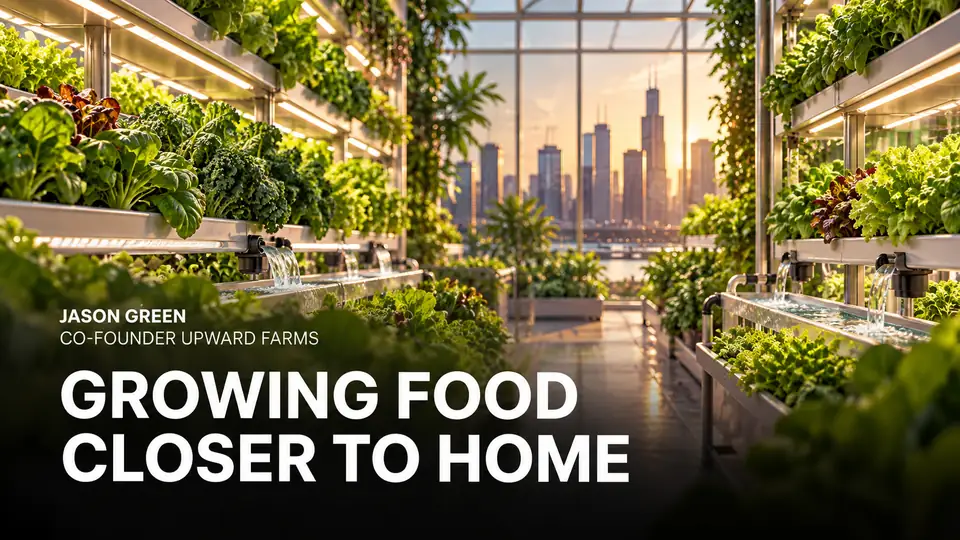
Jason Green describes Upward Farms’ approach to growing leafy greens and fish together, and makes the case for regional food production.
November 9, 2021



About the episode
In this conversation, we talk with Jason Green, the CEO and Cofounder of Upward Farms. At Upward Farms they're helping shape the future of food by growing organic, leafy greens and fish in a complete vertical farming ecosystem. In this conversation we cover the future of food, the work they're doing at Upward and how the tide is turning, how business as usual is over, and how we now have the opportunity to step up and build the future that we want to live in.
Links
Chapters
Select a chapter to play from there.
Read the conversation
Open the full transcript
CAMERON WIESE: Welcome to the Build the Future podcast where we promote exciting and positive visions of the future and those who are helping build it. Today we're talking with Jason Green, CEO and co-founder of Upward Farms. At Upward Farms they're helping shape the future of food by growing organic, leafy greens and fish in a complete vertical farming ecosystem. In this conversation we cover the future of food, the work they're doing at Upward and how the tide is turning, how business as usual is over and how we now have an opportunity to step up and build the future that we want to live in. Let's jump right in.
CAMERON WIESE: I spent the summer in LA out in North Hollywood where there is nothing. I didn't have a car, and Ubers now are like $100 to get anywhere. And so I was like, this is not great. And I was like, where do you go in the world today? If you want to be around other people, if you want there to happening things, like New York seemed like the only option. So I just kind of toss myself in a bag, headed out here and I've been loving it. Such a great place. Like the energy here is fantastic. Everyone talks about it. How do you imagine our cities kind of changing and in the food systems, specifically evolving and like what might that look like, you know, if we go pretty far out? And I'm obviously going to look back and talk about the specifics of what you're doing upward, but I'd be curious to hear your take on this facet.
JASON GREEN: My hope is that cities get ever more livable. New York City is the, if not, it's among, if not, the most expensive in terms of percentage of income spent on housing. There are other very expensive cities as well, San Francisco, etc. But New York's got real challenges to livability, as do many other cities in the US, especially fast-growing cities. And, you know, that's not the way a lot of like New Yorkers want to live in New York, but don't necessarily want to spend, you know, 50% of their paycheck on housing costs or more. So my hope is that cities get a lot more livable transportation, I think can improve vastly. You know, if you are now taking a subway now that now that you're in New York, I mean, you're you're in Manhattan, you've got great subway access, all the subways flow through Manhattan. So if you want to go from Brooklyn to Queens, for example, there are very few options to go from Brooklyn to Queens. is very limited inter-bar transit. You've got some buses, but otherwise you're probably relying
JASON GREEN: on a car, whether it's your car or a ride share. I think that can improve a lot as well. You see that in other cities too. You look like the Bay Area, and if you want to get from the peninsula to the East Bay, you have to go through San Francisco. Broadly speaking, livability improves, I think transportation improves, green spaces are so important. When it comes to food, that's a really interesting challenge because food and agriculture are industries that require tremendous scale to make the volume that's required, but also to achieve the costs that make Ford a foodable. So food's a really interesting challenge because what do you do at maximum intensity of agriculture, it's estimated that an adult requires about one to two acres in terms of how much land each individual leads from at sort of maximum intensive biodiverse agriculture, an individual could live off of about one acre. Now, of course, that's not how farming works at large, where it's like biodiverse and you get your squash here and your grain's there, but in a theoretical sense, an individual
JASON GREEN: living off the land would require about one to two acres. And so if you've got eight million New Yorkers, where are the eight million acres off of which those individuals will eat? That's not to say that we shouldn't be growing food in cities. We absolutely should. And I think it's a really important part of when you look at urban agriculture at large, cities have always been sources of food. This is something that like if you read The Economy of Cities, Jay Jacobs, I believe it's in that book that she talks about how cities have actually historically been the crucible of agriculture innovation, and that it's a relatively recent phenomenon that cities are not surrounded by farmland. I mean, even New York, you go back not even 200 years, and the northern parts of Manhattan were farmland, Queens, farmland. You could still go to the Queens County Farm and they're still a reasonably large farming Queens. You know, now it's really a learning center that you produce food for the community, but it's largely a learning center. So I do think that where we're going
JASON GREEN: because of the intensity, or I should say the density of urban living that we're never going back to the subsistence style farming of cities of 100 or 200 years ago even. But where I do think we're going, and we're seeing this right now with supply chains globally, that the way that logistics generally, the way that manufacturing generally has become so diffuse is really not resilient. It's very fragile, very prone to disruption. And so where I think we're going, and it certainly relates to our business, is a regional model of manufacturing and food production, where you've got enough scale that you can produce at the volume and at the costs that make food accessible. But also at the proximity, where you're talking about a less than one day haul versus a week or a month, that also keeps food fresh and something that is still local to where it's consumed.
CAMERON WIESE: It is this interesting trend where we've had everything localized, we've expanded almost arguably too far, where we have salmon that is being farmed in Alaska, and then it's sent over to China to be gutted and deboned, and then sent back to the States. It's such a wasteful process. But we do that with a lot of our produce, a lot of our meat just like bounces around the globe before I guess it's its final destination. And so it's interesting to hear that kind of the way you're thinking about is it's more the regional level, you know, communities have access to scalable food sources, healthy food sources, like right in their own backyard.
SPEAKER UNCLEAR: Right.
JASON GREEN: Yeah, I think that's right. And you know, the phenomenon that you highlight where the resources exist, especially the natural resources exist to produce what's needed in America. And so you highlighted with salmon and it's not just farm salmon, even for wild salmon, you catch salmon in Alaska, it gets flown as you know, to processing facilities in China and elsewhere in Asia, and then it gets flown back very similar with lumber. America will mill lumber, ship it to China for additional processing into whatever the finished product is, and then it gets shipped back. You're now seeing those supply chains stall out. It's pretty extraordinary to think that it's somehow cheaper to move all of those materials than just make your finished good here. What I think is also changing for industry at large is the combination of energy costs and automation. What you're seeing in China now, which is really interesting, is labor costs are rising in China, that you have an exploding middle class at the same time as energy costs globally are
JASON GREEN: coming down considerably. Industrial electricity rates in many parts of the US are now actually cheaper than electricity rates in much of China, including in the major industrial areas of China. What that means in an automated world is that if your electricity is cheaper in the US and you're able to automate a considerable portion of manufacturing, the incentives to produce stuff far away because labor was cheap no longer makes sense. In an automated world, energy costs are the key driver of your cost of goods sold now. So you're seeing that now, for example, if you brought up the seafood example, you're seeing recirculating aquaculture, which is part of what we do. So we're, as a vertical farming company, we're a little bit different, where we're growing our leafy greens in a vertical farm, doing all of that in a USDA certified organic format. One of the key drivers of our ability to be USDA certified organic is having a full ecosystem and an organic source of nutrients, which for us is aquaculture, is farmed fish. So we're raising our fish without added hormones, without mercury.
JASON GREEN: So it's a truly free from product of the things that consumers are wary about with farmed fish. But what you're seeing broadly is recirculating aquaculture, so growing fish on land, as opposed to farmed fish, as you've probably seen it before, and large pens offshore, or even wild fish, which helps from real challenges from a sustainability perspective as well. Once you're doing all that on land, what you're primarily purchasing is feed, and electricity to run all your pumps and your climate systems. Same with indoor agriculture for leafy greens. What you're doing is you're trading the weather outdoors and all of the, basically, the advantages that California has had historically is it's relied on good weather and it's relied on policies that have allowed for very inexpensive labor costs. For example, migrant labor, exemptions for minimum wage, exemptions from overtime pay. And that's not, I think, the way that as a consumer of food, knowing that the reason that my food is cheap is because it's been exempted from fair labor practices, that's
SPEAKER UNCLEAR: deeply concerning. You're seeing that change.
JASON GREEN: California has phased out, or is in the process of phasing out those exemptions. You're seeing costs go up. And on top of that, climate change has taken away all of that perfect weather. And you're seeing year after year these disruptions. The last couple of years, it's been fires and drought, but you've also seen issues with late season unpredictable rains that have caused things like fungal outbreaks in fields. And so the sort of salad bowls and bread baskets that America has relied on for inexpensive of food have lost their structural advantages that have kept costs low at volume's high. So we do need a new path forward. I think that to the degree that you want to make high-quality food accessible to everyone, and that includes affordability, technology is a key piece of that. For me, it's very exciting to see across a variety of industries that the technology is available today and that increasingly low-cost renewable energy is enabling the reindustrialization of industries in the US that historically have either relied on other regions because of things
JASON GREEN: like weather like California or otherwise things like labor costs in China versus in the US. You're now seeing the opportunity to rebuild those industries regionally and locally within in the US and that's very exciting.
CAMERON WIESE: Did you ever see Matthew Iglesias' piece on energy abundance that came out the other day? Tell me more. His argument was for far too long, the conversation's been focused on how do we minimize our energy consumption? Like how do we make appliances more energy efficient? How do we conserve, conserve, conserve? And really the main point that he gets at is listen, everything we do now, the constraints of energy, Our laptops, our food systems, our transportation, it all depends on energy. And so if we really want the world to thrive, we need to really focus on how we increase or how we can have moved to a world of energy abundance. And we know he talks about nuclear is an option, geothermal is an option, you know, like wider deployment of solar, wind, hydro, natural gas. It's kind of a starting point to change the conversation away from how do we minimize our energy consumption to how do we like maximize it? I think that fits well with what y'all are doing because it seems like, at least when I hear people talk about the vertical farming space, the constraint is always, oh, it's
CAMERON WIESE: too expensive. Because mostly, if my understanding is correct, it's because of energy.
SPEAKER UNCLEAR: It's energy costs, right?
JASON GREEN: Yeah, energy costs is a big driver. When you talk about that trade off in an industrialized world, you make a choice between how much invest in capital efficient that demands energy to run an automated process or how much you invest operating costs in a manual process. Those are your trade-offs. I do think that there is the ATM analogy. The fear was that when the ATM came in that you're going to lose all these financial services jobs, the opposite has happened. What you've done is you've freed up people to go from counting and handing out change to instead working in higher wage, higher utility because you have leverage off of that automation. And we've seen that in industry after industry, right? Like automation doesn't make jobs go away. They improve working conditions and they improve wages. I think there's a related point to Matt Iglesias is, and did you see the article in The Atlantic by Derek Thompson? I think it was titled America is Running Out of Everything, and Derek Thompson referred to it as the everything shortage, like the global supply chain issues that we're seeing.
JASON GREEN: And one of the later paragraphs in the article talks about an abundance agenda.
SPEAKER UNCLEAR: Yes, yes.
CAMERON WIESE: I didn't see that specific article, but that concept has seemingly been permeating the zeitgeist. A couple months ago, everyone was focused on other things, but as climate challenges are ramped up, as these conversations have become a bit more intense, and honestly, as capital has started to flow into these projects, everyone's like, okay, wait, we need to get on the same page about the sort of future we want to build. And I'm really stoked to see this like abundance, like narrative kind of come out because that's what's gonna enable all the other technological innovation and advances in science and progress. Ultimately, it's gonna lead to prosperity for not just the people who can afford it, but for everybody. And so as we focus on abundance, it's just like the future that we end up living in it's freaking awesome.
SPEAKER UNCLEAR: Yeah, I agree.
JASON GREEN: And I think so Peter Diamandis, like a decade ago or something wrote a book called abundance. He highlights a bunch of industries and indoor agriculture and vertical farming is one of them where it gets a quick mention and it's true. What if you removed the constraints? So you say, well, if I want everybody to eat fresh food, what do I need? Well, I need farms that can produce fresh food year round local to those consumers. That's an indoor farm. It's not California. You can make field production substantially more efficient. There are products that store well, that perhaps you keep in certain regions, but if the goal is to improve fresh food access to highly perishable products, well, yeah, you need to make those products more abundant, you need to make them more available. And I agree, as we think about energy, efficiency matters, right? You've got to keep consumption tied to additional production, but what we've seen is over the last 200 years since the Industrial Revolution is that output put is directly tied to how much energy we're producing.
CAMERON WIESE: Yeah, it is important that we focus on making sure we're being efficient with the energy. But like right now, it seems like the trick is, okay, how can we eke as much out of this as possible? And so we're optimizing on that axis instead of perhaps like other axes where, you know, we could generate better crops, tastier crops, or just not just crops, like anything. It's like, let's make this as efficient as possible. Instead of let's make this as impactful as possible, then have that then be able to actually make the trade-off. I actually have the quote from Diamandis on here. And I wanna use actually as a segue to talk about kind of the composite picture of like the food systems that you imagine. Because what he writes is, these systems have the potential to produce all the food while simultaneously requiring 80% less land, 90% less water and 100% fewer pesticides and nearly zero transportation costs, integrate a few emerging technologies, aquaponics for closed-loop protein production, robotic crop harvesting for lower labor use, AI systems attached to biosensors
CAMERON WIESE: for better environmental regulation, the continued development of biomass energy systems, the betterment and continued integration of waste recycling systems. We end up with a gold standard of sustainable agriculture and entirely local food production distribution system with no waste, zero environmental impact and scalable potential to feed the world. How sweet would that be?
SPEAKER UNCLEAR: It's compelling. What do you think the stories are
CAMERON WIESE: that we're telling about food right now that are not correct or that need to be changed because when you talk when Diamandis talks about that It's hard not to say hell. Yeah, let's go like let's make that happen or like what is preventing us from from getting there. I
JASON GREEN: Think there are there are a few different narratives, you know, one is this idea that the food system is broken and It's an overgeneralization. The food system is working exactly as it's designed to work, right? If you're a large scale food brand, like the food system is absolutely working. And so, you know, it's a real question of like broken for who, who's it serving? And so I do think that what you're seeing now is consumers are voting with their dollars in really meaningful ways. Yogurt is a great example. So you've seen this explosion of the perimeter of the grocery store and a shrinking of the center of the store. So along the perimeter of the grocery store, you have all your perishables, right? That's where all your fridge cases are. And in the middle, you've got your rows and rows of dry goods. And the perimeter of the store is eating the center of stores lunch. And yogurt is one of those categories that's really exploded over the last 10 years. You look back at 2010, yogurt at large was just short of a half billion dollar market.
JASON GREEN: yogurt today is $8, $9, $10 billion market, something in that range. Greek yogurt 10 years ago was about a $400 million market to less than 10% of the overall yogurt market. You look at Greek yogurt today and it's about $4 billion. Chobani alone is on the order of somewhere between $1.6 billion, $2 billion brand. What you've seen is an explosion of a high-quality product, so Greek yogurt being higher protein, lower sugar and a brand like Chobani is now 20% or so of the entire US yogurt market. What's also interesting is over that 10-year period, you saw Yoplait, who was the number one brand 10 years ago, and Yoplait known for its fruit on the bottom, high sugar, low fat products to then Chobani, which is this really, really thick and rich, high protein, low sugar product. Chobani is now the number one yogurt brand in the US. What's also fascinating is from a price perspective, Chobani is still twice the price of Yoplait. So you've now got the largest yogurt brand in the US that on the retail shelf cost twice what 10 years ago was the number one brand in the US.
JASON GREEN: And you're seeing that on a category by category basis and like disruptive consumer packaged goods, you look at whether it's, you know, beyond meat or, or Oatly relative to ground beef or conventional fluid dairy. And they're also about 1.7 times the price on a, on a either per weight or per volume basis. And so this is really interesting phenomena where, whether it's Chobani is the largest or otherwise like these really fast growing brands, consumers are saying, I will vote with my dollar, I will pay more for a product that is truly serving me. To make that accessible for all, I think you do really need to think about costs and pricing and my dream for an abundant future is that the highest quality products are also the most affordable and most accessible. I think we're on the path there and you're seeing that, like with yogurt, where a substantially higher quality product is the largest brand, but it's still retaining its premium. But there is this real question of who is food serving when you've got products
JASON GREEN: that are very cheap but made with artificial flavors that are based in petroleum products? Who are those products really serving? Are they serving the consumers, even if they're cheap, but they're cheap in more than one way. They're cheap in more than just price. They're cheap in nutrition, they're cheap in how they treat the environment. And what we want ultimately is, is a more abundant food future that serves all of the stakeholders.
SPEAKER UNCLEAR: Yeah.
CAMERON WIESE: I actually, I've never heard anyone frame the cheapest of food, not just in the price or quality, but in the supply or like on the production side. Do you elaborate on that a little bit more?
SPEAKER UNCLEAR: Yeah.
JASON GREEN: When I think about the value of food, the value of any product, there is the value that I offer as the consumer. So here's my dollar, that's the value I'm offering. And then there's throughout that whole supply chain, there's the value that's paid. There's the value that's paid for the package that it comes in, there's the value that's paid for the work that went into producing it, there's the value of the ingredients. Then there's all of the value that isn't assessed, all of the externalities. What are the alternatives on, if you were to buy, if you're buying a grass fed yogurt versus a conventionally farmed yogurt or the milk from that, what are the externalities worth? And so, my perspective is as people have sort of woken up to what's in their food and what it really costs and who it really costs, including themselves. And I think a lot of individuals are dissatisfied with the outcomes for their families, for their health, the sort of fully baked cost and the fully baked value is becoming more and more apparent. And now there is an effort, whether it's by producers and brands
JASON GREEN: or by individual consumers to create more value, create more value within the supply chain, create more value for themselves
CAMERON WIESE: and their families. What do you think is driving a lot of this change in consumer behavior? Because this only seems to be seems to have been a trend over the last five, ten years, or like even now, right? You're on the frontier of the space. I'm trying to, you know, paint a composite picture of like what's being worked on right now. It seems like just over the last, you know, two to four years, this entire like sustainable, scalable, healthy food system stuff has started to take
SPEAKER UNCLEAR: off. What's changed? Like what's it's not just food, right? It's I mean, it's, it's food, it's
JASON GREEN: politics. We are living through times of great change. And there are experts who are far more knowledgeable than I am on what's going on in people's in people's minds and hearts. But when you look at, for example, Edelman does these annual trust studies. And, um, what they've been showing for a couple of years now is trust in institutions is at the absolute lowest levels. And you're seeing that now with, um, Individuals response to vaccines, for example, right? Where folks are saying, you know, I trust myself and my instincts. I don't want to step in a pile of doo-doo, and I'm not going to make any other comments about that. But you're seeing these like, I don't trust somebody. I don't trust somebody else, and I especially don't trust entrenched institutions that has affected individuals' relationships with governments, for sure. And it's also absolutely affected individuals' relationships with brands. Brands are institutions too. And companies have actually, at least the last time I looked at that data,
JASON GREEN: companies have actually fared better than governments in terms of consumer trust. You do see we are right now living through the golden age of brand creation. And it's easier than ever for consumers to find brands that share their values. And that is to say that brands are clear on what their values are. What I do think that you're seeing is with the focus on healthy, sustainable, simple foods is that simplicity. That the more that the origin of food is obscured and individuals need to say, oh, I trust Brand X, but you look at the back of the label and there's a bunch of ingredients you don't recognize, The origin is someplace entirely foreign or unknown. There's a tremendous amount of mistrust. You look at the back of food product and its simple ingredients, or you don't even need to look at the back of the package because you can identify all of those whole foods that are there and you know where it's from. You know, in a time when individuals are more mistrustful of institutions than ever, the simpler and more obvious you make the product,
JASON GREEN: the better because individuals have the ability to assess for themselves whether this is something that they want, whether it's aligned with their values. So I think what you're seeing in food is exactly the same as you're seeing in culture broadly, which is that individuals are mistrustful of individuals who are saying, I know what's best for you, but obscuring the information
SPEAKER UNCLEAR: that individuals need to make the best choice for themselves. There's this protein powder that I
CAMERON WIESE: found, it's called naked. It's literally like one or two ingredients. Like this is all that is in here and in a world where everything else is full of like, additives and xanthan gum
SPEAKER UNCLEAR: and all this other stuff. We're going to like [interrupted]
CAMERON WIESE: It's like, what is this? What am I putting into my body? And the conversation has changed. It's like, I don't know, like, why are we so unwell? Why do we have like, health challenges? Like not feeling good? Oh, all this stuff we've been consuming, all All this food that we thought was good for us that's pumped with sugar or fats or artificial, whatever has been making us very, very ill. So it's cool to see the tides turning. Yeah, to your point, consumers be able to vote with their dollar around what things they want to support. And I think, I don't know, maybe you're seeing this, but in brand positioning, it seems like the stronger you can be about the values that your organization represents, the better Are you fair in the markets? Because you attract the people who are like, yes, I want my food to be grown sustainably. I don't want it to have any pesticides. I want it to be advancing this sort of future. It means that you think about kind of the positioning upwards like, hey, we're gonna be very bold about how we position ourselves in the market
CAMERON WIESE: and try and find consumers who are like, who believe in the mission, want to support, the advancement of this space early on and then grow with y'all.
SPEAKER UNCLEAR: I think our goal is to be really clear about what we do.
JASON GREEN: I think the why we do it is absolutely important, but I think if anything, where consumers are saying, very nice, very nice, you're telling me why you do what you do, but let's be really clear about what you do, let's be very clear about what is. So I can make a decision for myself, whether you're making good. I think our desire is to be really transparent, to be really authentic. we do differentiate in our product by, for example, being USDA certified organic. We do think that that's an important distinction that, you know, you can say that it's a clean food. There are objective measures of whether or not something's produced at a certain ecological or quality standard. We do open ourselves up to third-party oversight around food safety. And so, you know, we know that, for example, leafy greens are today the most dangerous food in America. They cause between one and four, one to five cases of foodborne illness. And so, you know, we want to be really clear about safety and we're a wash and ready to eat product. I want to be really clear about being a grower
JASON GREEN: that focuses on whole ecosystems, even when we're doing it indoors, which there's a whole conversation that you and I could have about where this marriage is between nature and nurture. And I think, you know, to our earlier conversation, I think there are these two silos of you grow stuff indoors or you grow stuff outdoors and it's quote unquote natural. And our view is there's actually this marriage where indoor growing can learn a lot from what's happening in nature and on the broad acre. And at the same time, outdoor growing can learn a lot from some of the things that I think we're uniquely focused on within controlled environment. agriculture, especially the relationship between plants, animals, and microbes and all of the power
SPEAKER UNCLEAR: that's in the microbiome. That seems to be like another one of the narratives. It's like it's an either-or versus what is the composite of these things look like, right? Yeah, the world is far
JASON GREEN: more nuanced than I think often the arguments suggest were allowed. One of the things I want
CAMERON WIESE: to make sure we touch on is like the composite picture of the food space. So not just kind of like agriculture, but like we have kind of these higher end brands that are focused on transparency and high quality ingredients and, you know, high quality, you know, supply chains and taking care of the people who are manufacturing their products, et cetera. But how do you think the whole entire landscape, like how we eat is shifting and what might that look like, you know, 15, 20 years down the road? just to tee this up, we've got like the regenerative farming, you've got the plant-based meat alternatives, you have the cellular meat, you have the vertical farm, you have the outdoor farm, like agriculture, like how do you imagine these things kind of blending together and creating kind of the composite picture of how we feed ourselves in the future?
JASON GREEN: I think one of the most important changes in terms of how we feed ourselves is the focus on freshness. When we talk about the perimeter of the grocery store and all the perishables, that's a huge change. If you looked at a grocery store 20 years ago versus if you look at a grocery store, now the focus on fresh or otherwise perishable products is much, much higher. That does demand huge changes in the supply chain. A processing strawberry or a processing tomato is a different crop than a fresh. And the supply chain is different. The packaging is different. There are these natural tensions between packaging that preserves shelf life and reducing plastic, for example. And so there are these trade-offs that need to be managed. But I do think in terms of where the food system is headed at large is the ability to make good on the desires of consumers and to manage those externalities in a better and better way. And I think what's happening in food broadly where you have authentic, high-quality, nutritious brands with ingredient lists that you can read
JASON GREEN: and understand intuitively, that your child can read and understand. That makes me very excited. And the engagement in the consumer wanting to make decisions for themselves, I think, is as a producer of a product that is really high integrity, a really simple product, that's very promising to me and the alignment between what we're producing and individual's desire for that product. I think pulling that back more broadly to what excites me about the future is that I don't know that the concept of impossible possible really exists anymore. You mentioned it in sort of the abundance concept and what's exciting is we have really all of the scientific and technical tools to solve the problems that present themselves. And I think the challenges really are one, problem identification and two, the will. And this is something that you had sent me and it was an article that I enjoyed reading when it was originally published, Mark Andreessen's blog post on, it's time to build, right? And, you know, one of the concepts that he highlights and that I totally agree with is just this,
JASON GREEN: that it comes down to will. What do we wanna do? What do we wanna allocate our mind share, our capital, our efforts to, ultimately that's a choice, but, you know, really comes down to problem identification and, you know, movement to action that really are the only constraints because we have the tools to solve the problems. And if we don't have the tools, we have the tools to make the tools to solve those problems. Whether they're computational and analytical or even in the natural world, like we are living through the golden age of biology and biotechnology right now. And you're seeing at the risk of going back to vaccines, the vaccines that the world is benefiting from today were, you know, in many cases, it was days from when SARS-CoV-2 was sequenced to when the first vaccine was produced, you know, was literally a matter of days. That is extraordinary. It took a year to go through regulatory approvals and manufacturing and all of that, but days to solve
CAMERON WIESE: the problem. It's absurd that we live in like this sort of world that we live in today. Like, There's so much crazy stuff happening in the mRNA, just like one example. But it's cool to see kind of all these things and kind of their exponential curves and where we go from here. As long as we keep building and maintain this like spirit of possibility and like make sure people preserve their agency, like we'll end up in like an incredible spot.
JASON GREEN: Yeah, I think there's another very well renowned venture capital investor, Albert Ranger at Union Square Ventures who has been writing about the world after capital for a long time. And it also aligns with this abundance agenda. You see it with the money supply over the past couple of years. You look at the money supply and this exponential production of capital, I think we do live in a time when we can choose what we want to allocate resources to. We can invent those resources and produce value, or we can invent resources and maintain
SPEAKER UNCLEAR: the status quo. That's our choice.
CAMERON WIESE: I think it's up to us who are wanting the frontier to be preserved and to be different than the status quo to keep fighting for it because otherwise the entrenched interests will just keep their pockets high and keep doing what they've been doing. And so any pressure we can add on those systems, the fast we all move.
JASON GREEN: The reality is business as usual is over, right? You can get out over your skis for only so long and you can keep saying everything is fine, but you look at what's happening in supply chains globally right now and shipping costs are 10x. If you want to build something, you can't find contractors because we just haven't over the last several decades done the work to, as a country, we have effectively entirely divested ourselves with vocational work, divested of entire sectors of manufacturing, implemented regulations without thinking through the implications. Like you look at the electronic logging, really important to create fair labor conditions for truckers and safety for those on the road. At the same time, you know, regulation goes into effect says, you know, you can drive for eight hours, no effort to make sure that there are enough trucks and enough drivers to move the goods when individual drivers can only drive for eight hours at a stretch.
JASON GREEN: And so, you know, we're in the messy middle right now where, you know, the train cars are being pulled in a different direction and they're clanking against each other. But, you know, I have I have a tremendous amount of optimism, especially for entrepreneurs to solve these problems in sustainable ways and, you know, from a market's perspective from a commercial perspective like sustainability is about having profitable businesses. And so to the degree that the way that a lot of these industries have existed are now experiencing significant challenges in supply chain, in inflationary costs, I think creates an even bigger window for disruptive businesses who are saying, this is the way that now you're actually seeing the effects born out of businesses that I think had an industry at large that had built models that just weren't economically sustainable, but we're on life support for a long time.
SPEAKER UNCLEAR: !
CAMERON WIESE: Jase, I can keep riffing with you on this for a long, long time. I want to be cognizant of time and respectful so we don't run over. Where can people find you? Any calls to action?
SPEAKER UNCLEAR: How can they support upward? Any plugs?
JASON GREEN: Yeah, shamelessly. Upward Farms, leafy greens, you can find our USA-certified organic Washington ready to eat salads. We have some beautiful microgreen mixes that are available in New York City whole food stores, expanding regionally as well. And you can follow us on social, very active on Instagram in particular at eatupwardfarms or on the web at www.eatupwardfarms.com.
CAMERON WIESE: Amazing, cool.
SPEAKER UNCLEAR: Jason, this is a blast. Thanks so much for coming on.
CAMERON WIESE: Excited to see where y'all go from here.
JASON GREEN: Thanks, Cam, appreciate your time.
CAMERON WIESE: Thanks for joining us for another episode of the Build the Future podcast. If you want to support the show, please share your favorite episode with a friend. If you want to get updates on the events we're hosting, new podcast episodes, and follow along as we build the new World's Fair, you can follow me on Twitter at c-a-m-w-i-e-s-e. Until next time, go build.
SPEAKER UNCLEAR: you
More episodes
All episodes Dr. Celeste Holz-Schietinger of Impossible Foods — The Future of Food, Sustainability, and MeatDr. Celeste Holz-Schietinger explains how Impossible Foods studies flavor and texture to make meat from plants.
 Dr. Sandhya Sriram — Growing Seafood from CellsSandhya Sriram explains how stem cells can be grown into seafood and why the culture medium matters.
 Elliot Roth — Algae, Food and the Future of SpaceElliot Roth explores algae-based materials, synthetic biology and lessons from a simulated lunar mission.