

Build the Future Podcast
Dr. Celeste Holz-Schietinger of Impossible Foods — The Future of Food, Sustainability, and Meat
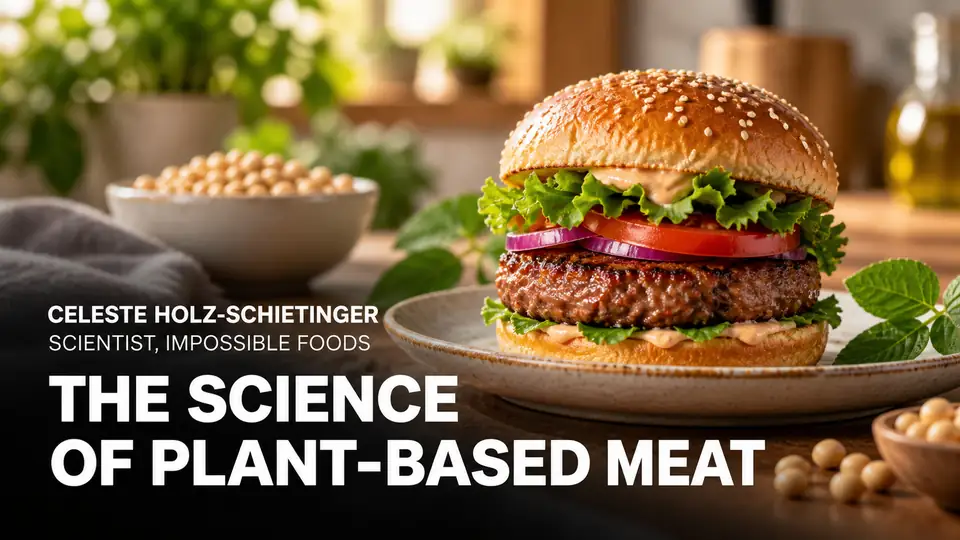
Dr. Celeste Holz-Schietinger explains how Impossible Foods studies flavor and texture to make meat from plants.
April 20, 2021 · 38 min



About the episode
In this conversation, we talk with Dr. Celeste Holz-Schietinger, the VP of Product Innovation at Impossible Foods. At Impossible Foods they’re recreating foods at a molecular level to give people the taste and nutritional benefits of meat with the aim of reducing the health and environmental impact of traditional meat products.
We talk about the future of food, sustainability, engineering protein, and more!
Links
Chapters
Times follow the podcast audio. The video’s timeline may be slightly different.
- 00:00Introducing Celeste and Impossible Foods
- 01:39The mission behind meat from plants
- 03:41Going directly to plant ingredients
- 04:26Land, water and biodiversity
- 07:58What makes meat taste and feel like meat?
- 09:38Heme and the chemistry of flavor
- 12:03Proteins, fats and texture
- 13:08From analytical instruments to tasting panels
- 15:40Prototypes, consumer tests and iteration
- 17:26Beyond replicating existing flavors
- 19:02Meeting consumers where they eat
- 20:37The breakthrough from version 1.0 to 2.0
- 22:59The challenge of whole cuts
- 24:54Plant-based and cultivated-meat approaches
- 26:56Celeste’s path into food science
- 28:47Nutrition and the meaning of processed food
- 32:19Restoring land and reconnecting with nature
- 35:10Food choices and ways to contribute
Read the conversation
Open the full transcript
CAMERON WIESE: Welcome to the Build the Future podcast. My name is Cameron Wiese and I'm your host. I've always been fascinated by the ideas and sentiment that drove American culture in the 1960s with the space race. A culture galvanized to dream about the possibilities of tomorrow, whether it's food, transportation, cities, biology, or anything else. It was this cultural mindset rooted in optimism that the world tomorrow would be better than the world today. A mindset where people were compelled to build things, and I quote JFK, not because they were easy, but because they were hard. It's this desire to build and to dream that seems to have been lost, and something we're here to bring back. With Build the Future, we're here to promote the ideas and stories of those who see how the future can be better and promote their plans to get us there. It's our mission to get you to dream about the possibilities of tomorrow, to dream about the future that you want to live in, and inspire you to go build. Today, we're talking with Dr. Celeste Holz-Schietinger, the VP of Product Innovation at Impossible
CAMERON WIESE: foods where she's responsible for leaving the team that events designs and creates impossible products. In Impossible Foods they're recreating foods at a molecular level to give people the taste and nutritional benefits of meat without the negative health and environmental impacts of traditional meat products. In doing so they're helping build the future of food. So let's jump right in. I'm very very excited thank you for coming on. I'd love to have you tell me about the future you're building at Impossible Foods.
SPEAKER UNCLEAR: What's the vision?
CELESTE HOLZ-SCHIETINGER: The vision of Impossible Foods is that we can make meat better, meat without compromise. So delicious, sustainable, healthy for the individual consumers, and amazing for the planet. Sustainable in the fact that it doesn't destroy the planet while making the choice to eat delicious food. So our goal is really to eliminate animal agriculture by 2035. Really with the movement of asking the consumers to continue to eat delicious food when we're providing that solution that's plant based.
CAMERON WIESE: With Impossible you're aiming to eliminate, is it all animal based foods by 2035?
CELESTE HOLZ-SCHIETINGER: All animal based foods, our planet needs it. Animal agriculture is the number one destructor of our planet. The carbon emissions, the water, the land use, over 50% of all land use is used for animal agriculture or the food to feed them. In comparison about 1 to 2% is covered by cities. So we all of that land used to be native land with lots of diverse animals that flourished and now we're replacing them with one or two species. And to me, that's super sad. Like those creatures have a place on this earth. We need to allow them to do that. And it really creates an ecosystem that's balanced to have all of these diverse creatures as well as different habitats. So that's really central to what we're doing at Impossible is can we go straight to the natural source of plants and create the foods people love to eat. And it's not surprising, it's totally doable because all of those same elements are in the plants.
CAMERON WIESE: Yeah, because essentially what we're doing is kind of cutting out a step, right? Because we have the animals that are consuming the plants and that gets turned into, you know, animal or like meat on the cows, the pigs, the chickens. And then it gets reprocessed back into things that people consume. So essentially it's kind of the trick is to figure out, how do we just skip that step and get the protein and nutrients we need directly from the plants themselves?
CELESTE HOLZ-SCHIETINGER: Exactly. That's that step is in house since more than like 90, 95% inefficient. And so yes, can we go straight from the plants, pull out the key nutrients and the key things driving the texture, flavor, mouthfeel, all of those things we care about and combine them in a way that's much more sustainable.
CAMERON WIESE: Before we can talk on the process of doing that and creating that, I think it's one of the things that's interesting to me is that a lot of people, like it's either the planet concerns the environmental concerns or the morality around kind of the factory farming. Is there a piece of this that people gloss over that you think they should be more aware of? Like, yeah, the cows are producing methane, it's taking a lot of land. Is that the biggest issue?
CELESTE HOLZ-SCHIETINGER: It's kind of a combination of so many different things. And I think people are still because they love what they eat, want to pretend that it's not making the impact it's having. We have so many initiatives and that's from individual base to I'd say policy base. We talk a lot about climate change and transportation and energy and how that needs to change. On just climate climate change, animal agriculture is as big or bigger of an impact. And you have all of the land use, which goes back to all of that land could be carbon sequestering and be brought back to native rainforest or grasslands and be going in the positive direction. If we just eliminated animal agriculture right now, we would start reversing climate change because all of that land would be able to sequester. And that dream that we think of, of just that fantasy land is actually possible if we start making these ships. And one of the other big areas is water and the health of our waters and our streams. And that's being really destroyed by animal agriculture as well. So it's kind of on every single front.
CELESTE HOLZ-SCHIETINGER: This is the major corporate thing that's destroying how we're living for ourselves and other creatures, and why don't we go and fix it? And that's what I think as a scientist that's amazing to be able to do is say, here's the biggest problem that our world faces. Now can I use my skills to find a solution and use technology for the better for everybody?
CAMERON WIESE: The water one's really interesting because in the US we treat water like, just like a abundance, like freely abundant resource. Like no one has any respect for how much water they're drinking, how much water they're consuming and how little of it we actually have.
CELESTE HOLZ-SCHIETINGER: Yeah, and we might talk about things like, let's use less ourselves. the biggest area we use it is the food choices we make. So a lot of these things we talk about are the day-to-day things that seem like, oh, I can make this difference. The difference, just making the choice of what you're feeding yourself or your family one meal at a time is the biggest difference we can have on the plan.
CAMERON WIESE: What is it? Like one, like one pound of beef is like a hundred, like a thousand gallons of water
CELESTE HOLZ-SCHIETINGER: or something. Post of that. Yeah. I think I usually go back to that energy conversion where 94% of the energy going into making a cow is lost. And so that's on the metric on the water thing, all of the water that had to be used to create those grains to feed it. And then of course the cow growing up as well.
CAMERON WIESE: For anyone kind of looking at this problem, it's pretty clear like, okay, yeah, we need to definitely do something about our consumption choices. What does it actually look like to develop an alternative to this that gets people kind of excited and willing to kind of change their behavior?
CELESTE HOLZ-SCHIETINGER: Yeah, so we took approach to say, it's a conversation, but really the difference is providing the solution. And so the solution here is making delicious meat. and making delicious meat is very feasible and doable. And so for us, that approach was really going down and asking what makes meat meat? What are each of the things that drive the sensory experience that we care about? What drives that juicy chew down? What drives that umami flavor? What drives that beef flavors? What are each of the components that drive that? And so I'm a biochemist, a lot of us are kind of go down to the molecular level and ask, what are the things that are driving those sensory experience? And then look to plants for those exact same components or ones that have very similar properties. And we weren't surprised that you can find all those things because what does a cow do all day? It goes and eats plants. And so we're just going back and pulling those same identical molecules and combining them in a process to bring out each of those key sensory experiences.
CELESTE HOLZ-SCHIETINGER: And so that's really what we're doing with what we've done with ground beef, pork, sausage, and really kind of the whole landscape is what we're working on.
CAMERON WIESE: Yeah, can you tell me what's with the experimentation that you did early on to kind of get a beef patty that kind of actually tasted and felt and smelled like an actual animal-based meat product? I was reading like, you had some experimentation for like the different types of oils to get the fatty texture. And then there was one key insight around Heem, which I think seems to be the breakthrough. Can you talk about some of those things?
CELESTE HOLZ-SCHIETINGER: Yeah, so when you kind of go and break the components down, what meat is made out of is lots of proteins, certain fats and key nutrients. And so in there, trying to figure out what the properties of those are that drive it. And so where I started my work is really on the flavor side and making the discovery that heme is what drives meat flavor. And we did not know that before. And what heme is, is a kind of coordinated molecule that holds iron. And iron is essential for life. Heme is also what makes our blood red and allows us to breathe. And it's essential in plants as well. And so what we identified is this molecule in its raw state, tastes like blood, it's metallic. It tastes just like maybe like for me as a soccer player, so maybe a soccer ball getting hit in your face and some blood, it's exactly that flavor. And if you take that heme and you put other essential amino acids and vitamins and some fats and you cook it, like you'd cook your burger, you get an explosion of flavor.
CELESTE HOLZ-SCHIETINGER: That is where all the meat flavor is created and you get those kind of sweet caramelized notes, your roasted notes, your beef notes, and that's simply heme and those nutrients and cooked. And we focused first on beef and trying to understand what that flavor combination to create that. However, that system is what creates your pork flavor, your chicken flavor, even your fish flavor is changing the ratio and the nutrient composition of that. So that's really the essential flavor basis for it. The other aspects that's really important is the texture. So how do we get that? And that's really driving into the proteins and then the facts. And so we've explored hundreds of different proteins and the ways you process those proteins to bring the chew down, the handling properties that you need, the mouthfeel. And fat is a great one because it's texture in terms of the mouthfeel and allowing juiciness, but it's also actually the carrier for flavor. So getting the flavor right requires you getting the fat and the fat release correct. And so you have a burger, it cooks up,
CELESTE HOLZ-SCHIETINGER: you'll have the fat sizzle out. That's also essential for the flavor generation. And then when you bite it, you get all these juices releasing and that fat carries all of those delicious flavors that heen created straight to your tongue. So it's really this inner play of figuring out each of those elements and then how they come together.
CAMERON WIESE: What does the process look like for this experimentation that y'all are doing? I'm trying to imagine like having all these different possible combinations and how you act like how you actually go about testing and combining things and kind of arriving at the final product.
CELESTE HOLZ-SCHIETINGER: Yes, I'm going to start like where we're in our lab. And in our lab, we have a lot of analytical instruments. These instruments are actually quite similar to what you'd use and medicine to understand how each things are, what are each of the components in it. And we have gas chromatograms, which can identify all of the aroma compounds in a food. And so we will put a sample in there, cook it up and be able to see what's in there. At the same time, actually, you can kind of separate out those aromas. you can actually have people smell them to identify what are those essential aromas that drive the flavor and what is how is it created and so that's kind of understanding we start I'd say with meat what makes meat and identify those key flavor elements because then we can go and try to find what are the things and plants that are driving it we can use the same instruments to now say okay, how does this gramatogram, which is this like each peak for aroma, how does that compare to our sample that we just created? And we'll compare multiple of them and how does that create
CELESTE HOLZ-SCHIETINGER: those? So that's kind of like on the early stage flavor who do. And then the next thing is we made that mix. It looks great from an analytical standpoint, but at the end of the day what matters is what goes on the mouth. So then we will have individuals taste that. And we usually start with ourselves who is a very trained group of individuals and narrow that scope a little bit. And then if we start being like, this looks interesting, we have trained panels of under hundreds of hours of figuring out and really descriptive analysis of those, and they'll help us along the way. And so that's kind of the early work on the flavor we'll do with some analytics and sensory. And say now let's take that and we actually want to make a prototype. This is actually make the meat. We need the texture side so maybe we've identified a few of the key proteins that we need. We'll do a lot of texture analysis so then again comparing what the meat texture is to these replicas of different protein combinations and different processes. Now we have these kind of key elements and we come to our kitchen.
CELESTE HOLZ-SCHIETINGER: And we start taking these natural ingredients and start recombining them. And there's three steps to make them like the heme. We need a way to produce that. But once we kind of have these key ingredients, it's actually quite simple, the combination of these ingredients. And it's really taking them and mixing them and combining them in the right way. And once we've made, say we've made 10 of them, we'll go and again analyze them in different ways, as well as do the sensory aspect. And again, that sensory aspect is key. And after multiple rounds and maybe hundreds or thousands of prototypes, we'll start getting to that better optimum and we'll pull consumers in. So we do probably one to two consumer tests a week with hundreds of consumers on our different prototypes. So this simple answer is we try to understand things at a molecular level from the analytical side, kind of define some of the elements we care about, come to the kitchen, combine these ingredients together and rapidly prototype doing sensory. And the more we can do that, the better we can get.
CELESTE HOLZ-SCHIETINGER: To me, one of the key things is beef, a cow isn't really changing much. And it really doesn't have the ability to evolve. We can go and make 100 prototypes in a day, and we can evolve. And so we can continue to get better. And when I think of the future, it's that we can make meat much more delicious than beef, of course, and all the other benefits too.
CAMERON WIESE: Yeah, what might that look like? Because if you get the point where the Impossible Burger is on par with the Meat Burger, you have the ability to kind of take it to the next level. So can you tell me a little bit more about your thinking there? Is this making it more nutrient dense?
CELESTE HOLZ-SCHIETINGER: It's kind of the space is endless. So you can say we right now need to get the consumer mentally shifting, and provide the products to get them there, which is really recreating the products they love. Once you get to that point, we have all the levers to be able to make it more nutritious, make it maybe more umami, or maybe there's certain characteristics that people really like on the flavor side, or maybe you like a mix of different meat flavors all in one, those are all on the table. And so it's just, it's fun to think about that. We don't have to be limited to your pork flavor, your chicken flavor and your beef flavor. You could have all these other flavors. And I think it's still hard for us to comprehend what that is, but there is thousands of flavors that make what each of these are. And we can go and change those in the proportions or how juicy is it or the chew down. The options are kind of endless. Right now it's really getting the consumer convinced that they get what they want from the products.
CAMERON WIESE: How are you all thinking about this process of transforming the way that consumers think about the meat they're consuming?
CELESTE HOLZ-SCHIETINGER: It's of multiple levels. For me, obviously it starts kind of at the product and how do I make that product experience what they want? And the product experience, we talk a lot about the flavor and the texture, but it also matters how well does it handle? Can they use it in all their favorite dishes? Is it the chefs, can they do everything that they want? And so all of those elements matter and we try to take those into account. And that's kind of you'd say the back end of it and we try to and then there's the communication. How do we get consumers to be eating this and all the things. And so a key area is how do people eat meat and in what formats. So some is going to the grocery store and buying a pack of ground meat and taking it home. So we need to make sure we're there. And that was really a key focus this year is really having retail be really strong. People also go to their favorite restaurants. That might be a Michelin star. That might be a Burger King or a Starbucks and everything in between. And so how do we meet the consumer where they are?
CELESTE HOLZ-SCHIETINGER: and we provide each of these established restaurants what they're used to using to be able to make those delicious meals. And so it's all of the above is how we really meet the consumer.
CAMERON WIESE: It's cool to see over the last year, y'all show up everywhere. I'm walking down the street in Manhattan. I see the kind of plant-based alternatives. So it's cool to now see that. It seems like there's some kind of breakthrough that y'all had in the last maybe two or three years where you kind of landed on the product that resonated with consumers and then have been able to shift to kind of getting it to market and getting in the hands of people. Is that kind of an accurate way of looking at it?
CELESTE HOLZ-SCHIETINGER: Yes. So in 2016, we launched our first product and that was our version 1.0. And it was great to kind of test the market and see where things were, but it needed improvement. And so, yeah, two years ago, we launched our 2.0 version. And it shows also in our process of innovating, you sometimes need to try to fix one thing and you end up needing to fix it all and it makes it much better. So the key initiative there was our first product would not grill. And so we needed a product that would grill to really be able to change the space and go into retail. So we started kind of from the ground up, how do we create that product? And in that process, we made something that much better texture, much better flavor. It handles just like meat and the nutrition are better as well. And it was able to scale faster. And so that's really was that kind of break through to make that modification and be able to kind of continue to scale. Another key piece is just us continuing to scale and get partners. So Copacker partners to really push on those levers as well.
CELESTE HOLZ-SCHIETINGER: And the speed at which we're hiring growing right now is tremendous so that we can continue to not just do this on this one product, but how do we really eliminate animal agriculture? We need the gamut. Ground meat is a part of it, but that's only a fraction of it. We need the hole cuts. We need the dairy platform. You need the fish. you need it all. And so that's really where we're going and the future for us and kind of the next few years.
CAMERON WIESE: Yeah, what is it gonna look like to replace like whole cuts? Right, because you're gonna replace all animal products by 2035, like people love steaks. It seems like ground beef or ground meat products are pretty easy. Toss them and kind of a giant that and you combine all the ingredients and you mix it together and then you kind of funnel it out into packaging. But the assembly of like steaks, if you can talk about this, like how is that going to happen? How's that going to work?
CELESTE HOLZ-SCHIETINGER: Yeah, I can give a kind of a high level, but there's still details being figured out and things we're doing. But one of the key parts to whole muscle tissue is really like the tensile strength. You have proteins that are held together in a way to give that structure. And so what are the properties of those particular proteins you need? And then what is the process to give that longevity and that strength of the connection? That's really a key focus is how do you do that? And then we can use kind of also our platform of the things in the ground meat, the flavor system. This need to be changed some, but it's still the same fundamentals. Heem is what drives meat flavor from your steak, your ground beef. So we can really utilize them. On the fat side, you still need your release. You need a lot of the same characteristics. You might need to structure it a little bit differently, but still using that platform. So it's really kind of on the putting these pieces then together to be able to make that breakthrough. So we will do it and probably hopefully in the near term,
CELESTE HOLZ-SCHIETINGER: because that really makes a big step forward. Because in terms of the cow, that's a big part of really taking that cow down. And of course getting the consumers really everything that they love to eat.
CAMERON WIESE: How do you think about the space holistically? Cause there's, there are companies that are trying to do this kind of taking a different approach, which is growing meat in a lab and then using that to produce all the kind of meat products. How do you kind of contrast the approach at Impossible with the approach of some of these other companies are trying to do the lab grown meat?
CELESTE HOLZ-SCHIETINGER: Yeah, Impossible's approach is really from the plants and saying our primary food source and the primary source is the plants. So that is going to be the most efficient way to do it and most sustainable. just if you think of just the conversion factors that are going on. And to us, we've already proven to ourselves that that is possible because those same components are there and you need to combine them. And if that's the most efficient and sustainable way, then that is the way to really make that difference. However, for us, we are really mission-based And there is so much meat that's consumed. And that meat needs to be converted to more sustainable ways. So multiple companies and multiple different fashions needs to happen. And when I think of what I'm probably, one of the things I'm most proud of is not just what I've done in Impossible, but Impossible was at the forefront of getting people to realize this issue. And that to me is what's kind of really groundbreaking. It is the fact that people now realize that animals need to be replaced as a food system.
CELESTE HOLZ-SCHIETINGER: And it's not only good for our planet and good for our consumers. It's a big moneymaker too. And so the things kind of go hand in hand and that needs to continue. And impossible, we want to be at that forefront And there needs to be a lot of other companies taking lots of different approaches.
CAMERON WIESE: What got you excited about joining Impossible early on? Before the product was in the market, you had Dr. Brown, if I recall correctly, with this impossible vision for the future. And you joined pretty early. What did you see and what personally got you excited about this mission?
CELESTE HOLZ-SCHIETINGER: I joined impossible over nine years ago, kind of now, and what got me was the mission. For me, my goal has always been how do I protect biodiversity. I actually started off as a field biologist in my earliest career thinking that's what was going to make the difference, and I was like that's not big enough. And so I went and got my degree in biochemistry, and that's how I met Pat Brown. And to me, it was the perfect combination. The mission and the sustainability that I cared about and what I wanted to put my energy into using my expertise and how to understand the systems and the convoluted and under all of that, my main hobby and passion is just food. And so that skill, I just can combine with my biochemistry to make this difference. And so that's kind of why I joined. And Pat is an amazing man. And so when I met him, it was clear he's one of the most brilliant scientists, and he has a heart of gold. And so when you meet those people, you're like, I want to be doing that and figuring out that solution with
CELESTE HOLZ-SCHIETINGER: you. Even to this day that we've grown, it still really comes back to the mission. We make our decisions based on how to make that difference. And it's hard, but we're still really optimistic that we need to do it. It's, it's not really a choice.
SPEAKER UNCLEAR: It's figuring out how.
CAMERON WIESE: How do you think about the healthiness of the Impossible burgers and what made people, what have you not understand that may be used for them to have clarified?
CELESTE HOLZ-SCHIETINGER: I guess the first way I'll think about it is really from what is like nutrition. And that kind of goes to the fundamentals of you have certain proteins, you have different fats, you have different vitamins. And that's what makes up your different foods. And so when we think about that in your protein space, there's quality and quantity, certain amino acids, your essential amino acids, and how much of that. And we think about all of that and we have all of our essential amino acids, we have lots of proteins because meat is the highest source. On the fat side, you can think of different makeups of the fatty acids in the compositions of those triglycerides. And again, those that composition, you don't wanna have huge amounts of your saturated fats. You wanna have a nice balance of different fats. We make sure we have that in the saturated fat being less than the animal counterparts to keep making it healthy. And then on the nutrition side, what are the key vitamins that you need? And one of the key vitamins that humans need is iron. An essential form of iron is heme.
CELESTE HOLZ-SCHIETINGER: And so we make sure we have that because that's also driving our flavor, but that really is a key nutrient. And then you have your B vitamins, your zincs, that's all within that form. And so at that level, we can look and compare and we make sure that we're equal or better than the animal part on all of those key nutrients. The other part that people sometimes go to is just it's processed. And I like to just say, process is how you've created nutrition from the beginning. If you're growing vegetables, that's processed. If you're cleaning the dirt off and you're cutting it or steaming your carrots or your broccoli, that's processed. And that can be helpful in bringing out key nutrients. Same thing with what we're doing with the impossible meat. How do we make sure we have the nutrients most available and enough form to deliver that nutritious taste so that we actually consume it as well? The meat industry and animal ag has done a very good job trying to hide that they have a lot of process in making their meat. You could say the process goes all the way back to how they raise the cows
CELESTE HOLZ-SCHIETINGER: and the hormones, the antibiotics that they put, the feedstocks that they choose, to the whole process that they use to make that particular product. And then in ingredients, you might see just the one ingredient that says cow. But does that include all of the things that I don't even want to talk about that's in the fecal material, hormones, antibiotics, all of those things are in there as well. And so it's more of a hidden process or hidden things that you might not want to know about, but process itself is not a bad thing. It's how you actually bring out nutrients from the plant kingdom.
CAMERON WIESE: I think as more people start to understand like, oh, there's actually more going on here than just the single ingredient, the more likely you're going to be willing to kind of evaluate different options. be like, oh, I'd rather know what's in my food entirely with impossible versus something else. I'm curious for you, what are you excited about for the future?
CELESTE HOLZ-SCHIETINGER: When I think of what our key goal is, and we say animals take up for animal agriculture, one in 50% of our land is being used. Well, what does that, we get that land back. What are we doing with that and we want to give it back to nature. What is the process of giving it back to nature and what can that look like? So that whole being optimistic and saying, okay, we've eliminated them. Now, how do we really bring that back and let nature be its course? Can we help in any way or is it just letting it be and how do we keep setting that stage? And I think from a human standpoint as well, us connecting with nature, then it becomes easier. Because instead of going by a cattle field, you see this nice forest. And you can go into that forest and go take a nice picnic. And that's much more rewarding and then that connection probably is a nice cycle to continue this type of kind of cherishing our earth. And how do we continue to build technologies technologies that take that into account, then thinking technology is a way to, I don't
CELESTE HOLZ-SCHIETINGER: know, separate ourselves. Like reconnecting in those ways, I think is really key. And when I think of the, I don't know, utopian place that we should be able to get to, that's
SPEAKER UNCLEAR: what I think about.
CAMERON WIESE: We seem to be creating technology for technology's sake. Instead of using technology as a means to the ultimate end of human thriving and flourishing. Like my favorite example is everyone, there's a lot of people like, oh, let's, we can't build in the physical world. So let's go build a virtual world. And then we'll all have everything better in VR. It's like, wait, no, no, we don't need to be like, let's take that energy and go build things in the actual world instead of trying to like switch into this virtual world that seems to be better only because of the fact it's unencumbered by bureaucracy. And it's like easier to build there's less friction.
CELESTE HOLZ-SCHIETINGER: To me it is really, how do we think of that future as being what we want it to be? You remind me of like lots of future movies of futuristic and they seem very dim and not how I'd want to be my future. And so how do we think in that optimistic way of what do we want our future to look like? And let's actually build the technology to drive that and humans want to connect. Humans want to be in nature doing things. And we have the opportunity to do that. And I think forefront of that is changing our way of eating to give us back our land.
CAMERON WIESE: Where can people kind of find you and how can they support the mission of Impossible Foods?
CELESTE HOLZ-SCHIETINGER: So to support the mission, the number one thing is thinking about your food choices. and what are different options that you can take. Of course, we love impossible. There are other options too, but impossible, I would say probably the easiest is go to your grocery store, pick up a brick of ground meat and use it in your favorite dish and maybe share it with somebody and see the conversation starter as well. You can also go to most of your, a lot of your favorite restaurants as well. and they have it on the menu and to support restaurants right now, they need to get that support as they're coming back online. And so that's a key thing as well. My favorite one I have to say is I just love the Starbucks breakfast patty. That's my kind of side one that I love to eat. So that's an option. And of course, when I think back to one of the early fun days was launching with Burger King and making sure to close that and really reach people at different places. So that's kind of the first lens. The second lens is then can you make actually a difference beyond the eating habits
CELESTE HOLZ-SCHIETINGER: and really start contributing to that mission itself. We're hiring hundreds of people this year so if you want to join at different parts reach out look at our website from the science side to marketing side. And then again, this is a big mission. So think of what your talents are. And what how does that fit in? And to think how to connect to that? Is that joining a company? Is that doing something your own? Is that right snap in the middle of this mission? Or is it something that connects to that mission? Because again, this is a huge industry that needs to be recreated and thought about. So there's so many different work streams that come into that.
CAMERON WIESE: Celeste, that's what I got. Thank you so much for coming on Build the Future and sharing your
SPEAKER UNCLEAR: vision for the future at Impossible Foods. Thank you for having me. It's a wonderful conversation.
CAMERON WIESE: Thanks for joining us for this episode of the Build the Future podcast. If you're building and want to get support, want to hear about certain topics or hear from certain people, shoot us over an email to hello at build the future podcast.com or follow me, Cameron, on Twitter at camwheezy and we'll see what we can make happen. That's it from us. Until next time, go build.
More episodes
All episodes Dr. Sandhya Sriram — Growing Seafood from CellsSandhya Sriram explains how stem cells can be grown into seafood and why the culture medium matters.
 Elliot Roth — Algae, Food and the Future of SpaceElliot Roth explores algae-based materials, synthetic biology and lessons from a simulated lunar mission.
 Courtney Boyd Myers — Akua & KelpCourtney Boyd Myers describes her path from journalism to co-founding AKUA and explains why she chose kelp as a food ingredient.