

Build the Future Podcast
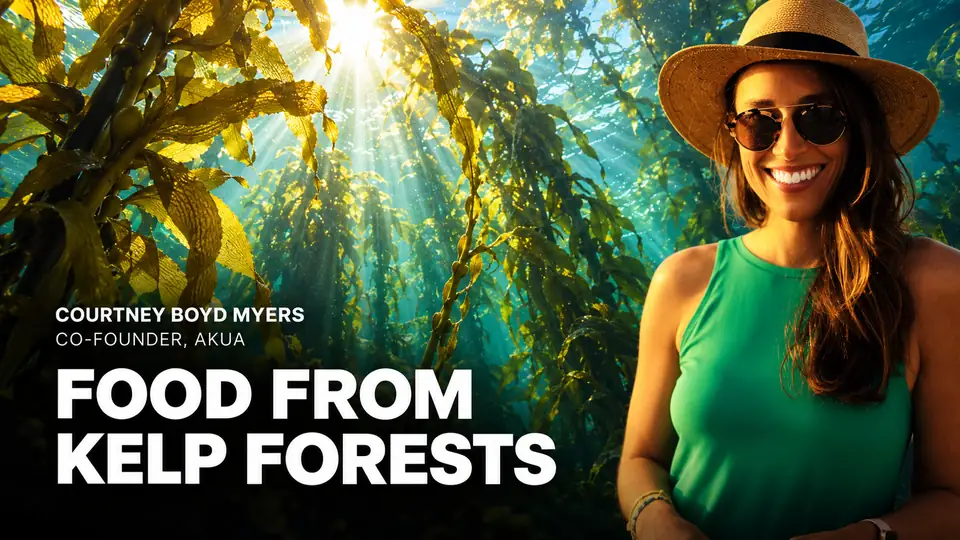
Courtney Boyd Myers — Akua & Kelp
Courtney Boyd Myers describes her path from journalism to co-founding AKUA and explains why she chose kelp as a food ingredient.
October 15, 2021 · 39 min



About the episode
In this conversation, we talk with Courtney Boyd Myers, the founder of Akua. At Akua they're building a household brand for sustainable sea greens based foods including their delicious kelp jerky and kelp burger. I loved talking about the future of food, kelp and about changing global travel landscape with Courtney in this conversation.
Links
Chapters
Times follow the podcast audio. The video’s timeline may be slightly different.
- 00:00Introducing Courtney Boyd Myers
- 00:35Responsibility and innovation
- 01:38Optimism and learning across cultures
- 05:00Local action and global responsibility
- 06:34From journalism to building a business
- 09:47Why kelp?
- 12:47Food habits and convenience
- 15:46Travel and eating across cultures
- 17:28Developing the kelp burger
- 19:41Retail, direct sales and marketing
- 21:02Food choices and environmental awareness
- 23:19Trust and echo chambers
- 24:33Positioning plant-based foods
- 27:28Cultivated meat and more food choices
- 29:34Travel, culture and global citizenship
- 32:38The future of seafood alternatives
- 36:41Family and the next stage of the business
- 37:40Where to find Courtney and AKUA
Read the conversation
Open the full transcript
CAMERON WIESE: Welcome to the Build the Future podcast. We promote exciting and positive visions of the future, those who are helping build it. Today, I'm talking with Courtney Boyd Myers, the founder of Akua. At Akua, they're building a household brand for sustainable sea greens based foods, including their delicious kelp jerky and kelp burger. I'm all talking about the future of food, kelp, and the changing global travel landscape with Courtney in this conversation. So let's jump right in. What should our individual responsibilities be when it comes to like trying to innovate, but also potentially creating new challenges in pursuit of that creation?
COURTNEY BOYD MYERS: I think about this all the time because kelp farming is such a new industry, at least in the United States. And you have basically this very powerful ecosystem, which is like a kelp forest that you're recreating with a kelp farm. And this idea that like too much of a good thing, is there something like too much of a good thing? And like, what if we have these giant kelp farms all over the oceans? What are the repercussions of that that we should be thinking about? It just sounds so crazy, but like, what if we plant too many trees? But it is important to think through that because humans tend to be so dramatic and swing in so hard in one direction. The beauty of nature is that it's a balancing act, right? Humans are just fucking everything up no matter what we do.
CAMERON WIESE: There's a lot of craziness in the world, but what are you most excited about? What are you optimistic about?
SPEAKER UNCLEAR: Yeah.
COURTNEY BOYD MYERS: Yeah, so, and as you say that I'm watching this giant barge of trash just float in front of my apartment. I'm like, what am I optimistic about? I think what makes this is going to sound so cheesy, but I'm very optimistic about the generation that's coming up. I think just in the same way that my generation and people who are really active in the workforce Today are trying to do things better than our parents generation I think you know, it's only getting better But that said it's it's only a more divided world as well that we're living in which comes with you know All sorts of drawbacks. So what am I most excited about today's is probably globalization. I'm a very global person I'm married to a European we live part of the year in South Africa and Europe and America and North America And I just I really being able to see how so many different societies operate like wish that There was more of like a UN council that could be like, oh, you know who does like recycling really well, Sweden Like oh, you know who does renewable energy really well, Costa Rica
COURTNEY BOYD MYERS: Like, you know who does education really well, etc And like why are we not taking the best things from all these different countries and and learning from them and sort of dropping our nationalistic tendencies of like, we're the best. But I think like we're not maybe able to do that as nations, but we're able to do that as individuals and people, which is definitely something that really excites me.
CAMERON WIESE: That's such an interesting way to think about it, right? Cause the UN right now is more preserving the status quo, if you will. And it's this kind of bureaucratic organization that's mostly, you know, well, I think when like, most people think of globalism, they're like, oh, you're like selling out jobs to other countries is to enrich a certain subset of the population. But what we really should be doing is how do we appreciate the globe and the unique cultures in each and every country? Then how can we learn from each other and how can we collaborate? Because we are all kind of stuck on this giant rock together, whether we like it or not. So if you're able to get along and share knowledge, the better off we'll all be.
COURTNEY BOYD MYERS: That's so true, especially in the context of climate change and what we do in New York City affects people all around the world. And we have a country that is responsible for more pollution and more CO2 emissions than like, I don't know the exact stats, but probably many, many, many countries combined. And I think it's, you know, I think it's US, China, and India that are our top three emitters. And, you know, especially in the US, like we've built our economy off the back of fucking the planet up. and now we're talking to countries like India and we're like, I'm sorry, but you can't do what we just did because now we know it's bad. And they're kind of like, we'll know like we want cheap electricity and cheap power so that we can grow our economies too. And like, who are you to tell us we can't do that? So unfortunately, you know, some of the poor places in the world are the ones that are most affected by climate change and are the least responsible for. So yeah, it's very, very, very sad. And as much as I try to think about how to
COURTNEY BOYD MYERS: solve the world's problems, like at the same time, like you, you have to fix what's wrong in your own backyard first, you don't have to, but at least that's what we're deciding to do. Yeah. Well,
CAMERON WIESE: I think this is, this brings up an important point. Like it's, it's always like, so like a lot of things are like always someone else's problem, especially on the global scale. It's like someone else to take care of it. Someone else to take care of it, which I think definitely shouldn't be kind of avoiding global challenges. But there's also a lot of local community things. Why do we focus so much on what's going on in other countries when we have problems in our own backyard as well? So it's almost like how do you balance the two of solving problems on a global scale, but also making sure that your home, your neighborhood, your community is well taken care of, and people are fed and they're healthy and they're educated and all these sorts of things.
SPEAKER UNCLEAR: It's an interesting mix.
SPEAKER UNCLEAR: Yeah, definitely.
COURTNEY BOYD MYERS: And I think as people who are looking at starting an impact business, which it sounds like most of your readers are in that bucket, it can be really overwhelming because there are so many problems and there's local problems, there's national problems, there's global problems. And I think the most important thing is just to start building what you feel like your heart is telling you to do. I know a lot of people who left America and are living all over the country and fixing issues that feel near and dear to their hearts. You know, I think also making sure that you're the best suited person for that role and making sure that you're if you are entering a different culture that you're doing so with with grace and and not just, you know, kind of being that American in the room trying to fix everything.
SPEAKER UNCLEAR: Right.
CAMERON WIESE: How did you land on what you're doing now?
COURTNEY BOYD MYERS: Yeah, it's a very long journey. So I'm 36. You know, if you looked at my LinkedIn, it's like many, many, many pages long. I've done a lot of cool stuff over the years, worn many hats. So I graduated into the 2009 financial collapse. So I know how horrible it must be for people who graduated last year and really hard to find jobs. And I had graduated in 2007, so I had a job, but then I got laid off in 2009. And it was really tough. And I was a journalist and I think getting laid off though was such a huge, huge benefit because that's when I started being a freelance journalist. And when I was a freelancer, that's quite entrepreneurial. You have to set up your own health care. You have to manage your own income, making sure your expenses are paid. It's kind of a micro, micro, micro form of entrepreneurship. And so that gave me the confidence that, oh, wow, I can do things on my own. And it's funny because in 2009, when I got laid off, that was the last time I was on a W2. And this month at Akua, we're starting to take salaries for our first
COURTNEY BOYD MYERS: time. So I'm going back on a W2, you know, like 12 years later or something crazy like that because this entire time I've been hustling and in running agencies and consulting and you know, it's just been really on that fiercely independent track. So I went in, you know, continued in journalism, which I think is an amazing career to choose if you're insatiably curious and want to learn about things. Every time you write an article, you become a mini master in that topic. And then I loved marketing. I moved into marketing. I moved into a sales role, an amazing events company, a community called Summit. Loved sales, actually, which I feel like a lot of creatives and potentially people who to start impact businesses and are like, sales, but sales is the backbone of any business. And it's really important to balance wanting to build something impactful with wanting to have money and make money because money is unfortunately what makes the world go round. We can't pay our rent in shells. It's like hiring the best talent takes money and investors invest in businesses
COURTNEY BOYD MYERS: that make money, etc. I think getting really comfortable not only selling something, but selling yourself is really important when building a business. At Summit, amazing community of people, definitely worthwhile checking out summit.co. It's really just like a festival for entrepreneurs. I met so many cool people like the founder of Four Sigmatic and the founder of Smarty Pants, Vitamin Gummies. These two founders became investors in Akua, I told them what I wanted to start. They were really supportive. And so a lot of other investors we've picked up along the way, but it was those kind of early conversations when I was telling them my idea. And that's what's so important about surrounding yourself with really supportive entrepreneurs when you're starting a business because it's totally crazy to go out on your own and start a business. And you need that kind of support from people and guidance and having them show you the way as much as they can.
CAMERON WIESE: When it came to landing on creating kelp products, what was the insight there? Walk me through your thought process there. What were you seeing and then how did you end up landing on creating kelp products?
COURTNEY BOYD MYERS: I've always loved seaweed. I've always been that weirdo looking for cool things to eat from seaweed and ordering multiple seaweed salads at restaurants. I love seaweed. I was thinking about climate change very seriously as I turned 30. I wanted to dedicate my career in some way to it. And I had a friend who just was like, hey, you should come out and visit this kelp farm. His name is Brendan. He's now our independent board director, which is wild. And I learned all about the environmental benefits of growing kelp. So we all know what a kelp forest is, but what's really cool about this new industry is farming kelp. We plant the kelp in the fall. We harvest in the spring. It's a completely regenerative crop. It's growing food at scale that's nutrient dense without using fresh water and dry land, which are our two most taxed resources when it comes to climate change. We also don't use fertilizer, which is poisoning our oceans and we don't use feed because it's not an animal. So a zero input crop. And then as we plant these kelp farms, same thing as you're planting a forest on land,
COURTNEY BOYD MYERS: the kelp is sequestering carbon and nitrogen as it grows. So it has really positive sequestration benefits for the oceans. So I loved that. I loved the fact that all these people who were growing kelp were fishermen who were looking for ways to augment their income. And I love this idea of kind of this transition from ocean hunting to ocean gardening. And then the last thing was just I loved kelp and I knew how healthy it was. And I grew up in a family where my dad was a big food marketer like Burger King and Pepsi and Frito-Lay and Kellogg's and just all these big brands that are responsible for making really crappy food and creating a really sick obese population and just getting people hooked. And I just thought, God, I care so much about what I put in my own body and what the people I love put in their bodies. And so I want to create products that you just know are going to be good for you and good for the planet too.
CAMERON WIESE: I was having a conversation with someone recently talking about the food industry and how the big food companies hooked us into consuming these processed foods, the high sugar foods, and it's really destructive. But now we're seeing this resurgence in the food scientists who helped create those systems are now shifting to go work on more pro-social, pro-health projects. Aside from that, what do you see as the way out? Right? Because we have a lot, there's this niche pocket of healthy foods being produced. The future food industry is growing slowly but surely. We have a broader problem of addiction to unhealthy foods. It seems like we're kind of in a tight spot around. When you came to think about
SPEAKER UNCLEAR: this, how do you think about... How do we get out of this, Courtney? I think it's just habits.
COURTNEY BOYD MYERS: There's so many times in my life when I stop eating sugar and then I'll have something sweet. And I'm like, whoa, that's really sweet. And it's the same thing with anything. Like it just takes time. I committed a couple of years ago to intermittent fasting. And I was like, oh my God, how am I ever gonna give up breakfast? And now I can literally eat whatever I want for lunch and dinner. I do like 15, 20 minutes of yoga a day and never gain weight. And it's all from intermittent fasting. And now if you told me I had deep breakfast, I'd be like, oh no, I don't want breakfast. And that's just one of many examples. So it's like, you know, you might think one of these amazing women works for us. She's from Texas, like Houston, and was eating meat almost every day of her life. And then when the pandemic started, obviously we all had to start cooking all of our meals and she realized how much meat she was eating. And it's so different to cook meat for yourself every day versus just ordered a Chipotle or whatever. And so she was like, I'm going to go plant based.
COURTNEY BOYD MYERS: And she went completely plant based during the pandemic and hasn't looked back. And I think so many people have those stories of like, you know, Ooh, I don't really want to, you know, like make meat every day and like see that blood, but I, you know, maybe now they'll eat it in a restaurant every so often when they go out and they don't probably miss it as much as they thought they did. And so it's all just about breaking habits and mind over matter on that kind of stuff.
CAMERON WIESE: It is super easy to get into routine too. And you're like walking to the office like, oh, I'll stop at Chipotle for lunch. And like, you're kind of abstracted away from the problem of like what you're eating and where your food's being sourced from. But if you have to cook it, like, oh man, this is what I'm eating. This is what's going into it. It's expensive. It's costly. Yeah. To your point, like gives people, give people like a reframe in their perspective.
COURTNEY BOYD MYERS: I mean, I'm sure there's a lot of people who Uber eats every meal for the entire pandemic, but But in general, those who did cook at home, I'm sure learned a lot. What we love about our kelp burger, it's just our hero product is this is meant to cook up in four minutes per side, so eight minutes flat from frozen. So it's meant to be a really fast meal, faster than any Uber Eats, taste delicious, and be super healthy for you. And that's, I think, marrying healthy eating with convenience is something that is what what I believe is kind of like the next frontier of food and truly healthy, convenient food. And again, back to the beginning of the conversation, like I'm a frequent traveler, right? And so for me, I'm always like, what is healthy that I can like eat fast or put in my bag on the go, which is why we invented kelp jerky, like super, super healthy, throw it in the bag, shelf stable. And yeah, I think, you know, from a perspective of busy moms that works the same way and just busy people as we return back to the workforce as well.
CAMERON WIESE: Well, that's the other thing I wanted to talk about. If somebody travels a bunch, how do you think about what you eat when you're traveling around different countries, different cities, given the low friction nature of fast food? Is it just making conscious choices,
COURTNEY BOYD MYERS: forming habits? Yeah, I never eat fast food. Basically, I eat incredibly intuitively. So like what am I in the mood for? So, you know, if I want pizza, I'll eat pizza Like if you know, I just I eat whatever my body tells me I want But yeah, I mean look like I only go to places where I know I can access healthy food I've definitely been to some food deserts in the middle of nowhere where like generally food manufacturers are and You know have gone to a panera because that's the healthiest thing or i've eaten An rx bar for lunch and because that's like, you know, I couldn't get a sweet a sweet green salad But yeah, I mean, I think, you know, the vegan plant-based movement, healthy food movement is really like all over the world now. Like I, you know, I spend time in Cape Town, South Africa. They have like more healthy food restaurants than New York City, like not on the probably scale scale the approach, but on a per capita approach. And then, you know, in Portugal, where we spend a lot of time, you know, it's just, it's just old school, right?
COURTNEY BOYD MYERS: It's like all the fresh seafood, like all the fresh vegetables, like tomato jams that your grandma makes, like, you know, in that there's no process. I mean, there is process through there, but it's just not a part of the diet
SPEAKER UNCLEAR: the way it is in America or the culture.
CAMERON WIESE: Yeah. Like you see that when we travel, like the culture of fast food is definitely prevalent here in the U.S. just because of the industries that I have propped up around to support it. But internationally, that doesn't seem to be the case. I'm really curious. Like, can you talk talk me through the process of like how you ended up creating the burger? What goes into that? Sure.
COURTNEY BOYD MYERS: So we launched Kelp Jerky in April 2019. And we learned that for a couple of reasons, the Kelp Jerky was not going to be like our go big or go home product that we would be launching in Whole Foods with or just going big. And so we went back to our original mission and thesis, which is creating meat alternative products made from ocean farmed kelp and thought, now is the time with the pandemic to return to that center of plate concept around burgers and crab cakes and sausages and nuggets and all these products we've always wanted to make but we started with jerky because it was shelf stable and it just felt like you know an easy product to start with easier but it wasn't it was a very hard product to make and that's what's really important too about creating products is you need to create products that scale right so jerky each piece is in a custom mold it gets pulled out of a dehydrator It's temperamental with burgers. There's a lot of people that know how to make burgers out there whether they're plant-based or more meat
COURTNEY BOYD MYERS: So we were lucky to find some great manufacturers for the product. So yeah, we you know My co-founder Matt came up with the recipe he sent it out to you know myself and some key stakeholders We iterated together my husband was really helpful actually because he's a trained chef So he was like giving Matt great feedback And then at a certain point we were comfortable selling it to our customers because we didn't really have money to pay for product development. It was like the pandemic, we'd kind of burning through the cash we had raised in the first round for the kelp jerky. And so we went at it where basically we launched the Kelp Bader Burger Club. And over six months, 1000 customers purchased the kelp burgers, got them delivered to their door during the pandemic. And they were excited about that. And then they gave us feedback. And so for six months, we iterated based on customer feedback, and then kind of came with this final recipe. And then we able to raise our next round of funding. And we launched the official Kelpburger
COURTNEY BOYD MYERS: direct-to-consumer in May of this year. And then at the end of the month, we're doing our retail launch, which is really exciting.
CAMERON WIESE: Amazing. How do you think about the transition from the direct-to-consumer to then the distribution through retail?
COURTNEY BOYD MYERS: Yeah. So direct-to-consumer is definitely a lot of fun. I prefer it because I get so much data on customers, I get to email with them directly. But with the grocery store, you get scale. And you also like with the frozen product, we have to sell a 12 pack on our website to make it worth it plus 20 bucks in shipping. It's quite expensive. You're really not getting off of our website to try the kelp burger under 50 bucks, which is a lot of money. But this will be under 10 bucks, grab it from a store, try two kelp burgers, and it's a much lower barrier to entry on trying a product. That's why that's very important. And then, I think just reaching people who aren't buying their food online, right? Even though a lot of people are and pandemic stuff, still, the majority of folks go to grocery stores or at least Instacart
SPEAKER UNCLEAR: from grocery stores.
CAMERON WIESE: Yeah, Facebook, Instagram ads only take you so far.
COURTNEY BOYD MYERS: Well, we learned that the hard way this summer when everything tanked because of the iOS changes. Yeah, that was real pain. And now, you know, we're sort of figuring out new marketing budgets and new ways to spend money to attract customers. But yeah, I think to your point, it's dangerous to build a business on Facebook and Instagram ads.
CAMERON WIESE: Yeah, but it's cool. Like I went to the changing landscape of like our grocery stores and retailers, like people go in like they're looking for choice, right? Especially now, everyone's looking for healthier options, looking for, you know, sustainable options. Like, I don't the sense that I get, and I'd be curious to know if you agree with this, it seems like over the last, not just pandemic driven, but like last three to five years, there's been this cultural shift to really being cognizant of the food you eat and the ingredients that are in it and the sustainability aspect of it. Seems like this is something that's been brought into the limelight.
COURTNEY BOYD MYERS: Yeah, looking at films that really showcase the environmental destruction around eating meat or just eating crap. I think that's woken a lot of people up to thinking about what we call the food print. So it's like your climate, your CO2 footprint, but this is your food print. And there's so many great stats, and I can't remember them off the top of my head, but that just switching to plant-based five out of seven days a week makes a huge difference in annual CO2 emissions. And that's just on top of the kind of questioning an animal morality thing when you look at these mammals, which are like us, that care about their young, that breastfeed their young, that carry their young. And it's just heartbreaking to see these factory farm setups. And because of social media, companies like PETA have been just armed with the ability to capture and share this content and have it go viral. And yeah, I just think like, I don't know how you can look at those videos and feel the same way
SPEAKER UNCLEAR: about eating meat. Oh, yeah, it's bad. Yeah, it's horrible. You know, for all the challenges,
CAMERON WIESE: like of social media, like this is like one of the shining like components, like this information access information was not like this wasn't accessible 10 years ago, right? And so, yeah, there's a lot of things we need to fix challenges to promise to solve, but we can now distribute information like about, okay, what is actually going on at factory farms versus like, what is the narrative that's being kind of promoted through like
SPEAKER UNCLEAR: their PR channels?
COURTNEY BOYD MYERS: Yeah, I think we then totally lied to by so many big food companies and governments that are sponsored by those food companies and social media has definitely, you know, had benefits on unveiling some of those truths, but unfortunately now my big problem with social media is like the echo chamber effect. I'm like, oh, gee, like all of my Instagram people are, you know, this anti this new abortion law or their pro animal rights. And I'm kind of like, obviously, that's why I follow them like, their heads head screwed on straight. But sometimes I like following people that have opposite viewpoints of mine because and looking at their comments and understanding just how many people in the world and we see it on our Instagram ads for Kua It's like it's not a burger unless it's meat like I'm not eating it unless it's bleeding Like screw you and your hippie vegan shit. Like I mean it's and I'm like Facebook targeting is like not doing a good job, right?
COURTNEY BOYD MYERS: So, yeah, I mean, it's just there's just a lot of people out there that don't agree with anything I'm saying and think what I'm saying is a load of shit.
SPEAKER UNCLEAR: And it's sad.
CAMERON WIESE: What do you think the narrative is that like people aren't buying into like where do you think this kind of tension is coming from. I asked this because I think like by by kind of shining a light on it we might be able to kind of figure out like what a new narrative might look like or am I going to kind of get people to the point where they're like, oh yeah, actually this makes sense.
COURTNEY BOYD MYERS: You know, I think we're beyond impossible have done a great job is creating a product that really mimics me. And then where they've lost people is like, the whole like, wait a minute, there's like 50 ingredients. Why is this healthier for me than me? And then that's where their business sort of falls apart, but are not business. But that's where that argument for a meat eater would fall apart. It's like you need to create products that are healthy and mimic meat. And I'm not saying the kelp burger is that. I mean, we're certainly healthy, but it's not going to trick you that this is a meat burger. Our goal is to give you something that is as satiating and delicious as you might feel a meat burger is, but we have to make that trade off. We don't use chemicals or weird process ingredients to mimic meat. And so we're not doing this as a company. We're 100% vegan, But I think it's really interesting for the companies that are going out there and they're doing less meat so they're doing sausages or burgers that are like 50% vegetables 50% meat and they're
COURTNEY BOYD MYERS: targeting the consumers that you know are anti vegan shall we say and and just helping them eat less of it and I think that's kind of where that new narrative can be. It's like you don't have to be vegan You know and you don't have to be a carnivore maybe you can just be more plant-based a few days a week. And we really try to work with a lot of plant-based influencers who are like male athletes, because I think so much of the eating meat is tied to like toxic masculinity. And I just, yeah, it's really sad because like, I know guys who just order meat because they feel like embarrassed if they order a salad, but they really want a salad. And my friends are like that, they all order salads, but that's a real thing, especially with kids as they're growing up. So yeah, I think the more we can normalize plant-based eating and make it look cool, that's why companies like Beyond and Impossible are awesome. It's like they have these huge budgets and they're working with big time celebrities who are coming out and saying, I'm eating plant-based
SPEAKER UNCLEAR: and that stuff really works. To your point, the challenge is when you start looking at the label
CAMERON WIESE: in the back of the box, you're like, what is in this? And it's the process of refined oils that have arguably made so many people so sick of the last 30 or 40 years as the prime ingredients. There's got to be some middle ground to strike. It's like we can have healthy foods that are sustainable and that do provide you with the nutrition you need, but are not running counter to everyone's health.
COURTNEY BOYD MYERS: Yeah, I think it'll get there. I mean, I think in the future we will have a lot more normalization around lab-based meat, so meat grown in a Petri dish. And when folks are kind of weirded out by that, I just don't get it. I'm like, oh, why? It's not a burger unless you killed something. That's so messed up. And if we have affordable lab-grown meat, and then we don't need to eat weird things like Beyond an Impossible, and then it's kind of like, all right, then the kelp burger makes a lot of sense. if you still want something that's plant-based but is delicious. So I think this kind of middle ground Frankenstein stuff is really just a stepping stone as we get the price and the tech more advanced around the left-grown meat, which I think is amazing.
CAMERON WIESE: It's almost like things like the kelp burger and beyond burger. They're almost like their own unique culinary experiences. Is that perhaps one way to frame it where it's like, hey, yeah, there's lots of options. What are you excited about? What do you want to taste? What sort of
SPEAKER UNCLEAR: gambit of different options for people. Yeah. I mean, I think that's one of the things we love
COURTNEY BOYD MYERS: about the kelp burger is because it is like a mushroom and an algae based burger. And if you're looking at like all the other plant-based burgers out there, like it really stands out as unique. And if you are following a plant-based diet, it's so important to have a diversified plant-based diet because you're going to get bored of beans and tofu very soon. And then you kind of maybe fall off the bandwagon, but I never get bored eating plant-based, but I also don't get bored eating the same thing every day. So I think there's some people that really need variety in their life. I'm just not one of, like I could eat avocado toast and like a kelp burger for like, and then like some like green spicy Thai for dinner and that'd be like every night.
CAMERON WIESE: Easy, easy, green spicy Thai every night.
SPEAKER UNCLEAR: I love Thai food, it's so good.
COURTNEY BOYD MYERS: Like everything feels so fresh and you know, it's just rice and vegetables with like these sauces. It's so nice.
CAMERON WIESE: And then you get the patsu and like, it was just like the right amount of spice on there.
SPEAKER UNCLEAR: That's a little naughty.
COURTNEY BOYD MYERS: I don't usually do the noodles, but when my husband's with me, I do.
SPEAKER UNCLEAR: And they're so good.
CAMERON WIESE: I did some kind of backpacking, like most people in their mid, most white dudes in their mid-20s through Southeast Asia and through Europe. And it was just like, the food was fantastic. I remember I spent some time in Singapore and the hawker stalls trying to eat a high niche chicken or just exploring all the different culinary dishes. This massive cultural experience, which you don't get if you're staying in the US and eating what everyone else is eating, which is really cool.
COURTNEY BOYD MYERS: I think it's one of the saddest things about the pandemic for me, from a travel perspective, is like we brought on all these amazing investors from Hong Kong and Singapore and Tokyo and I just so badly want to go visit them and like obviously like tour all the things that are seaweed about those cultures because they've been eating seaweed every day for thousands of years and and yeah it's just like that for the world is so shut off to us right now and I don't know when it's coming back and it's just sad but when it does come back I'll be there and I'm so excited I've never, I've only really been to Thailand. I've not toured too much else of Asia.
CAMERON WIESE: You know, globalism kind of has this like negative connotation. And there's, in the amount of people that there's this other perspective, it's like internationalism, which is kind of like the Anthony Bourdain, like, go travel, you know, and appreciate every culture for like, what is unique about it, right? So instead of trying to make Bangkok more like New York, like, how's Bangkok like, as Bangkok as it can be, right? Or Cape Town, right? It's like how do like these cultures kind of preserve their uniqueness and then kind of bring that to the world stage and kind of maintain this like excitement, right? Because we don't want every city in the world to look and feel the same. I don't, like I want to be able to go to other places and see cultures and like see things for as they, as the people who live there like viewing them versus you know what they're consuming and trying to like mimic from like the American
COURTNEY BOYD MYERS: mainstream media. Absolutely. That's really important especially as we look at like you know, how many McDonald's there are all over the world. And like, we certainly don't want to continue to export our what we would call US culture. And I don't, I think it's hard, you know, because we also increasingly want to connect with people. And so English is becoming, you know, just so the language of business internationally, and that skill could tip and it could be Mandarin and 20 years. And, you know, that's a little scary for us Americans. But at the end of the day, you know, I think that there is that again, getting to the beginning of our call, that increasingly global citizen who does seek out things that are different than him or her. And that's really one of the only, it's such a thing to hold on to and to support in this very polarized American world of kind of red versus blue, is just taking ourselves out of that and realizing that it's just one country out of hundreds and we all need to to be better connected and take care of each other.
CAMERON WIESE: I want to circle back briefly on the kind of cultured meat space. Like from kind of your perspective, like what are some of the exciting things being worked on? Are there any companies you're following? What are the implications of that system that excite you the most?
COURTNEY BOYD MYERS: Yeah, you know, there was a great article that came out in a publication called the Green Queen. She's out of Hong Kong and it was like around women's day. And I was like, all these women that are behind these plant-based products. And it was amazing to be on the list, But what was so cool is just how many other women are building not just plant-based food companies but these really technical cell lab-based meat-alt companies and all over the world too. And I just don't know all their names off the top of my head, but there's a lot out there that are coming. And personally, so I've never really enjoyed eating meat. I just didn't like the idea of eating my own flesh, but I've always loved seafood. I grew up near the seashore. A lot of my friends are fishermen now from starting Akua. I get fed ridiculous seafood from just being in the industry. And it's so sad, obviously, seeing Seaspiracy, it's devastating to continue to support that and feels really kind of out of line with my mission in Akua too, but I'm just so excited for the idea of plant-based seafood.
COURTNEY BOYD MYERS: And I imagine that's how someone might feel about plant-based meat, if they really are a steak eater. And so yeah, the idea of having like a lobster roll that's not actually a lobster.
SPEAKER UNCLEAR: Like that's awesome. I'm here for it.
COURTNEY BOYD MYERS: You know, plant-based scallops, like the whole thing.
SPEAKER UNCLEAR: I can't wait.
CAMERON WIESE: I'm curious from your, like your perspective, like is there a difference between, or I guess what you think about, you don't enjoy eating meat or like, let's say lobster for some, so it's like caught and then turn into lobster roll. It's like no bueno, but if it's like cultivated and like grown in a lab, is that kind of like forced to like view it differently? Like, does that consume a bit more manageable?
SPEAKER UNCLEAR: Oh, yeah.
COURTNEY BOYD MYERS: I mean, it's totally different, right?
SPEAKER UNCLEAR: You're not killing something.
CAMERON WIESE: So that's kind of like how you think about it. Is there death involved in this process?
COURTNEY BOYD MYERS: This is going to sound very hippie, but I really do believe that we absorb the adrenaline and cortisol that's released in animals' bodies right before they're killed. And it's like, obviously you see that with mammals and you see it a little less so with a sea bass. But I've seen lobster killed a lot this summer, and they do not want to go into that pan. And that is so sad. And there's people out there who are like, no, but that's man's dominion over animals. We're meant to kill them. That's the food chain. And I do understand that. I know, I'm not hippy enough to believe that we were put on this earth to just eat twigs and berries, but still it's like, well, if we could just let nature rest and maybe on very, very small scale of farms, you know, where you can go to a local butcher that's raised a cow until it was old and died, but we just can't feed a growing planet like that. And so in order to sort of get the type of supply we need to hit the demand we have, we need to have this lab-based meat or plant-based
SPEAKER UNCLEAR: meat alternatives.
CAMERON WIESE: I think like the future where all these factors are able to like kind of be propped up in different parts of the world. One, then we can reduce the movement factor. I was reading this study where there's some product or the salmon that's caught in Alaska, it shipped over to China to be deboned and then shipped over to the US. Why are we doing this? There's a terribly wasteful cash drop to the planet.
COURTNEY BOYD MYERS: It's insane. They do that with chicken too. Literally, we send chicken to China for processing and then it gets sent back. It's like we kill it here, we send it to China, it gets sent back for packaging and we sell it in a grocery store. And there's so many things that are messed up about that. Like we have to take China out of our supply chains when it comes to just sending things there
SPEAKER UNCLEAR: because it's cheap.
CAMERON WIESE: Outside of the food space, what are you most excited about for the future?
SPEAKER UNCLEAR: What are you optimistic about?
COURTNEY BOYD MYERS: I'm entering like a new phase of my life with my husband. We're likely going to have a child soon.
SPEAKER UNCLEAR: Okay.
SPEAKER UNCLEAR: Exciting.
COURTNEY BOYD MYERS: Yeah, I think that's really exciting. I've put it off a little while, like a theme 36. I think it's just been really the most perfect timing. The business is finally getting to a point where we have a big team around it. It's not just me running it. I'm able to take a salary now. It took us a long time to get here. We started working on the business in 2017, so that took us four years. It doesn't take everybody that long, but it did take us that long. So, I'm really proud of where we've come. We're far away from being a success. We still have so much work to do, but I think the fact that now I finally feel like, okay, I'm ready to have a family and enter that chapter in my life is pretty amazing.
CAMERON WIESE: Love that. Cool. Courtney, where can people find you? Where can they find the cub jerky cub burgers?
SPEAKER UNCLEAR: How can they support Akua?
COURTNEY BOYD MYERS: Yeah, thank you. We are on Instagram at life, Akua, AKA, and yeah, we have a website. We sell everything. I'm CDM on Instagram, so feel free to connect on either platform. Thank you. Your podcast is awesome. Thanks for having me on.
CAMERON WIESE: Thanks for joining us for another episode of the Build the Future podcast. If you want to support the show, please share your favorite episode with a friend. If you want to get updates on the events we're hosting, new podcast episodes, and follow along as we build the new World's Fair. You can follow me on Twitter at CAMWISE. Until next time,
SPEAKER UNCLEAR: go build!
More episodes
All episodes Justin Kolbeck — Wildtype & Cultured SalmonJustin Kolbeck explains how Wildtype approached scaling cultivated salmon beyond its first pilot plant.
 Jason Green — Vertical Farming & FoodJason Green describes Upward Farms’ approach to growing leafy greens and fish together, and makes the case for regional food production.
 Dr. Celeste Holz-Schietinger of Impossible Foods — The Future of Food, Sustainability, and MeatDr. Celeste Holz-Schietinger explains how Impossible Foods studies flavor and texture to make meat from plants.