

Build the Future Podcast
Samuel Ian Rosen (“Captain Planet”) — Water, Plastic and Tap
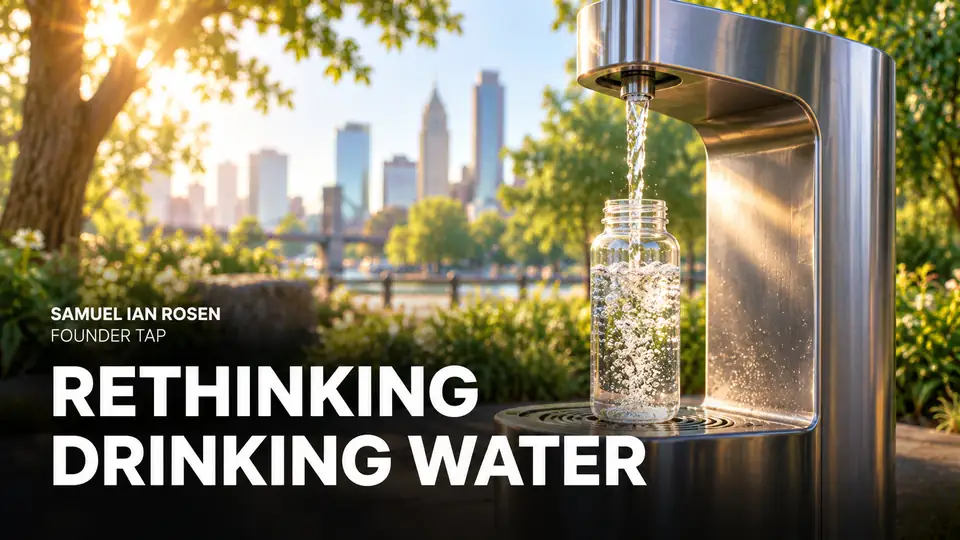
Samuel Ian Rosen discusses Tap’s approach to finding water stations and connecting water infrastructure to software.
February 9, 2021 · 46 min



About the episode
In this conversation, we talk with "Captain Planet," born Samuel Ian Rosen, founder and CEO of Tap. At Tap, they're democratizing access to clean water by connecting water to the internet.
We talk about the future of water, America's water problem, greenwashing, water ATM's, and how all of us should be thinking about our relationship with water.
Links
Chapters
Times follow the podcast audio. The video’s timeline may be slightly different.
- 00:00Welcome and introducing Captain Planet
- 02:34Connecting water to the internet
- 07:47Finding and understanding water stations
- 13:43Plastic packaging and incentives
- 18:52How water ATMs work
- 23:24Water quality and the information gap
- 30:46Rethinking our relationship with water
- 41:34Finding Tap and joining the conversation
Read the conversation
Open the full transcript
CAMERON WIESE: Welcome to the Build the Future podcast. My name is Cameron Wiese and I'm your host. I've always been fascinated by the ideas and the sentiment that drove American culture in the 1960s with the space race. A culture galvanized to dream about the possibilities of tomorrow. Whether it's food, transportation, cities, biology, or anything else, it was this cultural mindset rooted in optimism, that the world tomorrow would be better than the world today. A mindset where people were compelled to build things, and I quote JFK, not because they were easy, but because they were hard. It's this desire to build and to dream that seems to have been lost, and it's something we're here to bring back. With Build the Future, we're here to promote the ideas and stories of those who see how the future can be better, and promote their plans to get us there.
CAMERON WIESE: It's our mission to get you to dream about the possibilities of tomorrow. Dream about the future that you want to live in, and inspire you to go build. Today, we're talking with Captain Planet, born Samuel Ian Rosen, the founder and CEO of TAP. Hey TAP, they're democratizing access to clean drinking water by connecting water to the internet. I absolutely love this conversation with Captain Planet and know you will too. Let's jump right in. Captain Planet, I'm very stoked to have you on today. Can you tell me about the future you're building with TAP? What's the vision?
SAMUEL IAN ROSEN: The vision of TAP is to connect water to the internet. Water is our most valuable resource and it's completely mispriced. It's wasted. We don't know what's in it. And frankly, we don't even know where it is. And I figured that out for myself when I searched on Google Maps for Water Fountain a couple of years ago. And when I couldn't find a search result for Water Fountain on Google Maps, the company that has all the information in the world, I realized there was something not right about one of our most basic systems, the ability to find and drink clean water. So TAP's mission is really to democratize access to clean drinking water, and in the process of that, eliminate the need for packaging it up in single use plastic bottles by connecting water to the internet and creating a marketplace for TAP water.
CAMERON WIESE: Tell me a little bit more about how you're approaching doing that. Because yeah, it is frankly, it's absurd that you can't go on Google Maps and see where to fill up your water bottle. Instead you have to resort to going into the 7-Eleven or the Kwik-E-Mart grab a plastic bottle.
SAMUEL IAN ROSEN: And part of that is because there's an economy behind the status quo of packaging waters up and shipping around the world. And for hundreds of years, these kinds of wells, magical healing properties were kind of lore of how people would get better. Drink clean water is today's version of it, right? But back in the day, it was like cholera and all kinds of outbreaks and people had diseases and it was like, well, this magical well, that magical well had like iron in the water. We know the chemistry of it today, but back in the day, it was literally just magical. The challenge is that this paradox and Adam Smith talks about this of the diamond in the water paradox, if I recall correctly, but you know, the more scarce a resource is, the more valuable and the more abundant it is, the less valuable. So diamonds are extremely, quote, rare, they're controlled in the market, of course, but you know, they're valuable. And here's clean water, essentially, is available everywhere. People who are dying, by the way of water is not dying of thirst, they're dying of bad water. So it's not like water is not available. It's not that they're not dying of thirst in the desert. They're dying because of issues with the wall. So how do we solve this paradox? And the paradox is best seen at the airport where you can buy a four or five dollar bottle of water in a plastic crushable bottle that lasts 450 years and only 10% of get recycled or you can go to the water fountain and fill up for quote free and I believe that's a bad thing and the reason is because there is no
SAMUEL IAN ROSEN: economic incentive then to maintain that water fountain to build new ones to change filters it's a scene as an economic cost on the system. So what politicians like, yes, I need to, it's almost like it's mandatory to build water fountains into stadiums or airports, but they're not on every street corner. And if there was a water fountain on every street corner, we wouldn't need to package up bottled water and ship it around the world, especially if it's clean drinking water. So what TAP does is creates software for two sides of a marketplace. People who consume water and hardware companies or organizations or facilities, whatever, that dispense water. Every water fountain has an owner, whether it's in Central Park or an airport or a school. Someone built that station, so they paid for the physical station itself.
SAMUEL IAN ROSEN: They pay for maintenance on that station. People have to clean the station. They pay for parts and service. Let's say filtration, filters need to be replaced. But they get no economic benefit back. The reason why is that people believe that water is a human right. And I agree with that 100%. A very contrarian point of view that was raised by the UN's first special repertoire on water a few years ago was that water is a human right and it can have a price, which was something that the nonprofits were like, wait, wait, wait, what about people's rights? That means it doesn't, you know, the people will be priced out of it. And it's like, well, actually, if water is more than nonzero in terms of, let's say you go to a water accountant and you pay five, 10, 15, 25 a sense for water to be dispensed, what would that mean for the actual infrastructure?
SAMUEL IAN ROSEN: And part of what the issue is in water is that we have a very old decaying water system that costs billions and billions of dollars a year to maintain, and there is no money flowing into it. So the other side of that marketplace of the dispensers is the refillers. People pay for water at their house, and these are usually with monopoly companies that get regulated, you know, water companies that are utilities. So monopoly does exist in the ecosystem. You know, when people get their water prices raised, even the slightest bit, people throw their hands up in like in a huge storm. Like, you know, the classic example is like, you know, saving water during a drought in Las Vegas, or what happened in Chennai, India. And what people haven't realized yet, the consciousness of society has not woken up to yet, is that we are a freight train or from back to the future, we have gone past the point of no return where we where we must now commit on climate change in my opinion. And we it will be about adapting to that.
SAMUEL IAN ROSEN: And climate change is water change, right? When we think of what happens with climate change, we think of melting sea caps, we think of rising oceans, we think of floods, droughts, excuse me, floods on the one side and droughts on the other side. So what TAP is doing is creating the software to connect water to the internet that in a way of a internet of water that doesn't exist today, it's a smart grid for our water systems which currently have in let's say electricity. The basic premise of how someone would engage with TAP is if they go up to a water fountain today at the airport they fill their bottle and give no consideration in return. I believe that there should be some amount of consideration given.
SAMUEL IAN ROSEN: So what TAP has built is a few things, a few digital products that we've already started with. The first is as a search engine, right? So someone can go to findtap.com, push a button, and it shows a compass of the nearest water station. Those water stations around the world, 267,000 of them, will also then be integrated into the developer ecosystem. So when I thought about how to eliminate single-use plastic bottles, I took the classic Mark Andreessen, software is eating the world, so what if software eats plastic? So I said, okay, let's put water fountains on the map, build an upload tool, go up to the station, push a button, create information about it, take a picture. Great. Now those water fountains and stations are in a database. Then take that database and make it accessible by the push of a button to geolocate where I am using my smartphone, my orientation of my phone to find the nearest station. Then put those into Strava, Runkeeper, Google Maps, Apple Maps, the entire developer ecosystem that doesn't have an easy button for water. And Waze has that button for gas stations, but they don't have it for water. And if we think 500 years from now and gas is no longer what powers our cars, water will still power us. Then it was, okay, we've now got the base layer of where water is, let's say, now we create operating systems. So I created an operating system for the dispenser and an operating system for the bottle. On the operating system for the bottles This is for people who we call consumers, refillers, who have their water bottle.
SAMUEL IAN ROSEN: They have a code, just like I have here on my bottle. It's a sticker. We'll soon be an NFC chip. And when tapping my phone or my one day, my iWatch to that bottle, I can instantly log my hydration because about 75% of Americans are chronically dehydrated. I can find the nearest water station and it starts to give me statistics about things like how many plastic bottles I've saved personally. So in that way, it's allowing someone to have this quantified self, this quantified self-movement that we've done with Fitbit and we've done with other types of calorie tracking, really starting to get that around hydration and water as the key to things is core to that. On the dispenser side, the operating system does a few things.
SAMUEL IAN ROSEN: So if you go up to that water fountain at an airport, it has a few features. One is it a push button that you have to actually manually touch or is it a sensor? important in a post-COVID world. Does it have a water filtration system? And is it a green filter status, yellow or red? What's the filter status? And also you've probably seen it, those water plastic bottle save icons of like how many plastic bottles you've seen that?
SPEAKER UNCLEAR: Yeah, like right on, it's like a little meter next to the dispenser, right? Yeah. That's right.
SAMUEL IAN ROSEN: That entire system is offline. So what I realized with nothing more than a QR code sticker and software, we can activate a webpage for that station. Think of that as of all those amalgamated into almost like a Wikipedia for water. Each one of the 267,000 stations that we have currently logged around the world has its own webpage. The data shows who scanned that QR code and updated it last, who plotted the GPS coordinates of it, who recently marked an entry on it, who left a review on it, like this water is cold, this water station looks clean, etc. What we're now building is the ability to make a payment. And once someone goes up to that station, similar to how the carbon credit marketplace started voluntarily, we will allow someone to buy their refill voluntarily. And suggested a tagline on that sticker would be something like, frontline workers keep this station clean, suggested refill tip 25 cents. If they gift 25 cents, we will give 75, 70% of that to the station owner, tap for creating the software and the marketplace will take 20% and 10% will go back to refillers like yourself and people who travel through airports and whatnot to get some type of reward back because I do believe ultimately people act out of self-interest. What that would be is let's say you gifted 25 cents it would enter you into a sweepstakes which has similar mechanisms to a lottery but legally is very different is very different in that you can earn a free entry into the reward and we think the free entry is something
SAMUEL IAN ROSEN: like adding a review, like typing is the station clean, or sending in a postcard for one entry a month. We'll stay within the sweepstakes rules, but imagine if your 25 cents then bought you entries, similar to what Paisio does, bought you entries into a $100 gift card, or tickets to the new hockey team in Seattle, etc. That's where we can start putting an ecosystem where capital is flowing into improving our tap water system. I think that's the way to get, essentially, I'm a social capitalist, get money flowing into a system that is economically and environmentally better than the status quo. And the main reason what this really comes down to is single-use plastic bottles, about 60% of the cost of the bottle is packaging and transportation, shipping it, creating carbon emissions, et cetera.
SAMUEL IAN ROSEN: So it's actually that we can provide people a better water quality. Tap water is better than bottled water. It's well known. Bottle water is not regulated, or as well as it should be, for a lower price. And that's the Clayton Christensen, I think it's deflationary economics is the word, like we lower the price, the value goes up. That is what can lead to a breakout opportunity in tech as we think about creating this marketplace. So it's really the way to eliminate the single-use plastic bottle is, one, get everyone to carry their reusable bottles, which is starting to be the 21st century status symbol. That's not my doing. And then two, it's starting to create a marketplace around really delivering people tap water. And I think the owners of the marketplace have been doing this for a while with no consideration and getting them consideration. That's really who the customer is that we serve.
CAMERON WIESE: It's really cool because you're taking the, you're adding a layer on top of the Google maps approach where people get status or points or credit by leaving reviews, by being the first one to create a place and then further incentivizing them with the sweepstakes so that they feel some sort of social or financial incentive to participate in that marketplace economy for water, which is sweet. Can you talk about what the state of the plastic industry looks like? What's the status quo right now? And why is it such a big deal?
SAMUEL IAN ROSEN: The better question is what is the state of the oil industry? And the reason is obviously plastic comes from oil. And what we just saw with COVID was what people I think in history will refer to as peak oil. Like peak driving, peak flying, and then bam. And COVID changed business travel, COVID changed commuting. And the oil companies like think about how much oil a cruise ship burns and that's like down. So like, oil is, oil got whacked. So what did oil do? Pump plastic. What did oil do? They took advantage of COVID and be like, no, actually COVID lasts on plastic, you know, on reusable bags. Now we've got our plastic bags. So all the places that started doing the plastic bag ban, no, we need plastic bags again.
SAMUEL IAN ROSEN: Never let a good crisis go to waste is the saying. The flux of plastic into our world is done by big oil intentionally. because in the New York Times article about flooding Africa with plastic. And the surprising thing to me, because like I'm a bit naive, these are like bad people who, I believe in capitalism, I'm a social capitalist. This is like about, it almost seems like it lacks morals in my opinion. Like I'm a bit surprised, but I shouldn't be, but I don't think that way. So it's hard, it's hard to grasp what other people do, but they do. that's what's happening with plastic bags, with plastic bottles, et cetera. Now, I actually think that banning single use plastic bottles like what SFO did is a bad thing.
SAMUEL IAN ROSEN: It's bad because what it will do, and it gives the plastic bottle companies like Co-Pepsi and Nestle the reason to say, well, this is bad because it's automatically going to shift people to soda, and we need to provide a beverage for them. And that's true. And I've read books from water economists to, there's one called The Big Thirst by, I think his name is Charles Frischman, excellent book about this kind of stuff and reinventing the tap water system and making the tap system better and less expensive than bottled water is the way to win. It's not about eliminating plastic bottles because what it's gonna do is gonna turn people to let's say soda. In terms of the green washing here, it never ceases to amaze me.
SAMUEL IAN ROSEN: what liquid death has done to Murder your thirst and first off like how ignorant with so many people children specifically Dying of water related disease to call it liquid death when people actually die of water I don't care how many you know barbershop people or tattoo artists or skaters think it's funny and cool like I think they're jerks I really like I I, I, it, it, you can see there's a bothers me because it's like to call something liquid death and then greenwash putting it in a can. Like aluminum is a half measure better. It is, it's infinitely recyclable, 75% of it, but it's not, it's not reinventing our system of water delivery. It's not democratizing access for all. It still has the costs associated with it. So the The answer is not for me to go after the liquid death founder or the investor who's all over Twitter.
SAMUEL IAN ROSEN: That's not the answer. The answer is to quietly build software for the existing hardware infrastructure that what's better about and why I call the company TAP is think about, let's say, an LK water fountain, a Halsey Taylor water fountain. These are companies that are literally like 75, 100 year old companies that have been delivering clean water for a long time. Pentair is a publicly traded company that makes filters for pools. They opened a clean water unit. Even DuPont has a water unit. Now they will be, they will have a big problem. I think DuPont specifically, because a lot of the, you know, the PFA is in the water that's come from Teflon and flame retardants and things that go in our clothing to fibers and couches, all kinds of stuff, but the way to eliminate completely. A single use of classic battles is to develop the ecosystem and pull them all together with software, in my opinion. So the hardware devices have no software and to pull them together through a commonly branded software application that creates opportunity to build more water stations, to get water stations profitable. The best example of that, by the way, is a water ATM.
SAMUEL IAN ROSEN: So in Southeast Asia, there's obviously a lot of plastic pollution, but in India and Africa in particular, the way these communities are delivering clean water without plastic and at a lower price is through water ATMs.
CAMERON WIESE: What are those? Can you, yeah, can you explain a little bit about water ATMs?
SAMUEL IAN ROSEN: Yeah. A water ATM is a water fountain that is gated, that one must pay to unlock. And it dispenses just like a gas station, a volumetric amount of water in liters or ounces, however you choose, but it dispenses five liters for a price. And it's so affordable. We're talking, you know, cents in the United States, rupees in India for leaders of water. And these hardware devices exist in the marketplace, in a very fragmented marketplace, with many different players, but no one software brand. So what we intend to do is to have them as our partners, as part of a platform really, for people to come to this marketplace and engage. And I think the key will be keeping the refillers incentivized through the sweepstakes and things, and kind of those things.
SAMUEL IAN ROSEN: But I do want to say 60% of bottled water is actually consumed at home. And what that is then drawing at, it's not a matter, everyone says convenience, right? My initial original thought of it not being convenience was if water is not on Google Maps, if water fountains are not on Google Maps, then it can't be convenience. It's actually inconvenience. I can't find what I'm looking for, so I buy a bottle of water. And the reason why single-use plastic bottles are drunk so much at home is because, and it disproportionately affects communities of color and lower socioeconomic statuses, the water is not good. They don't trust it. There's stuff in the water. There's, you know, I don't know if you've turned on your faucet and it's brown, but like this, this is happening.
SAMUEL IAN ROSEN: And this is more than just Flint, Michigan, or Newark, New Jersey, or Whosick Falls. Like this is, this is in many communities. So when people in mass are drinking bottled water at home, it, it means there's something more systemic that is wrong about our tap water system and transporting water to them. So the classic like get the five gallon jugs that get delivered to the office. Um, that is very expensive. A five gallon jug of water weighs about 40 us pounds. So that is heavy. That's a lot of emissions to transport it in the car. That means generally speaking, a man has to carry it. If you're upstairs, you got to carry it upstairs. So that's why women are, um, disproportionately again, kind of disenfranchised by this in Africa.
SAMUEL IAN ROSEN: We see it's almost a billion women walking 30 minutes. I think a day. So it's a lot of kind of the development stuff too. Transporting water that way is not the most efficient or cost-effective. So then starting someone, you know, to be able to go to a website before they move into a new home and see what the water quality was in that home by typing in an address, that doesn't seamlessly exist today. To look on a hotel tonight application and see that, ah, this holiday inn in Flint, Michigan has a flow water machine and that flow water removes lead. I can trust the drinking water there. It means that people will start going to Flint, Michigan and staying in the Holiday Inn again. And that starts to bring an economy, right? So it's, it's, or, you know, buying a home on Zillow, the aim, let's see the water quality score or staying in an Airbnb, being able to see that the water quality was checked.
SAMUEL IAN ROSEN: These are all the software layer that doesn't exist for water today. And that's how technology, but specifically TAP, will democratize access to the information about water itself and democratize access to clean water.
CAMERON WIESE: I'm just envisioning kind of booking my next trip and looking at the Airbnb website and be like, okay, does this place have clean water? Because this is the problem when you're like, if you do any international travel, you don't know if you go to Mexico during the US and you go to Mexico, it's like the common advice is like don't drink the tap water.
SAMUEL IAN ROSEN: And what do you do in those situations?
CAMERON WIESE: So you go buy bottles of water. You're like, well, I'm going to go buy a five gallon jug or two gallon jug and I'm going to fill up water because I don't know if I can trust the tap. So it's definitely a problem in the developing countries. But how serious is this problem in the US? I mean, we said we have Flint, we have New Jersey, like there are a couple of spots where The water quality is known to be bad, but how pervasive is this issue and how bad might it get looking forward?
SAMUEL IAN ROSEN: There's an amazing book called Troubled Water by a man named Seth Siegel. Seth primarily talks about the lack of regulatory changes, and let's say the EPA, to update for contaminants that are in the water. This is a political thing. I'm not yet in politics, but it's a very deeply political thing. And one of the reasons why, so PFAs, which came from Teflon, it's in your popcorn bag that keeps the popcorn on the inside and the oil and grease on the inside and not on the outside. It's in fire extinguishers that put out fires and the flame retardants. It's in weapons. A big reason is the United States military is one of the worst polluters in the world. And they have forced the pollution onto us as consumers by saying, no, we corporation is not responsible for the cleanup cost of this.
SAMUEL IAN ROSEN: And why would the United States government, who's one of the largest polluters, then be like, well, we have to pay for this cleanup. They're not going to, well, the current administration may be, but I don't know, I have no idea. The current, I guess, I mean, incoming. But I don't think they will either. And the reason is we're in so much debt, there's no money to do it. So it's just keep kicking. I knocked my can over. It's keep kicking the can down the road. It was very metaphorical. The United States has a ticking time bomb that has like warning, warning, warning, warning. And it's gone on and it's gone off for me. I hope it goes off for other people. Reading the book, Troubled Water will make it go off for you.
SAMUEL IAN ROSEN: But the state of Michigan, right? Specifically, I think it was around a lot of the materials that were used in the automobile industry are just, it's one of the hot spots for PFAs. There was an article recently about the chemical DDT that was in Los Angeles and these canisters, like these literally 55 gallon drums, they didn't know what to do with them and they they couldn't dispose of them. So their idea back in the day was like, let's take them to the deepest part of the Pacific Ocean and just drop them. However, the people who were hired to do this were so, I don't know, lazy, incompetent, didn't care. They just dropped them on the other side of Catalina Island. And then they find this essentially minefield of leaking DDT cans, jumps. So, you know, When I think of tap, I think of all water.
SAMUEL IAN ROSEN: I don't care if it's in a toilet, in a sink, in a shower, in a stream, in a lake, in an ocean, because what people fail to realize is that we don't create, I mean, they know this from basic science, but we don't create more water on this planet. The water that you drink was dinosaur pee. So when we then have to think about filtering water, because we don't create new water, It's here and the 1% of it that we have access to, the other 1% in the ice caps, though, I guess we'll have access to it soon. That is required to live. Most of the ocean is literally saltwater and it's very expensive to desal. So the problem that America has, in a way, is almost worse than Africa or India who is delivering clean water through a water ATM system because those countries will leapfrog rebuilding the system with the new technologies that are coming online as we speak and soon, probably next five years or so, as we really hit what will be a revolution in water abundance. The primary driver on the hardware side will be an invention called the atmospheric water generator. You ever have a basement that has too much moisture and there's that device that you plug in and it condenses the water and then you take the bucket and dump it away. That's a condenser, right? It's why an air conditioner has water in it because it condenses the moisture in the air, removes the humidity, and then it's got
SAMUEL IAN ROSEN: to have a place to discharge the water that leaks out the backside. That device will be soon commercialized. It's already commercialized where you can plug in an appliance into the wall and And it has a fan and it filters the air and it creates water out of thin air. It's magical when we don't take it for granted. It means that literally we'll be able to one day hook up atmospheric water generators to solar power panels with a battery pack and provided that there's an operating system charging money. Because if we do it for free, just like all the other water projects that go in the developing world that fail within two years, that's the lifetime. If there's an economic driver, an IoT device that's on that machine that gates it, that you have to unlock it and pay a very, very low minimal cost, I'm talking pennies, it suddenly turns a water fountain that withers away or no one cares about into a water ATM.
SAMUEL IAN ROSEN: It literally prints money. There's economic return. And people will start investing in these in the same way that they put cash ATMs into their restaurants or convenience stores or hotels, etc. and make a fee every time it dispenses money, they'll do the same thing. So America's biggest problem right now is I would think political. That is my hunch, is that we don't have the politicians that have the courage to say, and I'm talking at the most senior level, I think there are absolutely politicians in Flint and in Newark that say this, but they don't have the power. So I'm talking about at the top of the top. Let's say not Allah Donald Trump We have the cleanest air in the cleanest water. That is not true. Finland might have that or something really America America actually has a huge Water problem. The second water problem for America is how much water we consume When we look at the water budgets for a household It is crazy how much water is lost just through like leaks It's astronomical how much water goes to a grass lawn.
SAMUEL IAN ROSEN: It's absurd how much water is outside the home in terms of washing their car, right? So the water budget for Americans compared to everyone else around the world is astronomical. Now, in my opinion, and based on the books, like I said, David Zeitling writes a book is a water economist called The End of Abundance. The best way to solve this is with a change in price, not with legislation that says you can only water your grass on this day or you can't walk because then people just figure out hacks to get around it but just raise the price and not on the first let's call it i'm just using a round number to make it easy not only let's say the first 1000 gallons that someone uses but those are basic needs right like that first 1000 gallons is like showering brushing your teeth what bathing cooking but all of the water that's used in excess that needs to be priced much differently than it is today because our cities, our infrastructure has all been built on this presumption that water is abundant.
SPEAKER UNCLEAR: Free and abundant.
SAMUEL IAN ROSEN: And free, exactly. So you got it.
CAMERON WIESE: Yeah, our relationship in the US is one where, yeah, water is a disposable resource. Like, oh yeah, I'll just go fill my water bottle, or I'll go buy a plastic bottle, or I'll just let my shower run forever, or I'll go wash my car. And so it's interesting when you contrast it to what's happening in developing countries, where the relationship in countries like Africa and Asia is one where water is not this free resource and it's paid for and it's kind of respected or not taken for granted. It'll be interesting to see how that, interesting and it's kind of scary to see how that plays out in the coming decade when we have the impending water, clean water crisis.
SAMUEL IAN ROSEN: Yeah, and I think there's this expression on what you said is like, I think it's, I can't remember, it was India, it was something like you value water so little in America that you literally go to the bathroom in it. Whereas like I said, people are primarily dying from water-borne diseases, not of thirst. It's also, in my opinion, it's a matter of national security. Like 500 years from now, I think it's pretty much general consensus that we won't use oil. Right? Like if we look out far enough ahead, like why would we burn something blowing it up when we're going to figure out better ways of capturing the sun's energy or research in nuclear? I have no idea, but like we're not going to burn fossil fuels.
SAMUEL IAN ROSEN: So what does that then mean becomes the most valuable resource in the world? It's water. And it means that countries that have access to deep pools of water as the globe warms, Canada, Russia, right? Not not Australia, not Los Angeles, you know, the United States, not Austin, Texas, Miami might be swallowed up, right? Like it starts to literally look that like if we can think 500 years from now, which frankly, most people even venture capitalists can't do, which I don't understand because they're supposed to predict the future, but they, I guess it's the entrepreneurs who do, we literally have a matter of national security on our hands and then it's the countries like India that will, so to leapfrog, how does one build a water system?
SAMUEL IAN ROSEN: Well, maybe we don't put water pipes under the ground from, you know, near Woodstock, New York, New Paltz area, upstate New York and pipe that water for 100 miles or something like that to New York City and lose 50% of it along the way. Maybe we install atmospheric water generators on top of every building in New York City and that makes up 50% of the water. And then because we raise the price of water, people use far less and they don't leave the shower running and they have what they need for essentials, but it's not this kind of taking everything for granted.
CAMERON WIESE: I love how you're thinking about this and how you're approaching it because this is one of those not frequently discussed issues. There are people who are sounding the alarms and you know, here in the US, I was like, okay, that's a future problem. What I don't think a lot of people realize is that the future problem is going to be a future problem for them as well. We need to get ahead of this. We need to be thinking about it and making changes and adjusting to how things are eventually going to be. I mean, you put a very interesting hypothesis forward, which is like, there's no economic incentive for people to care about their water. We've just grown up in situations where our relationship with water is one where it is abundant.
CAMERON WIESE: And so it just doesn't feel real. It's like the climate change concerns. They just don't feel real. We're disconnected from them. Even policy things. I mean, politically, it's easy to say like, oh, these issues don't affect me, right? And kind of kind of step back. So, so it's just human nature. We can easily retreat into our own little bubbles and like, oh, well, that'll affect someone else. It's not going to affect me. It's the same thing with hunger and disease in other countries. People want to talk about it for perhaps virtue signaling purposes, but at the end of the day, unfortunately, a lot of people don't care that children are actually starving and dying in Africa. They just don't care. But it feels good to talk about. And you can wear your sticker or you can chant about it on Twitter. But at the end of the day, you're not making any changes to go solve that problem. And that's what frustrates me the most. We don't have enough people who are recognizing these incredibly challenging problems in the world and then stepping up and going to build a solution.
SAMUEL IAN ROSEN: I think that's extremely well said. And it's why, one of the things you said, which you about social capitalism, right? Social capitalism, which I believe originated in West Germany, is really more about a fundamental change of ideals. Like it's the shift in us than it is the shift in how to make money. When I talk about water is mispriced, people immediately are like, you're going to price water. You're going to make money off of someone else having a human right. I'm like, do you realize that all the problems that we're in today are because we haven't done that? Like Campbell's Soup, I read a book. I don't know if this has changed since because the book was, I think, published in like 2010, Campbell's Soup, like put their real estate next to a river to get free water from the river because what is one of the largest costs of goods sold in a Campbell's Soup can? Water.
CAMERON WIESE: With all consumer packaged goods, it's all most of it is water, right? And then there's
SPEAKER UNCLEAR: a little bit of syrup or a little bit of like the meat that we eat, the burgers that we eat, the water subsidies for these farmers, where if they don't use the water, they lose it. So use it or lose it, the CAFOs, the big cow operations, then what happens? The runoff, the pollution of water, you know, like they're not being charged for this in your hamburger. So so much of what's what's wrong is that there there hasn't been capitalism around kind of this resource. It's mispriced. It's mismanaged. It's not connected to the Internet. So how can we measure it? How can we know what's in it? How can we know where it is? How much can we how much of what we consume and what we do with it?
SAMUEL IAN ROSEN: And and that's why as someone who's you know, when I first started this people were like, oh great cause you're doing here Literally, that was like the words like especially from investors who I pitched in here It is they're like, oh you're doing you know, this is a so is this a nonprofit? And I'm like, I'm like, what am I failing to describe and a certain point of like me I just think there's some people who do understand and pick up on it and people who don't but this concept of of social capitalism. And I don't mean just doing a good, you buy one, you give one, and it's a good marketing stunt. It's something deeper. It's how can we rebuild systems, right? Like the social component of TAB, at least in the public sphere of water fountains, is that you must bring your own water bottle in order to capture that water, or you must use your lips if it's, let's say a drinking fountain, which in a post COVID world, I think they'll all be upgraded just naturally to the bottle refillers as opposed to the mouth-to-mouth contact, you must carry your bottle. You must do a social act of carrying your bottle. The best way to beat Amazon is to not put something in the box. It's how to build a business that's completely outside the box, that can't be boxed up and shipped. It's why Amazon doesn't get into beverages because shipping, as I've said, you know, shipping, shipping beverages is very expensive.
SAMUEL IAN ROSEN: It's, it's the lowest, if I understand correct, margin part of one of the lowest margin parts of their business, they do it almost because they have to not because they make a ton of money on it. So that's why these types of new models will come. And in terms of why I'll say, you know, I'm about 10 years into my tech journey. And I've seen other founders who are kind of like, it's almost like generational, the class ahead of me, the people who I'm, I'm in my mid thirties, but the people who were, let's say their early 40s, they had a baby in the last five or 10 years. So they're like, Oh, I'm going to build a baby startup now. Like I've noticed that with internet technology, people solve their own problems, right? And they start building things. And someone like myself, who was a passionate outdoorsman who living on a lake, learning to skate on a lake, learning to swim there, getting into all kinds of water sports as a result, I, that lake doesn't freeze where I grew up anymore. And lots of people have those stories. So to me, I think, you know, it was a natural kind of evolution of myself as a technologist, as an environmentalist, as an activist to get involved here, to create solutions that solve these problems. And I guess one of the things I wanted to chat about too is like, why do I go by the name, the moniker Captain Planet? Captain Planet is a superhero in a comic series when I was a child produced by Ted Turner, who's a very well known environmentalist, I believe he owns CNN and created this comic.
SAMUEL IAN ROSEN: It was very inspirational to me. And the primary reason why is yes, Captain Planet had super powers to do certain things, but every time he, you're familiar with it?
SPEAKER UNCLEAR: Yeah, yeah. And he's fighting like, what is it like? Who's the villain? Dr. Pollution? Captain Pollution, yeah.
SAMUEL IAN ROSEN: But what's Captain Planet's tagline saying? Captain Planet's tagline saying is the power is yours. So we think that this superhero like Superman, where's Batman? Where's Superman? We need Superman to save us, right? We need Batman to save Gotham. It's like Captain Planet was like the planeteers would come together and together their rings combined to form Captain Planet and together their powers combined. And they summon Captain Planet. At the end, he's basically like, hey, the power is yours. Like you can only, you can do this without me. And the reason why I go by the moniker Captain Planet is as an artist, So I believe in creating art with technology. We create QR codes that can scan. I create an artistic message. So I order stencils that say naive, which spells avion forwards.
SAMUEL IAN ROSEN: Avion backwards is naive. So I create stencils that I stencil art and then I put QR code water droplet and basically say the answer is refilling. So my art is interactive. It's political, it's social, primarily about pollution. But I consider myself to be an activist, caring about social rights causes, environmental causes, animal rights causes, human rights causes, et cetera. But my point is it's not going to be one woman or one man alone who saves planet earth. It's going to be you, your neighbor, your friend, your mother, your father, your sister, my sister, my brother, my parents, my neighbors. It's going to be all of us, not one person. And that's the reason for going by that moment.
CAMERON WIESE: Everyone needs Captain Planet to ultimately get them to the conclusion that, or so that they realize that, oh, the power power was ours all along. Just takes leadership and kind of that's, that's the role you're feeling is Captain Planet to help everyone else realize what, what is actually going on and showing them the way so that they can go, they can go be the change that they want to see in the world.
SAMUEL IAN ROSEN: I feel seen and I appreciate that reflection.
CAMERON WIESE: I want to, I know we're a bit over time. Where can people find you and where can they join the movement?
SAMUEL IAN ROSEN: People can find me on the internet at my website, my full name, samueleneroson.com. My Instagram is at Captain Planet and my Twitter is at Sir. So they can find me there and if someone wants to get in contact with me, I have a contact section on my website. Pretty easy to message. I respond to those there. And then in terms of joining the movement, I'm sure everyone listening to this podcast, you yourself included, has a water bottle. And the best way to join the movement, and I launched something about three years ago called the Drink Different Pledge, very much inspired by Apple's Think Different campaign, was go 30 days without drinking a single-use plastic water bottle. And granted with COVID, you know, like I said, a lot of people have to do that because of clean water issues.
SAMUEL IAN ROSEN: So if that's the case, that can't be it. But for people who are fortunate, go 30 days without drinking a single use bottle. Ask your office, hey, can we remove single use plastic bottles? Don't buy that single use plastic bottle in the convenience store, choose the one. Again, I'm not thrilled about it, but in an aluminum can until those types of solutions exist. Make conscious consumption choices because ultimately what will drive, people think like, oh, my vote doesn't matter, unfortunately. People think, oh, my actions don't matter. But your dollars, like when you spend money, people very much listen. Going to the supermarket and saying, hey, to the supermarket grocery manager, I don't think that there should, that y'all should be selling, like there was this one supermarket in LA that sells $25, like jug of water and it's live this and marketing BS that I'm like, the problem is that you lose, Yeah, they're losing people's trust when they market something that is kind of just BS.
SAMUEL IAN ROSEN: And at the same time, there are people literally who don't have access to clean water. So the way for people to join the movement is make the choice themselves. Yes, they can buy a TAP QR sticker or soon NFC sticker and put it on their bottle if they want to keep track and join the movement and create a profile on this, essentially this network of people who are doing the same thing. And of course, it's about getting involved in someone's local community. Water itself is so local that I could not possibly know every single water-related issue concerned in every community. So become that person, become that model of Captain Planet in someone's own community. Take those initiatives, ask your local officials, have conversations with the water utility.
SAMUEL IAN ROSEN: Try to understand what's going on, whether it's from an environmental perspective of pollution or from the plastic side of things. Get schools to install bottle refill stations and then eliminating the single-use plastic bottles from the cafeterias if you're a parent with kids. Buy your school, if you have money, buy your school a water fountain that has a lead removing filtration system, you know, if that's the way someone wants to be about. So there's so, water is something that touches every single one of us, I would Imagine multiple times a day and as a result, there are so many ways to get creative to start. But for me, I think the main way was saying, making a pledge, making a commitment that someone wants to take this on.
CAMERON WIESE: Captain Planet, thank you so much for your leadership and for inspiring us all to drink different.
SAMUEL IAN ROSEN: My pleasure, Cameron. Thank you so much for having me.
CAMERON WIESE: Thanks for joining us for another episode of the Build the Future podcast. Lastly, If you're building and want to get support, want to hear about certain topics or from certain people, or just want to get involved in helping Build the Future, shoot us over an email at hello at buildthefuturepodcast.com or follow me, Cameron, on Twitter at CamWeecy. And we'll see what we can make happen. That's it from us. Until next time, go build.
More episodes
All episodes Dival Banerjee — 3D-Printed Metal and Better ManufacturingDival Banerjee discusses metal additive manufacturing, including the difference between print time and total production lead time.
 Sri Kosuri — Engineering Biology for Complex DiseasesSri Kosuri explains Octant’s approach to high-throughput biological experiments and drug discovery.
 Galen Wolfe-Pauly — Urbit, Communities and Personal ComputingGalen Wolfe-Pauly discusses Urbit’s personal-server approach, digital communities and control over computing infrastructure.