

Build the Future Podcast
Galen Wolfe-Pauly — Urbit, Communities and Personal Computing
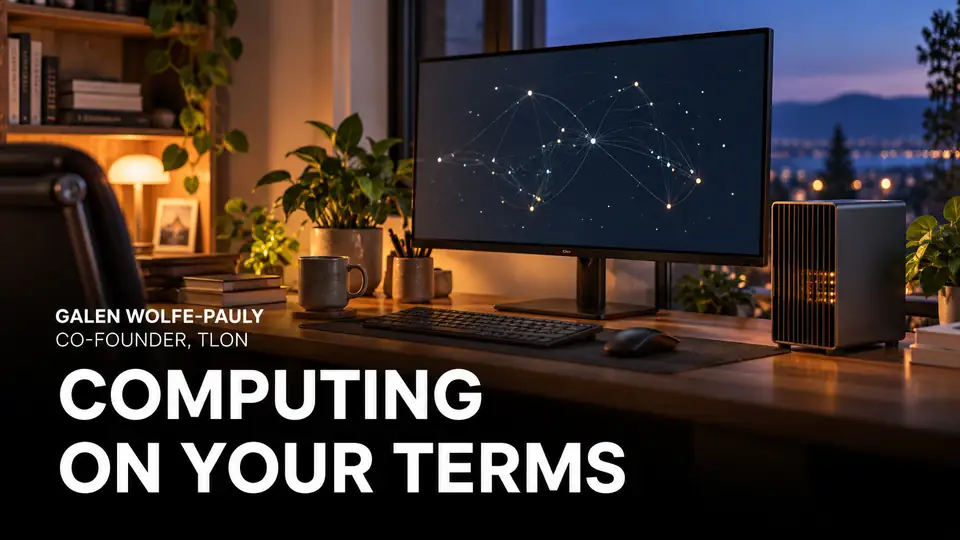
Galen Wolfe-Pauly discusses Urbit’s personal-server approach, digital communities and control over computing infrastructure.
January 19, 2021 · 40 min



About the episode
In this conversation, we talk with Galen Wolfe-Pauly the cofounder and CEO of Tlon. At Tlon, they're helping develop a new decentralizing computing platform called Urbit which is a new operating system and network built for the 21st century. We cover the future of the internet, privacy, the changing of the guard and more!
Links
Chapters
Times follow the podcast audio. The video’s timeline may be slightly different.
- 00:00Welcome and introducing Tlon
- 03:18Urbit as a personal server
- 10:57Different cultures and communities online
- 17:23Moving beyond familiar social platforms
- 19:08Building and sharing software differently
- 29:28What drew Galen to the project
- 33:10Exploring new ways of living together
- 37:00Getting started with Urbit
Read the conversation
Open the full transcript
CAMERON WIESE: Welcome to the Build the Future podcast. My name is Cameron Wiese and I'm your host. I've always been fascinated by the ideas and the sentiment that drove American culture in the 1960s with the space race. A culture galvanized to dream about the possibilities of tomorrow. Whether it's food, transportation, cities, biology, or anything else, it was this cultural mindset rooted in optimism, that the world tomorrow would be better than the world today. A mindset where people were compelled to build things, and I quote JFK, not because they were easy, but because they were hard. It's this desire to build and to dream that seems to have been lost, and it's something we're here to bring back. With Build the Future, we're here to promote the ideas and stories of those who see how the future can be better, and promote their plans to get us there.
CAMERON WIESE: It's our mission to get you to dream about the possibilities of tomorrow. Dream about the future that you want to live in, and inspire you to go build. Today, we're talking with Galen Wolfe-Pauly, the CEO of Tlon. At Tlon, they're one of the key organizations working on a new kind of operating system called Urbit. and Urbit, it's a decentralized computing platform, but also turn the internet into what it always had the potential to be, free, open, and for the people. Let's jump right in. Thanks for being here. I'm excited to talk about Tlon and Urbit, and I'd love to start with, tell me about the future you're building with Tlon. What's the vision?
GALEN WOLFE-PAULY: That's a good question. Thanks for having me, by the way.
SPEAKER UNCLEAR: You are so welcome.
GALEN WOLFE-PAULY: The way I think about it, what we're trying to do is basically to get computers back into the hands of the people that depend on them. So basically, we want to see a future where people actually control the communications and computing infrastructure that they depend on. So historically, we've used books, paintings, and drawings, even cities, to basically reflect the culture that we build. And computers, I think, have for the most part started to occupy that place. They're just this super important extension of culture. And for the part, they're still very centrally controlled. And my complaint, I guess, or sort of like Tlon's position would be that that just sort of doesn't make sense, that you want to see these technologies that we invent to allow us to do new things, to be shaped by the people that actually depend on them. And that there's this whole surface area of stuff that we could be doing, that we could be exploring, if computers actually belong to us and were easy for us to control. And so to what we're talking about earlier too, so maybe clarify, right? Like Tlon as a company is, you know, just in many ways, a very conventional word, Delaware C Corp, we just want to make products to this end. We work primarily on Urbit, which is a decentralized, like a collective of people who work on this one platform together. There are a bunch of people who make up the Urbit community, Urbit ecosystem and actually own parts of the network. And we're just sort of, we're like the primary developer, we did a lot of the foundational work, but we're not the only one. The one thing I always correct people for is when And they're like, oh, you're the CEO of Urbit.
SPEAKER UNCLEAR: I'm like, definitely not the CEO of Urbit. I'm the CEO of the one. Urbit is a bunch of people working together.
CAMERON WIESE: Yeah, so tell me a little bit more about Urbit.
GALEN WOLFE-PAULY: Sure, yeah. So Urbit is a personal server is one way to think about it. So basically like a complete software stack that's designed to run on a server somewhere. So I guess this is always confusing. It's a piece of software. It's not a computer. You can run it on anything, your laptop, a phone, a cloud server. And it's designed to be basically like run your applications, store your data, be this like permanent thing that lives in the cloud that you can connect to from anywhere. It is in fact a new software stack. So it's like a programming language and operating environment and a client so that you can actually connect to it and use it. We work primarily on making that client really nice to use, which is we call this thing landscape, which is like the primary client for Urbit that you use to talk to people, to write, to share links, and that's sort of like continuously getting better for people to use as kind of like collaboration software that's totally self-sovereign that like you can use independent of anyone you know getting in your way. And that's totally different of course from like Urbit as just like a software stack. Urbit's just this you know it's just something that you could build on top of that you could extend. Think of it like as a bundle of protocols. I guess the most important thing to understand I always like tread a little lightly on like as you're trying to explain Urbit but you're like walking over all these rabbit holes of like, we can talk, we can go very deep on like different parts of the technology, it's a long project.
GALEN WOLFE-PAULY: I think the main thing to understand, right, is that everybody runs their own node. So it's like, everyone is running these themselves or someone is potentially hosting them, we do some hosting. And then Urbit has its own network, right? So there are a bunch of different things, they're all completely independent. So when I send a message to somebody, it's like, I send it from my node to your node over an encrypted and authenticated network that's actually decentralized, unlike any conventional service, right? where we're both sending messages to some centralized server and the server is just sending them back to our devices. So that's kind of like the big sort of foundational difference between computing in an urban world versus computing in pretty much any conventional world. So anyway, I'm happy to go down any of the, you could probably see some of the rabbit holes. You can get pretty technical. We can talk about, I mean, there are lots of things to talk about, but yeah.
CAMERON WIESE: Treading lightly is probably a good idea early on to just kind of cover the surface. Hey, here's these, then we can circle back on all of this. I think so just to recap instead of the yeah, the current infrastructure is node to central server to other node, right? It's node to node So you kind of you're cutting out this middleman that that exists in the software world today, right?
GALEN WOLFE-PAULY: And that middleman today, right basically decides how long our data lasts who gets to see it What our interface looks like and you know, probably a whole host of other things But those are the ones that I tend to be the most worried about right? So when I write something even like taking notes So I want my notes to, I think for pretty much anybody who's grown up around the internet, right, there's this ephemerality to the internet. It's really kind of slightly unsettling. I don't really know how long something is going to last. And then if you, if you're, if you start to dig into this problem, it becomes very frustrating because you're basically starting to like Google, like who the investors of a particular product are.
GALEN WOLFE-PAULY: Like, you know, you have to understand them as a business. So in the urban case, of course, it's like this thing belongs to you. You know, if you want to, you can always just like download the entire thing, run it in your closet, you know, inside of a stone case, whatever makes you feel the most comfortable. Or a bit of course, then because of that same in a way for the same reason, protects your privacy, it's yours, it's designed to communicate with all the other nodes over an actual encrypted authenticated network. So you sort of privacy is downstream from control there, right? It's like, it's yours. So of course, it should be private what you do on it, you're not giving up what you're doing to some company, our goal is to give you control over the interface, right? Like, make it easy for you to customize as a naive user, certainly as a programmer, or, you know, as a kernel developer, you can go and change the way the whole thing works. Herbit's completely open source. It's, you know, it's designed to be vastly customizable in the spirit of like the original PCs, right? Like, Herbit is very much built in that spirit, just for like a networked world.
CAMERON WIESE: So lots of rabbit holes, we can get out. This is it's so it's so cool, though, what you guys are working on.
GALEN WOLFE-PAULY: I've been pitching this thing for like talking and pitching talking about whatever in so many different contexts. And I still for many years, probably five years now. And I still don't, like I've never found a canonical, like here's the only right way to talk about it. I mean, I'm glad you find it exciting. And I think I think urban is genuinely exciting, but it can also be confusing because it's sort of,
SPEAKER UNCLEAR: it's kind of big. And there's a lot to talk about. I kind of want to dwell on the kind of current state of the internet. And have you elaborate a little bit more on that, that fantastic piece you wrote on a coin desk about there used to be this kind of grand vision for the internet, we seem to have lost it. It's now this centrally controlled, monolithic kind of thing. And Urbit is kind of a way out. So can you talk about what is the state? Why is this problematic? Kind of diving into the data concerns, the ephemerality concerns. Well, so one, someone who works with me here has this whole
GALEN WOLFE-PAULY: Nick who's kind of out and about people see around talking about Urbit stuff. One thing that Nick often talks about is just like legibility. So in a digital world where companies make money on of advertising, that means that like impressions are paramount, engagement is paramount, meaning people need to stick around, and they need to look at like as much stuff as possible. So if you're going to make people or you're going to sort of incentivize people to look at a lot of stuff, that means everything has to be legible. There can be no real subcultures because you want, you know, basically strangers to that subculture. I mean, we've all done this, right? It's kind of amazing. Just go, you know, search a hashtag or especially, I always find the Instagram to be the most compelling, right?
GALEN WOLFE-PAULY: A random Instagram profile just plucked off of the out of the digital ether. It can be fascinating, right? You're just like transported into somebody else's life. And there's actually, I think, something legitimately amazing about that. And I don't think that's necessarily going away. But you see it having kind of, you know, I don't know, like there's like a dumbing down effect of it, right? Because it's very difficult for a culture or community to set its own boundaries and sort of set its own rules about what it means to enter into that community, what it means to be a member of that community, because everything is publicly legible. So I think that the internet's effect on culture writ large, and you can definitely, I think, see this in our political lives, like most sort of news culture, I think it's like it makes people crazy because it seems to be making everybody think the same way, or in the most maximally controversial ways, right?
GALEN WOLFE-PAULY: It's like it's looking for conflict because conflict keeps you around. And so I always tend to think of this as downstream from effectively like an engagement economy, which is actually just a side effect of the fact that the person running the server has to make money. So the urban approach is like, look, why don't you just pay for running a server? It's actually not even that expensive. It's like five bucks a month. And if you pay for running your own server, then you would no longer be stuck in this kind of like, everything has to be globally legible world. And then we'd have the possibility of our digital world looking a lot more like the physical world, right? In the physical world, you know, when you go traveling, right?
GALEN WOLFE-PAULY: You go to some rural community somewhere, it feels like the people there are, you know, have a particular relationship to the place that they're in and have a particular culture. My sense has always been, I think this was the case on the early internet, that there's something about when you take people who are physically disconnected and you get them to be able to come together, say around like bulletin boards or like early forums and stuff like that, It's actually a really magical thing. It's obviously different than like the small town in the Andes or whatever But there's something really cool about it, but it has to be slightly obscured from it can't be globally legible so anyway, I think that's like uh I feel like maybe i've wandered off from your original question, but basically like no
SPEAKER UNCLEAR: I love it
GALEN WOLFE-PAULY: It's an example of like look the culture of the internet is like one culture It's very weird If you look at the physical world We have all these different ways that people live the ways ways they communicate with each other What you want is a digital world that looks like that. But if you're going to get that, you've got to get everybody their own server. You've got to get everybody the ability to decide who they connect with and when and how. So that's obviously what we're on about generally.
CAMERON WIESE: Yeah, it's quite strange how one culture on the internet versus all these subcultures and it shouldn't be that way. That's not a good thing. It is weird.
GALEN WOLFE-PAULY: Sometimes I think there's app cultures. I was thinking of Tumblr as the canonical app. Tumblr is a culture. Tumblr had a vibe. There was a thing going on there Twitter has that too to some extent, you know, they're slightly they're kind of subcultures on Twitter But like not really, you know, it's all kind of one thing. Yeah, it's kind of boring. Honestly, I find the internet boring I I also find the way that people often talk about these things getting very you know Oh, it's like it's not fair for people to get canceled or it's not fair that things get censored I'm just like why do we even care about this stuff? It's so boring like everything about it just seems like sort of TV level It's like entertainment. The internet is the entertainment industry. It's it's it's not really a communication medium for the most part
CAMERON WIESE: What shaped that belief? That's not something I've heard often I think I may have heard that one or two times like yeah How did you how did you kind of land on that like what shaped this view of the internet being?
GALEN WOLFE-PAULY: Entertainment. I mean, I think that if you just look at the way that I don't know That's I think what it feels like to me like the internet as it exists today So it's always like toss around, it's kind of big. Mainstream social media, I guess, is mostly what I'm talking about, which is designed mostly around people with large followings being able to optimize their ability to deliver content to them. So you're just taking, instead of there are only a few TV stations, there are now a bunch of influencers. And so maybe it's true that those influencers can serve certain niches, but effectively you're just a content delivery mechanism. And there's something cool about that, but it's not very two way. So it's not it's not about community like back and forth communication. And that's the thing that I think of as being the real promise of like internet, the internet as a you know, just as a foundational technology, like I can actually interact with people not just consume.
SPEAKER UNCLEAR: Yeah, it's it's kind of funny, because I'm also in a position where you know, got to like creating content to like push a mission out like well, think about this way, they're
GALEN WOLFE-PAULY: like, how do you engage though, with like the people who follow your show, right? And And then how do you guys like develop a conversation that's, you know, very specific and ongoing and even potentially like engage in commerce? Like can you, is it easy for you to let people sort of buy what you make or compensate you in some way and a lot. Those things are still mediated by platforms that are mostly about just making sure that you can effectively act like, you know, the Kardashians or something, right? Like you really, really good content producer, which is fine. I don't think that's going away. Like TV is also not going away, but it's a different thing.
CAMERON WIESE: Yeah, interesting. The difference between community facilitation versus content creation. Because you could probably use one to create the other, but hmm.
GALEN WOLFE-PAULY: I think it's almost like the internet has never really been tried or something like that. I think of it as almost like a McLuhan-like argument where you see that it's obvious, we want more and more increasing access to information. There's a huge amount of demand for access to information. There is also demand for two-way communication, but for the most part, our demand for just like things streaming directly into our hands as we're wandering around aimlessly on the streets sort of exceeds our desire for actual two-way communication. But that desire for two-way communication I think is very real and exists as well. It's just somewhat like underserved. But we haven't yet, the problems we just really don't yet I think have, we have some tools, obviously we have lots of tools for it, but those tools I think are just immature I guess is my position, right?
GALEN WOLFE-PAULY: It's like if you imagine yourself in a future where those tools are extremely mature, where meaning like it's extremely easy to, I think of it also in terms of say like the way you interact with your local municipality or your neighbors or the way you pay your taxes and so on, right? Those things are incredibly outmoded and they're, they almost just seem silly. So if you think of those tools being really, really powerful, it's really easy to know sort of who's around you to talk to people about like what's going on. I don't know, you can kind of just, you start to imagine and what a future might look like where those tools actually work, even just in the vaguest possible terms. And you're like, well, what do the tools we have now actually look, you know, are they pretty good? Or are they extremely ancient? Like, well, actually, really sort of silly and simplistic. Obviously, they can be better. We don't yet know exactly how.
GALEN WOLFE-PAULY: But yeah, I do think the crux of it just boils down to, well, if they're going to get better, there's no one party that's gonna like, Apple is not going to solve that problem for you. You need a platform on which people can experiment with how they might use computers in a more sort of like integrated way in their daily lives. Anyway, I don't mean to be sort of pitching too hard. That's just how I think about it.
CAMERON WIESE: No, no, that's that's kind of I love kind of getting everyone up on their soapbox is going to go and talk at what's top of mind. Whenever you're talking with people interview or podcast interview or not, you have those like threads that you can get on where you kind of like the normal responses, but then every once in a while, you get on something that you're like really excited about, you thought a lot about the don't often get to talk about or that like outlet doesn't often exist and you get you get a chance and just you just go and that's what the really interesting stuff comes up.
GALEN WOLFE-PAULY: Probably true. Yeah. I mean, yeah. I mean, well, your job is basically to get people like me to sort of the edge of what they're thinking about, right? Yeah. So I guess the thing that always makes me a little bit reticent to get sort of too far out there in a way is that the reality is that what I'm also trying to describe is something that I think is like not yet known. So like the main thing that I think is worth letting go of is the idea that sort of like the forms of technology that we have today are actually even close to being finished or like completely explored. And so I think we exist at like a local maximum, the stuff that we mean, we're able to be on a video call right away.
GALEN WOLFE-PAULY: That's amazing. Like even, you know, that didn't really exist. Even when we were kids, that's cool. But I think then when you try and extrapolate this out much further, like where, you know, where are we going? I mean, can the existing forums get that much better? Well, I think it's actually that they're going to change structurally. And so what are, what are the impacts of that? Honestly, like we don't really know. I just know that there are things about that structure that have to change. So anyway, it's, I always feel like I'm painting kind of a vague vision of a future in some ways, but I think that might be what the future looks like when you're trying to actually implement it or get it done.
CAMERON WIESE: So how do you view us getting there, right? From our current state to this new vaguely painted future?
GALEN WOLFE-PAULY: I think there's a relatively broad recognition that social media is both useful and dead. So it's nice to stay connected to people, but most of the tools that we have for staying connected feel pretty ancient, right? I don't know anyone who loves being on Facebook. And so I think there is a big opportunity there, which I think Urbic can capture in a very different way than Facebook captured. And basically it stems from the fact that like, I mean, one way to think about it is like a lot of people I know use Signal. And I think the reason they use Signal is not because it provides you really good security. It's because it feels good to know that no one's looking at you, or like, you know, you don't have to be like looking over your shoulder.
GALEN WOLFE-PAULY: And there are a lot of things like that. Like it feels good to never look at an ad. It feels good to know that your data is not going to disappear. And so I think the first wedge that Urban has is basically just like build social software. It's not aimed at engagement or keeping you around as long as possible or selling you things. That allows you to stay connected without this feeling of being watched over or sort of thought and sold all the time. And that's what we're working on now. And that's kind of like what people use Urban 4 today. That's what we use Urban 4 today. And I think there's quite a lot of growth that will drive out of just get people to use this thing in this to build small communities effectively and kind of like reboot social graph, basically, because it's going to be very difficult for to salvage it from these existing mainstream services.
GALEN WOLFE-PAULY: So that's the start. And then I think from there, things get more interesting when you start to get into like, how is this used by local governments or by the Internet of Things or by you know, how is this expanded on as a platform. And that's the part that's honestly, yeah, I don't know what that looks like. We'll see.
CAMERON WIESE: I'm sure though, internally, when y'all are brainstorming late nights over beers and food, like, what is this going to become? Oh, I can't wait till this or that happens. What are some of those things? I know it's a vague, vague feature.
GALEN WOLFE-PAULY: But we do think about these things a lot. So on the one hand, I mean, the first thing I'll say is that like, or maybe to clarify what I'm trying to say, when you think about the way that anyone goes about building a new piece of software today, it means that you have to go and run a server, keep it up, and then eventually probably start a company or find some way to pay for it. And that's insane. So the main thing that we want to get to is the fact, point that Urbit is mature enough as a platform that a weekend project that you do just for fun is something that then you ship to the network and you never even think about again. And you can just build software, ship it out to people who use it, and you're not ever running the server as the developer. And so that that's where this kind of like, some of the sort of vagary comes from, what I hope is that people will come up with stuff that I can't expect because they can actually really use urban as a platform. And that's where I'm like, I don't know. Like, I think there's a lot, there's a lot there. I can kind of like, think about it from a distance, but I'm not sure. Some of the stuff I'm really excited about would be, I think that blockchains are cool, but they're not, they're not like truly cool until people can interact with them directly. So it's really hard for an individual to run their own node to actually send payments from node to node and to interact with smart contracts directly. So for example, there'd be like, there's so much interesting stuff about DOWs. So decentralized autonomous organizations, people have collective ownership and something that they're working on. Maybe they even get paid in tokens from that thing. Ideally, Urbit can be used to actually manage a DOW, do everything that doesn't involve the chain, meaning talk to each other, like share documents and so on, decide, you know, do corporate
GALEN WOLFE-PAULY: governance effectively, where the governance itself is on chain, the conversations happen on Urbit, there's so much cool stuff that can happen there. Relatedly, then, if you're actually operating some form of a business, you're making or you're producing content, you're selling goods, whatever, being able to have people do that over Urbit, where that commerce happens over Urbit, I think is so interesting. And there's all kinds of cool stuff that can be done there. I briefly mentioned like IoT, I do think like IoT is an absolute nightmare. There's some really cool stuff that's been done, but technically, it's still really messy and hard to coordinate. So I think the potential to have basically this unified computing platform that can run on a bunch of different devices, especially for the sort of maker world, people experimenting with getting stuff connected. There's so much cool stuff there that always overlaps with Yeah, like actual physical cities, right? So how do we basically, yeah, how do I interact with the the sort of like my neighbors, my local government is so so there's so much cool stuff there. How do you know even like who is in office, what they are doing, and how is that affecting you locally down to like, you know, the street lights outside your house, right?
GALEN WOLFE-PAULY: You can imagine that that's actually one that there are, you know, instances running on those physical pieces of, you know, like physical things, be them like sewers, lights, you know, actual physical infrastructure, all the way up to like handling, you know, how do local ordinances get past, how do people get hired and fired and so on. And having that be, that's the kind of thing that you want to be legible to locals, to the citizens of a particular place. But in the current world of software, it's just an absolute nightmare. So that's very far off, but those are the kinds of things that you would want to work really well. It's unclear to me whether you'll actually get the existing system to adopt some new way of doing things or whether you'll see the sort of DOWs mature to the point that you have new entities come to exist in this sort of Blue Book Cities approach that adopt things like Urbit. But anyway, maybe that gives you some sense of the kind of stuff I think about in the longer run.
CAMERON WIESE: Yeah, well, I think the city one's fascinating, but I think we can all agree that it's gonna be very challenging to get existing cities to overhaul their infrastructure or, you know, completely change all the ways that they've been operating. But there's new opportunity given coronavirus to develop new cities and people pull these social networks off the cloud into physical locations where they can be built from scratch. They can be built from first principles. What should this look like? Not how do we have to operate in with what we've been
SPEAKER UNCLEAR: given? And so stuff with Urbit is... It's such an interesting... I feel like this conflict of basically legacy infrastructure and new infrastructure is going to be the most interesting conflict of our lifetimes. And it's unclear, I think it's very likely to be a little bit of both. Some of it will be repurposed and brought forward, and there will be other new institutions that will become very, very big and replace legacy ones. It's going to be messy, I think, but it's also really exciting. I mean, conflict creates energy generally. So I think, yeah, it'll be interesting.
CAMERON WIESE: Yeah, one of the things I'm thinking about with Herbert is who's gonna be developing these apps? You mentioned kind of the weekend developer, they'll have an idea and they'll ship some code, but for some of the more complex code bases that may require several people, like how are those gonna be incentivized to be built? Because right now the companies are built because there's a financial incentive to do so. So how do you think about that in terms of the development community with Urbit?
GALEN WOLFE-PAULY: Yeah, such a good question. So like important question. Right now we have relatively thin protocols like TCP, IP, HTTP. And so they're very, very simple. And then the application experience on top, Facebook, Amazon, whatever is this giant thing, right? So you have kind of like a fat application and a thin protocol. The Urbit world is one where you have basically a fat protocol. You can think of Urbit as kind of this protocol of protocols. like it's a single operating system that contains a bunch of different protocols for how you might store and store data and move it Around the network. So the system itself is relatively featureful, right? So Facebook has some way that it stores your data and say does like message passing So does Amazon so does Google so does any startup right? They all duplicate these, you know Sort of essential pieces her bit handles, you know identity file storage application model network or it sort of like rolls all of these features of like conventional web apps into a single system.
GALEN WOLFE-PAULY: So that's a big part of how then you think of like, well, when you're an application developer operating on top of that, you're doing very little. You could even just be writing some JavaScript code. You're just writing something on the front end. But you ask another, I mean, another product question has to do with incentives, which is super important. So you can think of Tlon as like almost like an ecosystem developer in some ways, right? We own a big chunk of urban address space because we help work on this thing and get it going. That address space is, I guess we didn't even get into this. So there's a finite amount of address space. Think of it as basically IPV4. So there's 4 billion addresses. They're broken up into blocks or sort of like bundled into blocks.
GALEN WOLFE-PAULY: So there's 256 at the top that issue each of which issue 256 for 65,000. Each of those each issue 65,000 for 4 billion. Easier to think of in base two, two to the eighth, to the 16th, two to the 32nd. Galaxy stars planets, if you prefer the celestial metaphor. A planet is like a username and an IP address rolled into one. Because these things are finite, they have value, they trade today, like people actually pay for these things, and there are people selling them, and like you can trade them on OpenSea, there are third-party places that sell them. The way that we operate is that we own some of that address space, and because we own it, we want to make it valuable. So we basically, most of our work so far has been improve the platform and sort of build a single application experience.
GALEN WOLFE-PAULY: And we've seen that duplicated by other developers where they've maybe they bought some Adr space way back in the day and now they're like, oh, I kind of want to capture some of the value here. I'll sell off some of the addresses that I own and use that money to actually fund me, building stuff on top of her bit. The other thing that people are doing, and some of whom actually I think own very little if not no Adr space is that they're providing services like hosting. So they're like, oh, I'll host your orbit for you for whatever five, 10 bucks, 20 bucks a month. And obviously I can generate some revenue there And maybe that'll, that'll pay me to be able to develop bespoke services for my hosting service.
GALEN WOLFE-PAULY: And that's where that's kind of, I think the most likely future. Is it basically like within the urban network, you'll have people providing specific services like say really high speed, you know, trading RPC or they're, I don't know, they have some bundle of IOT software that you want to be able to have access to you. or yeah, they're a really great host that also gives you access to, I don't know, like they have an interpreter that's optimized for ML or whatever it might be. So basically these very specific services, which is where people generate revenue and are able to fund their developing software on top of Urbesh. The basic theory of the address space is that you want to, you know, if the internet had been owned, actually owned in terms of good property rights by the people who developed it, then the people who developed it would have leveraged that value to continue improving the protocol suite. But instead, for the most part, the people who capture the value of the internet as we know it today are these giant companies who then also don't release anything as a protocol. So the hope is that the core developers capture a good amount of that address space's value and are able to actually improve the core kernel. And then other people can build service and application development companies on top. But those are ideally actually smaller than what we think of these genus of giant tech monopolies today. Does that make sense?
CAMERON WIESE: Yeah, yeah, it has interesting implications in terms of like, what do public companies look like? Are there going to be massive companies that are going to be built for things? Or are we going to find this kind of part of the future internet world where people are kind of building stuff in small batches?
GALEN WOLFE-PAULY: I think there's still, there's lots of, I mean, think about Adobe. Adobe for a long time, I don't know when they went public, but I mean, they effectively just built software that they shipped to you and you ran on your computer. And what you were paying them for is a particular interface and the ability to do certain things. Urvid, totally, you could definitely imagine doing that. You just actually ship it over the network. So you're effectively paying a subscription for a piece of software. I think there's lots of opportunity for people to build specific experiences that way. And then I think there are also, yeah, there are these kind of more service-oriented things where you're paying for someone to provide really high throughput, whatever, or access to a particular thing or whatever it might be.
GALEN WOLFE-PAULY: I mean, even the streaming video, right? So it's just like it's a different network to deliver things over. That network, ideally, actually probably reduces is your like development costs in many ways, because it's just simpler, it's a simpler platform to develop or you're not maintaining all your own infrastructure. So it is different, it is definitely different, but ideally better suited to the user basically or it's a major user benefits.
CAMERON WIESE: Yeah, it's from Tron, it's doing it for the users or whatever that quote is. I wanna kind of step back and hear a little bit more about like what excited you about this project that pulled you into it?
GALEN WOLFE-PAULY: I studied architecture, but I grew up programming. And the interesting thing about architecture, I think if you look at it in the way that I did, is that cities are a kind of technology in that they help us organize how we relate to one another and get things done. And cities today, in terms of physical manifestation buildings, the whole thing, are pretty much sort of finished. Like we have the, sure, there are things that, you know, I'm actually pretty pessimistic about this. I just think like the toolkit for building buildings and building cities is pretty much done. There's not a lot of innovation there. And it's not really that interesting in terms of just the actual physically building cities. But what affects our experience out in the world interacting with other people is basically computers and connected computers especially.
GALEN WOLFE-PAULY: And so I think sort of thinking like an architect and sort of coming out of school, I was like, okay, well, if you look at the structure of the network and the way that we use computers, it's extremely sort of warped and very futile and very odd in that it's so tightly and centrally controlled, which I think is an accident. People always sort of, yeah, it sucks and it's bad. I tend to actually not be so sort of mad about it. It's just a total accident. Like it's because no one had a better solution. But I think that, yeah, if you think of it like, well, we want to, you know, the spirit of architecture is sort of like get the things that people use to reflect the way that they are.
GALEN WOLFE-PAULY: Well, like computers do not reflect the way that people are, I think. And so that's a very important problem to work on and a hard one and a fun one. Anyway, so that was clear to me probably, and I don't know, I have this memory of this conversation I had about this in probably 2008 or something. I was thinking about this for a long time. And then by the time, I think I finished school in 2011. And then I found Urbut in 2013. And I, in those interstitial years was kind of like looking at every possible thing. Like I said, I'm like, I'm pretty technical, but I knew that I needed to work with someone who was a lot more technical and urban was pretty far along by the time I found it.
CAMERON WIESE: What was that? What was that conversation you remembered having? You mentioned that you didn't, you didn't kind of elaborate.
SPEAKER UNCLEAR: Oh yeah, it's, it's a, because I grew up programming, I was able, I was able to go to school for free, which is amazing. And the deal was that you could go to school for free, but you had to pay to live in New York. And so the way that I paid to live in New York was to basically work as a programmer. And I was already doing that to some extent. So I was building tons of conventional software, just like websites, I mean, relatively extensive, like content management, e-commerce, whatever. I just do anything and could pretty much figure out how to do anything, but lots of just like conventional stack. And so it was some two friends who wanted to work on some new website project. And I just remember them describe it was kind of an interesting project. I mean, they're actually don't remember exactly what it was. They're both really interesting people. I'm still friends with one of them in the conversation was just like, I don't think I can ever build another website. Like, like I just can't do this anymore. As it's so stupid. And I remember saying like, we need another operating system, like you basically just have to build a new operating system because the whole way that this is done is so stupid. And, and it was one of those were like, yeah, I sort of that just like came to mind in that conversation. And I remember kind of walking out of there being like, and like, that is such a huge project. And like, wasn't exactly sure how that was going to be possible. That's the genesis. Again, there's there's so much to talk
SPEAKER UNCLEAR: about here for I want to make sure I cover the the basis. But one outside of the work you're doing at Urbit or working on Urbit, what excites you the most about the future? I love the trend that's
SPEAKER UNCLEAR: sort of spurred by COVID of people moving out of cities and exploring different ways of living together. I don't know, this last year, there are many things about it that are tragic, but it makes me incredibly optimistic, honestly. Like I think there's, yeah, it's amazing. I don't know. And kind of like we touched on before, I guess I just feel like, I felt like I was someone who was sort of like living in this world where there were so many things about it that seemed really, really broken, but it was really hard to see how you were going to get people to be motivated to fix them. And so now it definitely seems like there's a different sort of level of motivation just generally and or even like level of recognition people have about like things that could be worked on. And so yeah, I don't know. I mean, just like across the I feel like the future is just extremely bright. There's so much stuff to do. There's so much stuff to work on. And that's that's like, yeah, it's kind of like amazing. I'm just generally excited about Let's go. Yeah, I'm right there with you
CAMERON WIESE: I mean obviously this is kind of the thesis that I have with the podcast and the work But all of the leaders of 2030 all the people who are gonna be running businesses and like starting companies and like in positions Of influence they are being forged through this experience They are seeing the failure of our institutions and our legacy media and political organizations been like these people are all incompetent I can do a better job Wow Nothing's gonna get done unless I step up and I go build the future that I want to live in And so we have all these people who are being spurred into action because just the system Reveal itself to be completely fake. We're like, oh wait, we can't live with this anymore
GALEN WOLFE-PAULY: Yeah, yeah, right. So yeah, so I feel like I was someone who was sitting around in this world this very decadent world Being like this. I think this is fake and it's not gonna work and feel like what are you talking about? this is awesome. And I'm like, I don't know. It's a very, but I, I think of it, I've been thinking a lot about how it's a kind of like, there's this weird, like negotiation between generations, because people are, people are empowered, don't want to not be empowered. Being empowered is nice. Why would you ever not want to be empowered? So you don't just hand it over. You're not like, all right, guys, good luck. I'm good. You know, I mean, very rarely, you know, retirement, I think is makes sense. I'm sure I'm not going to want to retire or stop, you know. And so yeah, I think the thing it's almost like the thing that's exciting about the future is that like that will get figured out somehow. And yeah, I have I'm very optimistic about everybody who's on their way in, not so optimistic about the institutions that exist, but like, I don't know, we're going to figure it out. And it's going to be pretty wild and interesting. So yeah, it's gonna be great.
CAMERON WIESE: Yeah, Eric Weinstein has this this analogy is where he's like, all the boomers and everyone can be in the in their institutions right now. They're like, they've grown up, but they're still riding their tricycle. It's like, I'm good time to get off your tricycle and give it to the next kid, because you're no longer supposed to be riding a tricycle, like get out.
GALEN WOLFE-PAULY: It's such a weird, yeah, it's such a weird one. I've been trying to be balanced about this, right? Like I think that, so I think that in the world of, in art and music and just like general creative work, there's some of the things that happen in the mid-century, like even all the way through 70s, 80s, is actually amazing. There's like all kinds of interesting territory that's pioneered basically by boomers, but it has nothing to do with institutional responsibility and organization and efficiency. And so all this stuff is actually really important, but when it comes to basically how is, you know, sort of how does the structure of society sustain itself and how does it work? Yeah, that's maybe not been taken care of in the best possible way. So I think it's just, you know, it's complicated, like we'll end up in 50 years with a similar blind spot, you know, like things that weren't cared for. Yeah, the tricky thing is a transfer of power. We'll see, I don't know how that's gonna work.
CAMERON WIESE: Yeah, it'll be interesting time for sure, but like you, I'm wildly optimistic. Good. Sweet. Where can people find you? Where can they support Urbit? If they wanna go start a node or start playing around in the network, like where should they go? What should they do?
GALEN WOLFE-PAULY: Yeah, so if you're a little bit technical, it's actually not that hard, but requires you to jump into the command line. You can just go to urbit.org and follow our like installation and set up instructions and stuff. And if you're not interested in it, yeah, if the terminal is a scary place, which it can be, we did just start, we've started to roll out a hosting service as Tlon, so you can go to tlawn.io and see that there's a, you can like sort of sign up for the waiting list there. And that means we'll just, we'll spin up a node for you. You basically use it like a conventional service and can start sort of experimenting with building communities and stuff. Yeah, we've been doing this thing where we, for individual podcasts, like create us an invitation link so everybody from that podcast can kind of end up in the same place and stuff like that. We'll figure out how to get you one. And anyway, urban.org, slant.io, those are the places to find us. Urban is on Twitter, the rest of us, spice Twitter.
CAMERON WIESE: Twitter's a tricky beast. It's like, oh, how do I how do I like share ideas? How do I like meet like minded people? And it's great for that.
GALEN WOLFE-PAULY: You can well, we do a lot of that on urban itself. So the urban community is on urban. And if you if you end up on the network, you'll see there's lots of fun and weird stuff going on on there. So yeah, I imagine your listeners probably find it pretty, pretty entertaining.
CAMERON WIESE: Last thing on that, what would you recommend people do on Urbit? So they go sign up. I guess the question is like, why should someone go sign up for Urbit right now based on where it's at?
GALEN WOLFE-PAULY: So the Urbit community itself, which is a few thousand people, is pretty fun and interesting, which is kind of the place you get dropped into by default. And then I think at this point, Urbit is still at the early critical mass stage. It's pretty fun if you have any interest in starting. someone just today was like just about to start a synths and woodworking group or something like that. You know like I think it's like if there's if you have some specific niche interests that you want to like collect people around well like some of them are probably already there and like looking for you know people are in that phase of like creating new stuff and experimenting with the system so I think that's like a good that's at all interesting to you like you're like looking to found a new community on the internet because the rest of it is boring well like urban could be a good place for that.
CAMERON WIESE: Thanks for joining us for another episode of the Build the Future podcast. Lastly, if you're building and want to get support, want to hear about certain topics or from certain people, or just want to get involved in helping build the future, shoot us over an email at hello at buildthefuturepodcast.com or follow me, Cameron, on Twitter at [unclear handle], and we'll see what we can make happen. That's it from us. Until next time, go build!
SPEAKER UNCLEAR: Thank you.
More episodes
All episodes Doug Petkanics of Livepeer — Decentralized Video InfrastructureDoug Petkanics discusses Livepeer’s open video infrastructure.
 Sam Bhagwat — Gatsby.js & Open SourceSam Bhagwat connects his background in economic history with building Gatsby.
 Gabriel Luna-Ostaseski — Braintrust and the Future of WorkGabriel Luna-Ostaseski explains Braintrust’s talent-marketplace model and its proposed approach to user ownership and governance.