

Build the Future Podcast
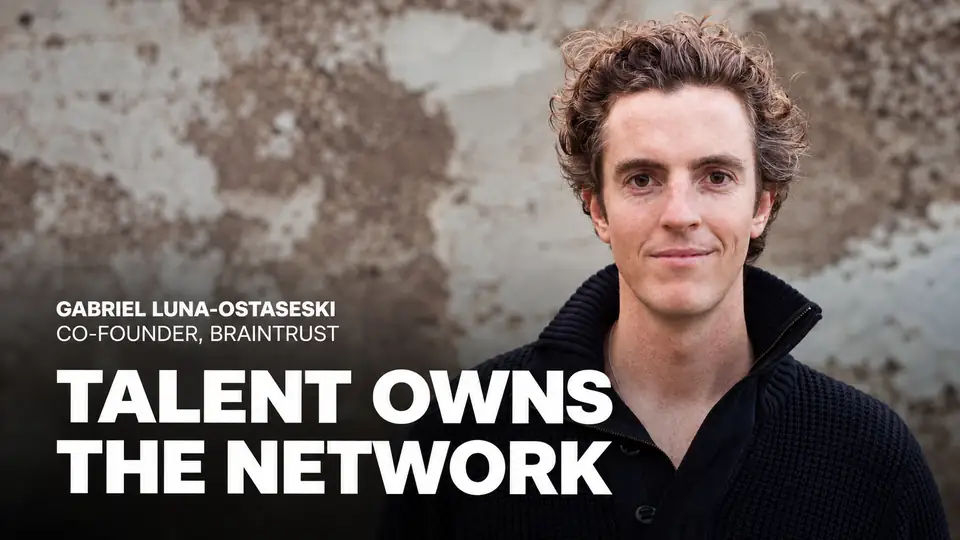
Gabriel Luna-Ostaseski — Braintrust and the Future of Work
Gabriel Luna-Ostaseski explains Braintrust’s talent-marketplace model and its proposed approach to user ownership and governance.
December 15, 2020 · 35 min



About the episode
In this conversation, we talk with Gabriel Luna-Ostaseski, Founder and CRO of BrainTrust — the first user-controlled talent network that connects organizations with world-class tech talent.
We talk about how Braintrust is building the future of work through their decentralized job marketplace, the token model they've built on, and how the future of this marketplace is owned by the users.
Key Ideas & Questions
Links
Chapters
Times follow the podcast audio. The video’s timeline may be slightly different.
- 00:00Welcome and introducing Braintrust
- 03:33What a user-owned network means
- 06:39Independent work in a global market
- 08:00Learning and support outside a corporation
- 12:56Teams and the Hollywood model of work
- 18:59Resilience, curiosity and useful skills
- 21:44Trust, tokens and network governance
- 28:14Why build a different marketplace model?
- 29:39Other possibilities for decentralized networks
Read the conversation
Open the full transcript
CAMERON WIESE: Welcome to the Build the Future podcast. My name is Cameron Wiese, and I'm your host. I've always been fascinated by the ideas and the sentiment that drove American culture in the 1960s with the space race. A culture galvanized to dream about the possibilities of tomorrow. Whether it's food, transportation, cities, biology, or anything else. It was this cultural mindset rooted in optimism, that the world tomorrow would be better than the world today. A mindset where people were compelled to build things, and I quote JFK, not because they were easy, but because they were hard. It's this desire to build and to dream that seems to have been lost, and something we're here to bring back. With Build the Future, we're here to promote the ideas and stories of those who see how the future can be better and promote their plans to get us there. It's our mission to get you to dream about the possibilities of tomorrow, to dream about the future that you want to live in, and inspire you to go build.
SPEAKER UNCLEAR: Today, we're talking with Gabe Luna-Ostaseski, co-founder and CRO of Braintrust. At Braintrust, they're building the first user-controlled talent marketplace that connects organizations with a highly skilled tech talent and leverages the brain trust token to ensure high quality output and incentive alignment. In doing so, they're helping bring about the future of work and create a marketplace where people all over the world can find exciting projects to work on, get paid for the value they create and work however they see fit. Let's jump right in. Thank you again for jumping on here. I'm excited to talk with you today about the future of work and all the incredible stuff you're doing at brain trust. Let's just to start with the basics. Can you tell me about the future you're building with BrainTrust? What's the vision? Yeah, so there's kind of a couple
GABRIEL LUNA-OSTASESKI: veins here, but like one observation is that the nature of both the work that needs to get done and where that work is happening is changing. People don't want to go and work in a corporate office. They don't want to punch a clock. Obviously, that was accelerated dramatically by this past year. So you've seen this big shift towards kind of freelance and more independent work. Now there's over 30 million people in the United States that want to be freelancers. And then on the other side, the nature of the work that needs to get done for employers is increasingly changing at a rapid rate and increasingly more and more technical. So it means that oftentimes the talent that they need to innovate and build new experiences maybe don't exist within the company, maybe don't even exist in the same state where those companies have offices.
GABRIEL LUNA-OSTASESKI: So essentially what we've done is build a marketplace that connects highly skilled technical talent that are leaving Google, Facebook, Amazon with large Fortune 1000 companies like Nestle and Porsche, even government organizations like NASA, and essentially connects those two to be able to actually build software. And that's not necessarily a new idea, right? Like there's been essentially labor marketplaces or people that have brought together, you know, talent and employers before. What is new is the, I'll say the ownership and the business model. So we are actually the first marketplace owned and operated by the talent. Well, I'm sure we'll get into that a little bit more, but think of it like a global cooperative or think about Uber that was owned or operated by the drivers or Airbnb being owned or operated by the people renting out their houses. So that's kind of like the, that's the new thing.
CAMERON WIESE: Yeah. Tell me more about what that looks like. What does it mean for the network to be owned and operated by the talent?
GABRIEL LUNA-OSTASESKI: You know, I've been building marketplaces and investing in marketplaces here in Silicon Valley for 15 years or so. And these have become the dominant business models. If you look at Uber and Airbnb and any other marketplace in Silicon Valley. The problem is they essentially build value on the backs of users. So they essentially extract big fees, sometimes 30, 50 percent fees out of the transactions. They're essentially extracting that value from the users. And then all of that builds the enterprise value, the value of that company. And that goes to a very, very small number of people who are arguably already rich here in Silicon Valley. And so the idea around GreenTrust and the idea of this, what we call the user-owned economy, is essentially distributing ownership and control and voting to all of the users so that it's decentralized versus all of the value and ownership and control concentrating just a few people. So currently we have contributors and people that are in the network that are over 100 countries. And that's a new thing.
CAMERON WIESE: I want to kind of dwell on how this is shaping the future of work. So right now people are coming out of their jobs from big tech companies or software companies in general, and then you're connecting them with the Fortune 1000s. How does this kind of grow and evolve over the coming decades?
GABRIEL LUNA-OSTASESKI: Yeah. So I think that if I look at the future of work, there's kind of two lenses to apply to it. So one lens would be like, you know, look at big enterprises or companies. So like, what's the future of work for them? And there's kind of, I would say, two big things that are impacting them. One is that all companies are now software companies. Like all companies are forced to act and operate like tech companies, right? So whether you're, you know, Stanley, Black & Decker or Nestle, now you have to build software. So you're not in the business of selling water. You're in the business of like, you know, building online acquisition channels or paths to customers. That's one new thing, which is that all these companies are kind of like facing digital transformation, digital disruption.
GABRIEL LUNA-OSTASESKI: And in many cases, the people in those companies don't necessarily have those skill sets. That's kind of like one thing that really affects them. And the second is what we call kind of the unbundling of corporate America, which means that when you think about the way in which these companies have been run in the past and you think about what's happening now, they're traditional like big kind of lumbering giants and hierarchies. And what's happening is that people are wanting to kind of peel off from these large enterprises and essentially become their own kind of micro entrepreneurs, whether they're a software developer or writer or marketer. These people are wanting to operate independently. And so that's causing some real challenges, even for big companies like Google, Facebook, Amazon.
GABRIEL LUNA-OSTASESKI: And if they can't retain that highly skilled tech talent, like how's a company in the Midwest going to do that? So those are big challenges that they're facing is the increased pressure of needing highly skilled technical talent. And then the pressure of those people not wanting to have to work in a traditional corporation anymore.
CAMERON WIESE: What does the future of work look like for the individual operating in that world?
GABRIEL LUNA-OSTASESKI: Yeah, so I think there's a couple of new things. One, you now have like a global demand for those skills, right? The second thing is you now have a, I'll say a global market and global distribution platform, i.e. the internet, to be able to sell your wares or your skills on a global scale. And so what that means, I think, if we project it out a little bit more is the potential for like global market rates for talent. So whether you're living in Pakistan or Mountain View, there should be some global market rates based on skill set versus geography. And I actually think that that's a huge bright spot in all of this is that if you can take away this kind of global rate arbitrage that's been going on and you create essentially a market for skills and have global market rates, what it does is I think it distributes opportunity more equitably around the world.
GABRIEL LUNA-OSTASESKI: So we have this belief that talent is equally distributed, but opportunity is not. And so if there's a global market with global market rates, it enables talent from all over the world to be able to earn more and in turn, push more money into their communities. So that part kind of gives me promise for the future.
CAMERON WIESE: It seems like the gap there to get there is in the education upscaling of people all over the world. How are you viewing that, one? And then two, within this project-based work model, it seems like one of the things that's lacking is this ability to upskill. One of the things you get from a traditional job is you get the security, you get the community, but you also get the training and the support. So it's like, one, how do we get everyone around the world upskilled? But then two, how do we think about this moving forward if a lot of work is going to be project-based and decentralized?
GABRIEL LUNA-OSTASESKI: Yeah, totally. So I think one of the things in this trade-off, right? Like when you leave a traditional corporation, I'm just going to use the example here in America is like, you are taking some risk, right? You're taking risk, of course, income risk. You're taking kind of benefits risk because there's not like portable benefits and things like that for independent workers here in the US. And the other risk that you're taking is this kind of like infrastructure to support kind of growth and learning and development. So you're now shouldering all of that risk yourself as an individual, essentially as an entrepreneur. And there's a bunch of challenges with that. But one of them is that there's not really kind of the infrastructure or a best in class kind of program or structure to follow.
GABRIEL LUNA-OSTASESKI: Everyone's just basically left to fend for themselves with all of those things, left to fend for themselves and finding benefits and healthcare, finding customers, and also like continuing to learn and grow. And so our belief is that that education, that upskilling needs to be tied to the market. It needs to be tied to the network. Otherwise, how do you know whether that skill that you're taking or that you're upskilling is actually driving, let's say, more customers, more revenue to you as a freelancer. So that's what we started building at BrainTrust. This is still early days, but launching the BrainTrust Academy. What we're trying to do is connect the demand of all of these different skills and all the kind of the attributes and the taxonomy of all of those skills with the rates and then with the third part, which is the education.
GABRIEL LUNA-OSTASESKI: So the idea is that rather than just taking classes for classes sake, you're taking classes because you know that there's increased demand for those skills and you can essentially increase your earnings. And right now, those things have been kind of like even in traditional education system in the US, like you have what you're learning, which is there's a big disconnect between what you need to know to actually earn in the market.
CAMERON WIESE: Yeah. So do you see this evolving in a way where instead of pursuing traditional modes of higher education, people would go to something like the Brain Trust Academy to learn the skills they need to immediately be valuable or to immediately have a job in the market?
GABRIEL LUNA-OSTASESKI: Yeah, I mean, I think that we have to see some changes through the traditional education system in the U.S. Like having people go to school and be saddled with a lifetime full of debt, in many cases to learn skills that don't help them earn an income. I think we have to really rethink those programs and that the traditional higher education system isn't for everyone. Those kind of specialized programs might be fit for certain kind of trades or certain kind of job paths, but it's certainly not right for everyone. It wasn't right for me. And so I think that we will see the emergence of a bunch of new kind of ways for people to learn, whether it be micro learning or trade academies, things like that to kind of fill the gap.
SPEAKER UNCLEAR: Yeah. And then the goal of brain trust is to then take those people who do have these skills and then connect them with jobs. Again, back to the primary reasons people choose like normal traditional jobs, at least before COVID, they didn't have the ability to work remotely, they didn't have the flexibility. but one of the one of the things that personally affected me was this sense of community right uh peter teal in in his famous zero to one talks about like the the transactional nature of being a consultant somewhere and when you're building a team you want to really get people rallied around the mission but it seems like one of the problems with this sort of project-based work is people just checking in and out and there's not a lot of camaraderie or team building that gets to take place how do you see that playing out this sort of model what our observation from talking to our
GABRIEL LUNA-OSTASESKI: we have a 40,000 person talent community, is that people want to do the work that they love, but they want to do it on their own terms. And in many cases, they actually want the novelty of working on really cool projects, but for multiple companies. And so that's where the desire is. What we've found internally is that the talent on BrainTrust have actually, we have a really strong community where people actually host training sessions for each other, People host workshops. So they're getting some of that community from being a part of brain trust versus getting it through traditional W-2 employment. So I think this is one of those things that's kind of like the trade, right? When you make that trade and you get out of a traditional W-2 employment, you move towards this. This is one of the trade-offs. But this is a really solvable problem, right? Like, I don't think that you have to take a nine to five job in order to be a part of a community. I'm a part of a lot of communities that aren't related to the work that I do.
CAMERON WIESE: Yeah, one of the things that excites me the most about what y'all are doing is this possible future where if I'm an expert in growth, my friend is an expert in engineering and product development, and someone else is in design. In a way, I see this possibly playing out where the three of us could go bid on projects together or work on projects together. So we form these little teams. Is that in line with how y'all are thinking about this?
GABRIEL LUNA-OSTASESKI: Absolutely. I mean, it's already happening. It happens every single day on the platform. One of the challenges, if you're operating independently, there's a limit to this kind of the size and scope of projects that you're going to get, because oftentimes they're multidisciplinary. When you have essentially like a little studio or a little agency, it enables you to be able to tackle like larger, more complex projects that are multidisciplinary. And then also like, I'll say band together for a project and then disband and operate independently and then reform as kind of a, you know, to tackle projects in the future. So, I mean, it happens every single day on the platform right now.
CAMERON WIESE: Is it safe to assume that you're familiar with like the Hollywood model of work? Yeah. Can you, for the listener, can you explain what that is and kind of how you see that translating from, you know, how they do it in Hollywood to eventually what we're going to be doing?
GABRIEL LUNA-OSTASESKI: Yeah. So I think the way that I describe it is imagine the Hollywood model being essentially a bunch of independent nodes and those nodes essentially can free form as independents and they can also form together as entities to basically tackle a project and then disband. Some of the advantages of that is it's highly flexible. It's also very resilient and it's very adaptable. So you can kind of swap in, swap out. You can grow, you can construct depending on the nature of the work that needs to be done for that period of time. And so it's been very successful for making movies. And I think more and more, if you can use software to drive the formation and consolidation when necessary and enable people to kind of break apart like that, it's kind of been one or the other in the past. It's like either you do that or you have this kind of like big lumbering giant model of a hierarchy that's really inflexible and slow to move. So I think we're seeing the emergence of, I'll say, like the shift from hierarchies to networks.
CAMERON WIESE: Oh, OK. Can you tell me a little bit more about that?
GABRIEL LUNA-OSTASESKI: Yeah. So this model of like the, I'll say the rise of the corporation has happened over this last couple hundred years. But traditionally, if you go way back in the rewind machine, like everyone was an independent entrepreneur. And then the rise of the firm was because of the costs of transacting as an individual were too high. We were just talking about that, right? Those are like the costs of transacting. I'll say the legal, they, you know, having your own benefits. It's like there's a whole bunch of different costs, both like hard costs and soft costs to operating independently. And so this gave way to the kind of the rise of the firm, which is essentially bundle the transaction costs under a firm and lower the individual transaction costs and operate as a firm versus operate as independence.
GABRIEL LUNA-OSTASESKI: And that model has worked for a very, very long time. But now the transaction costs have actually come down for a bunch of different reasons, right? You now, the main reason is you now have software that can do a lot of the things that traditionally people used to do, whether that be purchasing. You have software in the internet, right? You have communication platforms and software that helps to drive processes. And so what's happening, what I see happening is you still have this kind of like old outdated model, but you have the ability to operate in a much more independent, flexible, autonomous way. And the transaction costs of doing so have come down dramatically. And so I think that you're just starting to see companies see the benefits of having this kind of like highly flexible and autonomous workforce to kind of come together to tackle projects while not having the traditional hierarchy of costs and the slow kind of lumbering giant way of operating. Again, I'm happy to double
SPEAKER UNCLEAR: click into any of that stuff. Where's there still friction for companies that are kind of slowly
SPEAKER UNCLEAR: moving to adopt this model? Yeah. So I think the biggest friction is this kind of anachronistic thinking around butts in seats. And, you know, we experienced that, like I'll say late 2019, when we were, when we were originally kind of starting to bring on some enterprises, they all got it conceptually like, Hey, you know, I'm in the Midwest. I need to hire data scientists and UI people like the, I'm having trouble doing that. Like what I'm doing isn't working. Those people are not moving from Mountain View to Omaha. And so they kind of got it conceptually, but there was still this kind of anachronistic thinking of like, okay, great brain trust. Can you place, can you get people to move from Mountain View? Uh, or can you find me great data scientists that are Google level in Omaha? And it's like, no. So they, so they were dipping their toes in the water, right? They would put a couple of rolls onto the platform.
GABRIEL LUNA-OSTASESKI: And then frankly, the COVID pandemic, when all of these companies couldn't even go to their offices, it removed the biggest friction point, which was essentially this old way of thinking. And we got a company that was dipping their toes in the water, like 10x the amount of stuff that they were putting on the platform. And so I think that the biggest friction point is kind of the old way of operating. And that's both like the thinking and it's also the systems, right? Like the systems for these companies oftentimes are baked either in like pure W-2 or like working with a big firm, like an Accenture or something like that. And there's not a whole lot in the middle that allows them to work with like kind of flexible talent pools or individual contractors because they have such like kind of onerous procurement and legal processes that no individual contractor could get through that. So that's kind of what we do at BrainTrust is essentially we get through all of the procurement and sign the MSAs and get all those agreements in place. And that way, a big corporation can contract directly with the independents all over the world, but essentially have one place that they contract and do all the payments and everything through. So it enables them to tap into a global talent pool without having to like hire each person individually.
CAMERON WIESE: What skills are people going to need in order to thrive in this future? In addition to software development or?
SPEAKER UNCLEAR: You're talking about like soft skills, right?
SPEAKER UNCLEAR: Yeah. Yeah.
GABRIEL LUNA-OSTASESKI: Yeah. So my observation is I would say resilience and curiosity are the two that really strike a chord for me, which is the rate of change is only going to pick up. And the skills that people are going to school for right now are going to be like obsolete over the next few years, even writing software, like likely a lot of those skills are going to be done by robots and algorithms in the future. And so what that means is that people are going to have to constantly be changing and adapting in both what they do for work or how they work. And so I think resilience is incredibly important, being able to do that effectively and not be, yeah, not get down every time that something changes. The second is curiosity. Humans, And that's what makes us human in addition to other things.
GABRIEL LUNA-OSTASESKI: But if we can follow that curiosity and be continually interested in learning new things, what is cool about that is now, again, you have a global distribution platform for the things that you think are cool. Like, would that be, you know, Cameron, like you doing this, like building this podcast or somebody else getting really passionate about, you know, crocheted hand mittens. That's probably not the best example, but the idea is if you are curious about something and you really go deep and learning about that thing, now you actually have a global market for other people that like the same things that you do or that need the things on the other side of that transaction.
CAMERON WIESE: Yeah, it is like a testament to the power of the internet, right? We're moving this forward. Everyone can be an individual creator. They can be their own entrepreneur. They can pick and choose what they want to do. I think those of us who are in the Silicon Valley bubble, like we see it pretty clearly. I think it's still starting to kind of break its way out to the rest of the world. What would you say people like some of the biggest misconceptions are about this mode of operating or this future that we may understand intuitively working in the tech industry, but that most of the people would not?
SPEAKER UNCLEAR: I think that there's a big assumption, which is that people want a job. Like it's still this, it's this kind of still old way of thinking, which is that people want and they want a job and they want like a W-2 job that is with one company essentially doing the same thing over and over and over. A lot of companies are set up that way, right? Like they're trying to recruit and hire people that are looking for that job. And in the process, they miss the other like 70% of people that might have the skills to do the job, but are not looking for a job, right? And so I think that it's a misconception there in terms of the way in which a lot of companies are recruiting and hiring right now is a flawed assumption that people are looking for a full-time job.
CAMERON WIESE: And I think that that's really started to change. Yeah, I would agree with that. I want to jump back to the nodes and the network piece. It seems like in order for that to work, there needs to be trust, there needs to be some sort of reputation, and there needs to be some sort of kind of incentive alignment. Can you talk me through those components? And then I think that's a good segue into why y'all decided to build on the blockchain, Ethereum.
GABRIEL LUNA-OSTASESKI: So yes, if you're transacting with people in a global network, trust is paramount to that. Whether you're renting someone's house or getting into someone's car or having somebody design a website for you or build a piece of software. So trust is kind of at the core of that. And then if you peel back the layers of trust and like, okay, what are the components of it? well. You have like work history, right? You have kind of ratings and reviews. And then I would say you have to have some sort of escrow payments trust. And then you have to have some sort of like, I'll say like backup plan insurance. And so that's kind of how we approach this is essentially enable people to create their federated work history on BrainTrust, all the work that they've done, where they've worked and individual projects that they've worked on. We put it all out in the open. So totally transparent work history and projects, et cetera.
GABRIEL LUNA-OSTASESKI: The second part is the ratings and reviews, right? Like actually trusted ratings and reviews of work that people have transacted with them. The next part is we handle kind of all the escrow and global payments and compliance and all that's done by the BrainTrust software. And then I would say the last part is kind of the insurance. So we actually offer a guarantee on the match where companies actually don't pay if they're not happy after two weeks. So it's like a guarantee that that match is effective and that are essentially introducing a trust mechanism. Those things you could, I'll say like you could do them in a, I'll say like a web to marketplace way, right? Like Airbnb does those kind of same things. So there's nothing, that's not the reason that you would use like blockchain.
SPEAKER UNCLEAR: The reason that we use blockchain technology is, first, if you want to have a global network of people that are essentially like owned, operated and controlled, meaning people have governance and voting rights, you can't do that with the Delaware C Corporation. You can do that with a blockchain token and you can have people currently we have people over 100 countries. So that's one component. If you want to have in BrainTrust, the Btrust token is a sole unit of ownership and voting control in BrainTrust. And you can send a token around the world. It's easy as sending an email. That would be logistically impossible if you were doing that with a Delaware Sea Corporation. So that's one of the main reasons is that it gives you an ability to have a ton of flexibility in how you do governance and having essentially rather than a voting right or a share of stock or something representing ownership in a company, you would have a token that essentially represents your governance rights and voting rights in that system.
GABRIEL LUNA-OSTASESKI: And we have a one token, one vote system.
CAMERON WIESE: So why does that matter? Yeah. That people can vote or have this governance mechanism?
GABRIEL LUNA-OSTASESKI: Yeah, so I think it's actually best to describe as an example. So do you remember when DoorDash came out a few years ago and they enabled you this feature in the app to actually be able to tip your Dasher? Then it came out that the DoorDash actually just kept all the tips and they booked it as revenue. They essentially stole all of those tips from all of the Dashers. That would be logistically impossible in the brain trust network because all of the, essentially the way in which the network is operated is all in a smart contract. So if you wanted to change the rules, it would actually have to be a vote. And it's a one token, one vote system. So the community would have to vote.
GABRIEL LUNA-OSTASESKI: If you use that DoorDash example, all the dashers would have to vote to have DoorDash keep all their tips. Like, do you think that that would happen? Like, no, there's no chance. If you run your business on these platforms, governance really matters. The fees really matter. The roadmap really matters. And that's why we have such an incredible community is that these are people that are running their businesses on this platform. And they also have a voice. And that voice really matters when it comes to fee structure and roadmap and product features, things like that.
CAMERON WIESE: Yeah. So it's ultimately like a decentralized network. Is Braintrust effectively going to be at some point an enterprise customer to this network? Is there a point where you guys abstract out and you are just running projects on behalf of the network?
GABRIEL LUNA-OSTASESKI: Yeah. So Braintrust will end up being a foundation, much like the Ethereum Foundation, essentially becomes a public good. So essentially that foundation is a non-profit entity, it's a public good. There will be many for-profit entities on the network, right? Agencies, other for-profit entities that are essentially either bringing more customers or bringing more talent to the network and running their businesses on the protocol and the software that we've built. So we're here to enable for-profit entities to run on the software that we've built, but we will not be a for-profit
CAMERON WIESE: Is there anything that actually we didn't touch on the blockchain model or the kind of actual operation of Braintrust?
GABRIEL LUNA-OSTASESKI: So you can't just buy the VTrust token. You have to earn it. You have to earn it doing things that are accretive to the network growth. So in our network, it's bringing on more clients that want to hire or bringing on more talent that wants to get jobs or get hired. And so essentially people can earn VTrust by inviting more talent, right? Or inviting more clients. And that's one incredible way. The second thing that they can do is, of course, like helping to spread the word about brain trust. So like people on our network and waitlist actually earn VTrust by helping to share, you know, share about the programs and share about the work that we're doing. Then the question is like, how do you spend it?
GABRIEL LUNA-OSTASESKI: Right. So you have the trust. Like, how do you spend it? Well, one, you can use it to vote on features and roadmap, fee structures, things like that. That will go live kind of mid next year. The second thing is we're going to implement this thing called bid staking. The idea behind that is to our point earlier around like increasing trust in these marketplaces. It will enable people to actually stake the trust along with their bid for bid or proposal for that job. And if they don't complete according to it, they can essentially lose that state. The idea behind that is to essentially increase trust of another mechanism that increases trust in this global marketplace. And they can also spend it on things like the Brain Trust Academy, right? Upskilling, taking more classes, learning.
CAMERON WIESE: Why did you choose to do this? Why does this building this out excite you?
GABRIEL LUNA-OSTASESKI: Yeah. So what excited me was the idea of essentially building a brand new business model in a category that was as important as future work. To build a business model that more equitably distributes opportunity, right? Jobs and opportunity around the world. And also that more equally distributes value around the world. So like traditionally, like an Upwork or something like that, they take sometimes up to 35% of what the talent makes. We take 0%. So what that means is that the talent, when they come to brain trust, they essentially get a 30% raise. And in addition to that, they get to have a voice in the brain trust network. And I have this fundamental belief, which is that the next generation of marketplaces across a lot of different categories from ride sharing to food delivery to distributed work will be owned and operated by the users.
GABRIEL LUNA-OSTASESKI: And because of that, these networks will grow faster and become more valuable than traditional Web2 marketplaces. That's a fundamental belief. And so that gets me really excited is that I think it's historic. I think it's a shift from the way in which these kind of like extractionary business models have been done and pushing that value to the people and enabling the people to own and control the networks. And I think that that's a, I would be very proud to have that shift happen in my lifetime and have some small impact on that.
CAMERON WIESE: Yeah. So outside of the future work component for how marketplaces evolve, what are some of the other facets that are really interesting to you or that you think about that you would like perhaps to see other entrepreneurs go build?
GABRIEL LUNA-OSTASESKI: Yeah. So this model, we settled on this category for a whole host of reasons. We publish a medium post on it. I think this will happen in a bunch of other categories over the course of the next five years. Once that thesis of these things grow faster and become more valuable, it's this new business model. It'd be like a shift of when software used to be sold on premise. And then this guy came along and was like, hey, how about you just rent it by the month and you don't have to have anything in your office. And now that company Salesforce, and now there's hundreds of thousands of other multibillion-dollar SaaS companies. But I think that this has that kind of potential. And so I think you will both see existing categories, right?
GABRIEL LUNA-OSTASESKI: Let's say ride-sharing or food delivery, things that are kind of like known Web2 marketplace opportunities from us. I think there will be entrepreneurs that are going to go and attack those categories. And then there's going to be a whole bunch of categories that have never existed. From being in Silicon Valley, one of the things I've seen is that the new things kind of don't look like the old things. So there might be entirely new categories that we don't even think of or we don't even see right now that will be user-owned, user-operated networks in categories that just we can't see because they haven't happened yet.
CAMERON WIESE: Can I ask you to speculate on? I know we haven't seen those and we may not imagine what those might be, but are there any that you're thinking about? You're like, hmm, we don't have X today, but I see that X working really well on this sort of Web 3.0 decentralized model.
GABRIEL LUNA-OSTASESKI: And I think personal data would be interesting. Kind of the intersection of both privacy and second, being able to kind of monetize your own data. I'm sure there's many teams working on this, but I think that that's really interesting given how much data we're actually producing and how much value companies are building on the backs of our data. So I think that's certainly an interesting category. I'm really interested also, I think, in skills and knowledge marketplaces, because I think that there's interesting opportunity there to our earlier point around having a global market for your skills and talent. Right now, people are monetizing maybe through some kind of learning platforms, but those platforms are still taking 30, 40%. So imagine those platforms owned and operated by the users and people being able to create educational content and have a global market to sell it and essentially earning substantially more than they are right now with those big rigs in place.
CAMERON WIESE: Yeah, it's cool to almost think about the evolution of someone decides, hey, I'm really interested in field X. And then they can go find someone who's doing some sort of income share agreement to train them and get them upskilled. And then they can go to brain trust and find jobs that are projects that are related to that thing. And then they can go bet on a team or go bet on an agency or go pick up projects as they see fit operate on their own timeline. How would someone get started with Braintrust? Or perhaps like if they're with COVID, they are now working remotely and they're like, hmm, I want to do something else. Where would you recommend that they get started in pursuing this sort of kind of independent solo entrepreneur kind of lifestyle? And how does Braintrust fit into that?
GABRIEL LUNA-OSTASESKI: Yeah, so they can sign up with a wait list, which is usebraintrust.com.
CAMERON WIESE: And then probably same with companies that are looking to hire. Right, same?
GABRIEL LUNA-OSTASESKI: Exactly. Usebraintrust.com. They can see, of course, a bunch of the big companies that we work with, ranging from NASA to Nike and Nestle and Porsche, and a lot of companies obviously in between.
CAMERON WIESE: Last thing for you, outside of kind of the networks and the work you're doing at Braintrust, what excites you the most about the future?
GABRIEL LUNA-OSTASESKI: I'm excited that we have our first female vice president. as a father of a young girl growing up. I think that things like this create milestones that pave a path for other young women that are growing up and taking on more positions of power within the global economy. So that is obviously very recent, but it's something that it gives me a lot of hope and promise for the future is more women and also more underrepresented communities taking on more positions of power around the world. And I think that will be very positive for us in the long term.
CAMERON WIESE: Again, thank you for taking the time to jump on here. I'm very, very grateful. If you want to learn more about BrainTrust or get started as either an entrepreneur or an enterprise, head on over to usebraintrust.com. And then if you want to follow along Gabe's journey, you can find him on Twitter at Gabe Luneo, G-A-B-E-L-U-N-A-O. Thanks for joining us for another episode of the Build the Future podcast. Lastly, if you're building and want to get support, want to hear about certain topics or from certain people, or just want to get involved in helping build the future, shoot us over an email at hello at buildthefuturepodcast.com or follow me, Cameron, on Twitter at Cam Weesey, and we'll see what we can make happen. That's it from us. Until next time, go build.
More episodes
All episodes Alex Bouaziz — Remote Work and a Borderless WorkforceAlex Bouaziz on cross-border hiring, remote teams and Deel’s approach to global work.
 Pat Riley — Bitcoin & FreedomPat Riley connects his interest in Bitcoin with questions about freedom, community and the kinds of futures people want to build.
 Jill Carlson — Money, Hyperinflation and Financial AccessJill Carlson explores access to stable money, the limits of cryptocurrency and lessons from field research.