

Build the Future Podcast
Pat Riley — Bitcoin & Freedom
Pat Riley connects his interest in Bitcoin with questions about freedom, community and the kinds of futures people want to build.
September 14, 2021 · 45 min



About the episode
In this conversation, we talk with Pat Riley, a creative director at Bitcoin Magazine. At Bitcoin Magazine, they’re promoting the future of digital currency through media and the organization of the annual Bitcoin conference.
Links
Chapters
Times follow the podcast audio. The video’s timeline may be slightly different.
- 00:00Introducing Pat Riley
- 01:00Miami, Austin and a year on the road
- 02:38In-person connection and optimism
- 04:50Hope for the next generation
- 06:48Education and self-directed paths
- 09:37Bitcoin and cross-border collaboration
- 10:43The Bitcoin narrative and financial access
- 12:52El Salvador as a 2021 experiment
- 16:48Innovation and US policy
- 18:54Understanding fast-moving legislation
- 20:45Bringing a global technology into physical spaces
- 22:44Connecting capital with ambitious projects
- 25:45New funding models and research
- 27:16Long-term thinking and consumption
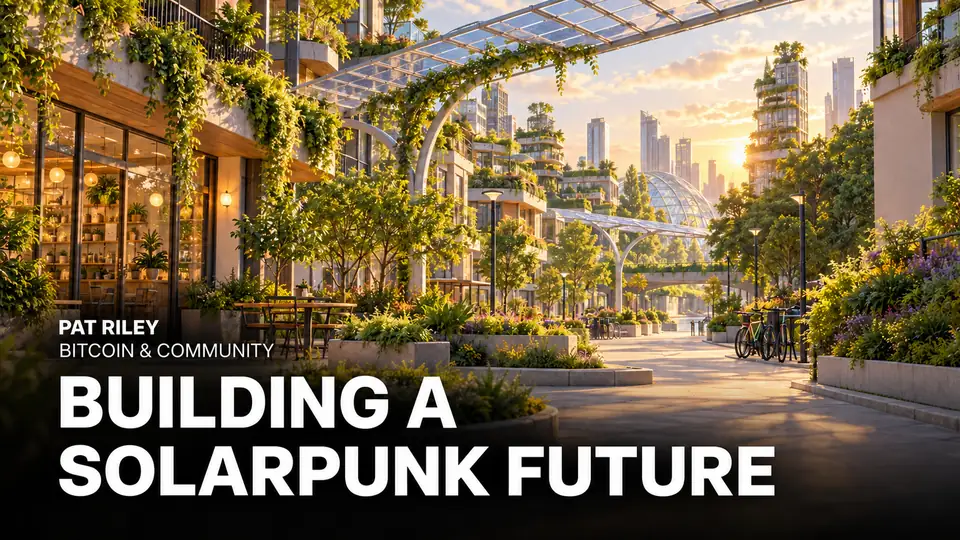
- 30:09Solarpunk: balancing cities and nature
- 32:17Science fiction and post-scarcity questions
- 34:29Inner exploration and speculative histories
- 37:41Inequality and intentional technology
- 41:36Biotechnology and future possibilities
- 43:49Where to find Pat
Read the conversation
Open the full transcript
CAMERON WIESE: Welcome to the Build the Future podcast, where we have conversations that promote positive and exciting visions of the future. Today, we're talking with Pat Riley, the creative director at Bitcoin Magazine. In Bitcoin Magazine, they're promoting the future of digital currency through media and the organization of the annual Bitcoin conference. Let's jump right in. Thanks for coming on. I love the solar punk piece you wrote. And I'm like, this is great. I should talk to Pat. And then I saw that you kind of you're deep in the Bitcoin space. Oh, let's just record this podcast. Let's talk about all things under the sun. So sustainability, crypto, psychedelics, all that good stuff. Thank you for coming on.
PAT RILEY: Yeah, of course. Yeah, appreciate reading that article. And yeah, thanks for having me. I'm
SPEAKER UNCLEAR: excited to see what we cover here. So you mentioned you're in Miami right now. I don't know,
CAMERON WIESE: I just went through Twitter feed, looked like you're also in Austin relatively recently. Both those cities seem to be the next tier of places to go live and work instead of companies, at least
SPEAKER UNCLEAR: in the US. Okay, how do you think about the two? Yeah, it's funny. I've spent a lot of time in
PAT RILEY: both of them this year. I don't know if I mentioned this, but I kind of during the pandemic, I actually sold my house and I bought an Airstream. And that was kind of my way of trying to make the best of a situation. So I actually, you know, me and my wife and my kids, we toured around the country, kind of like, you know, experiencing nature, you know, getting to see a ton of different, you know, parts of the US and how each city, each population was kind of handling this differently. And Miami and Austin were both spots that were kind of these bastions of freedom. And of course, the Bitcoin community, of course, kind of naturally gravitated toward that as well. So I'm interested in those two spots for that reason. They're becoming pubs for people that are trying to work on these projects. And it's been really cool to see the mayor of Miami kind of embrace that and say, welcome, let's trial some of this stuff. Let's Austin, of course, is, you know, Texas might as well be its own country. Right. So they of course have that, that spirit of independence. Yeah.
PAT RILEY: So I think that that's, that's kind of why they both popped up as kind of these, these hubs for some of this tech that we're working on.
SPEAKER UNCLEAR: It's cool.
CAMERON WIESE: You took, I mean, we're going to kind of go get an Airstream one. It's cool. You're able to get one at all because they immediately just like got pulled off the market to everyone's like, Oh, I have to get one. And now we're able to take the time to travel around the US. I just want to hear more about what that was like, what surprised you, what made you hopeful,
SPEAKER UNCLEAR: traveling around.
PAT RILEY: Yeah, I mean, it was incredibly eye-opening. I had always just wanted to explore the country just from a natural perspective. There's so much natural beauty out there. I spent a ton of time in Utah, which is just gorgeous. Montana, all these places that are just natural wonders, honestly, these preserves of just pure wilderness. It's just amazing to visit. But it's interesting too, is the people that come along with it. And I think that it was really eye opening for me to during the year of 2020 and leading into 2021, wow, we're all at each other's throats on social media. And the news is just blaring negativity to actually just go and talk to people, see how different people were handling it. And it was honestly really inspiring, you know, because I think there's a huge disconnect between how we act online and how we act in person, right? So you're in person, you're getting feedback from somebody, you're understanding that that's another human being on the end of the line, there's a feedback cycle. So I don't know, I felt like it
PAT RILEY: in a year that was like a very tough year for many people, I actually kind of took a big chunk of optimism out of it. People are resilient, people will survive. And also there's just a ton of different types of people, which if you don't go out of your way to go find them, it's very easy to kind of craft a narrative of what people are like. And, you know, that's a trap that we all fall into really.
CAMERON WIESE: The people who have time to post online are going to have a different like worldview than people who are just kind of quickly scrolling through to get like advice on something or, or check what supplements to buy or trade ideas. And I think Twitter is the same thing. It's like, there's just so much noise. We're like, oh my God, the world's burning down. But if you know where to look, that's not the case at all. There's a lot of cool stuff being built right now across all sorts of spaces. And that kind of segues into one of the things I love to just ask people is, what are you most hopeful for? Usually I ask, what are you most excited about? But in your, the Solarpunk piece, You used the word hopeful, which I thought was nice. So I think I'd reframe that here with you. It's what are you most hopeful for the future?
PAT RILEY: I think I'm most hopeful for the next generation, right? Like I'll just, I actually tweeted about this earlier this week. Yesterday I was getting coffee and I was just sitting there enjoying the morning and next to me was a table of, I'd say maybe 14, 15 year olds, right? And they are there getting their coffee, which I don't know. I didn't start drinking coffee till way later, but I rest my case. And I was just sitting there and overhearing their conversation. They were talking about all sorts of stuff. They're digitally native people, so they grew up on the internet. They never had to wrestle with the existential angst that a lot of millennials had to go through of being those people that crossed that chasm. They were just born into this. They don't see it's weird at all. And the topics that they... I know it's totally anecdotal, but they were talking about data privacy. They're like, how can I protect my data? I don't want these corporations stealing my data. I don't want people looking through my webcam. How can I use encryption to protect myself?
PAT RILEY: And I just was like, how old are you guys? You guys are 14-year-olds, and they're talking about how SMS is not secure and how they didn't like Mark Zuckerberg because they felt like he was extracting their data for his own means. And I was just like, oh my gosh. Like this was not the conversation I was having at 14. So I'd say, you know, if you want to know what the future is going to look like, you have to listen to people younger than you because they are the future. And of course there's always exceptions, but I've found, you know, Gen Z and people that are kind of coming up right now to give me a lot of hope, you know? And that's just been really cool to see.
CAMERON WIESE: It's crazy though, when you contrast that with the education system today, it seems like it's just not functional at all. And yet somehow we have kids who are somehow merging through that the muck in the mud to like innovate and want to do things. You have any thoughts on like what might be going on there.
PAT RILEY: I don't know I, you know, I can only speak for myself and kind of my experience with education system but I think there's a general sentiment right now that people are kind of waking up to, you know that this education system was essentially like it's like what 50, 100 years old, at this point. And it was designed for a very specific purpose, which was, you know, during the Industrial Revolution, we wanted to, you know, streamline our education process to make, you know, good workers and people that people that, you know, we're going to go and like fill out a need and like build up our, our efforts against the war. And I just think that that is just not the reality. But we're still going off those textbooks. I mean, there's, there's plenty of writing about this and people that know about the kind of challenges about how to change it more than me. But I think going back to the Gen Z people, I think they're just looking at it and they're not asking for anyone's permission. They're like, I want to start a YouTube channel, boom, I'm going to start a YouTube channel, I got income coming
PAT RILEY: in. Remind me again why I need accreditation or a stamp of approval. I think that's a huge factor. I'm not discrediting the importance of higher education. There's certainly fields that it makes complete sense to have that, you know, more centralized and organized approach. But I don't know, this is just something that I've observed. And I wouldn't be surprised that, you know, with like online classes and like these, you know, this exchange of ideas, master classes, more and more people are like, I'm just gonna subscribe to like six of these people and get my education that way and learn by doing. And I think that's a model that works for, you know,
SPEAKER UNCLEAR: more people than we know.
CAMERON WIESE: I was talking with someone the other day about this shift. And it seems like one of the main narratives is that like esports and video games is a great example of what I'm about to say, which is everyone can find a path. There's no more like, oh, you have to do X, Y, or Z. Those are the only three things. Like you have to, if you want a good life, you have to go, I think like doctor, lawyer, or banker, which is kind of what most people think of. But now kids are able to go online. Like, yeah, as you said, like, oh, I can be a YouTuber. Oh, I can go like, right. I can go connect with people from all over the world and feel like how I can help them with whatever project they're working on. And then I can actually get work experience versus sitting around in the classroom. And I think that's something that I'm trying to promote too. Just like, how do we get more people realizing that they can take responsibility and like go play their own game? Like the system that has been running the show for the last 50, 100 years, it's kind of had its time.
CAMERON WIESE: we're moving to a new era where there's new possibilities, lots of interesting paths for
PAT RILEY: people. Absolutely. And that's a segue into what I have been working on the past five, seven years, which is cryptocurrency and more specifically Bitcoin in my case, because the internet opened up the door for what we just described. That made it possible, but there is still a key component there that was missing, which was the monetization. And so of the, you know, now, if someone wanted to build an app that has monetization built in, if they wanted to do anything in finance, if they wanted to do anything international, right, and just in service customers outside of a centralized platform or service customers outside of their jurisdiction, they can now do so. And so, you know, that that was one of the most exciting things about Bitcoin that got me involved in the early days is just the fact that like, there can be a teenager sitting in somewhere in Argentina, and he can now trustlessly engage, collaborate and build with somebody in, let's say, Amsterdam, right? And that, to me, is like, when you grasp the implications of that,
PAT RILEY: it's just as exciting, if not more, than the internet itself.
CAMERON WIESE: Can you elaborate a little bit on some of those implications? Like, what is Bitcoin actually doing for the world? And what sort of world is it leading us into? So I think a lot of people just think, oh, it's this digital currency that's used for black market purchases or like story value for gold. Like, what else is going on? Like, what should people be thinking about? And just like how this
SPEAKER UNCLEAR: is actually going to change the way that our world works. Dude, you hit the nail on the head. Like,
PAT RILEY: that's something that, you know, since I've been in it has been like a narrative that like, I've had to face like I used to not tell people at parties, I was involved in Bitcoin because they're like, Oh, you must be a drug dealer. And I was like, well, like, no, the drug dealers dress nicer, they get paid better than me, they go to Washington, we're a totally different breed. But I mean, that's something that I have been seeing change is kind of the stigma around it. And I think more and more people we saw with the El Salvador announcement recently are realizing that Bitcoin is not just, it's such a multifaceted thing. You can look, it's like a diamond, you can look at this through a thousand different lenses, and it's endlessly fascinating and endlessly revolutionary. But to your point, I think there is this huge strain of optimism in that this is enabling, it's giving power back to people, it's breaking down some of the corruption and some of the control and some kind of the perverse incentives that we've seen in government.
PAT RILEY: It's stripping power away from them and it's enabling people to trade freely, take back control over something that should belong to everybody, which is just value, right? It's breaking down borders all across the world. It's very difficult to sell Bitcoin to Americans or people that were born into a Western society where your credit card works just fine. Your banking system, more or less, it gets the job done. You don't have to go that far outside of your bubble to realize that some huge percentage of the world is not only unbanked, but their currencies are more volatile than Bitcoin itself. They don't have access to basic financial tools. They can't build themselves up because they're lacking this human, this basic human need, which is sovereignty over their resources.
SPEAKER UNCLEAR: Yeah.
CAMERON WIESE: Well, that's why the El Salvador thing is super important. Can you just talk about what's happened there? This announcement, this thing that's been going on, and then what that means for El Salvador than other countries that don't have stabilized currencies or that have a bit more
SPEAKER UNCLEAR: price fluctuation.
SPEAKER UNCLEAR: Yeah, it's interesting.
PAT RILEY: We actually broke that news at our flagship conference down here in Miami recently, and it kind of came to a surprise to all of us, I think. It was kind of a last minute thing, a lot of moving parts. And I think the general sentiment from the Bitcoin community was this is happening a lot sooner than we thought. We all thought that this cycle was going to be about institutional adoption, private companies, more serious investors. I was taken back by the nation state adoption here. It's too early to tell how it's all going to play out. I think there's a motto in the Bitcoin community, like, don't trust, verify. And so we're always very skeptical of things and promises until you actually see the positive results or something that's working. Take it with a grain of salt. But really, I think the most valuable thing coming out of El Salvador is it's a laboratory. Right? Like this is an entire country that decided to move off of the dollar standard, not even move off of it, just introduce this other parallel system. And they're going to go
PAT RILEY: through and they're going to encounter challenges, UX problems, financial problems, like dealing with other countries. And that's going to be kind of a model that everybody can look at and learn from. And then when the next nation state comes along and says, hey, I'm thinking about offering this to my citizens, they're going to have a playbook here, some lessons learned to go by. And I think that that's how we should look at El Salvador, not as this is the end all be all, more like this is a lab. And it's the perfect place to do it because they lost their currency in the civil war. A huge portion of their GDP is relying on remittances, which is something that Bitcoin's exceedingly efficient at and they are trying to bring tech and innovation to their country and empower their people. And I think it makes sense for all those reasons.
CAMERON WIESE: I remember when it was Jack... Mahler's. Jack Mahler was on stage talking about this. He was tearing up and I mean, I wasn't in Miami, but I was watching kind of the recap from home. And I just like overcome with a sense of like excitement and possibility. In a way, like the rockets like real landing. It was like on that scale of like, oh, something big just happened here. And we don't know what the full implications are, but this is going to be one of those. This may be like a shelling point for the space or for like the movement where this thing is actually picking up steam and like it's actually being taken seriously. and how might the world change as a result of this? Yeah, that's like the big open question, but there's movement and there's something, there's like stuff going on behind the scenes. And so I don't know that that was super cool. You guys were able to kind of pull that together and showcase that announcement because then gave a lot of people hope.
SPEAKER UNCLEAR: Absolutely.
PAT RILEY: Jack did a hell of a job and we, you know, I think he's a great, great spokesperson for that cause. And I mean, the ripple effects, even the next day, were felt, you know, certain politicians started singing a different tune. A lot of people kind of initially thought, this isn't that big of a deal, like, what's the market cap of El Salvador? And I think, you know, it was kind of easy to, it's like, how many Apple, how many El Salvador's can fit in Apple's market cap, you know, and it's like, that's a valid point. But this is much more symbolic than that. This is much, this is the the scent shockwaves throughout the entire world, like not one country didn't take notice. And I think that kind of alludes to what you felt while watching it.
CAMERON WIESE: We're both in the US right now. How do you think that takes shape here domestically? It's kind of crypto Bitcoin movement. Because we saw you have Wyoming, they're kind of in legislature around Dows, you have a few other senators that are very pro crypto. I'm curious what you see going on here and like how this may be a path for us to solve some of the challenges we're facing here at the US.
PAT RILEY: It's such a complicated issue, especially politics is something that I've never really aimed to get into and understand. So I'm looking at this from a distance. And I guess my take on it is there's clearly some people that are like, look, this is one of the fastest growing sectors of innovation in America right now. Right now, a lot of the big companies, a lot of the talent are located here. And we need to do everything in our power to keep them here, right? especially after 2020 when people are going back to their, you know, homeland or they're going back to where other places that have jurisdictions that are encouraging entrepreneurs and innovation. I think that America needs to really wake up to this and be like, look, if we clamp down on this and apply, you know, 50, a hundred year old legislation to this thing that basically escapes definition, we're going to lose talent. We're going to squash innovation and that, and we're not going anywhere, you know, We're going to go where we need to push this forward because we believe it's that important
PAT RILEY: for the whole world, not just America. I really hope that that overrides our initial knee-jerk reaction, which is basically like
SPEAKER UNCLEAR: control.
PAT RILEY: I also do think that Bitcoin does pose a certain threat to the dollar and the government's control over monetary policy. They should be taking this very seriously. But the government doesn't work for themselves. The government, as it was originally designed, is supposed to work for the people. And I think we saw the people stand up to their senators, to their congressmen, all these people, and say, this is an important issue for us. We want it to be taken seriously.
CAMERON WIESE: Yeah, that was a pretty powerful moment. That was like two weeks ago, almost. Can you enlighten me on the specifics here?
PAT RILEY: Yeah, and I'm in the same boat as well. Like it moved so quickly and you know, it's moving through the political system and there's all these different amendments out. I would encourage your listeners to check out Bitcoin magazine. We cover all of this stuff really in depth. We're hosting Twitter spaces with people who are very familiar with like the up to date moments. Overall, I would say it really just highlighted that they had no idea what they were talking about, to be honest. That was kind of the shocking part is that we didn't really all the proposed amendments. they were like gonna, you know, ban proof of stake for a minute. And then they're like, no, not proof of stake, proof of work. And then they said, no, everyone's a financial broker. Like really, it was really like, shocking to me to see kind of some of our most experienced political leaders show a very rudimentary understanding of this technology to the point of where they couldn't even talk cohesively about it, you know, and so there was like some basic one to one stuff
PAT RILEY: in there, that they just weren't grasping. And you can tell that they just had people in their ear, and it was all happening fast. So I think that that was my main takeaway about their ability to handle the situation. This is something that should take years of in-depth discourse, hearing from the companies, hearing from the users, hearing from regulators, and really dive into this and craft a path forward. It's not something that can be solved in a week, for sure.
CAMERON WIESE: ! Certainly not. I think some of that's clearly broken in the system within which is people, It's not enough hubris, you're like, oh, this is a complex thing. This has profound implications. Let me look into it and understand it and get excited about it. Instead, it's like, oh, no, this is a scary new thing. I don't understand. Or this seems to pose a threat to my current interests. Let's just brush it aside. I don't remember if I mentioned to you the underlying project here, which is to revive and reimagine the World's Fair here in the US. So how do we turn the future into a physical place that people can, that millions of people who come to touch, feel, and experience. And one of the storylines things really important to immerse people into and get them to understand and think about is this kind of decentralization of Bitcoin narrative. And I'm curious, I just want to riff with you a little bit like what might that story look like to the people who are unacquainted with Bitcoin right now or maybe I've heard about it. What should the story feel like
CAMERON WIESE: or what should the story arc look like to get people understanding the technology and then being excited about it?
PAT RILEY: Yeah, I mean, there's so many angles. I think, you know, to your point about kind of touching and feeling and the whole kind of mission that you have going on with the World Fair, I just want to applaud that effort because as someone who throws events and has kind of seen the quality of discourse that happens in person versus online, it's night and day. And you know, especially when dealing with the subject matters that are just like so complex, it's not something you can describe in a tweet, like you have to have a conversation and react in real time and have that discourse. And so I think that what you're going for is absolutely the right approach. I think it's great. As far as the Bitcoin narrative, I mean, as far as being a world fair, there's nothing more global than Bitcoin itself. Bitcoin knows no borders. It knows no country. It doesn't know who you are. It doesn't know what age you doesn't know where you come from. And I think that's just a beautiful thing in today's day and age that like, this is a tool that humanity has created
PAT RILEY: to basically be a bridge that is almost exempt from our human biases. And that's beautiful in its own way. But I think another really interesting aspect to this is, and this is something that I've been thinking about recently is that as Bitcoiners and these early adopters and just really anybody who has kind of seen where things are going and bought into this, has some working capital, wants to basically do some good in the world. We're now looking at a very, very wealthy and ambitious and, in my opinion, optimistic demographic. And so I think one of the cool things about Bitcoin is that there's no middleman. So we can create new methods of funding projects that we want to see directly. And so I'm just looking at it, and on one hand, we have a very optimistic, forward-thinking, wealthy demographic. And then on the other hand, we have an upcoming generation that has all these ideas, all the ambition in the world, and they just need some working capital to go make it happen. And we don't need to sit around and wait for subsidies, or this or that we can just put these two people
PAT RILEY: together and be like, go.
CAMERON WIESE: That's what's been really cool to see is the funding or kind of the capital that's been committed in the Bitcoin and Ethereum and other crypto spaces like being repurposed, like you have most of the heads of a lot of the kind of the currencies who have set up foundations. You have this like Jed McCabe from Stellar has like this Estero, which is like this private science like foundation where they're funding all sorts of deep tech stuff and just research. And this, this was not possible 10 years ago. Even like if we separate crypto out, we also have like the tech space, where up until 2008, 2009, like the IPO exits, I mean, a lot of people made money in the early 2000s run up, but it wasn't the same sort of like cultural ethos where that kind of Silicon Valley had kind of accumulated over the decades. But then you had people starting comes like Uber and Dropbox and Airbnb and Stripe and like all these companies being built by forward thinking ambitious people who saw the world was broken and wanted to change it and now have the capital to like funnel that back into projects.
CAMERON WIESE: Like there's so much capital from not, not like there's a lot of capital out there, but there's a lot of capital specifically from people who are optimistic. I think that's something that we haven't had before. And these people are like, I want the world to be dope. I want that solar punk future. But instead of like, oh, I expect 10% returns every year for the like into infinity. I think people
SPEAKER UNCLEAR: start doing that calculus, but less, they're less concerned about it. Yeah, absolutely. And you
PAT RILEY: mentioned like some of the early IPO companies, like that's one of the cool parts about Bitcoin is that while certainly profitability and finding a profit product market fit is important, some of these products and projects are just in a sense free from that. They don't have to basically change their business model or be obligated. Well, they have to be obligated to their shareholders in a certain way, but I do think there is a certain freedom that comes with this new model that allows people to pursue the right idea and not make a pivot or a wrong turn for an artificial constraint.
CAMERON WIESE: If we play this out, how do you think this shapes the world we live in, right? Where people are able to finance some of these creative projects out, perhaps the challenging incentives that the existing system requires, where you have to constantly be chasing growth at all costs, if you want to get anything funded?
SPEAKER UNCLEAR: I don't know.
PAT RILEY: I think that's one of the things I'm most interested in watching play out. Bitcoin companies, I guess, I can speak to is that there's certain companies that have gotten funding and they conduct what's called blue sky research. Blockstream is a company that is in that field. What I really like about their model and other companies' model is that they might have raised the money for one reason, and that's certainly fine. But really, the thing about Bitcoin is that long as they're creating tools that the ecosystem needs and people are wanting to find, that essentially raises the value of the Bitcoin ecosystem. And then if they're sitting on, their treasury is sitting on Bitcoin, then of course they benefit from it. And that's just a whole different set of incentives than like we hired or we got funding for a Series A, we're going to go to market with a specific strategy. And if it doesn't work, then we're going to pivot and see what we can do here, as long as these companies are benefiting their ecosystem, a rising tide lifts everybody up if they're holding.
PAT RILEY: So I think that that is one example of what you're alluding to and a new model that's
SPEAKER UNCLEAR: unfolding.
CAMERON WIESE: Yeah, the religiosity of the Bitcoin movement too is like super exciting to see. It's like just hold, buy and hold. And everyone's taking this long-term view, which runs counter to most of the other things the more we live in where it's like, quick, fleeting, dopamine hit here, dopamine hit there, like, what's next, what's next, what's next? And Bitcoin seems to be one of the only, maybe like the last bastion of like, nope, I am taking a very long term view here. I am going to hold it, I'm not going to be influenced by the ups and the downs, just like write it out. Is there anything else that's kind of like not as mainstream that most people don't know about that makes the Bitcoin community or just kind of the space in general unique?
PAT RILEY: Well, I think you kind of touched on one of the most interesting aspects of it was basically when you hold Bitcoin, that mindset shift that occurs. So our existing system was totally debt-based. It was totally spending-based. When the market crashes, they pull all the levers that they can to basically encourage spending. Credit card companies actively market to new students saying, hey, go in debt with us, spend money. I mean, it's dangerous. I was in that same boat. I bought a laptop when I was young. So I feel like that's one of the really interesting parts that's often overlooked is basically, here's a money technology that basically incentivizes that long-term thinking like you were thinking about, but also it really makes people question their purchases. Do I really need to spend this amount of money on this thing when I can have double the spending power in the future. And that might have short term downsides when you look at it, as far as boosting the economy and stuff, but it's longer term upsides because then they're still going to
PAT RILEY: allocate that capital, it's just going to be something greater, it's going to be something more. And the interesting thing is that people making products, they'll hear that. So a big problem with consumerism is like planned obsolescence, right? Like we create these products and we almost, they're almost incentivized to have them break within a year. So that next year, you got to buy the new model. You know, I was just actually visiting some family and I was looking at like an old sewing machine and I was looking at this thing and it was like an old Singer sewing machine and it was built like a tank, you know, like it was like built out of solid steel, like it still worked like a charm today. And, you know, there's There's a whole conversation about why we don't have those things anymore. But I guess what I'm getting at is once the individuals, once the buyers kind of changed their preference and what they want, the market will adapt and will probably create products that are more quality, have a longer longevity.
PAT RILEY: And yeah, I think that that's probably going to be net positive for a whole bunch of reasons.
CAMERON WIESE: I think so, too. So any kind of pair that with some of the technology that they just build their own things, this kind of return to craftsmanship that may be fueled by this solar punk aesthetic where people are like, oh, I can go build a community kind of out in nature. I was talking with, I think I sent you the on solar punk sub-stack, if not, I'll send it back, I'll send it over to you. But the guy writing at Paul Fletcher Hill had this great point where people think it's either, it's like one or the other. We have these dystopian cities or these cyberpunk cities, or we had these kind of solar punk like out integrated in nature. We can have both. There's not this dichotomy like have a wild fun adventure in the city and live with your friends with your family with your community and like have a meaningful fun life out nature and like the transportation that will be created to enable kind of moving quickly between the two will only accelerate is moving in the future. So it's, I know, it's like a really cool thing to think about.
PAT RILEY: Absolutely. I mean, you know, as I was saying earlier, like I kind of, you know, took this past year off to go experience the side of nature. And, you know, I kind of had this thesis that like I wanted to, you know, exit society, go basically see, you know, how I could live more in touch with myself, live simpler, elevate my level of happiness. And I think I certainly did that to an extent. But it was it was so funny. I thought that basically I was like, this is my, I'm sending off and I'm never going to look back. And this is the way, this is the way to live. But it was so funny because I would be in the middle of the desert. I would be totally, you know, living in touch with nature. And I would be like, man, Bitcoin is the coolest project that is going on right now. And it's like, that is just a testament that like, you know, now I'm coming back from this journey. And like that balance was especially key. But now I'm coming back from this journey. and to your point, like you can have both. Like now I'm just like, I'm loving the feel of the city.
PAT RILEY: You know, I'm loving the high energy. And, you know, I think that that balance is super critical for individuals, but also, you know, for societies as we design them moving forward, it's not neither or, you're right.
SPEAKER UNCLEAR: Gotta find that balance.
CAMERON WIESE: Yeah, so on the solar pumps, just on that piece, we can have the shared understanding, or shared interest in the fact that like, the visions for the future that we have shape our imagination. And science fiction has done a not so great job of providing alternate realities that are exciting and prosperous. I want to ask, out of the science fiction you've read, what promised technology that hasn't arrived are you most excited about?
SPEAKER UNCLEAR: Man, that is a hard one. I mean, you could totally go for the fun stuff, right? Like
PAT RILEY: airships. Yeah, or like the biotech route where like you can like change your eye color and like change your appearance. I mean, there's so many, there's so much imagination in science fiction. One of the books that I think about often is Ian Banks. I don't know if you're familiar with him. He writes a series called the Culture Series. And what I love about his book, and kind of the promise of the technology he talks about is he basically is thinking so far ahead, you know, millions of years in the future where basically humanity has reached like what's called like post-scarcity where anything can be created at any given point in time. Like we have, immortality has been solved, like essentially like everything's been checked, you know, interplanetary travel and he basically kind of, you know, what I love about science fiction writers is they basically start wrestling with these concepts like, you know, thousands of years before we do or we even have to think about it. And he's any kind of looks into that, like, you know, if we have all our basic needs met,
PAT RILEY: if we have unlimited life, what do we do, you know, and it's really I mean, he has books about like how we play these games, and there's certain people that kind of say this isn't natural, they opt out of it. And like, you know, the struggle and the push and the pull still goes on. And you and you never I mean, utopia is a nice, it's something to strive toward, I think. But then And once you get there, conflict is part of the fabric of this reality. And I just think that authors like him, it just really makes you think.
CAMERON WIESE: I'm not sure if he talks about this in the culture series, but another conversation I have, we were talking about how when humans reach the point where we can, where we do extend our, where we unlock, where we cure aging, we unlock some of these longevity things, we're living longer, healthier lives. And then we have the acceleration in space tech and we'll explore the galaxy. There's going to be certain subs of people who are like, that just doesn't interest. And instead their frontier shifts from space to the frontier within. And this is a good segue to drugs and consciousness exploration, where there's a possibility where people can just go experience, explore, sustain psychedelic states, and tap into this theorized global consciousness that we all share. And there's like this this adventure that you can take into the self versus out into the galaxy. I'm just like curious what your thoughts are on this space in general and kind of the future of psychedelics. I know that's something we were,
PAT RILEY: I want to talk to you about. The future is certainly interesting, but also as far as psychedelics are concerned, I feel like the past is just as interesting to look into, you know, because if you look at some of like Graham Hancock's work and stuff, it's still theoretical, but I mean, it's looking increasingly likely like with civilizations that we found like Go! Bekli Tepe and places that we haven't even discovered yet just because we haven't dug that deep that basically humankind is much older than we think. And there were, quote unquote, advanced civilizations that existed here way before us. And I think a lot of times when we hear that word advanced civilizations, it's like, oh, what are you talking about? Like ancient aliens, like there's people that had cars on earth that like, we're just gonna dig up and stuff. And I think that that's kind of missing the point in that, like, you know, it's totally possible that we had an advanced civilization that kind of came to that conclusion that like, hey, if we,
PAT RILEY: you know, we have this infinitely inward space to explore. And, you know, if we found a way to live symbiotically with the environment, and we have all of our civilizations needs met, then like this is the frontier. And you know, whether they experienced that through plant medicine or whether they experienced that through like fasting or yoga or whatever, like we have no idea how advanced they got down that path. And clearly, you know, it didn't work out for whatever reason, they're not here, you know, who's to really say, but to your point earlier, like it's clear what trajectory we are on now. Like we're going to the stars, like we're moving.
SPEAKER UNCLEAR: it is happening. It's exciting. Yes, it's super exciting. Then the new space race getting kicked
CAMERON WIESE: off. I mean, I was hoping Bezos would throw the gauntlet down and say, I am now taking CEO of Blue Origin and then do what he did with Amazon or apply that kind of ruthless relentlessness to competing with Elon. Didn't appear to be the case, but nonetheless, there's lots of cool stuff being
PAT RILEY: done there. Yeah, I mean, that's the trick. We got to explore outwardly. And as we do that, we can't forget to explore inwardly as well. I think both are important.
CAMERON WIESE: If we could expand on that, what do you think the most important problems are for us to
SPEAKER UNCLEAR: tackle this decade or in the coming decades? The climate is certainly going to be a huge,
PAT RILEY: huge challenge. I think wealth disparity is another one, right? Essentially, this is something that we think a lot in the Bitcoin space about the eradication of the middle class that we see, you know, and just this growing divide between people with means to basically do whatever they want and people who can't live on more than $5 a day. I think that that is going to be a huge, huge issue that we see over the next decade or so. And I think that's also a situation which I'm not going to sit here and claim that Bitcoin can fix that 100%. But I think as long as we are pushing forward with new means of financial innovation, new means of governance, trying to pry the power away from people who got us in this situation in the first place. I hope that we can make some advancements as far as bringing back a healthy society that has a clear path to success
SPEAKER UNCLEAR: because that's missing right now. Yeah, that's the other thing I'm hoping. We can shift the
CAMERON WIESE: culture, I was like, Hey, how do we actually all end up in a positive sum world instead of this like zero sum one that we're living in now where there's this, yeah, there's this kind of growing gap between the growing wealth gap. It's almost like dystopian, a sense in like, you know, like an Elysium sort of way. I don't know if you've seen that, that Matt Damon movie, or it's like, all the people have money, like neglected Earth, they're up on their their spaceship, and everyone else is kind of down on Earth. But the gap that like interesting kind of thread with that. Technology actually enables, is the underlying solution to a lot of these problems. Oh, people on earth are sick. Oh, we have all these medical bays up on at least you can just provide that medical support to people on earth and then get them healthy and well and fixed and not neglected. And then they're able to go do more things and take responsibility for rebuilding and creating something new that they're excited about. We're not there yet.
CAMERON WIESE: I think the trends are all moving in the right direction, at least from my perspective.
SPEAKER UNCLEAR: Well, I think you're right.
PAT RILEY: I think something that I see in the tech industry is essentially that if we work on this technology product that it will solve problems on its own. And there's certainly some truth to that if you put that out there and solve a need or something. But it also is going to take conscious effort. Like just because there's like technology out there that is vastly more efficient, it doesn't necessarily automatically route that intention. Like we still need to do that. And an example that I always like to kind of think about to that point is like, you look at like, for all their flaws, the Carnegie's, the Rockefeller's of the previous era, when they became incredibly wealthy, they became the pillars of society and they built institutions, they built education systems, they built infrastructure, they gave back, and they did so because they wanted to be admired by the people. They didn't want to go isolate themselves and just live like the Elysium style of luxury. They wanted to lift up everybody. And I think at some point we kind of lost that, I think.
PAT RILEY: And so again, just because we have better technology doesn't mean that we don't still have to route our intention through said technology.
CAMERON WIESE: That's a great point. Yeah. It's like technology can be a force for good, if we allow it to, if we like, make it that way, left to run away on its own, you know, perhaps perhaps not. Outside of the Bitcoin space, we talked about a couple of these things, but just to explicitly ask, like, what are you most excited about? Like, what technology, what change in the world outside of Bitcoin are you most looking forward to?
PAT RILEY: I think biotech, you know, that's something that I admittedly just am a total amateur at.
SPEAKER UNCLEAR: I've like started to do it. It's just again, it's just like Bitcoin, like anything else,
PAT RILEY: it's just such a complex topic that like, I just know how much I don't know. But at the end of the day, it's something that like over the next 10 years, it's something I'm going to be looking really heavily into because I think it is probably the most other exciting thing going on. Like not only the ability to cure certain diseases, tackle cancer, but also the ability to augment ourselves to basically kind of begin experimenting with that, to begin overcoming some of our maybe hardwired flaws, right? That we might be able to edit. CRISPR is fascinating. The fact that that's being democratized essentially, where basically anybody with a laptop can can begin working with that. I think that that's probably the second most, well, I don't wanna rank them, but it's one of the most important fields. And I feel like the writing is on the wall that over the next 10 years it's gonna be just an explosive growth sector as well.
CAMERON WIESE: Yeah, it's cool to kind of be involved or have conversations and talk about this space. Because most people aren't privy to it, But if most people knew what was going on behind the scenes, the work we've done in Biotech, the innovation with CRISPR, with Alpha Fold recently, or even with OpenAI as codecs, or the stuff with DOWs and Ethereum, the implications of all this stuff is wildly exciting and just not something that's permeated the mass media zeitgeist. So I think we have work to do to get the message out there. But when you're looking the right places, the future looks bright.
PAT RILEY: Absolutely. And if you see something like progress happening and it's happening only amongst a small group of people, like the old saying is like the future is here yet, it's just not evenly distributed. So give it two, three, four years and that's going to be available to everyone.
CAMERON WIESE: Pat, where can people find you? Anything you want to plug?
PAT RILEY: Yeah, I think the best place to find me is on Twitter. I'm underscore Riley I.O. My website, everything that I'm working on at the Bitcoin conference at BTC Inc. is linked to from there. So I think that that's probably the best place these days.
SPEAKER UNCLEAR: Thanks, man. This is a blast. Appreciate you.
CAMERON WIESE: Appreciate you coming on and excited for all that's ahead in the Bitcoin crypto space and
SPEAKER UNCLEAR: just the future more broadly.
SPEAKER UNCLEAR: Thanks for having me on, man.
PAT RILEY: And I look forward to, you know, shaking your hand in person at the World Fair.
SPEAKER UNCLEAR: I'm looking forward to it.
CAMERON WIESE: Thanks for joining us for another episode of the Build the Future podcast. If you want to support the show, please share your favorite episode with a friend. If you want to get updates on the events we're hosting, new podcast episodes, and follow along as we build the new World's Fair, you can follow me on Twitter at c-a-m-w-i-e-s-e. Until next time, go build.
SPEAKER UNCLEAR: You
More episodes
All episodes Jill Carlson — Money, Hyperinflation and Financial AccessJill Carlson explores access to stable money, the limits of cryptocurrency and lessons from field research.
 Galen Wolfe-Pauly — Urbit, Communities and Personal ComputingGalen Wolfe-Pauly discusses Urbit’s personal-server approach, digital communities and control over computing infrastructure.
 Doug Petkanics of Livepeer — Decentralized Video InfrastructureDoug Petkanics discusses Livepeer’s open video infrastructure.