

Build the Future Podcast
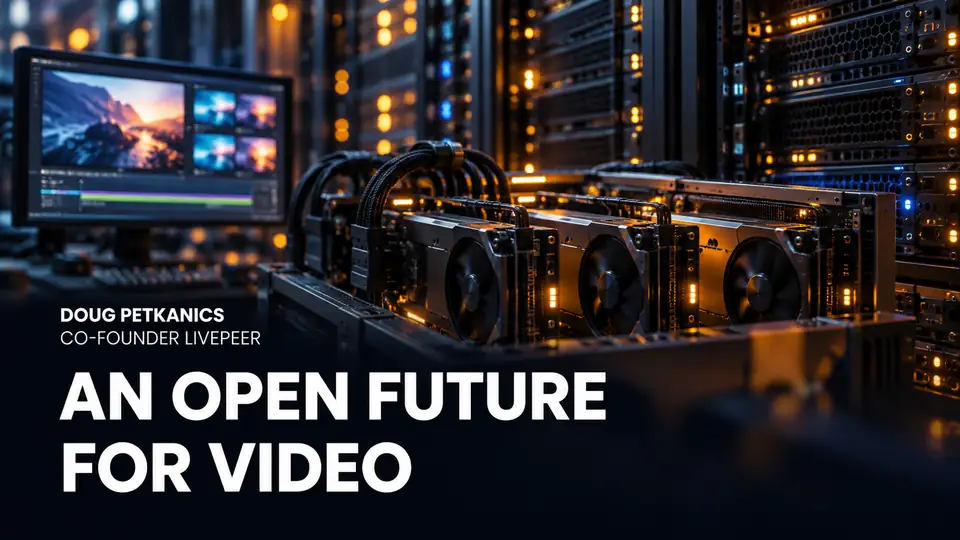
Doug Petkanics of Livepeer — Decentralized Video Infrastructure
Doug Petkanics discusses Livepeer’s open video infrastructure.
April 6, 2021 · 34 min



About the episode
In this conversation, we talk with Doug Petkanics, the CEO of Livepeer. At Livepeer they're building a decentralized video streaming network built on the Ethereum blockchain. In this conversation, we cover the technical side of Livepeer, the implications of decentralized video, Web 3.0, and more!
Links
Chapters
Times follow the podcast audio. The video’s timeline may be slightly different.
- 00:00Introducing Doug Petkanics and Livepeer
- 01:33A vision for open video infrastructure
- 03:45Infrastructure for streaming applications
- 06:06The rest of the video stack
- 06:57Applications for different kinds of creators
- 09:32Autoscaling and practical adoption
- 12:03Nodes, staking and protocol incentives
- 14:02Delegation and network participation
- 14:48Using spare GPU video-encoding capacity
- 16:14The economics of video processing
- 18:43What switching infrastructure could involve
- 20:45Building directly on the open network
- 21:42The path to founding Livepeer
- 24:56Why decentralization matters to Doug
- 27:20Web3 and an online financial system
- 30:09Connecting digital and physical lives
- 31:10What Doug is most optimistic about
- 32:22Finding Livepeer and closing thoughts
Read the conversation
Open the full transcript
CAMERON WIESE: Welcome to the Build the Future podcast. My name is Cameron Wiese and I'm your host. I've always been fascinated by the ideas and sentiment that drove American culture in the 1960s with the space race. A culture galvanized to dream about the possibilities of tomorrow, whether it's food, transportation, cities, biology, or anything else. It was this cultural mindset rooted in optimism that the world tomorrow would be better than the world today. A mindset where people were compelled to build things, and I quote JFK, not because they were easy, but because they were hard. It's this desire to build and to dream that seems to have been lost, and something we're here to bring back. With Build the Future, we're here to promote the ideas and stories of those who see how the future can be better and promote their plans to get us there. It's our mission to get you to dream about the possibilities of tomorrow, to dream about the future that you want to live in, and inspire you to go build. Today, we're talking with Doug Pecanics, the CEO of LivePair.
CAMERON WIESE: At LivePair, they're building a decentralized video streaming network built on the Ethereum blockchain. Let's jump right in. Thank you again for being willing to come on talk about what you're doing at LivePeer. I'm stoked for, I'm like so to dive into this. So first of all, thank you. Appreciate it. Doug, why don't you tell me about the the future you're building at LivePeer.
SPEAKER UNCLEAR: What's the vision? Sure thing. Yeah, thanks for having me on, Cameron. I'm super excited to dive
DOUG PETKANICS: into this conversation. So yeah, Doug P. Canik's founder of LivePeer. Our mission is to build the world's open video infrastructure. And so video has increasingly become a huge part of everyone's lives in normal times, you know, it makes up over 80% of the traffic on the internet, but especially in a socially distanced world. And during COVID times, I think everyone felt how important video was to their life, their work, their entertainment, their family, their friends, etc. And like I said, a huge amount of traffic on the internet runs through video infrastructure. but traditionally it all runs through the same couple companies, very expensive proprietary infrastructure and close source software. And that created really challenging circumstances for anyone trying to monetize their time through video to be able to do so effectively. They basically had to stream through YouTube and Twitch and Facebook, which controlled their experience, controlled their economics with their users. They're always at the risk of being de-platformed on a whim for any violation and we can talk about that.
DOUG PETKANICS: But I'm really excited about the future where there's an open video infrastructure that enables all sorts of developers and hackers and entrepreneurs and product visionaries to create the next great wave of video experiences targeted for specific use cases, targeted targeted for creators, targeted for entertainers, musicians, content creators, etc. And being able to do it on this open cost effective video infrastructure will create great economic alignment between the people creating the content, the people consuming the content, and the platforms themselves. And I think it can free us from this horrible attention economy at supported models that we that we see causing all sorts of problems in society today. And I really look forward to swinging the pendulum back in the other direction and having better aligned platforms. So that's the future that I want to see and that we're working towards building it live here.
CAMERON WIESE: What it means to build the infrastructure layer, because I think at least in my mind, it's like, oh cool, like you're building kind of a new video platform or new video infrastructure, like people's minds jump immediately to YouTube. Like, oh, you're building the new YouTube, you're building the new Twitch, you're building a new Vimeo. But my understanding is that's not what y'all are doing, kind of building the layer, kind of the bottom of the stack. So can you talk about kind of what that looks like?
DOUG PETKANICS: Yeah, that's absolutely right. A lot of people hear what we're doing and they think we're building a replacement YouTube, but we're not. We're not building a platform with all the features where a single person shows up to stream and they have a chat box and they have ads and they have whatever comments and whatever features they want. We're building the infrastructure that lets any developer build a streaming application like like a YouTube, like a Twitch, like a TikTok, like an Instagram Live, like any of these live streaming platforms. And there's a whole explosion of them as there's been kind of a backlash against big tech. So what are the infrastructure services that matter in live video and live streaming video? There's a few, first of all, video is very complex technology. So there's this piece of software called a media server. That's the thing that speaks video. It knows how to receive video. It knows how to send out video. It knows how to convert video to reach every type of device on the planet.
DOUG PETKANICS: And so one thing that's at the core of live here is this open source media server called the live peer media server. And essentially it's live peer node. And then the second problem, once you have the software that they can do all this is how do you do video at scale? Because video is so compute heavy to encode into all the different formats so it can reach every device. You know, if you want to build one of these video platforms, you might need an additional server for every two streams that people send in just to process it. And so scaling that is really challenging. So kind of the second piece is the live peer network is this network of all the live peer node operators who are incentivized to run this media server and keep their compute power available to encode video at scale. And, you know, we can talk about who's providing the supply and why it's really powerful, but there's a super scalable network that can handle hundreds of thousands of streams of video concurrently. And so for a developer that's so powerful just to be able to say,
DOUG PETKANICS: oh, no matter how popular my app gets, no matter how many users are creating streams at one time and pressing that Go Live button, the live peer network can encode it. Finally, there's other important pieces of the video stack that we haven't yet addressed, like content delivery. Typically, this is called a CDN. Maybe you've heard of a company like Acama or Fastly. And this is, OK, you have these output videos. How do you deliver them to thousands or millions of viewers at once? And there's actually no fully decentralized solutions that are performing enough to do this for live video yet. Something we certainly aspire to do and have opportunities to do. But currently, a user would put a traditional CDN on top of LivePeer. But so anyway, all of that is at the core of the infrastructure and the video space. And the output is developers that want to build these video applications. just use live peer software and network in order to power that. And it's gonna be 10 to 100 times more cost effective than using the current cloud providers.
CAMERON WIESE: Like YouTube, they build all this stuff in-house, right? So you upload your video to their server and then they do the transcoding, they do the hosting, they do the delivery of all the different like file quality types to different devices. But because it's all kind of run in-house, they're monetizing it in their own sort of ways with ads, et cetera, versus with Livepeer. It's a network of like nodes that are doing the processing, doing the transcribing. So anyone else can build their own like niche YouTube on top of it. Is that right?
DOUG PETKANICS: Yeah, exactly. So, you know, we see people building streaming sites that are catered towards musicians, streaming sites that are catered towards artists, streaming sites that are catered towards fitness instructors, streaming sites that are catered toward educators trying to teach courses. Right. I think all these users have different feature requirements that, you know, really make those platforms specific and sing for those users. Whereas YouTube is kind of broad and horizontal needs to try and serve everyone, but may not be serving any of those verticals
CAMERON WIESE: specifically. In the white paper for live peer, you outlined a couple of potential use cases for live peer now and into the future. Can you, can you talk about some of those, some of the ones
SPEAKER UNCLEAR: that excites you the most?
DOUG PETKANICS: So I think the one that's the most exciting to me is this idea of empowering creators of content or professionals to basically take like economic control over their, you know, the streaming relationship with their, with their audience. The fact that live peer can be cost effective means that you can build a streaming platform that enables this without bankrupting yourself on the infrastructure costs and the tie-ins to the cryptocurrency industry and some of the payments mechanisms we have in place like micro payments within the protocol level could be used for these sort of value exchange for streaming use cases. And I think that's really exciting. That's the future that I want to see. I think it does take product visionaries and entrepreneurs and developers to have a vision for exactly how to meet those needs for specific audiences and driving those forward. But the thing is, my peer enables a thousand of those experiments to bloom, whereas they couldn't have bloomed on the cloud providers like running on Amazon Web Services and Google
DOUG PETKANICS: Cloud because it would cost 10 or 100X as much money to try and experiment with those platforms and the platforms, the entrepreneurs and developers would be bankrupt by infrastructure costs before they could even validate these things. So that's what I'm most excited about. Technically, I'm a software developer by background. I felt the pain of scaling video. I'm really excited. So this might not be a consumer thought, but I'm super excited from a developer perspective of being able to build on like an auto scaling platform. That just means I don't have to do DevOps. I don't have to spin up servers. I don't have to manage them, but I'm still getting a cost effective way to do that. that's super powerful and exciting to me as a developer. So I'm really excited about what that can enable as well.
CAMERON WIESE: Essentially there's like kind of the infrastructure layer and then there's kind of in the future, this kind of like decentralized app or the dapp layer. And so kind of step one for live peers, like building out the infrastructure and then eventually kind of building dapps on top of it. Is that the right way to think about it?
DOUG PETKANICS: Well, I think the idea is anyone can build dapps on top of it, right? Or apps. So we've taken a really practical approach at LivePeer. Like we were the video layer of the Web3 stack, but we're not just sitting around waiting for all of the Web3 infrastructure ecosystem to mature to the point where there are tons of super successful and scaled decentralized apps or dApps built on top. Like I'm very excited for that day. I'm excited to see what's built, but we built in a way that actually meets and serves the traditional video industry directly in the workflows that they already use. So anyone who has a scaled streaming site, traditional scale video streaming site, has high infrastructure costs to do video transcoding. And they can use the LivePeer network to dramatically reduce those costs. And we've even built a gateway service at LivePeer.com, which means that they don't have to know anything about blockchain, they don't have to know anything about cryptocurrency, they don't have to know anything about running nodes. They can just
DOUG PETKANICS: use an API that leverages the super powerful and scalable live peer network. And that's driving a lot of the demand on the live peer network and a lot of the fees through the live peer network today. So all of our node operators, everyone who's earning fees and getting rewarded for contributing their compute power. A lot of that is due to the traditional like web to user base, but ultimately, you know, I'm really excited about what will be built in web three, the new things that can, you know, be enabled that will replace many of the web two platforms, I believe in the future, but I just can't sit around and wait for it. And it's probably not our core competency to pick one killer application and try and get it right instead of the platform that lets hundreds of people build different
SPEAKER UNCLEAR: applications.
CAMERON WIESE: I want to kind of jump back a little bit too, and have you kind of dive deeper into kind of the mechanics of the Livepeer network. How does this work? How are people incentivized? How's the blockchain involved? Give me the listeners kind of a crash course in that would be great.
DOUG PETKANICS: Definitely. So the Livepeer network is made up of a bunch of node operators who run the Livepeer node software, right? And what they're doing is they're contributing their compute power and their bandwidth to encode and distribute live video. So how is this network coordinated? How does the blockchain fit in? How does this work? So we created a token coordinated protocol, the Livepeer token is an ERC20 token. And I think it kind of formed the basis for a lot of work token protocols, if you will. The idea is anyone who wants to do work on the network stakes token, so they lock the token in a smart contract, right? And that becomes their collateral that proves that they'll do the work correctly. And if they don't, if they cheat at doing the work maliciously, that collateral can be taken away or slashed that provides some security for people using using the network, right and the incentives for for staking are twofold one is Every day every round in the Livepeer network
DOUG PETKANICS: Some new Livepeer token is generated out of the protocol and it only goes to the people who are staking and participating So that incentivizes people to actually like take stake and put skin in the game and be aligned with network long-term The second incentive is that users of the network, so people who want to stream and encode videos, they pay ETH in order to do that. And these node operators whose nodes are doing the work earn that ETH. And that's all settled by the blockchain using a probabilistic micro payments protocol that we built on top of Ethereum and a scaling update we put out. And so that's kind of at the core of how it works. The one other cool thing is if you don't want to run a node, but you want to play a part in this network, you believe in it long term, you want to add security to it, you can participate by essentially delegating your stake. You can, as a regular token holder, you can stake your token towards one of these node operators, almost like you probably heard about validators and other networks.
DOUG PETKANICS: They're called orchestrators in Livepeer, but you can stake towards an orchestrator, and then you'll earn a portion of the new tokens generated every day and the fees that they generate. And so this has been really effective at bootstrapping the network. There was a high rate of inflation in the early days and that encouraged a lot of participation. And, you know, we have a bootstrap supply side network that's encoding video reliably around the world. I want to talk about who is doing this work and why there's so much capacity. This is one of the coolest things about live peer. It's also one of the most technical. There are millions of GPUs or graphical processing unit cards that are out there that are mining cryptocurrencies like Ethereum, right? Ethereum, Zcash, Grin, Monero, these are all mined by GPU pieces of hardware. And it just so happens that many of these GPUs have little video encoding ASICs on there that can't hash cryptocurrency. They can only encode and decode video because these GPUs were made for gaming and video processing, right? And so those cards are
DOUG PETKANICS: hard at work hashing cryptocurrencies, but they also have chips on there that can encode video that are sitting there doing nothing. And so Livepeer’s software enables them to continue their mining and not disrupt their mining income, but to make additional revenue by encoding video. And so it becomes almost like a no brainer value proposition for a miner. is like, oh, I can make more money without significant additional costs. And by the way, I only have to use power to do this when there's a job to be done. So only when I'm making money. So this creates like an enormous latent supply of compute power that's available to the Livepeer network. And that's why we can encode video at scale. That's why we can do it so cost effectively. Just to give you an order of magnitude of the numbers, you know, cloud services charge at least $3 an hour to encode video. So over the course of the day, that's, you know, 72 bucks, right? One of these GPUs can encode at least two videos concurrently. So that's $144 that, you know, someone is paying cloud networks to encode video streams, right?
DOUG PETKANICS: The cost for a miner to use their GPU to encode these two videos in electricity and bandwidth is something like ballpark 50 cents a day. So their cost is 50 cents. People are paying cloud providers $144 for this level of service. So that's why there's a huge opportunity for the miners to like make a margin, still be hugely disruptive to what the cloud providers are charging. Of course there's some other overhead to make it that reliable and everything, but there's a huge room to play with here where everyone can still make money. And so that's really compelling. And that's what creates a lot
SPEAKER UNCLEAR: of the supply side of Livepeer. That's sweet. Why is it so expensive to run through these kind
SPEAKER UNCLEAR: of cloud competing providers? So it's partly because it can be because doing video at scale
DOUG PETKANICS: is very challenging. You need huge global network of servers and only the cloud providers like AWS, Google and Azure can provide that infrastructure. And so that infrastructure is typically marked up, 4X over what it would cost a bare metal server. And then you have someone who actually works on video and video software that needs to deploy on this infrastructure and run servers and do DevOps and whatnot on top of that. So they have to take their cut. So you're already paying 4X for a server plus a lot of these are CPUs, not GPUs. So they're not as efficient. So, you know, we're more efficient by design to begin with. 4X for the server, a layer for the software, it's proprietary and closed source. So there could be a markup on that. There's not a lot of competition. And that's just been the established market price for the, you know, the few people who can build these services and provide the reliability. So to use live peer reliably, you probably still have some additional cost in terms of you want your own redundancies, you need other layers in your stack, but yeah,
DOUG PETKANICS: I think there's huge room for cost disruption And we're seeing and validating that now.
CAMERON WIESE: So it's, I guess like on that, it seems like a no brainer for any company that's doing video to spread out and use some use like Livepeer versus kind of AWS, Google cloud or, um, Azure or whatever. I think like, if we just think about like Netflix as an example, like a process more video than probably anyone else, uh, well, second to YouTube, I guess. Like what would some of the challenges be for them to like in the way for the, of them kind of coming to use Livepeer versus kind of how they're doing it now?
DOUG PETKANICS: You know, YouTube or Twitch is a better example than Netflix, because what's interesting about Netflix is they'll spend $100 million creating a great two-hour movie, right? And then that two-hour movie only needs to be transcoded once, or, you know, they might do it multiple times. But if you look at Twitch, for example, they have over 70,000 streams of video around the 24 seven that need to constantly be re encoded, right? So it's like take two hours versus like, you know, millions and millions of hours each day, right? Okay, so what would it take for them to switch to live peer? You know, why would why would they or would they not do it? Certainly, if you look at, you know, a Twitter and Google, they've invested a ton over time in their own infrastructure, their own software solutions, their scale companies and product market fit, and they probably have deeply integrated technology stacks to touch many other components where, you know, it might be a tougher decision for them or they may not be facing the problems on these economies of scale.
DOUG PETKANICS: But if you look at someone who is using a cloud service, like someone who's running on AWS or one of these video cloud providers, and what would it take for them to switch to live peer for video transcoding? Likely very little. Likely they're using a transcoding API already, and they would just use the LivePeer API instead, and that would be LivePeer.com API, and that would be very simple transition. We also have plugins to popular media servers, so if they have their own media server workflow, they could use LivePeer just by installing a plugin, so that's great. I think it is interesting asking the question, what if they didn't wanna use the LivePeer.com hosted service, right? That's a little centralized, there's a cost markup there. What if they just wanna build on this open live peer network, right? What they would do there, they would download a live peer node, they would fund it with ETH by depositing it, right? And then when they start that node, it would give that it creates a local streaming API that their application
DOUG PETKANICS: would send videos into. So yeah, to do this reliably, they'd run a series of these nodes around the world so that they have local video ingest points. They keep them funded with ETH and then their application, wherever their users are using to stream, maybe it's a mobile app, maybe they're telling their users to use some desktop streaming software, it would stream into these live peer nodes and everything else under the hood would be taken care of transparently.
CAMERON WIESE: So you've been working on this for almost four years now, right?
SPEAKER UNCLEAR: It was like 2017. It looked like.
CAMERON WIESE: What kind of pulled you into this particular problem? I mean, I know you've had some experience with the kind of video in the past. Like what was it about doing this in the short term and the long term that got you really excited?
DOUG PETKANICS: Yeah, so a little bit of background is my co-founder Eric and I worked together on two startups previously. Yeah, one that was successful and we saw that outcome and then one that was like not successful. And so we saw the tough times of entrepreneurship. We, you know, there was kind of these two meeting trends. fun is we had a lot of experience doing video engineering. We felt the pain in both costs and scaling of building like these closed platforms. And the second thing is we had always been interested in Bitcoin, but with kind of the rise of Ethereum in 2016 as a developer platform that let you actually embed economic incentives into open source software. That was so exciting to us. And we just got really into web three and the Ethereum development ecosystem. We built a bunch of open source projects. One of them was actually, it was called Auction House. It was the precursor to NFTs. We authored a non-fungible asset standard and like the original NFT protocol definition. We were like the first comment on the thread and collaborators with that. So yeah, that was one thing.
DOUG PETKANICS: We built this attestation protocol for web through transactions. We were working out with the Swarm team that was building out this storage layer as part of one of the original Ethereum pillars. Our interest in video, our inclination for doing infrastructure engineering, and the recognition that there was a missing video layer in the Web3 Stack, along with all of the benefits that decentralization brings to video. You need a global footprint. You need software being running close to the source of videos. You need distributed pops to distribute video. We're like, this is makes perfect sense for decentralization. This is something that needs to exist. We are really excited about what video is going to enable in the future. Let's spend six months figuring out if it's viable for us to build this, right? And we did a ton of research and whatnot and eventually in early 2017 committed to building LivePeer.
CAMERON WIESE: It was right before the big, the first big, or well, the last big run-up, I suppose, wild.
SPEAKER UNCLEAR: Yeah, it was crazy.
DOUG PETKANICS: When we started doing this in 2016, actually, in building these open source projects, we would kind of tell people in the New York startup ecosystem and whatnot like what we were doing. And we would just play the role of educating them like what is going on in crypto? What is going on in Ethereum? Like what is this thing? There was no such thing as a crowd sale, eventually became ICO, right? Not that there was no such thing, but I hadn't connected with anyone in the mainstream yet. And then even in early 2017, when we committed, there was still not madness. There was no awareness. There was no hype. Token prices were low, et cetera. And then just as we were getting started, things really went crazy for that first time. And that was like a wild year,
SPEAKER UNCLEAR: year and a half, I think. Well, I do want to talk about your thoughts on the ecosystem. I'm curious.
CAMERON WIESE: From your point of view, why does decentralization matter? You're excited about Web3, which is all about decentralizing. And so I presume you have some sort of personal belief that this is fascinating and important.
SPEAKER UNCLEAR: Yeah.
DOUG PETKANICS: I mean, there's a number of different angles to look at that question, right? I mean, first of all, look at the balance of power question. and look at what happens when things skew too far, power-wise in a centralized direction and all the negative effects that we're facing as a society, as a result of that, right? Like we've traded all of our information and attention and whatnot to a few centralized platforms that then exhibit tremendous power over your lives and what you see and what your news is and what your perception of the world is. and everything and whatnot. And I certainly think there's a large benefit to some of that power and influence being spread out amongst all of the participants that contribute value into an ecosystem, a community, a project, a company, etc. So I think that's really important. I think, you know, from a technology perspective, decentralization is really, really important in terms of like efficiencies, redundancies, reliabilities, right? You can eliminate single points of failure when you spread things out to the edges.
DOUG PETKANICS: You can get this kind of open competition that creates cost-effective prices for resources like bandwidth, compute, and storage. You get the benefits of many different perspectives contributing to open source software and not just centralized planning, dictating what a roadmap looks like, right? So you end up with this more resilient, stronger, unstoppable public good, essentially, that I think brings a lot of benefits, specifically for things that can and should be commodities and shouldn't just be subject to whoever has the power in a specific jurisdiction or use case or area, right? So I think there's more benefits on different angles as well, but those are some that I'm excited about.
CAMERON WIESE: You're kind of deep in the space and ecosystem. When you're trying to educate people or kind of inform them as to like, what's going on, what the future is going to look like in this space. What do you think some of the misconceptions are? What do people not quite get? What do they get confused about? Do you think it would be good for them to understand?
DOUG PETKANICS: That's a really good question. What do people often get wrong? So here's one thing. I don't know if people get this wrong, but particularly when you look at all the financial use cases of crypto, you often hear that the new financial system is going to replace the old financial system, right? And DeFi and Web3 and crypto is going to become the world's money and financial system, right? Like, maybe to some degree that may be possible. I think there's a lot of challenges there. But what I would get really excited about, and I would want people to open their eyes to, is that forget about replacing the existing financial system. Instead, have this recognition that so much of people's lives exist in this new digital online world, or digital online realm, right? Whether that's, we're working in companies that exist all around the world, and all they need and interact on Zoom. We need to settle, you know, payments and compensation through that. People are gaming and that's like a big part of their life and it feels like a virtual world. There are going to be virtual worlds that emerge.
DOUG PETKANICS: There's online communities where people spend a ton of time like on Reddit and Discord and Slack and whatnot. And so like I think of DeFi and the whole financial aspect as literally being the underlying financial system and engine for this online realm. And it becomes like less and less important that it even like connects to the external world because your online only digital currency and assets and whatnot is going to be the way that you participate in the online realm, which is more and more of your existence. Like yes, of course there need to be bridges if you're going to to use this to pay your rent or buy your groceries. And I think those bridges can exist, but I think just the creation of an online only native financial system that transcends borders that lets people be in control of their own economics is super powerful. And it shouldn't just be about replacing the other system.
SPEAKER UNCLEAR: Oh, interesting.
CAMERON WIESE: So it's almost kind of separating the physical from the virtual and letting kind of a new system emerge rather than anchoring it to, like anchoring a way that where it's trying to replace something already exists. What do you think about the relationship between kind of like these virtual worlds and the physical ones in the future?
DOUG PETKANICS: Good question. Like people probably do want to be able to move back and forth, right? It's not just one or the other. You have to exist in both places. hopefully sort of like self custody and interoperability of your assets across these blockchain enabled platforms and the openness of them can enable that right we see like the lack of openness and the traditional financial infrastructure. make it really difficult to do things like, you know, move between places with complete freedom and move your assets between places with complete freedom. And so, you know, I do think this blockchain based open digital focused, you know, economy and web three infrastructure can hopefully help enable the bridge between those.
CAMERON WIESE: It seems like a long road, but definitely one that is exciting to follow. In this pursuit, obviously there will be challenges, but I'm curious, what are you most optimistic about either within the space or more broadly over the next five to 10 years?
DOUG PETKANICS: Yeah, I think it goes back to the beginning of what I was excited about in the first place, which is, yeah, we're moving to this online world. And I think the pandemic showed how quickly that was accelerated, where people are going to be able to participate in the economy, monetize their time, get their entertainment through these digital first global platforms that make borders matter less and less and make where you're located, you know, affect your ability to earn less and less and instead it's more directly tied to your skill set, right? And I think that's what these, you know, infrastructure platforms are to enable the apps and tools to exist that help enable this. I think the open financial economy is going to exist to help enable this. And so, yeah, that's probably the thing that I'm most excited about. I don't come at this quite as much from a political angle of screw big tech or screw big gov or anything like that. I'm just more excited about what could be enabled in the future.
CAMERON WIESE: Where can people find you and how can they support LivePeer? Like, sure, can you give them a kind of call to action here?
SPEAKER UNCLEAR: What do you want people to do?
SPEAKER UNCLEAR: Sure. Thanks.
DOUG PETKANICS: So yeah, check out LivePeer at livepeer.org. We have a great 10-minute primer that's really well done that can get you up to speed on that. Yep. At LivePeer.org is our Twitter and my personal Twitter is my last name, at Pitcanix. So feel free to join me there. One thing I'll say about the Livepeer community is the discord is where we hang out, but it's entirely development focused video focused protocol focused. If you want token price and speculation, head to, head to telegram, but But the team doesn't really engage there too much. So, yeah, we want people who kind of believe in a open video infrastructure ecosystem want to be part of it. And yeah, join and jump in. It's pretty active.
CAMERON WIESE: Fantastic. Doug, thank you so much for coming on Build the Future. I'm excited to see all the progress of live peer and how the future gets shaped as a result of the work y'all are doing. So thank you.
DOUG PETKANICS: Awesome. Thanks so much for having me, Cameron. This was fun.
CAMERON WIESE: Thanks for joining us for this episode of the Build the Future podcast. If you're building and want to get support, want to hear about certain topics or hear from certain people, shoot us over an email to hello at buildthefuturepodcast.com or follow me, Cameron, on Twitter at camwheezy and we'll see what we can make happen. That's it from us. Until next time, go build.
More episodes
All episodes Sam Bhagwat — Gatsby.js & Open SourceSam Bhagwat connects his background in economic history with building Gatsby.
 Gabriel Luna-Ostaseski — Braintrust and the Future of WorkGabriel Luna-Ostaseski explains Braintrust’s talent-marketplace model and its proposed approach to user ownership and governance.
 Alex Bouaziz — Remote Work and a Borderless WorkforceAlex Bouaziz on cross-border hiring, remote teams and Deel’s approach to global work.