

Build the Future Podcast
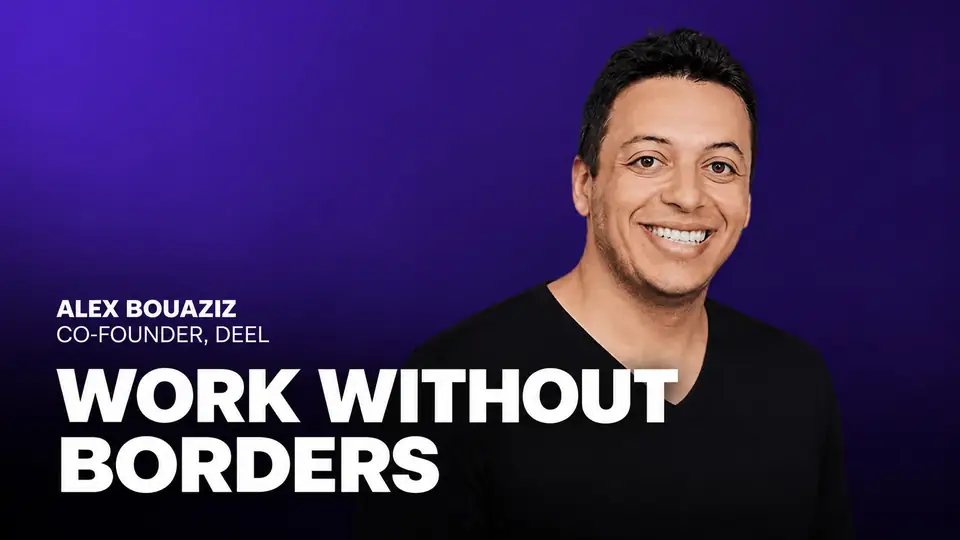
Alex Bouaziz — Remote Work and a Borderless Workforce
Alex Bouaziz on cross-border hiring, remote teams and Deel’s approach to global work.
August 25, 2020 · 32 min



About the episode
"What used to be called outsourcing has become normalized and standardized as remote teams"
In this conversation, we talk with Alex Bouaziz, the founder of Deel which is a startup that streamlines compliance, onboarding, and payroll for remote teams.
We talk with Alex about the future of work, what people get wrong about remote work & the independent contractor model, and how offloading the work of dealing with laws in every country is going to accelerate us to a future where talent, wealth, and access are available to all.
Links
Chapters
Times follow the podcast audio. The video’s timeline may be slightly different.
- 00:00Welcome and introducing Deel
- 01:07Making cross-border hiring simpler
- 02:44Contractors, employees and local requirements
- 05:14Keeping up with different countries
- 09:52How the pandemic changed remote work
- 12:28Relationships and culture on a remote team
- 15:26What a borderless workforce could mean
- 18:59Independent work and changing employment models
- 25:23Payments and opportunities for other builders
Read the conversation
Open the full transcript
CAMERON WIESE: Welcome to the Build the Future Podcast. My name is Cameron Wiese, and I'm your host. I've always been fascinated by the ideas and sentiment that drove American culture in the 1960s with the space race. A culture of possibility with a mission to build things. And I quote JFK, not because they are easy, but because they are hard. It's this culture that seems to have been lost, and it's something that we want to bring back. With Build the Future, we're here to promote the ideas of those who not only see how the world can be better, but those who have plans to get there. It's our hope that these plans inspire you to think about the future you want to live in and create plans to go build. Today, we're talking with Alex Bouaziz, the founder and CEO of Deal. At Deal, they're accelerating a borderless future by making it seamless for companies to hire anyone, anywhere in the world. Alex, welcome to the show.
ALEX BOUAZIZ: Of course, my pleasure. Thank you for having me.
CAMERON WIESE: I want to start with the basics. Can you tell me about the future you're building with Deal? What's the vision?
ALEX BOUAZIZ: The vision is really to make it very simple for anyone to hire anyone else anywhere in a couple clicks as compliantly as possible and in a way that's really convenient for both parties. We want to make hiring outside of the U.S. as simple as Augusto does it today for W2. You mentioned compliance. Why is that important? Well, I'm from Europe originally, right? I'm from France, which is probably the worst country, or the best country, depends how you look at it. And in the US, although it's starting to change a little bit from a state to another, it's very easy to hire people across states. And when it comes to international countries, when it comes to European laws and countries where you've never stepped foot in, there's so many things that differs from basic agreements of basic employment from the United States that people often disregard it.
ALEX BOUAZIZ: And, you know, when you're doing that for a couple of people, one, two people, you're sending them some money on PayPal, like you're hoping for the best. That's okay. I guess all the insurance, it's okay. But as soon as you start scaling and as soon as you start expanding and you hire, you're hired different people, you want to give them a really good experience. You want to comply with their laws and all of that. It becomes really crucial. and lots of risks come from it that a lot of early stage funder or unexperienced funder might not be familiar with, but most of the funders are companies that have scaled internationally really know. And compliance is something that I'm hoping I can make so easy that you won't have to spend too much time on.
CAMERON WIESE: Yeah, I think that's one of the things that most people don't think about is what exactly all these labor laws look like in countries. Can you give me an example of one of those countries where labor laws surprised you?
ALEX BOUAZIZ: Yeah, I think if you want to really look at that, you need to take a step back and understand, okay, if I want to hire outside of the US or outside of any country, what are the different things that I can do? And what are the different steps that I need to do? It's really easy. There's only three ways to do that. The first one is opening a subsidiary, which takes some time and it's pretty expensive when you think about scanning it back up to the holding, looking at how much you've spent and all of that. And all the accounting, your CFO is not going to like you if you start opening lots of companies everywhere. But, you know, when you start scaling, it's definitely something you should do.
ALEX BOUAZIZ: The two other ways are hiring people either as independent contractors, which is what 19% of the people do today, transparently, and hiring them under what's called an employer of record model, which is basically leveraging the infrastructure that another company has built out in a country to employ those people as full-time employees on your behalf and then contract them back to you as contractors. So what we do at Dill is we do both of those things really well, right? the employer side and the contractor side, we do it really well. We have a very, very strong angle on the independent contractor side because it's the bigger part of the market that a lot of people don't do really well. So now when you want to think about different laws and how it works and what can be really surprising, then it falls within the realm of those two things.
SPEAKER UNCLEAR: The independent contractor side where every single country has different rules as per what misclassifies a contractor, what makes them an employee versus a contractor. Like France, it's the link of subordination. and I mean if you look at Uber for example they deal with that problem on a country to country basis where in France I'm pretty sure the reason they lost was because you can punish someone and that makes it more of an employee. In the UK, what would miscalcify you more than anything else is the fact that you wouldn't potentially be able to subcontract to other people. Well, if you can subcontract that means you're running your own business to some extent funnily enough, if you can subcontract in other countries that means you can employ on behalf of the other companies so that doesn't work. So there's lots of different compliance at the contractor level without getting too much into it. And then on the employment side, you know, France has lots of rules for the employees, which are a lot more favorable around, you know, how do you fire someone? How long can you fire them after? It's a lot more complicated than in the US. So yeah, around those two things, there's always very interesting stuff happening around the world that are much more complicated than most people think. Yeah. So if I understand
SPEAKER UNCLEAR: correctly, the way that you and Deal work with this is you have partners in every country who keep you up to date on the latest compliance laws. Yep, that's right. On the contractor model
ALEX BOUAZIZ: that we've put in place, it's very, very unique. I'd say actually no one really does it that way, where we go into every country with a set of partners, legal partners, tax partners, accounting partners. We understand what are the different ways to build a localized contract, to understand what are the different setups that the person on the other side can have to invoice you every month because where I'm from in France is like dozens of setups that you can have, right? And that varies across countries. And we want to make the whole relationship a lot more compliant versus just a standard Californian contract or New York-based contract and that's it, right? So on that front, we have lots of legal partners that help us figure it out.
ALEX BOUAZIZ: Do quarterly reviews with us, keep us up to date. I mean, it's tiny, but to kind of show you the type of changes we make, Brazil announced completely different data collection laws a few weeks back, right? So having that contract was something that, you know, our legal partner in Brazil pinged us and said, hey, we need to update the contract. So that's what we do on that front. On the employment side, well, there it's a little easier. You know, we just have different subsidiaries and have a couple of partners that just own subsidiaries there and then we just employ people on behalf of others.
CAMERON WIESE: Ah, okay, very cool. So you're kind of creating, I guess, the shell organization they're employing and that's effectively what Deal is doing as well.
ALEX BOUAZIZ: right? Yeah, we do both. We basically, you know, our strength is we give you the ability to say, hey, based on the relationship that you want, based on the type of relationship you want to set up, we have both structures and we are as compliant as you can be, whether it's on the independent contractor structure or on the employee structure. And we give you the ability to actually switch from contractor to employee at any time. So this is actually very unique to us where you can start a relationship with a person if you deem it to be a contractor relationship, work with them for a couple months, yeah, and then switch into an employment relationship, whatever you want.
CAMERON WIESE: That's awesome. I'm curious, you're working with lots of countries, and it seems like things are changing very, very rapidly in terms of people now being forced to work remote. And so a lot of companies are adapting and iterating. What countries have the most innovative policies
SPEAKER UNCLEAR: around online or remote work? Well, I mean, you know, the only innovative country in that space is Estonia, right? Estonia has some crazy stuff to help people build companies, become independents in their country, getting a new residency. Other than that, I think there is a lot of innovation. There's going to be. You're going to have to have innovation around how do you employ people outside of your country because today you're kind of like forced into two models that are not ideal. Either, you know, the person is a contractor or the person is an employee of another company and then contracted back to us. Like to me, both of them feel not great either from a legal perspective or even from a you know from a convenience perspective you can make you know software can make it better but it's never going to be as good as being able to just employ someone and remit taxes for them this is where i'm hoping the word is going but in the meantime there's definitely some countries that are trying stuff that are more innovative like i think spain has dependent contractors which are basically hey i'm earning more than 75 percent of my income from that specific client and i want to say i want to talk about it to the government to be as clean as possible.
SPEAKER UNCLEAR: There's definitely some countries that are doing stuff there. But I'm still waiting for countries to cut out the whole employer of record model and just allow people to hire them directly. And some countries are very for it. I think different countries in Europe, not having the IP stay in the country is something that bothers them a little bit, I think. But things will evolve.
CAMERON WIESE: So in addition to the IP, why would some countries be opposed to adopting this sort of kind of globalized mode of operating?
ALEX BOUAZIZ: And there's lots of constraints, right? Like if you employ someone as an independent, you're technically not remitting all the employer tax that you should be remitting, right? And the only way to do that, to find a way to remit it directly to a country like Germany or France, right? And that's where the whole employer of record model is, right? The whole employer of record is, hey, I have a company, I'm gonna remit taxes for that specific person, you're gonna be as compliant as you want. And I mean, I appreciate the thought on the model, but I actually think down the line, even though we do it ourself, it will be it will get slammed by EU regulations at some point because there's lots of loopholes within the within the actual model itself but you know today is kind of a nice bandage that you can do to make the relationship a little better and this is you know this is something I have on a daily basis with our customers trying to make them understand hey these are the two ways to make the relationship works what works best for you what is the best approach for you what is the
SPEAKER UNCLEAR: relationship you have and try to cater for their needs. How has COVID accelerated this this shift to remote? Because I would imagine that most of the customers early on were startups, were early stage companies who had a bit more flexibility. Now we have bigger companies who are considering
SPEAKER UNCLEAR: this model. Yeah, I think every company pre-COVID or post-COVID hired international, right? There's lots of talent everywhere. And what used to be called outsourcing is becoming normalized and standardized as remote teams. So that's a bonus for us because what people used to try to hide under their bed and not talk about, now they're trying to solve from a compliance perspective, from a regulation perspective, from an experience perspective. So this is what has been pretty good for us, I guess. In terms of bigger businesses, most big businesses eventually do open subsidiaries. It's true that some of them had, I think the first transition we're seeing right now is people having to go back to their country and having to employing them back in their country is something that needs to be solved.
ALEX BOUAZIZ: But yeah, I mean, you know, transparently, I don't know if it's because we have grown as a company, but we do have IPO companies using Bill today, right? So it's been really interesting to cater for those bigger companies.
SPEAKER UNCLEAR: Very cool. Back to the kind of the country regulations. The whole digital nomad movement has people moving in and out of different countries all the time. And I think we see that with people who are, I mean, not just US-based, but people from all over the world. But if I understand correctly, most of those people are not operating within the boundaries of the law, right? No, not exactly. I wouldn't say that. I mean, I'm not exactly in the
ALEX BOUAZIZ: books of everyone. But as long as you have a tax residency, and that you pay your taxes in one single country, and you don't stay more than six months in any of the other countries and all of that, then you would be within that boundaries. And what we see on Dill is that people, I mean, they always have one tax residency that they eventually pay their taxes to, they always have a setup, that's actually one of the main thing we do, right, is check that the setups that they have is actually compliant. So in terms of mitigating those types of risks, like tax evasion and all that, that's one of the things we're trying to help companies with, for sure. Then a lot of digital nomads piggyback on the e-residency in Estonia, right, to make this work as well. So, you know, I'm sure there's some people not on Dill that are not doing this really well. And, you know, this actually one of the narratives to use Dill is to get those relationships straightened out and actually do it right. And this is what we're here for. The chances of you understanding how to be an independent in Tanzania or how to employ someone in Tanzania is really low. And to be honest, I wouldn't expect you to know, but this is what we're here for.
CAMERON WIESE: Yeah. If I understand correctly, you've never worked in an office. Is that right?
SPEAKER UNCLEAR: No, I've actually never worked in an office before. I mean, I've worked in a couple of co-working spaces for fun, I'd say, but I never had a proper office job in my life.
SPEAKER UNCLEAR: well so so on that one of the things that i personally believe is that one of the main values you get out of work are the relationships you build and the ability to kind of hang out with people in the office and shoot the shit for lack of a better word allows you to develop rapport and relationships in a way that i i personally have struggled to do remote i'm curious how do you think about the relationship development with your team yeah i think it's the type of
ALEX BOUAZIZ: personalities where like we hire very driven people that have that balance they care about which is being closer to home and with their families or with their wife their fiancees their partner and you know we always try to do it better we do all hands we were trying to set up making sure that people communicate more we actually i think you know from unanimously throughout my company i think everybody says that they've never seen a company use like as much as us too that That definitely works out pretty well. But, you know, I would say that we pretty much feel like a family. We're a very flat organization. We're very open, very trusty. Like we trust each other quite a bit. So I think we solve it that way.
ALEX BOUAZIZ: But, you know, I do end up having background tandem or, you know, meet up opening for two, three hours and just chat with some of my teammates and do my work and not even realize that they're there as well. So I don't know. I think it's a personality threat where like, because I've never really worked in an office, I don't build relationships the same way, but at the same time I feel really close to my teammates. So what do, what do other teams get wrong about going remote? Yeah. It's easy for me to say that and I might be wrong, but I think, I think people overthink it. I don't think you go remote. Like you're, you know, you're working from home. You're working from the office.
ALEX BOUAZIZ: Like as long as work gets done, And as long as people are happy and the output is good, then that's what really matters. I've never really understood the going remote narrative. It's just, you know, your colleague is working from home today. Did you miss him? Maybe. He's working from home for two weeks. Did you really realize? Yeah, if he didn't do a good job or if he hasn't communicated with you, but if he has, maybe not. And I think my friends back at Tendem did say that once to me, which is, what's the difference between a company on two floors where you never see your colleague upstairs so you know you might have your mates like four or five six people that you get along really really well and i you know hopefully you can create that within your departments and build those relationships and i think i think it does help to hire within time zones of this of those departments so you can communicate more but other than that you know i'm very biased towards the whole thing i've never actually experienced the other way so it's really hard for me to say that's that's
CAMERON WIESE: Totally fair. Totally fair. So the tagline for deals kind of accelerating a borderless future to allow companies to hire and retain talent anywhere. I'm curious, can you, can you break down what a borderless future looks like?
ALEX BOUAZIZ: Yeah, for me, it's very straightforward. It's going back to what we talked about at the beginning is I really want to make it easy for you to hire that person, to give them a bonus, to pay them in the currency that they want to understand what holidays in their country is really like. And like, this is, this is what a borderless feature is for me. And there's different layers to it, right? Like to some extent on the payment side, like Bitcoin is a borderless feature from a currency standpoint, right? So bridging all of that and whether it's on the compliance side, on the payment side, on the experience side, on the team building side, bridging all of that in one solution so that whenever you hire Cam in San Francisco or Alex in Paris, no one will really feel a difference.
CAMERON WIESE: What are some of the global implications of this?
ALEX BOUAZIZ: There's lots of those. so let's say the world doesn't go into our direction and doesn't allow countries don't like this idea of more global workers I think they won't really have a choice to be honest but wealth distribution is really key if you look at some of our engineers in Eastern Europe right now they're earning way, way more than the average salary in the country that means that the whole city, the whole country gets a lot more money and that funds quite a bit the second part is more and more talents are being developed and they're giving they're given a lot more opportunities I think you know it's a it's definitely from great companies that have built lots of wealth around resources and how to be a better developer how to be a better designer online at that directly impacted a lot of different people across the world and giving them the opportunity of doing those jobs give the whole community around them a chance to learn and to see that their mates are actually doing well so I mean there there's lots of effects to it to be honest and look if I wish every company could say, I mean, we're not exactly perfect at all, right?
ALEX BOUAZIZ: But that we have such diversity in a team like ours, right? That we understand, we align on culture. We understand what respecting the other party culture really means and how they think and what are they expecting from a relationship. And I really wish more companies embraced that. That would make for a much, much better future.
CAMERON WIESE: Can you elaborate on that a little bit? if more companies got their culture and they were more mindful of the backgrounds of their
SPEAKER UNCLEAR: colleagues, what that might look like? Yeah, I think the US is a melting pot, and already there, a lot of the teams are not diverse enough, right? And if you take it a step forward, past the communities within the United States, people in Ukraine, within communities in Ukraine, think totally different, right? People in Serbia, within communities in Serbia, think totally different right and the more diversity you bring to the company the more opinions you get that affects the product that affects the language that like think of our head of growth right she's amazing she's from turkey she moved to canada like she has such a diverse background that she really affects the company in a in a great way that no one really could right that melting pot background is very unique and that makes me really excited because i'm thinking already in the US, there's a diversity issue intra-communities, which is right next to each other, right?
ALEX BOUAZIZ: Imagine having to start taking into account all over the world people's opinion. That gets a lot more complicated. It's a lot more interesting because you get to build products that cater for you, but also for people in a totally different geography.
CAMERON WIESE: Love it. Yeah. What else excites you? What are you really, really keen on?
ALEX BOUAZIZ: So what I'm really excited about inside a deal is what we're building for the independent side of the equation. So whenever you're working internationally, a lot of the times you end up working as an independent because the ER model is too expensive or it doesn't make sense. And maybe sometimes you don't even want it. But independents are really, when you're working as a 1099 equivalent, first you're working as a full-time teammate, often within this project, then you are left out with a lot of things that usual W-2s do have, right? employees do have and I think we can break that whole model down I think we can make anyone working as an independent just as great as an employee through building lots of very specific features to cater for their needs so the very unique thing of deal is that we are in the middle of the of the flow of money that means that you pay us in the way you want that's an ACH or a credit card transaction and then on the other side your teammates get to pick however they want to get paid so this is where you know our way of building a form of bitcoin i guess to some extent is like we integrate with the transfer wise of the word the paypal the pioneer and then we route the payment through the best provider from an experience perspective for specific country or specific currency right and being in that flow allows us to go and see a health broker and say hey we have tens of thousands of people getting paid we want them to have access to better health insurance?
ALEX BOUAZIZ: What can you do for users, right? Or, you know, something that I'm really excited about is giving them advances, for example, or making their, you know, giving them their funds available earlier, going and building partnerships with meditation products, telemedicine products, like giving them what a usual employee would have while not making it a lot more expensive for both parties. Like, you know, I love saying that I want to make independence on part of employees regardless of where they are.
CAMERON WIESE: I mean, from your perspective, don't you see that's kind of how the world is moving? Is it just like people working on a series of like contract gigs?
ALEX BOUAZIZ: Yes and no. I mean, you know, I read a pretty cool article from Uber CEO a couple of days ago. I think he's right. I think the world is going to have to move away from that aging contractor or employee being both like separate, boxed out. You're either that or you're not. Like that's not going to last. And I'm really excited to see what people are going to build there. And that goes back to what we can do about it, which we'll see over the next few months. But I think there's a difference between the gig economy, which happens like intra-country, and the fact that sometimes the only way to hire someone outside of the country is going for an independent model if you can't afford the EOR model, if you dislike the model as well, right?
ALEX BOUAZIZ: But to some extent, both ways of working are right. And something is going to have to happen. And I want to be at the front line of making it happen. That's another thing you asked me what excites me, changing the way things work on that front is going to be very key. And if you look at what Europe has been doing over the last few weeks, the EU Commission, they've definitely pushed some really interesting new exemptions and new laws around this that I'm really excited about.
CAMERON WIESE: Just to kind of clue in me and the listener, what are some of those laws? What are some of those changes?
ALEX BOUAZIZ: Yeah, the one that excites me the most, and we'll see how that one works out. But for the first time, and sorry if I'm blurry about the details, but the EU commission just said that independence will be able to collectively bargain. That might sound small, but what it really means to me is, oh shit, independence are something that we legitimize and talk about and actually acknowledge. So this is basically the beginnings of people saying, okay, there is definitely, although, you know, they're completely different, scattered across countries, different jobs, impossible to unionize, right? People acknowledge that there is this demographic of people and that's how they work, right? And that's the first step of understanding, hey, the world is more than the nine to five employee that you used to have like 50, 60 years ago.
ALEX BOUAZIZ: And it's evolving towards not controlling the hours of your teammates, right? Letting them work from wherever they want, letting them work in different countries. Like all of that ties back to having to change the narrative of what defines employment. And yeah, that's gonna be really, really fun to see evolve over the next few years.
CAMERON WIESE: What would you say, like, what's the ideal narrative around employment?
ALEX BOUAZIZ: I think the immediate next steps are to legitimize people that work as independents for other companies. And whether you allow the companies to remit more taxes or the independents to pay more taxes through the company to make the relationship legitimate. This is the immediate next steps. And then I can't really get into the whole gig economy discussion because I'm still building my thoughts and my opinion on how to really make it work. But, you know, what's going to happen is if you make everybody a W2, Uber is not going to work in California anymore because it doesn't make sense. Right. The basic rules of employees is that technically they should be working from nine to five. Right. And you should be doing everything they do and how they're doing it and all of that.
ALEX BOUAZIZ: And if you misclassify them through AB5 or whatever rules are in California right now, it removes a lot of the flexibility that the world has earned today through all these different needs and all these different jobs. And although I'm clearly not really in favor of it, I need to have a better understanding of what are going to be the impacts on a law like that. And thankfully for us, we have a mastodons like Uber and Lyft that have to do it at the forefront and hopefully we'll lead the way in terms of how to make it better for independence.
CAMERON WIESE: Beautiful. Yeah, they can subsidize the cost with all their expensive lawyers and all that other nonsense.
SPEAKER UNCLEAR: The thing is the narrative is wrong for me. The whole narrative of people are not being treated well is not really right for me because what are you going to do? remove the job away from them, right? That's not what you want to be doing, right? So I understand that the government is getting less taxes. Let's fix that instead of trying to, you know, remove the way people are enjoying working today. You've mentioned a couple of times Bitcoin,
CAMERON WIESE: and I'm curious what your take is on potentially like the future of finance in the context of
SPEAKER UNCLEAR: paying people across borders. The way I'm looking at the whole way payments are going to evolve, I mean, we're really lucky to be in a world where TransferWise and Revolut and all those companies have been built where we can just come and say, hey, we're just going to leverage your whole product and build on top of it. It's a very unique chance that we have. To be fair, everything we're doing here is just to make the transaction as seamless as we can, right? To some extent, Bitcoin was not that bubble closed that people don't really comprehend. Then you would have a much, much better experience and you'd be really easy to pay around the world. So the way we subsidize for that is by saying, hey, you can pay people however you want, do your ACH, and then we'll have all the products on the other side to give them a much better experience. Split, withdraw, withdraw across currencies, across payment methods, like whatever is going to make their life better, we'll add on the platform so that they can get paid the way they really want, independent on how you want to pay them.
CAMERON WIESE: so you said that deal has been able to build on top of revolute and transfer wise what do you what do you want to see more people build that they could kind of stack on top of say deal or some of these platforms like that you guys don't have in your your roadmap but that you
SPEAKER UNCLEAR: you want to see exist we're building an api which is really exciting i'm really excited to see what companies are going to build on top of that you know unlocking compliance globally and unlocking payments the way we built it and leveraging all the different payment providers out there rather than one and being forced into one is very cool what can people build to make our lives easier i mean you have some really cool companies we work with like safety wing for example they're one of our partners on the insurance side and what they've tackled is how to give health insurance to people around the world right and hell i'm very excited that i don't have to build it. I would have built it actually if it wasn't for them. So that's great. You have some cool companies around background checks that are popping up. So, you know, we're adding background checks on deal. Some parts we have to do on our own, but some others, you know, we're very lucky to work with companies like Trora, which does the whole Latin America, for example, for background checks or certain that does Canada and the US. And, you know, if you want to bridge the world together, giving the ability to do what you can do today when hiring someone and referencing someone as a W2, doing that internationally is something that we think is really important.
ALEX BOUAZIZ: So anyone that wants to build that for Southeast Asia or Africa, because I have to build some internal stuff right now that I'm not really excited about. Apart from that, what else could be interesting? I think we're doing really good work in every country and really understanding what's going on from a compliance perspective, what's the right way to set up and all of that. I feel like it's great that we're building all of that. I wish more resources were written by local people and more available globally rather than, you know, in their own language only and hard to understand or even hard to find. So, you know, making it, building tools to make it really easy to set up as an independent in any country and then having that in English and available to everyone is, you know, that remove a little bit of the work that we're doing today that's very time consuming and, but very key to the business.
ALEX BOUAZIZ: so it's okay. So these are some of the products that I, you know, more health insurance is always welcome, giving a little bit of competition to our friends at Safety Wing, but also, you know, when you're building something global, it's never truly local, right? So having some companies build, you know, maybe more around some countries in Africa or some countries in Europe, and that to me would be really interesting. We're supposedly working with a pretty cool health insurance company in France that's starting to go into different countries. We'll launch that in a couple of weeks. That's also like having something hyper localized that we can integrate within the platform and give to our users in a specific region or in a specific country is quite exciting to me.
CAMERON WIESE: Love it. Outside of work you're doing at Deal, what future technologies or developments excite you?
SPEAKER UNCLEAR: I just tried VR for the first time. I just literally got a quest like a week ago. It's freaking crazy. this thing is crazy. I've never seen something like that. I'm really excited about it now. I'm a big gamer. So, you know, seeing how that's going to develop and like playing some of those games where I actually feel like I'm going to fall off the ledge is insane. Beautiful. Now, how can people support you and deal? Companies hire remotely and make sure you do it right, right? Don't start sending people money on TransferWise or on PayPal with your Californian agreements or not understanding whether it's an independent or an employee it's time to do this all right it's time to treat your people better and give them a better experience and the fun part about deal is even on the independent side we basically cost the price of your wire transfer anyway so you're just making that a lot better other than that i feel like in a couple months what you'll see is that a lot of people are going to start speaking about how remote is a fad and it was only for a few months and it was during COVID and everybody's really excited about going back to the office and stuff like that. That's fine as long as you understand that that doesn't affect whether or not you should hire great people around the world and whether or not you should give opportunities to people that might not have it and look I've hired people here that I can safely say are a lot better than some of the engineers I've hired in San Francisco
SPEAKER UNCLEAR: some of the marketers have hired in San Francisco so true there's some people that have lived things and can build things like nowhere else for sure but in terms of raw skills and in terms of shaping of the future of the different countries or the different talents in those countries I think being narrow in terms of hiring is it's just gonna you know it's just gonna make it's not going to make the world a better place and it's not going to make talent and wealth be more accessible. So regardless of whether or not you're going back into an office, you should still consider talent wherever they are and think more broadly. Thanks for joining us for this episode
CAMERON WIESE: of the Build the Future podcast. If you're interested in learning more about Alex, you can follow him on Twitter at Bouaziz Alex. That's B-O-U-A-Z-I-Z Alex. And if you're a company hiring talent all over the world and want to do it right, you can check out deal at letsdeal.com. Lastly, if you're building and want to get support, want to hear about specific topics or hear from certain people, shoot us over an email at hello at builtthefuturepodcast.com and we'll see what we can make happen. That's it from us. Until next time, go build.
More episodes
All episodes Pat Riley — Bitcoin & FreedomPat Riley connects his interest in Bitcoin with questions about freedom, community and the kinds of futures people want to build.
 Jill Carlson — Money, Hyperinflation and Financial AccessJill Carlson explores access to stable money, the limits of cryptocurrency and lessons from field research.
 Galen Wolfe-Pauly — Urbit, Communities and Personal ComputingGalen Wolfe-Pauly discusses Urbit’s personal-server approach, digital communities and control over computing infrastructure.