

Build the Future Podcast
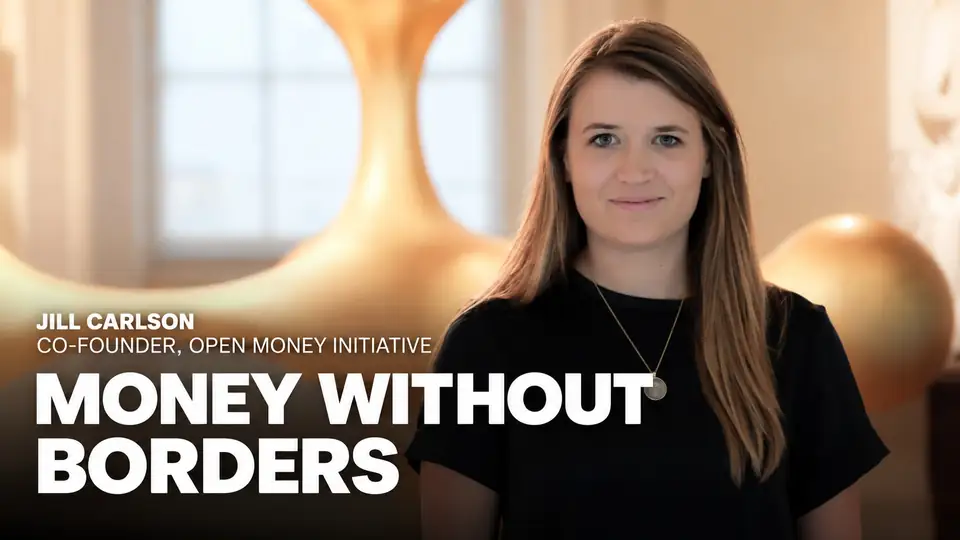
Jill Carlson — Money, Hyperinflation and Financial Access
Jill Carlson explores access to stable money, the limits of cryptocurrency and lessons from field research.
August 18, 2020 · 36 min



About the episode
"The future looks like a world in which everyone has free and open access to their money, to a financial system that functions in their favor."
In this conversation, we talk with Jill Carlson, the founder of the Open Money Initiative which is a non-profit that researches how people use money in closed economies and collapsing monetary systems.
We talk with Jill about what's actually going on the ground in Venezuela, hyperinflation, Bitcoin, financial security as a basic human right, and much more!
Links
Chapters
Times follow the podcast audio. The video’s timeline may be slightly different.
- 00:00Welcome and introducing the Open Money Initiative
- 01:18Why study money where access breaks down?
- 04:19The everyday effects of hyperinflation
- 07:28Learning from Venezuelans’ experiences
- 12:03Financial access as a human right
- 14:16Why cryptocurrency is not a cure-all
- 16:27What being unbanked can mean
- 24:48What drew Jill to this work
- 28:44Reasons for hope and places to learn more
Read the conversation
Open the full transcript
CAMERON WIESE: Welcome to the Build the Future podcast. My name is Cameron Wiese and I'm your host. I've always been fascinated by the ideas and sentiment that drove American culture in the 1960s with the space race. A culture of possibility with a mission to build things, and I quote JFK, not because they are easy, but because they are hard. It's this culture that seems to have been lost and is something that we want to bring back. With Build the Future, we're here to promote the ideas of those who not only see how the world can be better, but those who have plans to get there. It's our hope that these plans inspire you to think about the future you want to live in and create plans to go build.
SPEAKER UNCLEAR: Today, we're talking with Joe Carlson from the Open Money Initiative about the future of money, finance, and the role that cryptocurrency can play in creating a free and open financial system for all. Jill, welcome to the show. Thank you. I want to start with the basics. Can you tell me about the future you're building with the Open Money Initiative and what your vision looks like? Oh, that's just the basics, is it? Yeah. We like to start small when we're talking about the future.
JILL CARLSON: I love that. Yeah. So the Open Money Initiative is a nonprofit research organization that I founded a couple of years ago with a couple of friends, colleagues, collaborators. And really our mission is to explore how money gets used and what money systems look like in places where there isn't free and open financial access. and to color in a little bit more about what exactly that means and how we came to do this. You know, the three of us who founded the organization, it's since grown kind of beyond us, but we all started out working as builders, designers, engineers, strategy thinkers, whatever, within the cryptocurrency and blockchain space. And, you know, we'd all built kind of successful careers in the space, working for startups, advising startups, investing in startups, you name it.
JILL CARLSON: And we all kind of took a step back, sort of separately, but simultaneously, and asked ourselves, okay, what is any of this good for? And to put that in context, back in 2017, when Bitcoin was eclipsing like 20,000 in price for the first time, and there was all this hype, and everyone around us was kind of making a lot of money, and everyone was really happy and excited. but again we just asked ourselves like what is this good for and the answer that we kept coming back to or the hypothesis anyway was well it's good for people in places where their money system is broken and they need an alternative and maybe that alternative is bitcoin but again what we realized is we didn't have a ton of data ourselves as to what that looks like on the ground it's it It wasn't an experience that certainly I had lived.
JILL CARLSON: One of my co-founders who was from Venezuela, he lived it to an extent before he left the country. But so we decided, okay, we want to go to these places, get a better understanding of it and take those lessons in that research back and build ourselves and also enable those who are building that future. Which to answer your question, what does that future look like? That future looks like a world in which everyone has free and open access to their money, to a financial system that functions in their favor. and you know in that world we talk about freedom of money and financial movement and ownership the same way that we talk about in the United States freedom of speech or freedom of religion which is not a framing of it that you ever really hear and if you look at all kinds of manifestos around human rights and civil liberties very seldomly does freedom of financial transactions or freedom of ownership come up. And that's really what we want to shed light on and build towards is that being not only a part of those conversations, but really just a fundamental human right.
CAMERON WIESE: Absolutely. Beautiful. Yeah. Okay. There's a lot to unpack there. I think the best starting point is, can you kind of paint the picture of what's going on in the ground in countries like Venezuela?
SPEAKER UNCLEAR: What did you see? Yeah. Yeah. Great question. And it kind of leads also to this question of of why Venezuela, like why would we pick that as a place that is important to this conversation? So as I mentioned, one of my co-founders of this project, a guy named Alejandro Machado, grew up in Venezuela, had some experience with what I'm about to describe. And he was really, you know, among the key driving factors for us going and doing this exploration of what money systems look like there. And here's what they look like. It's a very complex history that has led to today roughly 10 million percent inflation year on year, which was a bit of context. We in the United States, we tend to complain if inflation goes above 2% a year. So 10 million percent inflation a year, that's to an extent where if you're a shopkeeper, you're literally having to go around intraday, like between noon and night when you close the shop and the actively changing price stickers. And then at some point that even in itself becomes futile and you just have to say, you know, I'll give you the price when you bring it up to the front of the store.
JILL CARLSON: You know, other issues that arise there, of course, is if you're holding money in cash, the metaphor that gets used often is it's like it's melting in your hands because you have it in cash and the inflation rate is such, it's so high, it's losing value so dramatically quickly that you can almost feel it losing value in your hand. So anytime you get paid, you want to go out and spend it almost immediately in order to get it into a hard good. Because if you wait, again, back to the shopkeepers, if you wait between noon and night to go out and buy bread or to go out and buy milk, it will be that much more expensive by the time night rolls around. And so that's just one of the sort of many ways in which the financial system in Venezuela is broken. Again, we can get into kind of the long history that has led up to this very extreme situation.
JILL CARLSON: But you look at a situation like that and you're like, yeah, there has to be a better alternative. And you also look at the harm and the problems that it causes and you say, it really genuinely should be a human right for people to to be able to have money that works for
SPEAKER UNCLEAR: them oh absolutely i can't even imagine having 50 on like right next to me and then suddenly not be able to be able to buy stuff with that and then have it be and then suddenly it's worth 20 dollars yeah it's like what the what the hell is going on like let's exactly exactly so you said you were on the ground and and you were looking in venice way to say okay like how can we make this better? How do we provide people this human right? So let's start there. And then I think that
SPEAKER UNCLEAR: connects to the banking versus unbanking concept. Yeah. So with the Open Money Initiative, we've done a series of projects and we have another that hopefully we're going to kick off soon in places where there are these types of issues. And these types of issues refer to hyperinflation, which is what I just described. They refer to things like capital controls, which means that you can't move your money freely in and out of the country. It refers to things like shortages. And for example, another dynamic in Venezuela is a shortage of bank notes. And so that in itself becomes a problem. But any of these sort of limitations or restrictions on what your ability to hold your money looks like. And again, we can get into more of what that means.
JILL CARLSON: But we were driven to Venezuela as kind of our first project. We spent most of our time on the border of Venezuela. So in Colombia, working with a lot of the Venezuelan diaspora, refugees, migrants. And then we spent some of our time also in the major cities of Colombia where there are large populations of people who've recently left Venezuela really fleeing this economic crisis. And we conducted a fair amount of research at this point, interviewing people, conducting sort of longitudinal studies, which means that will give people sort of challenges or ask them to record like what their daily life looks like, and kind of a diary study, both inside of and outside of Venezuela, people were interacting with in this way, just to really learn about, you know, okay, in this type of situation, what do you do? Like, how do you handle that? And it really is just a testament, the things that we learned to the creativity of the human spirit. Everything from women crossing borders with literally dollar bills hidden in their hair to smuggle money in and out of the country, hidden in their hair, hidden in their shoes, you name it, you know, all the way over to the banker we spoke to who's based in Venezuela, who's actually really benefited in many ways from this period of inflation because he was able to take out a loan. And if you're able to borrow in an inflating currency, then guess what? That loan is going to inflate to zero over time and
SPEAKER UNCLEAR: you've basically gotten free money up front. And so again, it really is just a testament to sort of the ingenuity of the human spirit and creativity, the number of different ways we saw people surviving, and then also in some of these cases, as I say, thriving. And it was just, it's, it is really inspirational, both to hear their stories, but it's also inspirational, I think, from a sort of product and design perspective to say, okay, seeing these behaviors sort of on the ground live, what can we draw conclusions about in terms of how can we bring these types of solutions or hacks or whatever it is to populations at large? And so it's not just every individual for themselves kind of hacking a solution together. Yeah, it's certainly a testament to
SPEAKER UNCLEAR: how we as humans can adapt and how we can make things kind of work. But it sounds like the whole point is that we shouldn't have to do that for something as fundamental as our finances. People shouldn't have to get creative. They should have, as y'all describe, financial access is a basic human right. And so I'm curious, how do you see us kind of getting there? Yeah. I mean, I think
JILL CARLSON: that a big part of it is shifting the narrative around all of this. So much of policy work is, it comes down to narratives and the stories that we tell and to some degree sort of marketing or branding around it. And that is definitely a part of what we want to drive is just this conversation, first and foremost, and get this on the agenda is something that people are actively thinking about, whether again, that's on the policymaking side, whether that's friends in Silicon Valley, who are kind of product thinkers and bringing new products to the world. You know, I think that it's not going to end up being sort of a single pronged approach that gets us closer. And importantly, nor will lessons necessarily transfer across geographies. You know, I think that what works in Venezuela is going to be very different from what works in Zimbabwe, which is also going to be very different from what works in any other country that's facing any of these issues, which really is every country in the world
SPEAKER UNCLEAR: is facing these types of issues. How would you describe the narrative that is, like, what's the narrative right now? And what should the narrative look like around this kind of basic human right of financial access?
JILL CARLSON: So I would say a couple of things here. The first is that around this as kind of basic human right, I would say that for the most part, the narrative kind of just doesn't exist. And, you know, I think that the Human Rights Foundation, my friend Alex Gladstein over there has done a decent amount of work in this space. He was one of the first people to point out to me the fact that this notion of financial freedom doesn't show up in any of like the UN charters or, you know, the development goals or anything like that. So, you know, I think that, again, people and individuals and organizations are starting to poke at this, but it's really not a narrative that has existed to date, which is insane when you think about just where power stems from. And so much of power stems from our ability to have financial control and wealth and all the rest of it and ownership.
JILL CARLSON: And that is right. And yet, again, we don't talk about it. The other thing I do want to touch on is that there's also a narrative around cryptocurrency and a narrative around Bitcoin that is worth mentioning here, because that's obviously a huge part of my story and a huge part of the story around Open Money Initiative, which is that, you know, people dismiss crypto is scammy or, you know, it's just kind of a passing craze. And I think that there are elements of it where I can't necessarily disagree, but there's also an element of it that I think is very, very important in terms of it being a censorship resistant, open platform that does allow, you know, at least theoretically free access to anyone with an internet connection. And I think that that's what sent me down this rabbit hole in the beginning. And I think that that is something that I really hope doesn't get lost in this sort of narrative about crypto being this sort of passing trend.
CAMERON WIESE: yeah oh man there's so much we can dive into i was listening to the conversation you and meltemore having about the on-ramps and the off-ramps into crypto and how this censorship resistant thing is facing is like there's a risk there that the government's like oh no we're just gonna audit your bank accounts over and over and over and over again until like there's no point
JILL CARLSON: totally totally and yeah i mean you can you can really take it to any level of extreme you know there are those who think it's extremely good that the government can audit, you know, almost anything that you're doing financially from a financial perspective, because it's likely going to have to go through the banking system at some point. You know, you can make the argument that's good, because that's, you know, how we catch terrorists and drug dealers and all sorts of other actors that are considered nefarious by society. But it can also become a very scary thing, right? Where you think about what the abuse of that type of power looks like by a given government, you know, and you look at other places and countries where people's bank accounts are seized. I mean, hell, even in the United States, you hear these stories of people's assets being seized. And, you know, suddenly that takes on a very different meaning and becomes a very sort of dystopian thing. And you're right to point out that crypto doesn't necessarily make you immune to any of that because very seldomly can you find people actually selling things in Bitcoin. So, you know, you have to kind of an off ramp at some point. And very often those endpoints are connected to the banking system and then still themselves come under scrutiny. And so by no means, and this was one of the most important takeaways as it relates to crypto, I think from this work that we've done so far with the open money initiative is that crypto is not a panacea.
SPEAKER UNCLEAR: It's not going to be this silver bullet solution, but it is, I think, potentially an important tool to have in the toolbox in this campaign. Yeah, I agree. It's not the end all be all,
CAMERON WIESE: but it is something that we can utilize to at least start to provide this financial infrastructure for people who may not have it today. I want to go back to this unbanked concept because in the US, we seem to take it for granted that we have financial security. The idea that the IRS can come seize someone's assets and it's just kind of absurd. It's like, oh, that doesn't happen. Then it does every once in a while. You're like, wow, that's wild. But I get the sense that's what's happening in Venezuela and all these other countries all the time. They don't have that stability to grow their assets and kind of move up in the world for lack of a better terms, right?
JILL CARLSON: Well, yeah, there are just there's so many things that that we can mean when we say unbanked. And I often think of it in terms of access and trying to define, okay, who has access to what, who has access to a bank account, who has access to credit, who has access to investments, investment in the stock market investment in real estate. And then also, you know, who has access, who has the access to be able to move their money freely in or out of the country, who has access to be able to freely send payments, all of these types of things. And then finally, you know, to go back to the kind of inflation point, who has access to a stable currency, which so many of those things that I just listed, they're all important. We, at least as sort of, you know, and I kind of put myself in this category, like a coastal elite sort of living in the United States, you know, and a privileged white woman in San Francisco, like I totally take for granted almost all of those things that I just mentioned. And very often I think that myself and people like myself tend to point very quickly to other countries when we're trying to point to places where that is not taken for granted. And so again, you know, I totally bought into this narrative myself
JILL CARLSON: I point to a place like Venezuela and I say, well, in Venezuela, they have hyperinflation and they have capital controls and asset seizure by the government and all sorts of other limitations on what you can and can't do with your money. You can open a bank account, all these types of things. And it's places like that where these types of freedoms are limited. I think that one area that I've really grown in terms of my perspective over the course of the last six months or a year or so is in thinking through, well, wait, there's a lot of that actually going on in our own backyard in the United States as well. And you don't have to look that hard or that far to see places where people can't get credit in the United States because of their zip code or because of the color of their skin. People can't even open a bank account because of their background or because of certain profiling that goes on. And then there's the kind of more macro challenges as well. If you look at what the Federal Reserve is doing, you're like, well, do we have a stable currency? For now, we certainly do. But what does the future of that look like too? And so it's just been an important reminder to me that so many of these where we're so quick to look at the examples of other countries exist as issues right at home.
CAMERON WIESE: Yeah. And that's the thing that's easy for a lot of people to, at least in the tech space, easy to dismiss. So I think you're spot on that this problem actually exists in our backyard, right? If you are in a major US city, you may be able to ignore it. But if you go anywhere else, you're seeing just the reality of the situation, especially now. Can you shed some light on how you see COVID playing a role in this narrative here and what the future might look like for us in the States, particularly in the context of this federal inflation concern? Do we have a stable
SPEAKER UNCLEAR: currency, et cetera? Yeah. I mean, it's a really hard and interesting period to be living through. I was going to say a question, but a hard and interesting period of time, actually. And I think the way that I've tended to frame it is that in many ways, economic time has stopped, or at least it was stopped for the period that we were all closed. You know, businesses weren't running, obviously. Restaurants weren't open. You know, travel got shut down. And so economic time stopped. Spending, in many regards, stopped. But then financial time continued moving forward. And we bridge that gap by having these government stimulus packages, by having what I think are very important, you know, small business loans, all of these types of things that have served as, again, I think a very good and important stopgap. But the problem is, is that all of that spending, that's basically debt, right? We've basically moved for future spending forward in time by the government, which has again, kind of bailed us all out for the time being. But debt always comes due. And it's unclear to me when it's going to come due in this case. And it's unclear to me who's going to put the bill. It'll probably be our
SPEAKER UNCLEAR: generation and future generations. But in many ways, I hope that it comes due sooner rather than later, as opposed to continually kicking the can down the road and having it build up further and further over time. That's my take on it. There are obviously disagreeing viewpoints, dissenting viewpoints that advocate things like modern monetary theory, which holds the perspective that it's actually okay for the government to be printing money like this, as long as it's fueling growth, et cetera, et cetera. I'm not sure that I subscribe to that. I just, I haven't seen that play out yet. And so I tend to be a bit more pessimistic, but again, it all depends on the timeframe. Yeah. Especially the, the, the debt to be
CAMERON WIESE: funding progress is great, but we're not, we're not really seeing that in most sectors. So it's, it's concerning like who is going to foot the bill and just to link it back to the kind of unbanked concept. It's if you have assets in the markets, you may be okay, but there's lots of people who aren't, right? And that's going to further exacerbate this problem. And what do we
JILL CARLSON: do? Exactly. And just to link it back, I think that where there can be a lot of value in looking to other countries and in spending time in other countries, a place like Venezuela is in lessons there. And you look at Venezuela and many people, again, in the United States who are kind of in my category don't realize this, but Venezuela was one of the wealthiest countries in the world in the 1950s. Massive oil wealth, really thriving, insanely good educational systems, all of these types of things. And what happened was they were lifting off the oil wealth. They implemented a series of very socialist policies, which meant very high government spending. And the leaders, dictators, leaders, made promises, wrote checks that their country then eventually could not cash. Oil fell from $100 a barrel to like $30 a barrel back in 2013, 2014.
JILL CARLSON: And suddenly the coffers came up dry. And now in the United States, we're not a petro state, but government spending has obviously had to ramp up during this period. And there is the question of at some point, will the coffers run dry? We also, of course, have the privilege in the United States with having the world's reserve currency. And so other countries have a sort of dependency or demand for the US dollar that we artificially keep around and impose, which is a whole problem of equity and human rights in and of itself, I think, that also doesn't get talked about. And so, you know, again, there's a chance that maybe we can sort of grow our way out of this with enough time bought through these types of dynamics, but it's not at all clear to me that
CAMERON WIESE: that'll be the case. Yeah, I would love to be hopeful, but it is very concerning when you start thinking about how does this train keep moving the way it's been. You mentioned that one of the things that got you into this space was the idea of censorship resistance. Can you tell me a little bit more about the moment where you realized that this was something you wanted to spend time
SPEAKER UNCLEAR: learning about and working in? Yeah, so this was back when I was working on Wall Street. I was trading emerging markets, government debt. So these countries issue debt, and then that gets traded on what's called the secondary market by big banks and big investors, names that are probably familiar to you and your listeners. But I started out as a trader of these bonds, and it was a really fun job in many ways. It was a very wild ride because there was a lot of volatility. At the time, I was trading Venezuela. It was one of the countries that I was involved with Argentina, which was going through a sovereign default and restructuring. This was back in 2012, 2013. And one of my colleagues at the time was living and working down in Argentina. And Argentina had had capital controls in place for over a decade at that point. And as I mentioned, there was this whole situation going on where the country was defaulting on its debt and so on and so forth. And, you know, so there's sort of a lot of financial turmoil, not only for banks down there, for the government itself, also for individuals. And my colleague down there said to me, this was the first time I'd really properly heard of Bitcoin, that he was getting his money offshore using this thing called Bitcoin. He was getting it out of the Argentine peso, which was experiencing all kinds of inflation at that point. And again, you know, he had not had the ability to
JILL CARLSON: buy into any other currency or to move his money out again for a decade. And you just try to imagine what that's like to be getting paid your paycheck every week and knowing that it's just going to be losing value. There's nothing you can do about it. You can't move it out of that currency and you can't move it offshore. And then lo and behold, this thing comes along, this Bitcoin thing that, okay, maybe didn't have the most squeaky clean reputation, but it holds this promise for where you would be like, look, you can put your money into something else, you can invest it in something else, and you can get it out of the country. And so that to me really stood out as the moment in time where I was like, okay, there's something interesting here. This is playing an important role that little else has been able to play throughout history. And I can see it playing out for this individual I know, right before my eyes. So that was that was very cool.
CAMERON WIESE: One of my best friends from high school is from Buenos Aires. And I just remember the conversation T and I were having about, it's like, oh yeah, I'm going to go take the US dollar back to Argentina. And it's like three for one, four for one. And I'm just like, I mean, obviously I was 17 years old. I didn't have any understanding of economics or finances, but it's just so fascinating seeing that play out and understanding like, oh, that was a crisis. That was not a, oh, hey, MacBook Pros are cheap. It's like, no, there's actual economic disparity that is happening and that is like
JILL CARLSON: playing into this. Exactly, exactly. And yeah, I mean, there's this whole disparity and this plays out anywhere where there's rampant inflation between what the official exchange rate is, that the government sort of claims is the exchange rate, and then what the actual street exchange rate is. And you can see this play out in even like what ATMs you use in places like this, you know whether you're getting the official rate or the street rate and obviously if you're bringing dollars and you want the street rate that's going to give you a lot more of a local
SPEAKER UNCLEAR: currency than than the official yeah if we look forward we see that with what's going on in the states and in countries like argentina and venezuela it's easy to paint a dystopian future It's like, this looks scary. But you said that when you're talking with your friend back in 2012, 2013, there's this not squeaky clean thing, but it held promise. If everything goes well, if we can work ourselves out of the situation, what does the future look like? What gets you
JILL CARLSON: excited? Yeah. And to be clear, I'm actually, I'm quite hopeful about the future from that perspective, I think that we might have to go through hell to get there. But I think that that's actually a really important process. And often when I talk like this, people tend to think like, oh my God, Jill has this very kind of doom and gloom about what the future looks like. I actually hope that everything I'm describing kind of comes to pass very quickly, such that we learn the lessons and then can kind of move on to a very different version of what this all can look like. And so, you know, as I look forward, what gives me hope is really the way in which I've seen technology over the last decade, decade and a half, galvanize people to take control of their financial lives, to understand their relationship with money, and then by extension, even their own governments in very different ways. And I think that Bitcoin is obviously kind of the go-to example for me of this, where Bitcoin has held real promise to people, whether it's this friend of mine in Argentina 10 years ago, or whether it's activists in Hong Kong, using it as a way to receive funds because they can't go and access their bank accounts.
JILL CARLSON: Whatever it is, I think that Bitcoin is, again, probably the biggest and greatest example of this that I've seen. But there are also so many others, even down to what we've seen in terms of people downloading and adopting Robinhood over the last six months, the whole sort of Robinhood rally phenomenon, which is deeply, deeply problematic in many ways. You know, I'm not a proponent here of like gambling or, you know, lack of financial education resources. Like there are a lot of issues there as well. But in a way it gives me hope because I think again of this question like, okay, what does it mean for financial access to be a basic human right? And it's like the share of people in the United States who own stocks, of households who own stocks, is minuscule compared to the share of institutions.
JILL CARLSON: And then you look at the numbers there and it's just staggering how underinvested even people, again, in the United States are. And we have ostensibly access to the stock market, to the S&P 500. And I think that Robinhood, for all of its faults, at least has shown us that, in fact, no, people in the United States do care and do want to be invested and do want to see their money grow. That's not just for sort of the elite or the 1%, as it were, but it's going to take sort of different products and different ways of talking about these things in order to get there. And so, you know, again, I do think that there is a lot of cause for hope just in the way that people are questioning things. And again, you know, interacting with their money and their finances differently, whether that's through something as revolutionary as Bitcoin or whether that's through something a bit more, not mundane, but just sort of straight down the fairway or expected in terms of new financial technology products.
CAMERON WIESE: Yeah, to kind of close this out here, what can people do who are people who are who are thinking about this? What can they do to either one support? It's like movement. And two, how can they kind of get started thinking about this sort of thing? Like what resources would you point people to? What advice would you have for people who are who haven't been thinking about their finances? And now they're like, Oh, I probably should.
JILL CARLSON: Yeah, no, great question. I mean, there are a few different directions that I'll point you here. If you're starting to think about this from the perspective of financial freedom and human rights and financial access, certainly follow the Open Money Initiative on Twitter, follow me on Twitter, reach out to me on Twitter, that's where I spend probably too much of my time. I would also encourage you to follow the work, I plugged it earlier, but the Human Rights Foundation. They do amazing work in this space and they're investing more and more heavily in this space. And they have been a huge resource to me over time in terms of learning about what all of this looks like and how it intersects with democracy. And then, you know, to the extent that you kind of want to get your imagination going on what all of this could look like or does look like, I would recommend reading. I just got done with this book called The Mandibles, which is this sort of dystopian science fiction about the future of what an economic crisis in the United States looks like. The book has its own problems, but it does definitely sort of get those creative juices flowing in terms of imagining this type of thing.
JILL CARLSON: And then finally, in terms of sort of taking control of your own finances, you know, I would say research, research, research. There's a lot of amazing resources online that can take you in all different directions. one of the devilishly hard things about it is that everyone is going to be in such a different financial situation, have different goals. It's really hard to have like a one size fits all pointer or solution here. But yeah, just start Googling and go down those rabbit holes and
SPEAKER UNCLEAR: get curious about it. Thanks for joining us for this episode of the Build a Future podcast. If you're interested in learning more about Jill, you can follow her on Twitter at Jill Ruth Carlson. And you can also follow the Open Money Initiative on Twitter, at Make Open Money. Lastly, if you're building and want to get support, want to hear about specific topics, or hear from certain people, shoot us over an email at hello at buildthefuturepodcast.com and we'll see what we can make happen. That's it from us. Until next time, go build.
More episodes
All episodes Galen Wolfe-Pauly — Urbit, Communities and Personal ComputingGalen Wolfe-Pauly discusses Urbit’s personal-server approach, digital communities and control over computing infrastructure.
 Doug Petkanics of Livepeer — Decentralized Video InfrastructureDoug Petkanics discusses Livepeer’s open video infrastructure.
 Sam Bhagwat — Gatsby.js & Open SourceSam Bhagwat connects his background in economic history with building Gatsby.