

Build the Future Podcast
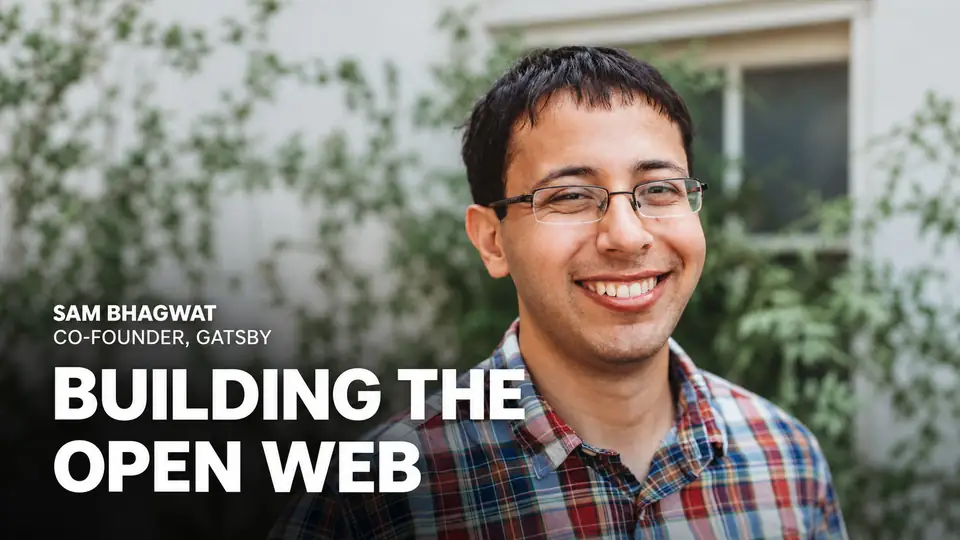
Sam Bhagwat — Gatsby.js & Open Source
Sam Bhagwat connects his background in economic history with building Gatsby.
November 2, 2021 · 40 min



About the episode
In this conversation, we talk with Sam Bhagwat, the Cofounder and Chief Strategy Officer at Gatsby. Gatsby's an open source web framework that enables developers to create websites optimized for the modern web. In doing so, they're ensuring that this digital web infrastructure, that we all take for granted, keeps improving and getting better.
Links
Chapters
Times follow the podcast audio. The video’s timeline may be slightly different.
- 00:00Introducing Sam Bhagwat and Gatsby
- 00:35Making progress tangible
- 02:21Economic history and building technology
- 04:25Looking forward from the history of the web
- 06:19Centralization and decentralization
- 09:38Open source and global collaboration
- 13:00Linux, Git and GitHub
- 17:11How Gatsby began
- 20:01Models of community contribution
- 22:52Why contribution and speed of change matter
- 24:41Open collaboration beyond software
- 26:51Remote teams and a global pool of talent
- 28:26Connectivity and web performance
- 30:52Incentives and commercial open source
- 34:10Maintaining shared digital infrastructure
- 35:14Prizes, rewards and community incentives
- 36:54Children, productivity and reasons for optimism
- 38:31Where to find Sam
Read the conversation
Open the full transcript
CAMERON WIESE: Welcome to the Build the Future podcast, where we promote exciting and positive visions of the future and those who are helping to build it. Today, we're talking with Sam Bhagwat, the co-founder and chief strategy officer of Gatsby. Gatsby is an open source web framework that enables developers to create websites optimized for the modern web. In doing so, they're ensuring that this digital web infrastructure that we all take for granted and it keeps improving and getting better.
SPEAKER UNCLEAR: Let's jump right in.
CAMERON WIESE: It's been really exciting to kind of see, as you said, like see the movement come together. Like what are you like most optimistic about in this direction?
SAM BHAGWAT: I think there's a lot of things to be optimistic about in a lot of different places in the world. I mean, I think especially with sort of
SPEAKER UNCLEAR: the whole concept of progress,
SAM BHAGWAT: I think we've lost a little bit of our understanding understanding of or belief in the idea of progress for a number of reasons. And I think there's an opportunity to have sort of an intellectual understanding of the visceral ways in which technology makes our lives better, you know, and has for a long
SPEAKER UNCLEAR: time.
CAMERON WIESE: It seems like right now it's kind of intellectual exercise. It's like, okay, how do we define progress? How do we talk about it? But I think what's going to be really exciting is we can translate that into something that's a bit more relatable for the everyday person. It seems like those of us on this tech Twitter
SPEAKER UNCLEAR: in Silicon Valley circles have an understanding of this concept, but it's not something that
SPEAKER UNCLEAR: is easily accessible to most people. Yeah, I think it starts with a lot of the illuminating
SAM BHAGWAT: of the different storylines of progress, whether that's the historical stuff or what's happening now. I was reading Robert Gordon's book with Jason Crawford from Roots of Progress and some other folks, and that's on economic history of the United States from I think 1870 to maybe 1950. And sort of in between, I was kind of texting my mother-in-law who's very into family history stuff of like, you know, the tidbits of household living and how people's sort of wardrobes had changed over time. So, you know, it touches historical, like that's historical things, but then there's also a ton of concrete examples, I think, that we see today as well, obviously.
CAMERON WIESE: There's this kind of intellectual debater on like, is Robert Gordon right? Has progress slowed really? Or is kind of like the lens to which we're viewing it not shifted to where
SPEAKER UNCLEAR: it needs to be?
SAM BHAGWAT: So, so I have an interesting perspective on that in that I sort of see both worlds. You know, as an undergrad, I studied I was an economics major, and I especially took a lot of econ history classes. So there's a ton of sort of like famous econ history papers is that study economic growth and historical perspective. There's Nordhaus's fire paper. He looks at the efficiency of wood burning or sort of light producing and how many lumens you get per watt from sort of prehistory to today and kind of uses this as kind of a rough way of modeling economic growth back really tens of thousands of years. You know, economics is a very sort of like specialized discipline that's really good at looking at this. A professor that I took some classes from, Petra Moser, had done her PhD thesis by going to the archives of the Crystal Palace exhibit in London, which was I think in the 1850s. There was sort of this vast Crystal Palace in London where tens of thousands of people came from across the world with various inventions. And she did a comparative study of how innovation
SAM BHAGWAT: was happening across different intellectual property regimes across Eastern Europe versus Western Europe versus North, like Scandinavia versus the US. And found it a lot of fascinating stuff. So in undergrad, I spent a lot of time studying that. Then, personally, I ended up in tech, taught myself to program, and went through various jobs working for various startups as an engineer. And now I'm the co-founder of Gatsby, which is an open source framework for building websites. In undergraduate, you see the, from an academic point of view, you see the study of historical progress, which I think is what Gordon is doing and has done.
SAM BHAGWAT: And now I'm sort of in the midst of folks who are trying to create technological change. And I think it's sort of an interesting perspective kind of being in both camps.
CAMERON WIESE: One of the things I was really keen to talk about is kind of like, what does the future of the open source movement look like? What does it like the future of the internet look like? Like, it seems like there's a lot of, a big question right now around, you know, kind of centralization, sort of like Google, Facebook, Apple, Amazon. Then we have this crazy wild decentralized movement seems to be picking up picking up pace. From your perspective, what do you see? How do you think about this?
SAM BHAGWAT: So I think there's a ton of threads here. And I think it's really interesting to pick up on a number of them. I think Robert Gordon is a really good economist. And so he is a very good grasp of economic history. But economics is an academic discipline. And so it's not super super embedded in the world of technology creation. Economists are not programmers. They're not rocket scientists. They're not the people inventing the future. They're very good at analyzing the past. And so I went to the career arc. You obviously always keep the analytical skill set, but you pick up a very different skill set around, how do we think about what is the incremental possible that we can create today? So with with Robert Gordon, I would I would say that like I trust his area, his expertise in his, you know, academic discipline. But when you're writing a book, you always have to have the last chapter. That's what comes next and what's the future. And so, you know, he took his best whack at answering, you know, his future. But I think his expertise doesn't lie in the future. It lies in the past.
SAM BHAGWAT: And so I think, you know, it's so it's probably more instructive to look at sort of the technologies that are existing today and that are sort of promising today to get a sense of, well, how is technological change going to happen over the next 10, 20, 30 or so years? So then I think actually that transitions nicely into the history of the web, the open source in general. So centralization, I think, is an interesting thread. Maybe we can start there. The web has gone back and forth between pieces of centralization and decentralization. In its infancy, the internet was a darker creation. So there were sort of a few blast nodes that were able to kind of connect to each other. You had to have an academic affiliation to get in. And then sort of like, you know, in 1991, 1992, 1993, eternal September happens, you sort of have these, you know, wave of folks coming on to the internet, internet growth rates at like 2300% per year in 1993, 1994, which is what gets Bezos to start. Amazon is sort of this vast flowering and decentralization where everybody kind of starts different websites.
SAM BHAGWAT: And so the internet is sort of very centralized to suddenly there's sort of decentralization. And then after that happens, and all these threads are sort of layers that build on top of each other. So you sort of have that flowering. And then you see sort of like Google gets started and Facebook gets started and like then all the social networks. and they're sort of like a centralized, you know, sort of a centralized strata on top of like that centralized, you know, on top of the decentralized layers. We also see obviously like the centralized, certain centralized verticals, right. Payments is one, there's only a few sort of folks that offer payments, they're kind of strictly regulated, which, you know, leads them to, for better or worse, and I think it can be both, you know, sort of ban certain types of transactions or discourage in certain verticals. And again, that's like a level of a decentralization, or a level of centralization. But in the meantime, right, it continues to be the case that thousands, hundreds, millions of folks are kind of creating websites
SAM BHAGWAT: and creating web presences on the internet to kind of continue that thread. But you saw WordPress is sort of like, was the first really, really popular CMS, very kind of aligned with open source, very aligned with like decentralization, in very sort of aligned with the idea that like, hey, you own your domain, you own your identity, you know, you have the right to kind of control sort of content on your site, but also like commenting, right, as a, as a behavioral paradigm, right. That was super popular in blogs in the 2000s, right? We don't really see comments anymore. We, you know, people mostly have turned them off. Well, why did they turn them off? Well, it turns out that they're actually not super useful, right? Like, right. You don't add a lot of value. So like, you know, you have a lot of spam, you know, the things that aren't spam, maybe are the users, you don't really want to give them as much prominent voices like comments allow you to come in, it's going to give them. So maybe just turn it off and have the discussion on Twitter, right.
SAM BHAGWAT: And I think like, you know, is this a good thing? Is this a bad thing? I mean, I don't know. I think again, maybe it's both. But partly, you know, partly at the end of the day, like decentralization and centralization will happen to to the degree that various user behaviors or central platforms have value to users. And so I think like, you know, the conversation about whether the web should be centralized or decentralized is real, is true. But at the same time, if we want to encourage one versus the other, we need to figure out how to create value in one paradigm versus the other one.
CAMERON WIESE: Do you elaborate on kind of how you're tackling that with Gatsby?
SAM BHAGWAT: You know, maybe it's sort of worthwhile before kind of like diving into kind of Gatsby specifically
SPEAKER UNCLEAR: to talk about, you know, sort of in the context of centralization and decentralization, certainly,
SAM BHAGWAT: talk a little bit about open source. So open source, you saw the open source kind of spring out in the late, you know, mid to kind of mid to late 80s. And really sort of like the first, open source, you know, context for, you know, context for folks, or just maybe a useful definition is that, and it's changed over time, right? But is that open source of software that is kind of free to use and also free to sort of contribute to and kind of be modified by and then reused.
SPEAKER UNCLEAR: So rather than kind of being distributed, created by one person and distributed to a number of people, it ends up being a little bit more of like a collaboration
SAM BHAGWAT: between a community of, of developers. So you had early sort of like early open source days were the creation of Linux in the early nineties, which kind of built on top of some work that had been done in the 1980s by Richard Stallman, which is the first sort of like open source operating system. And the evolution of Linux is kind of like an interesting thing, right? You saw Linux being adopted a ton in servers and enterprise data centers, essentially for business use cases, but you never saw like it really catch on as a personal, as sort of like an operating system on desktop, like Ubuntu never really took off, right? Until it kind of took off in the form of Android, which is kind of built on top of a lot of people don't realize, but Android is kind of built on top of that. In the mobile operating system world, open source kind of started in sort of like the developer, the sort of the developer really deep in the developer stack. So operating systems like databases and has kind of more recently migrated kind of like, you know, up the stack, like web frameworks.
SAM BHAGWAT: And sometimes you see projects like, you know, Wikipedia, most kind of like famously, that's actually brought it out of the, where it's actually kind of come out of the developer sphere into sort of the world where, it's a sort of a world where, you know, just your ordinary person on the street is going to be familiar with like an open source thing. And, but sort of like the promise of open sources is,
SAM BHAGWAT: again, the promise of decentralization. And you see allowing people no matter where they were in the world to kind of collaborate on a thing together, right? Open source means that like you are your, you know, you are your email that you
SAM BHAGWAT: have on, on a listserv or your username on, on, on GitHub and the reputation that you built on that, it's kind of irrelevant, whether you live in, you know, San Francisco or, um, you know, Denver or Omaha or like Estonia or like Siberia or like India or Indonesia, like, you know, like it's sort of democratizing and egalitarian and sort of allows folks to contribute on sort of equal grounds, no matter where they are in the world, which is really a beneficial sort of like, it's not only a beneficial force in terms of what it does to people, but like, in unlocking sort of like talent that otherwise wouldn't have the ability to sort of, you know, give back, I think tends to create types of software that couldn't exist otherwise, as well as the quality as a software that would otherwise not be possible.
CAMERON WIESE: If we do kind of a historical analysis, what enabled this kind of environment to emerge where people are able to contribute and you can be anywhere in the world and participate
SPEAKER UNCLEAR: in the creation of these sorts of things and find community and show off your skills?
SPEAKER UNCLEAR: Was it Git that kind of initially drove this? It's a number of things. I think the internet sort of being the first and kind of greatest enabling force.
SAM BHAGWAT: So Linux was sent, Linus Torvalds, when he created the Linux kernel was a 21 year old university student and a university in Finland and just sort of emailed it to a listserv that he was part of and was like, Hey, I just did this thing. Um, you know, I don't know if it's kind of production ready, but like it's an interesting project and then kind of people took that and then they, you know, built on top of it, sort of glued things to it until it was kind of feature complete. a kernel is sort of the core of an operating system, but there's a lot of other pieces that needed to be put together, stability, bug fixes, all that. And so, within a couple of years, his random hobby project became something that like a hundred people were kind of contributing to emails and listserv. That's actually interesting because, again, I think something that people don't realize is he was looking, so 12 years later, at this point, Linux is, at this point he's written a book, Linux is kind of a huge part of computing. Very common, especially during the dot-com boom.
SAM BHAGWAT: A lot easier to stand up like a Linux server than by a patchy, sorry, than by a Solaris server from Sun or whatever. So really common to use Linux servers. And then he's like, well, we need a new, Linux Torvalds is like, we need a new collaboration model here. Like this sort of email patch system is just really difficult to kind of implement. Like we need some sort of version control software that's distributed. And so he takes, I don't know, three, four months and writes this thing and says, Hey, I've like created this new thing to help us simplify our contribution model. And I'm calling it get, then Linux starts kind of like running on, on get, and then, um, and be like, Oh, wow, like this is, you know, there had been kind of previous version control software's, but if you look at sort of circa 2000, they were very, very low adoption rates, right? Like Joel Sposki wrote a blog post in 2000 and he was like, you know, if you can find a company with version control, like work for that company because you don't want to be working with it for a company without version control.
SAM BHAGWAT: And today we read that blog post and we're like,
SPEAKER UNCLEAR: what, there are companies without version control? Like, you know, as an engineer, just sort of like used to like, it just feels like water to you.
SAM BHAGWAT: It's just part of the ecosystem. So Lance Tervalds sort of like makes this thing, like Linux starts kind of operating on this model. And then a couple of folks in the Ruby on Rails community, at that point, like Ruby on Rails is sort of the hot new web framework. And they're like, hey, like this is really interesting. Like this is really a better way of doing software collaboration than like, you know, the current systems that we have. Why don't we sort of stand up an online service to enable people to kind of use get and collaborate with, like it's basically, you know, get is a distributed version control system, right? Which means that you need it, It sort of requires a centralized repo or source of truth about like, hey, you're working on this branch of code, and I'm working on that branch of code, and we're going to merge these two branches in together, and then we're going to end up with the main copy of code that's going to be running on our production servers. But you have a bunch of people working on their laptops, and you need something to sort of pull it all together.
SAM BHAGWAT: And so Tom Preston-Riner and a couple of friends make this thing called GitHub, and they're like, yeah, it's the easiest way to run your Git. And it's just this sort of like cool idea, circa 2007, 2008, that over the next kind of decade becomes really the thing that popularizes Git as a model of collaboration. Popularizes kind of open source as something that anybody can kind of contribute to just by giving visibility to essentially lets you surface your projects, right? And anything that you're working on, you can just kind of push it up like, hey, here's a link to my project. Like, I'm working on this, like, is this interesting? Like, I'm trying to solve x problem and y ecosystem. Maybe I'll sort of append some kind of personal history and kind of segue into the history of Gatsby a little bit here. So, you know, in 2015, you know, my best friend, co-founder, Kyle Matthews, was working on a startup with a friend. And he was like, I need a new website for the startup, but I don't like any of the existing web frameworks. I mean, he'd been
SAM BHAGWAT: sort of in the website world in Drupal, which is another sort of open source content manager in the system world for years and years. It's like, eh, that doesn't feel modern anymore. And there's this new web framework called React and it's the right way of doing development. Like this is the way that front-end development should be built, but there's not really a good way to make React work on websites. It's more like you sort of embedded in your web app, but it's not really like in the website world. And so it's like, okay, like I'll sort of take a week, instead of just building a website, I'm gonna build a framework to build the website, build the website and then open source the framework. So, you know, he takes a week, kind of does that. Then over the next kind of like days, weeks, months, like, you know, people start like, hey, start sort of commenting and like have issues saying like, Hey, you know, I like
SPEAKER UNCLEAR: this. This is great.
SAM BHAGWAT: I built my personal website with this, you know, I built my company, my startup's website with this. I built my blog with this. Hey, you know, here's a patch, here's a pull request, here's some code that can kind of improve it. And you know, as React kind of starts taking off in popularity, he starts getting invited to like react to conferences and you know he would like you know just kind of like ask the question at the beginning of the talk you know maybe there'd be like 500 people in the audience or a thousand people in the audience and be like so who here is like heard of Gatsby you know who here is using Gatsby and like a third of the people in the audience would raise their hands and he'd be like I literally just you know kind of pushed this thing you know up as like just kind of I wasn't even thinking about it's like a toy you know I guess it's bigger like are this many are Are this many people really using it? And the answer was yes, right? Because it was just easy, you could easily install it, deploy it, and build your website on it.
SAM BHAGWAT: And so people just, it's developers like him who were unsatisfied with the existing paradigm of CMS building, looking for a static site generator, looking to use React. Aha, Gatsby's the thing that lets us do both of those. And before, over a couple of years, was like, got to, you know, thousands of people using it
SPEAKER UNCLEAR: every week. I mean, he was maintaining this thing maybe,
SAM BHAGWAT: you know, a few hours a week or so.
CAMERON WIESE: It's so cool, like just the concept like, okay, let's throw this out there. And then like, oh, wait, no, no, we want this, like, oh, we want to be a part of this. And then because of it seems like because of the kind of the nature of the open source community or that like kind of idea space, was able to jump in and contribute. Like, oh, here, what about this? Is it like submit pull requests and improvements? And then it just It kind of takes a life of itself.
SAM BHAGWAT: One of the evolutions, so I mean, open source has gone through a ton of waves. One of the evolutions I think we're seeing now is the evolution of community contribution. So there's a ton of really interesting stuff that folks have written about this. Like Nadia Eggball's book is a really good one that I'd recommend to anyone that's interested. It's called Working in Public, the Making and Maintenance of Open Source Software. And so she, you know, she kind of segments it into open source projects into sort of four distinct groups like a two by two quadrant. So on one axis you have like usage of the projects, and on the other axis you have kind of like contributions to the project. So there are some projects that are sort of low usage but high contribution. So there's like a community of tight knit people that are using it. So she uses like Aser-Pye as an example there. There's astronomers, you need some certain libraries in Python, and like there are a ton of astronomers in the world. world, but like they all really need this. So they all sort of like work on it together.
SAM BHAGWAT: The other thing is like high, high usage and, and low, but low sort of contribution. And she calls those like stadiums. So those are typically like complicated pieces of software where they're just very intricate and it's, it's difficult for an average user of the software to kind of contribute to that. So there's JavaScript sort of compiler, transpiler type software like Babel and Webpack are examples of a JavaScript programmer, which kind of recognize that fit in that category. Tools like Docker also are, which is a containerization software. So because in databases are often there as well, right? Because to actually write a database, you have to write in C, which is, you know, you need to be really, really good at C. And it's sort of the same thing for like containerization. You need to know how like Linux container does virtualization. And that's the skills that very few people have. I mean, I have no idea how to do that. But to use it, you have to be like an application developer. So any sort of average, any sort of, I shouldn't say that, any sort of Ruby, Python, JavaScript,
SAM BHAGWAT: developer can use it, right? So it's great. These are obviously incredible technologies. But the tricky part from an open source contribution standpoint is that you don't have the ability to have as big of a vibrant community when you have a gulf between the folks that are kind of contributing and the folks that are using. And so that kind of brings to the fourth part of the quadrant that Nadia kind of outlines, which is she calls federations. And she uses like Rust as the language, as an example of this, which are projects with a high degree of usage and a high degree of contribution. And so these projects are incredibly valuable for a couple of reasons. One, they have a high degree of usage. So a lot of people are using it. And second, with their high degree of contribution, they have the ability to evolve really quickly. And so one of the things that you notice when you've been in software for a while is that everything is kind of like gets driven by rate of change. So the things that evolve faster, over time they generally tend to win.
SAM BHAGWAT: Whereas the things that kind of struggle to change, more change more slowly, tend to lose out because they just miss the next sort of the next market trend or the next feature that everybody wants. They're like, you know, six months late, 12 months late, whereas, you know, things that move faster, maybe six months before. So over time, the things that move faster sort of gain, gain share of, you know, developer tools or whatever else. And that's a lot of how Gatsby works in terms of architecturally with the, we created a plugin system to kind of enable that sort of contribution behavior where like a user could create like a plugin that other people use. And there's other models for that WordPress like does that, for example, as well, in many ways, like open source federations, you know, rest, you know, Kubernetes is a great example. That's like really sort of one in the infrastructure space for folks that are not familiar with that. It's basically a technology that lets you run servers at scale. So if you're trying to provision not just one server,
SAM BHAGWAT: but like 100 servers or like a thousand servers and kind of coordinate all the different containers, running different processes, or fix anything that goes awry. So Kubernetes, I think is a great example of, in Scott, it's obviously a ton of flaws, but one of the advantages it has is it is so large, has such a large and vibrant community of contributors that like you kind of see new projects bringing up in the ecosystem all the time. And also like it's able to attain feature completeness a lot quicker than like essentially box out other solutions because
SPEAKER UNCLEAR: it's been able to attain such feature completeness that it just becomes a barrier that like any new
SPEAKER UNCLEAR: thing trying to do what it's doing would have to kind of solve too many problems to get started
SPEAKER UNCLEAR: quickly. I want to kind of zoom out on the concept more broadly around open source projects.
CAMERON WIESE: Perhaps I'm tracking away from software and talking about how this sort of federation model might shape physical world projects as well moving forward. It seems like a really exciting time because we now have the tools for people to coordinate online and they can connect and they can talk about these things. Primarily, as a result of Twitter, it's like, what sort of things
SPEAKER UNCLEAR: can we create? I think it’s TBD, like, you know, info products are, you know, whether that's writing or
SAM BHAGWAT: code, you know, or, you know, it's kind of interesting or, you know, other forms of media, because there are sort of zero cost creation, you know, you can access them anywhere, no matter where you are, right, like, code looks the same, you don't need to ship code across the world, right, like, you know, Wikipedia is the other sort of like example that folks know a lot about, you say, open source, I think Wikipedia is open source, you know, a bunch of people made it because, you know, people can people can edit sort of like text anywhere, no matter where they are on the internet. There's some interesting approaches. I know a couple people, my friend Anthony is working on an open insulin project. Oh, okay. So biotech is like interesting, right? In the sense of like biotech, to some degree, it's kind of like, I would say information driven in the sense of like formulas and processes, but obviously, there's a huge physical component to it as well. And so So insulin is kind of challenging because you can't just kind of synthesize it in big
SAM BHAGWAT: vats the way you could normally do with, like, the way you can do with chemicals. You need to sort of like specific cell cultures and stuff to do it. And so he's trying to kind of popularize a set of instructions to help folks sort of synthesize insulin. And especially this is like, can be really helpful in like the developing world where the cost of like products like insulin is relatively much more expensive. A friend of mine actually in the Philippines, Pileo Carazo is working on open source biology in general. And I think, I mean, there's a lot of folks working on it. I think obviously there are challenges because it's harder to do this in the physical world,
SAM BHAGWAT: but I'm really excited to see what happens over the next five or 10 years to see like if the kinks can be worked out.
CAMERON WIESE: Yeah, but I think like doing the work that you've been doing and seeing kind of the power of the open source community
SPEAKER UNCLEAR: firsthand, that should give you like really like strong.
SPEAKER UNCLEAR: I'm incredibly excited to see the potential. I think there's a saying that I've heard it attributed a couple of different places,
SAM BHAGWAT: but no matter where you are in the world, no matter who you work for, the smartest people are always not in your organization or not in your locale. And I think especially as the non-first world gets more and more immersed, there's incredibly smart people. We built Gatsby as a remote first company. We have about 50 folks. And I'd say that very few folks live in the major US tech cities that most companies are headquartered in. And we started, obviously a lot of folks are doing this now that there's COVID, but we started this in 2018. We've got folks living in West Africa. We've got folks living in India. We've got folks living in Siberia. We've got folks living in Eastern Europe. And, you know, there's incredible people everywhere and the power of open sources in some sense,
SPEAKER UNCLEAR: like this global brain, right? You can, where like, no matter where you are, you can kind of plug into it.
SAM BHAGWAT: And when you, when you spend the bulk of your time, you know, chatting with your collaborator that's in Poland, for example, like there's a disintegration of borders that happens a little bit in a way that was very difficult to, you know, imagine, you know, 30 years ago, like instant, not just communication, right? But collaboration, working together.
CAMERON WIESE: Another trend that kind of accelerates this is the role of tools like Starlink, where more people are able to get high speed internet access, not, you know, let me see if we hold my phone up in the sky and see if I can get like some of my packets, like receive and send. It's like, oh, I can stream 4k video, literally anywhere on the planet.
SAM BHAGWAT: It's incredible to watch. And I think like, I mean, you know, there's a saying, right, you overestimate what technology will do in one year and you underestimate what technology will do in time. We've been trying to make this work for the last 10 years, right? Project Loon, Google has sent up those kind of big balloons. Turned out that wasn't the right solution. Turned out it was Elon sending up satellites instead, right? But it took us like 10 years to settle on the right paradigm.
SPEAKER UNCLEAR: But now that we have, you've got folks, they have a farm and like rural America has very poor internet conduct
SAM BHAGWAT: to be in a lot of places, right? You're sort of like in a rural area, if you're in a forest, if you're in a forest, maybe you went to a cabin in the woods, and let alone you're in
SPEAKER UNCLEAR: rural India, and your best internet is sort of 2G. So we see this in a very visceral way
SAM BHAGWAT: with Gatsby, actually, interestingly. One of the benefits of, one of the reasons people use Gatsby is that the architecture makes loading pages kind of incredibly fast. And so if you're on an ethernet like desktop connection, you know, the difference between a five megabyte page and a one megabyte page is not really materials to you. But if you're on like a, you know, if you're on a mobile connection, especially if you're on a mobile like 2G or 3G connection outside the developed world, like it can make the difference between, you know, a reasonable, like one or two second page load and like a 20 second page load or like a timeout in over time, right? Like interestingly, like we've seen sort of the recommended page weights to have incredibly fast to have like a sort of a normal user experience, even if you're on a five year old Android smartphone on, you know, 3g or whatever, like those have kind of consistently trended up over time by a factor of like two or three, you know, even
SAM BHAGWAT: in the last just four or five years, which is just, you know, you sort of see technological progress on a very concrete level.
CAMERON WIESE: Especially when you zoom out, right? Because in the moment, you're like, oh, all this stuff's broken. But when you like zoom out, you look at like the 10 year, the 20 year, it's like, oh, something's happening very, very, very quickly. I want to jump back to the open source, we're talking about the biology, but other other fields of science and how, like Eric Weinstein talks about the challenges in academia and in the institutions, particularly like in the physics community where everyone, according to him, is obsessed with string theory and no one's willing to move on and try anything else because there's no incentive. In fact, there's a counter incentive or disincentive to do this in one of these existing institutions. But there may be an opportunity for this open source model to allow people to anonymously contribute ideas and to collaborate on these things at scale and perhaps be financial incentivized to do it through different like blockchain or crypto setups.
SAM BHAGWAT: So I think like crypto has a really interesting promise to offer to sort of like before I kind of like go to academia, I think you make a really good point that crypto has a lot to offer open source in terms of figuring out ways of rewarding people that contribute sort of programmatically in some sense. Ethereum has done this. I'm forgetting the name of the exact mechanism that they used to do this, but they sort of retrospectively look back at code, not just lines of code, but sort of how much each piece of code was used on their chain over time. And then they're able to kind of, then they have sort of a fund that is like programmatically allocated to contributors in proportion to the amount that their code was used. Right. And so like, I think open source is very much a gift economy where sort of people contribute for kind of for free because it's a hobby and it's like really cool. And that's great to grow the size of the open source community and the contributions that happen over time. It's really important to think about incentive structure.
SAM BHAGWAT: And some of that incentive structure just comes from being able to say like, in an interview, yeah, I worked on this open source project or whatever. Gatsby is also part of like a, I've also sort of seen a trend right happening with commercial open source where companies like Gatsby are open source projects, but also kind of commercial entities and are able to kind of employ people to work full time on open source projects. And we've seen a number of kind of commercial successes these days and over certainly over the last like four years, companies like Elastic and Mongo that are now worth over $10 billion. And that's kind of prompted a growth in the whole commercial open source ecosystem where people sort of the investors realized like, okay, like this isn't just sort of like a one-off model where like a weird company like Red Hat
SPEAKER UNCLEAR: can become a really big company, but it's actually a formula that you can apply over and over again. And that means that they can invest in it, which means that companies can get funding,
SAM BHAGWAT: which means that the companies can invest in it by hiring engineers and paying them to work on sort of open source, as well as to encourage community contributions and community management in general. So that's sort of like another kind of like big, you know, piece of the puzzle. So I think open source is like expanding beyond sort of the central kind of like the sort of the old gift economy, kind of some ideological kind of some ideological origins as well, to sort of a broader base as these kind of institutions are coming in to really fund the public goods, which is again, like, you know, kind of like an intersection, right, my my econs of undergrad. do. You see this is really a public goods problem, which is that like open source, there's an XKCD cartoon that's really good, which is the kind of shows the internet as like a tower that's like resting on this like rod and the label on the rod is like, you know, Guy in Nebraska who's been like
SAM BHAGWAT: maintaining this open source project since 2004. That's a public goods problem. We don't expect some random engineer or mechanic to maintain the Brooklyn bridge or the Golden Gate Bridge, you know, so like, you know, we're able to invest in that as a, as a society. And so like having, you know, having various sort of like mechanisms to help encourage investment into the open source commons to create something that is then used by everyone is the huge thing, I think is, you know, kind of emerging really more and more over in the last five years. And I think we've seen sort of like previously, not how that gets into academia is is a different question.
SPEAKER UNCLEAR: One of you don't have as much expertise to answer,
SAM BHAGWAT: but I think there are certainly ways to do that.
CAMERON WIESE: Yeah, I think the trend really that I'm most excited about here is kind of this, yeah, the intersection of crypto and an open source and how like it enables people to, I mean, I kind of take that gifting model actually, oh, hey, you contributed this code base, so like, hey, here's this, or like biology has that project where it's like, go track inflation. I think it's like a hundred thousand dollar, like a million dollar reward or something. if you can go build that, that's sweet. And then that can be open so people can contribute on it. They can split the prize money, the purse money.
SAM BHAGWAT: I think prize money, I mean, prize money in general is I think an interesting mechanism that's been used. Obviously we see this with the, what was it, the Ansari, the Spaceship One, the prize that was awarded of a million dollars or $10 million for a specific milestone several years ago. And that kind of helped prompt a lot of the aeronautics and rocket stuff that we're seeing today with SpaceX, sort of like prize and reward money for doing specific things. You see this with bug bounties, right? You see this with bug bounties in the security industry, right? I think there's always a challenge when you're sort of putting a price on something that was kind of previously free, that you can kind of have a backlash around that. So I think it will be important to, I think over time, hopefully we'll see it'll not just sort of start to happen, but it'll happen. Maybe it'll start to happen. There'll be some jumps and starts, but we'll, we'll find it like bug bounties, right.
SPEAKER UNCLEAR: A good way of doing it that feels like both inspiring to the community and useful and sort of produces useful, additional incremental, you know, features and bug fixes.
CAMERON WIESE: Last thing for you that I want to kind of cover here, outside of the kind of software and open source space and in the biology space, since we touched on it a little bit, what are you most excited about for the future?
SAM BHAGWAT: I'll say the thing that probably every parent would say is my kids. On a personal level, I think it's a very personal decision for everybody. But I think for me personally, having kids makes me incredibly excited about the future, and hopeful, and invested in creating a world that all of our kids will be proud to grow up in. And so that's my, I think my, my probably like number one answer. Um, and my number two answer is I think, like, I think there's a lot of power in the trends that have played out in the last 10 years, like playing out in the next 10 years, right? We saw software as a service, like, you know, take over almost every, like we'll sort of start to gain a foothold in almost every sort of vertical and really increase efficiency, improve workflows and make sort of people more productive at work. Like in some sense, right, we're only seeing the tip of the iceberg there because the adoption is maybe just the first five or 10% and there's still the next 95% of industries and firms in each kind of vertical that can adopt the cloud and task business workflow technologies.
SAM BHAGWAT: And that's not exciting, per se, it's not rocketry, but But it is the thing that I think it is a thing that will do the most to increase productivity and spur productivity growth.
CAMERON WIESE: Sam, where can people find you and any kind of calls to action with people?
SPEAKER UNCLEAR: Yeah.
SAM BHAGWAT: So you can find me on Twitter at CalcSam, that's C-A-L-C-S-A-M.
SAM BHAGWAT: And you can also find my blog at moorshand.io.
SPEAKER UNCLEAR: Moore's Law, right? Moore's Law on the Invisible Hand.
SAM BHAGWAT: And I think is a great metaphor for the power that computing has to improve people's lives over the long term.
CAMERON WIESE: Sam, thanks so much for coming on that.
SPEAKER UNCLEAR: This is blast.
SPEAKER UNCLEAR: Thanks for having me, Kim.
CAMERON WIESE: Thanks for joining us for another episode of the Build the Future podcast. If you want to support the show, please share your favorite episode with a friend. If you want to get updates on the events we're hosting, new podcast episodes, and follow along as we build the new World's Fair. you can follow me on Twitter at c-a-m-w-i-e-s-e.
SPEAKER UNCLEAR: Till next time, go build!
More episodes
All episodes Gabriel Luna-Ostaseski — Braintrust and the Future of WorkGabriel Luna-Ostaseski explains Braintrust’s talent-marketplace model and its proposed approach to user ownership and governance.
 Alex Bouaziz — Remote Work and a Borderless WorkforceAlex Bouaziz on cross-border hiring, remote teams and Deel’s approach to global work.
 Pat Riley — Bitcoin & FreedomPat Riley connects his interest in Bitcoin with questions about freedom, community and the kinds of futures people want to build.