

Build the Future Podcast
Dival Banerjee — 3D-Printed Metal and Better Manufacturing
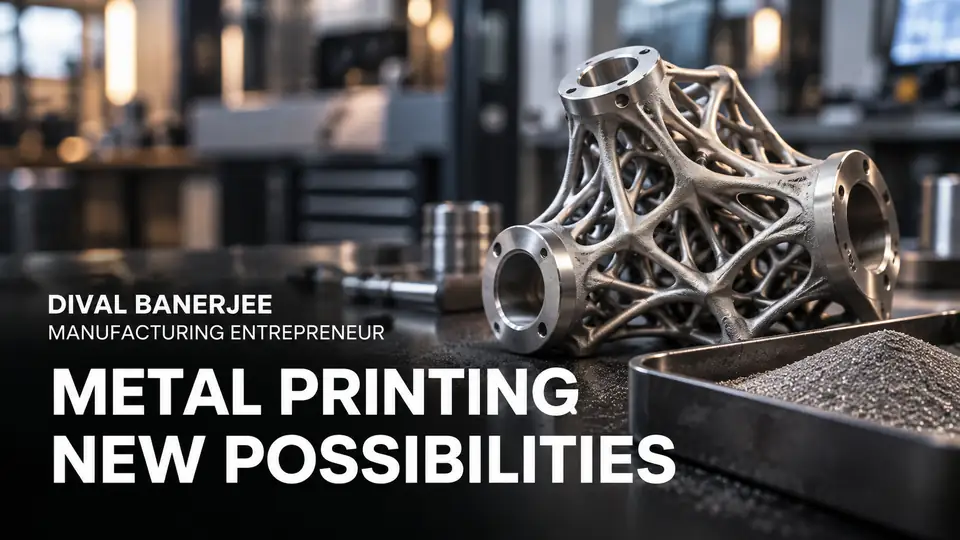
Dival Banerjee discusses metal additive manufacturing, including the difference between print time and total production lead time.
February 2, 2021 · 34 min



About the episode
In this conversation, we talk with Dival Banerjee, founder of Vuecason. At Vuecason, they're developing the technology to 3D print metal like we can currently print plastic. We cover what additive technology is, how to print metal, and the moral imperative for technology to improve life on Earth (and in Space!)
Links
Chapters
Times follow the podcast audio. The video’s timeline may be slightly different.
- 00:00Welcome and introducing Vuecason
- 03:33Materials and additive manufacturing
- 05:50Printing metal and handling heat
- 10:28Print time versus total lead time
- 15:08Changing how parts are designed
- 23:40Business models for manufacturing hardware
- 26:52Hyperloop and infrastructure challenges
- 28:22Technology as a way to improve life
- 32:52Manufacturing problems Dival wants to hear about
Read the conversation
Open the full transcript
CAMERON WIESE: Welcome to the Build the Future podcast. My name is Cameron Wiese and I'm your host. I've always been fascinated by the ideas and sentiment that drove American culture in the 1960s with the space race. A culture galvanized to dream about the possibilities of tomorrow. Whether it's food, transportation, cities, or anything else, it was this cultural mindset rooted in optimism. A mindset where people were compelled to build things. And I quote JFK, not because they are easy, but because they are hard. It's this desire to build and to dream that seems to have been lost and is something we're here to bring back. With Build the Future, we're here to promote the ideas and stories of those who to see how the future can be better and promote their plans to get us there.
CAMERON WIESE: It's our mission to get you to dream about the possibilities of tomorrow, dream about the future that you want to live in and inspire you to go build. Today, we're talking with Dival Banerjee, the CEO of Vuecason. At Vuecason, they're developing the technology that will enable us to 3D print metal just as easily as we print plastic. In doing so, they're developing a future when we're able to produce materials faster and more effectively, specifically materials that will be required for us to go travel the galaxy. Let's jump right in. Tell me about the future of building with Vuecason. What's the vision?
DIVAL BANERJEE: The goal of Vuecason is just to make it easier to build parts out of metal. So the goal is to, in the short term, is to build a 3D printer that can print metal like plastic. So you can think of like through a nozzle layer by layer. And generally it's going to be cheaper than like the alternative machines that are really expensive. We don't have any lasers or anything like that. It's just much simpler. And the goal is to make it really easy to just iterate in hardware and make changes and not have to rethink your entire manufacturing process.
CAMERON WIESE: One, what sort of parts are you imagining being printed? And then how are companies doing it now?
DIVAL BANERJEE: So I'd say that you kind of have to lend yourself the specific markets that, you know, will take those to have like huge advantages from additive manufacturing. So this will mainly be aerospace or like manufacturing tooling. Generally, these are industries where you're gonna have, you're not going to be making like tons of parts, it'll be
DIVAL BANERJEE: kind of lower volume. Generally, you need higher performance out of those parts. And so you can't really develop a manufacturing tool line to cut down costs or anything like that. You're usually making like fewer parts each year, a lot of these will be like machined or done on a CNC machine or like water jet cut, rather than developing like really super optimized machine tooling to do your manufacturing. I would say that within aerospace, like, aerospace is like probably the big use case for metal printing right now. And that's like the industry that's kind of adopted it a bit more than others. Like a friend told me or asked me like, what's the point of 3D printing? If like, what going to do like 3D print like Swiffer handles or something? Like, what's the point of that? You have to kind of think of, okay, where's metal printing going to be actually useful? And aerospace is usually focused on cutting weight for different parts. And generally, they're willing to pay a bit more. So it's kind of lend itself to the economics of printing a bit better.
CAMERON WIESE: How does this compare to something like 3D printed or like carbon fiber?
DIVAL BANERJEE: I think carbon fiber is excellent material, very lightweight, very high strength. It's still expensive, but the cost is trending to be a bit lower over time. But there's still tremendous demand for metal. And so I don't think metal is going anywhere anytime soon. Carbon fiber is also very difficult to work with. It's very expensive to work with because it takes a lot of just manual labor of setting up the molds and laying things out and doing all that. So carbon fiber is pretty cool. And then, you know, it's great for like formula one cars or, you know, maybe like high end sports cars and you'll see it in aerospace as well, but it's not going to be used for, uh, I think it'll be difficult to use everywhere. Um, you know, in the short term and especially once you're dealing with like high temperature things like, you know, like rocket engines, no one's going to make a carbon fiber, like a rocket engine anytime soon.
CAMERON WIESE: Right. Oh, so the, it is, you could print an engine with Yuka-san.
DIVAL BANERJEE: you'd be able to like engine parts, most of the parts maybe on the printer. There's some things that you often do with, you know, other manufacturing processes, but yeah, I think that that's like the goal is to be able to make it easier to print things like that. Generally larger parts rather than smaller parts. So we want to be able to print things that are like, at least the size of like a soccer ball or bigger.
DIVAL BANERJEE: I think that's where like additive manufacturing is like quite valuable. If you have the right additive manufacturing technology, I can do it. Though I think a huge advantage with additive manufacturing is being able to just like consolidate parts so like generally like you have to think of like what decision process does someone have to go through for like determining is this going to be one part or two parts that we have to like bolt together or weld together or something like that and Generally, those are going to be limited by like the geometry of the part or like the limits of the machine to make that part and Generally with additive manufacturing you can make more complicated things so you can make one giant part that kind of eliminates all the bolts or fasteners in that kind of assembly. And what you'll notice is generally your fasteners, like the nuts and bolts that have to hold something together, it might be like 5% of your build materials, but it'll be 70% of the labor cost of manufacturing that thing.
CAMERON WIESE: So by printing it all compiled or assembled, it completely eliminated that cost?
DIVAL BANERJEE: Yeah, you reduce the labor cost significantly. If your printing process is kind of like automated.
CAMERON WIESE: Yeah. How does it actually work? Walk me through the printer itself. How does this work for metal?
DIVAL BANERJEE: You can kind of think of like 3D printing, it's almost like a hot glue gun that can move around and with really high precision and layer by layer. So you're able to melt this material, lay down one layer and then build the next layer on top of it next down on top. The way traditional like 3D printer nozzle works is you have like a nozzle and you run power through it and the resistance in that material will basically heat up and the heat has to transfer from the nozzle into the print material in order to melt it. And then it like exits the nozzle and it's laid down. What I'm doing is I'm still using a nozzle, but we're using something called induction. So it's idea basically you can induce current into your material directly. So you can produce heat directly in the material rather than having to rely on transferring it from like the nozzle walls into the material. And so that makes things a lot faster and you're able to still control the temperature very precisely.
CAMERON WIESE: Yeah, because I'm looking at the printhead on your website. I'm most familiar with the 3D printing of little trinkets, which yeah, melt the material and then lay it down. So in this case, it's not necessarily melting it, it's using kind of a different method.
DIVAL BANERJEE: Yeah, we're still melting it. It's just like, we're just finding a different way to heat it. And like one of the reasons why, like why you could ask yourself like why hasn't this been done before? Like why hasn't anyone like made a three, why can't you just take like an existing plastic printer, increase the nozzle temperature and like use that to print metal? There's gonna be several problems, but like the big problem you run into is you're kind of like rate limited thermally by like if they'd be able to heat this thing to melting point and continuously like heat the metal. And that's very hard to do when you're relying on heat to transfer from the nozzle walls into the material. And that becomes like your rate limit. So induction kind of gets over that rate limit problem.
CAMERON WIESE: Who else is working on this? What's the, why is this not already the way that we are manufacturing all of our metals or a lot of our metals or materials?
DIVAL BANERJEE: It's partially because within manufacturing, a lot of these things are just hyper-optimized. So people have like built out like very specific solutions that are like really cost-effective for the specific part they're trying to build, at least in high volumes. That's why you when people talk about economies of scale, what it means is like someone's invested a lot of money into developing the manufacturing tooling that can like build that part for dirt cheap. So I would say that's like one big reason, but if you think of like within additive manufacturing, I mean, I'd say there's like maybe 50 or so companies that are like doing various things with metal, maybe a bit more. But like 50 like bigger ones that are like more well known. And I would say it comes down to like maybe two or three like maybe four or five like really big metal printing companies and the rest are kind of still early in development or much smaller market share.
DIVAL BANERJEE: I think a lot of times the reason why people don't do things is because they, especially within hard tech or deep tech, they like try to commercialize existing research and then build their business model around it. So they're like taking an existing technology and like trying to solve a problem with it. And I think you have to kind of go in reverse where you're like starting with a problem and then determining, okay, what are like the constraints I need or like things I need to do to solve the problem and then go find a technology to go do it. So a lot of these efforts will be like we commercialize this thing out of like the MIT mechanics and this lab and turn it into a printing company. That's why you see like all the metal printing companies like based out of Boston, because they're all commercialized out of that one lab. So I think that's like a huge reason. So they're not really thinking critically of like, Oh, which technology do I use? It's like, this is what exists. We know it works. We're going to go commercialize it. And I try to think in reverse.
CAMERON WIESE: So I'm curious, kind of how else are you thinking about this? that you would say is different from how everyone else is thinking about it.
DIVAL BANERJEE: So it just comes down to like, which things are you, I think engineers are generally just optimizers and people who pick constraints. So assuming your execution is like perfect or like, you know, good enough, the results come down to like, what did you choose as your constraints? And what are you trying to optimize? So for me, what it comes down to is optimizing for lead time and minimizing that for a part.
DIVAL BANERJEE: Uh, so lead time, what it means is like, just being able to, like, you know, start to finish how long did it take to make your part and including all the post-processing or like little steps you have to do, like fully functional, how long does that take? I think a lot of metal printing companies, they'll, they'll try to optimize for print time, which is not the same as lead time. And so an example of this is like one of the really popular metal printing technologies is binder jet printing or like binder based printing. There's a couple of different variants of it, but the main idea is you basically have this powder material that's maybe 60 to 80% like metal powder and then, you know, 20 to 40% some kind of binder material or polymer to hold that metal together.
DIVAL BANERJEE: The printer places the material and the shape of the object that you want to make, but it doesn't actually melt it. So that's considered the print time. Then you have to go to do of your next few post-processing steps. The main one is debinding. So you have to remove the binder material. And then, so like, let's say you had a 10 hour, like a batch of parts that took 10 hours to print, you'd have maybe 30 to 40 hours of debinding. And then after that, you have to go through like another 30 or 40 hours of like centering the part, which is like melting the powder actually together after you remove the binder material. So they've kind of like separated out all the steps in order to form the part.
DIVAL BANERJEE: what it ends up doing is like, yeah, your print times look way better. Like it's like, you're like a hundred times faster, 20 times faster than other print, bring methods. But then you added, you just kind of like shifted the steps around rather than like solving anything. So they've kind of like optimized for the wrong thing. And so like, you know, if it takes like five or six days for your part to go from start to finish, like what's the point in that? Like that's not that great. What you really want to do is it gets to the point where you can print the part and it's done. Like you could start it the evening, you leave the office and the morning you come back, it's finished.
SPEAKER UNCLEAR: And it can be left unattended and you can just trust that the machine will do its job.
DIVAL BANERJEE: Yeah, we're very, very far from that.
CAMERON WIESE: Why does this excite you? Like when you're kind of thinking about what you wanted to do, why is this what you chose to work on and where do you see it going long-term?
DIVAL BANERJEE: I really just like building things and making things. And I realized just how hard it is to actually build and make things, especially when you're slightly on a lower budget or you're trying to do a project. It's insanely hard. So I just wanted to make something that could help me make things and make it like way easier to make things and like remove all the frustration. And I would say that it's also something that kind of combined like not only what I want to work on, but also my existing skill set.
DIVAL BANERJEE: I have a lot of background with like firmware. I spent some time in the machine shop. And so it's like a mix of like mechanical engineering and software and electrical engineering as well. So like, I feel excited to work on it. And then it's also like, if you're making it easier for other people to make things, then I think that can produce like just a lot of progress in technology. And I'm always looking for more progress in technology. And there's this like scene out of Ironman where like he just tells Jarvis to make the suit. And then he goes off to his like fundraiser and like Jarvis tells them that the suit will be done in like five hours. I want prototyping and manufacturing to look like that in the long run. I think that would be really cool. We're very far from that, but I think that'd be the dream.
CAMERON WIESE: We have to start somewhere. I mean, if we could snap our fingers and have Jarvis assemble everything, like, well, I guess we'd find new challenges, but take the fun out of it.
DIVAL BANERJEE: Yeah, yeah, for sure. And so I think that in the long run, what we'll start to see is like, at least with metal added in manufacturing, it'll be used for more and more applications and enable different things that otherwise wouldn't be achievable with like traditional manufacturing methods. Like you can print different geometries that are more complicated. You can print larger geometries or things that wouldn't be done cost effectively with other manufacturing methods. And so you're gonna start to see like really cool things. One example is like SpaceX, actually their Dragon capsule is, like they actually printed their rocket engines on the side. that the Super Draco engines are actually 3D printed and that like radically reduce the cost and they're able to like actually go ahead and consider that like a feasible design strategy or like I think that that's what additive manufacturing can do is like you can add complexity with like a little bit less of a drawback. And so you can pursue cooler things.
CAMERON WIESE: Similar to how SpaceX is unlocking a whole new realm of opportunities and getting things to orbit by driving the cost down. It seems like additive manufacturing will do something similar. It will help people to design things that they otherwise wouldn't have built, or that would have been cost prohibitive to build. Is that the right way to be thinking about it?
DIVAL BANERJEE: I think that's one of the long-term effects we'll see. I think what it really does is, I would say that with additive manufacturing, it changes how much thought you have to put into designing a part. And I think that's a really big thing. We'll see cost reductions for sure in certain types of parts. And this is kind of like a side tangent, but sort of related. Like with a lot of the powder-based methods, you're maybe spending like 10 times more than like what the raw material might be, or maybe even a hundred times more. So a lot of times when you see like these things are done for aerospace, it's because only the aerospace industry can afford to make these parts. So it's actually still very, very expensive. What I'm trying to do is we're using pure wire, or just like pure metal to metal wire as like the feedstock material. So it'll actually be like far cheaper than your typical additive manufacturing process, just in material cost alone. Like the raw material costs on those are just way higher traditionally.
CAMERON WIESE: I want to jump back to again, kind of your long-term, like why this is exciting. So yeah, we get to the point where you can snap your fingers and Jarvis is building your iron man suit. What else might be possible with Vuecason and being able to 3D print metal?
DIVAL BANERJEE: Yeah, I think the huge advantage is just being able to iterate in your hardware really quickly. I think like one reason why we've seen a ton of progress in computing and especially in software is because you can like type your code and then like click run and then you'll know if it works or not. You don't even have to really know what's going on inside the computer. And so I kind of view additive manufacturing as like an abstraction layer of what you're doing. You won't have to think as much about the manufacturing process and you can kind to design the part and it'll just come out.
DIVAL BANERJEE: We're not there yet. And I don't think any printing company, I think actually right now with additive manufacturing, it's like, you have to think more about the part than you would with traditional manufacturing, but I think that's more of a long-term goal. What's so cool about code is that you can write something and then, you know, if you get like a bunch of users, you just deploy it on like Amazon's cloud and it just does everything for you. And I kind of want additive manufacturing to kind of serve the same way for physical parts, where you can just like design your part, then deploy it, and then you have production coming in. And that'd be really awesome.
CAMERON WIESE: The more we can make it easier for people to build physical things or digital things, the more progress we're gonna make as a society. Because there's so many barriers to being able to do those. This and everyone can have gravitate towards code because the infrastructure and the tools exist, because that's what's been invested in for the last 20 plus years. And so we're starting to see some of the investments in battery technology, manufacturing technology, and all that stuff. We should hopefully lead to more development.
DIVAL BANERJEE: Yeah, yeah. I kind of view additive as like this crusade against stagnation. Like outside of like legislation and just regulations and stuff, I think it just comes down to how do you make things really easy for other people to build with. And so yeah, I think that that's the way to go. A lot of times I think what happens with engineers is they'll start to see different trade-offs and start to realize like, oh, this is like slightly harder to do it this way.
DIVAL BANERJEE: So we won't do it. And they'll think like in the short term, rather than thinking like, you know, how design can evolve throughout, you know, the course of entire development cycle or several years. And when you do that, you end up with like optimization rather than like switching to an entirely new design. If you think about it, like, especially like with airplanes, like airplanes have gotten better, but we focused on fuel efficiency and like reducing like, you know, sound coming from, from airplanes. And so there's been a ton of progress there. And it's been a hard problem, but it seems easier in the moment, rather than going like, and try to build a supersonic jet. And so it's become super easy for people to rationalize, we'll just kind of like make slight iterations on what we're doing in slight tweaks. And I think what additive allows you to do is you can, like the cost of starting a new design from scratch completely is far lower, because you don't have to like dispose all the same, like all your old manufacturing tooling.
DIVAL BANERJEE: You can use the same machine to make something entirely different. Yeah. So I think that's going to be huge.
CAMERON WIESE: It seems like because we find ourselves in the state where everyone's optimizing, things aren't really improving, but these companies that have had the, you know, the Boings, the Lockheeds, like the infrastructure, they can't move their battleship very quickly. So it leaves room for companies like Boom to come in and say, hey, actually, we're gonna do this differently. And may take them take them a while. But in the end, they're gonna win out because they're gonna build the better product, have the better technology because they decided to say, hey, instead of optimizing what already exists, we're gonna go back to the drawing board and imagine like what things should be. It may be cool to see this kind of play itself out and all sorts of other verticals as the industry leaders keep playing their optimization games to get our efficiency while the entrepreneurs like us can come in and say, actually, I do it this new way. What do you think?
DIVAL BANERJEE: I'll say that the larger companies like Boeing and Lockheed are, you know, they're kind of bureaucratic, a bit slower, but I would say that they usually just have like, it's not like like dumb people work at like Lockheed or Boeing. I guess full of a bunch of smart people too. There's kind of like stuck in the system where, or culture where slight tweaks are kind of emphasized and celebrated and specialization celebrated. Generally, if you're an engineer there, you might be like working on one part or like one software module for like one thing. And you don't really see much outside of the scope of like what you're specifically working on. And it's partially because it's just like so hard to like learn everything and be like a generalist or whatever.
DIVAL BANERJEE: But I also think that when you do that, it becomes really easy to not be aware of all the other issues going on and like seeing the bigger picture, especially with these like larger companies we have larger teams or each person's like working on like one specific thing. And I think what some company like Boom has is they've usually they're like a much smaller team and they're able to see all the problems. Like, like, I'm sure, like, if you talked to an engineer at like Lockheed or Boeing, like they're going to talk about, like, you know, their days are probably a little bit calmer. And they can sort of work on things when, when you talk to maybe like an engineer from Boom, they'll be like, Oh, I know all these problems that are wrong within the company.
DIVAL BANERJEE: And, you know, you're able to identify them. And I think what happens is it's not like Lockheed Boeing doesn't have the problems, it's just that since the companies are so large, people are unaware of the problems. I guess on a side note of that, I think it's really easy to fall into optimizing just the wrong things or focusing on the wrong things. For an example, if you're trying to make money doing travel, one way might be to minimize your fuel consumption and try to cut down on costs because fuel is going to be the primary cost driver of your aircraft flying in different routes and then you can kind of get stuck in that local max. So I was just trying to optimize that. And then like boom decided, no, we're just, they're going to have like environmentally friendly, friendly fuels or something.
DIVAL BANERJEE: So it's not like they're ruining the environment, but they're entirely focused on increasing the number of flights so they can transport more people. And so each day you're running a boom plane, you're actually, I think you'll end up ending, like you'll end up making more money that way. So there's like different things you can optimize. And you have to realize like at some point, if you keep optimizing the same think forever, like their returns diminish and you have to switch to something new. And I think it's really hard for engineers to make that decision of switching to something new.
CAMERON WIESE: I'm curious, what's with the, the Lucas and duck?
DIVAL BANERJEE: So the company is named book son, but it's in depth or jacketed with the song who invented the all-metal lathe, but he's actually known for, uh, something called the digesting duck. It was something that was like a robotic automaton that would like eat food or eat food and then like poop it out. And that's what he became famous for. So I thought it'd be cool to like make the logo a robotic duck. And you know, maybe one day what we'll do is with the metal printers, we'll go out and print a metal duck that does exactly that.
CAMERON WIESE: How are you thinking about growing the company and operating in a, in this kind of hard tech space? We don't have a lot of models to follow, right? SaaS is pretty straightforward. A consumer, you're finding product market fit there is a challenge, but you know, the growth tactics are there. Those playbooks have been written, but it seems like not so much in kind of the spaces that you and I are excited about.
DIVAL BANERJEE: Right. Yeah, I think with hardware, like a lot of times the business model is not suited towards traditional venture, but there are things you can do to make it similar to SaaS. One of the things I've been thinking a lot about is doing maybe like a hardware subscription or like a lease where you kind of like pay for a yearly license to use the printer rather than buying the hardware upfront. And so like one problem is if you buy, if you have to buy the hardware upfront and pay for the full cost, what happens is that that customer is going to buy, buy your printer and you take all their money. But then the year after that customer is probably not going to buy the machine again. And so your ARR goes to zero every year. And like in a startup, you're trying to 10 X your ARR every year, right? And so you're kind of like, like losing, generally what happens with SaaS is like you solve subscription and then you can just sell more and like the revenue just compounds because your existing customer base is paying every year or every month.
CAMERON WIESE: And ideally they're expanding too.
DIVAL BANERJEE: Yeah, and you'd have to expand as well. But the idea is you're like, it's not like your feet are getting cut out from you underneath. Whereas with hardware, you're kind of like doing that exactly if you sell the hardware upfront. At the same time, what you're doing is you're increasing the barrier to entry if they have to pay full price upfront. I think with the subscription, you can make it so that people can first buy or get access to machines that they wouldn't have had access to. And then they're also like paying you every year or every month. So you have this recurring revenue that compounds And you're also establishing a more long-term relationship with the customer where they're, since they're constantly paying for it, you know, you kind of have an ongoing dialogue and it'll be easier to sell more printers in the long run because you have a closer relationship with the customer as opposed to selling it to them once upfront.
CAMERON WIESE: Another model, I don't know, you may have thought of, thought of this through, is like just manufacturing the parts yourself is kind of one, one business channel. And then the other is kind of the, the leasing of, of the machines.
DIVAL BANERJEE: Yeah. I think actually in the short term, we're going to focus probably more on a service, where a person can just submit the part and, you know, we have like automated checks that check for manufacturability, and then go ahead and print it and ship it. And then like try to undercut like other competitors. And then in a way this is really good because it forces the company to use the machine and they're gonna be so annoyed with like early versions of the machine that they're gonna be the customers. Like it's much easier if you're like engineers and like product managers are also your customers. And that way we're forcing them to be the customer for the machine. And so they'll know everything wrong with it and what to fix.
CAMERON WIESE: That makes total sense. I'm curious outside of the 3D 3D printing metal, you spent some time at Hyperloop. Give me the rundown on that space. I haven't familiar with the concept. What's going on, where things are in the Hyperloop space. Again, like this is assuming you're, you're still kind of following it intensely.
DIVAL BANERJEE: Yeah, I'm still on the team. I've cut down on my time significantly. Like I used to spend a lot more time when I was in school and working there and actually probably spent more time on Hyperloop than school. But yeah, I would say the big rundown is that I think like it's building a pod is super easy, all the technology is there. Like building something that can go 700 miles per hour isn't the issue. It's the infrastructure and like managing that regulatory environment. And so one of the reasons why I'm really excited for the boring company is their focus entirely on infrastructure. And they're not really talking about Hyperloop that much. It's an infrastructure cost problem. And it's like the reason why we haven't, we've seen like Hyperloop pods go at the Space X Hyperloop competition, which was like a student competition. I think the speed records around like 300 miles per hour and it hasn't really gone past that. The big reason is because the track's too short.
DIVAL BANERJEE: It's like really hard to reach that speed and stop within a mile. So Elon tweeted that the next Hyperloop competition, which isn't this year, but maybe in a couple of years it'll happen. They're planning on making a 10 kilometer curved vacuum tunnel underground. And so we decided, we went ahead and thought, even if it was, let's say Elon was being too ambitious and he could only do like five kilometers, what speed could we hit? And we found that it would be really easy to hit 500 miles per hour and break. And we could probably go beyond that with that track length. It's just really hard to like accelerate at two Gs constantly. Like once you're like around one G, it's much easier. So I think we'll see, as soon as there's a longer track, we'll see huge speed records broken and things are going to go faster.
CAMERON WIESE: How do you think about just getting to that point where we have these sorts of technologies like the Hyperly open, even more even like autonomous vehicles and all this stuff in the world of atoms like, how do you think we get to that point where these are all commonplace and everyone's excited about them.
DIVAL BANERJEE: Yeah, it's partially like a public sentiment issue. I think recently we've kind of been complacent with thinking, you know, the environments could, like I think the environment's important to go get me wrong, but we've kind of thought, oh, the having a larger human population is bad. You know, you shouldn't drive a car, you should walk, you should take a bike instead, you know, you have to get rid of your plastic straws and like use paper straws or like use your reusable grocery bag or something.
DIVAL BANERJEE: And I think that's like the total, that's like the wrong way to look at it. That's like admitting technology won't improve. It's not gonna solve our problems. And instead we must minimize our lives and minimize the population in order to sustain ourselves. And what I really wanna see is like, I wanna see like 20, 30 billion people living on earth. And that should be the priorities. Like how do we increase the human population and support them? And the only way to support that kind of thing is to go and improve technology to sustain that. Ideally, I should be able to do whatever I want and not have to think about the environment whatsoever because I know technology will solve all that for me. Like I should be able to indulge in whatever I want and not have to think about what to recycle and technology will just take care of all the problems with emissions or like energy. Like I should be able to leave all the lights on in my house and not have to think about the electric bill or anything.
CAMERON WIESE: Let's not try and patch fix these things and kind of restrict ourselves. It said, let's go figure out how to solve the problems that have been created. Oh my God. Crazy wild concept.
DIVAL BANERJEE: Yeah. I think like a lot of people kind of just assume that there's this trade-off that exists when it doesn't really exist. You know, you can like live life and consume a lot and still have a sustainable environment and like not ruin the earth. And like Tesla's like a huge example of this, you know, the electric car is generally better than most of your other cars. And you know, it'll outperform most, most other like gasoline powered cars. It's a better car generally, better product. And yet it's environmentally friendly. We didn't make the product worse in order to be environmentally friendly. Like the Nissan Leaf's kind of like the old, if you think of like the opposite view is like, we're going to make this like ugly looking car that's not fun to drive. and it's horrible, but you know, it's good for the environment. It's like your Prius or whatever, whereas the Tesla is like this cool looking car. It's fast. People love it. And it's still great for the environment. And I think we don't have to compromise. We just need to improve our standards and demand more.
CAMERON WIESE: We've covered a lot of ground around kind of different possible futures. Curious, what excites you the most about the future?
DIVAL BANERJEE: I think space is really exciting. I'm really excited for space and like just transportation in general. It's sort of like remote work, but the opposite. It's still in the physical world where like I can live where I want and be anywhere else I want to be within 30 minutes or something. And so like my house isn't limiting the people are like where I'm living isn't going to limit the people I can meet or the places I can go. So I think that's like going to be a really cool future, especially with Hyperloop where you could like live in LA and your job could be in San Francisco or the reverse. And that commutes like feasible and not only is it like fast enough, but it's also cost effective. And so like that's the future I'm really excited for. And then in the long term, like space would be fun. And I think actually in a way like space in order to like establish like a city on Mars, we're going to need all these transportation improvements and infrastructure improvements. Otherwise, it'll be hard to sustain that up there in space.
CAMERON WIESE: I'm going to challenge you.
DIVAL BANERJEE: Sure.
CAMERON WIESE: Why space? Isn't that almost like an escapist thing from the problems we have here on Earth?
DIVAL BANERJEE: This is a good question. I think that space is just a continuation of expansion. It'll be fun. Even if it's not useful, it'll be fun. I don't buy into this thing where we're going to leave Earth. No, we should put billions of people on Earth, and then simultaneously, we should put billions of people on Mars, and several hundreds of thousands of people on the, or millions of people on the moon. And we should just continue to expand the maximum rate and by not going to space, you're expanding less.
CAMERON WIESE: Well, I mean, we'll get there as long as we continue to get people to go build, right? How can people support you? Where can they find you? Any call to actions for people?
DIVAL BANERJEE: I would say that if you're like someone who is, who either has used metal printers or works with in a machine shop or like understands like even just being a mechanical engineer, I always like feedback. So I just go on Twitter and DM me your complaints. Like what do you hate about your job? It can be anything. It doesn't even have to be related to parts. It can be related to the design process or like your workflow. Cause in the long run, I think that we'll kind of use printers as like peripheral and expand on the software and make things easier. The goal of FocusOn is to make iteration or iteration hardware easier. And that not only includes this, the printer includes your entire workflow. So just tell me what you're complaining about so I can think of things to help solve it.
CAMERON WIESE: And then website Vucasan.com.
DIVAL BANERJEE: Yep. Yeah, Vucasan.com.
CAMERON WIESE: And then people can find you on Twitter at...
DIVAL BANERJEE: Devolve Energy.
CAMERON WIESE: Perfect.
CAMERON WIESE: Thanks for joining us for another episode of the Build the Future podcast. If you're building and want to get support, want to hear about certain topics or hear from certain people, shoot us over an email to hello at build the future podcast.com or follow me Cameron on Twitter at cam wheezy and we'll see what we can make happen. That's it from us. Until next time, go build.
More episodes
All episodes Ryan Dunn — Carbon Fiber 3D Printing and the Next Generation of MachinesRyan Dunn discusses carbon fiber composites as an enabling technology for lighter, more capable machines.
 Getting Food Robots Out of the Lab — Rajat BhageriaRajat Bhageria explains how Chef Robotics deploys food-assembly robots, learns from factory operations and tackles real-world automation.
 Chris Power of Hadrian — The Future of Manufacturing, Space, and AmericaChris Power makes the case for rebuilding the manufacturing supply chain behind space and defense.