

Build the Future Podcast
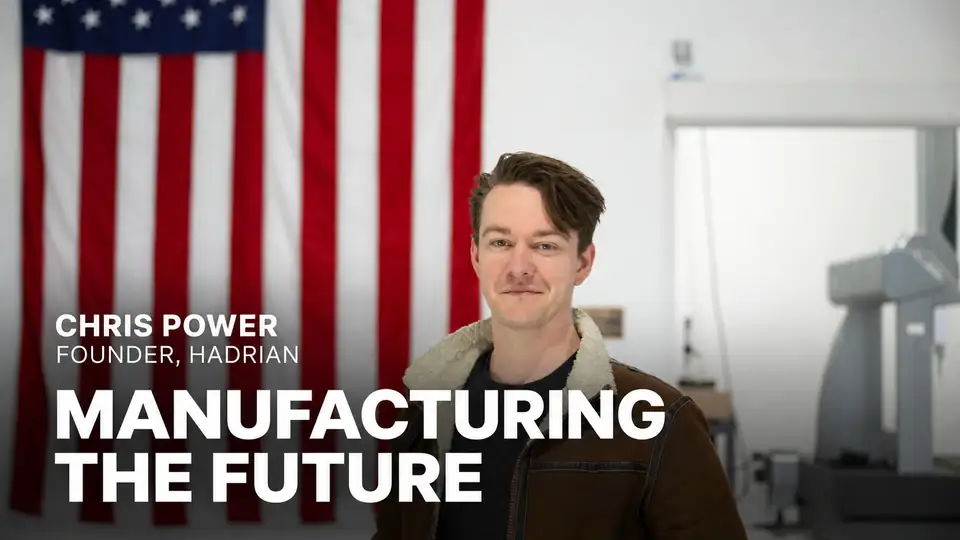
Chris Power of Hadrian — The Future of Manufacturing, Space, and America
Chris Power makes the case for rebuilding the manufacturing supply chain behind space and defense.
July 13, 2021 · 42 min



About the episode
In this conversation, we talk with Chris Power the founder and CEO of Hadrian. In the episode, Chris describes Hadrian’s autonomous component factories and their goal of helping customers make rockets, satellites, jets and electric vertical take off and landing vehicles 2x faster and cheaper. In doing so they're ensuring the manufacturing of our future and the companies leading the way in defense and space have the tools they need to go build.
Links
Chapters
Times follow the podcast audio. The video’s timeline may be slightly different.
- 00:00Introducing Chris Power and Hadrian
- 01:38The supply chain behind space and defense
- 03:56Manufacturing capacity and the future
- 08:11Inside a fragmented supply chain
- 11:59Factory-market fit and vertical integration
- 13:52The factory that builds the factory
- 15:24Automating one process at a time
- 17:59From part design to delivery
- 20:32Why small delays cascade
- 22:11Precision, data and environmental variables
- 25:01Building software with manufacturing teams
- 28:01A 2021 view of the Bezos launch
- 30:52Lower launch costs and new possibilities
- 33:23International cooperation and competition
- 35:02A moment of rapid change
- 37:02Optimistic culture and meaningful work
- 39:44Finding a mission where you can contribute
- 41:38Closing thoughts
Read the conversation
Open the full transcript
CAMERON WIESE: Welcome to the Build the Future podcast. My name is Cameron Wiese and I'm your host. I've always been fascinated by the ideas and sentiment that drove American culture in the 1960s with the space race. A culture galvanized to dream about the possibilities of tomorrow, whether it's food, transportation, cities, biology, or anything else. It was this cultural mindset rooted in optimism that the world tomorrow would be better than the world today. A mindset where people were compelled to build things, and I quote JFK, not because they were easy, but because they were hard. It's this desire to build and to dream that seems to have been lost, and something we're here to bring back. With Build the Future, we're here to promote the ideas and stories of those who see how the future can be better and promote their plans to get us there. It's our mission to get you to dream about the possibilities of tomorrow, to dream about the future that you want to live in, and inspire you to go build. Today, we're talking with Chris Power, the CEO and founder of Hadrian.
CAMERON WIESE: At Hadrian, they build autonomous component factories that help customers make rockets, satellites, jets, electric vertical takeoff and landing vehicles two times faster and cheaper. In doing so, they're onshore in the manufacturing of our future and ensuring that companies leading the way in defense and space have the tools they need to go build. Let's jump right in.
CHRIS POWER: I don't think people get the gravity of the national security implications. Imagine if you were McDonald's and all your fries and burger patty suppliers were 10 years away from going out of business. It's an existential risk, right? You literally can't run McDonald's without burger patties, right? That is effectively the entire space and defense industry right now in America and no one else
SPEAKER UNCLEAR: sees it coming.
SPEAKER UNCLEAR: And why is that?
CAMERON WIESE: Why is this a state of things right now?
CHRIS POWER: So the reason why it's a state of things is because the manufacturing supply chain first got built up from the first space race and the first defence industrial based build up. So it's just a demographics thing. And the congressional industrial complex meant that it was all fragmented across all 50 states, which at the time made complete sense. You know, zero criticism. But what you have is this demographics of, you know, owners who started a business 30 years ago, when they were 30. So now they're 60. They're all 10 to 20 employees, average 10 million in revenue, so real family owned, under operated mom and pops, and they're scattered across the country, which now is a completely untenable situation for several reasons. One is they cause absolute chaos for all our advanced manufacturers from Lockheed Martin to SpaceX to Relativity, to Jovi Aviation to AVL space, or any hardware startup at YC trying to build a future. And over the next 10 years, as the supply chain has never been in more demand for two reasons. One is the new space race.
CHRIS POWER: And secondly, the defense industrial base is gearing up for a great power conflict with China. In that same decade as the demand is going to exponentially grow, the supply is slowly gonna start falling off as all these small businesses shut down. So like this is a huge problem because you don't get to launch 100 starships a year without the supply chain. We don't get to do a bunch of weird shit in San Francisco with all our hippie friends, unless there's a bunch of like big scary guys in F-35s, you know, patrolling the skies. None of the flying car future or the spacefaring future or the peaceful democratic spacefaring future happens without the supply chain being super robust. And you know, I can tell you about all the cool stuff we're building, but that is really the problem we're solving is, one, how do we speed up all the advanced manufacturing the United States by an order of magnitude and have the same effect on advanced manufacturing that cloud computing had on software engineering, both on efficiency of businesses and also just
CHRIS POWER: this huge explosion of democratizing software engineering, right? Because now it costs you $500 to start something instead of a million dollars. So now you just have an order of magnitude more software startups, which is great. If we do that for advanced manufacturing, the same thing will happen. And then secondly is, this is the 20 or 30 year period where we settle the solar system. And what happens historically, if you look at how continents have been settled, or in other cases colonised historically, the culture and the politics and the ways of doing things kind of stick. Once the first culture lands, that's the way it is. And you look at the moon or the solar system as an eighth continent. And then it lasts for 100 years. So it's not just like the first space race where yeah, we landed on the moon, right? That wasn't a settlement or colonization event. So even if the Russians had won, would communism have stuck? No. This 30 year period, it's going to stick. So it's not just the fact that in my lifetime, I don't want
CHRIS POWER: to live under the CCP's yoke because they have a moon base and we don't. Whatever sticks in the next 20 to 30 years is going to stick for the next 500 years. And there are two paths. There are two paths. There's a path where there are two or three great powers keeping each other in check. Like it is just as important that the US has a key competitor as it is that the US is a key competitor, right? So that most of the conflict is minimal. It's fought with pens and paper over legal things with a bunch of lawyers and resources and it's not a hot war. And what that enables is an Antarctica style moon space. Like it's research oriented, it's resource controlled. Yes, it's capital driven, it's free market. But it's done kind of beautifully. And then we have this Cambrian explosion of a lot of cool stuff happening across the next century. The alternate path to that is we don't keep other great powers in check. We lose the foothold, which leads to two things. Once there's a power imbalance, power imbalances create conflict. So that's bad. And then secondly, we might lose that conflict.
CHRIS POWER: And the leading architecture is social credit score, chemical castration of millions of women, not the US has done some bad shit, don't get me wrong, but net net, I want to live in that system. If you track the root causes back of how conflicts are won or lost, you know, where the Rubicon gets crossed, it's basically manufacturing capacity. It's like, how much stuff can you throw the other person? Ideally, you don't even want to throw anything at the other person. It's all posturing, right? But But right now, you know, this is not public knowledge. It's just it's not in the zeitgeist. But anyone in the know knows that SpaceX doesn't exist without the supply chain. Well, it's SpaceX, they'll probably figure out. But the broad strokes of advanced manufacturing from EV toll companies like Jobe Aviation, launch vehicle companies, everyone from AVL space and Astra and Relativity and Rocket Lab and SpaceX and Blue, the entire defense industrial base, Andoril and everything in between that we haven't really even seen yet, does not exist or exists incredibly inefficiency
CHRIS POWER: like before cloud computing for software engineering. And if those companies don't exist and don't thrive, then people forget that that is the foundation of the US-led democratic system. So the future that I wanna live in is the Jetsons future. I don't wanna live in the Blade Runner future.
SPEAKER UNCLEAR: Absolutely not.
CAMERON WIESE: And so, and this is something we get to fight for every day. I want to have you paint the picture of, again, the supply chain network right now. So you kind of alluded to it. You have the mom and pop shops from the last space race that popped up, and they do the manufacturing of these things. Like, what does it actually look like? And how bad is it that it's fragmented this way?
CHRIS POWER: You know, about 10% of the suppliers are pretty great. They do a good job. I have zero criticisms of these owner operators. They do amazing stuff. They're artisans. like, you know, they've done an incredible job. It's just that they haven't pushed the limit
SPEAKER UNCLEAR: on what's possible. To give you an example,
CHRIS POWER: a lot of the rocket engine components are made in garages in LA with six people in there that look like they're out of the fast and the furious too. The reason why the F-16 fleet is at 60% readiness is because half of the birds can't get parts. And if you track that all the way back, it's because the engine housing got soul sourced cost to some 30 person business in Iowa 20 years ago. And that company has a 20 week lead time and doesn't have the capital capacity or efficiencies to produce many, many, many more of those. The worst example is the Stealth Bomber, which literally the business that used to make key parts for the Stealth Bomber went out of business, they retired. There are no digital files of those components anywhere. So the DOD literally has a contract out that you can RFP on today to win the contract to reverse engineer that part and find a way to like recreate that component. There's another another example of this, which is less about efficiency, but it's more about you know, you'll get the general vibe of the supply chain.
CHRIS POWER: And I'm not sure how much this is public knowledge. So I'll kind of dance around the edges. was one of the SpaceX anomalies when one of the early rockets blew up was because of supply chain fraud where there was a component that was made out to be made of one alloy. The supplier committed fraud and shipped it made out of another alloy and then it crumpled under load in the rocket blower and now that guy's in jail. Another example is, let me talking about hypothetical. Imagine that for a certain, a certain grade of satellite, you need a certain type of solar panel. And these satellites are super strategic to the country. It's communications infrastructure. There are about three companies in the US and know how to make those types of solar panels. It's high tech stuff. The Chinese don't have that IP. You cannot sell that IP to the Chinese because of regulations, which makes sense. Hypothetically, imagine that if through a series of financial entities there was a private equity fund that looked American,
CHRIS POWER: that bought one of these companies, and then it accidentally went bankrupt 12 months later. And then another private equity fund bought it out of Chapter 11 bankruptcy, and there happened to be a loophole in bankruptcy law that allowed you to skirt around the ITAR regulations. You would find a way to stealthily fund two different private equity funds that looked American but weren't. And within a year and a half had managed to export the solar panel technology IP out of the country. I mean, this really happened. Some of it is, this is really inefficient and it's annoying. Some of it is really, really, really, really scary. And I think one of the tricks with this industry is that everyone looks at SpaceX and Lockheed Martin and Andrew and goes, wow, they're really building advanced stuff, the whole thing must be efficient. And they are like, SpaceX, Lockheed, and real relativity, Vata, everyone is like super efficient. But if you double click a couple
SPEAKER UNCLEAR: layers deeper, it's a total mess. Yeah. Let's use that as a segue into how you're
CAMERON WIESE: thinking about tackling that. So what does it look like to start to consolidate these and become the manufacturer of all of these parts and pieces? Like where do you start and like how do you expand out?
CHRIS POWER: So what you want to do at a meta level with a startup is find a series of customers who have similar requirements and then scale the hell out of them to get to a size where you can tackle other markets like Stripe. Now you build payments for startups first, then you get big enough that you can do everything. So we are building a series of factories targeted at space startups, big and small, that will do about 60 to 90% of their requirements in terms of the types of parts, the materials, the envelope sizes, and the demand for that is growing massively. So basically, we have a concept of factory market fit. So that's what we're building first. It's vertically integrated in the sense that it's our software running the factory, but we also run the factory. It's the only way to control the lead times and the costs and the errors to a point where you can actually solve the customer's problems. Slapping a marketplace or a platform on top of inefficient businesses doesn't make them more efficient. It just solves the buyer and the buyer, you know, the supply and demand matching equation.
CHRIS POWER: It doesn't make it more efficient. So we have to go vertically integrated. And we use that as a leverage point to scale the hell out of our first party manufacturing while building the software infrastructure that will enable the rest of the industry to catch up with us. So yeah, that's basically what we're building first is, you know, the Alien Drednaut MVP down here in LA focused on the space industry. And that will give us the leverage point and the knowledge to be able to expand to other stuff, whether it's defense or different types of manufacturing or different types of hard
SPEAKER UNCLEAR: metals. That's what's going on at the moment.
CHRIS POWER: Can you explain the alien dreadnought analogy? The alien dreadnought is a sci-fi trope where there is a factory sitting out in space that makes other factories that make starships that makes X-wings or whatever. It's the factory that builds the factory. It's the machine that builds the machine. And what Elon is eventually trying to build with Tesla is Alien Dread not as a factory. It's a factory that spits out of the factories. It spits out cars. It's a self-improving engine. It's like an ML model or something. So ultimately, the ultimate version of Hadrian is that you whack open an API and you call our API and some machine in Texas starts whirring and starts spitting out a rocket, basically. Now, obviously, version one of that is just the components. And obviously, there's a lot of human in the loop stuff. But ultimately, where we should get to is that the entire entire advanced manufacturing infrastructure is abstracted into an API. And then it is self improving in the sense that like, oh, to get to this product, you
CHRIS POWER: need these components, we don't have the machine, but the factory knows how to build the machine that builds the machine that built the car or the rocket. And this is completely insane and decades off, but someone's going to do it at some point. And, you know, like Amazon continues to abstract things into AWS and, you know, Stripe continues to abstract things into Stripe and we will, we will do the same thing and eventually we'll get there. It might be 20 years, it might be 50 years, just see, see what we'll see where the technology curve goes. But that's the alien retinol concept.
CAMERON WIESE: What are the major like technological insights we have to go here, like discoveries we have to make in order to make this sort of thing possible? Or does it stuff already exist today? It's just a matter of stacking, piece of building up to it.
CHRIS POWER: I think it exists today. It's just stacking and building up to it. The real trick is chomping down the processes of a factory to a point where you can make them like digestible engineering problems. So starting from scratch and saying, put a robot in a factory so that there's never any human labor is a problem that will never get solved because it's not broken down into digestible chunks. Whereas if you have everything working so well that you can say, hey, a human being is doing these 10 tasks, let's just put an engineering team on task number one, and then now that's fully automated. And you just slowly build up to it. If you kind of look at history, there are two. The only way to build a complex system is to build a series of simple systems that eventually stack on top of each other. If you try and build a complex system from scratch top down, it's like this massive failure mode. So one of the tricks here is that I think assembly, like Tesla are doing, is the wrong abstraction layer to build the alien dreadnought prong,
CHRIS POWER: because it's too complicated as a starting point. If you start with just making parts, where it's more like a server farm, where, you know, a minute of machine time is like a minute of compute or something, and there are more discrete processes, it's more handleable, That's primitive number one. Then you could say primitive number two is take two automated components and bolt them together as an assembly. Now you have assemblies. Then you can do a rocket engine. Then you can do a rocket. But I think starting with the car metal layer or the rocket metal layer and trying to automate that, there's too many layers of abstraction. There are too many snap-off points. So I would say that like technology-wise, I don't think there's much out there that doesn't exist. You know, the OpenAI robotics team have solved a lot of the vision challenges, you know, scheduling algorithms are a known quantity, like all this stuff kind of exists in different patches. I think it's just basically, what's the right layer of abstraction to start with that lets you scale a good business with defined processes
CHRIS POWER: so that you continue to acquire capital, which means you can continue to acquire engineering teams to put on these discrete engineering challenges and then build up to it. And that's the only way to do it.
CAMERON WIESE: Part of these, like really curious about like the process when a company or when you have an end-row company and you're saying, hey, we need this part or we want this. Like what that actually looks like on your end, is that something you're open to talking about
SPEAKER UNCLEAR: or is that kind of internal?
SPEAKER UNCLEAR: No, it's pretty simple.
CHRIS POWER: I'll give you the current state.
SPEAKER UNCLEAR: And I'm curious like how that pairs with the software side too.
CHRIS POWER: Yeah. So, so let's say that I'm, I'm, I'm blue origin. Since Jeff is putting himself in the capsule in a little bit over a month. I'm blue origin and an engineer says, Hey, I finished designing this part for the rocket engine. I need 10 of them. Then it goes to someone in the supply chain team and they take a PDF print of the part and a 3d file, which is roughly accurate, but it's not fully accurate. and they send that piece of information to five different machine shops via email and say, hey, quote us this package apart. That can take two weeks. Then someone gets awarded the contract. This could be a $25,000 order. It could be a $10 million order. Like, you know, it's all the same thing. Then they get awarded that contract. Now there's a scramble because usually what's happened is Cameron, I've promised you I can do it in five weeks. In the proceeding two weeks of that bidding process, I might have filled my factory up with something else already. So is that lead time valid or not? Question mark. Do I have the software systems to even answer
CHRIS POWER: that question? No. And then I'm going through this production planning process of saying, okay, well, we need to get this out by the end of the month. Someone will design the manufacturing process. It goes in machine one, then machine two, then it goes out to an anodizer, then it comes back and then it gets quality inspected. So there's a variant of that process depending on what's required from the customer and for you to make a good part. So there's a planning process. Then the supply chain kicks into gear and you're ordering the raw material, you're ordering the tooling. Then it goes to the CAD and CAM team who are manipulating the geometry of the model and using a CAM piece of software to generate G code, which eventually runs on the machine and tells the machine what to do. In parallel with all the supply chain stuff, hopefully happening at the same time so that Friday, all of that pre-production stuff is done so that on Monday you can start making the part. From there, it can be as simple as operator gets the part,
CHRIS POWER: they put the part in the machine, they press go. It can be as complicated as they put the part in the machine, they press go, something goes wrong, it needs to go to QC, it goes through a kind of a recovery loop that takes a week, and then it finally goes through the production process and and makes it to the customer. What's tricky there is that very rarely in the current state does do all these, those things happen smoothly. You can track this back of like, SpaceX launch gets delayed, NASA is pissed off. Why? Because the rocket engine was two weeks late
SPEAKER UNCLEAR: on the assembly schedule. Why?
CHRIS POWER: Because the parts arrived late. Why? Because I told Bob to order 10 blocks of aluminum. He missed the email for three days. So the raw material doesn't arrive on time. We go to make the part, the raw material is not there. We have to reschedule the factory. That costs us a week and a half, and the whole thing cascades. So that's kind of the current process. It sounds simple, but getting it right every single time smoothly and quickly with all this error handling of everything you could possibly go wrong and using software to make that more efficient is the big challenge here. No one part of that equation is particularly hard. The software that handles the logic of, you know, Cameron, you're a quality inspection team, and it didn't pass quality inspection. What do you do? You know, you need to have an entire software system built around that, you know, unhappy use case to handle everything smoothly.
SPEAKER UNCLEAR: And that's a lot of what we're doing. Yeah, very, very straightforward process, you know, no,
CAMERON WIESE: not a lot of room for for error. And yeah, something slips up, you know, get right back on track and make those deadlines. Simple. So then the idea is, okay, bring that all in-house, provide visibility into the process, do the manufacturing of those pieces, starting with a number of parts and then scaling that up as you go. What's been the most surprising thing for you in the development of the software? So just like on the quality control example, I imagine currently that feedback is like, hey, this thing is broken. It needs to be adjusted like maybe here's a here's like an email with some of the areas that we read out versus having a baked into the system where it's like, Oh, here's exactly what went wrong. Like this seems to be adjusted this way. What does that look
SPEAKER UNCLEAR: like?
CHRIS POWER: So the data is usually not there. A lot of the infrastructure we're creating is to get that data. And aerospace, aerospace manufacturing is so complicated that it can literally come down to the, the sun was shining in the window and the machine was two degrees hotter. So you made apart the night before on the exact same machine. And now you're making that part on the same machine, but it's two degrees hotter. And that warped, that warped the tool incrementally slightly. So that the fifth part you made is out of tolerance. We literally are spending an ungodly amount of money on climate control for the factory. So that there's only ever a one to two degree Fahrenheit variance in the temperature at any given point in time, day or night. you're dealing with nanometer tolerances and you're dealing with like raw material physics and you know, all this crazy stuff. So for example, it can literally come down to if you don't have deep enough foundations for the machine to sit on and you're near a train track, which we're not, and the train goes past and a human being wouldn't even notice it,
CHRIS POWER: it might've vibrated the machine slightly such that the holes got drilled half a thou the wrong direction. And then the quality inspector is going, why is this the case? Someone did something wrong. There are all these environmental variables that you need to take into account. There are all these special situations that you need to kind of like track an account for. And yeah, this is how like, is that crazy?
SPEAKER UNCLEAR: That's unbelievable.
CAMERON WIESE: You think it's like, oh yeah, you just press the button and the machine prints the part and you're good to go. But when you're dealing with systems of this nature, precision matters. So precision is everything to be exactly the spec. And if it's off by nanometer.
SPEAKER UNCLEAR: So we combine the best of non-manufacturing principles like that,
CHRIS POWER: as well as the software to scaffold everything so that the errors happen a lot less. But yeah, that's unbelievably difficult.
CAMERON WIESE: Then you compare that with the state of the existing supply chain. Or like, do these common pop shops have the tools and the resources and the software and the insight to measure these sorts of things?
CHRIS POWER: Like, oh yeah, yeah, yeah, yeah. So this is, this is what's great is all those tools are out there, but no one stitched together into end to end, you know, a fairly persistent.
CAMERON WIESE: So this seems one of those, this problems that like everyone in the industry realizes a problem, but like no one had, no one had solved for it. Why do you think that was? And like, what, what insight did you have that, that kind of like, oh no, we've got do this right now? Like, oh, it can be done. Was it just asking that question? Or?
CHRIS POWER: I would say that the biggest mistake that other founders have made historically who have tried to tackle this or private equity firms who've tried to do roll ups in this space is that there's an ego attached to being a PhD software engineer or a private equity guy that is basically like, we're smarter than you, we'll work it out.
CHRIS POWER: Whereas if I was to tell you that the one trick of Hadrian that matters more than anything, it's the understanding that all of these problems have been solved before by somebody and having the right mix of team members who don't really care what the right answer is or the right fix for that problem as long as the whole system works. And that starts with like, I mean, we literally have people with applied math degrees from Yale sitting next to people who didn't graduate high school arguing over how to do something. And both of them have valid answers.
CAMERON WIESE: Incentives seem to really matter in stuff like this.
CHRIS POWER: And I think the other thing that is interesting is every single time someone's tried to build a piece of software for a manufacturing company, there's a principal agent problem of you build software to sell to a CFO, right? So manufacturing software is so deep and complicated that you literally cannot build enough of it by doing customer interviews, for example. It doesn't work. So there is no software toolkit for existing manufacturers that is good, because it's all built externally. And the reason why there are no software engineering teams in manufacturing companies is because the future is unevenly distributed and it's just a different culture and you know what. So basically the only way to guarantee that you eventually get to a piece of software that does this is co-locate software engineers with manufacturing people and own your own problems. You have to dog food your way there and chip away at the marble until it's right. So there are all these other interesting like historical patterns as to why this hasn't happened. And I think we've got the right mix here. I'm sure
CHRIS POWER: there are there are things that we haven't quite predicted. Yeah, there's a very specific kind of meta way to build this business that people often don't grasp. Yeah.
CAMERON WIESE: A lot of that a lot of the innovation we're seeing does require that kind of different different perspective. Because when you have private equity folks coming in trying to try to do something, they have very clear incentives. It's like what they're trying to optimize for that doesn't necessarily get you the outcome that you need. Can you kind of talk through the state of the Space Race right now, kind of the blue origin, SpaceX, like what's going on there and then, and then actually I want to hear your take on Jeff, our boy Jeff going up in space. Good idea, bad idea.
SPEAKER UNCLEAR: Do you have a hot take?
SPEAKER UNCLEAR: I have a hot take.
CHRIS POWER: Which one do you want, the Space Racer or the Bezos hot take?
CAMERON WIESE: Let's start with the Bezos hot take and then we'll go to the Space Race hot take.
CHRIS POWER: All right, here's my unfiltered opinion. That vehicle has not flown enough times that from the outside, it looks like a good idea. However, Jeff is like one of the smartest people on the planet. I have no doubt that he's read all the technical specs and test data himself and that there is a minimal amount of risk. Otherwise, he just wouldn't do it. I think that it is a massive throwing of the gauntlet to Elon and other entrepreneurs to do it themselves. I think that it is an incredibly effective marketing tactic for customers saying, this is safe enough for astronauts to fly on, look, I'm doing it, which they kind of have to do a move like this because they're slightly behind, right? Just think competitive positioning. And I think that there are two outcomes. One is it goes wrong and basically the space industry goes into an AI winter for 10 years, or it unlocks an order of magnitude more capital and excitement in the space. And we're going to have an incredible 10 or 20 year on. I think it's a real sliding doors moment. I think like, you know, there was the Doug and Bob launch
CHRIS POWER: with SpaceX. There was the first time SpaceX, you know, autonomous, autonomously landed a booster. And I think from like a, that's a bit technology sliding door moment, but from a cultural moment, I think this is massive. I think this is like Rockefeller, Carnegie grade boxing gloves coming on. And I'm like, I'm fucking super excited.
SPEAKER UNCLEAR: I think it's hilarious. That's my hot take.
CAMERON WIESE: Amazing. Because it really is a flex, right? Jeff going the rocket, say, hey, no, I'm going to do this. And it really allows it to permeate the zeitgeist and everyone is going to pay attention. Everyone's going to be talking. Everyone already is talking. Like Jeff Bezos, he's going to go up to space. Are you crazy? And they're talking and they're talking and they're talking. Brilliant move. Brilliant move.
CHRIS POWER: I think it's a massive, massive cultural moment. I think it's a huge deal. If I had to flip a coin, I'd say it's going to be successful. I think they know what they're doing. There's always an element of risk, but I think Jeff is the best, one of the best calculated risk takers on the planet. You know, I think it's, you know, the gloves are coming on to be great.
CAMERON WIESE: Now, let's kind of take that and then use kind of transition into the space race more broadly. So we've got Blue Origin, who's clearly, they've been off the radar for a bit, they're behind. Jeff had to come out of Amazon to, I stepped down from Amazon to really kind of start to amplify the seriousness of this. For insider's perspective, how do you view the landscape and like what's exciting, where are things going? Assuming that this blue origin launch, which really, you know, is anchored in this, is successful and kicks off this next wave.
CHRIS POWER: Yeah, I think the most exciting thing is like launch costs are on a Moore's law curve in reduction of, you know, per kilo into orbit that will continue to go down, whether it's SpaceX or another competitor crops up. And that's just enabling so much innovation in companies like Vata Space or anything else that we just can't predict. Like you just don't know what happens when you suddenly enable the American countryside to be connected with a bunch of cheap transportation like trains. You're expanding the economic bounds of America by doing that and launch vehicles are effectively railroads flipped vertically. But the economic bounds are multiple orders of magnitude bigger than unlocking Idaho. So I'm not going to make a prediction because who the hell knows what's going to happen? Once Delta V is cheap, it's wild. There's a lot of cool stuff going in satellites. I think like Planet Labs is, I still think it could be one of the biggest companies for both climate change and just financially, I think they've got a lot of cool stuff going on. I really think a lot of
CHRIS POWER: the launch vehicle companies probably over the next four to five years will consolidate. I think there's probably only room for five or six launch vehicle companies, not 100. It just doesn't make any sense. I think in the meantime, it's going to be a great raise and there's a lot of cool technologies coming out. I do think it's not just going to be SpaceX. I think it's going to be SpaceX and ABL space and Astra and four or five other players who form different chunks of the market. I think there is a at least 30% chance that Jeff lands takes the helmet off and declares that he's coming in as the CEO of Lou Arden.
CAMERON WIESE: Only 30% you think it's a monthly outcome? I think so. It's like, what better way to ask like, he's done it. He's done it Amazon. What's he gonna do next? Like this? This is the moment to announce, you know.
CHRIS POWER: So if it's going to happen, it'll happen. You know, on the 25 July, it may or may not happen. And then I think the more important thing is the space race that's going on between the US conglomerate, whether you want to call that the UN or NATO or whatever, versus the Russians and Chinese. I mean, China was never, you know, allowed to be on the International Space Station, although people have tried for years, both internally in American politics and externally to try and make that happen. I think it would have been great. Having now made the Russians pull out of the ISS, where we've had a long term partnership with them that's been very successful for international relations, you know, the communication between astronauts cross country and scientists across country does a huge, a huge, huge, huge range of benefit to like geopolitics. And the fact that that's being just disconnected is, I think a travesty. But the signaling alone of the fact that there's going to be two space stations. The Chinese have already got rovers on the dark side of the
CHRIS POWER: moon doing who the hell knows what. And it is a declarative moon base by 2030 from both sides. I mean, yeah, it's a 1960s Redux, you know, we just had a Nixon-like politician go in and out of office. You know, the BLM protests are very reminiscent of kind of the hippie protests from the Vietnam War era. You know, at the same time as there are rioting on the streets and protests on the streets of cities across America. You've got, you know, in that same weekend, Bob and Doug are coming to and from Earth. You know, there's a resurgence of there's a whole psychedelic movement going on. The parallels are insane. I mean, we're in, yeah, we're in the late 60s version two. And I can't wait to see what the simulation throws at us, you know?
CAMERON WIESE: Hell yeah. Isn't it a fucking incredible time to be alive? Like, there's so much amazing stuff going on. Like, there's so
SPEAKER UNCLEAR: challenges to solve. I often say one of the biggest, this is going off the beaten path,
CHRIS POWER: one of the biggest justifications I think just like psychologically for this being a simulation is you know if you have a post-scarcity world you basically end up with a bunch of bored people right? So people entertain themselves with video games or simulations or whatever and eventually like when people play video games they want harder and harder things or they want more complex games right? So if you follow that line of thinking you eventually get to a point where you go well I want live the most realistic and challenging simulation ever with the most amount of wild stuff going on. Can I think of a historical period that is more wild in the next 50 years where you've got income inequality reaching its peak, you've got a great power competition, you've got coronavirus, you've got a new space race, you've got psychedelics permeating like the global consciousness, you've got software and engineering finally permeating, you've got deep mind and open AI pushing out all like AI stuff, you've got supercomputers, you've got self-driving cars, you've got rockets that land
CHRIS POWER: themselves, like all wrapped up in this climate change is about to hit, there's going to be a three-way geopolitical conflict while we're settling the moon, the government's finally admitting there might be UFOs. If you were to scroll through the list of historical time periods and go, I want the wildest adventure and the hardest possible kind of dice roll in your RPG character, like I would struggle to find a 20-year period that matches more closely than what we're
SPEAKER UNCLEAR: about to get to, you know? Hopefully this time we don't, everything doesn't kind of cut off in 1970 as they say, where it's like, we're like on repeat, right? Yeah, you know, bring the gold standard back,
CHRIS POWER: you know, everyone's thinking Google what happened in 1971 and you can look at charts for yourself and
SPEAKER UNCLEAR: you know, we'll see what happens. Chris, I just put two and two together, we may not get the
CAMERON WIESE: gold standard back, but you know what we have now? Bitcoin.
CHRIS POWER: Totally, totally. The world is accelerating, my friend. Like, there's a lot of wild stuff going on. And this is this is one of my personal gripes, which is like, why I like what you're doing, which is kind of bringing back the World's Fair 2.0, right? I think the biggest, the biggest tragedy of our generation is that 90% of the smart people are not off on a sailing boat going into the new world doing who the hell knows as what or making art or making music in the way that happened in the 70s, whether it was this Cambrian explosion of styles from all cultures and races and religions or building really cool stuff or building the car or just accelerating on all these curves, right? And unfortunately, what we've got now is 90% of the smart people in America either stuck at a desk job making slide decks for McKinsey and wanting to shoot themselves in the head after four years, or the smartest software engineers sitting in front of a desk optimizing ad click revenue so that the algorithm is more accurate, but by 0.0001%. And the other thing that needs to happen here is that
CHRIS POWER: we need to find a way that the culture and the media that is coming out, that is influencing people to make life decisions is not dystopian. It's like, where is the, you know, high brow, high frontier, hopeful, hope-punk sci-fi that's coming out? If not, it's all, oh, the world is screwed and there's a bunch of rich people on a space station and there's a bunch of poor people on earth and they're all dying. Like that really needs to change on two axes. Like where is the optimism? And secondly, why the hell have we built our education institutions to funnel people into Goldman Sachs and McKinsey or into Google where we have all this like cool stuff to work on. You know what I mean? And I think people need to wake up one of the things that I hope comes out of the pandemic as bad as it was is that as people think about, wow, I'm going back into the office, I'm getting called back into San Francisco, I'm getting called back into Google or Apple. Do I really want to spend the next 10 years of my life playing this game? Is that worth the rub? And I think if
CHRIS POWER: people slowed down for two weeks and really thought about it, they would realize that it's not worth it. And that we need to be working on more important things. And that's not to say that, you know, building businesses is the only way to do that. Hell, go make art for 10 years, go write political philosophy, go write books, go on a kind of three wise men adventure across multiple countries. But hell man, we've got to, we've got to break some more people out of the matrix,
CAMERON WIESE: you know. Where can people find you and how can they if they want to break out of the matrix, how can they how can they do so in the facet of helping streamline space manufacturing and
SPEAKER UNCLEAR: manufacturing the future? They can find me on Twitter if they just google Chris Power,
CHRIS POWER: Hadrian. If you want to talk to us about working with us to manufacture the future, you can email us at jobs at Hadrian.co. But I would encourage people to think about their own mission and think about what are the five to 10 things that they really care about that if they spend their life working on, they would be perfectly happy whether they succeeded or failed. And that might be space, that might be longevity, that might be climate change. And pick one of those companies like Living Carbon or Planet Labs or Hadrian or Vada or a longevity company like my friend Celine's company, Loyal, or a biotech startup doing gene editing. Pick something that you think will have the biggest impact into whatever you care about and whether that's climate or space or defense, that is your personal philosophical choice. And then dedicate your time and art and craft to one of those startups really trying to move the needle. And that is the best possible thing you can do, but people are going to think for themselves and pick which of these arenas they think is the most
CHRIS POWER: important and think where they can have the most impact. You know, I worry about climate change all the time. I think it's super important, but it's one of those arenas where I don't have the technical ability or the background where if I dedicated my life to it, I just don't think I could have an order of magnitude impact. I think I can hear. And I think people need to do that logic for themselves and really decide like, where's the delta of participation? Like, where do you match what the world needs? And then go get after it. Connect with these founders on Twitter. I tell you, we're all trying to hire people hiring is the number one problem. And the best thing that you can do is get off your 400k salary and free coffee and 10 to three work schedule and go get back in the trenches and learn how to get your nose bloody. That's what
SPEAKER UNCLEAR: people can do.
CAMERON WIESE: Chris, thank you so much for coming on and I'm excited to see the future of Hadrian and everything that's to come.
CHRIS POWER: Likewise, man, and thanks for helping to change the cultural landscape. You’re doing good
SPEAKER UNCLEAR: shit.
CAMERON WIESE: Thanks for joining us for this episode of the Build the Future podcast. If you're building and want to get support, want to hear about certain topics or hear from certain people, shoot us over an email to hello at build the future podcast.com or follow me, Cameron, on Twitter at Cam Wisi and we'll see what we can make happen. That's it from us. Until next time, go build!
More episodes
All episodes Aaron Slodov — Atomic Industries and the Future of ManufacturingAaron Slodov and Cameron discuss how policy influences the adoption of new technology and how AI might support public decision-making.
 Robin Dechant — Aveo & ManufacturingRobin Dechant explains why manufacturing’s future depends on investing in people as well as tools.
 Adam Keating of CoLab — The Future of Engineering, Collaboration, and WorkAdam Keating explains why CoLab set out to make engineering design reviews and communication easier.