

Build the Future Podcast
Robin Dechant — Aveo & Manufacturing
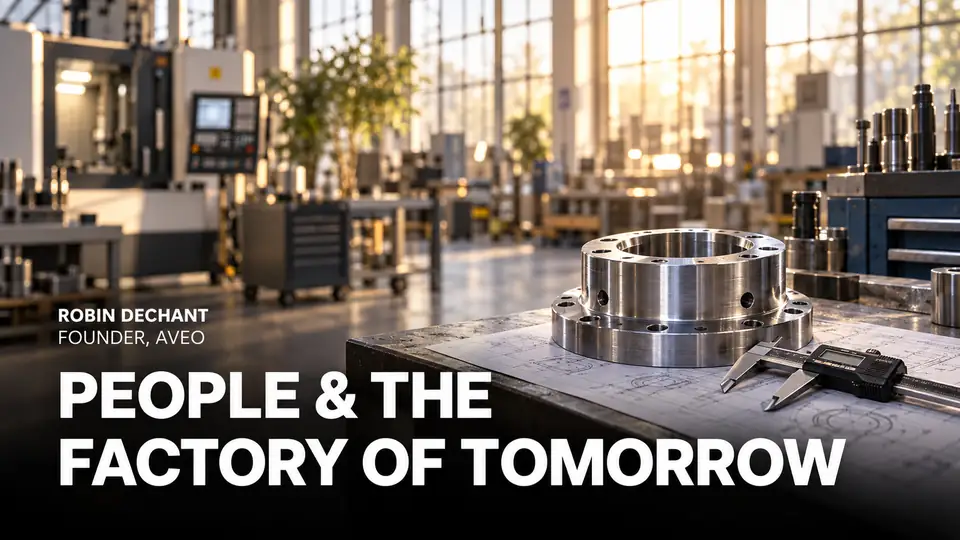
Robin Dechant explains why manufacturing’s future depends on investing in people as well as tools.
August 31, 2021 · 37 min



About the episode
In this conversation, we talk with Robin Dechant, the founder of Aveo and the writer behind The Future of Manufacturing Newsletter. In his work, Robin's helping shape the future of manufacturing and, in the process, helping people develop the skills they need to build the world of tomorrow.
Links
Chapters
Times follow the podcast audio. The video’s timeline may be slightly different.
- 00:00Introducing Robin Dechant
- 00:37Living with complexity
- 01:46Being present while thinking ahead
- 03:47Running and time to think
- 06:10Aveo and skills for manufacturing
- 07:58Workforce planning
- 08:59Why manufacturing and its people matter
- 11:22Remote work and factory realities
- 13:29Upskilling, reskilling and adjacent roles
- 15:30Supporting people through job changes
- 16:57Flexibility and meaningful work
- 17:59How the newsletter led to Aveo
- 20:29Following interests and staying consistent
- 22:23A vision for smaller specialized factories
- 25:34What is a factory stack?
- 28:04Connecting existing machines
- 29:14Building new factories and funding hard problems
- 32:46Mission-driven companies and empowerment
- 35:37Where to find Robin
Read the conversation
Open the full transcript
CAMERON WIESE: Welcome to the Build the Future podcast where we host conversations that promote exciting and positive visions in the future. Today we're talking with Robin Dechant, founder of Aveo and the writer behind the Future of Manufacturing newsletter. In his work, Robin is helping shape the world of manufacturing and in the process helping people develop the skills they need to build the world of tomorrow. Let's jump right in.
CAMERON WIESE: When you view the world, what lens do you typically view it from? Is it like, oh shit, everything's kind of broken, like fix it, it's like, oh, everything's amazing. How do you find
SPEAKER UNCLEAR: yourself showing up? It's complex. It's so complex. And it just becomes more complex. And I'm really
ROBIN DECHANT: afraid of this. I'm 31, I installed TikTok last year for the first time, and I see these kids here, but then running around shooting these videos, and I'm seeing the videos on my phone, and I'm like, holy shit, I feel so old. And this happened in just a short time period. And now, imagine, again, exponential growth. How will this be in the next 5, 10, 20, 30 years? And it just will become more and more complex. And how can we deal with this complexity just all around us? And how also we as humans can maybe spend more time with ourselves and zooming out of this complexity and more maybe on the things that matter most to us, which are probably here left in there and you can see them, but it's maybe harder to grab than before. And just because you know, we have to take on so many different things these days compared to let's say 50 years ago when you're living in a village and you're making wood for a living, and there was your family and a few friends and you were exercising, doing sports and hanging out. and that was your life basically.
CAMERON WIESE: Is that what we should be aiming to return to or to tap back into? What kind of future do you want to live in? When you think about the canvas of your life in 10, 20, 30 years, what do you want that to look like?
ROBIN DECHANT: I think for me, one of the biggest things is just being satisfied with the life I have. And I think actually, maybe the question is already wrong because you think about the life in 10 or 20 years. Why not think about the life today? Why think about the past or the future when you actually want to live in the present. And maybe here, you know, I'm reading actually Naba's book at the moment. So maybe, you know, you know where my inspiration comes from a little bit. But I think it's, to me at least, I can totally resonate with it. And so, of course, I think we have to take, we have to think about the future, especially I think at a society point of view, right? Climate change, the skill-scape, for example, which is a very important problem for me that I'm trying to solve. And so I think it's very good to think about it and to get smart people together and trying to solve these problems that will occur and that maybe will get bigger over time. But I think we shouldn't get lost in only thinking about the futures and maybe concerns that we're having, but thinking more about, hey, what
ROBIN DECHANT: can I do today that makes me happy? What is a good reminder? And so on. And now I'm talking about this and it sounds so simple always, I think, when you talk about it, but actually living it and practicing it, it's just insanely hard, at least for me.
CAMERON WIESE: I agree. I was talking with one of my buddies who probably hear this call out. I got in like, Hey, we should talk about like plans for the future. He's like, dude, I'm just trying to like live in the present. I'm like, what, where are you, what is just coming from? Like, Oh, aha. And just clicked with me when he mentioned that. Like, Oh yes, I got him the novel book and it's like, Oh, live in the present. Like how are you happy in this moment? I don't necessarily know if it's like being content, just like settling with what you have, but instead trying to do things that, that imbue your life for like meaning and purpose, right? So instead of like, Oh, I don't want to go for that run because it's like, my body's gonna hurt. That's going to make me unhappy. It's like, no, no, no. I'm going to strengthen my mind. It's like my body. I'm going to find happiness in the pursuit.
ROBIN DECHANT: I think running is not a problem for me. I actually love running. And I always, I think after this one rule, I always feel better after the run than before.
SPEAKER UNCLEAR: Really, always.
CAMERON WIESE: Always. Yeah, I'm with you. Always, every time.
ROBIN DECHANT: I mean, maybe if it was a super hard run, maybe a few minutes, I need to get my energy back and more air. But then I definitely feel better than I was feeling before. So it's just like this mental barrier in your head where you have to go through that, you know, maybe there will be pain, but pain will be temporary. But after that, you hopefully get the runner's high or you feel at least better than before.
CAMERON WIESE: That's pain plus reflection equals progress, right? It's like, okay, like this thing happened, what happened?
SPEAKER UNCLEAR: How do I feel? Like what was going on here?
CAMERON WIESE: Okay, cool, I'm gonna use that as fuel.
ROBIN DECHANT: And if you think about living in the present, actually, for me, for some running has become kind of like a meditation. I usually don't run with music or podcasts and so on, so I'm only by myself. And then, you know, it's like one hour just, you know, you yourself, the city, of course, the surrounding and your thoughts. And when I was injured, for example, for like a few weeks, I could totally feel how I was missing it. It was so hard, you know, I couldn't clear my mind, so to say, after a hard work, after a hard day of work. I was missing this one hour maybe for myself without a phone or anything. It's a very personal thing. And I think other people, for them it's maybe, I don't know, they go dance, they play tennis, they play golf, they go boxing, they go to the fitness, to the gym, whatever. But I think it's these things that probably people need in their daily life.
CAMERON WIESE: Yeah, it's almost like it's creating a space to take care of yourself and to detach from this matrix that we're plugged into. I mean, like it's so easy to check your notifications, check your email, like see what's going on on Twitter or whatever your social media is on TikTok, right? And then all these emotions, like, just get dug up that you can't really control. Like, just, just like the on TikTok, damn, I'm old, like, that's a weird feeling. Like, wow, like, I don't, what are these kids doing? I don't get this. That's an emotion that gets like triggered in your brain, right? And you're like, oh, man, I, You didn't come up with that, but that's just what got thrown at you. And so you don't have the space to detach from that. Like most people don't, brain just gets cluttered. It's rough. So Robin, tell me about the future you're building at Itavio.
SPEAKER UNCLEAR: What's the vision?
ROBIN DECHANT: The core vision is basically you want to empower people, and especially in traditional industries, to take on the jobs of tomorrow. And I highlight again in traditional industries, and especially manufacturing, because I think these industries are often overlooked, especially in tech. I think we're building a lot of products for other people who work in tech. We're building a lot of really good solutions for problems we have maybe in tech or in adjacent solutions or maybe in the consumer world. But if you think about these industries and especially in Europe, like manufacturing for example, has contributed a lot to the wealth of our society, to why we're actually where we are and so on. And so in the end, and I think empowerment is a very strong word that probably this industry hasn't seen so much before and which is also one of the reasons why I highlighted it because we want to empower first of all domain experts to share their knowledge, to get more let's say visibility also, and to help people to explore this knowledge in a collaborative way. So I really believe in
ROBIN DECHANT: community, I really believe in doing things together, learning together cohort-based courses and I think the win-win situation out of this is basically that we in the end help companies not only to survive because they're up level their employees but actually to stay innovative, to stay competitive without the need to radically restructuring themselves. Because I think actually the biggest asset they are having is the current workforce. And they also won't be able to hire only like the best talent in the market, given how competitive the market is today. And I think there's one quote from one of the consultants from BCG, where the thing is very interesting, because he says, workforce planning will become more important than financial planning, they used to come. And that's something a little bit where I think you notice, I totally can see the strength and where we also want to be the one where we help these companies to the up level of their current employees.
CAMERON WIESE: Tell me a little bit more about how you think about the workplace planning. So this is more how do you train and grow your team and your people?
ROBIN DECHANT: I think most of these companies, and it depends a little bit on the size, right? I think some of the smaller companies manufacturing, for them HR is an admin function. They don't even think about maybe training a lot, right? Or how they work for a certain group, like in five or ten years. It's not yet, unfortunately, I think, or I hope it is eventually we'll get there or they will die. I think they'll know the option. But if you think about the large corporates, basically for them, they all know that they have this talent shortage, that they need different kinds of roles, that they need people with different kinds of skills. And I think the problem with awareness now is very high and it's getting this higher and higher. And that's something I've experienced in the last few months already. But the question now is, you know, what's the right solution?
SPEAKER UNCLEAR: Or what do you do? Right?
ROBIN DECHANT: You can do many, many different things. And it's a very complex problem. It's about people. And I think the workforce planning plays a little bit in the role that at least people have a strategic vision where they want to be with a company, what kind of skills they need, and then basically go from there to define
SPEAKER UNCLEAR: how they want to get there. Contextualize the importance of ensuring that the manufacturers
CAMERON WIESE: can actually go produce stuff. Why does this matter?
ROBIN DECHANT: I mean, in the end, we're sitting here with a laptop, my phone here, the camera, like everything here in my room is manufactured of course at some point. It's crazy what we can manufacture these days, right? From like really small things from 3D printing to like big cars and so on to rockets that maybe fly to Mars and so on. I mean, it's incredible, right? It's all and it's all done by or it hasn't been all invented by people. And so I think there is some fascination and you know, shaping a physical asset. Similar, maybe when you were a kid, you were playing in the sand, you were building like a castle in the sand. And now we shape all these kinds of physical assets in factories and make things that we benefit from. And I think this won't go away, of course. And in Europe, for example, we have been very good at engineering and have been very good at shaping some of these physical things. And also have benefited a lot from it, right? That drive our society, that drive our wealth, generations to come and so on.
ROBIN DECHANT: And I think if we want to stay competitive, we want to stay innovative, we want to stay also like a wealthy society. We need to keep up the innovation there. And this is only possible by giving people the right skills and the knowledge. Basically build up upon what they've built so far.
CAMERON WIESE: One of the problems is that the talent, the traditional path is not to go into manufacturing. We have to build all of the stuff, but software is more attractive because it scales. There's this narrative where we're not going to be able to go build the things that make our world exist. Like again, we're having this conversation over things that we're manufactured. And we can't, we need to preserve that space.
ROBIN DECHANT: But I think maybe just to add one more piece to this, I think one of the, a part of the problem is also that some of these companies have just underestimated or undervalued the people and the talent, right? Where I think they, they haven't not invested enough into them. They have not acknowledged them. And then again, we're here with empowerment, you know, they haven't empowered them enough, uh, so that they also, you know, then leave. other people won't find it attractive anymore. And of course, you know, if I can choose whatever equipment I would like to work with, whatever I want to learn, and get some other benefits, I mean, then the choice maybe is more obvious that you turn down the manufacturing world.
CAMERON WIESE: I want to get your take on how COVID affected this, because now people realize like they, just how many options there are out there, and they've been forced to go work remote. And so they're traditional like, hey, I'm saying this job, this, you know, manufacturer, even though I may not be empowered at work or may not be filled, it's like this is this job I have is just what COVID kind of forced everyone to reevaluate. And I'm curious kind of how you see that, like, the role that COVID played in shifting the landscape of where people choose to go work, and how this may play out. Like, why would I go work for a company that doesn't, doesn't treat me well? Or it doesn't like, I don't feel empowered? I'm curious kind of like what you're like, how do you think about that?
ROBIN DECHANT: I think the empowerment actually is probably independent of the COVID. I think COVID probably underlines more the trend of remote work. And of course, you know, the question is if you have to be in one factory or one office and not able to work remote, then of course, these options are gone. That said, I think for example, for Germany, I guess it's in Europe and also maybe partly in the US, a lot of these companies are maybe not, you know, in the city center. But also I think people in the last few months have actually seen that living maybe in the countryside can be very nice. So I really don't know yet how this will play out. Very curious to see. I'm still, you know, I'm still living in Berlin. I really like it here. But I also can see people maybe who want to say, hey, you know what, it's also fine to live on the countryside. It's a bit more calm and so on. I don't have to be in the big city. Well, then again, it's going to be a positive impact of for manufacturing companies. But I think in general, of course, they also
ROBIN DECHANT: need to open up to, let's say, the new world of working and remote work and so And of course, it's also hard if some of your workforce cannot even work remote, right? Because then you directly are a hybrid model. And I think hybrid model are also very difficult to manage. I'm not saying impossible, but I mean, if you, for example, if you haven't worked remote before, there has to be so much change in communication and how you communicate with employees if you know, suddenly work remotely. And I mean, many of these companies, they have zero experience. And so it's a big challenge for them, I think, just to establish this kind of model.
CAMERON WIESE: Tell me more about how you're going about training and empowering the manufacturers you're working with.
ROBIN DECHANT: I think there's two ways of training I'm thinking about. One is basically more the upskilling part, where you're basically trying to help people to learn to get better at their job, to maybe do a few more different tasks, just getting a ground level of knowledge for certain areas. This can be, let's say, electromobility, this can be digital transformation, or can you implement software, for example, in the factory. read and this can also be maybe the modern way of how you should work in HR. And then I think, and this is a part where this will probably become increasingly more important where we are not now yet with our view. But I think in the future is definitely possible for us. What's more about reskilling. And I always give the example with Volkswagen, where there's 30,000 people which they who they don't need anymore due to electromobility. And we're in Germany, we have strong unions so they cannot fire 30,000 people. And on the other hand, they need 10,000 people as software developers. So what do you do now?
ROBIN DECHANT: What they did, for example, they have built their own academy where they reskill a very tiny part of the employees, roughly a hundred per year to become a software developer. But of course it dropped in the ocean. It's a drop in the ocean. You also cannot reskill the 50 year old woman or man who runs a machine to become a software developer on the next day, right? It's impossible. But I think we need to carefully think more and more about different skills sets that people have and maybe future roles and how we can match them in a good and efficient way. So one example for example is if you have a truck driver, maybe not every truck driver can be a software developer. But truck driver have very good skills at navigating complex hardware systems. So maybe you can reskill a truck driver to become like a drone pilot. And I think that's a little bit the way how we probably need to think about these adjacent and skill sets and adjacent roles. And it's gonna be very difficult and interesting at the same time how the future will play out with us.
ROBIN DECHANT: And I think we'll just have a very early phase actually.
CAMERON WIESE: We all want the future to be better, but we don't realize it's gonna come with change and challenge. Yeah, certain jobs are not gonna exist. Like even the jobs that we have right now, like the work we're doing probably will morph and change and we'll have to adapt and do something different like five, 10, 20 years from now.
ROBIN DECHANT: Yes, and now I mentioned somebody comes to you say, hey, your job won't be here in a year anymore. Now you have these three options. You can choose job A, B, or C. We have a program for you six months. What do you do? It's fucking hard. And I think we need to also carefully prepare these people that it's not only one job you will do for the next 20, 30 years, maybe because they're used to, but it's going to change. And there's nothing we can do about this change, but we have to shift it into like a positive way of changing. I mean, similar to what we discussed initially, that it has be like this positive and it's actually, hey, it's cool. You can do another job. You can learn something different. How cool is that? You don't have to do the same task all over again for the next 20 years. You actually, we have these different possibilities. We have a coach here and a mentor that helps you. It's a big challenge. We know this, but we're here to support you. We empower you and choose one of these three shifts. And
ROBIN DECHANT: maybe there's even like another incentive which role this person should choose, but But I think that's the way where we have to be. But it's challenging in an environment that has been very, let's say, managed top down, you know, strong hierarchies, maybe not the most modern way of managing. And this change won't come from today to tomorrow and will take years.
CAMERON WIESE: How do we start to build new organizations such that people can apply, like whatever skills they have, right? Because like the truck drivers, like how do we enable them to go, like drone pilots, they may actually not have to sit in the truck. They could go do that from home, right? So they can go live in the country or the city and they can do like the work that they need to do to like sustain themselves and feed their family and have the kids go to school and all that and define like meaning and contribute. But we can also give them space or we can all create space to go do things that are like not necessarily like work driven. We should live, not work ourselves to death. What you and I are doing, well, maybe I'll do it for myself, is like is not work. It's just like fun. I'm like, let's go do some cool, challenging shit. Versus like having to go make sure like parts are operating properly like on an assembly line or like at a factory. And like, I think like that's a different type of work than what we do. And if we can enable people to have more flexibility
CAMERON WIESE: or give them more options, I think they'll be excited about it. So just like, it's a reframing of the story. I'm curious kind of through the newsletter you've been running last three years, what have you learned in that process? What did you go in thinking about? Because you had this idea, okay, I'm going to write about manufacturing.
SPEAKER UNCLEAR: Why was that the thing? And then how did it evolve?
CAMERON WIESE: How do you view the space now?
ROBIN DECHANT: I studied industrial engineering and management. So there was a few touch points when manufacturing during my studies. Friends went into the sector. I did a few internships. Then when I started at point nine, which is a traditional VC fund focused on C, B2B, software and marketplaces. There was this hype, especially in Germany in early 2017 about industry 4.0s, new things on the shop floor and in manufacturing. And of course it caught my interest. And then I started blogging a little bit about it and suddenly people were reaching out and asking me for more opinions and asking me for the stuff I'm reading. And I was like, okay, before I send the same email to 10 people, I started very lightweight newsletter. And that's actually how it started. And suddenly I posted once on LinkedIn, I think overnight I got like 100 or 200 signups. Okay, there might be more people who are interested in that stuff. And so I started writing the first issues of it, got good feedback, I think, which kept me motivated. And then I think, for example, what happened was I went to San Francisco and to Boston,
ROBIN DECHANT: and I was writing to people who I got to know through the newsletter. very senior people, founders who have been operating for years in robotics companies and manufacturing companies. And I was writing them and they invited me to the office. And I was like, wow, you know, I'm this German dude working at the VC fund, which is focused on seed anyways, and not relevant for them. I'm only looking at the space from the outside. I haven't really worked in manufacturing except for my internships. And these guys invite me to the office to chat about it. That's cool on the one hand, it's also a bit scary. But this, of course, you know, was a big change for me because suddenly, even though I was very junior, people kind of like to be serious. And then I think, you know, I just went on from there and meeting more people writing about it. And I just, you know, then kept on digging and got very passionate about it. And I think so passionate that I found this problem that I heard so many times, but I didn't see anybody solving
ROBIN DECHANT: where I was like, hey, if we don't speed up here, if nobody's really doing it, like, then maybe I have to do it and in the end one thing came to another one and now it all makes sense. If you look at it now from the idea that you're writing this newsletter, he's already long in the space, it all makes sense. Yes, looking backwards, but it was... You would have said it to me two years ago, but it's like, no way. It wasn't really easy, but I also learned maybe it's good if you follow your passion. Probably people are sometimes afraid to do this or they look at what others are doing you know, maybe you know, you can be successful. Otherwise, the success is only the money you're making, not the problem you're solving or so. So, of course, you know, these are all thoughts you're also having like during your thought process.
CAMERON WIESE: Oh, yeah, and the self doubt and the challenges and like, I'm not even doing the right thing.
SPEAKER UNCLEAR: Like, this makes sense.
ROBIN DECHANT: Yeah, yeah. And ignore the fucking noise. There's so much noise out there. All right. And there's so much different kinds of advice.
CAMERON WIESE: Oh my god, I know. It's crazy.
ROBIN DECHANT: It's crazy. Yeah. Did people tell you you shouldn't do a podcast? Because there's maybe too many people running a podcast already?
CAMERON WIESE: Maybe like one or two. Like, all right, I want to do another podcast.
SPEAKER UNCLEAR: Like I want to do another newsletter.
CAMERON WIESE: It's like, the one thing I will say though on that is like, there's like a certain point where people actually take it seriously, right? Especially, you know, starting something. I mean, you've been doing your newsletter for a while, but starting kind of a podcast, like a year ago with COVID, like everyone and their mom started a podcast like, Oh, I'm home now. So I'm going to create something. And you saw this huge uptick of, of newsletters. I was like, oh, sub stack. Oh, like join my mailing list or listen to my podcast and then huge spike. And then like a massive drop off. Like it's, it's so funny.
SPEAKER UNCLEAR: Because it's hard. Yeah. It's hard.
ROBIN DECHANT: Everyone's like, it's hard. It's hard to stick to it. It's not that hard to begin with, I think, but it's hard to stick with it.
SPEAKER UNCLEAR: Yeah.
CAMERON WIESE: I think like that's something like people, one thing that people could appreciate more just like in general, like doing anything just takes time. and being patient and this is all advice to autobiographical but also it's like, we say things that we need to like tell ourselves, it's like, it's a process. I would just kind of loop things back to Aveo.
SPEAKER UNCLEAR: So what's the outcome? How does the world change?
CAMERON WIESE: Like, paint me a picture again of like what the world looks like as a result of the work or what you guys are doing? Like here, helping empower, helping kind of upgrade the manufacturing. How does this manifest in the physical world? What do our manufacturing facilities look like? What does that world look like? What everyone is feeling empowered and enabled?
ROBIN DECHANT: I think actually if we can empower, and I think we're only part of the contribution. I think it's great if we can empower people to learn what they want, to give them maybe skills they need, to empower experts to share their knowledge, and get maybe a bigger audience and so on. I think all of this is great, and we probably eliminate a lot of inefficiencies in this market. In the end, also, it has to come from the companies, the management, and everybody in your organization as well. It's a mindset, it's a cultural topic. So I wouldn't say we can solve, only we can empower all these people. But I hope that we at least can make some positive contribution to this and then hopefully an impact that can be very big. And I think what's very interesting is now we actually have a lot of new technologies, we have a lot of new science, There's things we can do a lot and I think people need creativity, they need time, they need to see also other things and then hear different things in order to basically judge
ROBIN DECHANT: for themselves what's the best new technology, what's the best new way of working, how they also can modernize the factory. If I could choose, let's say, a vision or a picture of the future, I would love that we have even more smaller factories, smaller manufacturing companies that really are very specifically doing one thing really, really well compared to, let's say, a few big giants that control, let's say, 90% of the market. I'm always more the Shopify fan than an Amazon fan, even though of tremendous respect of Amazon. I mean, it's like everything what I've done and how they do it and the execution and the operations excellence, it's just mind blowing. So my biggest respect, but in the end, I like the Shopify analogy in terms of empowering people, empowering small businesses, everybody to get started. Even though maybe the analogy for what we're doing is not like one by one, but that's at least how I think about the world and where I believe, you know, the sum of a community, the sum of people, and maybe that's a very positive
ROBIN DECHANT: way of thinking, but the sum of people usually does something good more than, let's say, maybe
SPEAKER UNCLEAR: only one or two who control the whole thing. I think it's cool to think about, I get excited
CAMERON WIESE: thinking about, it's like everyone being able to specialize and then like doing unlocking that through software too because like the challenge is like coordinating that like how do you make sure that everyone is able to kind of build the pieces that they're best at how do you plug them into a system where like if you're building a rocket or you're building a home or you're building you know a laptop how do you just get like each of the individual components like all kind of aggregated source together instead of having come through one factory where it's you know essentially controlled or decentralizing manufacturing process or something, if you will. You could have quickly given me the concept like the factory stack. Like what is that? And like, why is that interesting?
SPEAKER UNCLEAR: It's funny that you mentioned it because we had a session in our community to talk about it today.
ROBIN DECHANT: Like literally today we talked about, let's say the future of the factory stack. The analogy or where I come from is if you think about tech companies, all of them have like a tech stack, right? They have like a database, they have the cloud provider, where they run the applications, they have something for the deployment and so on. And a really cool thing, I think with tech is here that it's very compatible. So you can really choose, maybe the database provider you want to start with, the top provider you want to start with and so on. And also it makes things very easy to build application on top of this, on top of like, let's say the tech stack of other companies. So I can build upon like a Salesforce or whatever. And if you think about a factory, there's like material, machines, there are people, there's a data layer, there are sensors, and then there's software. But the problem is that all of these different things running around the factory, usually they're not that well connected yet. And so there's not one dominant platform that connects all of this.
ROBIN DECHANT: The software that's running in the factory is usually very different. So what you're building cannot maybe easily scale from one factory to another one. And I think in the future, there will be a point in time, and I think the biggest question is just like when this can be two, five, 10 years, or maybe even longer. There will be a point in time when we have this kind of like stack in a factory, where you can just like easily build things on top of it, right? And this doesn't mean that there will be one platform, let's say one IoT platform or one manufacturer execution system, but maybe, you know, different kinds of like things in factory like also again a database layer or different database and so on, we then can build easily applications on top of it like predictive maintenance or analytic and so on. But right now the problem is everybody or nearly everybody has to build integrations, build, I don't know, like even bring devices into the factory to connect different machines and so on. And this makes it just so difficult to scale and to build really cool shit on with the
ROBIN DECHANT: data these companies have, these factories have and with the machines and everything. And unfortunately, yeah, that's what I think still takes some time. But I still believe really in this mission at some point, you can build a predictive maintenance app maybe within a few days and just boom via cloud, and deliver it to one of your customers that may be sitting in South Germany running a factory.
CAMERON WIESE: So it's almost like we have to go back through and we have to reinvent the stack, create APIs, new hardware. Because it's like you have these devices that are very, very, like these manufacturing devices that are like very precise machines that create parts or whatever, but they don't talk with
SPEAKER UNCLEAR: all the other pieces.
SPEAKER UNCLEAR: Exactly.
ROBIN DECHANT: And the problem is that many of the factories, I mean, they have been built in all 10, 20, 30, 40 years ago, and the machines are there for like a long time. So if you build a factory today from scratch, then you can do it, right? You get the newest technologies, newest machines, it's all connected. So, fine, get it. But, and I don't have the number, but like many of the factories, they won't disappear. One analogy that a friend of mine is doing is it's like a LAN party. Basically, a factory is like a LAN party where everybody over time brought in his or her PC. They're all different and they somehow get connected. And that's basically what a factory is. All these different machines and types of devices, and they're all connected. It somehow works. But even if you just pluck out one computer, maybe the whole system crash. That's a little bit how it feels.
CAMERON WIESE: With that in mind, like, why spent the energy and effort like trying to upgrade, or like make like existing manufacturers and facilities like move into the modern world instead of going different path like building your own manufacturing facility that is focused on one creating like an exciting environment for working, game, but two is building out the stack from like first principle from the ground up, other than that just being like hard.
ROBIN DECHANT: I love this question because I think it's a fascinating opportunity. Nick Pinkston tried this a little bit, I think, or did it with Plitora, one with like a kind of like a vertically factory that it's kind of automated, I would say. I think it's crazy hard. It is crazy hard because you need so much upfront investment. You need very talented people. And so I think Because say if you produce batteries, then I think you can do it, right? You can get a lot of money, you can build a whole factory and so on. I think Northwalt does it a little bit like this. But why? If you do this from scratch, I mean, there's so much upfront investment. And the problem is manufacturing doesn't have software margins. It's not that you build a factory and once you've built everything and it's running, you have like an 80% profit margin. It's not like this. And so this makes it, I think, even harder to then at some point return the amount of investment that you need to put into just get it going.
CAMERON WIESE: I wonder if that's true. I wonder if there's like, maybe there's perhaps another way of thinking about it where you can actually generate significant margins. How much is lost in the inefficiency? Yeah, it costs this part. You can probably say like 20, 30% on human labor, on labor costs. And I don't know, it just seems like there's like a room for a lot of the error and a lot of innovations to pull out of the system and turn into margin, which could then make it a viable thing to invest in and get the capital for. I don't know, just on that, I see the capital markets changing too. I don't know about you, but it seems like certain things are able to get the funding they need to go and take these sort of bets.
ROBIN DECHANT: Which I think is good. Which I think is very good because if you think about the biggest problems we're having, like the climate change and all the CO2 in the atmosphere and so on, where you just need different types of investors and different money pots, because these problems are so complex, they require so much upfront investment, which is just much harder than a bottom-up SaaS solution that you built. And it's not negative at all, right? It's just like a different type of company or product you want to build. And I think it's good that the capital market is in a way shifting in a sense that these opportunities or the people who want to solve these problems also can get the money they need. And I think for example, the vaccine was similar, right? Today was today, the KuraVec announced how their vaccine is going. And I think their success rate, I don't know how it was the right name, but it's only 40% or so. So you know, like Pfizer and BioNTech and so on, it's a big, looks like a big loser, but it's part of the game. It's part of innovation, right?
ROBIN DECHANT: I think we're incredibly lucky that some of these providers like Biontech were able to build a vaccine in that amount of time with this level of success, right? And so it's also find that there's a player where there's also a lot of investment, but maybe, you know, it's just not as good. I mean, that's part of innovation, right? And so I think this should be similar for other types of problems and so on. And I think just a good example too, as a reminder for us, how it should be.
CAMERON WIESE: What excites you the most about the future? What do you what are you hyper-optimistic about?
ROBIN DECHANT: I'm hyper-optimistic about more people taking on the world's most pressing challenges. So, you know, seeing more people going into, for example, trying to solve climate change problems is something that I think is very positive. People who really care about, let's say, health or society disinvalances, I think, in trying to build companies there. That's something I'm very positive. There's, of course, you know, also people who maybe just see the opportunity and do it because of that. But I think there's more, more and more like very mission driven people. And this excites me a lot. And I think we cannot have enough of these kind of people and also the courage to do it. Also, maybe, you know, it might be not the best financial investment for themselves, because in some of these problems, it's just much harder to make money compared to let's say, I don't know, in gambling or gaming or whatever. And again, nothing wrong with this. But I think that's something I'm seeing at least in the last few years that makes me very positive. Also,
ROBIN DECHANT: I think the way companies get built, if you think about, for example, letting all people participate in terms of stock options, or that when they IPO, they get something back, kind of like policies they have in place, diversity and so on. We have message challenges, like of course, manufacturing is completely bad, by the way, when it comes to diversity, so let's not even talk about it. But at least there's more and more role models who build companies in a way where I think, hey, this is really cool. And they're really thinking about deep about the human, basically. And it's again about empowerment. And I think if you have a company like Patagona that has the vision, hey, we're a business to save our home planet. I mean, this is pretty incredible if you think about it, right? This is a company.
SPEAKER UNCLEAR: Kudos to them.
CAMERON WIESE: It is amazing. I share your optimism there. It does seem like, especially over the past year, people have realized that, like, I things are gonna play out a certain way unless they Step up and take responsibility for making things different I think there's a lot of people who who saw like oh no we need new institutions We need new media. We need new kind of vision to the future We need to be solving all these existential crises that are facing our world like most importantly I need to fucking work together because like Hey, you and I are thousands of miles apart, but we have like the climate challenges the like plastic challenges, like socioeconomic, political challenges, like all these things like affect both of us, right? We are connected now. Like it's no longer like me over here in, you know, California and you you're there in Germany and being like, okay, cool, like you do your thing, I'm gonna do my thing. It's like, I don't know, we're this boat, we're this boat together. We're all in this boat. So, so let's, let's, let's make it work. But hey, where, where
CAMERON WIESE: can people find you and how can they support the mission?
ROBIN DECHANT: People can find me usually on Twitter, Twitter and LinkedIn, I think it's the most common channels. My newsletter as well. It's called the community, the community is future manufacturing.io. The courses we're running with are video is a video.one. And then just my I think my name on Twitter, I'm always super happy to talk to people who maybe share some of the same thinking around the future, how we see it. I think we're still very early in this market. At least that's the way when I talk to people, I sometimes also get a lot of pushback, which is fine. I think that's probably a good sign when you're early, but maybe not too early to a market, but very happy to talk to people and anybody who maybe has new ideas and so on in general. I think being very open-minded about this also helps a lot. So it was really cool also to talk to you about all of this kind of stuff.
CAMERON WIESE: Thanks for joining us for another episode of the Build the Future podcast. If you want to support the show, please share your favorite episode with a friend. If you want to get updates on the events we're hosting, new podcast episodes, and follow along as we build the New World's Fair, you can follow me on Twitter at camwiese. Until next time, go build.
SPEAKER UNCLEAR: you
More episodes
All episodes Adam Keating of CoLab — The Future of Engineering, Collaboration, and WorkAdam Keating explains why CoLab set out to make engineering design reviews and communication easier.
 Liam Cadigan & Nick Warren — inspectAR and Augmented Reality for ElectronicsLiam Cadigan and Nick Warren show how augmented reality connects circuit boards with their designs.
 Dival Banerjee — 3D-Printed Metal and Better ManufacturingDival Banerjee discusses metal additive manufacturing, including the difference between print time and total production lead time.