

Build the Future Podcast
Liam Cadigan & Nick Warren — inspectAR and Augmented Reality for Electronics
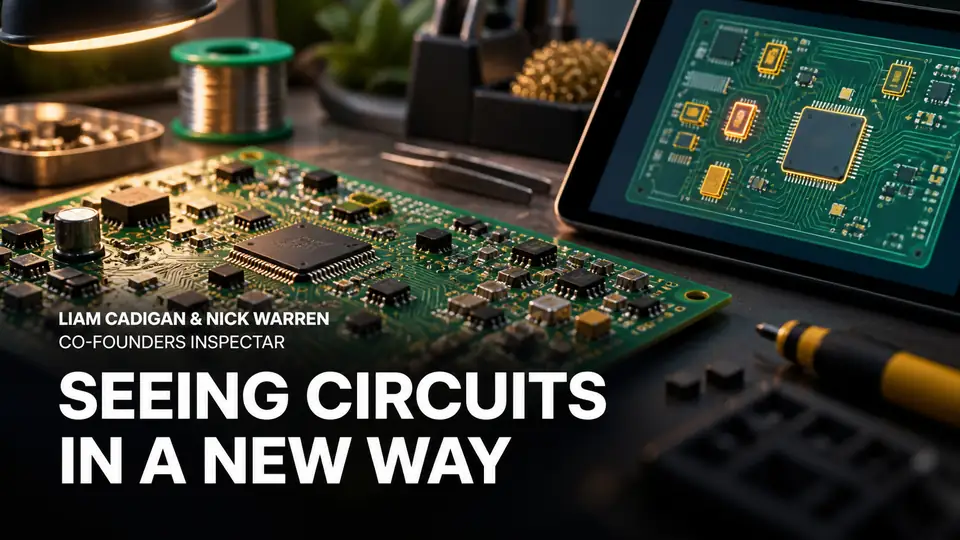
Liam Cadigan and Nick Warren show how augmented reality connects circuit boards with their designs.
June 8, 2021 · 36 min



About the episode
In this conversation, we talk to Liam Cadigan and Nick Warren, the co-founders of InspectAR. At InspectAR, they’re building augmented reality software that helps engineers building circuit boards visualize and test their circuit boards in real time. In doing so, they’re helping drive practical adoption of augmented reality technologies and reducing the friction in developing circuit boards...which are just about everything these days!
Links
Chapters
Times follow the podcast audio. The video’s timeline may be slightly different.
- 00:00Introducing Liam Cadigan and Nick Warren
- 01:39Where InspectAR fits in electronics development
- 02:56Connecting a circuit board to its design
- 04:17Why better engineering tools matter
- 05:21From student teams to a company
- 07:42Hyperloop and new career possibilities
- 09:56Entrepreneurship and the pull of Silicon Valley
- 12:07Bootstrapping in St. John’s
- 12:48Practical uses for augmented reality
- 15:41Cameras, scanning and wearable platforms
- 17:55Consumer hardware and workplace adoption
- 19:33Computing for people working with their hands
- 21:11Privacy, standards and an optimistic future
- 23:29AR, VR and remote engineering
- 25:09Imagining healthcare and training uses
- 27:44Making training more accessible
- 28:43What could drive widespread adoption?
- 30:05Neural interfaces and remote connectivity
- 31:43Bandwidth and access beyond cities
- 33:49Where to learn about InspectAR
Read the conversation
Open the full transcript
CAMERON WIESE: Welcome to the Build the Future podcast. My name is Cameron Wiese and I'm your host. I've always been fascinated by the ideas and sentiment that drove American culture in the 1960s with the space race. A culture galvanized to dream about the possibilities of tomorrow, whether it's food, transportation, cities, biology, or anything else. It was this cultural mindset rooted in optimism that the world tomorrow would be better than the world today. A mindset where people were compelled to build things, and I quote JFK, not because they were easy, but because they were hard. It's this desire to build and to dream that seems to have been lost, and something we're here to bring back. With Build the Future, we're here to promote the ideas and stories of those who see how the future can be better and promote their plans to get us there. It's our mission to get you to dream about the possibilities of tomorrow, to dream about the future that you want to live in, and inspire you to go build. Today, we're talking with Liam Cadigan and Nick Warren, the co-founders of inspectAR.
CAMERON WIESE: At inspectAR, they're building augmented reality software that helps engineers building circuit boards, visualize and test their boards in real time. In doing so, they're hoping to draw practical adoption of augmented reality technologies and reducing the friction in developing circuit boards, which, to be honest, aren't just about everything these days.
SPEAKER UNCLEAR: Let's jump right in.
CAMERON WIESE: Tell me about the future you're building at InSpector.
SPEAKER UNCLEAR: What's the vision?
LIAM CADIGAN: Really what we're doing is we're trying to change the way that electronics are developed. Right now, today, it basically starts off that you have an idea that you're going to need to design a circuit board to realize, and then you end up using a piece of software to capture requirements, and you go through several phases of the design with that piece of software, and at a certain point, everything is done to the best of your knowledge. And so what you do is you go and you have that board manufactured, and then it comes back to you, and you test it, and if it works, you're done. but if things don't go as expected, you've got to basically go through that whole process again. And so we're trying to come in there right when the board gets manufactured before it's either done and in mass production or before it goes into another design cycle and we're trying to speed that part up with augmented reality. So that's what we're trying to do, accelerate
GUEST — IDENTITY UNCLEAR: electronics development past manufacturing. Because I imagine like you know you said they
CAMERON WIESE: get the chip, you check it out, you hope to god that it works, if not yet to repeat the process. But my guess is that that's not like a hopeful thing, that's something that happens every single time, right? It's really hard to get the initial chip design perfected,
SPEAKER UNCLEAR: right?
LIAM CADIGAN: Yeah, definitely is. And bugs, glitches, or even just manufacturing errors are commonplace. And people often just have their own experience and best practices they've developed on how to work on a circuit board in the lab to help guide them. And they're looking back and forth nonstop between their computer that they designed this thing in. And that's the only view of this board they've ever known. And then the real board that's on their desk. And so that's the kind of bridge that you can make with augmented reality to create the improvement.
CAMERON WIESE: So right now, you have your screen on your computer. You're viewing the circuit board design. And then you're trying to match it to like the physical circuit board you have in your hand,
SPEAKER UNCLEAR: you're trying to make sure like all the things line up.
SPEAKER UNCLEAR: Right?
LIAM CADIGAN: That's right. And the most basic feature of our software is that it will make that correspondence for you 30 times a second. And so while you're doing all this complicated electronics engineering, you don't have to worry about making that correspondence all the time. You can just let and inspect our stand there and do that for you 30 times a second. And then we built a lot of other great things on top of that to help you find even greater efficiencies. But that's the most simple value add of it for starters and what we saw starting out.
CAMERON WIESE: Obviously, you know, everything has a circuit board in it these days. Contextualizes for me, like, why is this really important? That we're going to speed up the chip manufacturing process or chip design process.
LIAM CADIGAN: You know, right now, some of the earliest software products ever made were ones to go and design faster and better computers, because basically someone got a computer and they started writing software for it. And the people who designed the computers actually were the most willing to use them. So they started using computers to go and design faster ones. And that sort of, you know, took off and that was like a snowball rolling down a hill. And so at a certain point, they had just taken care of all the different phases of the design and the improvements are more marginal. And so now you can go and make this really big step change to that back end of the process for manufacturing into the lab at prototyping. And because electronics feeds 169 different industries right at its output that can have a really big carry on impact if it's widely adopted over time.
CAMERON WIESE: On a personal level, we'll get to you guys, we'll get to both you guys really excited about what you're working on. Why is this what you you've kind of chosen to devote your career to at this point?
NICK WARREN: We were all classmates back to when we were undergraduate degrees. And we all worked really closely on some student teams. The SpaceX Hyperloop team was probably our biggest like point of realization, where we were working on some of the boards there. And it wasn't exactly there that we seen that augmented reality is the solution, but we've seen that there are definitely deficiencies in this process. We are making up our own processes as we go and on our work terms, we're not really learning or seeing like a lot of industry standard processes like there might be in software development, right? So then it was just kind of coming together when we were trying to figure out what were we going to do for this big capstone project that we had to do that that really would make a big impact. And then it was really looking at, okay, like this is a map of everything that we're interested in. All of these cool new up and coming technologies, like augmented reality, and then things that we just had intimate knowledge of, electronics design, and working in some of the lab tech roles,
NICK WARREN: like on the Hyperloop team, like we couldn't afford to get anything assembled. Like we were doing all of this by hand, right? Like Liam himself, you were up for like 18 hours at one point just like soldering for some of the stuff that we were doing, right? So like it was just that lab rat just being in there doing it all that it seemed like there was an inevitable solution here. And if we weren't going to do what someone else was, so like there was very clear output, like there was a very clear milestone we were trying to get to. So we just
GUEST — IDENTITY UNCLEAR: dove in. I was very lucky after this Hyperloop competition that the four of us did. And then
LIAM CADIGAN: later on, we brought on a fifth co-founder, Mahir, who also, you know, really saw this problem extensively at internships he had and jobs he had. But I had an internship at Neuralink and I had to do really fine, tiny work on tiny circuit boards. And I just wish that I had a smart microscope that could tell me what was what. And when I'm in looking in the microscope and I put this wire here, what am I actually connecting it to? But that sort of thing didn't exist. And then when we came together for this capstone project, we sort of put all the pieces together and then we realized like, oh, this could be a great idea if you could develop, you know,
SPEAKER UNCLEAR: something to automate this for people. I want to kind of just circle back on the Hyperloop
CAMERON WIESE: challenge because this is something Adam and I talked about. And I assume you guys were all on
GUEST — IDENTITY UNCLEAR: the team together, right? Yeah, in 2017. Yeah. And Adam was also involved with it. That just goes
NICK WARREN: back to the small close-knit ecosystem, right? Like, where just everyone grew up, like, working on these projects together, it's great to see it continue on here now.
CAMERON WIESE: Which is like absolutely amazing, right? Because then, like, everyone is everyone, and then everyone's kind of supporting each other's companies and projects and connecting everyone. And I think that Adam said, though, about the Hyperloop competition, he's like, he was saying, like, that was the first time that he, he like realized that there were, there's like a new path forward for himself, right? I think he was planning on going to like oil and gas, and then the Hyperloop competition, like, why would I go to oil and gas? Like, yeah, that's the default where if I recall correctly, it's like, Oh, no, we don't have to do that. Like this is a new possibility. And so I'm curious kind of like, if that had a similar effect for you guys, or, you know, maybe how you how you think about the context or the role of things like the Hyperloop, and provide any path options for people.
LIAM CADIGAN: Oh, yeah, it definitely opened doors for me, because just before I joined the Hyperloop team, I remember I was cleaning up an internship at Exxon Mobile. And I actually I had a good time there at Exxon, but I really wanted something different. You know, I've kind of felt like I just plateaued and I had seen everything that there was like the bigger industries like construction and oil and gas. And I was like, you know, it'd be cool to work in technology. It'd be, it'd be cool to work at SpaceX. And so then I just remember my last week at Exxon mobile, I was at my desk on the corporate internet or anything. I didn't care. I was applying to internships at SpaceX. I just realized like, I don't have a hope like with this current experience that I've built up. So I really needed to diversify. And a couple weeks later, I seen this SpaceX Hyperloop competition. I was like, well, that's the perfect way to get in there. And one thing led to another. And then a year later, actually, I had transitioned to the point where after this competition, I was able
LIAM CADIGAN: to get an internship at Neuralink. And so then it's like I just went from ExxonMobil to literally Neuralink. And it was just crazy. The change in perspective couldn't describe it.
NICK WARREN: I think my experience was a little bit different and my motivation was a little bit different. I was involved, so Memorial also had this new idea of a memorial center of entrepreneurship and when I got involved with it there wasn't, there was just a prof and he had a promise of a trip to Silicon Valley in exchange for coming to his little lunchtime session and he would give you free pizza and you would learn about entrepreneurship. And I knew about Silicon Valley. I was always into the parts of Silicon Valley, like movies growing up in that entire world. So the thought of getting to go down to California, that was the exciting thing to me. So I was already very engaged with, I wanna do entrepreneurship by the point that we got involved with Hyperloop. But what I was really missing was the technical rocket fuel to really be efficient at building things. So that's kind of why I wanted to get involved with it, just like everyone else that was so talented. So I appreciate everyone there that helped me along and taught me stuff along the way,
NICK WARREN: because otherwise it just wouldn't have happened.
SPEAKER UNCLEAR: Yeah.
CAMERON WIESE: What do you think about that? That draw to California resonated with me. I mean, I grew up all over the place, and I was like, oh, California, Silicon Valley, Silicon Valley, Silicon Valley. What do you guys think that is? It's like, pursuit of the frontier. How do you think about that? And then, like, yeah, you guys still kind of have set up shop in St. John's. So it's almost like the frontier has shifted to perhaps like the internet, right? because you can find everyone who's doing these sort of things.
SPEAKER UNCLEAR: How do you guys think about that?
NICK WARREN: I think the biggest draw of Silicon Valley and that entire world, at least from a very naive point of view, is just you can build anything you want. Dreams can happen overnight, and the nerds and the geeks and the dreamers and the doers can go there and find a place that they belong. And that was kind of why I really was drawn to it originally. And then I think being down there and coming back, Like there's a bit of a name in St. John's now of like Silicon Harbor. We won't have anything of that scale, but like we have a small version of that and it's very similar in a lot of ways where there's a lot of crazy things that are happening and you can go and do all those crazy things too.
LIAM CADIGAN: So I think we were drawn to St. John's a lot by needing to bootstrap our idea. Yeah, that's just when we started out with this, it began as a capstone project. And so sort of, you know, development just started and we would have been happy enough to, you know, have this open source repository on GitHub that was just, you know, part of our resumes and whatnot, here's the school project I did. And then we actually said, wow, there's actually a significant opportunity to commercialize this. And so then, you know, it snowballed from there, but we were already bootstrapping. And so, you know, St. John's let us live cheap and kind of work together and get this up to a point where we could actually go and start to sell it to people.
CAMERON WIESE: I want to shift to talking about kind of the applications of AR. Because one of the things that's like super cool with me about what you guys are doing is it's like, you're taking this technology and you're like doing something practical with it. Versus I think what a lot of people think of and think of AR, like the Snapchat filters or maybe there's some cool stuff with like showcasing like your furniture in your apartment. but what have you guys seen that's been really cool? And kind of what do you want to see moving forward in terms of kind of the real world practical applications of AR?
LIAM CADIGAN: It comes down to a couple of different things. On the one hand, there's like glasses based applications which involve spatial computing. And so a lot of that is the, you know, glasses know you're in a certain location and then they can augment to you a bunch of interesting information. You know, if you were in a store, could be a bunch of different sales and stuff like that. It could be a game like Pokemon Go, right? And then there's other, you know, more niche applications of AR where it's like giving people more precision, like in football, when they, you know, display those lines over the field. I mean, that's, you know, really, really basic augmented reality. But like when they started bringing that in, people really appreciate it. And it gave them a lot of value to, you know, understand things better. So for us, we are like going down on the chip resistor and package level of a circuit board and kind of just giving people that extra augmented information to go and work more efficiently. And I think, you know, the impact can be that this type of work is more accessible
LIAM CADIGAN: to other people who are maybe less trained and but know how to use tools and stuff. And if there's the place out there that can, you know, sort of very directly point them and give them instructions on how to do it, well, then that's just huge, huge benefit.
NICK WARREN: When we kind of approached it as well, like we were really interested in augmented reality. And we went into this with the big assumption and the confidence that augmented reality was going to improve over the next five, 10 years. It's just an inevitability as the fangs start to do their own projects in AR. When we start to see more adoption, and we were just trying to figure okay, using the hardware that's available today, what really practical non-gimmicky things could we do? And I mean, like for a long time, we were very hesitant to use the word augmented reality anywhere in our branding, because oftentimes people treat augmented reality cinemas with like a game, but it isn't a game. Like this is a very functional use case. And I think it's a great demonstration of just, when everyone is saying AR is a really big part of of the future, there is actually some really tangible things that you can do here. And now that we're seeing like the Lidar packs on all these phones and stuff, like it's only gonna get more impressive the practical applications that we can do with it.
CAMERON WIESE: Yeah, you guys give me some examples of some of the things that you're looking forward to seeing.
LIAM CADIGAN: Well, one right off the bat, and it's more specific to us as higher resolution cameras, because like conceivably, if you got to a high enough resolution, and it would just be like you had a microscope on the back of your phone. And so we're not quite there yet, but as the resolution bumps up, 4K is kind of the standard now, there's a couple devices with the 8K. As that becomes the standard, you'll be able to zoom way lower, see things in a lot greater detail. And then also like LiDAR scans like Nick mentioned. So being able to take in the object, not just with pictures, but like sort of scan it and really bring it into the digital world. And then, hopefully overlay stuff back onto it afterwards when you're done as another big one. And then also just wearable platforms. I would say it's the third. And some of those are big, bulky. Well, they're getting much smaller to give them credit, but things like HoloLens and Google Glass. But then there's also some people who are doing like really sleek, almost smaller things. There's another company, Vuzix, that does some great,
LIAM CADIGAN: just low profile AR wearable platforms.
CAMERON WIESE: Yeah, I think that Google Glass has been an interesting one because it was very hyped up, what was that probably like seven or eight years ago? And then kind of faded, but I get the sense, like people have continued to work on, maybe not Google Glass specifically, but on that technology. You have like the North, which is at one wearable glasses company and then I presume that Apple is working on something like this, although, I mean, it would be my guess from, you know, press stuff that's been leaked. And Nick, my guess, I know you worked at Apple for a little bit. And you probably can't disclose, you know, what you worked on. But it seems to be like there are companies that are
GUEST — IDENTITY UNCLEAR: kind of pushing this forward. Facebook Reality Labs, that's a huge one. FRL they've got and they're probably the most public, you know, with with their developments and whatnot, if there was there was a keynote delivered about a few months ago now where they kind of showed everything is crazy.
CAMERON WIESE: From that, like what do you guys see our world looking like with when that technology is more widely deployed?
NICK WARREN: I think it's definitely when we have like just glasses in general, like in the wide audience. It's gonna be interesting to see just all the consumer apps that are taken to it. But I think just having that technology out there is going to enable a lot of enterprise because you definitely see about so-and-so enterprises deploying the new hollow lens to their factory floor to increase efficiency like this many percent. But just when there's no barrier entry, when glasses are a commodity rather than a big investment and a big risk for an enterprise to take, and it's just something that they can download on their own time and try out and then go pitch to their manager, hey, we should do this. I think that's when we're really going to see it also take off for business use is when we have it available for the consumers and whatever the cool new filters, augmented reality, XR games that come out. Like I'm excited to play those too, don't get me wrong, but it's going to be really cool to see what those actual enterprise applications open up.
LIAM CADIGAN: I think there'll be once, you know, a good fraction of consumers have the glasses, we'll see widespread spatial computing, which could be very helpful. And so basically, wherever you are on earth, if you put on the glasses, you'll have certain things that are available. If you're in a store, that store might give you a bunch of different content based on when you're within their boundary. Then everything can kind of be location specific and it can do a lot. But there's the other side of it, which is the way that it can help people who don't traditionally benefit from computing. Like, you know, people who work with their hands a lot, if you're in like, you know, a car shop or somewhere like that, now you can start to get extra information from, you know, computing that's more wearable, because you've got the input now to interact with it. Normally, you can't use a laptop if you're in a mechanic shop easily, because your hands are busy. But once you take those input from like your vision or, you know, hand gestures, or even, And if you look at some of the companies,
LIAM CADIGAN: they are doing their own sort of neural interfaces that go off EMG and all these other different signals our bodies emit. Then you can handle the input side. So that'll be a big bridge to cross.
CAMERON WIESE: It's interesting to think about kind of how the world evolves when we do have that kind of consumer technology out there and then all the cool things we'll be able to build on top. Cause there is, as you said, like the fun games, like the standard like, oh, what's the weather outside and you're looking around as if you need to like see what the temperature is when you're standing outside. I don't know. But with cars and mechanics and even like medical, like the medical application are interesting too.
LIAM CADIGAN: Yeah. Yeah. All of those, even like, if you think about weather, like you get some indication of the weather when you look out the window, but if you had glasses on, let's just pretend, you could see, you know, the forecast as it changes over time. You know, maybe you can see a bunch of cool arrows that show you how the wind changes. And for some people that'll be useful, for other people they're gonna wanna, you know, kind of plug into a different part of their spatial compute. But it's all just, you know, things that aren't possible today.
CAMERON WIESE: Paint to like the hyper-optimistic vision of this, right? Because it's easy to think like, okay, cool, if I'm gonna store and I have, you know, AR classes on, like, do I really wanna be like, yeah, I could be seeing a bunch of ads and coupons and like all of that. And it gets really kind of messy quickly if you kind of put it on that path. But if you take the opposite approach, it's like, okay, that like this could be really, really, really good? Like, what
SPEAKER UNCLEAR: might that look like?
NICK WARREN: That's definitely a good question. I mean, because a lot of times it's easier to look at black mirror and to feel so pessimistic of what are these technologies for sure. And I mean, obviously, there's going to be a bunch of new questions and like privacy and is already such an important conversation that we're having right now in technology. But like as soon as we introduce the spatial computing and all of this other layer of your entire sensory input, well your visual sensory input, I should specify. Like there's that entire thing of like who's having access to that data, where is this going? So I mean really to be like optimistic, I'd love to see a lot of this compute happen locally, like never leaving these devices like entirely based on these new architecture of chips. What else would we like to see? Like in terms of consumer behavior, like it would be really cool like all of the glasses companies could pump in the augmented reality underlay into like any sort of prescription glass and it's just like a consumer staple. It's the same thing equivalent of an Apple watch right now
NICK WARREN: except more generalized.
LIAM CADIGAN: Some standardization between everyone so that, you know, you don't see people walking down the street with, you know, one set of glasses and you say, oh, okay, well, they're just getting a bunch of, you know, cheap ads for soft drinks on those, right? Whereas if I have my more premium glasses and I'm getting much more high-end specific content. So some standardization among everything would be great. Hopefully people use them in a way that benefits them, and people feel like, okay, my life is significantly better with this, but I'm fine to take it off and just be unaugmented for a while as well.
NICK WARREN: Yeah, there's definitely that big thing of not getting too diluted in reality. Yeah, yeah, it starts to make a blurrier line for sure between the analog and the digital world.
CAMERON WIESE: So how do you contrast that with VR? Right. It's probably better to have, you know, not a little better subjective, I guess, like socially more constructive to have, you know, where we are living in a hybrid world versus like one where people are just kind of complacently sitting in a, you know, their high rise apartments, with the VR headset on, you know?
LIAM CADIGAN: Yeah, I think there'll be some really useful collaborations that can happen from VR to AR. And one of the big benefits of something like InSpecdar is that you can go and do like tele-engineering basically. So people can just do a Zoom call and screen share a video feed of their circuit board. And then the person at the other end can take control through Zoom. and start to activate things. And so that type of tele-engineering, like if you look at other applications, in our case, we're able to do it with just a screen, which is great for the state of the art today. But for other applications, you might need something more immersive like the VR goggles, where you can make use of all those other hand and eye gesture inputs in order to interact with the other person who's in AR. So I think there could be some pretty interesting go-betweens between it.
CAMERON WIESE: Because ultimately, it reduces the friction to where it can collaborate, not just within the same room, but around the world. Because with that, it doesn't matter where the other person is. If they're in Buenos Aires, if they're in Austin, Texas, or if they're in Antarctica, you can collaborate in real time on stuff like that.
NICK WARREN: Well, and I think the healthcare sector as well, and I know very limited, nothing about healthcare. So this is just speculation, but I feel like there's a good number of similarities between what they do there and what we do with inspector, whether it's just like having a lab bench with all these different screens and all these different inputs, tests, measurement devices that you need. Similar thing when you're working, treating a patient, there's a lot of different inputs and things that you're monitoring there, tele-engineering, telehealth, like that all goes into the same sort of thing, being able to have a world-class surgeon, help a remote surgeon like through AR, VR, hybrid of a surgery there. Like, I think those things are really going to be powerful and especially for a remote community of Newfoundland, like those things I think would be a big game
SPEAKER UNCLEAR: changer for us here as well. So you can have, you know, like the best surgeon in the world who
CAMERON WIESE: historically would have been, you know, capped at, you know, their, their local market, but instead they can go help perform surgeries for people all over the world. And then even, you know, pair like artificial intelligence machine learning and they're like, the machines could learn like, okay, how is this surgeon doing it? And then they could extrapolate and build a model off of that person's kind of surgical behavior. You know, as a human is the best in the world to then go do that stuff
NICK WARREN: and scale it up. Also as well just let people get more specialized, more niche, like let people focus deep on what they're good at and do that at scale rather than do that just at the area
LIAM CADIGAN: that they're serving. Certain things too would be captured and able to be replayed that weren't before so you know people are wearing AR glasses, you know we've talked a little bit about LIDAR scanning and who knows how it'll all be implemented but if someone wearing AR glasses effectively has some type of recording of what that environment is in that room. Well, now you can kind of go back with VR and almost replicate the scenarios and maybe do very, you know, challenging and specific things that are hard to see in training because it's, you know, a rare event doesn't happen that often, but then you can put someone there in VR and see how they react to it and, you know, teach
GUEST — IDENTITY UNCLEAR: them what to expect if it ever happens to them in real life. It's like the implications of that are
CAMERON WIESE: crazy. It means anyone can get like the best education possible. Cool. You have, you know, best surgeon in the world, having all of their surgeries, you know, maybe anonymized and published so that way then people can go and like do the training exercises like in those hell of situations and like be hands on, which like wouldn't have been possible for.
NICK WARREN: And just bringing that democratization like one step further, like we've seen what can academy and like all of these great educational revolutions I've done on the internet. Like I anticipate a lot of this education will be accessible to whoever really wants to go deep on it. I mean maybe in some of these niche cases it'll be behind numbers of paywalls and very exclusive, but I'm sure there's going to be a lot available in terms of this content to the masses.
LIAM CADIGAN: It would be easy to create training scenarios too, you know, if you were doing that because now people can just sort of individually contribute and you know it's all done through software so you know, one person can kind of set up their VR training and then lots of people go and join in on it. You know, it doesn't need to be done by committee or anything like that at some big institution where people say, well, you know, is it worth this much money and you know, fake mannequins and stuff like that to set up this disaster scene? Let's be sweet.
CAMERON WIESE: I want to kind of get you all's take on kind of how do we go from kind of this to the widespread applications? I think someone else phrased this sort of question differently. They're like, what's like the iPhone moment for this technology, right? So it's cool. Everyone sees it and like, oh no, widespread adoption kind of gets kicked off. What do you
SPEAKER UNCLEAR: guys think about the iPhone moment for AR being? I think for a lot of the consumer spatial computing
LIAM CADIGAN: stuff that we've talked about, it's just lightweight glasses that don't look out of the ordinary, you know, someone who doesn't go online would think that you're wearing something out of a sci-fi movie just simple sexy glasses that look good, that will get it to the average consumer. Now in workplaces, I think that the transition can happen a bit sooner. And so we've kind of with inspectAR, hold ourself into what we think will be a good really early use case of this, where there's a lot of benefit to the end user and their professional work, and it can run off devices today that are out there. And so I think we're just hoping to kind of hitch along and ride that transition. We're just kind of riding the wave, whatever that great iPhone moment for consumers will be. And while that's forming, the phone today will still work and give people great value.
CAMERON WIESE: What excites you the most about the future? What are you really optimistic about?
LIAM CADIGAN: For me, I think there's a lot of opportunity for brain machine interfaces and neural interfaces to actually step in here and help out a lot on the input side. I think there's a ton of really interesting work being done today on neural interfaces, both at the high end if you look at a place like Neuralink, but also at the low end if you look at some of the projects that Facebook Reality Labs are putting off, trying to give people this extra input that they haven't had before. And I think that will really come in in tandem with AR to just help people get this fully remote world that we all kind of have gotten the taste of, but now we actually have to go make it a perfect reality because there are some flaws with our fully remote lives today.
NICK WARREN: Yeah, I mean on that vein of remote lives, I think what I'm really optimistic and really excited for is just increased communication bandwidth, especially for like rural remote areas, the entire Starlink constellation, and that has such big impacts for Canada as well, Joseph, very well positioned for it. I think as we start to really enable a lot more communication bandwidth for everyone, no matter where you're at, and then you're starting to look at some of these applications of AR, XR, and the telestreaming of all of that data, I think that's when we're really gonna see the world feel a little bit smaller in a good way.
CAMERON WIESE: It seems like one of the, you know, inhibitors of growth and progress, like most places, is just like bandwidth. It's like how fast is your internet connection? Cause my guess is like Silicon Harbor, if you will, would not have existed, like really probably couldn't have existed 15, 20 years ago, just because like the, I didn't have projects like Google Fiber or even Starlink to provide high bandwidth internet. Or that may be, you know, my American presumptuousness.
NICK WARREN: No, no, I mean, you're definitely in the right vein. Like, I mean, there are the Metropolis regions here that are very well plumbed up for high speed internet and have been for the last several decades and is quite reliable. But like there's significant amount of the population and still it just doesn't have access to strong communication. And you're starting to see like, with COVID and everything, people moving out of big urban areas and looking for the next stage of their lives and more rural remote areas. And that needs to happen. And then also, as we're looking to more IoT worlds, and we're needing to get more clever about using resources, those need to connect to the internet. So it has to be something that either we need to install cell networks or or get these space constellations on the go.
LIAM CADIGAN: What Nick mentioned about global bandwidth is totally spot on, because that can be a huge blind spot, right? If we have all of this available, but you aren't able to push and pull the data down, how do you go out and do it? So that's kind of like a separate problem that has to be solved in order for ARR to take to the masses, but I'm fully optimistic on the hardware companies that are out there developing AR, but then also the software companies that are just, you know, putting out the frameworks and packages to make it more accessible. What we've seen in the past few years is really good news for the future because the rate of development is accelerating. And I think that means we'll get there quicker than we think.
CAMERON WIESE: Where can people find you guys? How can they support? I assume you're hiring. If you want to kind of go explore somewhere new, you sponsor visas to St. John's. How does that work?
LIAM CADIGAN: So if you want to find out more, you can go to inspectar.com and then there's a careers page there for anyone who's interested in looking at the open positions. And there is a free version of the tool. So I'd put it out there to anyone who has a circuit board within their household, whether it's you know, Arduino or something to take a few minutes and give it a go. We've got some free projects available. You can try it right on your phone without any extra tools and just see how this all works.
GUEST — IDENTITY UNCLEAR: I mean, even if you don't have a circuit board in your home, if you have access to the internet,
NICK WARREN: you can pull up a picture of the circuit board on your computer, and that'll work just the same. So it's a great introduction to the technology just to get a feel for what we're doing and where it can go.
LIAM CADIGAN: Yeah, that's right. There's a tutorial project for anyone who's interested.
SPEAKER UNCLEAR: Amazing. Sweet guys. Yeah, and hopefully we'll get some people checking that out,
CAMERON WIESE: give them an opportunity to kind of explore technology that they hadn't thought of before. And yeah, looking forward to it. I'm going to support and see how you guys progress and
SPEAKER UNCLEAR: continue to grow. Thanks for coming on. Thanks for having us, Cameron. Absolute
NICK WARREN: pleasure. I mean, we love the podcast, love what you've been doing with it. So please keep it up.
CAMERON WIESE: Thanks for joining us for this episode of the Build the Future podcast. If you're building and want to get support, want to hear about certain topics or hear from certain people, shoot us over an email to hello at buildthefuturepodcast.com or follow me, Cameron, on Twitter, at Cam Wiese and we'll see what we can make happen. That's it from us. Until next time, go build.
More episodes
All episodes Dival Banerjee — 3D-Printed Metal and Better ManufacturingDival Banerjee discusses metal additive manufacturing, including the difference between print time and total production lead time.
 Ryan Dunn — Carbon Fiber 3D Printing and the Next Generation of MachinesRyan Dunn discusses carbon fiber composites as an enabling technology for lighter, more capable machines.
 Getting Food Robots Out of the Lab — Rajat BhageriaRajat Bhageria explains how Chef Robotics deploys food-assembly robots, learns from factory operations and tackles real-world automation.