

Build the Future Podcast
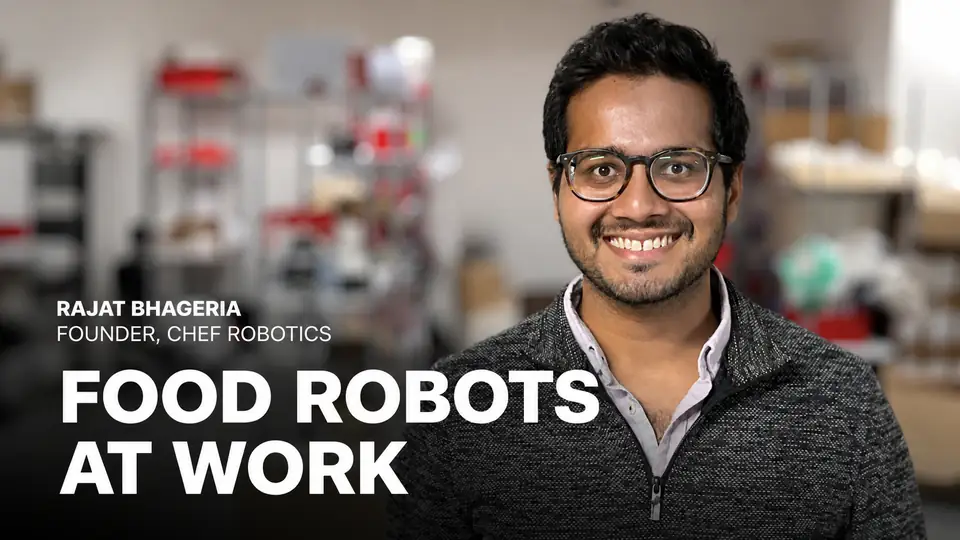
Getting Food Robots Out of the Lab — Rajat Bhageria
Rajat Bhageria explains how Chef Robotics deploys food-assembly robots, learns from factory operations and tackles real-world automation.
August 8, 2024 · 52 min



About the episode
Rajat Bhageria is an entrepreneur, investor, and the CEO of Chef Robotics.
What does it actually take to build and deploy generally intelligent robots? Rajat's company is actively scaling robotics in the food industry and is here to tell us all about it.
In this conversation, we talk about what the current food manufacturing process looks like, the challenges and opportunities in robotics, what the coolest AI and robotics companies are on the market today, why the future might look like WALL-E, and much more.
Links
Chapters
Times follow the podcast audio. The video’s timeline may be slightly different.
- 00:00Welcome to Build the Future
- 01:11Introducing Chef Robotics
- 03:41What food assembly requires
- 07:04Installing and operating a Chef module
- 09:46Vision, motion and utensil design
- 12:55Shipping first and learning from production
- 17:50Why real-world robotics data is hard to get
- 21:19Humanoids and the manipulation challenge
- 24:03Production robots beyond the demo
- 30:15From technology to a useful product
- 35:38Why build a robotics company?
- 41:53Specialized robots, work and abundance
- 44:52Human ambition and policy tradeoffs
- 50:36Positive visions and examples to follow
- 53:00Where to find Rajat
Read the conversation
Open the full transcript
CAMERON WIESE: Welcome to the Build The Future podcast. My name is Cameron Wiese and I'm your host. I've always been fascinated by the ideas and the sentiment that drove American culture in the 1960s with the space race. A culture galvanized to dream about the possibilities of tomorrow. Whether it's food, transportation, cities, biology, or anything else. It was this cultural mindset rooted in optimism, that the world tomorrow would be better than the world today. A mindset where people were compelled to build things and I quote JFK, not because they were easy, but because they were hard. It's this desire to build and to dream that seems to have been lost and something we're here to bring back. With Build the Future, we're here to promote the ideas and stories of those who see how the future can be better and promote their plans to get us there.
CAMERON WIESE: It's our mission to get you to dream about the possibilities of tomorrow, to dream about the future that you want to live in, inspire you to go build. Welcome back to the Build the Future podcast. Today we're talking with Rajat Bhigeria, the founder and CEO of Chef Robotics. It's not only doing AI and robotics stuff, but they actually have robots out in the market helping food manufacturers pack meals and meal kits you get for Joe's or Costco. They just come out of stealth and I'm excited to share this conversation with what the future holds. So with that, let's jump right in. Thanks for being here on the, I pulled Build the Future out of the light, it was like on the back burner. I'm like, we got a jam because obviously there's a lot of interesting things around but I haven't seen anything on the robotics front that's actually like meaningfully deployed and being used and growing. And then we got kicked in like, okay, cool.
CAMERON WIESE: We should, let's record something because people don't think that robotics is actually happening. They're not exposed to it. So let's start with, tell me about the future you're building with Chef Robotics and sort of the vision that you have for it.
RAJAT BHAGERIA: Yeah. And again, thanks for having me on. I'm super excited. I'm really glad we got connected. and I'm excited to have this conversation. Yeah, so I think that the future that we're trying to build is one where in the food industry, we find that these jobs are honestly very tough. A lot of the jobs are in either a very cold environment that's like a refrigerator basically 34 degrees, or it's a really hot environment. And Americans basically just don't want to work in these jobs. And the reason is that you're just doing these redundant motions all day long. And because of this, there's a really, really crushing labor shortage. So I think the future we'd like to build is one where, you know, essentially you have robots doing these kind of redundant motions. So for example, our initial use case is one where, you know, in these in these food factories, you essentially have these people who are in a 34 degree room, they're scooping food for eight hours a day, oftentimes, it's frozen material. So like, their hands are numb. I mean, I tried this job for like five minutes, and it's like my back is hurting and my arm is aching and I live five minutes. And like, you know, it's just a really tough job. And so I think we'd like to work a job where like, there we like to create a feature where we can have these kind of robots do that kind of day-to-day mundane work. And now with those other people, they can actually do something better suited for people, right? So continuous improvement, line monitoring, robot operating, things like that.
RAJAT BHAGERIA: And of course, they're starting in one place. But really, what I'd like to see is a world more generally where robots are doing these mundane tasks and humans are doing something better suited for humans.
SPEAKER UNCLEAR: Totally. Yeah, I think we'll sort of come back to that. But for the unacquainted, like what specific are you guys doing at Chef? Within this kind of labor shortage in the food
RAJAT BHAGERIA: industry, we find that the majority of the jobs are actually in the food assembly portion. Food assembly is basically this idea of kind of taking pre-cut and pre-cooked ingredients and kind of portioning them at the right portion size and then placing them into whatever form you might want. That might be a prepared meal, that might be a sandwich, a wrap, it could be a pizza, party tray, yogurt, per se, whatever you might want. So essentially, our goal is really to kind of deploy these robots. And what we're doing right now is deploying these robots into food factories. Right. So think about any kind of meal you might find at a, on an airplane or meals might find at a hospital.
CAMERON WIESE: Even like Trader Joe's, right? Or Costco. It's like,
RAJAT BHAGERIA: Yeah, exactly. Trader Joe's or like meals you might find at any like Starbucks, for example. That's kind of a starting point and it really makes a lot of sense because it's a really great use case for robots. It's pretty high volume. And then the idea of course is that scooping is scooping is scooping. If we can manipulate a chicken and do that consistently without damaging it, without crushing it, and we can do this for thousands of ingredients, then why stop there? Why not go to ghost kitchens? Why not go to fast casuals, prisons, hotels, universities, et cetera. Really the ultimate goal is to build AI enabled robots that kind of help automate the human part of this job that is really tough for people, and then ultimately allow them to do other things.
CAMERON WIESE: It was something that I hadn't really thought about until you and I were chatting initially. A lot of the food that you see at the grocery store is sort of pre-assembled. It just didn't click. It was something I'd consider. I'm like, how does this get made? It's literally giant assembly lines, but everyone's like, oh, hasn't it been automated? No, it has not.
RAJAT BHAGERIA: Yeah, exactly. It's really fascinating actually because even when we started chefs, we thought it was automated, which is why we... Our initial impression of where to start was actually fast casual restaurants. But then we went to a lot of these factories and exactly you said, it's these giant assembly lines, you have 30 people on the line and they're scooping. And we're like, why isn't this done? Why isn't this done by automation? And what we learned is that our customers have actually tried traditional automation. It's just that traditional automation It's kind of like, it's traditional for a reason. It's very simplistic automation, right? There's not many sensors. It's not really making a decision. It's a bunch of stainless steel, basically, and maybe one motor that's kind of just doing the same thing over and over again.
RAJAT BHAGERIA: So you can make it work, let's say, for one ingredient. Pick any ingredient, you can make a dispenser work. But then if you change how you cut that ingredient, or you cook that ingredient, then it won't work so well. So, you know, it's really good if you're essentially, Basically, if you have five SKUs, let's say in craft times, five SKUs make for ketchup, and five is an arbitrary number, 10, 12, 15, whatever it might be, a low number basically, you essentially get a dedicated custom line for each of the SKUs and you just run it all day long. On the other hand, if I'm making a meal, well, there's 200 different kinds of meals, and so now you're not going to get 200 dedicated lines, you're going to get five to 10 flexible lines, and you're going to change over. But of course, that flexibility is not something that depositors, suspensors, traditional automation can handle, which is why they end up using people. And that's where we can come in.
CAMERON WIESE: So deployment, walk us through sort of like what deployment looks like for you guys. So right now it’s humans on our assembly line, presumably food from the preassembled pan, I think it's like the hotel style giant pans into these preassembled or the sort of, yeah, preset containers, right? And then just one after another over and over
RAJAT BHAGERIA: and over and over again. Yes, exactly. Exactly. So like status quo is exactly that. So you know, you have like each human right now has kind of a big tub and they're kind of scooping, you know, maybe the first two people on the line on either side are doing rice and the next person is doing a meat and the next person is doing some vegetables, etc. Right? So the deployment process for Chef, we really designed it, engineered it, I guess I could say, to really be very simple. And the reason for this is each Chef, we kind of call them modules, Chef modules, they're the same footprint as a human, which is again on purpose. So the idea is that we're not automating like 10 people or 10 stations, if you will. It's automating one station at a time. So essentially, the system itself is the same footprint as a human, and it's on casters or wheels. So you literally slide it to the line. And then the only kind of two inputs we need is really a power line 110 AC, which every facility has, and then a compressed airline, which also every facility has, it's kind of like pneumatics basically. And they use pneumatics for other equipment on the line. So that's why they have it. And basically, you slide down to the line, you kind of put down the forecasters, and essentially, you're kind of ready to run. At that point, what you're going to do is you're going to tell the robot, okay, you know, 6am, it's 6am time to run production, what meal am I making? Well, I'm making the Pad Time here. Okay, great. Then it's gonna ask you what ingredient you want to run. And then you say, well, I'm doing the broccoli. Okay, great.
RAJAT BHAGERIA: Then it's gonna say, great, well, you need to put in your trays of broccoli, you load the broccoli trays, hotel pans. And the final kind of step is it's gonna say, okay, well, based on the AI policy, I have to manipulate broccoli, you need to get the A52 utensil. So you go and grab your A52 utensil, and it's like a dovetail mechanism to attach the utensil, there's two pins to hold it into place. And essentially at that point, that's essentially the only kind of work that the line manager has to do. And at that point, basically the robot will kind of fine tune, it'll kind of pick and dump is what we call it. You kind of pick ingredient broccoli from one tub to the other tub over and over, 10 times or so, until it kind of feels, okay, I'm pretty consistent.
RAJAT BHAGERIA: At that point, you press play. And that's kind of it. At that point, the system will kind of see that there's trays going down the line. And when it sees the first tray, it'll say, okay, it's time to pick, and then it'll place. And every tray, it’ll try to get better, right? So we actually have weigh scales underneath each of the pans to actually get some, how much weight we picked up, and we can say, okay, well, it's too high or too low. Let's actually improve the next time. Sweet. Yeah.
CAMERON WIESE: I can imagine that, like, well, the interesting thing that I think happens here is like most people, so you get it set up, but where does the more like technical component come in? Right? Because you have the stamp, you have the old, this sort of automation name attempted, It's like, pick up and go. Where's sort of like the, where's the insight?
RAJAT BHAGERIA: Yeah, I think the secret or the insight is that dispensers by their nature are, you can't really have much sensing. It's kind of just doing the same thing over again, right? And our insight was, okay, well, how does a human, a human doesn't care if it's shredded chicken or sticky rice or like cheese grits, they don't really care. Well, and how do they do that? Well, they use their eyes, of course, first of all, to figure out, okay, first of all, what ingredient is it? Second of all, once I understand the ingredient, okay, well, how am I going to scoop? First of all, where in the hotel pad am I going to scoop? Like the actual like where? But then also how? Right? So how much force am I going to put?
RAJAT BHAGERIA: What kind of like motion am I going to have? Right? So there's some, there's some perception and there's some intelligence there. And then of course they have arms through these motions. And the thing with scooping motions is that with a scoop, you can basically pick up anything. You don't care how it's cut. You don't care how it's cooked. You don't care how sticky it is. So long as you have the right place, you start in the right place, and they have the right motion, you can essentially pick up anything. And then the final portion is they have a utensil. And so we essentially said, okay, let's mimic that idea, which is we're gonna have computer vision to figure out where do I pick from and where do I place? We're gonna have a lot of intelligence to have figure out what the motion is. And also, for example, if I have a very sticky ingredient, I actually need a lot more force to actually kind of go through that material. Or if I'm picking broccoli if I just like kind of dumbly go through it, then I'm gonna like fling the broccoli off. So I need to actually kind of like delicately kind of scoop it in. And then maybe I need to jiggle a little bit so that if there's anything that's like about to fall out, it falls in, things like that.
RAJAT BHAGERIA: And then utensils. Basically, it's kind of like computer vision, machine learning, motion planning, and utensil design. So we essentially built our system around that idea, which is scooping. And the idea was that every customer, no matter if it's Thai place or Indian place, or doesn't matter with the customers, doesn't matter what kind of containers they have or conveyors they have or ingredients they have. So long as I have this module which has a six-staff arm, an interface to have different utensils, and the best CPU and GPU can get at the moment, then essentially I can mass manufacture that hardware, that module, and ship it to every customer. No customization whatsoever for a customer. And then basically each ingredient can have its own AI policy. That might be like dozens of different parameters about how do I scoop that ingredient to be consistent, to not damage it, to not spill it, to get the right portion size, all these things.
RAJAT BHAGERIA: And finally, the third part, of course, is the right utensils. And the utensils, you have a library of utensils. Once you have a good library, you can mass-manufacture them as well. You don't even make something custom per customer after that. So I think that was the insight, which is instead of having this hardware-driven approach, which is very much do the same thing over and over, can we have more of a scooping or software driven approach, which is a lot more AI driven.
CAMERON WIESE: Tell me about how you guys are going about doing that. Because a lot of the previous AI, so like on the policies that mentioned policies, it's like, okay, here's a predefined set of rules. Right? When you drive like all the, this is how Waymo and Cruise and Tesla, or at least how they started out doing it, which was like, cool, if this, then that hundreds, thousands, hundreds of thousands of times, but then something changed in probably what, 20, actually sort of industry-wise, what changed that doesn't enable sort of this computer vision type approach?
RAJAT BHAGERIA: Yeah, no, it's a really, really good question. So you're right. I think since 2014, you've ended, basically what the self-driving car companies did and what all the robotic companies did is essentially a rule-based system. And rules, by the way, there's still a lot of machine learning the rules, it's a rule. So for example, I can get from the AV world is like, okay, I'm a very simplistic example. I'm going to detect a red light and when I detect a red light, I'm going to stop. That is a rule. Now, the issue with that rules architecture, which is what you alluded to is that you have a lot of like, it gets very convoluted very fast. Okay, well, if you're a red light and you can turn right, am I allowed to go or not?
RAJAT BHAGERIA: So anyways, and that's a very simple, but there's thousands of these different rules you kind of create. We started Chef the same way, right? Which is, okay, well, essentially, we were like, okay, let's create like a config. That is kind of what we internally call it. So maybe like sticky barbecue sauce is going to have a config. I just came up with that. But it's a good example. And the reason I came up with that is because it's sticky. Okay, so what does stickiness mean? Well, if I am above the tray, once I've detected the tray that I want to place into, and I've tracked it, now I have to, it's going to take like, because it's sticky, it's going to physically take the material like a couple seconds to drop down. So we have this like config parameter dwell time. Dwell time is basically the time you like follow the tray before you move on. And that's a parameter that an application engineer tunes. So an engineer basically creates that kind of backbone software and then an application engineer says, okay, because it's a very sticky ingredient, I need to do a little bit more. Or maybe another example I can give is like, we're talking about broccoli. So, you know, we have a utensil that's close around broccoli and if I just dumbly close, I'm going to sometimes get one piece, sometimes I'm going to get three pieces and you're going to be very consistent. So we kind of create this like twist motion where basically we try to like fill the tool as much as we possibly can. But there's constraints because these are collaborative robots and if we apply too much force then they'll protect us stop. It's a safety mechanism. It's meant to be collaborative. So there's a safety mechanism where if you put too much force it'll kind of stop. But of course, if you're trying to pick broccoli, it's very dense material.
CAMERON WIESE: Yeah, it's much more difficult than corn or zucchini or something.
RAJAT BHAGERIA: So anyways, and we were talking about this more, but basically, the way we actually got to production, basically, there was a lot of deep learning and machine learning, but each ingredient had a rule about how to leverage that model to do something useful. And these configs had like 200 software parameters apiece. So that's how we got to market. And what was beautiful about that approach is it allowed to ship. I think that was the most important, which is like, what is the quickest path to getting something useful out in the world? And that's kind of what we started to ship. And what was nice about that is by shipping, we got real production data in the field. We learned about, okay, well, actually, the sauces actually are different densities day by day. Or if you have a pan of shredded chicken, it's actually different material properties as you go throughout the pen because it's different parts of the bird, etc.
RAJAT BHAGERIA: We learned these things in the field. Now we get production data. We have a mapping from image data, basically RGBD to robot control data, about what works and what doesn't work, robot action data, about how do we actually in production be consistent, how do we not spill, how do we not damage material, how do we place in the right compartment without spreading or spreading based on what the customer wants. Now that we have that production data, Now, we've started more of an end-to-end approach, which is say, okay, let's go from images and input data to more core robot control data. But I think that was only possible because we started with production data. And the reason I say this is when it comes to manipulation, there's no deformable physics simulators that really exist, that are really good. So what a lot of companies do, even autonomous vehicle companies, is that they can train in simulation. Well, Chef can't training simulation because there's no physics simulators for deformable material. So the only way for us to get that data was going to production. So anyways, that was kind of the story, right?
RAJAT BHAGERIA: Which is like, you have something useful in the world by using this kind of approach that software like driving cars and others came up with, which is kind of like you have rules based on different kind of parameters, and then you ship that, you get production data, and once you have production
SPEAKER UNCLEAR: data, now you can do a modern end-to-end approach. Well, I think that's exactly sort of why what I like fishing for, because the thing that I just, the physical world's so complicated. And there's all this, I am a hundred percent like profugelike, lots of build stuff. But there's this sort of narrative around AI and robotics going, oh, it's going to take over everything. And it's like, it's not that simple. It's, these things are really complicated. There's no training data. There's like, okay, I'm going to pick up this cup. Okay. Well, how do you know this is paper versus ceramic versus metal.
SPEAKER UNCLEAR: And it's even deeper than that. But from the outside, so it's even deeper. So from the outside, you can't tell how much coffee's inside that cup. And by the way, a human, in other words, what I'm saying is vision is not enough. So what a human does is that they use their vision to figure out, okay, generally, where do I pick from? But then there's appropriate reception. So they actually figure out, oh, how much force do I need to impart so that cup doesn't fall out. That's all real time that humans are doing that. It's really hard for robots. No, so your point is exactly right, which is that I think the sense I get is that, and this is just a sense in my opinion, is that I think a lot of people looked at what happened with large language models and chat GPT and they're like, what used to happen in the world is we used to have these point models. You have a model that plays chess, you have a model that drives a car, a model that does some natural language processing, so to say. And now, can we have this foundational model where it can do anything? And I think that that paradigm actually works quite well for kind of language. And the reason it does well for language and kind of written stuff, basically, code and things like that, or purely the digital stuff, like an image even, it's a purely digital idea. It can work well for that because there's a lot of language, image, data pairs on the internet that you just download.
RAJAT BHAGERIA: So I mean, all the LLMs and GPTs and all these foundational models are essentially trained on more or less off-the-shelf data from the web. And now, of course, more people are getting proprietary data with proprietary resources. But generally, it's off the shelf. Well, I think with robotics, it won't just be like a snap. I think chat GPT was like a snap. It felt like it, if you will. I mean, obviously, they've been working on it for years. But for the outside world, we suddenly have this kind of relevational transformers and things like that. But I think that's not necessarily going to be true in robotics because the big missing thing is exactly what you said, which is that training data. And I would even kind of go so far as to say that the simulation is good, but even for non-deformable, let's say I was working on a bin picking company or I was working on a palletizing robot company, even then, SIM is kind of not sufficient.
RAJAT BHAGERIA: I think you really just... And the reason for this is the physical world is very highly dimensional. There's a lot of noise in the physical world. Like in simulations, everything is kind of what you expect. But in the physical world, there's like, I mean, in the palletizing case, there's like forklift drivers that are coming in and out of the workspace. There's people who are like doing dumb things. There's weird kind of orientations of the pallets. So there's all this noise that you can try to simulate it, but it's always going to be limited compared to what's going to happen in the physical world. And I think the thing then becomes what is the fastest pathway to getting data from the physical world? And I think the fastest pathway is shipping robots. But now you have this chicken-nite problem, right? It's just do you ship robots without that? So I think it'll happen, but I think it's going to require companies that are really maniacally focused on shipping into production, getting data, and then using
SPEAKER UNCLEAR: that to make their models better. Yeah. This is kind of an argument for games for general purpose, robots, right? Like you're like Rosie from the Jeffsons River. I love Optimus aesthetically and figure, cool. I just have a hard time seeing where, How do they design these things so that they can learn to move your laundry? It's so complicated. I don't know. This is a little bit of a deviation, but how do you think about this?
RAJAT BHAGERIA: I 100% agree. There's a bunch of thoughts about this. A lot of people are comparing these general purpose robots as self-driving cars. Well, the reality is that self-driving cars, the first start program challenge that really, In my opinion, and others might again, disagree with this, but I think AV in my head kicked off with the Darkboard Bench Challenge, where Sebastian Thoreau and some of these other folks first competed. That was 20 or so years ago. So from the time that competition happened in the early 2000s to now was two decades ago. And I think my opinion is that general purpose robotics and humanoids will probably take around the same. And it's basically a time horizon in question, right? It's like maybe that happens, but how long is it going to take? And then there's some other kind of angles to think about it from. So one angle to think about it is like, essentially, the walking part is honestly not the hard part. I think we've kind of figured out walking. The hard part is manipulation, right? And yet, we have not as a humanity figured out manipulation. I mean, forget deformable goods. What we're doing is deformable. Food is hard in and of itself, but we haven't even figured out non-deformable goods. I mean, there's companies, many companies and we can talk about some of them in particular if you like, but bin picking is just not a solved problem by any stretch of the imagination. So now we still haven't solved that basic like how do you pick up that like coffee cup you just talked about or different objects you might have around. We haven't even figured that and now we have to add that on to this other problem which is okay, well half of my compute, half of my load resources are being used
SPEAKER UNCLEAR: to not fall down. And there's a lot of safety ramifications. Anyways, all these will happen. I'm not saying that won't happen. I just think that it's a little bit early, which is to say, I think we need to just solve manipulation, adding legs onto it. It's a good vision. But we just need to solve the manipulation part. And I think just focusing on just getting manipulation in a good place, then you can have that instead of an arm mounted, for Chef, instead of an arm mounted on like casters, you can put an arm on legs, that's fine. It's great. But just the hard part is manipulation. And just focusing on a problem is an important thing.
CAMERON WIESE: You can't just toss the legs on it right now and be like, oh, cool. Now it's more of an order of ops.
RAJAT BHAGERIA: It just, exactly. And this is so easy to do demos. I mean, I think there's a lot of really compelling demos. I think what I'm really impressed about is when somebody actually ships production robots, because in production, you know, manufacturers just don't care. They're technology, they don't care about imitation learning, they don't care about transformers, they just care about output, give me reliability, give me throughput, give me flexibility, give me the things they care about, right? I'm really impressed by the companies that actually ship
CAMERON WIESE: in production. Yeah. And you guys are one of the leaders. How many meals have you guys helped assemble? Right now we're at 22 million, I think. 22 million. Incredible. So you're getting real data and real customers are using this to improve their processes, which I think is just like, again, that's why I'm like, okay, we got to do a pod because it's like, you don't hear that every day. It's like, oh, there's another demo on X or someone got a funding round for this. Do you have stuff in the market? Like, so like, who, and I think back to your question, like who else has stuff in the market? you're like, okay, this is cool. This is meaningful. There's stuff going.
RAJAT BHAGERIA: There's a few that I'm really impressed by. And this first one I'm going to say is maybe one company that actually has done it well. So there's this graph I saw and maybe you've seen it like the Tesla FSD miles driven. And I don't know if you've seen it, it's kind of this exponential curve and they're doing like a billion miles. I think that that... So I think here's what's funny, right? And again, there's not a right answer for this, just different opinions. I remember when I first started in robotics, everyone was essentially making fun of Tesla for their whole approach of, obviously, cameras, but also other things, but just shipping something. And a lot of people had this approach of, okay, we're going to raise tens of billions of dollars in funding with the Waymo approach or the cruise approach, right?
RAJAT BHAGERIA: And we're going to try to learn, sort of say, in a lab, and then over time, we'll get to full autonomy. And Tesla said, no, we're going to ship a bunch of vehicles, get production data, and improve over time. I'm not saying that that approach has definitively won, so to say, but it really seems like people are pretty happy with FSD12, the imitation learning part of it. And it seems like that's working and that vision is exciting. So if you look at Tesla's robotic company, arguably they're an extremely successful robotic company because they have production robots that are using imitation learning to actually successfully drive around cities, that's pretty cool. Other robotic example, but I think it's necessary to call out, which is Amazon Robotics.
RAJAT BHAGERIA: Amazon Robotics actually has the biggest fleet of robots in the world, and I say intelligent. Now, the ding again, and that's hundreds of thousands of robots, right? The ding against Amazon is that, well, it's not the ding, it's still very impressive. It's just like they're not deploying these robots at other customer sites. If you're deploying your own facility, you can engineer the facility to be perfect for robots. Let's make it really easy. Let's have April tags everywhere. Let's really basically just make it perfectly amenable for robots. But obviously, if you go to a different customer site, which is what we have to do and other robotics companies have to do, then you kind of have to deal with their randomness, that high dimensionality, which you don't have to do if you engineer them in space.
RAJAT BHAGERIA: But anyways, I think it's really impressive nonetheless what they've been able to do. A couple others that I'll call out that I think are impressive. So I think the colloquial one that everyone talked, not everyone, but many people talk about is locus robotics. So, Locust Robotics makes these kind of AMRs, these are robots that kind of help with picking in a warehouse, a 3PL or e-commerce warehouse, right? You need to assemble a kit or basically move materials around. And you have a human who's kind of taking an object here, taking an object here, taking an object here, and these robots essentially kind of just help them do that and kind of follow. It's not actually doing the manipulation. The human is actually doing the manipulation, but the robot is actually kind of just like essentially It's kind of like a moving shopping cart if I were to simplify it quite a bit, but it'll also do other things like move pallets around and stuff like that.
RAJAT BHAGERIA: So they've deployed a lot of robots and I think there's a lot of lessons to be learned from them. But I think the point still stands is there's not hundreds of robotics on these little ship production robots. There's like tens that are... And when I say production robots, I mean intelligent robots. There's like thousands of companies that have shipped dumb robots, which are these kind robots you might find in car factories that are doing the same thing over and over again. These are robots that are essentially hard coded. They've been around for 40, 50 years, kind of a solved problem. You go to Systems Integrator, they'll make you buy a robot for FANUC and they'll do some PLC programming and lose the same thing over and over again.
RAJAT BHAGERIA: I don't want to say solved, but I think it's a pretty stable place. You can basically solve any problem you want within some limitations. But essentially, most problems you can solve that way for applications where it's very low flexibility needed. So if you just want to do the same thing over and over and again, like I'm making millions of iPhones done, right? Just get a custom line that just does that. But when it comes to intelligent robots that are kind of making decisions and having to be flexible, there hasn't been a ton.
CAMERON WIESE: Yeah, I think that's a really, really important distinction for people because they're like, oh wait, they have robots in factories? Yeah, for giant assembly lines, but the places where there's a little bit of like, at least right now, human intervention needed is the place where that hasn't been entirely taken over.
RAJAT BHAGERIA: Yeah, I mean, a good example just to finish the car analogy is the first kind of parts, the early parts of car manufacturing line will actually be fairly automated. There's these giant Faunuk and Kuka and ABB arms. If you were to go to the Ford plant or the Tesla, and really any kind of car OEM. But then you go to General Assembly, which is kind of the last phase. And it's extremely complex. And I mean, the classic example a lot of people talk about is like kind of adding the wire hardness, right? It's like this kind of a deformable bendable thing. You have to finagle this around the chassis of the car. I mean, that's just very hard and you have all these people doing it. But there's a lot of examples for that where the last phase is very flexible. There's a lot of these deformable parts or moving parts and changes. So that's where you have a lot of humans. And that's where intelligent robots would be in this equation.
SPEAKER UNCLEAR: So it's like the problem with last mile delivery. It's really, really good up until that last little bit and then it gets super complicated. Okay. I think that's kind of a really good sort of picture of the landscape on robotics right now that most people, myself included, honestly, may not be completely aware of. Is there anything else that you think the average person or general like may not know about robotics or that may have like misperceptions about, misperceptions about right now? It's a very good question. So like, I mean, I think like, yeah, we kind of talked about
RAJAT BHAGERIA: the data bit, which I think is the really hard part, we kind of talked about there are these production robots, but they're for low mix applications and high mix, so to say, where you have varieties where you need robots, intelligent robots, and we talked about how it's different from like language, I guess a few other things I'd call out, I think, you know, here's actually interesting one. So I think robotics is one of those industries more like in, you know, in startup world, we often hear about like in polygram talk slide with this, but I think a lot of people talk about how the number one reason startups fail is they build something nobody wants. Right. I think that's especially true in robotics, I would say. And why is that is it's because like, in robotics, it's these very technical founders, right? Like these really incredible engineers, very easy to kind of build something that's kind of a cool technology, it's very easy to build technology. But it's really hard to take that next step of building a product and it's even harder to take that further next step, which is a solution. So here's what I mean by that.
RAJAT BHAGERIA: In the food, I'll just talk about the food world. I mean, in the food world, you cook at home a lot, maybe not you, but I'm saying people cook at home a lot. And they're like, oh, cooking is what I should automate. So you have these robots that do cooking, like burgers, flipping, things like that. The issue you find is that if you actually talk to customers and you actually really understand what they're facing. What you find is that cooking actually scales relatively not sublinearly. It takes one person to cook at your house for a few people, but it also takes one person to flip 50 burger patties. One person can actually do a lot because one person can kind of do... It's kind of batches basically. And so the pitch of robotics is really tough, for example. That's something that's not intuitive. And if you were just built a technology, you end up building a cool cooking robot, but that actually really does not solve any customer problems because you're going to go to the customer and say, hey, we have this cool cooking robot. And they're going to say, okay, great, how many people can I kind of offset and have them do something else? And you're going to say, well, you can offset them, but our robot's going to fail sometimes. You still need that person actually. And they're going to be like, well, there's not really an ROI anymore. So that's something that's not obvious. I think so. One of the things we try to do is actually sell the product before building it. And what that gets you is like, you really, as soon as you have to ask for money, people really tell you what they really want. And then you can actually work backwards from requirements as opposed to let's just build a cool thing. That same idea, I think, is true in a different way.
RAJAT BHAGERIA: So like, now let's say you have a general kind of thing that people want, right? When it comes to robots. I think even then, it's kind of really easy to focus just on the core like computer vision and motion planning or AI or whatever, hardware, whatever it might be. And sometimes not think so much about the rest of the solution. So here's what I So in chef world, we got to make something that's very flexible. And the more ingredients it can do, the more like different kinds of, you know, consistencies it can deal with and textures and things like it, like, how do we pick up a blueberry without squishing it? The more we can do, obviously, it's very useful. It's very, very useful. Now, but it's not so it's not it's necessary, but it's not sufficient. So what also matters is things like, okay, well, the users who are going to use this line are usually non English speaking, often not college educated, they're not they haven't really dealt with technology outside of maybe their smartphone.
RAJAT BHAGERIA: So, okay, the things that matter also, okay, is the entire interface in Spanish. Is the entire interface as simple to use as Netflix? The things that also matter might be like, how easy is it to clean the thing? Sanitation? How human safe is it? I mean, these are things that are honestly not sexy, right? Making an interface into Spanish is not the most technically complex thing you might have to do. But that's what separates a technology into a product and a product into a solution. Because I can have the most flexible robot, by the way. Maybe some maybe somebody can build a robot that's extraordinarily technically competent, but if it's not usable, people don't want to use it on the line. Well, the sanitation teams hates to use it or the production team finds it annoying. They're not going to use it.
CAMERON WIESE: And so we have to sort of feel like it's all sort of like integration into again, into the realm world. It's like, hey, how's this going to interface with everyday people? It's not like, I mean, there's sort of an argument for like, the like on the ghost kitchen stuff. Like if you were fully automated, like there's this restaurant in San Francisco that had this sort of like assembly line, a robot that was just picking the ingredients. Like you had a whole team of people who were at some industrial kitchen who are prepping all the ingredients and like loading them in. And so it's like, it ends up being kind of, at least in that, it's like kind of gimmicky. Same with the, the robot. It's caffex.
CAMERON WIESE: Yeah. Like SFO. It's like, it's cool. Oh, and I think photos of it, but it's not actually solving a problem. Like I'd rather go to the Starbucks so I can talk to the barista and be like, Hey, actually, can I do this without like six pumps of like vanilla syrup? Cause I don't want nobody who wants that. Or I don't want that versus like entertainment. I think it's, it's interesting to sort of differentiate between like with robotics. It's like, what's, what's being done for entertainment? Like BattleBoss. Great. Cool. Like more of that, please. but larger ideally. Yeah, they're not actually having a problem, exactly. Like if we were to sort of like imagine a future where robots are solving like a lot more like real problems not just superficial ones like what does that world look like? And so this sort of text you mentioned to me you're hoping that with Chef you inspire a lot of other people to do more like real practical and powerful things with AI and robotics and I wanted sort of see I can get you up on a soapbox to riff on what some of those things might be.
RAJAT BHAGERIA: Yeah, I mean, it's really important. So like, actually, early on in the chef history, like, again, robotics is not easy, honestly. So there was a moment in the early days when I was like, this sucks, right? Like, you know, like, it's like every day is hard, like, dealing with physics is hard. Everything's just hard about it, right? And then you even even if you get the thing to work, then the customer is like, oh, but this is just like, everything's hard. And there's supply chain issues, and there's deployment issues and customer support issues. And customer support is just not on the online, it's like you have to go to the customer site, sometimes, etc. Anyways, there's a moment where I had a conversation with another friend in the self-taught truck space and I was like, this sucks, why are we doing it?
RAJAT BHAGERIA: Why don't we just do like SaaS or something, just something easier? Basically, I was considering quitting, right? And you had a really interesting response, which is like, I still remember to this day, which is like, yes, it's really hard, but that's kind of why we're doing it, which is to say we're kind of in the era of Friendster and Facebook hasn't happened. Or in the era of Shockley Semiconductor and Facebook hasn't happened. Or we're in the era where we're still using taxi cabs and Uber hasn't happened. In other words, I think it's like, and I really like this point, which is like, we're doing it because if we can actually succeed, not only can we make our company successful, which is great, but hopefully we can inspire all these other founders and engineers and entrepreneurs and investors and operators, everyone else, to do AI and robotics.
RAJAT BHAGERIA: And I was like, holy crap, that's pretty cool. That's pretty exciting. And so I went home and I was like, okay, that's got to be our mission statement, which is like, it's not about chefs succeeding per se. It's like, how can we kind of inspire other founders to do AI and robotics? It kind of reminded me of this, like we were talking about Olympics at the beginning, we're like, the four minute mile, right? Nobody thought the four minute mile was possible. And then one person did it. And then there's a ton of four minute milers, right? I think that's exactly what I hope to be able to do with chef, which is the food industry is huge. It's arguably one of the biggest industries on planet Earth. I hope that we can make Chef into an insanely successful company, deploy tens of thousands of millions of robots.
RAJAT BHAGERIA: Great, amazing. But I think more than that, I hope that what we can do is inspire other people to take that and solve these other really important problems. And what are those other important problems? So let's talk about that. One simple way to think about this is literally go to the Bureau for Labor Statistics and go down and what are the biggest labor forces on planet Earth? Right? And on an international scale, it's actually agriculture and food. So I mean, outside of the US, agriculture is still number one, actually. So from a labor force perspective, and I think labor force is a good proxy for the market-sized robotics, I would say. But in the US, you know, you kind of just go down, you're like, okay, what are the biggest occupations?
RAJAT BHAGERIA: And then each of those has literally, like, opportunities for, like, trillion dollar companies. Literally, like, it's not billion dollar markets, it's trillion dollar markets. It's because the human labor market is $45 trillion of global GDP. It's like any particular market is a trillion dollar, not any, but most of the big ones are trillion dollar markets. Yeah. So I mean, I'm pretty excited about like, obviously I'm really excited about food just because I think I'm excited about food because it's a really big market. It's the number one labor shortage in the US. It's over a million jobs unfilled and it seems technically tractable. Like it seems like it's possible in the short term, but I think there's a lot of others that I'm excited about. So construction is one that I think actually is getting a little bit of love. There's Dusty Robotics, there's Bilt Robotics, there's some companies there, Civ Robotics, there's some love there. But I think construction is one of those mega industries where there's so much more that we could do there. And I hope that there's more there. I think medical robotics is one where, obviously, the DaVinci system with Intuita Surgical, I think that's actually a pretty crazy company. It's worth like 70. I didn't check lately, but last I checked, it was like $70 billion in market cap. But the intuitive robot, the Da Vinci robot is still controlled by a physician. It's still a surgeon who's actually controlling it. And the robots kind of just helping essentially prevent you from having errors. But I think more surgical robots would be actually really important. And then I think right now there's a lot of robotics, some of these that are in manufacturing warehousing. I think mainly that's because of the rise of e-commerce
RAJAT BHAGERIA: as of late. And I think that's great. I think yes, we need that. But then you just go to manufacturing plants, general manufacturing plants. And there's literally thousands of people, a lot more than you might expect. But we're just doing these manual tasks, any from machine tending and just working with different equipment essentially. There's some tasks that are still manual, like clothing and stuff is a very manual task, clothing manufacturing, making shoes. So anyways, basically take any job in the physical world, there's literally like, at least a 10 to 100 billion potentially billion dollar company to be made. This is amazing.
CAMERON WIESE: Yeah. Yeah. So it's like the goal is sort of like lay the scaffolding or sort of like, we'd be the form them either. But in a way that like, here's all this other knowledge that like, or here's sort of the learnings. And it's in the same way, I'm gonna make the Amazon comparison. And it's like, they were able to ship on existing freight lines. And they had the internet. They didn't have to do a bunch of this innovation. Just like, oh, all these pieces sort of came together. Oh, what is now possible? And it got people asking the question. I think when people see 22 million like nails served, like, whoa, oh, this is work. Oh, like we have to be very specific about the problem we're solving.
SPEAKER UNCLEAR: Oh, and building stuff for customers. Like, okay, what else can replace? like people are gonna be like, okay, cool. Like this, this can be done like chefs doing food, like, okay, well, I'm gonna go try and be in the market on true construction. It's like, sweet. Cool. All right, go for it. Like, I guess what does our world look like then? This is our result. Like what's our 2020 years out? Have you have you seen Wally? I have seen Wally. I have some interesting takes on Wally, but let's let's let's see. Let's do yours now over it. I watch Wally.
RAJAT BHAGERIA: And this was like, obviously, like it's an old movie now, but it was pretty cool, right? And one thing that was really interesting is like, there are some like general purpose robots in Wall-E, but almost all the robots are like for some reason, like Wall-E is a trash compacted robot. But the trash compacted robot doesn't need to do some other tasks. Like in our use case, like it's kind of coming back to like humanoids, I guess a little bit, but like, like in our use case, which is kind of like assembling these meals, having a humanoid is like negative value. It's like you don't need that. The solution works as good as it needs to. Anyways, what I mean to say is what I'd hope to create is a world like Wall-E, which is you have tens of millions of these robots that are doing these day-to-day tasks.
RAJAT BHAGERIA: And then you have some general purpose robots that are doing specific tasks that make sense for those general purpose robots. I think the total carrying application in a lot of automotive of plants actually is a good example where like, great, that I can see that makes sense. And maybe there's millions or there's tens of millions of like specific robots for some specific thing and then millions of robots for these more general purpose tasks. And then I think what ideally, well, not ideally, but almost certainly what's going to happen is what's happened in prior kind of revolutions and industrial revolutions, where it's like the tractor or like the steam engine or the printing press or the G-throw toll. Like what's always happened is these inventions create, like basically they reduce the cost and the economy swells because the economy swells. Business people open up more businesses, right?
RAJAT BHAGERIA: They create more factories and more stores or more whatever and now there's more jobs. And this whole cycle continues and basically like the abundance increases, the price of goods decreases. And I think abundance is really the goal. It's just how do you like in the food world, how do you create a world where the cost of fresh food goes down marginally so that it's equivalent to the cost of fast food, for example? Or how do you create a world where housing is, because of this construction innovation, is much more affordable? It's not affordable housing, but rather all housing can be much cheaper than it needs to. I think really creating a world worth of abundance. I don't think there's going to be this world. I do not think there's going to world where humans are out of work. The invention of social media, for example, led to the invention of social media marketing and people whose whole job it is to do social media. That was not a job before. So there's going to be a lot of new jobs created. I don't think people are going to be out of a job, but hopefully they can invent and they can wander and they can do these things that they previously couldn't do and do things that are better for humans and robots do these mundane tasks.
CAMERON WIESE: Totally. Okay. I'm going to ask this obvious challenging follow-up here. How do we So we want part of the world in the future, but obviously, maybe not all of it. So how do you think about someone building this technology? How do we make sure we don't fall into the sit-in big chairs and drink slushies and just plug in, tune in, drop out that a lot of people may find super attractive?
RAJAT BHAGERIA: Yeah, I think it's a good question. I, my opinion is that that's not going to happen. So long as we don't kind of screw up from a policy perspective, I would say. So I mean, what I mean, so specifically, I guess what I'm referring to is like, I think like COVID was actually a really good example of this where like, people gave out all these stimulus checks and, and right, like a lot of people just left work, and they kind of stayed home and they invested in like, all these like, GameStop and all the games. To generate online gambling. Yeah. That only happened because there's an abundance of money and people do not have work. Right. In this case, I think if we don't do something dumb from a policy perspective, I think there's just going to be people.
RAJAT BHAGERIA: You actually have to retrain yourself. You have to figure out something new. You have to do that work. But in our case, for example, nobody's being laid off. They're becoming real pro operators. They're doing other tasks. They're actually furthering the career. And I think people need money. people need, they actually, first of all, they need money, but also they need to feel like they're making progress in their life. People want to do something. So my opinion is I don't actually think that's going to happen. And I think the only thing, the best thing we can do to prevent that, just prevent some kind of governmental policy thing that's going to provide an influx of free capital, basically. I think I'm not a fan of UBI and things like that, basically, for example,
CAMERON WIESE: on that note. Yeah, I'm with you on that. The new study that just came out that Sam Altman It was like very revealing. So it's like, oh, hey, actually, this doesn't move the needle the way you think it does. I mean, the other thing with that is like, what we want to do is sort of like put the beacon, beacon out to be like, hey, instead of just, hey, you're, you don't have to like, labor force has shifted. So there's all these other options for you now. Like you could just watch Netflix and scroll TikTok, but there's a spiritual calling. I was like, this one's like calling him and you're like, Oh, wait a minute. Like, is this what I want to do? Or like, what else could I do? I can do anything. anything is possible. So I want to go start a robotics company. That's where I'm like my sort of like hero's journey, my own sort of adventures like finding a mountain worth climbing
SPEAKER UNCLEAR: and then going to pursue it. And then I think that's right. I mean, like, I think that's exactly right. Which is like kind of like I think the goal of AI and robotics is to kind of continue going up Maslow's hierarchy of needs, right? Like towards self-factualization. And I think like, I think there's some there's some would say that that's like, not possible. Like any time you have some people that can satisfy ! You need some people that cannot just like but but but I think generally bringing the entire everybody closer to self-evolution is the
CAMERON WIESE: goal. Raise the floor instead of lower
SPEAKER UNCLEAR: the ceiling right? Yeah exactly, exactly and I think and I think that's really where abundance is too and and maybe one interesting example of this is like gig economy. So when I talk to like people in the food industry for example they explicitly say that it seems like things got a little bit worse in this decade or sorry not this decade the 2010s and they kind of credit that to the gig economy, which is to say like previously if you had a college right out of college or in high school, whatever, what do you do? You go to a restaurant or something, right? You go to work at a restaurant. But now what can you do? Instead of being all sweaty in a hot kitchen working on somebody else's hours, you go work for Uber and you're kind of sitting in the AC car and it's much more nice and things like that. And that was only possible because of technology. And I would hope that to your point as more and more technology happens and kind of gets productionized, you use more choice. As opposed to having to do it,
SPEAKER UNCLEAR: you can do it. Yeah. And I think there's sort of a cultural component to it too, which is like making certain things more desirable than others. It's like, hey, it's a good thing to be uncomfortable for a while. But like, hey, there's so much choice in the world. You don't have to do this forever. But this is, you level up. It's an opportunity for you to improve and get better rather than like just be comfortable on the mission of the time.
RAJAT BHAGERIA: Yeah, I'm very excited about this feature, right? Like I think like I've been very lucky in my personal life where I've been able to focus on things that I'd like to do. Right? Like and I think that's amazing. And it seems like same same with you. But that's just that's for so few people. I mean, it's literally like the vast majority of the world billions of people, right? You know, they're kind of working paycheck to paycheck and they're they're just doing it because they have to do it. But wouldn't it be incredible if they had a little more choice. The basic goods of life, food, shelter, all these things are cheaper. There's more abundance when it comes to those materials. And it's interesting, economics is a study of supply and demand. It's kind of the study of scarcity, if you will, is the way one economist put it. So if you don't have scarcity, if you have abundance, then a lot of economics then breaks down because you already have a lot these goods just like freely available, right? And then hopefully these people can kind of do do whatever they would like to do. Now, that's not exactly whatever they would like to do, it's probably still a job, but they have more choice than that job.
CAMERON WIESE: I'm going to save the discussion of like, okay, what's sort of like a abundant future sort of like economic system look like that's, you know, post? That's not like capitalism or communism or anything else. Like, what is it new? What is it sort of like a new economic system look like when We have incredible abundance through limitless energy and material goods and automated labor and AI. But that is for another day. One question before we wrap, other than parts of WALL-E, where else have you seen a positive vision for a future of Naval Biobiotics published? Like in books, films, essays? Like when you sort of are using the art, what do you point to? This is sort of like what we're going for.
RAJAT BHAGERIA: I mean a few thoughts are coming to mind and some of them are like anti-stories, right? So like Isaac Asimov writes a lot of like not anti-stories But like he kind of talks about like like with iRobot and others, right? What can go wrong? Yeah, right I mean, I think the classic example that many people might call out is like things like Star Wars, right? We have these like robots are kind of like these little, you know beings that kind of help you I I would say they're like, you know, honestly, like the thought that's also going to my hands like there hasn't been like a very clear There isn't the story of like, wow, which is kind of like the whole reason I kind of came back to this, which is like, I was thinking about quitting and it's like, okay, why are we doing this?
RAJAT BHAGERIA: There wasn't a clear like, aha, that's why we're doing it. I think like, I guess I'll just say for me personally, right? Who inspires me is like people who have like done it. And I would say like, I think like, you know, Elon is somebody who's like inspired probably billions of people on this planet because he took this thing that like nobody thought possible and he made it doable. And you look at his background, it's like, sure, there's all these theories about whatever, but I'm sure he's a smart person, but like, okay, if you can do it, why can't any of us, right? Me personally, I'm less inspired by science fiction or fiction or writing or any of that. I think I'm more inspired by biographies, if you will, people who have done it themselves. And I think in a lot of industries, there are success stories, right? So if I'm building a marketplace, I'm going to be inspired by Travis Kalanick or Tony Zhu.
RAJAT BHAGERIA: Some people have opinions, but whatever. Maybe it's Tony Zhu you're inspired by, whatever. If I'm running a semiconductor company, maybe I look towards like, there are really guys at Intel and Andy Grove and maybe look at Morris Chang at TSMC, but who do I look for for AI and robotics? Well, I can maybe look at like, I don't know, it's kind of something we talked about, but there isn't that company or that person. So I hope that. I hope and this is a very bold claim, but I hope that I and my peers in robotics and help like Really become one of the early success stories and help create that playbook for others
SPEAKER UNCLEAR: Amen. Love it. That's a great note to wrap on. Where can people find you? Where do you want to point them to I think Twitter and LinkedIn are the best
RAJAT BHAGERIA: I'm just at result Bulgaria find me both there and then if you are interested in you know If you are, you know interested in chef system chefrobotics.ai. And on the other hand, if you think this is an exciting mission, also,
SPEAKER UNCLEAR: feel free to reach out as well. Amazing. Oh, man, this has been a blast. Thanks so much for coming on. Yeah, thank you, Ken. This is fun. Thanks for joining us for this episode of the build the future podcast. If you loved it, we'd be really grateful if you share it with a friend or post a review on whatever wherever you were watching or listening to this. That's it from us. We'll see you next time. Until then, go build.
More episodes
All episodes Chris Power of Hadrian — The Future of Manufacturing, Space, and AmericaChris Power makes the case for rebuilding the manufacturing supply chain behind space and defense.
 Aaron Slodov — Atomic Industries and the Future of ManufacturingAaron Slodov and Cameron discuss how policy influences the adoption of new technology and how AI might support public decision-making.
 Robin Dechant — Aveo & ManufacturingRobin Dechant explains why manufacturing’s future depends on investing in people as well as tools.