

Build the Future Podcast
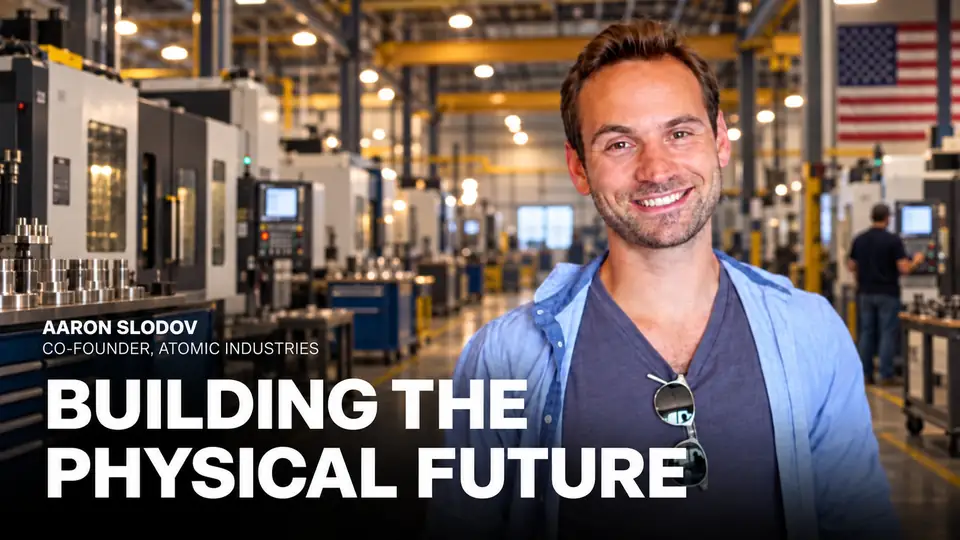
Aaron Slodov — Atomic Industries and the Future of Manufacturing
Aaron Slodov and Cameron discuss how policy influences the adoption of new technology and how AI might support public decision-making.
September 28, 2021 · 37 min



About the episode
In this conversation, we talk with Aaron Slodov. Aaron's the founder of the stealth startup Atomic Industries where they're building the future of manufacturing with the goal of building a more efficient and less wasteful world.
Links
Chapters
Times follow the podcast audio. The video’s timeline may be slightly different.
- 00:00Introducing Aaron Slodov
- 00:35Why technology policy matters
- 02:00Autonomous vehicles and testing grounds
- 04:15AI and the pace of policy
- 06:08Proactive decisions and human oversight
- 08:46Resource allocation and representation
- 10:43Experiments in governance
- 12:32AI-informed leadership and power
- 14:19Information abundance and its tradeoffs
- 16:16Craftsmanship and the physical world
- 17:56Solarpunk and changing work
- 20:05Deep tech and meaningful problems
- 23:18Atomic and manufacturing bottlenecks
- 24:13Apprenticeships and new industrial skills
- 28:07Tools that extend skilled work
- 30:02Automation and supply chains
- 32:11A more proactive future
- 34:44Connecting and sharing deep-tech work
Read the conversation
Open the full transcript
CAMERON WIESE: Welcome to the Build the Future Podcast where we host conversations that promote positive and exciting visions of the future. Today we'll talk with Aaron Slowdoe. Aaron's the founder of the stealth startup Atomic Industries but they're building the future manufacturing The goal of building a more efficient and less wasteful world. Let's jump right in.
CAMERON WIESE: When it comes to the future, what's storing in your brain right now?
AARON SLODOV: Personally, I'm really interested to see where policy goes in the future. And I think that there've been a lot of interesting illustrations of the need for change in policy. And it's stuff that gets overlooked a lot, right? I mean, like, nobody really likes to think about politics and policy in particular. It seems like, you know, for a lot of younger people, that's just not at all what anybody's thinking about, honestly. And it's weird because it's not something where the future is necessarily like this illustrious vision, right? It's basically active planning for what will happen. And it's really challenging, I think. And it's not at all my domain, but I find it really fascinating. I don't know if you'd pay attention to that stuff at all, but...
SPEAKER UNCLEAR: Definitely a little bit.
CAMERON WIESE: Because I mean, I think there's this Silicon Valley mindset of like, let's go build it and then kind of everyone get on board, but we also have to realize that we're not this leap or building a vacuum and the implementation a lot of these technologies does run into like come to head with a lot of the stakeholders in Washington or even on the state level when it comes to implement these things like I Don't I think like autonomous cars is an interesting example to kind of frame this policy question around because clearly the technology would save lives and would be really cool to be rolled out and have like profound implications. How do we actually go from demos in San Francisco and Phoenix and I think maybe New York and then like Pittsburgh where these companies have like unmanned or you know like pilot it or training or co-pilots for these AI systems or self-driving systems? How do we go from that to actually like, robo-taxi mode where people are able to summon this ride independently? That's a really important policy question because that's going to be the blocker.
CAMERON WIESE: The technology is different. People say it's closer, farther away. But regardless, we need to roll this out somehow. How do we get the cities to get excited about this and shift their legislation around adopting this stuff.
AARON SLODOV: When I worked at Google X working on the self-driving car, we had a massive celebration when Nevada was one of the first states to pass any kind of legislation to allow autonomous vehicles on their roads. And that was really interesting, right? And that was back in 2011. And without that, there would have been no, you know, public road space to really begin testing. And you're right. I mean, these things kind of do go hand in hand. You can't necessarily build in a vacuum, especially when you're trying to build things that are, you know, trying to improve people's lives and trying to introduce new technology into society. It needs a testing ground, especially with the advent of AI, because you need massive training data sets. You need to refine the models that end up influencing decision making in different systems. And so a lot of that requires humans to buy in to implementing these systems. And I think that this is going to be a huge... I think this is going to be a really huge point of contention down the line. And I know that we think about the intersections of AI and politics and
AARON SLODOV: policy and how government has run. And I think that a lot of what really, you know, interesting, famous people, whether they're, you know, Elon or Sam Altman, anybody that has, you know, a strong opinion on the place of AI and society in the future and how much of a quote-unquote threat it will be, it's not going to be necessarily a leap from zero to 100, I think because politics and policy are a natural dampener on how quickly those things enter the public space. And it's going to just be really, really fascinating to watch that unfold because, yeah, we can get into what I believe that point of contention will be and how it can be resolved. But I do find that to be incredibly fascinating. And it's something that does excite me a lot about the future.
CAMERON WIESE: The way I think about the policy thing, it's much more clear to me that we're going to run into some friction for things that are like for physical world innovations. So all the, you know, the Adams versus Bitz thing. But I don't quite, I'm not quite connecting the dots on like how AI will kind of fit into this. It seems like AI is mostly a software innovation and the policy is certainly gonna lag, right? So it's not even like we have to have policy before the stuff gets implemented. It's gonna take on a life of its own. And then people are gonna have to try and like fit it in versus a lot of the super selling jets or autonomous cars or biotech stuff. Like those are all like policy has to happen before they're implemented. In the AI's case, I don't see it playing out that way. I'm so curious, kind of like, in your eye, what is that point of contention?
SPEAKER UNCLEAR: Like how will that play out?
AARON SLODOV: So like most things that happen in society and are driven directly by humans, we're pretty bad at being a proactive society on a whole. A lot of what we do is reactive, right? Which is very easy to see on the level of basically a natural disaster. Like, why did Hurricane Katrina affect people the way it did? Right? I mean, like, it's surprising in a lot of ways. And if you look at medicine, right? Like, medicine is very much a reactive kind of field where if we were more proactive about our health, I think that the entire question of universal health care and how we afford things like that would be a lot easier your stomach because people in general would be more proactive about their health. And you can do that without infringing on people's liberties or freedom, which I think is a very, very sensitive area these days. And so it's interesting because what I'm talking about is more the fact that to be a better society, I think it requires changing our mindset and becoming more proactive about
AARON SLODOV: everything. And politics is a huge impedance to how everything happens. And that's a necessary and kind of natural byproduct of it, right? Because it goes through this human filter. And without that, you would argue that we don't actually live in a free society. And being a reactive set of decision makers basically is all based on how much we kind of glom on to how much freedom and liberty we're trying to maintain for everybody. I don't know if that makes sense, but like where AI enters into that is the fact that no human politician, no matter how experienced, no matter what their job is, can process and aggregate the data of society to make really accurate decisions. And the natural place for AI to step in is in that kind of a level. And you don't have to necessarily remove humans from decision-making. It's just that an AI is going to be orders of magnitude better at it, right? And how that actually manifests, I'm not sure. I mean, it could be anywhere from urban planning and development to resource allocation, right?
AARON SLODOV: To strategic planning, and I think people get nervous about that, obviously. But when you start removing humans from how they actually assess a lot of these situations, right? Like, it could be down to a community level. Like, where do we put our taxes, right?
SPEAKER UNCLEAR: Like, does it go to a sidewalk? Does it go to a road?
AARON SLODOV: And people, I don't think, honestly, anybody necessarily agrees that their taxes are spent efficiently. I think that's a huge sticking point between the two major political parties. And what better way to alleviate that kind of contempt than to introduce a third party who's effectively neutral, but can do a much better job at allocating where our resources go and how they're spent, right? You just kind of need, you need to optimize where those things are going, and you need objective functions to do that. And so the analogous way that we do this now is that we elect a politician that represents us. That politician is supposed to act in our best interests, right, depending on what level of government they are appointed, and they act as an objective function for us. Yeah, so we put that power into the politicians hands and maybe we should just be
SPEAKER UNCLEAR: voting on objective functions. Jeff Lewis was talking about this a while back from bedrock.
CAMERON WIESE: He just had this point, he's like, in the future, people are going to most likely be voting for algorithms instead of necessarily politicians. What sort of algorithm do you want to represent kind of governance in this city? Maybe one that optimizes for quality of life, it could be one that optimizes for growth, and then people will be able to kind of choose which algorithm they want to be governed by. But furthermore, I guess this also taps into the ideas of like experimental governance, right? Because we have, yes, we live in a world where theoretically we're electing people to represent us, but when you have a two-party system, that's unfortunately not what happens, right? Most people would say, oh, she's no lesser of two evils, regardless of, you know, the the party and that's clearly dysfunctional, right? It's like, oh, I don't want this, I want this person to represent me, but you know, they're better than like the other option. It's like, yeah, we probably should figure out a way to kind of move, move past this. And you know, as different states,
CAMERON WIESE: now, I don't know, this way I'm viewing the world is different states can step up, it's very somewhere what we're seeing in Miami, in Austin. And I mean, hopefully, I mean, Wyoming seems to have some stuff going on here where states saying, oh, you know, we want to do things a little bit differently. We'll have this type of governance here. We'll kind of support this and that. And then we get to a point where states are battling it out and competing in the realm of ideas and policy. And we actually can get to a point where, you know, we can stress test these things and see what works and what doesn't. And then that kind of is a conduit to eventually get the AI based policymaking and governance.
AARON SLODOV: Yeah, I mean, you definitely have to do this stepwise. Because a lot of a lot of incumbents, you know, don't want to give up their power, maybe they don't necessarily think they can be easily replaced. It's going to be challenging. And I think that that's that really big point of contention that I'm talking about, whether it happens within the next 20 to 50 years, or maybe two to 300, depending on how technology really rolls out. I think if and when, and this is on a very large scale, but I would put money on the fact that there is potentially one more relatively violent kind of global conflict that's based around ripping the power from the incumbent's hands and putting it into the hands of software, basically, and how that transition actually occurs ultimately, right? And that doesn't necessarily mean like flipping the switch on Skynet or whatever. But I think that you'll see political candidates in the next 10 years who are backed by an AI. Like, look, all the decisions I'm making are informed by an AI.
CAMERON WIESE: Oh, that'll be interesting. That's almost like a hack. Here's what's actually going on in the world. Here's what everyone seems to want. And then their policy is actually being shaped by data on the ground versus this abstract notion of like, oh, here's what we think people want, especially as we kind of like, move through this era of the current era, like the mainstream media institutions into more of this kind of creator economy, or creator centric kind of media, there will be more more of a need for data, or like substantive data, driving kind of these policy decisions such as people feel like they're actually represented versus, you know, what they're being told is what's going on.
AARON SLODOV: Yeah, it's a much more optimal scenario where people can get that kind of feedback really quickly. I mean, like, go ask your congressman about where all of your taxes spent. There throw a giant cavernous book at you, where you can look at a ledger for the past 20 years for your congressional district. And nobody's going to dive into that. People have definitely become either way, way too overcome with the amount of data that's out there, right? And I think that this is, this is another really big thing about on a personal level, how, how action occurs. And I think that, you know, I'm talking pretty big on like a societal level, how do you, how do you consume all of that data and make really effective decisions with it. But then on the individual level, you have, you know, people who have access to everything at at any moment, basically. And I think that that's not something that we've been wired for, really. And a lot of it is anxiety-inducing.
SPEAKER UNCLEAR: So I mean...
SPEAKER UNCLEAR: Yeah.
CAMERON WIESE: I think within this kind of world, having access to all this data enables so much more collaboration, so much more communication. Yeah, it has its challenges, but all these things are... Problems or solutions to problems always bring more problems. that are, you know, if you follow the kind of David Deutsch, beginning of infinity, every like will, will solve problems, will just continue to solve problems at the end of time, then you can kind of view this, at least the current social media landscape, if you will, to be more concrete here as something that has enabled a ton of like, a ton of progress, a ton of communication, I mean, you and I are able to have this conversation as a result of these tools, we're able to find other like minded people and go build the things we're building, parses result of like these ecosystems that exist. They also obviously create more challenges, but those are things that we can solve for. And everyone wants to kind of talk shit on Twitter, Facebook, but I'm actually extremely grateful that we live in a world where these things exist. I don't
CAMERON WIESE: think people are like understand enough how just how much they've made people's lives better. And they've enabled widespread access to information that was previously gate capped or like
SPEAKER UNCLEAR: withheld.
AARON SLODOV: Yeah, 100%. I mean, I'm on this little trip in Charleston, and I went on a guided tour, architectural tour, whatever. And the tour guide was basically, he was an older gentleman, and he mentioned the fact that a lot of the homes and really eccentric looking buildings around in Charleston were handmade by artisans and that kids these days are on TikTok or whatever and not going into these fields anymore. And I found that to be really fascinating because it is true on some level that the amount of people going into artisan crafts or trades right, is much, much lower than it ever has been. But the question I guess is, what is the newer wave and what are we actually losing by not having those people going into those fields anymore? And I think just on a really anecdotal level, it's I think why you see the guy in the flannel with a mustache making an artisanal product on Etsy, right, and selling it for a lot of money and people being like, wow, this is really cool. Like where does the excitement for that come from? So I kind of wonder, right?
AARON SLODOV: Like what, what have we lost and what are we gaining? And I don't disagree with you at all because yeah, we wouldn't be having this conversation otherwise. So I wonder if there's like a happy medium there.
CAMERON WIESE: That's the thing you ever need, like the cyberpunk stuff, or have you been following this niche movement or niche content area that's been swelling on certain pockets of Twitter.
SPEAKER UNCLEAR: Have you seen it? No.
CAMERON WIESE: Have you heard of the concept of Solarpunk? Yeah. So Paul Fletcher Hill, he just kind of started to combine these notes on Solarpunk, kind of combining different links and resources and essays and articles and films, and kind of just riffing on different themes. And one of the things that he was talking about was the potential shift in knowledge work, the decline of the importance of knowledge work as a result of some of the AI innovations we're seeing, particularly stuff around like OpenAS Codex. And if we play this out, we think that, oh, our knowledge work, creative jobs are not at risk. But that may just be kind of self preservation bias. And in reality, we may find ourselves in a world where the real skills, the most valuable things end up being, I don't know, craftsmanship and construction and operations in the physical world, where you're able to bring your print home so you can fix them or you can adjust them, you can kind of develop them with your friends, with your family, with your community. And then there's kind of profound resurgence of appreciation for the physical.
CAMERON WIESE: That obviously, I mean, as you mentioned, the Hipster Etsy artwork, there's clearly some need there. And I think we've just perhaps straight away from it a little bit, but as they say, like what is old is eventually new again. And so we may find ourselves back to that point where everyone's like, oh yeah, this digital stuff is less fulfilling, not as important as we thought it was because a lot of the stuff we were worried about has been kind of handed off. and you should build in the physical world again, not just like cities and machines and devices and stuff, but also communities and homes and things that are a bit more natural, but also integrated with technology. So it's a cool thing to poke around on.
AARON SLODOV: That's the pretty spot on segue way into why deep tech and hard tech kind of problems are becoming more and more interesting put in the spotlight. And I know that the cultural shift moving away from being an engineer at a social media company or an ad company that has a search engine attached to it has been growing, right? It's a really interesting shift, I think. And the number of problems that we're going to see people attacking and getting into is another thing that I'm really excited about. And I think that we'll see quite a resurgence in that. I don't know if you agree if that's kind of a good segue into
SPEAKER UNCLEAR: deep tech. Yeah, well, I mean, I think so. I think there's the gradual shift away from kind of the
CAMERON WIESE: big tech into, I think maybe like deep tech is one classification, but it's more, I think, but more of like the impact projects, like what's going to actually lead to a thriving and engaging world versus how to optimize software. That may be one distinction, but yeah, let's, let's, let's talk deep tech, man. What, what facet of this is kind of appealing to you and maybe you can talk a little bit about kind of the, like how the work you're doing at Atomic fits into this landscape.
AARON SLODOV: I do think that there is a lot of really interesting stuff happening at the intersection of software and hardware in the physical world. And I enjoyed watching the Tesla AI Day presentations. Yeah, it's super cool. And I don't know if I could argue necessarily a whole lot with Elon on the fact that Tesla Tesla is positioned really well to become a company that tackles real world AI problems. I mean, in the physical world, at least. So, I find that to be super interesting. And I wonder, honestly, you know, like, when we talk about a lot of the policy driven stuff again, and look at this, I mean, one of the first things that I think about is how do we actually implement these things? Well, what's going to come first? Like on a very, you know, practical and pragmatic level, like, what am I going to be? What's my life going to be like 10 or 15 years from now, even maybe five years. And I don't know if you've like tracked that yourself for how how potentially like you've personally been impacted by this stuff. But I
AARON SLODOV: think about that a lot. And I think about how the rest of the world has experienced this stuff as well. And it all kind of circles back on these fields where a lot of people are not going into them anymore. Are we just expecting maybe to replace that stuff with automation? Where do the creative aspects of it come in? I don't know. There's a lot of question marks there for me. But I think that, you know, what we're trying to work on is just one small facet, you know, of all of this stuff. And we're still kind of in stealth right now because we haven't launched. But I will say that what Atomic is going to focus on largely is a bottleneck in how physical goods are made. And we'd like to focus a lot on some of these older trades that don't have enough people going into them anymore, or a lot of the work has been outsourced. And even where it has been outsourced, a lot of people aren't going into it anymore. And a lot of it is built around how much of this knowledge can you silo and pass on through apprenticeship basically, because you don't go to college for a lot of this stuff. So yeah,
SPEAKER UNCLEAR: it's fascinating.
CAMERON WIESE: On that, I mean, I guess how do you think about job training? It's like apprenticeships moving in the future. I've been having conversations with people where it seems like we may see a resurgence there too, where people are able to go find, you know, do you pair the AI stuff, we can do apps, do tests, figure out like different paths for them, different things or rescale in different areas that could be exciting based on market needs. And then they can go to preliminary training in VR or online, and then get connected to kind of physical world apprentice-like programs and get the physical experience they need to go solve these problems or do this work that's currently being overlooked. How do you think about that future?
AARON SLODOV: If things start going that way, do you think that you're going to have this trade school 2.0 effectively of the intersection of newer technologies with old and where do humans fit into that? And how do they actually make a job out of it that can pay their bills? Because You don't want to just be a part-time component of a nearly autonomous system, basically. To be 100% honest, who wants to do shitty manual labor in a factory? Nobody wants to do that. You could probably argue that a lot of jobs that people do right now, they don't want to do. And then you have, this is a complete tangent obviously, but there's a lot of different attitudes about people and what kind of fulfillment they have with their own work. If you get a job at a fang tech company and you're just kind of like the rest invest mindset, you're there for like five to seven years, you're a millionaire just from your equity grants, what do you have to worry about? And you're just chilling. So, I mean, it's either that or you put your head down and you work really hard on, you
AARON SLODOV: know, engineering something new into the world. And I think that for me personally, I left, I left Google like almost 10 years ago now. And I realized that pretty early on, even though I was working literally in like the early, you know, Google X moonshot factory. And yeah, I wanted to build that for myself. And I wanted a really roundabout way of doing it, but nonetheless, I find myself where I am. And yeah, so I don't know. I think it's really interesting trying to get people excited about this stuff. And it could usher in a completely new set of skills. Like what if part of your training is understanding all of the most important bits and pieces of what you would get out of an apprenticeship and maybe then also how to train a new AI model or just be proficient in writing machine learning code or being more data scientist oriented. But then you also have some industrial training as well. Those people will be hugely valuable because even in building the kind of company that I'm building right now or some of the other industrial automation companies that are starting to crop up,
AARON SLODOV: go look at their job page. They need people that have lived and worked at those intersections. Those are the most critical people to their team. And without them, they're not going to move forward.
SPEAKER UNCLEAR: Yeah.
CAMERON WIESE: I think there's a deficiency. One of the challenges seems like, at least in the hard tech space, there's not a lot of people who have that overlap experience. Or maybe that's not true.
AARON SLODOV: It's increasingly difficult to find them for sure. I think there's also a mindset that if you work kind of like the incumbent in that space, that's, you know, that we're like actively working to quote unquote replace. It's not even really replacement, I would argue. It's more of the next evolution of how those fields will grow. And this is a pretty weak example, right? But like once architects got to move from a drafting desk and a pencil to going to CAD software, I'm sure the early days of that were awful. But I mean, I don't know, this is really interesting because maybe architecture is a poor example, but you will have some of the best architects in the world. They're all drafting by hand for sure, but they're still gonna digitize their designs. they're gonna be way more productive because they can do more in software. And I think that a lot of these manual industrial different fields and manufacturing methodologies, all of that kind of stuff is gonna be moving that way in the future. And I like to bring that to life. And that's part of why we're building Atomic.
CAMERON WIESE: I actually, I do think architecture is a good example of like an industry that has kind of gone through this process of digitalization or a kind of softwareification, I guess. And it seems clear from the outside, I should probably talk to somebody who's in it, that it's so much easier to design and collaborate and discuss your projects than it was 10 or 15 years ago, especially with CAD. And it's like, probably reduced, has dropped costs down significantly as well. And I think we can kind of apply it to other industries and other spaces that have not had the same sort of like innovation. It's like net win.
AARON SLODOV: I'm gonna just keep hammering on this like policy thing. The connection back into that, right? It's a really interesting question to wonder how globalization has really worked out for people and not necessarily just like the average American but pretty much anybody anywhere. Like, how has that really worked out for us? And some people would argue that the industrialization that China experienced over the past two to three decades really put them on a trajectory to be in the position that they're in right now. And we just gave that to them on a platter. And that was because we couldn't afford, quote unquote, the labor, basically, to make all of our crap.
CAMERON WIESE: That's a generous way of looking at it.
AARON SLODOV: It's really interesting. Yeah, it is generous, I guess. But, you know, and a lot of the people that wanted globalization are now complaining about the byproducts of it. And I think that automation in a lot of these fields or a high amount of automation to make the costs go down where we can actually be in control of our supply chains is not necessarily this like nationalist, anti-globalist mindset, but it's just, it seems more reasonable in a lot of ways, especially just from a resource constraint perspective, right? Like we're literally living in a time right now where you have material shortages, you have labor shortages, all kinds of critical things are not really ubiquitous right now, right? And, you know, costs are increasing because the goods are scarce. And some people would call that inflation and some would. Depending on how long it remains sustained at those levels, I think that kind of just speaks for itself in a lot of ways. And I think that there's a really pressing need to look at and examine automation in a lot of these fields to bring this stuff back.
CAMERON WIESE: I'm curious, what does like the end of this tunnel look like if all goes well? So given kind of your lens and the work that you're doing and the perspective you have on the world, like what does it optimally take for, you know, where we're at in 10 years?
SPEAKER UNCLEAR: Like what does that world look like?
AARON SLODOV: I'd like it to be a less dumb world. Less dumb world that's more proactive. And I'd really like to see more prosperity globally. I'd love that to happen here at home, but I think that the better off everybody is, the better we'll be as a whole. We want to be awesome. And we're getting there. We are definitely getting there. It's definitely
SPEAKER UNCLEAR: a challenge for us. But that's progress though. I actually want to drill in as we kind of come
CAMERON WIESE: real close here. What's one of those areas you'd want people to be proactive in? Earlier in the conversation we're talking health and policy. Where else do you think we can get a lot of leverage
SPEAKER UNCLEAR: if we shift our minds to be proactive? Exactly. I think on an individual level,
AARON SLODOV: it really starts there. Because if you're personally not motivated to do something, Why are you going to do it? And I think the incentive structure, again, is just kind of lacking in a lot of ways because we're not incentivized to really dig in and question things and to be motivated. I would say that like a majority of people are just kind of, you know, going about their daily lives for no fault of their own, not super highly motivated, right? And you don't need everybody in the world to want to change it at that kind of level, but it sure helps. So that was the really fascinating thing about the space race and the Cold War. People were super motivated by seeing people landing on the moon. That's wild. And I think that really propelled a lot of people to go into engineering. And who knows? It's incalculable, what kind of effect that had on us as a general public. And I'd love to see a more forward thinking and proactive mindset. If that was anything that I wished for, it would be that in people on an individual level. Because I think that without that, it's going to be hard to push
AARON SLODOV: for anything that we really want to build. That's truly fascinating and awesome in a really genuine
SPEAKER UNCLEAR: in a way.
CAMERON WIESE: A lot more to riff on there, but I want to find out where we're coming up on time. Aaron, where can people find you and any kind of calls to action, anything you want to kind of touch on that we didn't quite cover? I can be found on Twitter.
AARON SLODOV: I'm trying really hard to be a better Twitter citizen. I'd like to be a little bit more active than I am. I'd like to do that a lot more. I'd love for anybody that's interested in anything that was talked about here and really also just kind of the connection to deep tech problems to reach out. And I would love to have a collaborative sub-stack or newsletter that really drilled into individual problems that people are working on. Secrecy, not withstanding, obviously, don't want anybody to give up any sensitive information, but I think that it's really interesting to hear more about this of stuff and how people think about it. And I'd love to get that kind of stuff out to people. So any kind of call to action around people who want to share what they're working on and maybe like a written form would love to hear more and would love to obviously offer that to anybody interested. Otherwise, if you're interested in working on the future of manufacturing, also reach chat or anybody that really wants to talk about anything that we discussed and would
AARON SLODOV: love to have somebody barking my ear about policy because I don't know anything about it, but I have a lot of thoughts.
CAMERON WIESE: And you are, you are a physicist on Twitter, right? Yep. Coleman, thanks for coming on.
SPEAKER UNCLEAR: This is a blast.
SPEAKER UNCLEAR: Thank you for having me.
AARON SLODOV: Would love to obviously do it again.
SPEAKER UNCLEAR: Super fun.
CAMERON WIESE: Thanks for joining us for another episode of the Build the Future podcast. If you want to support the show, please share your favorite episode with a friend. If you want to get updates on the events we're hosting, new podcast episodes, and follow along as we build the new World's Fair, you can follow me on Twitter at C-A-M-W-I-E-S-E. Until next time, go build.
SPEAKER UNCLEAR: Thank you.
More episodes
All episodes Robin Dechant — Aveo & ManufacturingRobin Dechant explains why manufacturing’s future depends on investing in people as well as tools.
 Adam Keating of CoLab — The Future of Engineering, Collaboration, and WorkAdam Keating explains why CoLab set out to make engineering design reviews and communication easier.
 Liam Cadigan & Nick Warren — inspectAR and Augmented Reality for ElectronicsLiam Cadigan and Nick Warren show how augmented reality connects circuit boards with their designs.