

Build the Future Podcast
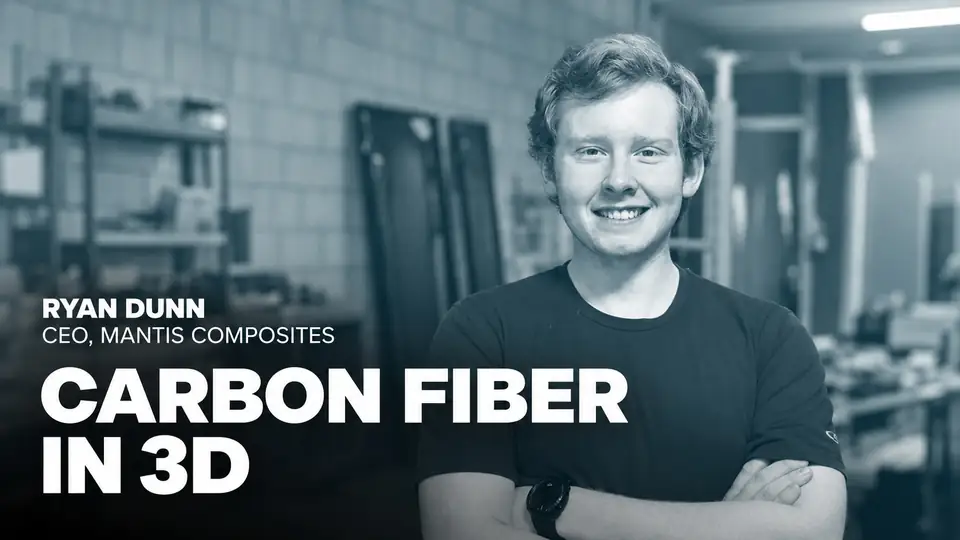
Ryan Dunn — Carbon Fiber 3D Printing and the Next Generation of Machines
Ryan Dunn discusses carbon fiber composites as an enabling technology for lighter, more capable machines.
June 30, 2020 · 44 min



About the episode
"What we're really trying to accomplish is, providing another tool for one of these step changes. Something where we go from an expensive & manual process to one that's highly automated to enable the next generation of machines."
In this conversation, we talk with Ryan Dunn the CEO of Mantis Composites.
Mantis Composites has developed a 5-axis, 3D printer for carbon fiber parts. In the development of this technology, they're helping usher in the next step change in materials innovation. Innovation that will enable the technologies of tomorrow to be built more efficiently and affordably — technologies like rockets, satellites, hyper-cars, and planes.
In this conversation, we talk about the step changes throughout history; Ryan's most anticipated technologies and their implications; and the role that government can play in helping foster the development of these frontier technologies.
Links
Chapters
Times follow the podcast audio. The video’s timeline may be slightly different.
- 00:00Welcome to Build The Future
- 01:10Materials, manufacturing and economic step changes
- 04:33The components behind ambitious machines
- 06:55Space infrastructure, supersonic flight and satellite internet
- 11:09Why faster travel can matter
- 14:09What makes carbon fiber composites useful?
- 18:19Why this manufacturing approach became possible
- 20:46Lightweight parts and aerospace applications
- 25:08Working across defense and commercial technology
- 33:02Funding hardware and explaining enabling technologies
- 36:38Long development cycles and working backward
Read the conversation
Open the full transcript
CAMERON WIESE: Welcome to the Build the Future podcast, where we share compelling visions for what the future might look like. Visions that inspire you, instill a sense of wonder, and get you thinking about the possibilities of tomorrow. I'm your host, Cameron Wiese, and today we're talking with Ryan Dunn, the CEO of Mantis Composites. Mantis Composites is building a 3D printer for carbon fiber parts. This technology is helping usher in the next step change of innovation in the world of manufacturing. Manufacturing where they're creating materials that are used in all of the technologies that will shape our world. Like rockets, satellites, hypercars, and planes. This technology is literally helping build the future, which is why I'm so excited to have Ryan with us today. Ryan, welcome to the show. Thank you, Cam. Good to talk to you. So on this podcast, we're aiming to share the compelling visions of the future and the stories of those like you who are building it. Can you tell us a little bit about what you're trying to build with Mantis?
SPEAKER UNCLEAR: Yeah, so fundamentally what we're trying to do at Mantis is allow for a step change in what we can do from a physical technology perspective. How we can make things go faster or use less energy when they're moving. fundamentally, if you look back over time, we define ages, right? So there's materials ages, bronze age, iron age, stone age. And then there's also manufacturing ages, right? Industrial age, and we can go through that. And as you mentioned earlier, what we're doing from a fundamental perspective at Manthis Composites is carbon fiber 3D printing, right? We've developed methods that we can use to produce extraordinarily high performance parts that are not otherwise available. But what we're really trying to accomplish is providing another tool for one of these step changes, something where we go from a manual process that can produce fairly simple parts to a highly automated process that can produce incredibly high performance parts that really enable another generation of machines and of transportation. And we're doing that using the technology that you described, carbon fiber 3D printing. And it's really tailored in order to to produce that kind of step change. What might that step change look like? What are the things
SPEAKER UNCLEAR: that we'll be able to build in the future? Sure. So, you know, usually when we're looking at new
RYAN DUNN: materials or new manufacturing processes, frequently what they are accomplishing is not a change in what can theoretically be made, but rather a change in what can be made and operated economically, right? So something where instead of saying, all right, it's going to cost $1,000 for me to get a helicopter that crosses a city, and that's not an economical thing to be doing on a daily basis, you can say, all right, well, now we can make a machine that is light enough, that is inexpensive enough to manufacture, that is easy to replicate, so that our operating costs and our initial purchase costs are such that you can actually operate it in a way that you can use it on a daily basis, right? That's sort of going down the unmanned aerial mobility, manned aerial mobility, depending on which kind of form we're talking about direction.
RYAN DUNN: But there's a lot of directions like that. You see that in satellites. You see that in rockets. You see that in a lot of different areas. And so fundamentally, I think if you want to look at what is that step change, what's that next generation going to look like for what we're doing and also for a lot of different technologies, the question is, what is that bleeding edge right now that is really cool, but you think there's no way that's ever going to really affect me? And what kind of technologies exist today are getting developed today? Or could I develop that will bring all of those bleeding edge technologies that seem ridiculous now and bring them into a realm where they're actually affecting somebody's daily life. And so I think that that's really where you frequently see those step changes.
RYAN DUNN: And the easiest example of this is sort of stone age to bronze age, right? You can sort of make a sword out of stone. It's not easy, but you can do it. And you know, it's not great, but it took a new material in order to get to the point where that was something that was readily accessible, where you could use that material to have something that many people could use that could fundamentally change society, as opposed to being, you know, a nifty thing that a couple people have
CAMERON WIESE: access to. So it's very similar to what SpaceX is trying to do with the rocket launches. They had, in the sense that there's this very expensive process and they found that by reusing certain components, they could bring the cost down and make it space flight more accessible to everybody. So what you guys are doing is making certain components of certain technologies to bring the cost down so that you and I, as normal civilians, will be able to use those sorts of things, right?
RYAN DUNN: Right. So actually SpaceX is a really interesting parallel here. So a lot of people think, oh, SpaceX is like the cutting edge technology. And the reality is it's not really, right? If you talk to somebody that worked on the space shuttle program, they'll tell you that, you know, all those gimbling systems and all of the propellant systems, a lot of those, you know, it's not like SpaceX is developing new technology. Frequently they're tuning it to be a lot better than it was in previous generations. But fundamentally what SpaceX is doing is changing the way that rockets are manufactured and reused as sort of an aspect of that in order to have that greater accessibility. So, you know, there's a very similar step change there. Again, nothing SpaceX is launching is something you couldn't theoretically launch, whatever, you know, 60 years ago.
RYAN DUNN: But it is stuff that wouldn't have made economic sense to do that with. And so, you know, the way that we're approaching that is sort of at a different level. SpaceX is assembling the big fancy machines that you can really see, you know, they're hundreds of feet tall, whatever. The reality is all those are made of components. And all of the components are undergoing the same thing. Right. So they all in order to make a big machine like that more economical, more capable, you need to have all the small components that are more economical and more capable to make that happen. And, you know, those are really two ways to sort of approach that industry. And so from our perspective, you know, we're approaching it very much from a component perspective because it allows us to have a much broader applicability.
RYAN DUNN: So, you know, in SpaceX, they're very focused on rockets and some satellites starting on that now. We're able to focus on, sure, there's some satellites, but there's also UAVs and there's also hypercars and there's sort of this whole mix of things that allow for a step change like that. It's a little less public. There's smaller vehicles getting made, but the impact is still enormous. It's still something that is fundamentally changing the way the economics on those sort of next generation of machines work.
CAMERON WIESE: What do those next generation machines get you the most excited? because right now everyone is very hype on the SpaceX launch. But I know as someone who is on the forefront of hard technology, there's got to be other things that you're looking at and you're saying, oh my God, that's so cool. What are some of those things?
RYAN DUNN: Yeah, so I think that right now there's probably three areas that I'm most interested in. Not putting them in any specific order and also not assigning a probability of success to any of them. You know, the reality is that there's always areas where there's a startup that's really pushing it. And that's great. But it also doesn't necessarily mean that's going to happen. There kind of needs to be a preponderance of companies and variables that enable it. But I think that three areas that are really starting to gain speed and become interesting are lunar and cislunar economics. So getting from a point where we have a space station that's up there that theoretically you can rent space on a space station, but it's not like you're going to be doing anything.
RYAN DUNN: You know, you might be doing some research. You're not going to be like manufacturing something that makes sense, at least right now. I think a lot of technologies are changing to allow that to move into some where, where you can actually manufacture something economically, where you have people up in space whose job it is to be in space, not because they're in space, but because they're doing something in space. Right. That fundamentally can't be, can't be done any other way. And, and, you know, that's like a profession, not just like, you know, a couple astronauts that get to do it and really broaden what they're doing. So I think a lot of the economics there are starting to change. And I don't know how fast that's going to take place because there's sort of the fundamental economics, there's the fundamental machine capabilities, and then there's also the economic willingness, right?
RYAN DUNN: So there's the investor willingness, there's all that, and that kind of ebbs and flows. So I think that's one. Another one that I think is going to start to move here is supersonic flight. So, of course, we kind of had Concorde, and Concorde was a great thing initially, but the problem was it had not achieved operational readiness yet. So it was not cheap enough. It was not reliable enough. It was not needed enough, really, in that version of the world to where it made sense to be flying those jets. The technology has kind of caught up to the operations at this point. And I think that we're getting to a point where looking at much faster flight is going to start becoming interesting here in the next 15 to maybe 20 years.
RYAN DUNN: And I think that that's a really interesting place to look. And then the third area is in low Earth orbit satellites. So obviously, I have a focus here on the aerospace side. That's mostly where I live. That's also sort of what I can speak to most accurately. That's a really interesting development. So there's a lot of people betting for and against these huge clusters of low-Earth orbit satellites that can supply the world with internet. And it's a little bit unclear, you know, especially recently there's been sort of a rash of bankruptcies related to that. But the promise is very interesting. So right now you can get satellite internet anywhere in the world, but it's unbelievably expensive. And the lag is really high, right? The latency is really high because you're bouncing a signal all the way out the geostationary orbit and back again.
RYAN DUNN: And you think, oh, well, light goes really fast. Yeah, well, that's a really long way. You're talking like seconds there. So getting something where you actually have connectivity in the whole world that's fast, that starts to get really interesting. Especially in the U.S., we're under the impression that most people have reasonably fast Internet. And that's really not true. A lot of people do, but a lot of people don't. And that is true for individuals. It's also true for companies that are operating in crazy, weird places that are hard to get connectivity to, and that dissuades operations. So I think that that's a really interesting area. And if it really gets going, I think that that'll be a step change. So I think those are the three areas that I'm probably most excited about. Whether or not they're the ones that'll have the biggest impact, I don't know. It remains to be seen. But those are certainly the ones that are most interesting to me.
CAMERON WIESE: What does that world look like when we have supersonic flight? Is it just people get to travel faster?
RYAN DUNN: So the short answer is yes, but the implications are broader than that. So fundamentally throughout history, the speed at which we've been able to communicate has governed a lot about what can and can't happen. And the internet has solved some of that. But I think one of the fallouts that we'll be looking at for a long time from coronavirus is that working entirely remotely and on the internet isn't the end-all be-all. You can't do everything on the internet. And so, yes, that has had an enormous impact on how we work and the speed at which we can work. But fundamentally, there are a lot of things that still need to happen face-to-face to some degree for a whole variety of reasons. And the faster you can make that happen, the more stuff happens, right?
RYAN DUNN: the more time you have people stuck in planes with garbage internet, the less time they're spending doing something valuable. And the less time, the less willing they are to do that also is the other aspect of it. So, you know, I travel usually 50 to 60% of the time for work. And if I didn't have to deal with plane flights, especially, you know, transatlantic, transpacific plane flights, that would give me an additional 15% of time I can be playing with, both because the schedules work out and because time zones work out better. And so everything starts to move more quickly. Is it the kind of thing where you're going to go get on the plane, get off the other end and go like, oh my gosh, that took 10 minutes instead of 10 hours. That's amazing. No. It's going to be like, well, that took an hour less, two hours less than it would have otherwise.
RYAN DUNN: and that's great but when you have millions of people saying oh that took an hour less two hours less that's a big deal and that's the kind of thing that can can change a lot about how the gears of the economy turn so i think that that's probably the bigger implementation is just how you know how that speed will affect how people work and how people function that's fascinating
CAMERON WIESE: especially when you think about the the category of traveler who is who are making those trans Atlantic or Trans-Pacific flights, generally the business people who are sitting on those planes, they're doing high leverage work. So the sooner they can get to their end destination, sooner they'll be able to close that deal, do that research, share that report or whatever
SPEAKER UNCLEAR: it is that they need to do. Yeah, no, that's absolutely true. You know, there's always an argument to be made that executives don't necessarily do as, you know, as much as the people on the ground or whatever that is. But the reality is those people are still getting stuff done. And is it possible that they could be getting stuff done in other ways? Maybe, maybe not but the reality is the the more you can use people like that that are doing those transatlantic flights whether it's you know flying all over the place doing things or whether shorter flights enable them to do more things from home or whatever that combination is the better right the the faster those gears are going to turn and one of the other things I want to talk
CAMERON WIESE: to you about is can you explain like what is so great about carbon fiber what is that going to
SPEAKER UNCLEAR: do for us so so that's a really good question I'm actually going to answer that as it relates to composites overall, right? So you almost never see carbon fiber as just fiber, right? It's basically a yarn. There's a couple applications for it as, you know, just a raw thing. But it's almost always used with a resin, right? Something that binds it together. So the cool thing about that is it basically allows you to cheat. So fundamentally, the reason the materials fail is because there's some crack, right? Some start of a failure in that material, and then that expands throughout the material. Composites allow you to take a material, turn it into a bunch of fibers, so that if one fiber fails, that crack doesn't propagate through the rest of the material.
RYAN DUNN: And then all of a sudden, you're kind of cheating, because if you have one fiber fail, the entire material doesn't fail. And you can use materials in those fibers that you can't feasibly make in any other way, right? So you can't make a carbon brick that has the same material as carbon fiber. It's fundamentally a material that's stronger in one direction than the other. It's called an anisotropic material. It means that if you theoretically, at a very small level, took a carbon fiber and cut it into a block, it wouldn't be the same in all directions. So it allows you to use these materials that have different strengths in different directions. And it allows you to cheat by having a material that doesn't just fail when it starts cracking.
RYAN DUNN: Now, carbon fiber specifically, why is carbon fiber so great? Well, carbon fiber is really great because it allows us to take advantage of a type of bonding that's very challenging to get in other ways, right? So having that sort of continuous carbon fiber bond, right, where carbon atoms can bond to a bunch of other carbon atoms and they can do that essentially indefinitely, that's what gets you insane materials like the graphenes and the carbon nanotubes. But essentially, carbon fiber is structured in a similar way. And so it allows you to access that type of bonding in a way that you can make stuff out of. Because before carbon fiber existed, we knew that that was a strong bond. We knew that that was something that was going to be a great material if we could turn it into a material.
RYAN DUNN: It's sort of where graphene and carbon nanotubes are now. It's like, all right, we know in theory that they're great materials and we've made some. But the connection between where we are now and a block of graphene that you can use for something, it's just not there. So carbon fiber was sort of an initial step like that. It allowed us to use these materials that already exist and sort of cheat with the composites.
CAMERON WIESE: What was that moment where I went from, oh, carbon fiber is this theoretical thing like carbon nanotubes or graphene are right now. When was that switch to, oh, we actually know how to apply this or we can create it?
RYAN DUNN: Yeah, so realistically, that was about 50 years ago. It's hard to pinpoint sort of exactly when that was happening, because composites have been around for quite a while. So what sort of happened is we could produce carbon fibers poorly before we got to the point where we could produce them well. So like, you know, the first Edison light bulb used a carbon fiber in it. But if you tried to make a, you know, material, structural material out of the light bulb filaments, it would have been worthless. So about 50 years ago is sort of when our manufacturing processes started to switch over to the point where carbon fiber, we started looking at it and going, okay, this is competitive. And so before carbon fiber, the king was basalt fiber. So it's volcanic basalt that they melted down. They basically put it in the cotton candy machine and pulled it out and made into fibers. And that's still remarkably close to carbon fibers. I mean, it's not quite there.
RYAN DUNN: It is in a couple applications, but it sort of happened 50 years ago that that changeover happened. And of course, basalt came from glass fibers, fiberglass, which is still, of course, used in a lot of different places. So it's always been this sort of evolution, and you've kind of gotten this continuous improvement in properties over time. And shift happened about 50 years ago for carbon fiber.
CAMERON WIESE: So if the shift happened 50 years ago, why is the technology that you guys are creating just now starting to come about?
RYAN DUNN: Yeah, so there's a few answers to that. But the easiest one is that industrial components got a lot cheaper. So, you know, what I've said before is if you really wanted to build our printer 40 years ago, you probably could have. It would have been astronomically expensive. And there's no way that the economics would have worked out to have that be the thing that you're using to produce your, your parts. So what sort of happens starting sort of, you know, 2005 to 2012 was a lot of industrial components started to get a lot cheaper. So all of a sudden, you know, yeah, sure. If you want to make some really simple thing, it was cheap enough to do that. But now you could say, all right, we're going to make a five-axis machine, you know, machine that can really access a lot of different places, a lot of different angles. And that's going to be cheap enough in order to be economically feasible on application. So for us, what we're fundamentally doing is using material that's been around again for like 50 years, but we are making components that you couldn't previously make out of that. So prior to sort of what the technology we're working with, you could make big sheet structures. So, you know, the outside of an airplane, the fuselage for an airplane, the airplane wing, you know, whatever that sort of really big flat structure is, but if you want to make some intricate component, that was very, very challenging.
RYAN DUNN: It was either very expensive or essentially impossible. And the problem is that most of the really high performance machines have to have a lot of intricate components. So you can take a lot of the weight out, you can get a lot of the performance by changing the outside shell, but you still have anywhere between 30 and 40% of those machines by weight that's made out of metal. And the reason it's made out of metal is because it's impossible to make that part or it's not economical to make that part out of something else. So what we are doing is we're applying a lot of these sort of new age industrial controls. They're a lot cheaper and more easily accessible to a material in a way that allows us to make much more complicated, intricate components that can replace a lot more of the metal than previously we could with the same material.
CAMERON WIESE: Sweet. Can you tell me about some of the parts you guys have replaced and some of the applications of the technology you're creating?
RYAN DUNN: Yeah, so it's going to sound mundane, but a lot of what we do is combining big parts, brackets, clips, fixtures, right? That's a lot of it. And the reality is that that makes up a lot of weight in a high-performance machine. So when you have to attach the skin of a wing to whatever the frame is, the hydraulics, the cabling, whatever it is that's running inside that structure, that adds a lot of weight. And that's the kind of thing that we are frequently working on. And there's also a lot more esoteric applications. So carbon fiber has a really low thermal expansion. So you can heat it up and cool it down. And you can really tune in how much it shrinks or expands when it's doing that. And so a lot of times we'll be focusing on making some kind of component for a satellite that has to be very thermally stable, right? So if it heats up or cools down, nothing, you know, no, none of the optics warp around, none of the antennas warp around, and you can, you can get the same lock on whatever it is you're trying to focus on on the ground using that. There's a bunch of applications like that, but those are, those are sort of common applications that we're dealing with.
RYAN DUNN: And to kind of put a scope on the kinds of parts we're doing, this is always a fun thing for me to think about. You know, if you look at like the Saturn V rockets that bring people to the moon, Most of the parts in there were taking maybe 50 G's, right? That means that they were vibrating around and the peak of that vibration, the most acceleration they took was 50 G's where it's like 50 poles of gravity that they're pulling away. Maybe the astronauts took a peak of 7 G's, something in that neighborhood. To put in perspective where that bleeding edge is now, the highest G load we've had on the part that we made was 286 G's. And that bar has just moved massively.
RYAN DUNN: And kind of going back to the point I was making before, that cutting edge never really stops evolving. It's a question of how can we bring that cutting edge down to something that affects your daily life? So a lot of what we're trying to do is take those applications where you're getting 200 and whatever Gs and give a part to the customer that allows them to start to bring that cost down, allows them to put that in the application that is actually usable and really starts to change what's happening at sort of an economic and global scale.
CAMERON WIESE: Can you talk about any of the work you guys are doing now? What sort of companies you're working with? What sort of applications you're seeing? Your parts?
RYAN DUNN: So most of the companies we work with are large aerospace companies. And that's a really interesting market. So it's challenging for me to discuss specific ones and specific applications. but one of the most interesting things about that market is that there's not that many companies yeah it depends on how you skin the cap but there's probably anywhere from 20 to 30 big players in aerospace in the world and that's you know that's kind of that right when you when you really look at the the companies that are making the vehicles that you think about right the planes the satellites whatever it is so from our perspective a lot of what we end up doing is looking at ways that we can expand what we're offering to those customers within what they do, as opposed to, you know, how is it that we can find a new customer? Because frequently, you know, we have some amount of project, you know, some development project, whatever it is, with almost all of those major players. The question is, how can we work with that customer to find a new interesting area, of which there's many, right? Those companies are enormous. So it's not like if we have one development program here, then we're doing something over there.
RYAN DUNN: So in terms of who our customers are, you can look at a list of big aerospace companies and probably have a pretty good idea what that list looks like. But the interesting thing is where we go within those companies. So a big focus area for us has been military UAVs, satellites specifically, sort of medium to larger satellites for sort of the short term. And then also some on the hypercar and high performance automotive front. So that's really the kind of vehicles that we're targeting most, but we're not really limited to that exclusively.
CAMERON WIESE: If you're working with most of the big players, there may be some conflicts of interest if you're working with different governmental organizations. Has that been a challenge for you guys?
RYAN DUNN: Well, the short version of that is frequently it is a problem, but it's also a lot of that is codified. The question is, why is it codified that way? and how do we make sure that we are following that? So one of the most challenging aspects of sort of any defense department around the world, any commerce department around the world, and depending on the government, there's a bunch of other organizations to get involved, is where do we set the bar at what we don't permit to be exported and what we do? It's really easy to think, okay, well, there's commercial stuff and there's defense stuff. And those are two separate entities. But the reality is they're not. So the technology that went into the space shuttle came from defense.
SPEAKER UNCLEAR: And the technology that was developed in the space shuttle program went back into defense. So let's take the tile from a space shuttle. Is that a defense product or not? Well, that's challenging. And it's very challenging to do in a way that doesn't limit innovation, but conforms with sort of the goals that that government has internationally, right? So we're trying to avoid weapons from going to somebody that is going to use them irresponsibly, but we're also trying frequently to help the societies that we don't want to have those weapons innovate in ways that give them access to larger economic levers that they can use to, you know, help their populace. So from our perspective, there's sort of two ways that we get involved in that. So, you know, the first way is when that gets codified, we make sure we understand not just what those, what that is, but also the reasoning behind it. Because there's always, you know, gaps and loopholes, but our goal is not to, you know, find that. Our goal is to go in and be able to say, all right, you know, what is it that we can do to help not only our sales, but also help expand what we're trying to do, help improve the capability of the machines that said customer in said country is working on, but also make sure that the intent of whatever this rule or law or whatever it is, depending on what country it is, is followed.
RYAN DUNN: So that's sort of one side of it. And the other side of it is when we see areas where that's getting challenged, which is frequent. So in our case, none of the rules were developed for carbon fiber 3D printing. Nobody at the Commerce Department sat down and said, well, we're going to make a bunch of rules for, you know, ITAR, EAR rules for carbon fiber 3D printing. So a lot of what we'll try to do in that case is, all right, you know, let's try to follow the intent. Let's also see if we can interface with the people who are setting these and make sure that they kind of understand what we're doing and why we're doing it and make sure that the future goalposts get set up reasonably.
RYAN DUNN: So, you know, frequently you are, it's tempting to say that, let's say a really big company like a Lockheed Martin, you know, they're doing the same kind of thing at a much, much larger scale. And it's really tempting to say, oh, well, you know, Lockheed Martin is just out there or, you know, Boeing or SpaceX, whoever it is, they're just out there lobbying, trying to get their weapons sales, and that's all they care about. that's usually not the case right usually they're trying to make sure that those policymakers are educated in terms of the decisions that they're making and sure they have they have a horse in the race but it's not like they're unnecessary right that that involvement is critical and fundamentally those companies don't benefit from an extraordinarily unstable world No company wants instability everywhere.
RYAN DUNN: It's in their benefit in some ways and in some forms. But the idea that a defense company is going out and just trying to promote chaos, look, there's a few in the past that have done that. And the short version is that those are historical companies, not current companies. The people who are really going out there and know what they're doing, they're trying to optimize for the same thing. So for us, in many cases, we're trying to mirror that. We're trying to make sure that we're in the game, playing the game, and really helping our customers in other countries, especially on non-weapon related stuff that's regulated as some kind of weapon. A lot of what we're trying to do is make sure that that is synced up and working in a way that really benefits all the parties involved. So yeah, that's something that we jump into a lot.
CAMERON WIESE: it seems to be one of the challenges in some of this forefront innovation is it's also new it's uncharted territory and you have i guess a lot of it does fall under this defense category right so anyone who is like any of the big aerospace companies any of these research labs that are doing something leading edge won't that stuff generally get classified or bucketed as you know things that should stay within the country it was created in
RYAN DUNN: Sure. And that's what happened to the internet. So you remember, right, the internet was a DARPA project. It started out as ARPANET. And through a lot of work by a lot of people, it was eventually released in a way that we can use now, right? We're talking over it right now. And that's because a lot of people put a lot of time and energy into making sure that it didn't end up being a defense thing forever. The fighting force against that is when people see something like ARPANET, they frequently only see the defense applications. And that's really challenging because if you only see the defense applications of something and you go and talk to your congressman or your senator or whatever you're doing, you're speaking out online about it, you're making it less likely that that will ever benefit people in the future.
RYAN DUNN: So there's that problem. And the other problem is it doesn't encourage, especially companies and organizations within the Defense Department, to talk about stuff. So it doesn't encourage declassification of things that really shouldn't be classified. Because the problem is if you declassify something And then all of a sudden, there's, you know, a huge outrage. Well, all of a sudden, you've just deleted all the future benefits of that, right? It's really hard to manage that in a way that is productive for everyone. And so within the sort of realm of classification, that's always the fight, right? We want to make sure that we don't turn this into sort of a PR disaster for whoever's involved. but we also kind of want to make sure that that this is ultimately it's a government thing right the government's trying to do something that is beneficial to the people that they serve and there's always sort of this six to one half dozen the other how do we manage that classification and of course there are programs that need to be classified right there's that system exists for very good reasons yeah but a lot of it doesn't necessarily and the decision you know of course this is not a decision that I'm making or a decision anybody usually in private industry is making, but a decision that, you know, people at the defense department or the state department are making is, you know, how do we, how do we manage this in a way that that's really beneficial, both to our direct needs and also to the government overall.
RYAN DUNN: And that's a hard decision to make.
CAMERON WIESE: One of the other things I want to, I'm very curious about is what does the investment space look like for, for some of these forefront technologies when the return is so far ahead in the future and everyone is clamoring to invest in the latest SaaS application or e-commerce play. Can you tell me a little bit about your experience with that?
RYAN DUNN: So I'll sort of start off by taking a whole look at the industry because to some degree, you know, what you touched on there is really important, right? There's a lot of investors that are after the SaaS play. There's a lot of investors that are after the, you know, whatever programming, you know, some really fast non-hardware play. And that's not everyone. That is a specific group of investors. And it is a very large group of investors. It is realistically the majority of investors, but that doesn't mean that it's everyone. So, you know, it's rare that a software really fundamentally changes something to the degree where your payoff is enormous, right? It does happen. Don't get me wrong. It does happen, right? Microsoft, Apple, right? Yeah, that kind of stuff does happen.
RYAN DUNN: But frequently the technologies that really pay off are the hardware. So like silicon chip manufacturing, that one paid off big time, right? Aluminum, manufacturing aluminum, that one paid off big time. so there are investors that recognize that the challenges that it's very challenging to for investors to understand the full landscape so it's really easy for an investor to go in and say okay you know rockets are that's going to revolutionize something let me put money in a rocket company the problem is that they're trying to do that with rockets they're trying to do that with cars or trying to do that with a whole broad range of stuff. And it's very challenging for them to understand what are the key things that need to be accomplished on that rocket in order to make it higher performance and make that step change possible. So, you know, we're kind of one of those companies, right? We're not making the rocket. We're not making the thing that is sort of directly related to that step change that you're thinking of, but we are something that's an enabling technology, right? We're, we're sort of fundamental to that. So the challenge for us is always connecting those dots, finding investors that we can connect those dots with and that are willing to see that out. So it is true, right? Big hardware plays like this take longer and fund structures that those investors have frequently have to be different than a software-based fund structure in order to accommodate that. But those kinds of investors are out there. It just means
RYAN DUNN: that my job as a CEO raising money is a lot more on the education front than it would be for a software company. Because most of those investors, they already know the inputs and outputs and how that's going to work. There's a bunch of market adoption risk, but the technical risk isn't there as much. Whereas for us, there's a lot less market adoption risk. If you can make something lighter and economical, in the median term, the outcome is practically inevitable. right? But the question is, you know, how do I match that up with what I'm seeing in the market and with what those technological risks are and understanding those in a way that I can understand and accommodate in my investment portfolio. So, you know, onus is on me in many ways to make that kind of conversation happen in a way that's productive.
CAMERON WIESE: Very cool. How are you thinking about the timeline when most people are fleeing to the the quicker wins the like let's go to silicon valley let's go start a startup let's go try and play that game but you've taken a different approach where you're you're kind of buckled in for the long haul all right the technology you guys are creating may not really see itself out
SPEAKER UNCLEAR: for another few maybe like what five ten years yeah that's a pretty that's a pretty hopeful assumption right in terms of realistically speaking you know there's there's payout opportunities at sort of that five to 10 year standpoint, but the, you know, the really big implementation where you're seeing these step changes enabled by the technology that does take a long time. Cause we're not, you know, we're not just waiting for, for our technology to, to catch up to what the customer requirements are. We're also waiting for, you know, them to then develop the vehicle off of that, that, that gets through FAA approval or whatever approval body they need to get through and then you know then then is manufactured enough that it makes that change so yeah there's there's x opportunities in that five to ten year time frame that are that are good but you know the full the full arc here is is a long one and that's something you point out
CAMERON WIESE: so for for the timeline right so this this arc is going to take a while how do you think about it because personally like i struggle with that how can i think 10 20 30 years out is that just something that's just like inherent to you you're like oh this is kind of cool i'm gonna work on it
SPEAKER UNCLEAR: for a while just hack away or yeah so i think a lot of people are more challenged thinking in long term and less challenged thinking in the short term and for better or worse i am the other way around i always think long term first and frequently i'm blindsided by the short term so So, you know, from my perspective, how am I thinking about it? When I started the company, I thought, all right, fundamentally, from a humanity perspective or from a high-performance machines perspective, what can I do to change this thing? And then I kind of worked back from there and worked into a business model where the short-term realities line up well enough that it makes sense, that it's something that's investable, that it's something that is something something that I can get employees behind and founders behind and business partners behind.
RYAN DUNN: And, you know, if you don't have all that, then you're doomed to failure. It doesn't matter if you make a great plan a hundred years from now, you're not going to be alive to see it and, you know, you're never going to achieve it. So, you know, you have to work back from there, but I frequently am working in that very long-term perspective and then kind of moving back from there. In terms of, you know, how I think about it, I'm lucky that I, you know, I don't have an incredible drive for, you know, the financial, direct financial outcomes from this. So I'm not trying to say, you know, oh, I'm going to exit in two years before it makes sense. And one of the key things we've done is try to get investors that are behind that. You know, I'm not asking them to say, all right, we're going to exit in, you know, 30 years or some ridiculous thing like that.
RYAN DUNN: Obviously, no investor can get behind that. But I am structuring the company in a way that permits that longer-term thinking. I'm still within the investment horizon and still within the horizon that business partners can get behind and that kind of thing. But that's very much the way I've approached it. And it's kind of the way I think through things, which is a benefit and a curse.
CAMERON WIESE: No, it's really cool when you're able to take that long-term view and then work backwards. So the last question I have for you is kind of in line with that. what was that what is the what is that long-term vision that that kind of inspired this for you so when you are thinking about okay what do I want to go work on you painted some picture of the future and you're like okay how can I how can I build something that's going to support that like
SPEAKER UNCLEAR: what was that that future you envisioned I won't lie I'm partial to aerospace of course and I can yeah and so so you know I can make arguments all day long that say you know aerospace is is the fundamental thing that is going to revolutionize as a society. I think that some of the people working on CPU processing or AI would all have disagreements with me as to whether or not that is the end-all be-all, but certainly it's the way that I think. So for me, going back to your initial question of what are the things that you're excited about, that's the kind of thing that I was thinking about. All right, if we're going to take these technologies that are bleeding edge now or have been bleeding edge at sort of the same place for a long time and are waiting for something to happen before they become me. You know, what is it that I can do to change that?
RYAN DUNN: So looking at, again, internet all over the planet that you can really utilize effectively, ways to get between places way faster than you normally would, ways to start utilizing resources beyond earth in a way that's economically feasible, effective, and beneficial to society. those are the things that I was kind of thinking about and continue to think about and have thought about for a long time and that's sort of how I ended up where I am now is thinking about those things and working backwards how is it you know what what can I do to do that and you know realistically it's easy to think oh well you know then I landed on carbon fiber 3d printing but that's realistically not not the case right I did a lot of personal projects I built a lot of built a lot of machines both growing up and through college and to today that sort of exemplify that, that need those high-performance components. And that's what allowed me to kind of get to the point where I'm going, all right, well, if I'm having this problem and I'm not making stuff that's incredibly bleeding edge, but cool stuff, whatever, then that means this problem must be enormous as you scale up into the stuff that's really bleeding edge. So it's nice to think about, well, I thought about the long-term thing and kind of landed on this. That's not really true, right? I thought about the long-term thing, started doing some stuff around it, and then got to the point where I kind of had an idea of what those fundamental limits were and, you know, which
SPEAKER UNCLEAR: ones I might be able to address. Thanks for joining us for this episode of the Build the Future podcast. If you want to learn more about Mantis Composites, head to mantiscomposites.com. And if you want to learn more about Ryan, you can go to rduntech.com. Both links are in the show notes. Furthermore, if you're interested in exploring the ideas discussed in this episode or on this podcast, head on over to buildthefuturepodcast.com and sign up for our newsletter, where you'll get weekly updates on our episodes and our newsletter that dives deeper into each theme we discuss. Lastly, if you like the show, we have two asks. First, please leave us a review on iTunes or wherever you listen to the show. It helps us get discovered by more, more folks.
CAMERON WIESE: Second, if you have a friend who you think would enjoy this episode, please send it over to them. The best way for us to grow this community and this podcast is when we have amazing people like you sharing it. Lastly, lastly, if you have any feedback or ideas, please reach out on Twitter at buildthe underscore future or email us at hello at buildthefuturepodcast.com. That's it from us. Until next time, go build!
More episodes
All episodes Getting Food Robots Out of the Lab — Rajat BhageriaRajat Bhageria explains how Chef Robotics deploys food-assembly robots, learns from factory operations and tackles real-world automation.
 Chris Power of Hadrian — The Future of Manufacturing, Space, and AmericaChris Power makes the case for rebuilding the manufacturing supply chain behind space and defense.
 Aaron Slodov — Atomic Industries and the Future of ManufacturingAaron Slodov and Cameron discuss how policy influences the adoption of new technology and how AI might support public decision-making.