

Build the Future Podcast
Roman Teslyuk of Earth AI — The Future of Mining, Energy, and Materials
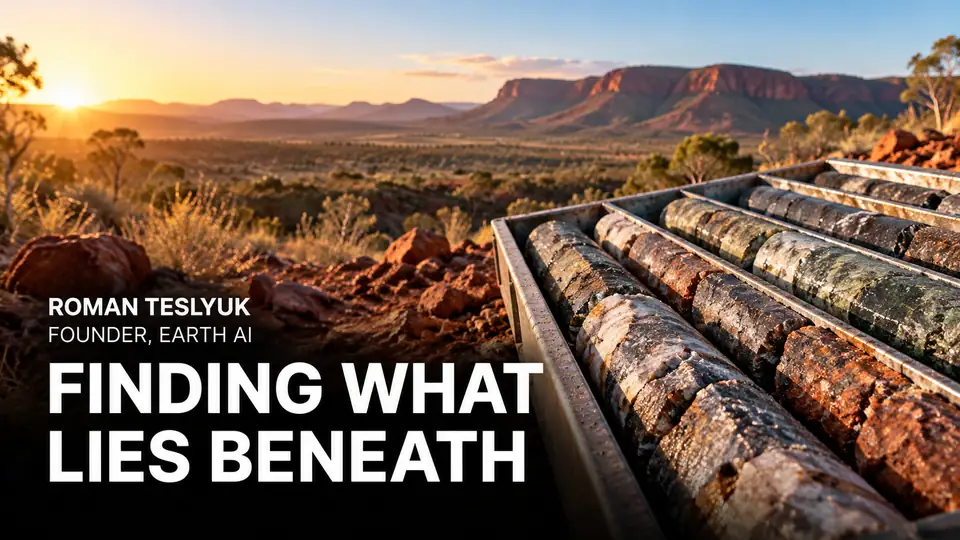
Roman Teslyuk discusses Earth AI’s approach to finding mineral deposits through AI predictions, fieldwork and drilling.
March 30, 2021 · 40 min



About the episode
In this conversation, we talk with Roman Teslyuk the founder and CEO of Earth AI. Earth AI is a vertically integrated metals exploration company that finds and develops metal ore deposits required to manufacture technologically advanced products. In this pursuit, they're helping ensure sustainable energy production and clean mining practices.
We cover the definition of value, tribal signaling, sustainable energy, and more!
Links
Chapters
Times follow the podcast audio. The video’s timeline may be slightly different.
- 00:00Introducing Roman Teslyuk and Earth AI
- 01:29Value, vision and supporting ambitious projects
- 05:25Digital assets and the meaning of value
- 07:27Community identity and ways to contribute
- 10:45The physical world and the pandemic economy
- 15:12Metals for sustainable energy
- 18:10Why new deposits are harder to find
- 20:22Learning from geological archives
- 22:08From predictions to evidence in the field
- 24:30An exploration funnel and mobile fieldwork
- 26:37Drone surveys and remote logistics
- 27:43Rethinking the drilling operation
- 29:16A closed-loop drilling-fluid system
- 30:58Mobility, water and site disturbance
- 32:23Exploration today and future mining ambitions
- 34:02Cuttings, contamination and waste handling
- 35:42Critical materials and planetary exploration
- 37:53Finding Earth AI and closing thoughts
Read the conversation
Open the full transcript
CAMERON WIESE: Welcome to the Build the Future podcast. My name is Cameron Wiese and I'm your host. I've always been fascinated by the ideas and sentiment that drove American culture in the 1960s with the space race. A culture galvanized to dream about the possibilities of tomorrow, whether it's food, transportation, cities, biology, or anything else. It was this cultural mindset rooted in optimism that the world tomorrow would be better than the world today. A mindset where people were compelled to build things, and I quote JFK, not because they were easy, but because they were hard. It's this desire to build and to dream that seems to have been lost, and something we're here to bring back. With Build the Future, we're here to promote the ideas and stories of those who see how the future can be better and promote their plans to get us there. It's our mission to get you to dream about the possibilities of tomorrow, to dream about the future that you want to live in, and inspire you to go build. Today, we're talking with Roman Teslyuk, the founder and CEO of EarthAI.
CAMERON WIESE: At EarthAI, they're developing a vertically integrated metals exploration company. In doing so, they're accelerating both sustainable development and planetary exploration.
SPEAKER UNCLEAR: Let's jump right in.
CAMERON WIESE: The most exciting problem I can work on is how do we shift the culture so that people have conversations and care about the future? Because at large, people are kind of indifferent. They want the world to be better, but there's no movement in that direction.
ROMAN TESLYUK: Yeah, no, it's true. Because, yeah, we kind of got into this consumer growth sort of wealth mindset. That's like the that's the main thing, the main point of the of the of existence. It's not, you know, it's like they're selling this to us because it's good for business. But what if we just start selling a different thing, which is like, let's do some cool projects. I'm like, I was thinking like, is like about the public markets right now. And it's like, it's not really that much anymore about the kind of asset performance and how much profit it brings. It's more about the story and the future. Even Tesla raising 30X, it's just because they're cool, mostly. If the performance of the... And there are companies that are like a mining company, I know, I don't want to tell, but their market cap is like 30-ish billion dollars. and they're not costing profits for years, but they're worth, they're valued at 30 billion. Like what is value of a company? Like just producing revenue and doing some work,
ROMAN TESLYUK: but then obviously they're not actually making any money themselves. So, but they're valuable. So what is value? If doing something important with a purpose has the value in itself And it's not making profits. Well, then it should be done. And, you know, and people can support it and it could be funded well, it doesn't need to look for profit, you know, maybe like a company or business doesn't need to look for profits, if it's doing something really valuable. And it could be just successful like that.
CAMERON WIESE: Oh, that's, that's an interesting way to think about it. Like, people are like, no, no, we want this to exist. We want to support this company, we want to support this mission. And we don't care if it generates revenue or not, but that runs counter to the fundamentals of corporate finance that a lot of people on Wall Street or in industry are making their forecast and they're building their models off of. But I think everyone's sick and tired of the world being so static of things not changing, of things not getting visibly better, right? I mean, you can argue kind of socially and economically and medically things have improved, But we don't, a lot of people don't see that in their day to day. I think there's this frustration with the system and if they can put their money in a company that's giving them hope for a better future and helping contribute to that cause,
SPEAKER UNCLEAR: people are doing it.
ROMAN TESLYUK: Yeah, I guess, you know, that is the thing, you know, because we come back to textbook like business must make money. Obviously, in the past, there was a lot of speculation on the stock market where people who were genuinely like making money of giving promises and not fulfilled, but like if a company, you know, even going back to Tesla, Tesla had like a huge vision and they also delivered on it. And that's why they became so valuable because they have a huge vision and they deliver on it. And it's probably like such an outlier. That's why they are like 10 times more valuable than the best next best car company because the next best car company either doesn't have a huge vision or doesn't deliver or they have like a very little, not very little, but much more, much more ambition and much more execution kind of backs it up. So, like should the company be valued by the amount of their vision and the quality of their execution to kind of deliver that? Not necessarily, you know, on the balance sheet
CAMERON WIESE: performance. Yeah, I think the other thing, other dynamic play here is the definition of value has changed, at least in the mind of the consumers. Why do people buy Bitcoin? Why do people buy NFTs? And I know that's like, it's super hype right now, but it's just fascinating watching people put their money into these because they just believe in it. Like, you know what? I don't know if this is ever going to make any money, but I want to support this ecosystem. So I'm going to spend $70 million on a digital piece of artwork. And they have the capital to do it because they believed in Ethereum or Bitcoin five, six years ago, and now they're sitting on loads of cash. And they're like, cool, I want to make the world better.
SPEAKER UNCLEAR: I want to do something different.
ROMAN TESLYUK: When there was a lot of speculation, then the market just having that sort of public market was the solution to determine the right price and have people in control. And it was kind of like, it's a market, so it's fair. But, you know, like, obviously, back then, you know, the market, like every all the shares and products on the market, have the backing, cannot the asset that backs it up with physical one that you know, you have to, you can own, you can sell, you can like, it produces dividends, produce some profits, but Bitcoin is like, hey, why do we need this asset, you know, The ability to trade is an asset in itself. Like we don't need to waste all the money for handling that asset shipping. Like even with normal stuff, like no traders are getting close to where their goals should be delivered because they bought some of these. They're just the futures, right? And I guess, you can't really print it. So it's a good sort of standard of value now when all the other currencies are getting devalued. Well, yeah, exactly. Like how do you define the value,
ROMAN TESLYUK: like the market value? Do you need even the asset? Or like, is it the asset or is it just purely how much people want it?
CAMERON WIESE: Yeah, I think there's also this kind of other element at play here, which is kind of this like tribal signaling. You want to be a part of something bigger than yourself. We all want to be a part of something bigger than ourselves. And if you can say you believe in support Tesla, you're part of a community of hundreds of thousands of other people who are also like, hey, we want a world with electric cars, and we're supporting Tesla. And we will pay for it because we believe in it. Same with the Bitcoin ecosystem or the really, really anything. It's like we want to tie our identities to something. And we now can find other people who share those identities using things like Twitter and Facebook and all that. So everyone who has these weird interests can now connect. Whereas before, you're just like that weird, I was that weird kid and you know, the out in the country who was like obsessed with computers. And I'm like, this is weird. I'm the only one. But now that's like not a not a thing. Because you can go online and find everybody.
ROMAN TESLYUK: Yeah, you know, you, you obviously have the people that are physically building the cars at Tesla, but, but they need the support of like, to get something really kind of change the world, you need the support of millions, hundreds of millions or billions of people. And that's, and that's part of that, you know, like, if it's a if it's a large enough movement, and it's, it's like, it's likely to succeed because of all the support. And looking back at the individual, you don't necessarily need to go and start a company and go through all the hurdles to, because it's really hard. And you might not be able to do this. And you just, you shouldn't be like, okay, that's if I, if I, you know, if I'm too busy, or I have a different plan for my life, so I can't do anything, so I shouldn't, you can contribute in any way they can. And that's how the people find their purpose in the way of what, okay, I'm gonna like, invest in Tesla or support Tesla or support Bitcoin or support something else is changing the world in any small or big way, and it's really relative. They can,
ROMAN TESLYUK: so in a way they can, and that's kind of cool. And they are not less, if you relatively take their position versus anybody else in the world, no matter how rich or poor, they're doing their part just as well as anybody else.
CAMERON WIESE: It's cool because anybody can get like regardless of resources or knowledge, like you can get involved, whether that's starting the company or liking tweets and sharing stuff online. Everybody can help be involved in building like the future they want to live in, which
SPEAKER UNCLEAR: is sweet.
ROMAN TESLYUK: Yeah, I think it is important that people are active. You know, I think it's the important bit here is like being active in making choices and making decisions and doing something, it's much better than being passive and kind of watching the kind of how the events fall around you. And yeah, people want some future, they should be more, they should be active. And just yeah, it doesn't matter if they are wrong sometimes, but it's better to do something and you make a mistake than to do nothing.
CAMERON WIESE: Absolutely. That's why I'm so optimistic for 2030. Because I think 2020 with COVID was the year where most people woke up to the realization that people who were supposed to be making sure things were operating well, at or asleep at the wheel, media is decaying, our academic institutions are decaying, our governments are decaying. And we're like, wait a minute, why are these people like, who are these people that are supposedly responsible for our wellbeing and our safety and like are the things we're consuming content wise. Like, wait a minute. How did they get there? They're not doing the right job. They're not doing their job. So, all right, well, I guess I have to do something. And then people are starting companies, they're starting podcasts, they're starting businesses, they're starting to get involved in politics, they're going to Twitter and they're voicing their support for people and for organizations and for things that are are kind of fighting the status quo. And play this out 510 years from now. Everyone is gonna be in positions of leadership is
CAMERON WIESE: going to be shaped by what we're going to or what we've what we've been going through. And that's super exciting to me. I don't know if you feel the same way.
ROMAN TESLYUK: Yeah, I mean, 2020 was like a big standstill. And in my opinion, it's kind of like really pushing the boundaries of our society in terms of like in economics, in terms of how we can do things. And firstly, firstly, I think things were very logical, you know, the lockdown and the, you know, the kind of share market crash and everything went like just the way it should be. Like if we are not using product, you know, if we're not working this, but then things became really kind of huge trust into the future of the economy and just huge growth that's kind of mostly on paper. The markets grew while the economics shrank 10%. That's kind of surprising because we're going more and more kind of into the software world. And sort of like our economy is more about our imagination, not about the reality, because like a lot of the real problems of the world hasn't kind of moved forward that much in that time, but we were way more entertained watching more Netflix and this and so we thought the life is you know the world is growing. So that is that sort of disconnect is what kind of is kind of
ROMAN TESLYUK: interesting to me because is that just the new way where we don't care about the real state of things? Why do you need to like this? There are beautiful games camera, Moon exploration and Mars and like galaxy fighting and you know, should we play games? And don't worry about building rockets.
SPEAKER UNCLEAR: It's so much harder.
ROMAN TESLYUK: Or, you know, we should get back into the reality of things and like, these are games that are not actually real. What we should do is to is to go and grab an explorer and what we're saying that, you know, there was this Mars rover. It just landed, which is amazing. You do what they make. It's really, really cool. So huge kudos to NASA to actually making that delivery done through COVID. That's really, really cool. But obviously, it's tremendously much harder now for the hardware businesses to operate COVID, change disruptions and things. And I feel like there is a huge amount of sectors of the economy that are just not happening, like travel, tourism. And travel is really important, I think, you know, between the cross the world, like to share the ideas as you were talking about your, you know, conference things. It's just really important for us. I'm not sure, I don't know if you can be just virtual all the time. I think we are like biological creatures. We do need that sort of in-person communication. So just so we kind of be refocused into something more virtual and less,
ROMAN TESLYUK: like more and more imaginative, I would say, less real. Whereas I think, I don't know how far we can go with kind of not taking the real problems. And real problems are really exciting.
SPEAKER UNCLEAR: We have to do them.
CAMERON WIESE: Tell me about the real problems that you're solving. What's the future you're building at Earth AI?
ROMAN TESLYUK: Yeah, so the biggest fundamental problem we're solving at Earth AI is the sustainable energy production. Because right now the world is powered by hydrocarbons. Since the 18th century, it took over the world. And we know it's polluting the environment. We know it's not sustainable. We know these are literally fossil fuels that have been deposited, you know, a few hundred million years ago, 10s to 100 million years ago, they will run out. Everything's been conserved there. We take it out, put it in the atmosphere. Like it's it is it is not not helping, like it's not the sustainable way to do to to to move ahead. And it's running out. But it is expensive. And also it's really not exactly feasible right now to move the whole world to sustainable energy like to go panels and wind and and you know others other things and obviously stardom and batteries. Why? Because to build this hardware for sustainable energy unique a lot of very unique metals that are not very usable very sort of like not usable not very commonly found
ROMAN TESLYUK: And the current rate of the world production cannot sustain that sort of massive growth. It doesn't really have enough deposits of these metals to build all the hardware we need to complete the transition. And moving further ahead on that problem, these metal deposits are also not sustainable and there's also a finite amount of them. The only good thing, a difference is that they're not getting used. So like we take the metals, we put it in a product, we make something from them, then we can recycle it and do something else out of it. But they're never getting used to just use them to build things, but we don't like actually use them, use them up. Whereas, you know, hydrocarbons, we use them up and we throw away the CO2 and that's it. The chemical energy that was in that hydrocarbon is get used, released, and then we have just the waste to deal with. And the waste that hydrocarbons produce is kind of like disappearing somewhere in the air, but you know eventually we're going to spend a lot of money, we already spend a lot of money, like from deteriorating climate and
ROMAN TESLYUK: like the air quality and the pollution and like the further we go, all those things we burn or the 20th century people burn, it's going to be all, we're going to have to pay all that in the 21st century for sure. You know, it's gonna, it's just a delayed, delayed remediation.
CAMERON WIESE: So we're at this point where we have, we're using up like all the, all the fossil fuels. So that's, and we're gonna have to deal with that because chemically we're altering that and we're gonna have to reclaim carbon from the atmosphere, do something. But then we're also gonna have to figure out a new, like something sustainable because moving it over into batteries or recyclables is also a challenge. How are you thinking about solving this? And what are
SPEAKER UNCLEAR: you guys doing at Earth AI?
ROMAN TESLYUK: So adding to that, but there's one more thing to tell you about the was metals. We also kind of found what we could found easily. So pick all the easiest, you know, like lowest hanging fruit already, because it was just sticking out on the surface, you could see greens of copper, you could see, you know, find gold in the streams and you know like that's all the prospectors before and like exploration companies and mining companies did that systematically but like now everything obviously been already found and we need to really find deposits either that are underground that are completely blind completely you can't see them or there's some sort of like a little sign like a small sign in the data that they're there, but they're not visually strikingly obvious. So the rate of actual rate of discovery has been declining crazy over the last two decades. And it's like the success rate the industry knows is about half a percent. That's right. You know, so that one in 200 projects become successful. And the world is spending more than 10 billion
ROMAN TESLYUK: indoors every year to look for new deposits. And on average, it finds around 60 and only like six of them are big, and the rest are like small. So overall, about 150 million per deposit discovery. And what we are doing is we started in 2016, sort of building a technology that will better, but more accurately predict the location of the mineral site. And the main concept was there is a ton of archive data from previous exploration. Since the 80s, it's more or less digital, literally millions and millions, hundreds of millions of samples that people have taken. Whether it was successfully or not, it's public data now. There is remote sensing data that covers the whole world. There is geophysical maps of gravity, magnetic and radiometric fields. There is geological data. There's a lot of public data in archives that has been carefully documented and stored. And the way it's used right now is only locally. When I have an expression license for some block of land, I would look at the archive, what has been done on that block of land before. And so learn from it.
ROMAN TESLYUK: And we thought there was a far more powerful way to use the archive data is to build an AI system that trains on the bulk of it. So all the exploration done over the decades, let's train on all that knowledge and then use that to predict new deposits. Yeah, so that worked well. We run like 80 industry trials. We had some success selling it. We run our own field testing. We've proven 26% success rate just out of our prediction in completely unexplored land. We can find copper just from predicting from satellite data. And that's 50 times better than the industry status quo. And it's a big game changer. However, we realized that was in 2018 after we had the success that it doesn't take, it doesn't build the whole bridge across the river. You know, this is a great start. Predict where it is. However, like to find deposits, what we need to solve the problem is to find more deposits of these metals that we could dig. And we have to supply more metals for the sustainable hardware, you know, sustainable energy hardware. So we define the deposits, you know, we find a better like
ROMAN TESLYUK: targeting method, but we don't actually find the deposits. Because to find them, you have to prove that they're there. And it's, it's quite a lot of work, because they're like in the middle of nowhere in the desert, you have to send people there, they have to take samples. They have to study the geology, geological structure of the area. They have to predict where the ore body should be. It's much harder than the oil and gas expression for metals because oil and gas, they're usually horizontal ish seem like, you know, layers of rock with hydrocarbons. With the metal deposits, they're like weird shape, not necessarily under. They're pretty small. They are like in the order of like a thousand feet per thousand feet. They're like a thousand feet cube. That's how big it is. And they're like at the depths of like down to one and a half thousand feet. So I guess like you gotta like you gotta poke them somewhere from the surface and try to hit them. and they could be whatever shape and not directly under what you see on the surface.
ROMAN TESLYUK: So it's much harder problem than the normal. So we then thought about that problem and we realized that the way to kind of guarantee success is for us to build a exploration funnel. So okay, a portfolio of projects that start from the early stage and then they get progressively matured and as we get more information and run that portfolio to guarantee our success at finding the deposit. On the technology side, what we need to do after that, after we predict the side, is to be able to safely send people out there to collect samples and map the geology, be able to survey the area in an efficient way and be able to drill. So drilling is like a three-dimensional, it's different from metals and oil and gas, it's like a really small drill rig and a small drill hole. And the purpose is to get a three-dimensional sample of the ore. And that's down to like a thousand feet or 2000 feet depth. You just go and drill it. So we, for us, obviously for that, thinking about that big funnel that has a lot of projects at the top and a lot of the bottom, we want to minimize the waste
ROMAN TESLYUK: because we are gonna like not just minimize, eliminate the waste. We, because we will, we're starting with a lot of projects we're gonna, we have testing. And then like we trim a third of it pretty much every stage. And it's like five stages. And we wanna make sure that, you know, if we test it, if there's nothing there, we move on. And the site that we went through, it doesn't have, it just, we leave it the same way we found it. So moving on, our predictions, obviously, it goes no harm. Our remote exploration is like a mobile camp for two people that they can sustain, kind of they can live for three weeks without resupplies. It's like a off-road car and a big trailer. And they have like enough water and fuel and supplies and shower and air content to live comfortably and explore for three weeks. It's the best job ever, by the way. It's just so, you know, you get food covered, you get to camp in the most beautiful remote places comfortably and every day you go for a hunt and you might find some some treasures. The stage after that is a surveying. We took an off-road car,
ROMAN TESLYUK: kind of blocked off the back and bought a drone with a magnetic sensor and so we have, we can fly around magnetic surveys. The fun thing about it is to run it constantly you need six sets of six batteries and you charge them constantly and the flight time is 20 minutes. But that's enough because the charge time is like one and a half hour or something. So by the time you charge, you deplete your six sets. The first set is ready back to charge. It's in the desert and it's really hot. We run the aircon. The car is blocked off, shielded with insulation, and there's a big aircon sticking out the back. So it's cooling this cool room for charging. And I guess we have to train our pilots and get the pilot license for the company but it's been fun and it's not that hard. People think it's really hard to set up a drone operation, it's not that hard. It's quite fun. And then the drilling has been a very major project and drilling we didn't realize how big it is. It's not just about buying a drill rig or building a drill rig as we started from building a drill rig. It has the logistics
ROMAN TESLYUK: part of it, it has the accommodation part of it, it has the kind of operating maintenance things. And the current status quo for metals drilling is pretty old, like maybe like technologies from like 40 years ago. You know, you have to get a bulldozer to dig your pits, make big kind of pools for mud. you bring everything in big trucks, you have to make tracks, and so it does cause the sort of scarring of the land and removing vegetation. So we wanted to remove that and also be much more efficient. And I guess across whole stages of our funnel, we wanna be quick, be accurate, and also limit the cost. Like the cost is really important. you know, our exploration is twice, maybe twice cheaper. Our surveying is about five times cheaper. Our drilling is designed and actually it does fulfill it. It's 50% cheaper than industry coal. And it's big because drilling in one drill operation is about five million and we do it for two and a half million. So it's massive savings. Yeah, so what we did in our drilling
ROMAN TESLYUK: research, like the hardware innovation is, we need to remove the need for the mud pools. It would build a closed loop mud system for an affordable amount. Obviously there are mud systems for oil and gas rigs, but they cost hundreds of millions of dollars and they're huge. You still need this massive tracks and bulldoze everything. The mud, the purpose of mud is to cool the drill bit to move the cuttings back. So there is a cord that comes out from the inside, but there is a cutting where the bit is that brings them back and lubricate because it's spinning. And we were thinking about who would do something like laser, but spinning and breaking turns out to be the most efficient process to make the core, to make the hole. It's very efficient in the product. Just getting the chips is really, You don't have to burn every atom cell by cell. You just break off. So the closed loop system we have is just text the mod and it filters it and it gets it back into production. So we don't lose anything and also closed off. So there's no evaporation. And it's also much cheaper.
ROMAN TESLYUK: Like it's like under 100 something K. So it's very significantly cheaper than buying something off the shelf for our own guests. And just in dealing with it, like within our thing is very mobile. It's like on a 20 feet container. So all the equipment we built, we built the whole kind of drilling hardware setup. And all of it is either in container basis or on trailers. Super hyper mobile. The big cost, big problems with drilling campaigns is that they are campaigns. you have to, when you get a contractor, you have to give them like a work program because they mobilize for weeks and then they stay and then they need demobilize for weeks and then if they broke it down, you kind of have to be there because you don't know what the fault is and then, and also we minimize the water trips and water usage because we really kind of, we use far less water because it's closed loop and it's insulated. That's kind of the main one. And all of our equipment, it doesn't require special tracks or bulldozers. Completely the need for bulldozers,
ROMAN TESLYUK: so any ground disturbance. So after we leave the drill site, there is really even the hole, the little small hole we make, like palm size, half palm size, depends how big the person you are. The hole is the size of a Pringles diameter. We fill it up, like we fill it up, and that's it. And all the ground we remove, so there's no digging. It's pretty impressive, I think. There's no track making, there's no digging. It's all really light tracks, and we kind of remediate them, and we don't do much of the clearing for vegetation as well. So we're really kind of exploring with the nature.
CAMERON WIESE: So you guys come in, you do the research, you do the scouting, you do the drilling to kind of test and that's to see if the ore and the minerals are there. And then the next piece is if you find something, then you kind of come back and kind of dig
SPEAKER UNCLEAR: up the site.
ROMAN TESLYUK: So the idea is we are finding deposits. We find deposits and we are assessing the economic potential. And then where's the company that will produce it? It is our plan in the future to produce ourselves. But again, we will need some serious research put into that. There is a lot of ideas on kind of how we can change the way mining is done. And the main one is obviously removing the open pits because they just have big holes in the ground that don't get filled up. and mining more underground. And there's like ideas about chemical or biochemical mining. Okay, minimally invasive surgery concept. Like we have tools that come down, you do the work and then they come out and you see nothing from a surface. And that is the importance. I think like an important problem to solve next. For us, it will probably be a few years until we get to work on it. But at least it's really important because we also need to think what we want to protect. And what we want to protect is probably the biosphere. And if you're a thousand feet down, there are just rocks.
ROMAN TESLYUK: And they're already chemically contaminated. I guess the other bit is the important bit about the chemicals and contamination, like the metals. At the concentrations we are in, they're toxic for everything we live in. Our sites might have 1-2% lead, like our site has 2% lead on the surface. It's not healthy. We need digging them up technically and like extracting, leaching out that metal and putting back things that don't have that metal anymore is not bad. that's kind of pretty good work when you think about it. With kind of our actionable work towards that is, the status quo on drilling is that people who dig those mud pools, they drill the materials, they leave all these cuttings with metals in the ground and then just close them off and leave them there. But it's not the material that actually came from the surface, it's like the material from 1000 feet down that has the little chemicals. You bring it up, you deposit it on the surface, and you leave. And you say, close enough is the bulldozer saying, was it some soil? And you're like, this is here, it's been there.
ROMAN TESLYUK: That's not true, you just contaminated this land. But all of our waste gets collected and driven out and disposed. Like because it's a closed loop system, we have to collect our own waste. And we don't pile it up on site, we drive it off. And I think it's a good practice for everybody to sort of pick up and start being cleaner
SPEAKER UNCLEAR: when they explore.
CAMERON WIESE: Why is this exciting? Why is what you're doing super exciting? Why should people get riled up about the ability to kind of mine things differently? And then what role is this going to play in our future?
ROMAN TESLYUK: It's exciting because it's exploration and it's kind of treasure hunting with a purpose. And the purpose is that we enable, but we just enable the possibility of transitioning to sustainable energy. Well, it's not really possible right now because we don't have enough metals. And we are focusing on these electricity metals, battery metals, electronics metals. But the other aspect is exploring space and other planets. And we wouldn't be able, Like when we build our process, it could be replicated on another planet. It's like we're starting from scratch and it's standardized and it's like an vertically integrated system. You take that and put it on Mars and it will work. We will need more automated equipment, but it will work the same way. I guess our dreams are, it'd be really cool to explore and find more. like find the metals to build the outpost on Mars. That'd be really cool. Or moon, like it's still really, really cool. I think it's just, you know, it is more about the future because, you know, somebody else into sort of the transport problem.
ROMAN TESLYUK: But then once we have the transport sorted, you know, the first thing we want to need is to establish sources of building materials for that outpost on a different planet. and we would like to help with that. And that is really exciting. I think there is this big vision that we have about exploring the planets and that really motivates us. But even like our purpose on Earth is super huge as well. The work we do creates these building materials for the new Earth that's going to be much cleaner. And I think it's something worthwhile to kind of devote your life towards.
CAMERON WIESE: Where can people find you and how can they support you in Earth AI?
ROMAN TESLYUK: You can find us by Googling Earth AI.
SPEAKER UNCLEAR: Nice and easy.
ROMAN TESLYUK: Earth-AI.com. I guess the importance is like how they can support us is understanding or raising the awareness of that we do need the metals to build the future. And, you know, there are people that are focusing on this problem and trying to solve it in a cool way.
SPEAKER UNCLEAR: Sweet.
CAMERON WIESE: Cause the issue is like, just to reiterate the key problems. We don't have the materials to like that, that are going to be required for us to completely transition to sustainable energy. So we need to find new deposits, new places to source from. And right now the way that we are currently doing it is not adequate.
ROMAN TESLYUK: Exactly. That's right. Yeah, we need to find a better way, build a better way to source critical materials for building a sustainable future. And that is a fundamental key that will unlock that future without it, we can't really do it.
CAMERON WIESE: I'm grateful for you for the work you're doing because we all have to play our part. and you found something that's like critically important that most people don't think about.
SPEAKER UNCLEAR: Thanks Cameron.
CAMERON WIESE: Thanks again for coming on. Excited to support you and Earth AI in developing this sustainable future.
ROMAN TESLYUK: Cool, thank you Cameron. We work hard to make sure we do solve this problem.
SPEAKER UNCLEAR: Ha ha ha.
CAMERON WIESE: Thanks for joining us for this episode of the Build the Future podcast. If you're building and want to get support, I want to hear about certain topics or hear from certain people. Shoot us over an email to hello at build the future podcast dot com or follow me Cameron on Twitter at cam wheezy and we'll see what we can make happen. That's it from us. Until next time, go build.
More episodes
All episodes Phnam Bagley of Nonfiction — The Future of Design, Experience, and Space ArchitecturePhnam Bagley discusses Nonfiction’s mission to turn science fiction into reality through design.
 Dr. Anton Howes of The Royal Society of Arts — Innovation, Invention, and Great ExhibitionsAnton Howes discusses the RSA, the history of invention and the Great Exhibitions.
 Ro Gupta — Maps, Autonomous Transportation and Urban MobilityRo Gupta explains the maps, road data and practical decisions behind autonomous transportation.