

Build the Future Podcast
Dr. Anton Howes of The Royal Society of Arts — Innovation, Invention, and Great Exhibitions
Anton Howes discusses the RSA, the history of invention and the Great Exhibitions.
March 16, 2021 · 42 min



About the episode
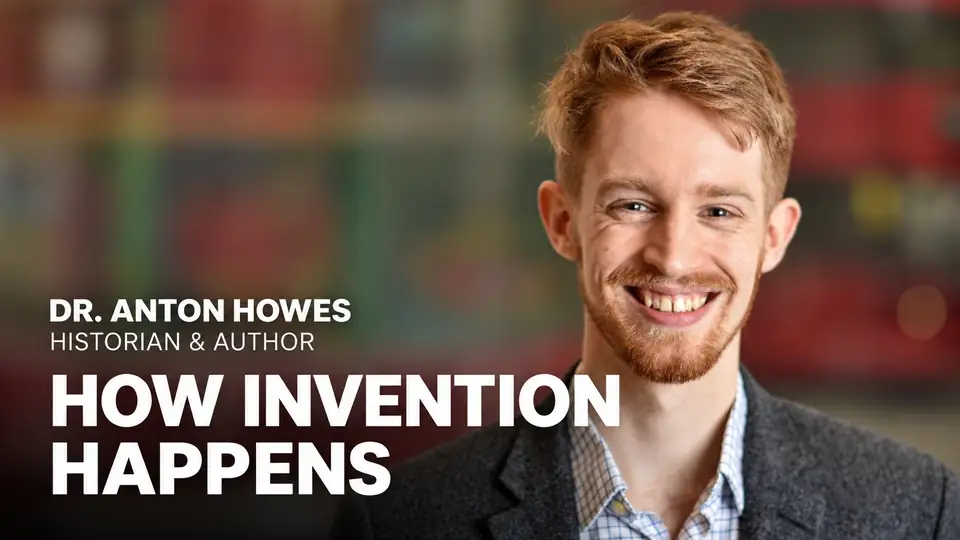
In this conversation, we talk with Dr. Anton Howes the author of Arts & Minds and the historian-in-residence at the Royal Society for the Encouragement of Arts, Manufactures, and Commerce.
In this conversation, Dr. Howes & I discuss his research, how institutions help drive progress, the history of invention, and of course, the Great Exhibitions.
Links
Chapters
Times follow the podcast audio. The video’s timeline may be slightly different.
- 00:00Introducing Anton Howes
- 01:36Writing and sharing research
- 03:21Arts and Minds and the RSA
- 06:16How an improving mentality spreads
- 08:14Learning from the history of invention
- 09:54Polymaths, outsiders and self-education
- 12:30Inventors inspiring other inventors
- 14:50Subcultures and public-spirited invention
- 18:11Thinking about growth and stagnation
- 21:46Useful narratives and progress studies
- 24:52The myth of effortless genius
- 26:26Resources and small improvements
- 28:53Progress and a diversifying economy
- 30:43A new Great Exhibition?
- 31:21Industry, media and a focal point
- 33:07Competition and the original Great Exhibition
- 36:10Mass appeal and specialist exhibitions
- 37:36Possibilities in medicine and research
- 39:17Making invention feel accessible
Read the conversation
Open the full transcript
CAMERON WIESE: Welcome to the Build the Future podcast. My name is Cameron Wiese and I'm your host. I've always been fascinated by the ideas and sentiment that drove American culture in the 1960s with the space race. A culture galvanized to dream about the possibilities of tomorrow, whether it's food, transportation, cities, biology, or anything else. It was this cultural mindset rooted in optimism that the world tomorrow would be better than the world today. A mindset where people were compelled to build things, and I quote JFK, not because they were easy, but because they were hard. It's this desire to build and to dream that seems to have been lost, and something we're here to bring back. With Build the Future, we're here to promote the ideas and stories of those who see how the future can be better and promote their plans to get us there. It's our mission to get you to dream about the possibilities of tomorrow, to dream about the future that you want to live in, and inspire you to go build. Today, we're talking with Dr. Anton Howes, the author of Arts and Minds, How the Royal
CAMERON WIESE: Society of Arts Changed a Nation. Dr. House has written extensively on the history of innovation and the role that the Royal Society has played in shaping invention in Great Britain. Furthermore, his research dives deep into why people become inventors and the institutions they create to promote invention even further.
SPEAKER UNCLEAR: Let's jump right in.
CAMERON WIESE: What's it been like for you since you published your book, gone on the speaking circuit? What's the process of sharing the vision of what you've been working on, been like?
ANTON HOWES: Yeah, so I guess two things happened at once. Well, first of all, the book came out in May 2020, at possibly the worst possible time when literally every bookshop in the world seemingly had closed. And it's I think it's done all right in terms of online sales. So I'm hoping one day to finally be able to go into a bookshop and actually see it on the shelf there to be bought because I've seen it. I've seen people post photos which are really nice of them where it's like, oh, I've just got the book in the post, here it is. And that's really nice. Otherwise, the promotion is, you know, I did that on Twitter at the same time I'm writing my second book. And so a lot of what I post on the sub stack will be almost like first drafts of bits and pieces that I'm writing. Very often, I haven't written the sub stack in a while, which is right now, actually, frankly. what I'll do is probably look over what I've just been writing in the draft and try to extract something and then maybe I'll package it up in a kind of more general way.
ANTON HOWES: Because obviously when you're writing a book, you can assume that people already know what you're talking about and you don't have to start things again and think about there being new readers you've never seen your work before you need to explain stuff to them fresh with with a blog or with a newsletter. letter. So there's always a bit of repackaging going on. But that's, yeah, that's what it feels like a lot of taking the kind of stuff I've already done and having to shift how it looks for different audiences, which is itself quite challenging, quite sometimes quite tiring, but you know,
SPEAKER UNCLEAR: tends to be rewarding.
CAMERON WIESE: So give me a high level overview of arts and minds. And then what's this next book you're working on?
ANTON HOWES: So Arts and Minds is a history of quite an extraordinary organization called the Royal Society of the Encouragement of Arts, Manufacturers and Commerce founded in the 1750s. Essentially, a pro invention or pro innovation group society set up by inventors to promote invention. I felt that there was a lack there of the kind of the next step taking stuff that we know, or new discoveries in the sciences and actually applying them to useful ends, you know, increasing living standards, solving diseases, so on and so forth. So the Society of Arts starts off that way. And it's a kind of, it's a, there's no, there's nothing quite like it, which is always the challenge and has been part of the problem actually, we try to sell a book about is that if no one's ever heard of it, really, even though it's been around for 260 something years, it becomes a bit of a challenge because so it's what I call it is Britain's national improvement agency. So in terms of it being an improvement agency, it's in anything and everything.
ANTON HOWES: So in the first hundred years, it's prizes for non-patented inventions, to opening new trade routes, to planting trees, for solving all sorts of social problems, even moral problems in some in some cases in the mid 19th century it becomes very much obsessed with exhibitions and the power of exhibitions to themselves promote invention and educate consumers and to raise people's tastes by exposing them to new things or showing them the things that they didn't even know that they wanted and you know kind of all of the effects that you get from that founding museums being at the head of a kind of movement to revitalize the old mechanics institutions, which are sort of bottom up, higher it's all further education institutions for adults to better themselves, to educate themselves, to raise their social standing and their kind of career prospects. And then, you know, kind of again reinventing itself with all sorts of other projects like lobbying for patent reform, copyright reform for all sorts of other minuscule changes.
ANTON HOWES: and in the 20th century becoming a sort of pro-beauty organization in some ways, first of all for the natural, sorry for the built environment, so architecturally speaking. So the sort of thing it does is constantly find things to improve, find a solution, promote that solution. If that solution is institutional, let that institution kind of go its own way and do its own things. and then start from scratch and try to find the next thing that they need to do. So it's a kind of, it's a weird story. It has a sort of almost social, hidden social history with lots of reformers that nobody's ever heard of, or very few people have heard of. So it's been quite an exciting thing to uncover that. So that's, that's the RSA book. That's Arts and Mines. And then the second project in a way is, is much broader, much older. Something I've been working on for almost a decade now, which is explaining why it is that innovation seems to accelerate from the 16th to the 19th centuries in Britain, I mean, continuing all the way to today, really, but looking at that period in particular,
ANTON HOWES: where England goes from technological backwater to the place that everyone's trying to copy and trying to emulate, and the hub, I mean, often quite a paranoid hub, often worried that people are catching up too fast that they're about to lose the lead, but still firmly in the lead in pretty much every respect, you know, industrially, commercially, even militarily, and so on, which, you know, often stems from that technology as well. So that's kind of my big project. And the focus there for listeners who are unaware of my work is on the inventors themselves, the individuals who made that happen. So it's gonna be me outlining my general theory of how invention works, which is that it spreads from person to person. There's a sort of improving mentality that people have, it's a kind of viral thing based on looking at the individual inventors and innovators of the period and you know what made them tick and you know having assembled this vast database of them and pretty much everything there is to know about them into it and
ANTON HOWES: extrapolate, well not just extrapolating but finding the patterns there and showing them. And also, and this is the bit that's been the holdup really with publishing this book, which is to outline a kind of history of British technology and innovation and the way people thought about innovation over this period. So what are the institutions that they're creating, the evolution of the patent system, the evolution of how people, how the population conceives of innovation, how the elites are thinking about innovation and how they're involved with it. And so a kind of general sweeping, almost like a kind of intellectual history that you might write
SPEAKER UNCLEAR: about an idea, but about invention, about improvement. What sort of future do you hope
SPEAKER UNCLEAR: to help create as a result of this work? That's a great question. That's something I've been
ANTON HOWES: thinking a lot. I mean, actually, I originally got into this topic because of the applications and thinking about learning standards and improvement and its importance. I mean, I would hope that in some way that this work will, by increasing people's understanding or our understanding of how invention, how improvement works, make it faster, you know, accelerate the acceleration because, you know, even if it means that we get 2030 living standards in 2025, that's a big deal for a lot of, you know, for potentially millions of people. And means that we'll also have 2035 living standards in 2030, you know, it's a bit, even a small acceleration or doing one's bit to promote invention is, I think, very important. So one thing I found from my work is that, you know, it's not just inventors promoting invention, you've also got evangelists or proselytizers for invention, who are also extremely important, you know, Benjamin Franklin's famous as an inventor, but he's also famous, I think, as an intellectual promoting invention, promoting improvement, has a much broader
ANTON HOWES: influence as a result of that, I think, than specifically inventing bifocals or discovering certain properties of lightning and helping develop lightning rods and so on. So yeah, I think that sort of thing. And finding lessons from the past, so looking at the way that people
SPEAKER UNCLEAR: used to promote inventions, seeing what we can learn from that. Yeah, I want to just jumping back
CAMERON WIESE: Benjamin Franklin. Through a couple of the other conversations you've had, I've gleaned there, kind of like a few high level patterns with inventors and kind of invention in general. One of them being that most of these inventors are polymaths. Can you tell me about, in the case of Benjamin Franklin, that's clearly the case. Can you talk about some of the other patterns you've seen?
ANTON HOWES: Yeah, so polymaths is one. Polymaths, this is not in the sense of some inventors are also poets, some of them are, but in the sense that if you're an inventor you can improve multiple fields. So improvement is generalizable. It's universalizable. I'm sure that's a word, but it's something that you can apply to anything and everything. So I've got examples like the engineer William Fairbairn, when he first starts getting this improving itch, you know, his first thing that he tries to do isn't engineering, which I mean he is trained as to try and reverse engineer the published love letters in a magazine because he has a crush on a girl in the village next door and he wants to figure out how to improve his love letter writing, so he gets one magazine, reads it, then he frames his own reply and then looks at the published reply and then compares that with his own reply and tries to work out where it could be improved, how to make it slightly better. So the other patterns, so polymathy is one, the other is that
ANTON HOWES: very often inventors are improving areas in which they have no prior experience or training. So again clergymen very often doing mechanical stuff, getting their hands dirty with agriculture, getting involved in medicine despite no formal training. And so what happens there I think is very often inventors can conceive of improvements, but they don't necessarily have the wherewithal to put them into effect. So they'll rely on experts, you know, in the same way that today, if you have an idea for a great new app, you don't necessarily code it yourself, you're still an inventor, but you might hire someone to put your vision into action. Yeah, so and so that's part of it is relying on others, but also very often, inventors educating themselves to solve particular problems. And when your computer starts acting up and you know there's some kind of error, what do you do? You go and find the solution to that specific area. You don't necessarily learn everything about computers to try and you know need formal training to solve a problem.
ANTON HOWES: I think invention is very similar because what's happening in the mind of an inventor is that they're identifying something as a problem which isn't necessarily seen as a problem. They're becoming dissatisfied with a status quo in that way. And so once you identify a problem, it's then just solution searching and that can be done to varying degrees and there's all sorts of different strategies for that. But the actual initial impetus behind it is this improving mentality. And so finally, well, actually there's two more. Another pattern is that inventors from all sorts of walks of life, you've got male, female, rich, poor, urban, rural, dissenter Anglican, Catholic, you know, any background you can think of. And that's certainly recognised, I think, more so today, but is something we perhaps take for granted. But I think isn't actually an obvious thing. So the fact that pretty much anyone, including skilled unskilled, right, as I just said, the fact that that that's part of the event that who become inventors, there's something interesting, I think, in that diversity,
ANTON HOWES: suggesting it's not something that's just purely skilled, it's not something that's reliant on some of those factors, but it's something that's happening in people's minds. And finally, there's the most important one of all, it's that people of the, so the vast majority of the inventors who I've looked at, so just under 1500 of them actually more now, these before they became inventors or before their first known improvements, they were, they knew other inventors. this isn't people searching one another out having invented and forming some club, it's that beforehand they, you know, well, while they were still young or sometimes they're older, but you know, before they were themselves inventing, they've come into contact with someone who has inspired them, sometimes directly face to face, most commonly directly face to face, I think occasionally indirectly through text, you know, through written works. Though even in those cases, I suspect that the person giving them the book or recommending the book is maybe the connection. I just can't capture that in the historical record. So it's
ANTON HOWES: an inspiration effect. And so this improving mentality is spreading from person to person, and you can trace it back through the network effectively as a sort of genealogy.
CAMERON WIESE: It seems like this is perhaps one of the most important things. How do we get people inspired in inventing new things? What do you think helped shape and develop this culture in the era that you were that you're studying?
ANTON HOWES: Well, it's often the inventors themselves. Inventors have always been around. I suspect the improved mentality is, I can't prove it either way, but I suspect it's been independently invented multiple times throughout human history. What's happening is that they're getting especially good at proselytizing. So one way of putting it is that the mentality is becoming more viral. And I think that's often from the actions of the people who are doing it themselves. So maybe that's in some ways just they're getting more successful and so they're becoming more visible and so you can be more inspiring if you're more successful right. I think a lot of it is also reframing themselves as somewhere in between commoners and the aristocracy and the elite. So part of what happens in the 16th century is sort of changing the meaning of expertise to be about capability, something that you can apply to anything in any situation rather than a very specific experience. So a great example would be a navigation. If you're someone who knows the coast of France extremely well, that's experience, right?
ANTON HOWES: But if you're someone who knows how to use a compass and read the stars, you may not know France very well, but you can maybe actually do all sorts of other kinds of navigation, including exploration. And you can apply it to other coastlines in addition to those ones. So the way experience is defined changes. So you have this sort of midway position. And then as a result of becoming more and more accepted by elites, they develop institutions to attract investment, get people bought in, in some ways actually too successfully because by the 17th century, you end up with a lot of inventors effectively becoming tools of the monarch as they try to become more absolutist and less democratic and try to stamp on older liberties of guilds and cities and certain people's kind of ancient freedoms, to the extent that after the English Civil War, when a lot of that has come to a head and been hashed out quite violently, to the extent that a king loses his head, then there's this project to try and redefine what an inventor is. They try and rebrand in many ways
ANTON HOWES: and show themselves to be less profit-seeking, more public-spirited, and so on. So in terms of culture, I don't think it's the case that England as a whole has, you know, some kind of culture of invention, but rather when we have cultures, they're really subcultures they're amongst specific groups of people they have common terms of references. They try to negotiate common norms, which may be change over time, right? And then so each generation is trying to renew those norms, is trying to renew those institutions coming up with new informal ways of talking to one another. And then those informal institutions will sometimes result in more formal level changes. So, you know, changes to law or changes to actual organizations and so on.
CAMERON WIESE: How do you think about that today? When you're looking at the world right now?
ANTON HOWES: Yeah, well, I'd say it's actually extremely widespread to the extent that we may be sometimes take it for granted. Slow growth is what we call stagnation rather than actual stagnation when nothing is growing. I mean, that's astonishing, right? In human history before the 17th century, we're talking, you know, it's actual stagnation and actual decline. And in a way that today there's nothing like that. Yeah. there's, you know, even worldwide, most countries are either catching up to the technical frontier or we're slowly pushing it out, right? So everyone's growing, they're growing at different rates and sometimes that growth can be can be slow but it's still growth, there's still improvement and even then I suspect we're mismeasuring or under counting some of that growth with the more traditional methods. You know GDP per capita is a decent proxy but I I think it radically underestimates things, especially because, I mean, in a very simple way, for it to be real GDP per capita, that is, accounting for inflation, you have a basket of goods that changes in price.
ANTON HOWES: The problem is that basket of goods keeps getting rerated because of quality improvements, or we add stuff to it, right? So it's like, you know, if we use the current basket of goods, then we somehow have to put in televisions in the 1550s, and that makes no sense, right? Whereas today, it's like part of common consumption for people with a certain number of people every year to have televisions and to pay for these things. Or the same with the internet, right? It's a, it's practically utility. Whereas we can measure things like light and, you know, heat and things like that, I suppose, going back, but we don't do it in quite the same way either. So if we actually took into account those cost changes, that would be even more dramatic, I think. I mean, just to give you a kind of a very easily understood example, as a proportion of our incomes, we spend historically very, very little on food, despite the fact that the food that we buy is almost unimaginably more diverse than it was in the 17th, 18th centuries. But that's not captured by the figures in quite the same way, I don't think.
ANTON HOWES: People do care about invention, they care about growth, there's certainly a bit of worry in in the UK for example about there being a productivity crisis, that this is something total factor productivity needs to be raised but we don't really know how because we're so used to it just happening in the background that I certainly there's been a lot of concern I think that there's stagnation and that concern I think is good. At the same time though the cultures of invention the little subcultures seem to be pretty strong. Innovation has become a buzzword sure but but you've also got people calling themselves makers who are tinkering with things. You've got people who call themselves, are called by others hipsters, who if you actually look at what they're often doing, is they're improving things. They're reimagining common items and saying, how can we make this more valuable to us? And we often mock that sort of thing, but I think it's the sort of mockery that you could trace back through the centuries. And there's something similar about every new fashion fad and trend.
ANTON HOWES: to actually these aren't fashions and fads and trends. These are things that we've just gotten very used to. In the 16th century, it's all everyone's got fancy colorful clothing. Today, you know, anywhere in the world, anywhere in the world, the kind of vibrant colors, for
SPEAKER UNCLEAR: example, people's t shirts, which we just take for granted with with back then be considered
CAMERON WIESE: quite astonishing, I think. I'd love to have you kind of elaborate a little bit on more of kind of how you view these dominant narratives and how they kind of shape our perspectives and kind of how they play with innovation and invention.
ANTON HOWES: Yeah, so I think there's a role for what I like to call useful myths, you know, that just because something's not true doesn't mean that it's not good to believe it. Actually, there might be some use to it in the same way that I imagined that maybe religion played this kind of role in trying to make sure that everyone wasn't just going around murdering everyone else. If you thought it was a sin, that's actually a useful belief for everyone to have. I suspect that, yes, I suspect that this is something about the stagnation thesis where the fact that we're worried about it, even if it's not actually a true worry, or there's no basis for it, is good because it's getting us talking about this and thinking about this. There's something separate going on, I think, with progress studies. I know it's partly spurred by that conversation, but there's another kind of phenomenon there, which is sort of almost like a lightning rod in some ways is that certain things or actions or articles can often have this effect where they attract a lot of people doing already doing this
ANTON HOWES: kind of stuff, but gets them to talk about it in a new way, or just have a label for themselves. You know, we see this in politics all the time, like think deplorables, whatever it's like, it allows people to, it gives people a word for something that they already had implicitly but they didn't have something explicitly. I think progress studies has been like that for a lot of my own work. Someone like Jason Crawford for example, is he a historian of technology? Is he a technologist? What is he? Progress studies, that works. There's a definition there. I call myself a historian of invention, which I still usually go by, but I think a lot of people probably associate my name with progress studies in to some degree as well. So what's useful there is, you know, it comes with an audience of its own, it comes with expectations of its own in terms of we know what debates we're going to be having if we use the term progress studies, I think that people who are in the progress studies movement, there's an implicit understanding
ANTON HOWES: that progress is or can be at least good. So there's not we're not going to have that debate or there's you know there's a few implicit assumptions there maybe some of that needs to be made more explicit actually for it to kind of last a bit longer I don't know that's I've been in a few conversations with people about whether or not that's the case certainly maybe movements need their gardening and kind of maintenance in that way and I'm still uncertain about where where that term is going because you know even just through entryism it could change completely right in terms of how people start using it if people start having particular kinds of conversations while using the label. So yeah I'm uncertain about where that's going but yeah so useful myths I think is part of it. I guess one of my projects increasingly has been that I think there are certain ways we talk about invention that are harmful to invention. I've been looking at this with film in particular, the depictions of invention film, which I think are part of the
ANTON HOWES: a general zeitgeist where you know people when they think of invention they have the eureka moment, there's the light bulb or there's almost divine inspiration going on or there's this idea of the genius in that. Now so you know a lot of people a lot of historians of technology are very critical of images of the great inventor. I think I share some of that skepticism, but what I think is actually even the worst bit within the great inventor narratives is the idea of the genius inventor. Like the classic example is Tony Stark, right? This is a guy who literally in one of the films like solves time travel in an evening, literally, he's like, oh, I just, I hadn't really thought about it before. Oh, now that I've applied my genius to this problem, now I've done it. So there's the kind of effortlessness of it, which I think is, it's just, it's not only is it wrong, but it's actually a bad myth. Because it means that if someone, you know, if we want more people to be inventors, if people think that you need to have some kind
ANTON HOWES: of God given gift, then those people won't become inventors, they'll they'll be dissuaded in some way or they'll, it lowers their aspirations. I think something potentially similar is happening with a lot of the kind of, if you, for want of a better word, cult of innovation around Silicon Valley, something that's perhaps damaging is how tied it is with money or resources. Now, the truth is, I think, that historically it is easier to raise money for some innovative project than at any other time in human history. In fact, it's almost like there's a shortage of good ideas to fund, not a shortage of cash, right? I think that's very much true. And maybe this varies a bit by country, but globally, I think that's the case, that there are places where it is extremely easy to raise the money for things. But at the same time, I think we do want more people doing the kind of low scale, cheaper, just in the garage, in the garden, down the garden shared kind of invention, improving their everyday lives, improving,
ANTON HOWES: you know, if you're a restaurant owner, making sure your restaurant is the best on the street, the best in the city, you know, we've got, I think we've got a lot of these subcultures because the improvement has become so endemic that a lot of people don't even consider themselves inventors, but they are because they're constantly improving things. I mean, just, I mean, just actually restaurants is a great example. In the 1960s in Britain, restaurants were meant to be terrible. Britain still has a reputation for bad food. Even though London's probably one of the culinary capitals of the world now, it still hasn't shaken this reputation. And that reputation was changed by a few individuals who made it their mission to improve the quality of eating out and then that kind of through emulation and competition and people wanting to outdo one another. and it naturally resulted in, well not naturally, it purposely resulted in a general standard raising throughout the city and now, you know, increasingly throughout the country, I guess abroad as well. So yeah, this is, I think this kind of,
ANTON HOWES: what we need I think is a sort of cult of marginal improvement, a cult of optimization rather than a cult of the great inventor. And then, you know, obviously celebrate the successes of people who implement these things. But I guess, I don't want the great inventor to be the rich inventor or the one with all the resources. I want it to be the person who's made significant and celebrate, there's something to write home about
CAMERON WIESE: in terms of the kind of improvements that they've made. It's almost like we wanna celebrate achievement over influence, right? Instead of like, oh, how many followers you have or how much money you've made? It's like, what good have you done?
SPEAKER UNCLEAR: what contribution have you made? Yeah, but I mean, there's even a risk with that though. So a lot of
ANTON HOWES: my favorite inventors are quite marginal improvers in the particular industry that actually as a result of other people's improvements has become smaller and smaller, right? So this is the thing I've been calling the paradox of progress, which is that as the economy grows, each part of the economy becomes narrower and narrower proportional to the whole. So a lot of what we call stagnation is I think just to the kind of looking at it from the general bird's eye view, it looks like things are slowing down. But if I actually zoomed in on any particular field, that field has pretty constant, if not sometimes increasing rates of improvement. It's just that as it improves, it gets a bit larger, but other fields get larger. Other new fields are invented, but then so proportionally things get smaller. So agriculture used to be easily
ANTON HOWES: over half the half of GDP. Agriculture now is more valuable than ever before, even in the service economies, right, we actually produce more food and of greater variety and greater value than we did before, but it's now less than 1% of our economies because the other bits grew even faster because it freed up resources for those things. Same with manufacturing. We think that manufacturing has declined in the US and the UK. Nonsense. If you actually look at the figures and trace it back to World War II, like, wow, we actually produce way more, or at least stuff of more value than we did before. We're spending much more on these things and people are buying much more of these things than at any other point. But we've become so efficient at it that hardly anyone's employed in doing it. Yeah, I mean, this is also partly why I think there probably is a need for a new great exhibition of 1851 or kind of old school world fair. I'm obviously the world's fair still going, but an old school world's fair is just to expose people to this. You know, like if I
ANTON HOWES: told you right that people are literally using mech suits in factories all the time, you'd be like, Oh, well, I thought that was just in movies. No, I mean, it's this commonplace stuff that people have augmented strength and they're lifting ridiculously heavy loads wearing these suits. That technology has existed for years.
CAMERON WIESE: When we think about exhibitions and world's fairs and the relevance they may have today, there seems to be one of the challenges, the role that the media has played in our inability to all get focused on the same thing.
ANTON HOWES: Well, I don't think it's a media problem. I think, if anything, they've got loads of support. You know, you've got, you know, the Garden Gnomes Association is coming up with an industry year display. And there's a there's a service in St. Paul's Cathedral. And with talking about industry and all the unions involved, the small business associations, the big business associations, they're all supportive. And they have lots of teachers partaking in industry related things and having people go to factory factory, kids going to factory floors. So the big thing that comes away from it is a lot of schools do end up with connections with businesses. I mean, I remember myself once going to I think some plastics manufacturer or something, got to design like a chess piece and a little competition amongst the kids and our little chess piece got made, you could see the machinery cutting it out. But that's it, right? There's no, that's not like it It inspired me to go into industry. The fact that I didn't suggested it had basically no impact at all.
ANTON HOWES: So there's this attempt, media did talk about it, I guess a bit, and you do get all of this kind of civil society support, but it lacks the lightning rod, right? It lacks the focal point. It was meant to be the TV show, which could have been huge, right? But it never happened for industry, never happened for invention. So I think, yeah, you need that focal point. that I think needs to be, we need more things like that progress studies article, where it kind of gets people to rally around something.
CAMERON WIESE: When you think back to the The Great Exhibition, what do you think people miss about the role that that played? Because we all look back like, oh, yeah, the world's first, oh, The Great Exhibition, like, what are we missing?
ANTON HOWES: A few things. So I think the world's fairs today are very much, generally speaking, there are a few exceptions to this, but generally speaking, they're a bit like national branding exercises for big countries. I mean, it's all state-led, like a lot of states who've signed up, it's all governed by international treaties and, you know, it's very bureaucratic thing and yes, they're big events, they get tens of millions of people along to them, but the kind of displays we're seeing are the sort of PR gloss of different countries that are exhibiting, whereas the original exhibitions, they had a particular purpose which was oriented around industry. One way of thinking, in fact the Olympics in some ways are inspired by the exhibitions, not the other way around. These are competitions of industry, right? So countries, different businesses are sending in their best and saying we want to win this and they have a sort of prize system, right? There are medals handed out and I don't think it should be reported in quite the
ANTON HOWES: same way as the Olympics. Like, you know, I can't imagine it being televised like, oh, we're going look at the different textile machinery, textile machines and see which gets the gold, but this year, maybe that's going a bit far, but it should have that kind of thing at its root. This is peaceful competition. It doesn't even necessarily need to be an international thing. Like I think, you know, the Great Exhibition itself was inspired by French national exhibitions of industry, which were created as part of a sort of catch-up strategy with Britain. So sending the best from all over France, and occasionally some international things and trying to work out what is the best of technology that they currently have, can they outdo last the previous one from a few years ago, and have this almost sort of audit of industry before we have the statistics that just tell us automatically what, after a bit of collection, what exactly is going on. So before GDP statistics, you've used the exhibitions to look at the productive capacity
ANTON HOWES: of the nation, of companies, of people, I suppose. And that has all sorts of effects, like it has this pro invention effect because it excites emulation, it gets people to see what the best is and then to try and do that as well. In the same way that I mean, we see this in in market economies anyway, right, that when Starbucks comes along, if you're a small coffee shop, you need to exceed the Starbucks, right. So I mean, this happens in a slow way in industry in the after industry after industry. And I think what the Great Exhibition did was it sort of concentrates that effect because for the 6 million people or 6 million visitors, I mean, it's actually fewer, you think of it in terms of unique visitors versus visits. It's six million visits, right? I can't remember how many actual visitors it is, but six million visits, right? Of those people who are coming along to it, this is, you know, they're seeing it all at once. They're seeing all of the different machinery. They're seeing all of the different designs and they're able to see what's better and what's worse
ANTON HOWES: and they can cultivate a taste for things that way. You know, imagine getting every advertisement for a great product that you actually will want all at once, you know, in the same room. So the effects there is, I think there's something commercial about them. I think that's lacking. So the closest thing to exhibitions of industry are big, you know, industry exhibitions, things like
SPEAKER UNCLEAR: the CES, right, even like South by Southwest or the Paris Air Show, or even like the, I don't know,
ANTON HOWES: the world's toilet Congress or whatever there probably is, they show off the best of toilet technology or plumbing technology or the best taps. There's loads of very specific, industry-specific things. But frankly, who's going to go to that except for industry insiders? What you want is an event that, by doing everything at once, has mass appeal. That way, if you have a really innovative new toilet, which you very may well, people are going to see it, and they're going to want it, and it's to create a market for that thing and most importantly, the other producers who have worse products will want to exceed you the next time and they will try to emulate what you've
SPEAKER UNCLEAR: currently got. What excites you the most about the future? I think we've got some really exciting
ANTON HOWES: stuff in medicine on the horizon. I really think we're just a few decades away from a lot of, like nearly all of the major diseases just being things of the past. There's that. But I'm pretty excited about us resurrecting some of those species. I mean we saw it just the other day where there was a ferret that had gone extinct and they brought back, they've cloned. That's really exciting. I think there's a lot that we can learn as historians, natural historians, but also you know even about just we could resurrect past breeds let's say of We can learn about the wool industry in the 16th century or something, you know, from doing that kind of research. That's really exciting stuff. And who knows what applications I'll end up having as well. The anti-aging stuff, I don't know if enough breakthroughs have been made for that to be on the horizon. I very much hope it is. I'm planning to, I'm hoping for 120 at least, and in good health. I think already a lot of our technology for improving our health, improving our environment is getting a lot better.
ANTON HOWES: And actually that's another thing I'm pretty excited about is clean streets, lack of pollution. A lot of that, it seems like minor stuff because each of the particular inventions can be quite small but it really accumulates. And that's often not just innovation technologically but in terms of institutions as well and how We govern those sorts of things.
CAMERON WIESE: I'm curious, like how you think about Elon Musk. He's like our, you know, demigod right now, saving the planet, if you will. But in a way, like he is making invention and progress and technology more accessible. And he's serving as a role model to a lot of kids, but he's also like fairly inaccessible as well. It's like, oh, he's this lone, lone genius. How do you think about the balance of those two things with someone like Elon Musk?
ANTON HOWES: I'm not talking about the real Elon, I'm talking about the cult of Elon, right? As a role model, I think there's some interesting positives. He's self-taught. I think that makes him more accessible. But on the other hand, there's the kind of Tony Stark genius vibe, which is inaccessible. He's successful, which is accessible because people, well, it's good because people are motivated to, you know, if he can become rich, I can become rich too. But at the other hand, well, how am I supposed to do space stuff? How am I supposed to get billions to do this or maybe you need certain connections or relationships or, you know, a great degree of luck to be able to, you know, work on those same problems. So there's some good things in the narrative there that I think are worth stressing versus some of these negative things where I think, you know, the ideal, right, is I guess someone who is self taught. So very accessible, who has made money but has come from maybe a very extremely poor background,
ANTON HOWES: where it's clear how the money has been made in a way where, and maybe where they're very clearly not a genius, and you can show that it's through incremental improvements. Yes, so I think, you know, this is why I mean that I think we need a cult of incremental improvement, or cult of incrementalism.
CAMERON WIESE: Thanks for joining us for this episode of the Build the Future podcast. If you're building and want to get support, want to hear about certain topics or hear from certain people, shoot us over an email to hello at buildthefuturepodcast.com or follow me Cameron on Twitter at camwheezy and we'll see what we can make happen. That's it from us. Until next time, go build.
More episodes
All episodes Eliot Peper — Science Fiction & CultureEliot Peper explains how curiosity about the present becomes material for fiction.
 Don Clark — Art & OptimismDon Clark traces his path from music and album covers to Invisible Creature’s illustration work.
 Phnam Bagley of Nonfiction — The Future of Design, Experience, and Space ArchitecturePhnam Bagley discusses Nonfiction’s mission to turn science fiction into reality through design.