

Build the Future Podcast
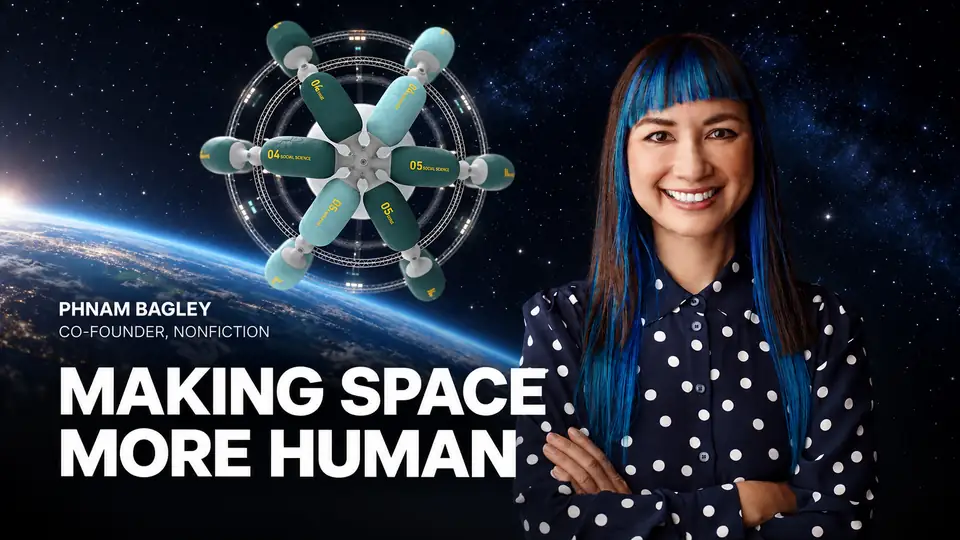
Phnam Bagley of Nonfiction — The Future of Design, Experience, and Space Architecture
Phnam Bagley discusses Nonfiction’s mission to turn science fiction into reality through design.
March 23, 2021 · 41 min



About the episode
In this conversation, we talk with Phnam Bagley, Co-Founder of Nonfiction - a creative studio specializing in industrial design, engineering, strategy, branding, user experience design, and space architecture. Nonfiction turns science fiction into reality for a better future.
We cover the future of space architecture, design, the self, and more!
Links
Chapters
Times follow the podcast audio. The video’s timeline may be slightly different.
- 00:00Introducing Phnam Bagley and Nonfiction
- 01:30Curiosity and connecting disciplines
- 03:32Finding a purpose for life and work
- 06:01Turning science fiction into something attainable
- 08:06Science, technology, design and art
- 09:22A different process for each project
- 10:52Rethinking education from human experience
- 13:03Designing for different ways of learning
- 15:51Self-awareness, difference and hierarchy
- 20:14Hope, agency and finding help
- 23:28Honesty and the conditions for hope
- 24:27What space architecture includes
- 26:19From surviving in space to thriving
- 29:29Starting with the human experience
- 31:09Adaptability and multisensory environments
- 32:02What designing for space could teach us on Earth
- 34:34VR, presence and staying connected to ourselves
- 36:55Having a part in the future
- 38:53Finding Nonfiction and Future Future
Read the conversation
Open the full transcript
CAMERON WIESE: Welcome to the Build the Future podcast. My name is Cameron Wiese and I'm your host. I've always been fascinated by the ideas and sentiment that drove American culture in the 1960s with the space race. A culture galvanized to dream about the possibilities of tomorrow, whether it's food, transportation, cities, biology, or anything else. It was this cultural mindset rooted in optimism that the world tomorrow would be better than the world today. A mindset where people were compelled to build things, and I quote JFK, not because they were easy, but because they were hard. It's this desire to build and to dream that seems to have been lost, and something we're here to bring back. With Build the Future, we're here to promote the ideas and stories of those who see how the future can be better and promote their plans to get us there. It's our mission to get you to dream about the possibilities of tomorrow, to dream about the future that you want to live in, and inspire you to go build. Today, we're talking with Phnam Bagley, the co-founder and creative director of Nonfiction.
CAMERON WIESE: In nonfiction, they specialize in industrial design, experience, branding, environmental and systems designs that turn science fiction into reality for a better future. Let's jump right in.
PHNAM BAGLEY: It's funny because a lot of times I talk about my background, which surprises people a lot and it's just not important because it's not important to me. I grew up in a project, nobody cares. That's just a fact. You know, this doesn't really influence the way I design the future of humans on other planets. And a lot of people really insist a lot on me talking about, you know, being a woman in design or whatever. And it's just something that's incredibly unimportant to me. I don't think it's an unimportant subject. It's an extremely important subject. It's just not important to me as my person.
CAMERON WIESE: The background stuff isn't interesting or exciting to you. What is? What are some of the things that get you really, really excited?
PHNAM BAGLEY: I'm extremely interested and excited about things I don't know. If someone comes in a room and comes to me and start talking about things that my brain can't even wrap around, that opens my appetite a lot. And that's probably why we work a lot with pretty extreme industries, you know, space industry, neurotech, biotech, and how to transform your body from wherever you are today to an ideal that works for you, finding happiness in places, using technologies that are very surprising. I love all that stuff because, you know, I never really learned about it in school or surround myself with people who do a lot of that stuff. And that always comes back to what kind of link can I find as a creative that have not been built by someone else, or or have been built by someone else, but haven't been designed in a way that reaches out to people, right? There are two bridges that I build, the bridge between two disciplines and the bridge between what I create and the person I'm designing for. And it's pretty rare to have one person do both. Different place, one person does one,
PHNAM BAGLEY: the other person does the other one. That's the nugget that's so interesting about the work that I do.
CAMERON WIESE: Tell me about kind of the feature you're building at nonfiction. What's the vision for the world you want to create through your work?
PHNAM BAGLEY: So a couple of years ago, I went to a leadership summit, south of San Francisco. And one of the exercises we had to go through is to find our own life purpose. And I showed up the thing and I was like, what is a life purpose? You know, I like you only have one, I thought everybody had 1000 of them. So I showed up the first year and I don't find it, right? I see a bunch of people having you know out of body experiences and finding their purpose and they're very happy and all that I don't find mine. I come back the second year kind of like anticipating what's about to happen and then I find it the life purpose that puts you know on paper for myself in one sentence and the one sentence thing is very important because it really synthesizes everything that you want to do is To turn science fiction into reality for a better future I realized that everything that I've done in my life, everything that I want to do now and everything I'm doing in the future is related to that. Whether my career is as a designer, as an architect, as a business owner, it doesn't really matter.
PHNAM BAGLEY: If I quit design tomorrow, I will still continue doing that. And that was a very, very valuable exercise that I went through. And since then, that life purpose has become our company motto. And one thing about company models is that the minute you write them, the minute you advertise with them, you manifest a lot of things. You know, all the companies, the world, you know, doing something along the line of sustainability, social impact, building, you know, joy, happiness, performance, longevity for the rest of society, just all of a sudden started coming to us. Because before that, the type of work that we're doing was pretty general in terms of design. who are designing computers and we're designing headphones and speakers and things like that. Things that honestly anybody else can do and I've never really been interested in doing what anybody else can do. Right, of course not. No, so really building not only my own path or my company's own path into the world of design but really building the future of what design is based on what we
PHNAM BAGLEY: wanted to be is where the life purpose was very instrumental in carving that path for.
CAMERON WIESE: Yeah, no, I love that. This is a bit of an anecdote. But I remember five years ago, I was visiting a friend of a family friend in Hawaii. And he was taking my buddy and I out to this kind of fish market, we were walking around, and he was talking about life purpose. I don't specifically remember what his was. He's like, Yeah, you got to find your life purpose, cam. And I'm like, I don't know what that means. But okay, Steve, like, sure. And really, I've had the back of my mind. I was like, what are we doing here? Like, why are we on earth? Like, what is what is my function? What is your function? Like, what is the point of all of this, right? We need to figure out some way to make sense of reality, and find something to kind of channel our focus and attention to otherwise, we just kind of like wither away. And really clicked with me about a year ago, my purpose, which is kind of is like why I'm excited out what y'all are doing. Mine is to support and inspire the building of the future. So less on the kind of sci fi side, but like, how do we, how do we coach people to become the best
CAMERON WIESE: version of themselves to go do incredible, heroic, world changing things. So so it's like, very cool that we're kind of on the same page there. But with you, for nonfiction, how did you land on kind of like that, like science fiction, as the word that you chose for your life purpose? And then is it like what science fiction has most shape you're thinking?
PHNAM BAGLEY: So when I talk about science fiction, I don't really think about movies or books or anything like that. What I mean by that is things in the future that sound completely crazy or magical today, but as engineers, as scientists, as designers, we know how to get there eventually. So I'm looking for things that sound completely crazy to the average person. And my job is to create the bridge between the present and the future. But I could do that in a way that a lot of people do, with prototypes of products that are very niche, very expensive, very unattainable. But my job as a designer is to make all of this very attainable. We design a product that helps physical performance. So you can learn things at the gym or learn to dance or learn to play an instrument a lot faster by stimulating your brain. That sounds like a complete science fiction, but that's actually science that's been around for quite some time. But a lot of people still today are terrified of the idea of putting electricity on their brain for one, and also not knowing how to put the thing on, right?
PHNAM BAGLEY: That's why the form factors are pair of headphones. So one is a lot less scary, and two, you don't necessarily need to know where your motor cortex is to learn this thing. So design to me is really that connector, right? Again, it's, it's, there's the science, there's the technology, design creates the connection. And on top of that, what I like to add is art. So art is really what triggers emotion, you know, something that's you're in front of something on the presence of something or someone talks about that thing. And it makes you feel a certain way you desire it or you, you want to be around it, or it has a certain energy that speaks to you. So really playing with these four elements of life, science, technology, design, and art, I think we can build a wonderful, wonderful future for all of us.
CAMERON WIESE: On the art evoking feelings, I know just intuitively what you're saying, but how do you go about designing for that? How do you take a problem or take some creation and design it so that it evokes the sorts of emotions in people. Is this like a process you can engineer or is this like an intuitive thing that you have and that designers have to be able to kind of channel, that gets channeled through the work?
SPEAKER UNCLEAR: What's the mystery here?
PHNAM BAGLEY: Yeah, it's actually all of the above and it changes based on who you're working for, you know, what you're designing and all that. A lot of people ask me about, you know, what is your special sauce? What is your methodology? What is your process to get to a solution? Well, they'd be disappointed to know that there's not one process, it's a process per project, right? You really have to dig deep into who you're designing for, why does this product exist? You know, when do you want it to have an impact globally? You know, really answer those hard questions even before drawing the first line or what this thing looks like. And then once you're honest with all of this, you know, go into different methodologies that work for you. So some of our projects do require a lot of disciplines when it comes to engineering and manufacturing and cost, value engineering and all that. And that's where we go first. Some other projects do require almost cutting out the world. For example, when we're designing the educational system for the country of Singapore, which we're working on right now.
PHNAM BAGLEY: All of us have our own experience with school. You know, good things, bad things, things we retain, things we completely forgot, traumas, etc. So because nonfiction has a very diverse team, you know, of people from all over the world, you know, different gender, etc. And we all have very, very unique stories attached to us. So instead of, you know, going to all the PhDs and educations and, you know, specialists and childhood development, which we eventually did, but we actually took what was within us first, and then developed it from there and start sketching ideas about what the school of the future should be and how it should align with the future of work and how it supports people's wellbeing and how it influences societies instead of having schools be this place where you shove a bunch of information into little brains and drop off your kids and pick them up every day, right? Which is what school is today for the most part. But all of us remember spending hours and hours in the classroom and just not caring that much what's going on, unless we were very nerdy
PHNAM BAGLEY: about the subject, right? So there's a huge element of inefficiency or misalignment about what we want school to be ideally and how they're actually serving the children and the teenagers and the young adults that are eventually going to be ready for the workplace. You know, we can't use systems that were created 150 years ago. I'm not only talking about education, I'm talking about everything, you know, university, everything. If something has been around for that long and hasn't changed that much that long, even though the world changes every second, someone somewhere has to put on the table the question, are we doing the right thing? And that's my job to do that.
CAMERON WIESE: Yeah, it's COVID is kind of like an interesting example, but really it revealed just how inefficient and ineffective the systems around us are, and how fragile they are, and how they've been kind of stuck in an age that really wasn't adapted to the technology in the world we live in now. Yeah, the future that we were we were expecting back in the 50s and 60s, like never really arrived, or hasn't arrived. And seemingly, it's a result of, you know, these institutions or organizations kind of holding back the future on a unsure of like, what's to come? How do you think about changing something as big as education? How do we actually get to a point where we have schools that are designed for kids to thrive, and workplaces for people to thrive in? Like, How do we bridge that gap?
PHNAM BAGLEY: The best way to build something like this is to not bridge the gap, is to not start from what exists, is to not ask the question to people who are so enabered with the way things are today, is to completely divorce yourself from that world. And as I said earlier, from working from within and really building the foundation of what is actually important in relation to the future, not in relation to the past. I'm not saying that all that is related to education in the past is wrong. There's a lot of rights. I mean, look at all the evolution and innovation we have access to today. But it is not in support of neurodiversity, for example. School has been designed for the most part for one type of person. And if you're not that type of person, well, good luck for the rest of your life. Even though a lot of these other types of people have a lot of potential, a lot of ways of thinking that can benefit not only themselves, but the rest of the world. And you see it in a lot of, you know, there's this famous billionaire CEO of today. They weren't, for the most part,
PHNAM BAGLEY: they didn't really fit in that mold. You know, they had their genius that went beyond what was offered to them, and they took advantage of that, and hopefully are doing good things with it. But I believe that if we create educational system or any type of supportive system that allows people to blossom in a way that works for them, in the way that we're born, in the way they evolve, in the way that makes them happy, in the way that integrates them in a healthy way into society, that's a life changer.
CAMERON WIESE: If we could dive all the way down to the root cause, which is like, whatever education system actually enabled everybody to learn the way that worked best for them. Like what could we achieve? That question is fascinating. Like what could we do if everybody had kind of education set up for them or worked with the way they learned best?
PHNAM BAGLEY: Well, the first positive impact of that is that you would have a lot less adults being out of touch with themselves. Right. I learned very recently that there's a very large percentage of adults who don't even know they exist, which to me is just crazy. I was just having a conversation with a therapist and yeah, there's I think a third of the population on this planet is just not aware that their body, their personality is part of the group. And they just live, they just wake up in the morning, do the same thing, go to bed and don't really change in that way. That was fascinating to me because for obvious reason, you and I are not like that. We probably are anxious about things that are not even important. But yeah, there's a lot of people like this. I mean, part of me sometimes envy those people. What if you woke up every morning with zero ounce of anxiety about what is to come? I mean, that is part of human nature, I guess, to have these people part of us. They're not lesser than us. They're not better than us. We're just all human, right?
PHNAM BAGLEY: And we all have our qualities and our drawbacks and all that. So I thought it was fascinating. And I want to make sure that when we design the educational system in our society that we welcome these people as well. And really that hierarchy of, I think I've always had a problem hierarchy. You know, earlier today you asked me, you know, what kind of subject is very sensitive for you? Like hierarchy is one of them. I've always never understood why people love to put people on a scale of IQ levels or, you know, hierarchy in the corporate entity or whatever, like this person is above this person. Like one word that's completely forbidden in our company is using the word boss. Like that's, you can't use that word. Like you can use anything you want, but like, why would you ever use that word? Because to me, everything is an exchange, right? It's not like one person on top gets to everybody at the bottom and trickles down. It's a very complex system of give and take that happens and that really makes the work and really makes being a lot more interesting.
PHNAM BAGLEY: Actually, I'd be interested to know how one of those people who is not aware of themselves being alive would live in an environment like this. Understanding and welcoming difference is one of the hardest things that we have to do as humans, right? And education, how we grew up, how we're being treated, how we treat others, it's all going to have an influence on how we do that as adults and how we influence that in the workplace, right? It's one of the hardest problems to solve. That is one of the main reasons why this earth is suffering right now, because, you know, pushing the dirt under the rug, We're pros at that. Having people be so far away from the source of where things come from has completely divorced our brain from why we do things and how we do things and what is the consequence of the things that we do. Some people teach their children how to think that way. But what's wonderful about the generations are coming up right now, you know, younger millennials Gen Z and younger, is that now the demand, a different way of thinking, because they see their agency.
PHNAM BAGLEY: they see older generations suffering greatly from what has been done during their time and before their time. And it looks grim for the future generations, right? And that's why people like us, future is people who think about the future, who connect people together to build that better future. We need to have a stronger voice. We need to be involved in a lot more projects that have significant relevance in the way that future is going to be built, whether it's local, whether it's anywhere in the world, or whether it's off-planet, right? Our species, I believe, depends on it. Otherwise, we're just gonna start another war and kill each other, right? It's, you know, and peak history. But yeah, that hope is wonderful to speak about, but it's also very powerful when you know how to use it as a tool to build something productive.
CAMERON WIESE: Hope is something that we definitely need to be promoting and channeling and getting more people thinking about. So Ivy Keirse here can like, how do you think about accelerating our path forward in like a positive light? Like how can we get more people hopeful and excited about the future? And what kind of cultural shift do we need to undergo so that we end up in a place where we're building incredible things and thriving here on earth. and into the galaxy.
PHNAM BAGLEY: Yeah, it's well, number one is not waiting for the people to do it for you. One thing that I love about this this younger generation is that if you want to learn something, you'll find a way to learn it. YouTube or whatever class you find out there. That's that's number one. And you know, not asking for permission. I think it's very important because we were taught at least I was taught when I was a kid, you have to ask permission for everything. You know, if you want something at work, you have to ask for your boss. You want something at home, you have to ask for money. And I'm not that interested in asking for permission anymore. And, you know, typically the people who think this way now have been some through some sort of trauma and or some sort of privilege to be able to think that way. But if you feel that something is right, if you have the vision of how to get there, but don't know how to do it by yourself, we live in a world that is so incredibly connected. that we can find people to help us get there, whether it's through the form of a startup,
PHNAM BAGLEY: whether it's through the form of an organization to put together, or you can be like a few friends in the living room, you know, putting an event together that really changes the way something is thought about, but that independence from how the world works in order to move your own agenda, I think it's something quite wonderful.
CAMERON WIESE: Yeah, the world is a lot more, The world is a lot more malleable than people think. Our ability to shape and mold, this kind of crazy reality you live in to change is something I don't think a lot of people recognize. Like, no, you can go start that company. You can go solve this problem. You can't, like, you can go be the change you want to see in the world. Just like get started, get after it.
SPEAKER UNCLEAR: Yeah.
PHNAM BAGLEY: There's a fine line though, because some people are quite delusional and are trying to build certain things that obviously are not going anywhere. And some other ones are terrified, right? They were conditioned to think that they could not do anything, or they don't have the right background, or whatever belief they have. It's a fine balance. And that's why bringing in other people is essential to one for your own mental sanity, and also because you need help. A lot of people need help. And I love that a lot of people today have no shame in asking for help, right? And help can come in different forms. Help is not only a bunch of people throwing money at you. It can come from, let's sit down for a coffee and talk about how you're feeling right now. Do you feeling distressed? Do you feel like you've been working on this thing for three years and not going anywhere? Well, let's have an honest conversation about it. Mental health, for example, you know, like not that long ago, it was extremely shameful to expose to the world that you know,
PHNAM BAGLEY: you were suffering, even though it's one of the most human things out there. So, so that honesty, that authenticity, the fact that you can be in a safe space being yourself is very important into believing in that hope we're talking about. Because if I'm living a life where everything is fake or it's about appearances, it's about how you know I represent my family or whatever is important to people. That is not productive towards this outwardly reach that hope requires. Because hope is not really something that's just about you or about your little circle of friends or family, right? Hope is huge, hope is bigger than us and that's what makes it so wonderful.
CAMERON WIESE: Yeah, speaking of things that are bigger than us, is it just transition to a kind of the work you've done with space?
SPEAKER UNCLEAR: Fascinating concepts.
CAMERON WIESE: I understand correctly, you studied space architecture, which is like a first, like, tell me like, what, like, what is that? Right? For listeners, like, it's like a very niche thing. And then from there, I kind of want to talk about the, the, the orbital university and the lunar habitat that you've been working on.
PHNAM BAGLEY: Yeah, so space architecture is something that actually, I started studying in France. I went to design school there, the top that. And at the end of my school there, I was invited to study at the University of Houston. You are in Texas and that's where I landed. I actually moved to Houston a week before Hurricane Katrina. So that was an interesting. Welcome. So 2005. And so I was set to get a master's degree in space architecture. And space architecture is basically the marriage between architecture, systems, engineering, you know, and everything that makes a spacecraft with, actually it's with and without humans, but I focus on humans specifically. So it can be something that floats on low Earth orbit, to microgravity or it can be a habitat on the surface or underground on the Moon or Mars. Space architecture also covers everything having to do with geological exploration, rovers, and any type of structures like this. We also deal with landing, lifting off. We were taught a little bit about propulsion type of technologies, but that's more the work of aeronautics engineers.
PHNAM BAGLEY: So anyway, my take on space architecture is rooted in the fact that I want to make space more human. So for a long time in the early days of Sputnik and all that, It was all about surviving space. You send a human up there, Vostok, with you were a Gagarin, you send him up there, you make sure he comes back alive. That was the goal. And if you talk about Apollo and all that, it's kind of the same. You send them up to the moon, make sure they're alive when they come back. And that was necessary. That was the necessary first step for human space exploration. Now, when you see people on the ISS, The ISA is 20 years now. It's quite old if you think about it. And you send people there for like weeks, months, and sometimes almost a year at a time. And what they do out there is not surviving. You can't survive for a year out there. That sounds exhausting. What they're doing is that they're living up there. You know, they're eating, they're going to the bathroom, they're sleeping, they have relationships, meals together. They're doing some experiments. This is all work to be done, right?
PHNAM BAGLEY: So they're living up there. Now to me, I don't know if you've ever seen the interior of the ISS, but it's about the last place I would like to hang out in. It's like stuff everywhere. Like if you accidentally propel yourself, you know, one way you might hurt yourself or damage something. And that has a lot of stressful impacts on how you live up there. So what I'm trying to do right now is how do we go from surviving to living to thriving? And thriving is about creating an environment, technology, and creating yourself in a way that supports your well-being, you know, supports your performance, your health, and perhaps your longevity. So longevity is a big point in space because the minute you go in space, you start aging faster. That's because of radiation levels. That's because of the stress level that you put yourself through and all the very dangerous things you surround yourself with. You look outside the window, there's death. So imagine that. But yeah, so as a designer, as a space architect, it is my aim to completely revolutionize that
PHNAM BAGLEY: world of sending humans to space, which is going to be for longer and longer stretches of time, right? Like going to Mars, for example, is going to take two and a half, three years for the, to go there and to come back. So, so how do we create that experience? So not only highly trained astronauts are able to go there, but people like you and me, who are not athletes, who are very difficult, but about what we eat, who don't like to, work that many hours in a day, right? We are humans and messy and all that. So I want to design the future of space to fit people like us because we are going to space sooner or later. So might
CAMERON WIESE: as well start now. Yeah. How do we start on that? Like, how do you think about some of the kind of the concrete things that you think about in designing kind of this more human experience experience in space that may be interesting to kind of cover.
PHNAM BAGLEY: Yeah. So from a designer's perspective, you know, the colors, the shapes, the textures, the that you surround yourself in the grain of things, the relationship between different spaces, the relationship between different bodies, that's what we care about. Right. Because right now a lot of spacecraft that support humans are basically tin cans that are designed based on the size of rocket size, as well as everything is based on system engineering. I need 40 leaders for this system that goes next to this other system that goes next to this other system. And to me as a designer and architect, that's not how I think about things. The way I think about designing anything, whether it's a wearable, an architecture, school system, or whatever, is where do we start? We always start with the human. We always start with who they are. We always start with what works for them, what supports them, and what will help them blossom, right? You start there, and then you create the environment, and eventually the square footage, you know, shows its face, and you eventually,
PHNAM BAGLEY: what kind of lighting, what kind of modularity of the system starts showing up. And that's the revolution I want to see in the world of space, but also in the world of architecture or the way we design things on Earth, right? A lot of the time it's very static. You design something that is it. It is part of your home environment. But that modularity of things, that adaptability of technology, that personalization of experiences is based on your mood, the day, the season, who you are, how you change is quite important to integrate. And I love the time we're living in, access to VR, AR, multiple multi-sensory experiences, vibroacoustics, EEG, and all these technologies that we can put together to really do more about who we are and what we need at a very, very specific time, whether it's in our waking days or our dreaming state, it's going to be primordial. And what I love about space as well is that we're doing this one extreme environment. Doesn't get more extreme than space, right? We're not designed for that. So whatever we design for space is going to be brought back
PHNAM BAGLEY: to earth and benefits the way we handle anything. You know, if I think about the way we consume energy right now on earth, for the most part is very inefficient, We're digging a lot of things or we're throwing out a lot of very toxic things out in the environment. But up in space, we don't have a choice. The ISS is what, 80% efficient? We send food and some water up once in a while, but our goal is to be 100%. That's the only way we can start settling on Mars or whatever. And once we reach something that's close to 100, imagine the benefits that's going to have on the extreme environments that we have on earth, because there are many of them, right? Think of that one third of all the V societies, human societies on earth are going to disappear within 50 years, that's crazy. So how do we design for that? How do we support these people? How do we not force them to move to places that their ancestors didn't really adapt to. Because all of this is about culture preservation and culture evolution. Everything that we do is that in the end. Why do we do this? Why do we support people?
PHNAM BAGLEY: Why do we help people we don't even have names for? Why do we go to space? All of this is to support our hopeful future.
CAMERON WIESE: Yeah, I think the exciting thing is we do these things. I like your word cultural preservation, but it's almost like cultural like advancements. Like we didn't go to them. We don't do these things because we can. We do them because like we believe we have to. There's something innate in us. It's like, you know, we have to go explore new worlds. We have to go travel like Alex and we have to go like land human on the moon. Like we have to go. So like even, But even locally, it's like, you can just sit around and watch our oceans get filled with plastic and our cities decay. It's like, no, no, we have to do something else. We have this, if anything, this mentality of optimization. We can make things better. Things should be better. They can be better. And it's just a process to get more and more people to bite into that and to get involved and find ways that they can influence the future, whether it's big or small. You mentioned VR and AR, and I'm curious from a design perspective, what do you think our relationship with these technologies should be?
CAMERON WIESE: Right now, if you think about the trajectory we are on, if we don't change, possibly where we live in a world where VR ends up being the better reality to be living in. Would you agree with that? And then what do you think about that more broadly? like our relationship with VR moving into the future.
PHNAM BAGLEY: I'm sure it's the case with some people and it will be the case where more people on VR gets there, but to me VR is not there yet. We're at the infancy of what VR or AR or MR are. It's funny because as a designer I'm always like kind of dissatisfied with like what comes out always. I'm like oh but it should be like this, but I know we need to wait another 10 years to get there. But I think we're on a good path. And it's not like this world is better than this other world. They're good and bad things in every world. And we need to make sure that we set it up in a way where people use this technology healthily. That people don't forget that they have bodies, they have a natural systems, that they need to be aware of what's going on, that they need to not abuse certain drugs or technologies or whatever enhances experiences so they don't lose touch of who they are. You always have to come back and check in once in a while. Ask the hard questions of who am I, what am I doing, who am I influencing, right? It's very hard to answer questions like this, but
PHNAM BAGLEY: it's very healthy to do it regularly and do it early in life, right? Typically people don't start asking themselves questions like this naturally until they're teenagers and start experiencing angst or whatever. But if we bring society and people to a certain level of consciousness early in life and keep it up and always ask them to check in, yes, all this technology is incredible or all this technology is harming you, who are you?
SPEAKER UNCLEAR: Why are you here? Are you connected?
PHNAM BAGLEY: Are you here right now talking with me? Are you present? That's extremely important.
CAMERON WIESE: Do you get everyone to think a little bit more critically about the world around them and their role in it? What excites you the most about the future?
PHNAM BAGLEY: Two things excite me. One, I don't know what it is. And I love to not know exactly what it is. And two, I love that I've built my life, that I've set myself up to be able to to have a part in it. I would say that was my greatest achievement in life to set myself up to be part of it. And it's not like, you know, I'm smarter or more educated or whatever. It's like, that's not about that. I think everybody can be that. They just need to believe in it and they just need to start and start small like anything, right? What kind of impact, what kind of point of view, what kind of influence can you have on the world? And it can be very small, that's fine. It can be just your community. It can be just yourself, you know, dealing with yourself and knowing what makes you happy is a huge job, right? And actually some people do it the other way around. They make the world a better place, but they completely forget about themselves. So there's a huge imbalance there. But I believe that everybody has a say in the future, you know, as long as it's not about hurting other people, obviously.
PHNAM BAGLEY: I wouldn't wish that on anybody, but when I talk to children, when I talk to people who are interested in the field of design or the field of space, when I talk to people in different countries who live in the middle of nowhere where electricity is sparse, when I talk to very high level billionaires and whatever, like to me, they're all the same people in the context of the future. It doesn't really matter who you are today, the future is what you make of it.
CAMERON WIESE: Where can people find you?
PHNAM BAGLEY: Yeah, so anybody interested in talking or building that better future, whether it's in space, on Earth, wherever, we're super interested in working with you. So the company that I run is called Nonfiction. The website is nonfiction.design. and you can find us there. You can find us on Twitter. The panel is nonfictiond. You can find me on Clubhouse a lot. I roam in the rooms about space exploration, about robotics, about education and many other subjects. We're on Instagram a lot as well. That's nonfiction.design. We also have a video series that we launched in 2020 called Future Future. You can find it on futurefuture.design. design. And it's basically me and my partner talking about design, how it's practiced, as well as the future of everything. So looking forward to see you there.
CAMERON WIESE: Love it. Cool. Again, thank you for taking the time to come on. I'm glad we got to connect.
PHNAM BAGLEY: Yeah, thanks for inviting me.
CAMERON WIESE: Thanks for joining us for this episode of the Build the Future podcast. If you're building and want to get support, want to hear about certain topics, or hear from certain people, shoot us over an email to hello at buildtophuturopodcast.com or follow me, Cameron, on Twitter at camwheezy and we'll see what we can make happen. That's it from us. Until next time,
SPEAKER UNCLEAR: go build.
More episodes
All episodes Jim Pethokoukis — Building an Up-Wing CultureJim Pethokoukis makes the case for a culture that believes in progress and builds toward it.
 Jason Crawford — Progress, Prescriptive Optimism and Useful KnowledgeJason Crawford argues for understanding and appreciating past progress while actively working toward future improvements.
 Dr. Anton Howes of The Royal Society of Arts — Innovation, Invention, and Great ExhibitionsAnton Howes discusses the RSA, the history of invention and the Great Exhibitions.