

Build the Future Podcast
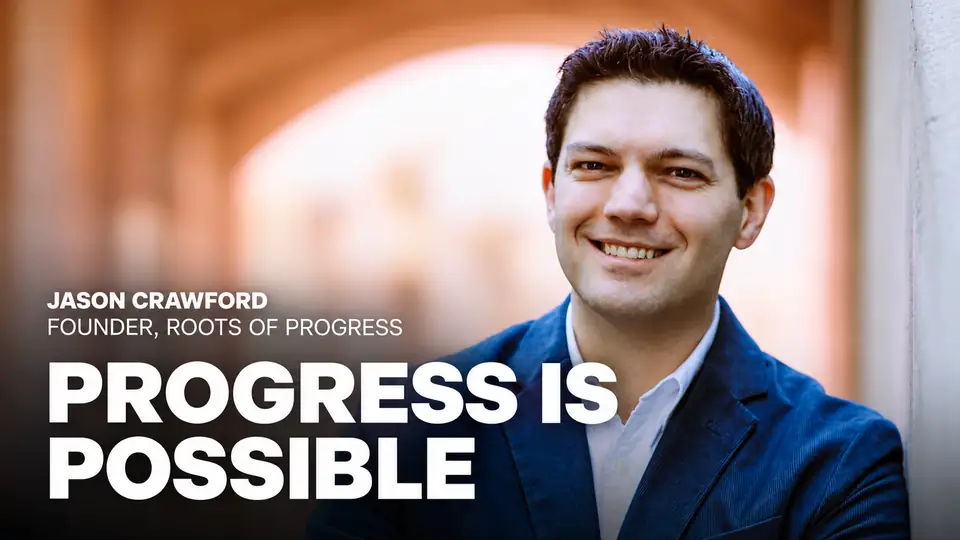
Jason Crawford — Progress, Prescriptive Optimism and Useful Knowledge
Jason Crawford argues for understanding and appreciating past progress while actively working toward future improvements.
July 28, 2020 · 46 min



About the episode
"I want all of us to build a world where we in the future and our descendants are as fantastically well off compared to today as we are compared to the past."
In this conversation, we talk with Jason Crawford, the founder of Roots of Progress. Roots of Progress is an organization promoting the history of technology and industry, and the philosophy of human progress.
We talk with Jason about the three layers of progress, how much better the world is now vs. 100 years ago, the space race, knowledge creation, and so much more!
Take a listen to this episode to understand the importance of understanding the role progress has played in our past and how important it is in building the future.
Links
Chapters
Times follow the podcast audio. The video’s timeline may be slightly different.
- 00:00Welcome to Build The Future
- 02:42Why study the roots of progress?
- 07:50Financing and organizing new discoveries
- 10:08Institutions, rules and regulation
- 11:51Culture and prescriptive optimism
- 15:36Progress includes tackling risks
- 19:20Learning from cultural movements
- 20:29What the space race can teach us
- 26:49Teaching the history of technology
- 29:17Stories that make building feel possible
- 30:39Communities and the creation of knowledge
- 37:38The Haber-Bosch process and modern agriculture
Read the conversation
Open the full transcript
CAMERON WIESE: Welcome to the Build the Future podcast. ! My name is Cameron Wiese and I'm your host. ! Before we kick off today's conversation, I want to tell you a little bit about the show and what you can expect. ! Over the last few years, I've always come back to the ideas and sentiment that drew American culture in the 1960s with the space race, a culture of possibility, and the pursuit of a mission much greater than ourselves. A mission to do things, to quote JFK, not because they're easy, but because they are hard. I've always asked myself, why have we stopped dreaming about this future? Why have we stopped pursuing the world of tomorrow? Well, I've decided to stop asking and instead start building. To start building a future where we're all dreaming about the possibilities of tomorrow and creating plans to get there.
CAMERON WIESE: See, if we want to overcome the challenges that are facing our world today, we must build. To drive forward innovation in frontier technologies, we must build. And when I say we, I mean you, and me, and all of our friends. Whatever the issue or opportunity, we must refuse to sit idly by while some version of the future inevitably arrives. We must step up. We must challenge the status quo. And we must build the future that we want to live in. See, that's what Build the Future is all about. It's a place for definite optimism in a world of negativity. A place that promotes the ideas of those who not only see how the world can be better, but those who have a plan to get there.
CAMERON WIESE: We're starting with this podcast where we share the visions of the future from those who are building it. Visions that inspire you, still a sense of wonder, and get you thinking about the possibilities of tomorrow. All this with the hope that you too will decide to take action and build the future that you want to live in. So with that, I welcome you. Not only to the show, but to the future and the possibilities that lie ahead. Today, we're talking with Jason Crawford, the founder of Roots of Progress. Roots of Progress is a blog and project documenting the history of technology and industry and the philosophy of human progress. It's through this research and education that we're going to be able to understand how progress was made in the past and how we can ensure that it continues to be made to help build the future. Jason, welcome to the show. Thank you for having me. Jason, so there's a lot we can talk about, but I want to start us off with, tell us about the future you're building with Roots of Progress. What's your vision?
JASON CRAWFORD: Yeah. So there's the future I'm personally building, and then there's the one that I want all of us together to build, and they're related. The future that I'm building, the world that I want to see, is one where people stop taking progress for granted. One where instead we appreciate progress, where everybody knows how far we've come, where people look around and see the world around them and actually appreciate what an amazing, amazing world it is and how much better it is to be alive today than it was to be born into the world of even just a couple hundred years ago, let alone a couple thousand or a couple tens of thousands of years ago. And how lucky we all are. I want to build a world in which people see everything around them that was made by humans and recognize it as a solution to a problem, a problem of daily life and work that we used to have and wrestle with and suffer from that we no longer have to fight because somebody solved that problem in the past and we inherited that solution.
SPEAKER UNCLEAR: So I think this is a perspective that we're lacking today, that too many people do take progress for granted. They don't realize how unprecedented it is in human history for us to enjoy the standard of living that we do. And that is what I want to change. I want to tell that story of progress and just make it clear to everyone so that we can all appreciate it. Because I think that when we do, we will naturally start asking a few questions. How did we get here? What actually made the modern world? Why did it take so long? Why were there thousands and tens of thousands of years of human history before really that hockey stick of progress took off. And then how do we protect this, you know, this precious thing that we have, this growth, this forward movement and momentum? How do we keep up the momentum? How do we keep it going and make sure it doesn't slow down or stop or even reverse? And so that, you know, leads into the world that I want all of us to build is a world where we in the future and our descendants and future generations are as fantastically well-off compared to today as we are compared to the past.
CAMERON WIESE: That's the world I want to create. I think we're very much aligned in the mission there. What are some of the other things that you're looking forward to advancing over the next few decades?
JASON CRAWFORD: Oh, I mean, there's so many things on the horizon. There's so many remaining challenges to solve and so many exciting frontier technologies. I can't predict, of course, which ones are going to be big. I guess probably the big thing in the next 50 years is maybe something that we're not even really thinking about yet. But if I had to pick one to bet on, it would probably be a genetic engineering and biotech in general. I think we've just discovered an amazing new tool for this, which is CRISPR, which is rapidly advancing the state of our knowledge. And I look forward to the day when genetic disease is a thing of the past, when we've cracked the code of nutrition. And I think once we figured out the principles underneath those things, we will see kind of a convergence of all those in genetics and biotechnology.
JASON CRAWFORD: The same way that we kind of had, 50 years ago, we had disparate information technologies. We had sound recording. We had audio. We had tape. We had video. We had broadcast media like radio and television. And we had the telephone networks and so forth. And today, just everything has converged into digital media and everything is processed by the computer. It's sort of the uber technology of information that ended up sort of sucking everything into its paradigm. And I kind of can foresee a similar thing happening in the bio world where all these disparate bio and agricultural technologies sort of converge on genetics.
CAMERON WIESE: Yeah. So going back to the mission that you're set out on, where that's a world that we are striving towards, in the context of what you're doing at Roots of Progress, how do we get there?
JASON CRAWFORD: Well, we are heading there. The question is, are we heading there fast enough? Is progress slowing down? And even whether or not it's slowing down, can we speed it up? So I think, look, our world fundamentally is still making progress and we're still making progress much faster than the world did for most of its history. We have many institutions that are deep and strong. We have science. We have the university system, which by the way, does not have a monopoly on science, but is the main place science has done these days. We have invention. We have venture capital. We have in some places of the world, if not everywhere, we have a very entrepreneurial spirit. We have even better technologies today to disseminate information. Online learning is now available to almost anybody in the world who really, who was, you know, sort of really ambitious and disciplined and wants to go after it.
JASON CRAWFORD: It's never been easier for talent anywhere in the world to educate themselves, to learn about opportunities and then to find them. So I think, you know, in many ways we have what we need. I think we need to protect all of that and enhance it. And so maybe I can just in very broad strokes kind of paint three layers of how we can think about the causes of progress and some, this is not quite a grand unified theory of progress, which I keep declaiming that I don't have yet, but I can indicate some important themes. So one level we can think about how is progress financed, organized, and managed. We have some amazing mechanisms for that today. I think the world of startups and venture capital has been a great mechanism of financing an organization for certain types of progress, but not for everything. I think where we, you know, where we, I think, struggle a bit more is in longer term and more speculative and more basic research. So how do we really fund and manage basic research in science and in far out and speculative and risky technologies?
JASON CRAWFORD: How do things make the leap from university, where a lot of that is done today, into industry and actually get turned into useful inventions and get distributed. I have a hunch that, and there are some indications that we don't do this quite as well as we used to. And that there are some sort of some indications that like the university tech transfer process, you know, is not ideal. And maybe that we've got too much of a split between research and development and they used to be more integrated, especially in the days of like the great corporate research labs. You think about like Bell Labs and the Transistor, Dow Chemical and DuPont when they were, you know, doing fundamental research in polymers, which is how we got nylon, for instance, you know, and that kind of thing. And sometimes I wonder if we need to either bring something like that back, or invent some new kind of mechanism for the future that will get us some of that. And then, of course, there's a lot of, I mean, since World War II in the US, the government has really taken over a lot of research funding. And, you know, While it's great to have the money, it's not clear if the mechanisms that we have for distributing and allocating that are anywhere close to ideal.
JASON CRAWFORD: So anyway, that's a whole topic, of course, that we could spend an entire podcast or three to five of them on. So that's one layer is kind of financing organization and management. Okay, so digging one layer beneath that, I think, are just fundamental institutions, especially of law and regulation. And I worry today that we have kind of a slowly creeping, frog-boiling type of regulatory regime that has resulted in kind of a thicket of rules that, you know, all of which maybe were put in place for some reason or at least for some rationale, but which collectively are actually in the end doing more harm than good, are actually hampering us more than they're helping. and perhaps they're not even helping as much as we expected or intended them to.
JASON CRAWFORD: And this is everything from the accumulation of FDA regulations that have caused it to, you know, now cost well over a billion dollars on average to get a successful new drug to market to the environmental review that slows down a building and construction. And those are just sort of two examples off the top of my head. So, you know, I wonder at least whether we need to like seriously consider unwinding some of this effective regulations and allowing for, you know, forward progress while still, of course, you know, having the safety that everybody wants and that was often the justification for these regulatory regimes. And then the so digging one more layer down sort of the third and I think the most fundamental layer is culture and sort of philosophical attitudes and views, especially towards progress itself.
JASON CRAWFORD: I think that the most important thing you need to make progress is a view broadly held in the culture that progress is both possible and desirable, that it is a thing that we should go after. This is a view that is not the default at all in human history or in human societies. In most places and times, people have had a much more cyclical view of history rather than one of upward progression or even an idea that upward progression was possible. Let's not say inevitable, because it's definitely not inevitable. But even the idea that that is possible and desirable is a relatively new one in human history that mostly kind of comes from Western culture in the last 500 years or so. And I wonder if we are beginning to lose that, or if that has been eroded in the last 50 to 60 years. This is one thing I haven't made a systematic study of, but just anecdotally, it seems to me that the 19th century certainly was very positive on progress, very gung-ho, celebrated it, anticipated it, couldn't wait for more progress, couldn't wait to see what the future would bring. And then I think, you know, sometime by at least the 1960s, that tide seems to have turned or at least was beginning to turn. And people got a lot more pessimistic, a lot more dystopian about the future. People started asking things like, is all this progress really good? Are we actually helping humanity? Are we hurting ourselves? Are we destroying the planet? Are we setting ourselves up for a nuclear holocaust?
JASON CRAWFORD: Are we, et cetera, et cetera. And I think a lot of those fears are still around. And we need to, I think, acknowledge some of the grain of truth in many of those fears. But I think we need to also reclaim our optimism about the future. Optimism is maybe the wrong word because optimism implies an idea that the future is going to be good, which is sort of a descriptive optimism. I think what we need is more of a prescriptive optimism, which is like, we can make the future great if we try. It's not going to be easy. It's not going to be inevitable, but through choice and effort and applied intelligence, we can make the future great. It's going to be hard work, and it's not guaranteed, but we can do it. I think that's the kind of attitude we need, not sort of blithe dismissal of actual challenges, risks, and fears, but courage and confidence and ambition and energy to go tackle the risks and the dangers, no matter how bad they might be,
SPEAKER UNCLEAR: and make tomorrow better than today. Yeah. Okay. So there's a lot to unpack on each of those each of those layers. I do want to dwell on the cultural component. How do we shift the culture to get people buying into this ideology of progress? I think fundamentally, so I would
JASON CRAWFORD: think about there's at least two parts to that. So how do we think about the past? How do we think about the present and future? I think first off, we need to take another look at the past and we We need a retelling of the story of progress. We need to take these facts of history of how much better everything has gotten and how we did that. And we need to really tell that story in a clear and compelling way. And that's really the focus of my work, is to look at how did we get here and to just remind people of how far we've come. So I think that's the absolute foundation is to rescue, to revive those historical facts that really ought to be a core part of education, of how intelligent and educated people understand the world, really how everybody understands the world.
JASON CRAWFORD: I think we need to bring that back. And then second, I think we need to then apply those lessons to show the world a couple of things. One is, again, just like how can the world be so much better in the future? What are the opportunities? What does it look like? What does it look like when we have cured genetic disease? What does it look like when we've cured aging and solved longevity? You know, what does it look like when we can produce even more abundant material goods and agricultural produce, you know, than we can today? So just paint a bright and compelling vision of the future. And then the other part of that is to, I think, directly head on address the actual fears and risks and dangers that are on the horizon. So what are the things that people are concerned about?
JASON CRAWFORD: And I think we need to show that the way to tackle those problems is by applying the lessons of how we've made progress in the past. I think maybe a misconception about progress that I want to counter is that progress is just kind of this like single track thing, moving us forward, chasing riches, chasing more goods and services and chasing faster vehicles and so forth. And that's kind of like the only thing it sees. And it doesn't see the risks and dangers. And therefore, we need to like balance progress with something else. Maybe we need to balance progress with environmentalism or balance it with equality or balance it with safety or something like that. I think this is a mistake. I think all of those things, so not only more goods and faster vehicles and higher bandwidth communication and so forth, all those things are part of progress. But by the way, safety technologies are also a part of progress. Cleaner air and water is a part of progress. A world that is robust against pandemics, including bioengineered weapons, that's progress.
JASON CRAWFORD: And so I think we need to see it that actually all of these goals that we want, sort of every legitimate goal is just a thing to be achieved and accomplished through applied intelligence. And so if we want clean energy, we need new technologies for that, right? If we want safety against genetic technology in the future, we should look to how we created safety mechanisms and protocols against technologies in the past. If information technology has led to a loss of privacy, well, information technology also contains the greatest tools of privacy that have ever been invented within cryptography. So it's not a matter of balancing progress with something else. It's just a matter of smartly choosing the goals that we go after using the fundamental tools of progress.
JASON CRAWFORD: So those three things, one, how good things have been in the past, and that's the fundamental vindication of the concept of progress. Two, how much better things can be in the future, that bright, shining, positive goal to all work towards together. And then three, how even the answer to the risks, dangers, and fears is contained in the same seed of what worked in the past and what's going to work in the future. that it's all part of the same sort of fundamental philosophy and approach of applied intelligence and moving forward with new ideas. I think those three together are kind of the formula for getting the right idea out in the world.
SPEAKER UNCLEAR: Yeah, and it's definitely not something that's going to happen overnight, right? It's going to take quite some time. I mean, if we could snap our fingers and have everyone just get on the same page, it'd be great.
JASON CRAWFORD: No, a movement like this, a cultural philosophical movement takes decades at a minimum to truly get established.
CAMERON WIESE: Yeah. Tell me more about that. Like throughout history, how have movements like this focus on progress kind of come about?
JASON CRAWFORD: That is something I wish I knew more about. So I don't have a full answer. I can point to some places to look. First off, I think it's great to look at progress-oriented movements, but really I think you should look in general at sort of the history of social and cultural movements. some of them good, some of them bad. The biggest one, you know, overall kind of progress movement to look at is just sort of go back to the 1500s or so. Maybe you'd even want to go sort of further back to the beginnings of the Renaissance, but definitely by the 1500s and kind of like Francis Bacon timeframe, the beginnings of the scientific revolution and how a whole culture of people turned towards observation, experiment, and really adopted this ideal of useful knowledge, right? That knowledge would lead to improvements in arts, manufactures, and commerce, and agriculture, and so forth, right? And so that was a major, I was sort of the first major progress shift in history. So that's definitely one that I would look at. Yeah, I mean, maybe
SPEAKER UNCLEAR: that's the place to start. Yeah. What about the space race? Because I feel like that was, I mean, And I bankored on that as kind of my historical, my moment in history that that's what we need to be supporting. But it sounds like in the 70s, we kind of fell off, right? People like something happened. And so all of the people who pursued engineering and science as a result of the space race were, they weren't in university at the time. They were in school in the late 70s and 80s. So shouldn't we still see some of the effects of that? I'm just trying to sort this out.
JASON CRAWFORD: Yeah, a couple of things. I mean, so first off, the space race itself was sort of mixed. Without getting too deep into it, on the one hand, it certainly represented extremely ambitious and fast moving science and technology, right? Really a heroic engineering effort. On the other hand, the whole thing was sort of motivated by this political posturing during the Cold War. And I think that was kind of, was sort of its undoing, right? By the time we got ahead, like we weren't getting ahead in order to reap the economic benefits. We were getting ahead to show that we could get ahead. And, you know, and look, there may even have been some military justification for that. I mean, I think it's understandable that people were pretty freaked out when Russia sent Sputnik over our heads, especially given the destruction that the Nazis had rained on London with the V2 rockets.
JASON CRAWFORD: It's the idea that a geopolitical enemy can send something over your head into the air higher than you can reach it. Yeah, is like sort of an objective threat. And so the idea that actually we needed technology to get out there, you know, maybe so maybe there was kind of a military or geopolitical justification for it. But again, once we were clearly ahead, once we had clearly, quote unquote, won the space, quote unquote, race, and, you know, nobody was in, like, we weren't in danger of losing that lead. Well, the funding dried up, right? And so I think these sorts of things are more robust if they're actually done a little more organically, more bottom up and less top down and more with a kind of economic motivation and justification, rather than just sort of these political ends.
JASON CRAWFORD: It makes me wonder a little bit about space today, a bit of a tangent, but the exciting thing about space today is that it's decentralized, that we have more private players entering and we have multiple kind of distinct efforts going on at the same time. What I haven't figured out is what's gonna be the profit engine of this sort of thing, right? Like, why are we gonna do it? Elon Musk wants to get to Mars, but it's just not at all clear that there's like a reason to go right now. So as much as I'm like excited by that effort from a pure science and technology standpoint, I can't really get excited about it from an economics standpoint. So I don't know, that's an open question on my mind to be determined. I mean, to put a positive note on it, I do think that space technology could conceivably support itself purely through tourism and kind of novelty and entertainment for at least the first period of its development until we bring the cost down to the point where maybe something like asteroid mining or whatever becomes economical or et cetera.
CAMERON WIESE: Yeah, yeah, that's what I was going to say is asteroid mining may be the economic driver there, but we're still quite some time out.
JASON CRAWFORD: Yeah, but then, I mean, to answer the other part of your question, right, you said, well, okay, we had the space race. I see, you know, Apollo in a certain sense was like the last gasp of American techno optimism. It was like the final curtain. I mean, yes, it was there. People were excited about it. They were proud. The whole world was happy about it. But it, in a sense, belonged to an earlier age because in the 60s, while all that was going on, you also had the sort of the rise of this counterculture and the beginnings of sort of the modern environmentalist movement, which at least, you know, significant parts of it, you know, Stuart Brand says that within the environmentalist movement, there's the scientists and there's the romantics. And a significant part of the environmentalist movement was kind of dominated by the romantics and a romantic view of nature and a kind of backlash against technology that I think is simply not grounded in science, economics, or actual humanism, if you want to look at what is actually best for kind of human life thriving and
SPEAKER UNCLEAR: flourishing. It seems like the environmental movement was like, oh, wait, no, this is not, or they weren't viewing it from a progress standpoint where, oh, the way to solve all these problems is by continuing to move down this path and said, wait, we need to slow down and to stop these things and to impose more restrictions. Right. Yeah. I think there's at least two
JASON CRAWFORD: potential mistakes you can make in, in, you know, within thinking about environmental issues. One is to have a, a sort of unjustified fear of technology, you know, even deeper than that is kind of to have the wrong standard that you're working from in the first place. I think there, Or, you know, the right standard that I think everyone can get behind and that I think is morally justified is a humanistic standard. What is best for human life? If we want to save the planet, we want to save it because it's our home. But there is sort of another faction within or approach to environmental issues, which takes a deeply philosophical... I've heard a term used for this. I don't know if it's widely used, but I think the term is deep ecology.
JASON CRAWFORD: a notion that maybe untouched nature is actually kind of valuable for its own sake and that actually interfering in nature is like kind of evil on its own terms. And that I think is something, if you set that up as a fundamental premise, that kind of nature has intrinsic or inherent value apart from human life and society, then I think you are holding onto something that is actually counter to the interests of humanity. And so I think we need to be much clearer on that in our discussions and conversations about environmental issues. And I think people need to come out and declare that, no, humanity is my standard and we're going to do sort of what's best for the life and thriving of human beings.
CAMERON WIESE: Yeah. And it seems to all come back to education around those sorts of things, right? Especially from a younger age, which is what you're doing with the Young Scholars Program, right?
JASON CRAWFORD: Yeah, that's right. So you're alluding to a program I launched or co-launched this summer, Progress Studies for Young Scholars. It is an online learning program in the history of technology aimed at the high school level. We go through the sort of the summary of the history of technology, everything from the history of iron and steel to the mechanization of agriculture, to the origins of vaccination. And the course is designed to give students a basic intro to this field and also to really inspire them to take part in the story themselves, to think about what part they want to play in the future of progress. And kind of the message at the end is ultimately that every generation has to anew pick up the torch of progress and carry it forward. And we really want to inspire the students to do that.
CAMERON WIESE: Yeah, that's one of the things that I've kept coming back to when I think about the work you're doing at Roots of Progress, which is how do we take these learnings and move them from being kind of an intellectual exercise to tangible things that we can tell people to, here's how you get started, here's what you go do. So I think education is one component. Are there other ways that we can get people moving in this direction? Any mental models or, yeah, what are your thoughts on that?
SPEAKER UNCLEAR: Yeah, even mental models are a form of education, right? I mean, I think it fundamentally is ideas that we need right now. It's ideas at every level. So education, yes, but I mean, education in schools, I think we need a movement in academia. I think we need education in popular culture, so in media, in books. So really, every way that ideas are communicated, really, this message needs to get out.
CAMERON WIESE: Yeah, we need to definitely take a more optimistic approach because a lot of the sci-fi, I think you've mentioned on kind of other conversations, a lot of the sci-fi is dystopian.
JASON CRAWFORD: Yeah, absolutely. I mean, art is another medium through which ideas and especially ideals are communicated. And so absolutely, I think we need this to be, I think we need more stories of progress in novels, in film. I do think we need more optimistic sci-fi. Again, maybe more of that prescriptive optimism, more than descriptive, right?
CAMERON WIESE: What are some of those books or movies or films or pieces of art that have shaped your thinking?
JASON CRAWFORD: Oh, wow. Yeah, there's a lot. I mean, so just because my mind is on it in terms of optimistic sci-fi or perhaps prescriptively optimistic, I really enjoyed Seven Eves, a Neil Stevenson book that came out a few. That's actually one that's sort of descriptively pessimistic and prescriptively optimistic because it talks about a calamity that the entire earth is facing and really how all of humanity steps up to face it. Another one, and actually kind of the same pattern is The Martian by Andy Weir, which also came out a few years ago, right? Again, about sort of a disaster that happens, but then how do we step up? And so both of those were pretty good. I mean, in terms of other things, I really appreciate the novel Atlas Shrugged, just because it's sort of one of the few places that really paints a picture of the scientists, inventors, and industrialists as, you know, as adventurers and sort of heroes going off on a noble quest.
JASON CRAWFORD: The idea of industrial production and solving, you know, the material needs of humanity's existence as like a romantic adventure, you know, it's just a perspective you don't get in a lot of different places. And it's one of the, probably the most famous where you can get that kind of portrait.
CAMERON WIESE: Well, it also paints the builders as these heroic symbols, as something to strive towards. I'm curious, going back to the culture and the community component, in the book, The Myth of the Lone Genius, Brian Eno talks about this idea of the scenius, which is this community gathering of people who are challenging and supporting each other. and it seems to be the that's kind of what we've seen in silicon valley where there's the serendipity and these natural interactions that are driving this community to to strive in the same direction however with this push to to remote work and the shift that we're seeing with covid i'm i'm unclear what the future of of some of these community efforts look like what are your thoughts on how we, or I guess one, how are you thinking about this? And then two, what might be doing in addition to kind of forming online communities to rebuild these environments and get people together to
SPEAKER UNCLEAR: support and promote these ideals? Yeah, I think, I mean, I think online communities are great. And, you know, we need more of them, not only because they allow you to obviously have the community interaction across time and space and to sort of conquer those things, especially the distance. But also, and I think this is probably underappreciated, they allow niche communities to form that probably would never have formed otherwise. A year ago, after Tyler Cowen and Patrick Collison published their article in The Atlantic that coined the term progress studies, within days of that, I think there was certainly within weeks, there was a Slack group that was created. And now there's this progress studies Slack, right? And that still has, I think, under a thousand members and they're from all over the world. So how would like those thousand people would never have found each other if it weren't for the internet, right? So I think the internet of labels kind of like the long tail of communities to form. And some of those small communities in the long tail could actually be super important for the future. You know, at the same time, yeah, I don't, the tools are not yet good enough to replace in person. Maybe they will be someday when we have insanely high bandwidth, high fidelity, virtual reality, whatnot. I don't know. But they're not there yet. But I don't know. That just means people are going to keep getting together. And COVID, look, COVID is temporary. It's a big deal right now, but we are actually
SPEAKER UNCLEAR: tackling it faster than we have ever tackled any disease. I mean, look, already there's like multiple COVID vaccines in phase three clinical trials. And it's like six months in. That is amazing, right? So I don't know how long it's going to take. I don't want to make any optimistic projections, but it's not inconceivable that it could be essentially solved next year. And I just think given enough time, attention, and resources, we're going to solve it. So COVID is temporary. We're going to be getting back together in person again in the near future. And that'll solve that. Yeah. I think that's one thing you just said
CAMERON WIESE: about time, attention, and resources is something to just emphasize because we literally can solve all of these problems. New knowledge will get created and we will use that knowledge to solve
SPEAKER UNCLEAR: all the other problems that get created. Yes. In David Deutsch's book, The Beginning of Infinity, he has this principle that anything that is not forbidden by the laws of physics is possible given enough knowledge. And from this, he derives something he calls the principle of optimism, which is that all evils are evils of lack of knowledge. And there's nothing that, again, unless it's literally physically impossible, there is nothing that more knowledge cannot solve. And it's certainly not forbidden by the laws of physics to defeat COVID, so we will solve it. Again, assuming that we try, and the good thing is there's a lot of trying going on right now. A lot of research is going into it. Yeah, I think it's easy to get overwhelmed
CAMERON WIESE: with all the, I mean, if you pay attention to the news, which probably shouldn't, it's easy to kind of feel like we're not making progress. But to your point, there's a lot happening, a lot of
SPEAKER UNCLEAR: stuff going on. I mean, if you compare this to, say, the huge pandemic that hit a century ago, the influenza pandemic of 1918 to 1919, you know, like we're just so much better off than we were back then, right? Back then, we didn't even know what a virus was, really. Like, no one had ever seen one. It wasn't until like the 30s or so that with electron microscopes that we were able to actually image viruses. You know, today, not only do we know exactly what viruses are, like, we've already sequenced the DNA of this damn thing. Not only have we sequenced its DNA, we've actually sequenced thousands and thousands of copies of its DNA from different mutations and variants around the world, and through that have been able to build the phylogenetic tree and actually track the spread of this thing around the world. I mean, so like just that fact alone, right? I mean, during the influenza pandemic, we actually would have saved an enormous number of lives if we'd had antibiotics, because even though influenza is a viral disease, what actually killed a lot of people was secondary bacterial pneumonia, a secondary infection once your immune system and your body's been weakened by the flu. So if we had just had antibiotics, which were invented, you know, two to three, you know, two, three decades later, then, you know, we would have saved an enormous number of lives. COVID doesn't work that way. It's not a bacterial pneumonia that's killing people. It's actually the virus directly. So antibiotics don't work.
JASON CRAWFORD: But that's the other thing sort of like to just to think about with the context of COVID is we've actually solved the vast majority of infectious diseases. We've solved everything, you know, pretty much everything that's based on bacteria can be effectively fought through antibiotics. Not quite everything. There's some multi-drug resistant strains of tuberculosis, et cetera. But, you know, most bacterial diseases are basically gone. Most stuff that is carried through the water has been solved through water treatment plants and general water sanitation. Anything that's insect born, we can basically fight the insect populations. you know, even anything that is nice, you know, any disease that is polite enough to not be contagious until symptoms appear, we can kind of solve through like contact tracing, isolation, and quarantine, right? It's basically, so like COVID created this pandemic basically because it fit in this very narrow category of germs, of pathogens, that it's viral, spreads directly person to person, that has asymptomatic transmission, that it has a relatively high fatality rate and that it's new. So we haven't had time to make a vaccine yet. It had to be all of those things or else it could never have created this pandemic. So we just need to remember that and kind of keep that context in mind when we're thinking and worrying about this pandemic in the
SPEAKER UNCLEAR: context of progress. No, that's very important. We need to keep focused on the right things. As we kind of get closer to the end here, I want to ask, what's something that you often find of wanting to communicate to people, but you don't get asked about?
JASON CRAWFORD: You know, I actually just love telling the stories of specific technologies. And every interview tends to go to the big picture and the big questions and stuff. And what are the roots of progress anyway? You know, and I sort of give the same spiel. I actually, I could geek out with you for hours, days, you know, about telling you about like the Haber-Bosch process or the Bessemer process or like the combine harvester or the history of smallpox and like how we and inoculation and the first vaccines and germ theory and like that's that's actually the stuff that i could
SPEAKER UNCLEAR: geek out about forever uh well yeah yeah can you can you pick one that excites you and just give me a little cliff notes of of what's cool about that that technology and that innovation so i
JASON CRAWFORD: mentioned the Haber-Bosch process in that list. It is maybe the most unknown, underrated, unappreciated industrial processes that actually all of our lives absolutely depend on. Because it is actually how we grow enough food. Well, literally, it's how we make the precursors to the fertilizers that power modern agriculture and actually support 8 billion people almost on the farmland that we have today. So, okay, some quick background. The basic problem of farming and agriculture is that your field, if you just keep farming it season after season, becomes infertile. It can't grow crops as well as it used to. This was discovered by, I'm certain, the first agriculturalists some 12,000 years ago or whenever it was. And farming ever since has been sort of dominated by the quest to solve this problem. So it used to be that when a field became fallow, they would just kind of, or when it became infertile, they would just sort of leave it for a while, move on, try another field. And gradually, as it lay fallow, it would regain its fertility.
JASON CRAWFORD: Eventually, this got systematized into systems of crop rotation, where you would plant some crops like wheat, for instance, which deplete the fertility of the soil. Then it was discovered that other plants, legumes, actually replenish the fertility for microbiological reasons that were discovered centuries later. And then maybe you would rotate those two things with like leaving the field fallow for one third of the time, right? So you'd have like a three-year, three-field rotation. This is kind of a classic thing in the Middle Ages. And we got better rotations over time. It turns out you don't have to just let it lie fallow. You can like plant clover, for instance, and then turn the soil and bury the clover. And now the nutrients get into the soil. But what we finally figured out was, okay, hey, look, what's going on is that there are nutrients in the soil. There are chemicals like nitrogen, especially potassium and phosphorus that plants need to grow. It's plant food essentially. And all the plant food gets eaten up and it doesn't get as replenished as fast as it gets eaten up when we do our sort of human driven agriculture. So what you actually need to do if you don't want to, if you want to have maximum productivity on your agricultural land, what you need to do is fertilize the land by, You got to feed the plants, basically. Okay. So how do we do this? Well, like I said, the plants need a number of different things, but the thing they need in greatest quantities actually is nitrogen. Where can we get nitrogen? Well, there are some natural sources. Crazily enough, in some of the 19th century, there was this island off the coast of Peru where it almost
JASON CRAWFORD: never rained. And so for who knows how many centuries had been accumulating, don't laugh, seagull droppings. And there were these mountains, piles of guano, you know, that they literally mined. It was a commodity. And they would pack it into sacks and put it on ships and ship it all over the world to fertilize. It was one of the best natural fertilizers known to man. But eventually it ran out, right? It only took a few decades to mine through this stuff. It was a finite resource. And so there was a lecture given towards the end of the 1800s warning of an impending agricultural collapse if we didn't find some way to essentially synthesize fertilizer. Okay, so where do we get nitrogen from? Well, the astute listener might have occurred to them that we're actually swimming in a sea of nitrogen. It's in the atmosphere. It makes up 80% of the atmosphere. Problem is plants can't use nitrogen gas. And the basic reason is that nitrogen gas has a triple covalent bond, and that is a super tough bond to break. There are some bacteria who manage to do it through certain processes. And they are the ones who take the nitrogen gas and then they quote unquote fix it, which means they put it into compounds like nitrates and nitrites like ammonia and basically chemical compounds that involve nitrogen, but are not N2 nitrogen gas.
JASON CRAWFORD: So what we needed to figure out ultimately was a way to do this through industrial chemistry rather than through bacteria. And that's what the Haber-Bosch process is. You can break apart the nitrogen bonds with heat. Enough heat energy, you can break them apart into free nitrogen atoms. The problem is you're trying to create ammonia. Ammonia is actually much weaker than the nitrogen. So under the same levels of temperature that break apart the nitrogen, they also burn up the ammonia. Whoops. Okay. The secret turns out to be pressure. At high enough pressures, and we're talking like one to 200 atmospheres, right? One to 200 times the pressure of the atmosphere, you can actually break apart the nitrogen with less heat. And so that is the fundamental key to the Haber-Bosch process.
JASON CRAWFORD: Fritz Haber, a German chemist, figured this out. And then it was scaled up at BASF under the leadership of Carl Bosch, the chemical industrialist, who they pioneered the field of high-pressure industrial chemistry doing this. And there were a lot of problems, technical problems to solve to scale it up. They had to find the right catalyst, and they tried thousands of substances to find a catalyst that was both effective and cheap. They also had to just work out, how do we actually keep the tanks from getting degraded from all of these free hydrogen atoms that are flying around and eating away at the walls of the tanks? They ultimately had to add in a liner that they would periodically replace to sort of protect the tank itself from the free hydrogen.
JASON CRAWFORD: Anyway, so there are all these problems that they solved. But ultimately, they came up with this process to take nitrogen gas out of the atmosphere and then hydrogen gas, which you can get from water through electrolysis, and react them in these high-pressure chambers to create synthetic ammonia, which then is the precursor to a lot of important compounds, synthetic fertilizers, and also, for that matter, explosives. So highly industrially important. The estimates that I read, and by the way, most of the stuff that I know about this comes from a really excellent book called The Alchemy of Air, which is the story of the Haber-Bosch process and the people who created it by Thomas Hager. Highly recommend. One of the favorite books I've come across in this process.
JASON CRAWFORD: But that book estimated that 1% of the energy of the world goes into this process, right? And that's kind of an enormous flabbergasting amount. Similarly, it has been estimated that this is responsible for about half of agricultural production. And in fact, that something like half of the nitrogen atoms in your body came through this process, right? So say thank you to Haber and Bosch for, you know, half of the food you eat and half of the tissues in your body, basically, half the people on earth.
CAMERON WIESE: Thanks for joining us for another episode of the Build a Future podcast. If you're interested in learning more about Jason, you can find him on Twitter at Jason Crawford. You can also find Roots of Progress at rootsofprogress.org. And lastly, the Young Scholars Program at progressstudies.school. If you enjoyed this episode, we'd absolutely love it if you would share it with anyone who you think could benefit from thinking about progress. See, the best way for us to build the future together is to spread this idea of definite optimism, to start talking about the future we want to build and then creating concrete plans to get there. So if you're thinking about building, want to get support, or simply want to hear about specific topics, ideas, or from certain people, shoot us an email at hello at buildthefuturepodcast.com and we'll see what we can make happen. Thanks so much for listening. That's it from us. Until next time, go build.
SPEAKER UNCLEAR: Thank you.
More episodes
All episodes Dr. Anton Howes of The Royal Society of Arts — Innovation, Invention, and Great ExhibitionsAnton Howes discusses the RSA, the history of invention and the Great Exhibitions.
 Eliot Peper — Science Fiction & CultureEliot Peper explains how curiosity about the present becomes material for fiction.
 Don Clark — Art & OptimismDon Clark traces his path from music and album covers to Invisible Creature’s illustration work.