

Build the Future Podcast
Eliot Peper — Science Fiction & Culture
Eliot Peper explains how curiosity about the present becomes material for fiction.
November 14, 2022



About the episode
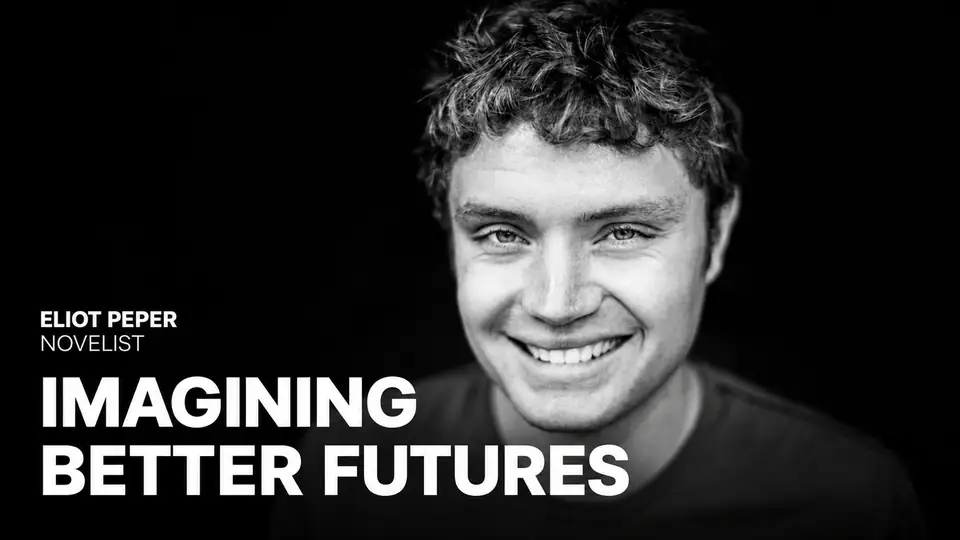
In this conversation, we talk with Eliot Peper the novelist behind great science fiction books like Reap3r, Veil, Cumulus, and Bandwidth.
Links
Chapters
Select a chapter to play from there.
Read the conversation
Open the full transcript
ELIOT PEPER: Hey everyone, welcome back to the Build the Future podcast. Today I'm excited to be releasing a new episode and to be kicking off the next chapter of the podcast and this project which will starting in a couple weeks have a home on YouTube and other social media platforms as we start to add video to our programming here. That said, we have today's episode which is featuring Eliot Peper, the brilliant novelist and science fiction author behind books like Cumulus, Bandwidth, Vale, and his latest book Reaper. In this conversation we talk about the role that science fiction has in shape and culture and all that there is to be optimistic about amongst other things. So without further ado, let's jump right in. Hope you enjoy.
ELIOT PEPER: What are you most excited about for the future? What am I most excited about for the future? You know, it's sort of interesting. I don't spend that much time thinking about the future. I write novels set in it. And I love reading books set in the future that imagine a really diverse array of possible futures. But the things that I'm interested in are actually all in the present. So like for me, what gives me material that I for writing fiction is paying a lot of attention to the thing to stuff in the present. And by stuff, I mean, I just give myself full license to follow my curiosity down whatever weird rabbit holes it leads. So to give you a concrete example, right now I'm in I'm drafting a new manuscript, you know, for a new novel and I've just been learning a ridiculous amount about semiconductor manufacturing, like, and it is super weird. I mean, like all of modern civilization depends on laser wielding robots, right? Like that's like, I mean, it's just like there are so many levels of beautiful, awesome
ELIOT PEPER: strangeness to the sand and lightning that we've like fused to give machines cognition, And so to me, when I, so I will read up on that, like, to really unusual amounts. I'm like, talk to people working in the field or whatever. Basically, if something sparks my curiosity, I try to pay a lot of attention to that spark and nurture it and kindle it until it turns into a bonfire. And then that is the material that I use to write novels set in the future. So to me, writing a novel set in the future isn't about predicting where the future is going. It's about remixing the things I find interesting about the present. And so that might be external or explicit, like learning about how we make chips. But it also might be internal, right? you have a deep conversation with a close friend and it makes you look at emotional growth differently. And that's another ingredient, right? Like, you know, it might be the just the way that a certain color and texture looks on a tree trunk at a certain time of day when it's really highlighted.
ELIOT PEPER: And I'm like, oh, that's something that should be in the novel, right? Like it, it, it, it like calls out to you, right? it attracts your attention. And because writing fiction is really about directing the reader's attention, right? Like it's like a laser pointer. Every sentence is directing your attention to the next thing. Like trying to be very self-aware about where my attention is being dragged by reality, right? Like is the most helpful thing for me. in writing about the future.
CAMERON WIESE: So it's interesting thinking about it that way, because my general sense is like, okay, what do you imagine kind of the future looking like and then working backwards from there? But it sounds like that's not at all your process. You're like, okay, what's going on right now? What's interesting, what's exciting? And then how do we tell stories about these things in a way that's like gonna resonate with people?
ELIOT PEPER: Yeah, I optimize for what's most interesting. I don't optimize for what's most plausible or what I think, or yeah, like I'm absolutely, like to me, so I love reading speculative fiction, right? Like I love reading stories set in the future, but to me, and you can look at a long history of things that science fiction writers got right and that they got wrong, right? I mean, like the wrong list is much longer. But to me, what's interesting about reading, like the future is an imagined place. Like we'll never arrive there, right? Like, so it's fictional. Like the future is a fictional concept. It's a collective fiction, but it's a fictional idea. And so to me, what's fun and unique about reading fiction set in the future is that it's so embodied that if you read if you look at like You know an analyst's white paper about a trend or a graph that's being projected out It's very abstract. You're just thinking about It's a mathematical projection of one way or another or in an analytical one, but it's very idea level you're thinking about literal I mean even the word trend right it's
ELIOT PEPER: it's abstract and I think that one of the really powerful things about fiction that is set in imagined futures is that it's embodied that as a reader you're getting to vicariously take a ride in someone else's mind and someone else's heart that's living in like this richly developed possible different alternate reality future. And that's what makes it emotionally impactful. That's why science fiction novels often have a much stronger cultural impact than a white paper because people can connect to it and it makes the idea feel real. Like it makes the things in that future feel possible in a way that just saying they're possible doesn't. So like both as a reader and a writer, that's something that I try to channel, right? And try to learn from.
CAMERON WIESE: This is like the fundamental difference when people talk about, well, just to kind of segue into the book, like the concept of Reaper than the network. People may talk about it in podcasts or may mention it kind of on Twitter or in random kind of conversations, but wrapping it around a story and showing people like, what might this look like? What sort of future might this exist in? Makes it a lot more real to people. And I think that works on some of these not so good things we wanna have in the world, but also on the things we're really excited about. And so it's all about making these things accessible, Which is which is actually like why I loved Reaper like I like we trade of DMS I downloaded I read the whole thing on my flight up to Seattle the other week and I just like I couldn't put it out like I was like, oh wow like and I haven't been hooked by a book like that in quite some time and I think the thing that got me the most excited was Coming from that like the the Silicon Valley tech world if you will I could like close my eyes in like
CAMERON WIESE: almost imagine the characters as people that I know in industry as exemplified in the book. And so I think that just speaks to something really important that you're doing, which is telling these stories in a world that kind of already exists that people can connect with.
ELIOT PEPER: Yeah, well, thank you. I'm really...it's really moving to hear that the story resonated with you. And yeah, I mean, again, like the material I draw from is just my lived experience. And so I'm trying to be true to that, right? And so, yeah, it means a lot to hear that that strikes a chord with you and with readers in general. I do think like I mean I love the experience of Picking up a novel and Getting totally absorbed right like just wanting to find out what happens next not wanting to put it down I think that's such a beautiful experience and one of the things that I love about it is both that it's very immersive and and that it gets me excited about reading. Whenever I read a book that makes me feel that way, then I'm excited to go read more great books, right? And I think we've all had that experience of the opposite, when you read a book that you think you'll like, or that has stuff in it that you wanna know, but it's sort of a drag. Like, you wanna keep reading, but then you just slow down, and then because that's the book you're reading, you don't read anything for a while.
ELIOT PEPER: And so I really, I'm delighted to hear that you really got sucked in to Reaper because that making a story compelling, I think is a big, that's a big part of what I seek to do when it comes to craft is to be like, okay, like how do we, like people will only get exposed to these ideas that are woven into the story if the story itself is the reason they're reading, right?
SPEAKER UNCLEAR: Yeah. Yeah.
CAMERON WIESE: And then it just, it also makes it more fun to read too. Because I won't spoil it for listeners who have not read it. But the kind of scene at the Ferry Building towards the end, like, I've like, I've had so many walk and talks going to the Ferry Building. I know where all the stands are. And I'm like, oh, this scene would probably happen in this corner by the bookstore, by that coffee shop, or by the ice cream. I'm like, this is great. One of the things you mentioned in your writing is you try and communicate something to the world. What was the thing that you wanted to communicate or the thing you wanted people to think about when they put down a reaper after devouring and start to finish?
ELIOT PEPER: Well, I guess, you know, when I think about like writers' ulterior motives, like I don't have like a, I don't know, like a billboard level message that I tried to wrap the book around. And I also think that writers that claim to have no message at all, all that means is they aren't self-aware enough to realize that they have a point of view, right? And so that doesn't mean the book doesn't have a message. It just means that the author might not be aware of it. That said, I actually think that most morals are things that readers bring to a story. So in fact, you can see this with fairy tales. Different fairy tales are effectively reinterpreted by every generation to mean the thing they want it to mean, rather than to, like, mean some kind of platonic, like, kernel of truth that is, you know, that stays unchanged. For me with Reaper, or actually this isn't unique to Reaper, this is true of every one of my novels including Reaper, I really like hard questions. So to me if I learn something and it's sort of
ELIOT PEPER: straightforward, like it's something that like if we were having a chat I could be like, oh, I learned this cool thing today. Or like, maybe you should try this if you're grappling with this kind of a problem. Like, there isn't enough meat there to write a novel about. It doesn't hold my interest for long enough. It might be a great essay or blog post or even a tweet, but there's just not enough there for me to stay interested to write a whole novel about it. And so the things that get me interested enough to write a novel, which is just like novels are long, it has to have a lot of shades of gray. I have to have an open question that I don't have obvious answers to. And so the act of writing the novel is the act of me processing the question. So I actually hope it leaves readers with more questions than answers. When I was working on Reaper specifically, One thing I was really sort of curious about and wondering about is, you know, I've humans are doing all of these amazing things right now. Like we're we've figured out not only how to make sense of,
ELIOT PEPER: but now how to manipulate an engineer like DNA, like the code that makes life life. Like we also have the code that makes computers work, right? which we've done these extraordinarily ambitious things with, and that is this sort of invisible new infrastructure behind effectively everything in modern civilization. But you also have, you know, like people that are trying to push equivalent boundaries in the arts, right? They're trying to invent new ways of telling stories, new kinds of media, and exploring that possibility space of creativity. And I started noticing among friends that were working on these kinds of diverse projects that they have totally different training, right? Like maybe they've been a cell biologist for decades and like maybe they're a poet, but that internally there's this shared sense of ambition, right? this wanting to push back a frontier and explore new territory with the risks involved to go on that quest and bring something back to share with the people you care about. And I really wanted to explore that. I wanted to explore what it means,
ELIOT PEPER: like how far you would go to achieve your greatest ambition, right? And what it means when people with these really diverse sets of ambitions intersect, right? Like what unexpected occurs when that poet's, you know, sort of life's work runs into that cell biologist life's work and fireworks happen and either for better or for worse, right? So that was the seed, That was the question for me that really drove Reaper was, was what does it mean to have these kinds of creative ambitions and what does it mean when they come together in unexpected ways?
CAMERON WIESE: Yeah, I also loved on that the kind of exemplification of like the individual and the collective. It's like, hey, how do these individuals who are working on, who are pushing forth their own frontiers kind of come together to either work together or have their ambitions kind of conflict? On the tool of Reaper specifically in the book, what do you think about where we're at in the world and the likelihood of that being developed, or the role that science fiction plays in telling stories about these things? How can we prepare for that technology or how might we save it off?
ELIOT PEPER: Should we tell listeners what it is? I mean, Reaper-
SPEAKER UNCLEAR: Yeah, let's yeah, yeah, just good.
ELIOT PEPER: So people have shared context. So in the novel Reaper is basically a blockchain murder market. So you can go on there and set a price on someone's head and an assassin that you never have any direct relationship with executes the hit and automatically gets paid via the smart contract, right? So it's totally anonymous, it's secure, and you have plausible deniability. And that's part of the... The book is a thriller, and a lot of the thriller is about exploring the possibilities of this and also what happens when it breaks.
ELIOT PEPER: I mean, frankly, I don't... I sort of think I'd be surprised if some version of this isn't already in the world? I don't know of it. Reaper is not journalism, but it seems so eminently possible that someone's going to try it if they haven't already. I think that that's true of all new technologies. Humans love to push boundaries, and that's not always for the good. And so yeah, I think it's really fun to imagine what those sort of contingent possibilities can be. And it's tough. I mean, I think Kevin Kelly, the founding editor-in-chief of Wired, he has this wonderful idea that if you imagine the social impact of new technologies, that there is almost always almost as much bad as good. And the best that we can hope for as a species is that when we introduce a powerful new technology that the impacts it creates are 49% bad and 51% good and if that's the case we should call it a roaring success because that 1% compounds across generations. And so it can really change life for the better. But just because it compounds doesn't mean you
ELIOT PEPER: don't have the 49% bad and Reaper is very much in that category. Right? Yeah, it's it's like, what is like the good? So if we imagine Reaper in the world, like, what is the counterbalancing technology or innovation?
SPEAKER UNCLEAR: You mean in the world of the novel or you mean like in general? In the world of general that you and I...
ELIOT PEPER: Oh, okay. I mean, oh my god, there are so many things, right? I mean like antibiotics have saved me from countless deaths, like, and I'm 35 years old, there's no way I would have made... I've had enough accidents and like diseases in my life that like I never would... like I wouldn't be alive today, right? Like, we are talking right now. And like, you're able to share this conversation with listeners who even if we, the two of us happen to get together and, you know, my office here or in your room, like, they wouldn't be able to benefit from from this conversation. And like, Oh my god, for me as a writer, the internet is a godsend, like, there's so much material there, like, I use it so much every day and it informs the art I'm trying to put into the world and share with others and contribute. So I mean, I like, frankly, I think there are just uncountable amounts of things to be grateful for in in the world we happen to be lucky enough to live in. And like one way that I think that it's easy to get distracted by negative headlines because those those sell.
ELIOT PEPER: But the thing I always, the heuristic I always try to bring to it for myself is if I had a time machine, you know, would I go back, right? Like what previous time, if the time machine can only go in like, in the back, we don't know, we don't know what's coming next. So so if I can go to any moment in history, whether it's five years ago, or 500 years ago, or 5000 years ago, and I have a time machine, but I can't return to the present, right? Like it's a permanent decision. Where would I go? And the question is, I would lock the damn time machine. There's no way I'm going anywhere. Are you serious? Like, I don't like, yeah, I like, there's no place I would want to no place in human history I would rather live in than the present.
CAMERON WIESE: This is why like, it's so funny that everyone does focus on on the negative, like the world that we living today is so much better than any other point in time. And yeah, we have challenges, but this is Kevin Kelly's point. It's like these things, like technology and knowledge kind of allow us to do new things and solve the problems of our day. Um, you know, okay. We have climate challenges. What about geoengineering? And I know you explored that in, um, in veil and then like synthetic biology and vaccines and CRISPR and all that stuff.
ELIOT PEPER: It's like, I mean, I do think that also there's room for us to like for humans today to be kind to ourselves like like both like like I think it's important to feel that gratitude for for all of the just amazing boons of modern life and I also think that where did those boons come from? Well, a lot of them came because people were so upset. And by the suffering that they had to go through in all of these different spheres, so that actually the dissatisfaction we feel with the present is the engine of the future. So and so I feel like sometimes Sometimes I fall into the trap of I will think, oh man, stop stressing about the negative stuff when there's so much positive stuff out there. And then I'll almost feel like I'm blaming myself for getting too sucked in to that negative psychology. And then the flip side, when you do get sucked in, then you're almost like, how can anyone sit on their hands? There are so many big problems in the world. And so one thing I've tried to pay attention to is that there is no one psychological state
ELIOT PEPER: You should be in all the time as humans we cycle between them and that's the best that's the whole point, right? So so appreciate when you're feeling dissatisfaction appreciate that because it's actually like is what motivates us to go further and to be kinder to be more generous to make life better for for humans and when you're feeling that gratitude, like appreciate that too. Like don't blame yourself for not worrying about the next thing. Like there are many things that we should be grateful for today.
CAMERON WIESE: 100%, 100%. It's funny, because even it's almost like the negativity or any of that stuff, it's almost like serves a forcing function for reflection. And then you're like, hmm, okay, I don't like this, or this seems broken. What do we go do about it? But that obviously requires that everyone has, everyone feels like they have the agency to go do some of these things, which is another theme. I think that your writing has done a good job of it. How do you kind of give people characters they can like identify with and who do exemplify these sort of values, which like, hey, like you and I have responsibility to step up and build the sort of future that we want to live in. Like no one else is going to do it. Like we have to build. And I think this is, I don't know, like Ministry of the Future and then walk, the Cory Doctorows run a walk away. Both phenomenal, like phenomenal contrast of books. There's one set in this kind of dystopian world and one in this kind of aspirational like, hey, how do we fix what is? But both have characters and then in Reaper
CAMERON WIESE: and in your other books, like these characters who are like, I'm going to do something. Rather than sit around and worry about how awful things might appear. But in reality, like things are much, it's like the people like that who end up going to shape the future and make progress for everyone else.
ELIOT PEPER: Yeah, I mean, the world is really complicated, right? And we're always discovering new layers to that complexity. Like I both mean collectively, like that's in some ways what science is attempting to do as a whole, but also individually. Like you're born and you're trying to figure things out. Like first, like where do you pee, right? Like, you know, like, you know, like, you're trying to figure out the world and you're placing it. And and that never stops. Like, you don't reach a point where suddenly you understand the world and and you're now in a static equilibrium. Like that just continues for a whole lives and then we die. And I think that sometimes for all of us, like, I think we all go through these cycles, like complexity can be terrifying. And it can be sort of numbing sometimes because you know, it's almost like I remember being a kid and you're like in government class or whatever you're learning about how the Senate works or you know, just like basic like American government functions.
ELIOT PEPER: And then as you're getting older, you're starting to learn about like lobbying, which in the US is effectively just like legalized corruption Right and so like and so then you suddenly start to read Oh wait, like that vote went that way like it wasn't just like people believed This is a battle of ideas, right? Like there are all these other forces at work And so initially when you first realize that new layer of complexity to the world you inhabit it, you can throw up your hands, right? And say like, well, Washington is owned by lobbyists. So we might as well not do anything. Right? Like that. And like, that's one example. But like that, like there's examples of that in every sphere of life. But the reality is that like change in every sphere of life happens at the margin. Right? Like nothing happens that someone isn't trying to do. So if you try to do nothing, that's the only way to rob yourself of agency. You might be born with different resources and have vastly different situations. So that doesn't mean that everyone has equivalent agency or power in the world,
ELIOT PEPER: but everyone has agency at the margins within their own life despite that complexity. And sometimes I find I have to remind myself of that because I, like everybody else, sometimes you sort of like see how all of these systems that we live within and you could sort of feel like nothing I do really matters. And so that's why it's important to keep that front of mind where you're like, actually, that's the only thing that matters.
CAMERON WIESE: Yeah. That like nothing matters kind of nihilism. So it's so funny to me, right? It's, oh, nothing matters. Okay, so then then go do whatever you want. Right? It's like you have to like not get stuck in the nihilism, like you have to like pass through it. And anyway, one of the, one of the things I wanted to kind of get your perspective on given kind of your balancing of the speculative fiction and Silicon Valley worlds. It's like everyone, everyone likes to point to Snow Crash and Ready Player One as the like defining novels that have shaped kind of the zeitgeist of what technology gets built and what sort of things people choose to work on. I'm curious, are there other examples that you personally point to of canon or novels that you think have influenced the sort of technologies or Things that are being created in the world
ELIOT PEPER: Yeah, I mean well first of all, there are tons of examples I mean like one of my favorites is Ken LaCavora who is a paleontologist who discovered the largest currently known dinosaur He had a whole thing where some interview asked him interviewer asked him about Jurassic Park and And the question was asked under the assumption that his response would basically be like, oh, there's so much wrong with it. There's this, this is wrong, they don't have feathers, like whatever, right? Like all the things that are like technically inaccurate to current science is understanding of dinosaurs. And he was like, I love Jurassic Park, it's amazing. And the interviewer was sort of surprised, right? And he was like, no, you don't understand. Like it may have tons of like loop like technical loopholes, but every postdoc I've ever worked with Got into paleontology because they watched that movie right or they read the book and so I think that that is You know, like that's a wonderful example of sort of the role that
ELIOT PEPER: Stories that play with technology the the feedback loop between them and real world science and technology where people push the future. I mean, there are a really long list of examples of like that feedback loop with science fiction. I mean, whether it's like literally like cell phones and the Star Trek communicator or like, you know, these other big examples. I'd say that some of those examples would be easier, easy for listeners to find just by Googling. And one of the reasons why Snow Crash and Ready Player One are held up so much is also simply because they're really popular. And so by being so popular, it means that you can have a shared language, right? Like you have like a common metaphor to use. And so popularity is one of their most important features. However, there are speculative fiction stories that do not have that kind of like blockbuster popularity, but I think have had an outsized influence on real world technological development. And one good example of this is Jorge Luis Borges, who was an Argentinian writer, who he's a well-known literary fiction writer
ELIOT PEPER: from the mid early 20th century. And he wrote a short story collection called Fictiones where I think the stories were written from like 1938 to 1942, something around that time frame. And like that like short story, like his short stories are not widely known. Like they're known among in literary circles, but they're not like, I mean, they're not Jurassic Park, they're not Snow Crash. But those sort of, they're almost fable like stories really prefigure many of the problems created by the internet. Both are not even just the problems like many of the the promise and risks of the internet and its sort of growth in human society and culture and so what's really interesting about Borges's work is that although like if you ask a random person a random engineer they won't have heard of him, but many mathematicians and computer scientists and science fiction writers, myself included, have been really influenced by his work. So they're not like, you know, like Snow Crash and, you know, some of those, like they'll
ELIOT PEPER: still get onto the bestseller charts, like when there's some timely thing that happens, like Borges doesn't but his ideas and his way of making sense of the world and thinking about the future have had these like Ripple effects that go far beyond his notoriety as a writer
CAMERON WIESE: Yeah, I think that's it's like almost like who is the influencer of the influencers, right? So who's
SPEAKER UNCLEAR: Like if you've kind of like zoom like zoom up the stacks
CAMERON WIESE: Like who is who is everyone kind of reading in the various circles one one example of this that he may you may be familiar with, but if not, hopefully I can share some new knowledge. The one of the most influential I would argue pieces of media is Disney's Man in Space. So in the kind of opening sequence for, or as Walt was kind of planning the opening of Disneyland, he sold 35% of the company to ABC and did a television deal that would lead up to the opening of the park. And they developed a series of films, one of which was called Man in Space. So they worked with Warner von Braun, and they designed this short film that would showcase human exploration in space. And it went live, and President Eisenhower picked up the phone and called Walt Disney and said, Hey, that was incredible. I want to show this to all of my generals. And so he had Walt Disney send them the raw footage of this short film. And not too far along after NASA was founded. And then you had kind of all of the fodder or kind of all the infrastructure set up so that when Kennedy took office,
CAMERON WIESE: he could go to Rice University and give the infamous moon speech and kick off kind of the space race.
SPEAKER UNCLEAR: Oh, that's really cool. I'll have to check that out.
CAMERON WIESE: Yeah, I'll send that to you after. I'll put in the show notes as well.
SPEAKER UNCLEAR: Yeah, please do.
ELIOT PEPER: There's actually, for those interested, there is a sort of fun prequel to that story, which is that a lot of the, I mean, pretty much all of the leading rocket scientists at the beginning of the 20th century, so mostly German and American, right,
ELIOT PEPER: were huge science fiction fans. And a lot of their work was actually influenced by 19th century science fiction. And there's a great, what's it called, The Moon.
SPEAKER UNCLEAR: There's a, have you read Oliver Morton's The Moon? It's a... I'm familiar with it, yeah. Okay.
ELIOT PEPER: It's a, so Oliver is the Briefings Editor at The Economist magazine, and he's one of my absolute favorite science journalists. And he has this wonderful book called The Moon, which I mean, it's about what you what the title is, right? It's about the moon and and sort of from many different angles both like the humans wanting to go explore it But also the geology like like many different angles And he has some wonderful sections in here in that book that that dig into the sort of breadcrumb Tracing all of the ideas that then like became the space industry in the 20th century So I'll go I'll go watch that short film and you should read all this book
CAMERON WIESE: I well that I think because one of the books that he probably references So it's oh, it's like the moon is written. It's like, you know in the last like 20 years or so
SPEAKER UNCLEAR: Written right within accounts. Yeah, it was written a couple years ago
CAMERON WIESE: Okay, but then it recounts kind of the history of the different like bits and pieces. Yeah. Yeah. Okay. Yeah Yeah. Because I'm trying to just have to look it up. I think one of the more influential ones is probably Jules Verne's, where is this on here? I should know this, the moon, Around the Moon, short story. It's kind of one of the, that seemed to influence.
SPEAKER UNCLEAR: Yeah, Jules Verne wrote a lot.
SPEAKER UNCLEAR: Yeah, it was super influential.
SPEAKER UNCLEAR: Yeah.
CAMERON WIESE: And then you have Asimov and Arthur C. Clarke and then who did they get their ideas from? And then you know who then you have kind of the next generation of writers who are reading your books and Neil Stevenson's books And they're like sitting there You know dorm rooms or high school classrooms drop drawing on their iPads like what sort of you know stories They want to tell about the future One of the things that I was I that I also want to get your take on is Are you familiar with Nadia as per Oba or yeah? She had this tweet that I linked in, that Doc I sent you, said, tech's biggest opportunity in the next five to 10 years is building out cultural institutions in its name. A lot of this work will fall outside of tech's core competency with startups. We're in the pick axis stage of building for the future. I'm curious kind of how might you see that playing out? What sort of cultural institution should we work to develop and then how does storytelling and kind of speculative fiction play a role in that?
ELIOT PEPER: Sure, yeah. I mean, I guess like the first thing that I'd say to that is I think it's a good thing that there's a lot more skepticism brought to new technology. And I think that both are right. Like from people who work in technology's perspective, everyone loved people who worked on tech for a while, and then everyone turned on them and it's so unfair. And that's true, right? If you look at coverage of the technology industry, it went from being pretty gung-ho and optimistic to being really skeptical. And that human experience is true. And at the same time, I think that one thing that that sort of like first order analysis misses is that this is the product of success. Like the internet, to take a single example, went from being basically a toy to being like literally infrastructure that our entire civilization depends on in an equivalent way to electricity or plumbing, like if not more, right? And so like the amount of power that gives the people making that infrastructure and the scale of the side effects of anything in that infrastructure going wrong
ELIOT PEPER: are now much bigger than they ever were before. And as such, I think it's totally fair that like there is much more skepticism and, you know, brought to that effort, right? Like, I think that's healthy. Like, even though it might not be fun, I think that like overall it's healthy. Now, at the same time, I think that one thing that I've learned as an individual person, one thing that I deeply, okay, let me start this story in a different place. I never grew up expecting to be a writer, and I never grew up expecting to work in technology in any shape or form. When I was growing up, I wanted to do academic research. My dad was a professor, and I wrote my grad school application was a extremely passionate essay about wanting to study the law of the sea and do research into international marine treaties to basically help conserve marine ecosystems. And so that was the headspace I was coming from. And then I got an internship working in a tech startup and I loved it and I had so much fun. And the reason I had so much fun was that it felt very different from the world of academic research
ELIOT PEPER: that I also enjoyed right like it wasn't like I hated that but what I loved about my colleagues as an intern was that was what we were speaking about before was the bias to action was this optimistic way of choosing to look at the world where if you didn't like something in the world like just try to change it try to actually fix it don't just complain about why it's broken don't just explain why it's broken, but actually try to fix it for others. And I found that to be enormously, it gave me a lot of energy and optimism in my own life. And so it really changed the path I took. And I try to bring that to my writing, as well as to, you know, when I consult for companies or do commissioned projects. And I think that that philosophical stance of trying to think about the long-term, trying to think about trying to choose agency, right? Of really trying to take action against suffering. That is a really beautiful way of looking at the world. And to me, that's where some of these new cultural efforts are already starting to emerge.
ELIOT PEPER: So like a good example of this as for me as a reader is something like Our World in Data Like it's not it's not like It's not the traditional format. It's not like a TV show or or even a magazine, but that's sort of part of the point right, it's its own thing and it it just you know by actually trying to be really rigorous about quantitative lenses to take to big social problems it channels that way of looking at the world. I think the Long Now Foundation, which we sort of mentioned before, is another example of this. Is this that, hey, what if we really try to take a step back and take the long view and think about sort of the fundamental forces that are shaping how the world is changing? To me, those are they're just the beginning. They're the seeds. But I think that those kinds of efforts are doing some of that work of bringing those ideas more deeply into the culture in the same way that other cultural institutions have their own point of view and try to uphold that in the culture. And I do think that there is ample room for people in the technology industry basically
ELIOT PEPER: because they have a lot of power now, right? Like because of that power shift, there is an enormous room for them to become cultural patrons. Whether that means like spinning up a new magazine or you know doing one of these things or whether
SPEAKER UNCLEAR: it means like literally like donating to support a blog or or whatever right like those efforts
SPEAKER UNCLEAR: are part of where what Nadia is talking about I think can emerge that that becomes an intellectual
ELIOT PEPER: garden where people are growing new kinds of plants. And like, yeah, you still want the tomatoes, but like there are also some really yummy new things you haven't tried yet. And I think that sort of in the larger cultural ecosystem, I think there's a lot of room for that to flourish right now.
SPEAKER UNCLEAR: Absolutely.
SPEAKER UNCLEAR: Great.
CAMERON WIESE: That's a great, great way to put it. Where can people find you and any other kind of shout outs or plugs for upcoming books?
SPEAKER UNCLEAR: Yes, we're yeah working work people find you I'm easy to find on the internet if you google my name. I'll pop up
ELIOT PEPER: I'm pretty active on Twitter. I send a newsletter about books I'm reading that I really love that you might too and you know I blog as well but Definitely my best work are my novels So if you're if you enjoyed this conversation, I'd say start there read Reaper if you like it you'll probably dig some of the other stuff. And I really love hearing, some writers like to, you know, sort of silo themselves off for good reason, but I really love hearing from readers. So if you give any of my books a read, I'd love to hear from you. And yeah, thanks for having me on. I'd say that, you know, beyond that, my only plug is not for any work of mine, but simply that I hope that listeners, like the people that this little conversation is going to go out in the world as its own seed. Embrace that bias to action too, right? That the world can be terrifying, the world can be scary, and it can also be a really wonderful place. And if you inject your, if you figure out what to contribute, you know, that whatever that is, small, large, power, whatever, and if you really approach it
ELIOT PEPER: with kindness and generosity, that's the way we make the present even better.
CAMERON WIESE: Amazing. Fantastic. Thank you for coming on.
SPEAKER UNCLEAR: Thanks for having me.
ELIOT PEPER: Thanks for joining us for this episode of the Build the Future podcast. Until next time, go build.
More episodes
All episodes Don Clark — Art & OptimismDon Clark traces his path from music and album covers to Invisible Creature’s illustration work.
 Phnam Bagley of Nonfiction — The Future of Design, Experience, and Space ArchitecturePhnam Bagley discusses Nonfiction’s mission to turn science fiction into reality through design.
 Jim Pethokoukis — Building an Up-Wing CultureJim Pethokoukis makes the case for a culture that believes in progress and builds toward it.