

Build the Future Podcast
Ro Gupta — Maps, Autonomous Transportation and Urban Mobility
Ro Gupta explains the maps, road data and practical decisions behind autonomous transportation.
March 9, 2021 · 38 min



About the episode
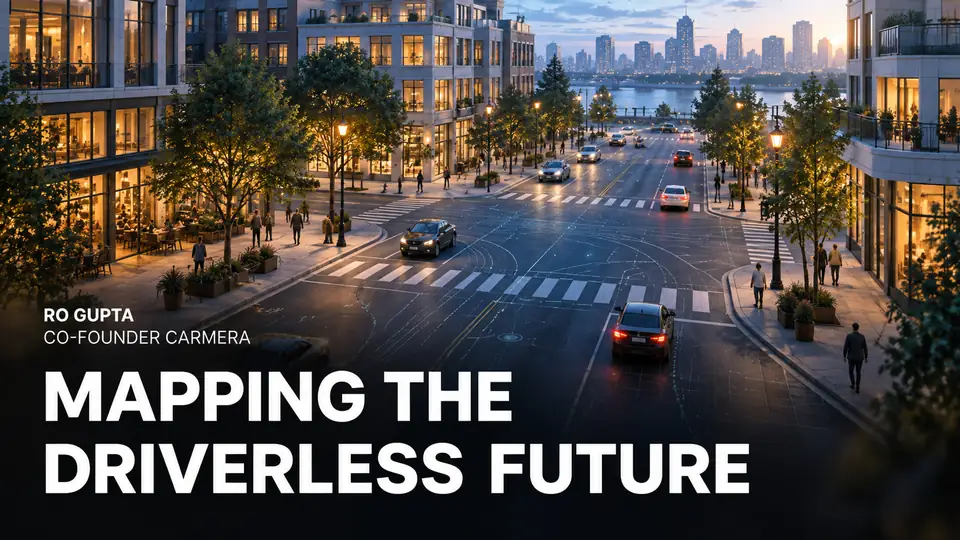
In this conversation, we talk with Ro Gupta the CEO of Carmera. At Carmera, they maintain the maps that move the world — from HD maps for autonomous cars to consumer maps for human navigation.
We cover the future of maps, autonomous vs. human driving, autopilot, and more!
Links
Chapters
Times follow the podcast audio. The video’s timeline may be slightly different.
- 00:00Welcome and introducing Ro Gupta
- 03:00Why autonomous vehicles need current maps
- 10:04Mapping the middle and last mile
- 11:58The autonomous-vehicle hype cycle
- 15:09Barriers to deployment
- 18:12The next revolution in the physical world
- 24:26Implications for cities and other industries
- 30:43Tesla, driver assistance and public trust
- 34:20The future Ro wants for his children
- 36:11Finding Carmera and closing
Read the conversation
Open the full transcript
CAMERON WIESE: Welcome to the Build the Future podcast. My name is Cameron Wiese and I'm your host. I've always been fascinated by the ideas and sentiment that drove American culture in the 1960s with the space race. A culture galvanized to dream about the possibilities of tomorrow, whether it's food, transportation, cities, biology, or anything else. It was this cultural mindset rooted in optimism that the world tomorrow would be better than the world today. A mindset where people were compelled to build things, and I quote JFK, not because they were easy, but because they were hard. It's this desire to build and to dream that seems to have been lost, and something we're here to bring back. With Build the Future, we're here to promote the ideas and stories of those who see how the future can be better and promote their plans to get us there.
CAMERON WIESE: It's our mission to get you to dream about the possibilities of tomorrow, to dream about the future that you want to live in, and inspire you to go build. Today, we're talking with Rho Gupta, CEO of Carmera. At Carmera, they're developing systems and sensors that enable them to capture and process real-time map data. In doing so, you're laying the fundamental groundwork for the future of autonomous transportation and mobility. Let's jump right in. Thank you so much for coming on. I'm excited to have you here on Build the Future to talk about Carmera. Thanks for inviting me. Tell me about the future of building Carmera. What's the vision?
RO GUPTA: Vision is to be the road intelligence platform of the future, really. And so road intelligence is sort of the broad term we use. We specialize in mapping and in particular something called high definition maps that are used for sort of next gen autonomy and mobility use cases. So, you know, we've been focused primarily on building first for autonomous driving, which we can get into in a bit and why maps are used. But more broadly, a part of maps, both high definition maps, as well as the maps that you would have on your phone today. The part that's really hard and unsolved is how to maintain maps as things change in the real world. It's either very costly or very slow or just not accurate. And we're going through a revolution of sensors everywhere and processing technologies and techniques that just weren't available seven, eight, 10 years ago, but were five or six years ago when we started Carmera.
RO GUPTA: And so that's what's really exciting is like really being able to make a dent in a, in a problem that's been a problem for decades now in mapping. And finally we're seeing, you know, a way to actually skin that cat, pardon the expression in a way that can actually be at scale.
CAMERON WIESE: So what is the process for collecting this information? And then why is it important that we update and keep our maps current?
RO GUPTA: Obviously, it's something that companies Google and Apple and companies like here and Tom Tom who are suppliers to the automotive industry. They certainly have had to do some updates on maps, but not really to any level of high bar of frequency. And that's because historically all these use cases have been really for humans to use maps to research directions to a place or navigate or see what neighborhoods are interesting in any city or whatever. And so if things are a little bit old or outdated, the sign, a turn restriction at an intersection is wrong or isn't there anymore or whatever, not the end of the world, you're still a human in control whether you're driving or you're walking or you're just not at your computer looking at the map and researching something.
RO GUPTA: So it wasn't a big deal, right? But now it's these maps needing to be sort of upgraded for machines, not just humans, right? And so in our case, you know, we're building for, you know, arguably the hardest to satisfy use case, which are machines that are driving around on public roads and you don't want to crash into things, right? And so there you have a much, much higher bar. And so basically I'm obviously referring to, you know, autonomous vehicles, or driver's cars. And that's when I think that, that really was one of the catalysts for the mapping, road intelligence industry to start to really step things up in the past few years, because that's a clear use case where, you know, especially for these high levels of autonomy, where you're talking about a very unsupervised experience where the humans either totally out of the loop or mostly out of the loop in terms of being expected to, to, you know, operate the vehicle.
RO GUPTA: There's a very low tolerance for certainly for any risk in terms of actual safety. But even if you feel really good about your safety case for your robot, for your driverless car, there's also still a very low tolerance for a lot of like interruptions or disengagements because the sensors thought it was seeing something, but the map disagrees or vice versa, whatever. So basically to get to a really fresh, accurate map, these update cycles have had to really be improved whereas in the past it was fine to try to update your map once a year at best. And again, the reason that these maps are used by these autonomous vehicles are, they're a really important redundancy and source of foresight for the vehicle. So the vehicle in real time is sensing things and making decisions, but it's really very, very helpful to have a what's called a prior, it's just a technical term for what your last knowledge of the world was in that intersection or that stretch of road.
RO GUPTA: And that's what the map tells you. And if that prior is really high quality, meaning it's very recent and it does reflect that new turn restriction sign, it's even better. And you start to make your decisions with a lot more certainty and reliability, right? And then the other nice thing about a map is some people call it the fourth sensor. So, you know, these driverless cars often they're using light cameras and radars and LIDARs to see what they can see line of sight. But a map can also tell you what's around the corner or six blocks away that your sensors can't get to see. Anyway, all this to say is that requirement, that's a big, big difference from just a human driving around on Waze or something.
RO GUPTA: And so that's why we saw this sort of coming, this need coming about six, seven years ago when the concept of Carmera was brewing and that that was really gonna up the ante on next generation mapping, particularly on the change management side. And so that's what we focused on using sort of a crowdsourced camera-based approach because there are now so many sensors on streets today. And so you can do it in a way that's high frequency, but still actually very cost-effective.
CAMERON WIESE: And then kind of how this fits into the broader picture of like autonomous transportation is, you know, we can't have cars driving down the streets thinking things that are no longer there or there or things that, you know, they didn't think were there or there and causing all sorts of problems with like reliability of the things, right?
RO GUPTA: There's a lot of analogies to humans Because even though it's okay if the map is wrong for just about any human use case, it's still a lot better even for human use cases if the map is really good. And what we're seeing is, not to get too heady here, but if you think about concepts like singularity, right? There's a kind of analogy a little bit with maps because where we see things going is maps are basically like the next generation of maps are helping machines act more like humans. So that's what I just described to you, right? Like the driverless car make better decisions like a really good attentive skilled driver would, right? But we also see that these next generation maps can allow humans to benefit from data that normally machines only get access to. So for example, like the Amazon delivery driver from a next generation map, he or she should be able to get much better hints that hey, you know, after that McDonald's is where you should pull over or, you know, that's a good place to stop or, you know, you should actually like, you know, you can use more sort of natural language type directions that typically humans have just sort of fend for themselves. So I guess what I'm saying is we kind of see convergence where just better maps are good for both machines emulating humans and humans kind of emulating machines, right? So it's sort of like it's both. And I think the other thing we're also projecting is that, you know, right now, a lot of the focus on these maps are
RO GUPTA: for redundancy, you know, for making the decisions on a couple key things. So basically, these drivers cars have to answer these three core questions all the time. One is where am I? We call that localization. Two is what's around me. I call that perception. And three is what do I do next? That's called planning. So maps are used for all three of those pretty extensively for these high levels of autonomy these days. That's because, you know, for all three of those, you can refer back to the map to sort of assess whether you think you're making that decision correctly. But we also think that in time that the onboard systems are getting better and better so that it's quite possible for example for perception, let's say, that the onboard real time perception just from the sensors and the software in the vehicle are just going to get so so good that the the confidence levels will be perfectly good enough on vehicle that you don't even need the map so much to verify that anymore. However, if you think about it, right, you will always want to know more about foresight. If you can, you're always going to want to know what the map can tell you about what's around the corner or six blocks away, because it just then makes it even a better experience to plan around.
CAMERON WIESE: Well, I want to talk on the space more broadly. I'm curious to know what your take is on mapping technology in the context of like the last mile delivery. How do you think about that component
SPEAKER UNCLEAR: of this autonomous technology space developing? Yeah, we're definitely bullish there, both middle mile and last mile. On both of those, actually both for humans and machines, because I already described to you on the human side, for example, actually a number of our employees came from Amazon, Amazon logistics. And so we're quite familiar with that world of delivery. We also, So part of how we crowdsource the data to keep maps up to date really cheaply is we work with delivery fleets. So these are, you know, non just human driven delivery vans doing their pick up some drop offs you know they might be delivering cleaning supplies or packages or maintenance. They might be maintenance vehicles going and doing the rounds and you know we touch sensors to them and you know they're able to get a service that allows them to keep their the driver safe, but with this, you know, visual monitoring and safety analytics service. And in turn, we're able to cross search data really cheaply. But my point is, that's also means we know a lot about that delivery space. And even for humans, as I was saying earlier, better, much better maps, you know, that are for machines can also almost give these human drivers superhuman capabilities, right, like make it a lot easier for them to navigate, especially in the chaos of a city, if you're giving them more clues on what features to, you know, to navigate around or if you're giving them more up-to-date information, for example, on a construction zone, right, that may not be perfectly accurate in ways or something. So that we believe in and we build for in our maps, but also we also are believers in the autonomous delivery space.
RO GUPTA: That's like, you know, especially with COVID, but even before COVID, you could see that that was, you know, very real. And both on the middle mile and last mile, there's some, you know, really interesting companies and traction we're seeing there.
CAMERON WIESE: Can you give me a bit of an overview or paint the picture for the listener for like what the autonomous space looks like right now or the autonomous transportation space looks like right now?
RO GUPTA: It's been very interesting because like total classic hype cycle, you know, in the mid part of the last decade, you know, every, I always gauge the hype cycles by CES, you can almost like measure it by the buzz of CES every year. And I would say by about 20 CES, was it 2019? I think I remember at CS 2019 telling people, you know what, people are still bullish, but you can see there's a sobering up going on a little bit. People talk more realistically. Then last year that definitely was happening 2020. And then of course COVID happened. And so I think that's good because frontier technologies, the technologies, they typically progress in these S curves. What that means is there's always this trough, you know, there's this hype initial hype, and then there's this kind of flattening a little bit.
RO GUPTA: but then in time it actually does pick back up again when you get to mature deployment phase. But if you're building for a frontier type space and you know it's in the early days of the hype cycle, you actually want to know it's actually almost better to get to the trough sooner, because it allows you to plan a lot easier on, for example, how much money to raise or how to think about doing a proof of concepts versus gearing up for large scale production. And it's actually really useful to start to get that pattern recognition. I'm not saying we're totally out of that trough. But I definitely think there's some, I think actually COVID accelerated some things in that trough. Because one is it shook up a lot of the industry.
RO GUPTA: There'd already been a lot of winnowing out a little bit of companies or consolidation or just slow down the timelines, realistic timelines, et et cetera, before COVID. And then COVID just accelerated that. But then also on the flip side, obviously with people starting to rethink mobility and getting into a vehicle with someone else and also getting things delivered to them, that also really changed just even lay people's understanding of the benefits of things like, you brought up autonomous, like last mile delivery, for example, right? Oh, so there's one other thing that happened, China. They obviously kind of went through their COVID cycle first, but then people got to sort of see a sneak peek of them regrouping and auto sales really downs back. But also, if you're seeing some of the news reports on autonomy in China, it's no surprise because it's very top down authoritarian and they can move faster than most other countries can who have much more complicated regulatory environments.
RO GUPTA: But I think what that effect will happen is that will then shake up, you know, everybody else and sort of make sure like, you know, keep people chomping at the bit to catch up and not have sort of China dominate that space. So that's a little bit of how we've seen things transpired sort of our view of where we are in this in this S curve.
CAMERON WIESE: What are some of the largest barriers to getting autonomous technologies rolled out more broadly? What's it going to take for us here in the US and other countries to catch up and to be able to get that deployed?
RO GUPTA: One of the challenges the US has is it's very federated because you have 50 states that can all have their own laws. That's been a big push from the AV industry over the past few years. And the federal government recognizes that like all the private companies need to know what the rules of the game are and ideally in a uniform way so they don't have to have a different playbook for Arizona versus California versus Oregon versus Washington, you know, like that would be a nightmare. So that's one, I mean, especially in like urban, the urban robo taxi phase, there's been a lot of interesting developments for sure, like drivers being actually finally pulled out of the vehicle, commercial services being deployed, you know, people actually paying for this and showing that they're having a really good experience.
RO GUPTA: That's awesome. You know, there's still work to do to make that scalable, you know, fully economic within in just one city, let alone going too many. And by the way, I think there are certain technological governors on that, including mapping. We know for a fact that all these companies, at least today, as I said, that might change over time when the map is being used a little bit differently, but today that map is almost like virtual railroad tracks. They won't, unless you have a really high quality map in the routes that you're driving in a given city, you can't deploy. It's like the car may as well not have wheels on it. And all that takes resources, it takes a robust supplier ecosystem, and you're dealing with the real world, you're dealing with atoms. It's not just like a bunch of software that you build it and then you let people and then it's just sort of exponential from there, right? Those are a few. I think of course there's also consumer acceptance.
CAMERON WIESE: It's also interesting to see how the media portrays this sort of technology, or kind of any frontier technology in a bit of a negative light.
RO GUPTA: I think it's both though. I think the media, I actually come from a background in digital media and actually in the news world itself. I used to work at ABC News years ago. First off, I have a respect and appreciation for a good functioning press in media. At the same time, you see it over and over with tech where the media is almost too lovey-dovey oftentimes in the upward part of the trough part, right? It's just sort of very much built the business model and just the nature of it is so built for sort of over emphasizing it on both the positive and negative side. And it's usually more boring than both of those. It's usually somewhere in between the truth is, you know, so the nice thing about this industry is, I think in terms of the people in the industry working on the problems. Sure, there's some tourists, but you know, I think I actually been really impressed by all the folks we deal with, because generally they really like to keep their heads down and keep chipping away.
CAMERON WIESE: Leaves is helpful. It's like, cool. No, this problem is being worked on by people who genuinely, genuinely care and are in it for the long run. You wrote this blog post on the revolution, like the next revolution being in autonomous technology. What excites you the most about this space? And then what will this begin to enable for people that they're probably not thinking about?
RO GUPTA: I would say still like the overall concepts that I was writing about still apply. I'm sure I'd change some things in there, but still apply because one of the things that has always gotten me so excited about this, you know, my kind of entree into next generation transportation was actually goes back to the 90s when I was an undergrad and is in a kind of an engineering program, but which multidisciplinary and we were working with various autonomous mobility concepts and a bunch of other things. So I've been, I thought it was cool for a long time. you know, it was more recently than that, probably a little bit before I wrote that blog post back in whatever it was, 2014, that it dawned on me just how impactful automating mobility would be.
RO GUPTA: And I think that for two reasons. One is I was coming off my previous startup was, you know, in the sort of web 2.0 social web, you know, kind of big hype cycle there and got very familiar with the internet and how the digital, the kind of the network of our digital lives works, the internet. And I saw parallels that the real world were starting to be sort of like more and more digitized and that sort of, there's this expression that Mark Andreessen coined about software is eating the world. Well, it also seemed like software and data was eating the real world, the built world as well, around that time in terms of like IOT sensors, you know, being in everything and like, and what was going on, by the way, also in mapping technology.
RO GUPTA: So, you know, it got me thinking like, arguably the biggest revolution of the internet was search, right? And developing a crawler and an index for all the nodes that are in the network, you know, the digital network of the world, the internet. And it seemed like that was inevitable, like that the real world, you know, needed that as well. And if you really think about roads are very much It's kind of like the edges that connect up the nodes of the real world. Yet, we still had pretty poor knowledge of roads and hadn't really digitized them very well. Sure, we had Google Maps, et cetera, but as I said before, pretty limited in terms of what information you know about those roads and certainly how frequently they're updated.
RO GUPTA: So from a super abstract point of view of taking my digital experience and then thinking about how we're seeing some megatrends of applying that to the real world, that was very intellectually interesting. And then also, just realizing that the second order effects of when you can really automate moving things around in the real world and like all the waste, just the economic waste of the way things are moved today. Like if you can sort of almost like, again, going using the digital knowledge, like if you can kind of packetize and load balance the world, the real world a bit in terms of how things are moving around. that could just have a profound effect on so many other things besides the transportation itself, you know, land use and, you know, productivity and, you know, I listed a whole bunch of other things. I actually think those particular things though are probably nearest and dearest in terms of, you know, like what I think, if you just think about it abstractly, time and space, right? Time and space are very poorly allocated right now in terms of what we use land for in the real world, like I'll give you a hint, parking.
RO GUPTA: Like there's way too much parking real estate in the world. And yeah, so that's one example in terms of the, you know, the XYZ plane. And then on the time side, you know, in that post I mentioned, you know, one other thing I remember reading,
SPEAKER UNCLEAR: you know, probably a little,
RO GUPTA: but yeah, probably like in around that time when I wrote it was I'd seen there was this like major longitudinal study that someone, it might have been Google or it might have been someone else, had done, I know it wasn't Google, someone else, had done about happiness. It was like, I think, considered the most robust kind of peer-reviewed academics study on what drives happiness and like, and being and showing causality. And I remember there was like, at least in the summary of it, they were like, you know what, there was only two things that really showed any causality. And one of them was I think it was like divorce rate, which is not surprising, you know. But the other one was they showed a very strong not just correlation, but I think causation with commutes and commute times. And it dawned on me that that you know what that makes a lot of sense like there's a lot of anxiety and stress and drudgery associated with people just figuring out how the hell to like, get around get to work and back, whether that's driving yourself or whether that's taking a bus or a train and then transferring to something else, whatever, you know, it just sort of causes a lot of mental overhead, you know. And I think that's the, you know, and again, like what's been so interesting about this last year is like, hey, what if you don't have to do that every day, right? Like I just have a crazy travel schedule, both commuting, you know, almost like an hour, hour and a half commute into our office in Brooklyn, and then, and also travel all around the world a lot.
RO GUPTA: The automotive industry is all around the world, right? And then I've just realized how needle moving it's been to not have to do that. But even once we do go back and do more in person, being able to have either much more pleasurable experience or not having to, for example, actually drive yourself and being able to use that time for something else, whether that's taking a nap or emails or whatever, like I just think that's very, very highly impactful. And it's hard to quantify that sometimes for, you know, like, let's say given market size or something like real estate. But I think it kind of what I like about it is it's like it's sort of across the board, you know, it's just like all of society impactful. So yeah.
CAMERON WIESE: I'd love to kind of a few more kind of examples from you on because you mentioned like insurance, civic planning, construction, healthcare, like can you dive into like concretely things that you think are going to change as a result of the upcoming revolution?
RO GUPTA: I'm going to leave out like, you know, the obvious like automotive and transportation. But yeah, so like, I think real estate construction, I kind of already hinted at it, you know, there I think that built environment industry is already rethinking a lot about, I mean, it's not just AV, it's not just autonomy, but even things like EVs, right, like everyone, all developers are rethinking how they think about, you know, parking, charging infrastructure, modularity, so that you don't have to waste a ton of space on permanent parking.
RO GUPTA: You can kind of re configure that for a different use if you like to. Same thing with city planning and, you know, the use of. Lanes curbs. Even just full neighborhoods, you know, Either first off just ruining cars wholesale or reserving certain lanes only for high occupancy or a high autonomy. Type of modality. that's all happening. I think insurance, huge one, they're all trying to figure out how the heck to underwrite this. Although they're also, I think, both excited and anxious about it. Because on one hand, they don't know how to, their actuarial models don't really incorporate this yet. But on the other hand, they also think that they can, I think they see a lot of opportunity in kind of managing risk better with autonomy that can really make a dent in safety, in terms of just given what we know about human fault for over a million deaths every year around the world with cars.
RO GUPTA: So that's another one. Healthcare is obviously related, though it's not just a million deaths, but it's also many millions of injuries and exactly. And by the way, that also has insurance implications on the healthcare side, media and entertainment. As I mentioned, on one hand, it's very exciting to get a lot of time back in a given week or month on inner commute to be able to do other things. And of course, whenever you get time back, the media industry wants that time and attention. So they're all trying to figure out how to get in front of you and monetize it. And yeah, those are just a few, but maybe we could go on.
CAMERON WIESE: Yeah, it's exciting. There's like, clearly a lot of connected pieces to this that we're not really expecting right now. But as we see the technology roll out and we, it's just going to have ripple effects throughout the industry and throughout our day-to-day lives. Where do you see opportunities for other entrepreneurs to kind of get involved in GoBuild and like this changing landscape?
RO GUPTA: I think there's some really techy stuff that, you know, people smarter than me tell me are still gaps in the, so I'm talking right now about autonomous driving technical stack. And this includes for personally owned vehicles. So, you know, I think when we talk about autonomy, there's two pretty distinct types. I think in this podcast, we've been mostly talking about what's called level four autonomy, where it's, you know, it's really more like that robotaxi model where you don't even own the car. There is no driver. There's may not even be a steering wheel and it's just, you know, basically like an autonomous Uber, right? But there's also a parallel path going on in what a lot of people refer to as like level two autonomy or level two plus.
RO GUPTA: And that is more really driver assist. You know, it's still the driver still has to be in the loop, but it's like adaptive cruise control and steroids You know through the car just doing a lot more for you You still have to pay attention and if you don't you'll get beeped at but you know It can you can not only stay in the lane to change lanes and you know do some more sophisticated things And so that's you know, you're certainly Tesla autopilot was really first out of the gate with that But you know all the other car makers have been catching up there and as they get more and more as they sort of basically build their cars more as like a computer on wheels, which is really what Tesla did from the get-go, because they were able to do that.
RO GUPTA: Whereas all the other car companies had all this legacy way of doing things. And so they had to do it much more patchwork. But you're seeing those traditional auto companies realize that, no, we really have to rethink this and have a new sort of software, more software-centric platform where it is more like a computer on wheels. You know, VW is a good example. They created this thing they call Cardot Software. You know, it sounds much more like a Silicon Valley organization than a, you know, auto based organization. So, and so I mentioned that because with that, that's all well and good, but what that means is that's still a massive change for those traditional auto companies. And those folks tell me there's a lot of gaps in terms of like getting them to be able to behave more like, you know, let's call it more like the Silicon Valley, software centric computer on wheel style.
RO GUPTA: And that includes things like semiconductors that are really more purpose built for our computing stacks like that, within automotive or middleware, that was really more purpose built for again, that use case or better ways to approach data management, especially edge versus cloud. you know, again, it's just like, you know, companies like Tesla may have already been able to plan for all that, but you know, these hundred year old auto companies weren't able to and so they're now really trying to fill those gaps. So that's one area where I think if you're starting a company now, I would do a bunch of research, talk to these people. You know, the good thing is, I think there's a lot of humility in, you know, I think there's a, there's, on one hand, there's actually a lot of like, you know, self respect, which is deserving from these auto companies that, hey, look, like we're still like the best at bending metal and actually shipping these cars at scale manufacturing at high quality and safety and scale.
RO GUPTA: On the other hand is humility that yes, this is a new way of thinking, any paradigm for them and that they don't have all the answers. So they're very interested in keeping up with really sharp young people or startups or entrepreneurs and telling them what their problems are.
CAMERON WIESE: Is anyone really going to be able to beat Tesla? Is there patchworking stuff to try and make it work retroactively versus Tesla building that from the ground up?
RO GUPTA: The short answer is yeah, absolutely. I don't know if the growth prospects match Tesla's stock price right now or not. I think Tesla is a very complicated story in our industry. On one hand, the entire industry should be absolutely thankful of what they've catalyzed on both the EV side and on the AV side. you know, they woke things up across the board and it's just absolutely undeniable that we wouldn't be where we are if they hadn't scared the heck out of the industry to catch up on those important things. On the other hand, you know, they do have a fairly very different approach that a lot of people are uncomfortable with and or pessimistic about. And I'm in some ways partially one of those. I say partially because I think some of those things that they're doing are actually very forward thinking and they need to be leading in a way that is not conformist to convention, particularly by the way, on the AV side. On the AV side, I share some of the discomfort because I think one of the keys with autonomous mobility, particularly cars on public roads is they are on public roads. They're not a contained technology like a rocket, that yes, if something happens, most likely it's going to go into the ocean or something like that, right?
RO GUPTA: Same thing, or with, you know, a tunnel or with a neural lace or something, you know, like, they're much more contained in nature, whereas robot cars are not, you know, they are immersed with the public domain, with many other stakeholders who care. And even if you can make all these claims about the technology, There's a lot of these sort of, you know, these externalities that really matter for from government sake, society's sake, insurance, regulators, all these other things really, really matter. I guess what I'm getting at is like a lot of the redundancies and processes that the more traditional companies, well, the traditional auto companies are taking, but also the competitors in the robot taxi space are taking. I think having much higher likelihood of sort of meeting all those other stakeholder requirements for, you know, societal acceptance, again, insurance, etc.
RO GUPTA: Because, you know, you're dealing with things that are just hardwired into people like they want to know again and aviation is a really good example or elevators to, you know, even if you can say hey look at our data, it's this much better than, than human drivers today. that may not matter, right? If like you're still showing that the machine is at fault for a death that was caused by machine decision. There's just a sort of societal psychology there. And I think, so it's a long-winded way of saying that for one reason in autonomy, I know I don't think Tesla or quite frankly, anyone can run the table. But I also think you have seen kind of a windowing a bit in the past couple years on, you know, let's call it half a dozen or so, maybe a little bit more big, maybe half a dozen to a dozen big players in the Western world and then another half a dozen in China, who are kind of showing, you know, that they have a very big ambitions and a big an ability to get major market share.
CAMERON WIESE: If some kids come cares for you, when you think about the future, what sort of like, what's your vision for the world you want your kids to grow up in?
RO GUPTA: It's a good one. Cause like, you know, first off, like my kids are at that age, like honestly, when they start to become, you know, old enough to, to get a license and old enough to then, you know, be adults and leave the nest, so to speak, that timing is likely to time quite well with a lot of like these, you know, Ray Carlswall has prediction on the singularity, for example, and you know, whatever that was, 2029, and like, a lot of the deployment plans that we see in autonomous space, you know, again, in the next 10 years. So it actually it is very personal, I do think about like, oh, what could my daughter expect, you know, and I just think that it's, it kind of goes back to that point where I would love to sort of see this really great equilibrium of human machine working in a harmonious way. That sounds a very kumbaya, but I think that's sort of always been a dream, I think, of people who have, you know, been in kind of like, into robotics or AI or whatever. And quite frankly, I think we're going through growing pains there because there is hype and that there's also a lot of fear about that, right? And my hope is that by the time my kids are of age, like, we will have sort of gone through that, you know, that crazy ebb and flow of like, too much hype, too much fear, too much give, too much take.
RO GUPTA: And we kind of get to this this equilibrium where machines are actually really enhancing humans for the right reasons. And it's not on one extreme or the other. That's how we also think about maps, By the way, we think maps can play a real role in that for both human and machine mobility. So we'll see.
CAMERON WIESE: Where can people find you and how can they support and kind of are there any what do you all's needs? I assume you're hiring always.
RO GUPTA: Yeah, yeah. So carmera.com, carmera.com.com. If you're interested in coming to join with us where, you know, we have sort of traditional full-time roles, technical roles that we hire for, but actually we recently also, just what is it, a week ago or two weeks ago, launched something we call project ships, which are targeted at younger people who kind of want to, especially people who may not always have easy opportunities to get their foot in the door at companies like doing interesting work in technology, and just like six weeks paid projects, we call them project ships because it It has similarities to like traditional internships, but they're a lot less friction because oftentimes they're built for people maybe younger and maybe don't have much experience, but maybe they have time on the weekends, even if they're in school to work on something like this. So that's also, I think, if that's interesting for your audience, you can check that out there. And then, yeah, and then also Twitter at Carmera, C-A-R-N-E-R-A.
SPEAKER UNCLEAR: That's usually where we try to keep folks up to date.
SPEAKER UNCLEAR: Thank you so much for coming on. I love talking about the future of Autonomous with you and you're excited to kind of stay in the loop on everything that progresses. Likewise. Thanks, Cameron. It's a pleasure. Thanks for joining us for this episode of the Build the Future podcast. If you're building and want to get support, want to hear about certain topics or hear from certain people, shoot us over an email to hello at build the future podcast.com or follow me, Cameron on Twitter at camwheecy and we'll see what we can make happen. That's it from us. Until next time, go build!
More episodes
All episodes Jonathon Barkl of AirGarage — The Future of Parking, Cities, and CommunityJonathon Barkl explains how AirGarage’s parking operations could become the foundation for more flexible uses of city space.
 Evan Goldin — Parking, Public Space and the Future of CitiesEvan Goldin argues that parking rules and pricing shape housing costs, travel choices and public space.
 Garrett Scott — Pipedream and the Future of DeliveryGarrett Scott explains Pipedream’s proposed underground delivery network and its approach to scaling infrastructure.