

Build the Future Podcast
Jonathon Barkl of AirGarage — The Future of Parking, Cities, and Community
Jonathon Barkl explains how AirGarage’s parking operations could become the foundation for more flexible uses of city space.
June 15, 2021 · 35 min



About the episode
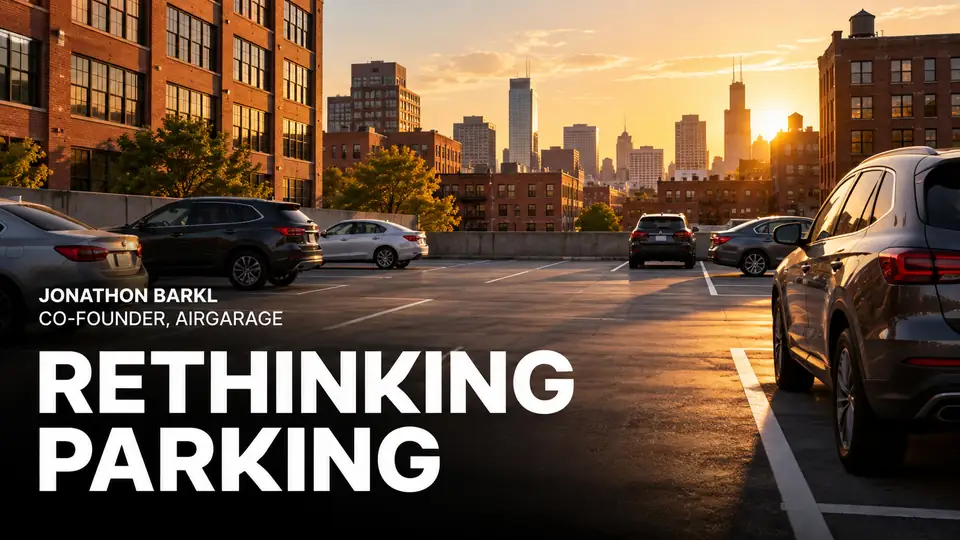
In this conversation, we talk with Jonathon Barkl, the CEO of AirGarage. At AirGarage they’re reimagining the use of parking, real-estate and cities. In the episode, Jonathon describes parking as occupying 30% of the American city, and AirGarage’s work to repurpose those spaces and automate the operation of parking lots. In doing so, they’re helping transform the landscape of our cities turning these single-use spaces into multi-use hubs — all to support a future filled with cloud kitchens, micro-mobility, autonomous vehicles, on-demand fulfillment, and more.
Links
Chapters
Times follow the podcast audio. The video’s timeline may be slightly different.
- 00:00Introducing Jonathon Barkl and AirGarage
- 01:50Making parking space more useful
- 04:41The reality of parking operations
- 07:29Parking minimums and city land use
- 09:34A church parking example
- 11:21Jonathon’s case for zoning reform
- 13:09A proposed property-rights argument
- 16:49Housing advocacy through the courts
- 17:50Preservation, aesthetics and building rules
- 21:18Building parking software with customers
- 22:08Simplifying payment
- 23:42Occupancy data and an automated experience
- 24:43Beyond parking: a network of space
- 26:40An API for the physical world
- 28:01Smaller spaces and lower barriers
- 29:07Starting a physical business in small steps
- 30:40Retail space and neighborhood businesses
- 33:09Where to find Jonathon and AirGarage
Read the conversation
Open the full transcript
CAMERON WIESE: Welcome to the Build the Future podcast. My name is Cameron Wiese and I'm your host. I've always been fascinated by the ideas and sentiment that drove American culture in the 1960s with the space race. A culture galvanized to dream about the possibilities of tomorrow, whether it's food, transportation, cities, biology, or anything else. It was this cultural mindset rooted in optimism that the world tomorrow would be better than the world today. A mindset where people were compelled to build things and I quote JFK, not because they were easy, but because they were hard. It's this desire to build and to dream that seems to have been lost and something we're here to bring back. With Build the Future, we're here to promote the ideas and stories of those who see how the future can be better and promote their plans to get us there. It's our mission to get you to dream about the possibilities of tomorrow, to dream about the future that you want to live in, and inspire you to go build. Today, we're talking with Jonathan Barkle, the CEO of Air Garage.
CAMERON WIESE: At Air Garage, they're reimagining the use of parking real estate in cities. More specifically, they're working to repurpose the 30% of the American city currently occupied by parking and automate the operation of these parking lots, enabling churches and businesses to rent out parking to drivers on demand. In doing so, they're helping transform the landscape of our cities and converting these single-use spaces into multi-use hubs to support a future filled with cloud kitchens, micro-mobility, autonomous vehicles, on-demand fulfillment, and more.
SPEAKER UNCLEAR: Let's jump right in.
CAMERON WIESE: Tell me about the future you're building at Air Garage.
SPEAKER UNCLEAR: What's the vision?
JONATHON BARKL: At Air Garage, we're really focused on taking the 30% of the average American city that is currently dedicated to parking and trying to make that real estate more valuable and trying to make it available for higher and better uses. So that sounds kind of pie in the sky, but right now, how that manifests itself in the world is Air Garage is kind of a 21st century parking apparatus. the equivalent of like property management, but for parking lots. And the reason that we're doing that is because we've identified that, hey, these parking lots, these parking garages that do occupy a huge portion of the real estate in the average American city, they're kind of sitting underutilized. They're sitting on poorly managed. They're not being used in a way that is data driven. They're really being used for one use case. And oftentimes they're locked away for private use only or car parking rather than being available for public use for many different use cases. So the thing that we've always been focused on since the very beginning of air garages,
JONATHON BARKL: how do we take a space that is currently like private use for a single use case and how do we make that space available for firstly for public use and then secondly for many different use cases. And so that thread has kind of carried us all the way from the time that we started when we were in 2017, renting out people's driveways near our university to today where what we do today is you know operate parking lots and parking garages across the country and we you know do it in a software first way that you would expect a company to operate in 2021, as opposed to a fax machine driven way that the companies that we're competing with do it. And really, the end goal being that, hey, if we can take the way that parking operations work today, and we can add kind of this digital ledger on top of it, if we can make that, you know, parking real estate legible to the digital world and to our software, then we can start to say, hey, we know how this space is being used every day and every week, we can look at trends over time and see when is their space sitting unused. Maybe it's after 5pm
JONATHON BARKL: on a Thursday or maybe it's on weekends and we can start to say, okay, this space would be better utilized in a different way. And we can say, okay, we're going to open up a food truck park 5pm onward Thursday evenings in this parking lot, because that's the higher and better use that it could be serving. And really today that data just doesn't exist because these companies just don't think the parking companies that currently operate these parking lots, they just don't think in a very data driven way. They don't have one unified piece of data for a location where they store their data, where they track occupancy, where they see how parking lots are being used. So our goal is, hey, build a better parking operator. And then on top of that parking operator, we can build the future of things that are going to be built in our American cities. Because right now, the way that you have to go out into the world and try to get real estate in a city if you want to start a business is still very old school. So
JONATHON BARKL: we think that this parking company can be a platform for building cities of tomorrow and building things within cities of tomorrow.
CAMERON WIESE: It's crazy just how archaic that something as simple as parking is, right? You have the printed cards, you press the button, the machine spits out a card and you hold on to it, you have to like maintain that piece, and then put it back in the machine when you leave. Like, if you're lucky, you can pay with like Apple Pay, or
SPEAKER UNCLEAR: the credit card, some places still require you to pay with
CAMERON WIESE: cash, which is like, strange.
JONATHON BARKL: The scenario that you just described is actually like, kind the bleeding edge of parking technology, right? That's the good experience that the parking industry has designed over the last 50 or 100 years. A lot of parking lots, like you mentioned, they are still very they're still very cash driven, right? They're still very like there's so many parking lots and parking garages that are operated by companies where there's there's supposedly, according to the US government, there's like 10000 parking companies in the United States and only a small handful of those are like large, regional or national players. A lot of those are really just some, you know, a woman that has decided I'm going to start a parking company. And they basically just go and run one or two parking lots. And then they hit this kind of asymptote where, hey, they have themselves and maybe a couple employees where users like friends or family, and they stand out there and they collect cash day in and day out. And they do that in a very manual offline way, where it's
JONATHON BARKL: like the first parking lot that we actually started with, the way that they were running it before, it was this church and the way that they were running it before we took it over, was they would literally just have a guy that they kind of hired from their homeless outreach program. And one guy I would stand there from 5 a.m. to 12 p.m. and the next guy would stand there from 12 p.m. to 7 p.m. And mind you, this is in Phoenix, where during the summertime, it's 115 degrees outside and it's very sunny. And they would stand there 5 a.m. to 12 p.m. and they would take $10 cash from you. And then they would give you like a little raffle ticket that you would stick in your windshield to show that you had paid for the day. And the guy, I remember sitting there the first week that we launched the parking lot, I sat there with him as kind of like the quote unquote parking attendant to transition people over to like, Hey, this is the air garage. You have to do it this new way. At the time we kind of forced you to download an app and our app we had just
JONATHON BARKL: built in the last like three weeks before we launched parking lot. So I was sitting there in the parking lot with this guy who had been the parking attendant there for years. And I remember just very distinctly we're sitting there under this umbrella. Heat rising from the asphalt. You're just baking alive. You can't really think at all. You just stare into the distance. And I remember him being like, yeah, at least they finally got me this umbrella a couple of months ago. And I'm like, you used to sit out here without an umbrella in 115 degree heat in the sun and like he just was like roasted alive basically. So it's pretty wild. Like that's how a lot of parking lots are still running today. It's like crazy that that's the state of the industry still in 2021. And even the companies that are doing the more advanced experience you described with like the machines and the gate arms and things, they're still, you know, internally, at least very much driven by like fax machines and paper invoices and just a lot of behind the
JONATHON BARKL: scenes things that are happening that should be happening through software. One of the fascinating
SPEAKER UNCLEAR: things like just how much parking space there is. If I understand correctly, there's some
CAMERON WIESE: differences and different mandates, but you have to have one or two spaces per resident in apartment buildings. Businesses have to have parking capacity. Can you speak to that at all? What's that look like? What does that requirement look like? No, you're definitely,
JONATHON BARKL: you're 100% correct. But part of the reason for America's parking issue and real estate issue and housing issue is all this zoning code that has been put in place over the last hundred years. If you haven't read it, a really good book about that is like the color of the law, which is a book about the history of zoning, how it basically was invented 100 years ago as an extension of Jim Crow and how zoning was used to keep black people, minorities out of certain neighborhoods. And so really fascinating concept, but parking minimums is definitely part of that. And part of the reason that we have so much parking today is those parking minimums. And you're right that they totally differ by city. They differ based on your use case. Like we've looked at places where it's like, okay, if you have a church for every queue that you have, you have to have like three parking spaces and they've like defined it based on like very specific requirements like that where it's like not even based on like the square footage
JONATHON BARKL: of building anymore it's like based on like how many pews do you have in work like church that defines how many parking spaces go into the parking lot and these parking minimums are really quite fascinating because they've led to this overbilled parking where you know the staff that everyone in the industry kind of like likes to toss around and all just put on on it that it's estimate and there's no real definitive count but there's an estimate that goes around that says there's probably about at least eight parking spaces for every car in the United States which is quite wild if you think about it that we've overbuilt parking to the point that there's eight times as many parking spaces as our cars. It's like even if you think about where you go in your daily life if you drive a car every single day day in day out say you live in a city like Phoenix where it's like you know very car driven you probably don't park in eight spaces on any given day you probably park in maybe your driveway and then you park in a space of school or space of work and maybe a
JONATHON BARKL: spaces, grocery store, so maybe three to four. So it's quite wild that we built double the number of spaces that you maybe occupy on a daily basis. But the you know, other interesting artifact that comes about from these parking minimums is just the effect that it has on, you know, small businesses and churches and things like that, because there's a church that Eric Raj works with, and we operate their parking lot for them. And the only reason they have this parking lot is because the church has been around since like 1885 or something, right. And in 2005 2006, when they decided to renovate their building, they did all these renovations to the building. And because they did those renovations, it was more than 50% of the value of their building. And so the city said, you now have to bring everything up to zoning code. And one of the things you have to do to do that is get more parking. And so they forced this church to go out and lease this massive parcel across the street from them that is a parking lot. And it's literally just sits there as a parking lot, because
JONATHON BARKL: this church is required to have it. And then they sell parking to try to pay the lease or at least break even on the lease that the city forced them to take out. And then the worst thing is the city then taxes them on that parcel that the city forced them to take on, right? It's quite fascinating that parking zones then lead to this huge headache and this huge hole in the budget of a church. It's like the church was there before the city was even incorporated. So it's like pretty funny that the church has to then submit to these zoning codes that have come about, you know, 100 years after the church was founded.
CAMERON WIESE: Yeah, it's really unfortunate that you'd think that the church was just able to do whatever they want to do on their property.
JONATHON BARKL: It's fascinating that the government has so much control over property. And like, I mean, that's part of the reason that we have all this housing problem, right? Is that there's so much government control and the government also makes it so that it's like one no to stop you from building everything. And you need a million yeses to allow you to build things. Right? And that's part of the issue that we have here in California
SPEAKER UNCLEAR: and San Francisco. And that's why my rent.
JONATHON BARKL: So it's because I live in this beautiful single family home in the middle of San Francisco, which should be probably an apartment building or a skyscraper, but instead because zoning and planning and things, it's not.
CAMERON WIESE: How do you think we get out of this pit we're in, where we have so much zoning code that's prohibiting new innovation, new construction, new developments?
JONATHON BARKL: So I think what we're doing in California right now is probably the way forward where it's like there's slow marginal step-by-step improvements happening where, for example, the California State Senate or state, I think the Assembly House just passed a bill that basically makes it so that parking minimums are no longer required if you're within a certain distance of transit, right? And it's like almost finding these like small wedges to just chip away at the zoning code that we've implemented against ourselves in the last 100 years. But I think ultimately, I think there's got to be some sort of step function change that completely removes some of this regulation. And, you know, I think that there's different arguments on how to do this. One of the ones that I know it's almost like, you know, I think every founder has a dream of like, hey, someday if I am super wealthy, what am I gonna do with my kind of FU money? And one of the things that I often think about is how would I basically use the FU money to then force this change? Because this could be a huge unlock for society
JONATHON BARKL: where if we removed the zoning code that we had placed on ourselves in the last hundred years, it's like if you think about cities and the cities that everybody loves, and the cities that everybody loves to walk around in, the cities that everybody loves to walk around in were all built before the zoning code was put into place. right? It's those walkable streets with no, you know, no setbacks. So the buildings are right, right up against the sidewalk in the street. And you're walking down this beautiful, you know, building line street, and there's no cars between you and the buildings. And, you know, all these things were, you know, very commonplace in 1800 before we really put in these zoning codes. And so it's like, how do we go back to that time? Because that's the cities that we all love walking around, were built during that time. So I think that, you know, will be a huge unlock for society if we can get rid of this zoning code and and allow people to build whatever they want. And there's a kind of a little bit of an extremist libertarian argument to be had that,
JONATHON BARKL: one way to look at this is to say, okay, the government is not allowed to just come seize your property, right? It's basically like the Fifth Amendment, like no unlawful search and seizure, specifically seizure, right? And so if the government wants to take your property, they have to compensate you for it. They have to give you just compensation. And so the way that that's been interpreted in the past is like, hey, basically, if you want to take my property, the basically government has to compensate you for that. But the key being that typically they only think of your property as a physical parcel that you're on. So if the government's going to build an interstate, and they're going to bulldoze your house and take your land, they're going to use eminent domain to do that. And they say, okay, your house is currently worth $500,000 or whatever, we're going to pay you $500,000. That's a just compensation. And so they take that. There's a more interesting interpretation that might be applicable in the future or could be argued to be applicable and
JONATHON BARKL: I'm not a legal expert by any means I've just done some reading on this, which would be to say property is not just a physical land on which you reside, property is also the like right to build on that land, right? And so it becomes the value of anything that you could build. And so what the argument would be then is okay if I wanted to take the land that I own in the middle of the city and I say, I'd like to apply to build a skyscraper on this land. If I say the skyscraper is gonna be built here and its end value is gonna be $25 million versus the home that I'm currently residing in, which is $500,000, or whatever fair assessment of that value is, if the government wants to tell me, hey, you can't build that there, they need to justly compensate me for that denial of my right to build on my property because property rights may or may not also include the right to build whatever you please on your property. And so that becomes an interesting argument of, could you almost bring it all the way back to the unlawful search and seizure amendment of the constitution, the bill of rights,
JONATHON BARKL: and say, hey, if the government would like to deny me my right to build on this property, that's totally fine, but they need to just compensate me if they want that. Because if you think about it, oftentimes what the government is doing, if they're stopping you from building, what they're doing oftentimes in San Francisco is they're saying, this is going to affect the other people around you. So there's like all these shadow studies and things like that where it's like, if you build this building, there's gonna be a shadow cast on your neighbors. It's like, okay, that's totally fine. And what you're doing is you're trading the private value that I have with my property. If I were to build on that property with the building that I'm requesting to build, you're trading that for a public good, which the government is basically giving as a subsidy to the people around me saying, hey, we're not gonna allow this person to build so that they can get shut, right? It's the same thing as an interstate. If they want to build an interstate on my property, that's a public good.
JONATHON BARKL: So they need to compensate me for taking away my private property to build that public good of that interstate. And so I think there's a really interesting opportunity in the future, maybe for someone to, with FU money, go out and like try to fight legal battles like this, where it's like coming up with creative ways to try to really topple the zoning code that has been put in the place of the last hundred years, because if someone can do that, and if somebody can unlock this real estate, then I think our cities are gonna be changed for the better in the long run.
CAMERON WIESE: Yeah, it's almost like we need a, we need Peter Thiel to run another gawker, right? Another, another one of those like, you know, 10, 10, 15 year legal investigations to go
SPEAKER UNCLEAR: make some of this happen.
SPEAKER UNCLEAR: Right, exactly.
JONATHON BARKL: It's like a good thing where it's like, you know, the government kind of drains the average individual of their money and their resources by just like winning battles fully, externally, it's like a war of attrition. And it's a question of like, who will be the one that has the money to the point that they can win the war of attrition against these local governments. And I don't know if you've ever heard of this group. It's called CARLA or something.
SPEAKER UNCLEAR: I don't remember what it stands for. That's their acronym.
JONATHON BARKL: But they basically go around and sue small cities in California that are not compliant with their housing minimums. So California has, at the state level, become very kind of yimby in the sense that they're pro-building housing. And so they're creating all these laws that require every city to make a certain amount of housing. And then this group, which is a nonprofit, goes around and says, hey, city, we notice that you're not compliant with this new law, which requires you to build 500 homes, you need to get compliant. This is your warning. And then the city says like, no, we're not going to do that. It doesn't apply to us. Like, we need to maintain our historic preservation laws and blah, blah, blah. And then this group says, okay, well, we're going to take you to court and then they take the city's court and fight these court battles and then eventually win these court battles. And there's then a court order that the city build more housing You push for legislation that pushes things in a more progressive direction. And then you go out and you become like the almost
JONATHON BARKL: the Atlantic enforcer through the legal system, of course.
SPEAKER UNCLEAR: It's pretty interesting concept.
CAMERON WIESE: Tying back that historical preservation though. It's a tricky thing because for example,
CAMERON WIESE: there's that street in Boston that you couldn't build today that everyone's like obsessed with on the internet. We couldn't build it today because it doesn't like align with zoning codes. But arguably that could be like a historical preservation. So how do you balance the like, where do you build? of what do you build and how do you maintain the aesthetics of the city without, I guess, building new things that like neutralize it. Cause like in any, any like beautiful city, when you go and you build high rise, like luxury condos, they all look the same, right? And you kind of like suck out a lot of the energy and a lot of like the aesthetic of the area.
JONATHON BARKL: Yeah, that's, that's fair. I think, but what's also true is that a lot of the reason that they all look the same is because of zoning code, right? And because of the, the way that the zoning code is written is, is they all have to fit within this kind of narrow box. So like good example is there's this building, I was just in Austin over Memorial Day weekend and there's this building that's being built. It's a really beautiful building, I don't know if you've seen it, but it's like being built in this shape of like a sail where one side is like curved and then it's like a triangle like front. So the front is like sloping backwards that it's almost like a triangle sitting there where the front is sloping backwards from Lady Bird Lake and the side is like a sail shape. And it's really interesting. Like you think, oh, maybe they just designed this building because it's architecturally beautiful, which it definitely is, but part of the reason that they designed it this way is because there are setback requirements and step back requirements. And so the step back requirements require that
JONATHON BARKL: as you go up, you know, 10 stories, you need to step back your building by 10 feet or whatever it happens to be. And so they built this building into basically the largest possible shape that they could make, like achieve using this sail shape and the slope shape. And they show this rendering in their proposal diagrams. So they show like, this is the building and this is kind of like the available manifold that they gave us through Zoning Code where it's like, because of the setback requirements as we go up, this is the largest possible building that we could have built in this zone. And it's really fascinating because it's like that dictated the design of that building. So that building's not a building like what you're describing where it's like very stereotypical, apartments four on one stack building. So it's not quite the same, but it is a great example of like, hey, Zoning Code often dictates what we have to build right now. and prior to zoning code being in place or being enforced in terms of the aesthetics and the like subjective things
JONATHON BARKL: rather than objective things about buildings which are enforced oftentimes before that was built or before that was in place, those beautiful places were built. So it's a question of like, could we build more of those beautiful places like the street that you're describing if there was less zoning code restrictions on what we can actually build? And if so, then like, hey, maybe that specific street, maybe it stays, maybe it doesn't, who knows? It's kind of up to the individual property owners. But what's more important is like can we create more streets like that to replace that one if that one does disappear and the answer should be yes Shouldn't be like hey No We have to preserve this one because we're not allowed to build any more of these We should be able to build as many of those as we want right and I think that's while I was in Austin I thought that was one of the interesting things about Austin You know, it's not particularly like an old city like that where it's like got this beautiful 1800s walkable city kind of vibe
JONATHON BARKL: There's like so many different little distinct neighborhoods that all feel like small town America like Main Street America And there's like five or ten of those throughout Austin. Where it's Like this feels like a little Main Street of a town But it's like within the greater city of Austin and that's a great thing that we should create more of right?
CAMERON WIESE: Yeah, it's a cool vibe for sure You mentioned like the archaic parking infrastructure just to enlighten the listener and everybody like how is how are you guys doing it at Air Garage? It's like condensed down
JONATHON BARKL: Hey, there's a large approach that we've taken to running parking lots is, you know, we've really tried to do this from first principles in the last few years where it's like none of us come from the parking industry. We've really built this from the ground up alongside our customers, our customers being the parking lot owners. And so anything that the parking lot owner says, Hey, we need this. We try to build that, right? And we've done all of that from the same approach of like, we're software people, we're trying to build software, trying to build the best product. And so rather than using gate arms, gate machines, hardware, parking machines, parking independence, cash, rather than it being based on all those kind of old systems that everybody in the parking industry takes for granted, we've instead built our own full stack software solution to this problem. And so it's like, instead of pulling into a garage and like there's a machine that you take a ticket from, we have signage throughout the garage that says, go ahead and park first and pay. When you pull into the garage,
JONATHON BARKL: we ask that you basically it says text pay to a phone number that's on a sign and that phone number is unique to that garage. So you text pay that phone number, it automatically sends you a text back and that text has a link to pay online. So you don't have to download an app and it takes you to a very basic webpage. All of this sounds probably really dumb to someone that is in software. It's like, Oh yeah, this all sounds pretty basic. Right. But the key is that a lot of these kind of old school companies, they don't build their own software. They outsource the software or they buy, you know, third party software. And so then the people buying the software or the parking companies and their dictations of what they want the software to look like are different from what the end user appreciates. So as an end user, our goal is to make it as simple as possible and as fast as possible and as straightforward as possible for you to be able to pay. You pull into the garage, text pay to that phone number, it sends you back a link. We take you to a simple page that has three
JONATHON BARKL: foreign fields. It's your phone number, which is prefilled because you texted us. We know your phone number. It has your credit card and it has your license plate. Sounds very basic, right? But all these other applications, they'll ask you for your email address, your date of birth, your car, make and model. It's like this whole process just to be able to pay for your parking. Then what we do is we say, okay, start rental. So you press the start rental button and it basically tracks how long are you in the parking garage. And when you leave, you push end rental and then we bill you for the exact amount of time that you use. So if you park for an hour and 36 minutes, you pay for an hour and 36 minutes. Wild concept, apparently in the parking industry, because most of them want to bill you for two hours if you park for an hour and one minute. You know, the thing that we're doing more and more in the future is we basically in some of our locations have installed license plate reading cameras. So they scan every car that goes in and out of the parking garage,
JONATHON BARKL: and attracts every vehicle that goes in and goes out. So then we get real time occupancy, but then also what we can start to do in the future is say, okay, we have your license plate on file, we have your credit card on file. When you pull in, we're going to automatically start a rental for you. We're going to send you a text to tell you that we did that by the time you park in your space. And then when you leave, we're going to end that rental for you automatically. So it's almost like the Amazon Go experience, but for a parking garage, right? where it's like you walk in, you don't have to go through a checkout process, you don't have to do anything. It's like once your card is on file and your license plate's on file, we're going to automatically bill you and create this really seamless experience. So that's the future parking experience. That's part of what we're building. Obviously, that's the focus right now is building the best possible parking company that we can. And the reason for that is that then the better
JONATHON BARKL: that we are as a parking company, the more parking locations that we can get, the more parking lots of freaking garages we have, the more real estate that we have available in cities to then build on. because really what we're working towards in the future is how do we make this space available for not just parking but many other use cases. So building the best possible parking company and kind of crushing our old school competition through the use of technology and data is kind of the short-term goal to get to that long-term, hey, how do we start to rethink the use of this
CAMERON WIESE: parking space? So that's the API for space. What is that world going to look like? Paint me a picture, paint the listener a picture of like what our cities are going to look like, what that's going enable why you're like super, super excited about it.
JONATHON BARKL: The reason that I'm super excited about it is because I often think about, okay, you know, starting AirGarage in the year 2017, how many advantages that I have that, you know, people 15 years ago didn't have, right? It's like, if you think about the founder journey, the goal of a founder in any company is to spend as much time working on the things that are core to your company as possible. And as little time working on things that are the kind of extraneous or extemporaneous to your company's core function, right? And so what we did at Air Garage, obviously, is we said, hey, we need to be able to accept payments. And so instead of building our own payment infrastructure, we went and said, hey, Stripe, we'd like to use your payment infrastructure, and we just tapped into their API, and they did all of the legwork to set that up for us, and it was super easy, right? In the same way, we did that with Twilio for phone service and for sending text messages. And we did the same thing for AWS and hosting. It's like if we'd been building Air Garage 10, in maybe 12 years before we did,
JONATHON BARKL: we literally would have had to rack servers in our dorm room. And that would have been a whole other thing of like, can we keep the servers up? Can we keep them running? And instead we were able to just focus on like, hey, we need to build a parking app to get it out next week so that then we can launch this parking lot, right? And in the same way, the way that I look at the physical world right now is there's not that many businesses being built in the physical world. There's not as many as I would like there to be being built in the physical world. And part of the reason for that is because there hasn't been this change that we've had in the software industry over the last 10 or 15 years in the same way. So, you know, if you were building, for example, Zipcar 15 years ago, what you had to do when Zipcar was started is they said, okay, we need somewhere to park our Zipcars. We're going to go knock on individual businesses and hotel doors and sign individual contracts one by one, just pounding the pavement, finding these locations for us to park our Zipcars.
JONATHON BARKL: If you wanted to start Zipcar today, the process would be basically the same. You would have to say, okay, let's go door to door, find small businesses, might find circle K's that will allow us to pay at least and park our car there. And so, you know, what we want to work towards in the future is being able to say, there's no reason that you should be able to be having to do that legwork. What Aero Garage is building is a network of parking spaces and network of parking real estate at the end of the day. And that real estate can be used for any sort of use case. And so in the future, instead of having to go door to door and knock on every single hotel and circle K in the area and say, can we park there's a car here? You would instead just tap into the Aero Garage API for this real estate network that we built out of parking spaces in a city and say, hey, we want to park our zip cars here. Zip cars are very obvious use case because it's also using parking, but in the future our goal is, hey, how do we make this available for food trucks,
JONATHON BARKL: for cloud kitchens, for scooter rental businesses that want charging space, or any sort of business that wants to build in the physical world, whether it be a small boutique jewelry retailer that wants to get started in a small parking space size location, rather than having to go lease for 12 months and sign an upfront contract for a place that they want to get started. the goal is how do we take real estate and make it as small and fractional as possible? Because then that allows you to scale up or scale down instantaneously so that you can get started at a really small scale without having to go to sign a big lease and take a big risk if you want to get started in the physical world and build a business. So I think that if we build that future successfully in that future, it will be, there will be the same proliferation of businesses being built in the physical world as there is in the software world right now. And that is the goal that we're working towards is how do we enable that in the future? And how do we make our space available to that in the future?
JONATHON BARKL: Because the more businesses that are being built in our cities, the better because those businesses all make our cities better. And when you're walking around cities like in Europe and you're walking around and there's like a little market that you happen to walk through, it's like somebody has to be providing the real estate to those stall owners. And it's like, how do we provide the real estate to those stall owners or to any other business in the US on a flexible, affordable, on demand, scalable, instantaneously way in in the same way that we have Amazon for AWS, right? That is our goal. And I think that the cities will be a lot better off
SPEAKER UNCLEAR: if we achieve it.
CAMERON WIESE: Yeah, it's almost like right now, we've seen the software boom, we're now seeing the creator boom, cause there's tools and like avenues, and then next step is how do we move that offline into the physical world? Because ideal, I mean, the best feature is one where everyone has the ability to be an entrepreneur. Everyone can work on their own business. Everyone can kind of work for themselves or work on a mission that they're excited about instead of needing to go slave away for the Sackler family, McKinsey or whatever.
JONATHON BARKL: Exactly. Yeah. And the lower and lower that we put the barriers to entry and like the more people that will start businesses, right. And the more people that start businesses, the more ideas that will come to fruition where it's like, there's so many people out there that have ideas and they just don't know where to start. They don't know how to start. Ten years ago, they would have said like, Hey, I don't know how to get a server. Five years ago, they might've said like, Hey, I don't know how to accept payments. And maybe in five, you know, right now they say, Hey, I don't know how to get a store where I can't afford to get a store or I can't afford to get a physical space. And you know, our goal is to be able to reduce that barrier to entry so that more people will say, you know, I can take this leap, I can try this. And like, because I can say I only want this space for two hours on a Thursday, I can start with just that. And then if it works, like I can start to scale up from there, really flexible. And if we
JONATHON BARKL: lower those barriers to entry, there will be more entrepreneurship in the world.
CAMERON WIESE: It's so amazing to think about the implications of that, right? Because you have a small jewelry shop and you're like, Hey, yeah, we want to do this like two hours a week, And then with like one stall and then as they get more customers and they build a fan base,
SPEAKER UNCLEAR: they can scale it up and then they can eventually maybe get a storefront or not.
CAMERON WIESE: That's an option for them, but like they can start with an MVP in the physical world, which is mind
JONATHON BARKL: blowing. Yeah. And I think, you know, this kind of flexible real estate slash small shop mindset is a lot more popular outside of the US. Like one of the, one of the interesting things, I don't know if you've ever noticed this, you kind of mentioned the apartment buildings that are all kind of like sterile, the same sort of apartment building. And one of the reasons those are being built the way that they are right now is like, they're kind of called like four on one stacks. It's like one layer of concrete and then four layers of wood frame on top of it. And that's kind of like the maximum that you're allowed to build in a lot of cities. And they usually make the one layer on the bottom, kind of this mixed use, like business layer, right? And then one of the things that winds up happening is it almost becomes this like modern day blight, where they have these business locations on the bottom, technically, that's not where they actually make their money, it winds up being a big headache for them property management-wise, and the way that they actually
JONATHON BARKL: make their money is the apartments on top. And so the builders, they develop them and they build these locations, but they never actually bother or they don't put a ton of effort into actually filling the tenants on the bottom floors, or those tenants just wind up being Starbucks or another major retailer. And so it's become this blight in America where you see these standard five-story apartment buildings with businesses on the bottom floor, and those business locations are often empty. And the reason for that is because the landlords don't care or don't want to subdivide those spaces into smaller and smaller units, so that then those people that have a need for small locations can actually get started. And so the only people that can afford this giant retail space are these corporate large chains like a Starbucks or a Target or whatever it happens to be. And so then these small businesses have nowhere to go, and they're kind of getting squeezed out of the market. And meanwhile, in other countries, it's very popular to have like,
JONATHON BARKL: hey, you can lease out this bar space from us. And a bar space is literally like the size of like, your bar and like four bar stools that are sitting in front of you. And like, that's the entire thing. And it's like, that's how you get started as a bartender. And it's like, it just makes sense, right? Like, there's no kind of like, entry level lease space where it's not a common thing to see in the United States. And we need more of that as a like, a gateway for people to to start businesses in this country. And if we continue to build on the trajectory that we're on, it's like there really will be no opportunity for small businesses that want to have a physical presence to start or to get started in the physical world. Because there's really either, hey, you don't have a physical presence, or you rent this very large, brand new, huge space that you cannot afford, and that's going to probably sink your business, because it's like way too expensive for what you need, so you can't get started out in the first year.
CAMERON WIESE: We could talk for hours on this stuff, But I want to, I want to research of time is to come to the top of the hour. Where can people find you and how can they get involved with Air Garage?
JONATHON BARKL: They can find me on Twitter. My Twitter handle is Jonathan Barkel and our website is now airgarage.com. They want to get involved. I mean, you know, what they could do is, is if you happen to know anybody that owns a parking lot, let us know. We'd love to talk to them about operating their parking lot in a way that, you know, is in line with the year 2021. Otherwise, if you want to join our team and help us build the future of real estate and really open up real estate to many different use cases beyond just parking and beyond just old school ways of doing things. And we'd love to talk to you.
CAMERON WIESE: Fantastic. Jonathan, thanks so much for coming on. Looking forward to seeing you guys continue
SPEAKER UNCLEAR: to build out the future real estate and all that's ahead.
JONATHON BARKL: Yeah, thanks for having me.
CAMERON WIESE: Thanks for joining us for this episode of the Build the Future podcast. If you're building and want to get support, want to hear about certain topics or hear from certain people, shoot us over an email to hello at buildthefuturepodcast.com or follow me, Cameron, on Twitter at camwheezy and we'll see what we can make happen. That's it from us. Until next time, go build.
More episodes
All episodes Evan Goldin — Parking, Public Space and the Future of CitiesEvan Goldin argues that parking rules and pricing shape housing costs, travel choices and public space.
 Garrett Scott — Pipedream and the Future of DeliveryGarrett Scott explains Pipedream’s proposed underground delivery network and its approach to scaling infrastructure.
 Jamie Gull of Talyn — Electric Flight Between CitiesJamie Gull explains Talyn’s two-part aircraft concept and its focus on regional trips.