

Build the Future Podcast
Jamie Gull of Talyn — Electric Flight Between Cities
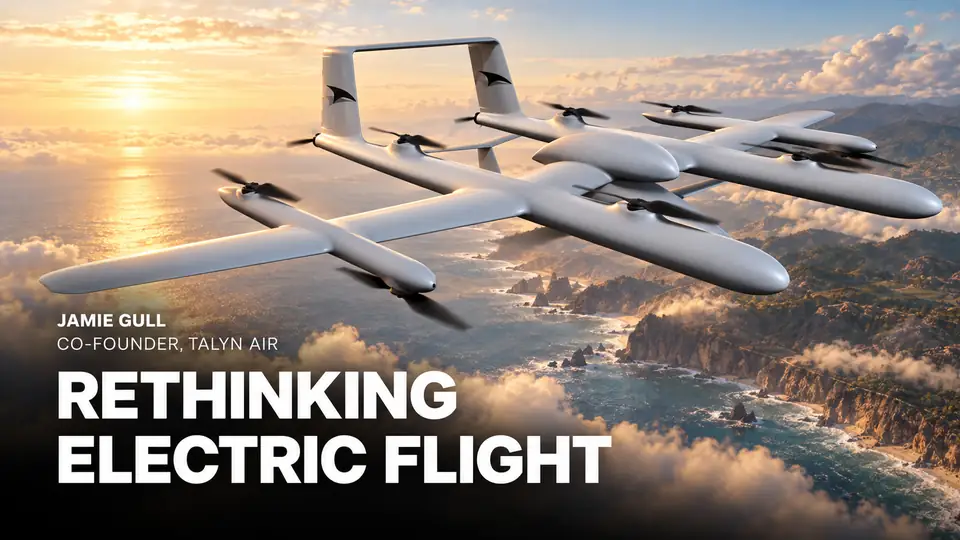
Jamie Gull explains Talyn’s two-part aircraft concept and its focus on regional trips.
December 1, 2020 · 37 min



About the episode
In this conversation, we talk with Jamie Gull, CEO of Talyn Air, about their electric vertical takeoff and landing aircraft system that separates and recombines in the air. Talyn Air has designed a green, battery operated aircraft system that will be able to take off from a local convenient location, without the hassle of having to fly out of a standard airport. It will be able to take you from city to city in less time than it would take to drive or fly through a commercial airline.
Are you tired of waiting at the airport for hours to travel a short distance? If so, this is the episode to listen to in order to find out more about this new stress free and environmentally safe way to travel.
Links
Chapters
Times follow the podcast audio. The video’s timeline may be slightly different.
- 00:00Welcome and introducing Talyn
- 03:36A more direct trip between cities
- 07:00The two-part aircraft approach
- 12:15Starting with cargo
- 16:40How faster travel could affect cities
- 18:41Building hard tech together
- 27:26Batteries, autonomy and electrification
- 31:57Freight costs and environmental trade-offs
- 34:21Opportunities beyond software
Read the conversation
Open the full transcript
CAMERON WIESE: Welcome to the Build the Future podcast. My name is Cameron Wiese, and I'm your host. I've always been fascinated by the ideas and the sentiment that drove American culture in the 1960s with the space race. A culture galvanized to dream about the possibilities of tomorrow. Whether it's food, transportation, cities, biology, or anything else. It was this cultural mindset rooted in optimism, that the world tomorrow would be better than the world today. A mindset where people were compelled to build things, and I quote JFK, not because they were easy, but because they were hard. It's this desire to build and to dream that seems to have been lost, and something we're here to bring back. With Build the Future, we're here to promote the ideas and stories of those who see how the future can be better and promote their plans to get us there. It's our mission to get you to dream about the possibilities of tomorrow, to dream about the future that you want to live in, and inspire you to go build.
SPEAKER UNCLEAR: Today, we're talking with Jamie Gull, the CEO of Talyn Air. At Talyn Air, they're building the fastest and greenest way to travel between cities. Now, to do this, they build a two-part electric vertical takeoff vehicle, or some people like to call it a flying car, that separates and recombines in the air, allowing for peak efficiency and zero waste energy. Let's jump right in. Jamie, so first of all, again, thank you for being here.
SPEAKER UNCLEAR: Thanks for having me.
CAMERON WIESE: Of course. I would love to start with the basics. Tell me about the feature you're building with Talyn Air. What's the vision?
JAMIE GULL: Talyn Air, we're building a way to get people around with zero emissions and at high speed. We have a little bit more specific than just high speed, and this is over regional distances, point to point without airports. And this is important because these are distances that people travel a lot. It's a frequent travel distance, 300-ish miles. And they're kind of the distances that have a lot of hassle involved per distance, if that makes sense. So if I'm going to go from LA to San Francisco, that drive could use like five or six hours. A flight usually takes four hours door to door when you're at in the airports and driving and the lovely traffic of Los Angeles and San Francisco. And I've actually known friends who beat people in a car instead of flying on bad traffic days.
JAMIE GULL: And most of that hassle comes from the airports and the traffic. It's not the flying, the flying. It's super short. It's like 50 minutes in the air. You got to add the timing for the gate in the taxi, but it's really just over an hour. So our design right now could do that flight point to point from a building in downtown to downtown in 90 minutes. So you cut out two and a half hours and that's like a pretty huge savings. You could imagine flying out to Tahoe from San Francisco and instead of having to go through Reno, or if you're lucky enough to have like a private jet goes into one of the little airports, you go directly to your destination. You save a ton of time.
JAMIE GULL: You're doing it on zero emissions because we're doing it on batteries. And that's a super important part of what we're doing. So it's really a way to get people and then also goods around faster, cheaper, point to point in a green manner. And so that's our vision, just getting stuff around faster. A lot of the world right now just evolves around moving people and goods around. And so any way to speed that up, doing it in a better manner is very beneficial.
CAMERON WIESE: Okay, so there's a couple different paths we can take. Let's go down the door-to-door component, right? So how are you all going about doing that?
JAMIE GULL: Yeah, that's a good question. So I'll paint a brief picture of what a trip might actually be like in reality so that you can get that. And then I'll compare it to some other things that are happening. So for us, if you're going to fly, an example uses for VCs, right? So there's Silicon Beach, there's areas you could take off around there from a building and fly directly into San Francisco. So you would have something where you say have to walk or drive or some other, maybe a bicycle, a few blocks or maybe even a mile. So it adds some time to what would be a vertiport or an existing heliport. And the same thing on the other end. So you're not actually directly doing it door to door within a city that's unrealistic.
JAMIE GULL: It's going to be very close by. These type of vehicles aren't going to be going in and out of people's backyards. and nothing doing anything real transportation wise will be going in and out of people's backyards unless your backyard happens to be like a ranch. And so, yeah, you would walk or maybe you take an Uber a few minutes and then you do the flight. And it is important to note that time on each end because a lot of the competition right now is doing what's called urban air mobility. And there's a ton of players in this space. It's a massive industry and we're trying to kind of ride the tailwinds of this industry. There's players out there, It's like Joby, Lillian, Kitty Hawk are the ones that come to mind real quickly.
JAMIE GULL: These are flights over a city, ranges anywhere from five up to 50 miles. And the reality is for those, even in the best case, you're saving maybe 30 minutes because you're hopping over traffic. Like in LA, you can imagine time when it's an hour long drive and maybe you do the flight in 20 minutes. And then you add on there, little time on the end, right? The five or 10 minutes on each end. So in the end, you're saving 30 minutes. You're spending a significant amount of money compared to driving. And so it's nice and people will pay for that. And we want the industry to succeed. There are plenty of people who would pay to save 30 minutes. It's not going to be the everyday person.
JAMIE GULL: But when you start flying longer distances, those little hassles start to not matter that much. So now your five or 10 minute drive is being compared to going to an airport for an hour and you're saving hours. And so when those little things add up, it still saves a ton of time. It still makes sense financially. everything just becomes better. And those companies can't fly the routes we're flying because of the technology. So we haven't really talked about what exactly we're building. I think this would be a good time to talk about that. So the other battery, eVTOL, what that really is, so it's electric vertical takeoff and landing aircraft. And these are aircraft powered by batteries that take off vertically like a helicopter. Instead of one big rotor, it's got what's called distributed electric propulsion. Just a few words from meaning like four, to more rotors. The reason you do that is you get a bunch of little smaller electric motors, and you get rid of one big rotor. And a lot of the noise from the helicopter comes from the low frequency of a big rotor. Also, the tip speed becomes very important. A lot of the noise comes from the tip speed of that rotor. So as you take a bunch of smaller rotors, they can spin faster with lower tip speed. So the noise goes way down, you can put a bunch of little electric motors, it's much more efficient. And then you can only do that really with electricity, because if you You try and do that with a giant turbine or other combustion engine.
JAMIE GULL: It's really hard to distribute power out with shafts. It's very heavy. They take off vertically and then they transition to horizontal flight. There's a bunch of different ways to do it. Our type is called a lifting cruise. And what that means is there's lift rotors and then there's cruise rotors, which essentially is a propeller like an electric airplane or a normal airplane that pushes aircraft forward. So it transitions into horizontal flight on a wing and now the wing is carrying it. There are other types that are tilt rotors where the rotors literally tilt. And so that's how it transitions to forward flight on the wing. There's tilt wings where they tilt the whole wing. There's a couple of classes. And then there's like other versions where they literally don't fly on a wing.
JAMIE GULL: It's just a bunch of rotors. It's essentially a mini bunch of rotor helicopters. And those are super inefficient because they're never flying on a wing. But all of these vehicles are powered by batteries and their range is terrible. And that's mostly because you can't carry a ton of energy on a battery. And then you're dragging all that stuff around the sky. And so looking at these reasons that these vehicles can't go very far, Evan and I took our SpaceX background. We did the classic Elon thing, which is apply the first principles reasoning and look also at staged rockets. And we're like, well, you don't want any of that stuff around that you use for vertical takeoff and landing when you're in cruise flight. Let's literally get rid of it.
JAMIE GULL: And that's how we came up with the idea. And everybody else tried to like put strouds around them or fold them up or use them for both portions of the mission, which is inefficient. We're like, no, let's just get rid of it. So you get rid of the mass of all that system, right? And so you carry around a lot less. It's much more efficient. You get rid of the air drag, which is where a lot of your energy goes in cruise flight. And you get to do some cool things with your batteries that you can't do with other designs, splitting out different chemistries. And also you can use much more of your battery because you don't have to do a vertical landing when you get there.
JAMIE GULL: And so you don't have to save all this energy and reserve to do a vertical landing. You get to do it on a nice, efficient cruise flight. And your whole mission is designed around the electric airplane now. And all it is is an electric airplane. So they take off together. They get moving forward. They're flying on their wings. They separate out. And now you have an electric airplane. It flies fast. It flies efficiently. And it can go much further. When you get to where you're going, it's going to do a midair docking with another lift aircraft where they hook back together with the different lift aircraft and then do a vertical landing. That's our key technical challenge. And if this doesn't all make total sense describing it, it's a little complicated. You can see a pretty sweet animation on our website that makes it much clearer.
CAMERON WIESE: Yeah, I have it pulled up. I was going to just like, I'll definitely link to it in the show notes. But it's cool because when I'm looking at this and if I understand correctly, so you have the piece one, which attaches to the top of the electric plane. And then it allows for the vertical takeoff. And then the propellers kind of move it forward. And then it detaches. The plane's kind of cruising on its own. And then the takeoff component flies itself back down to the ground to presumably latch onto another one. And then it does it on both ends.
JAMIE GULL: Yeah. And so we call them the Lyft vehicles, or sometimes Atlas is a nickname. And those are designed to do a bunch of takeoff and landings with various cruise vehicles or the airplane.
CAMERON WIESE: In a way, it's pretty cool because you have Uber and Lyft and all the companies trying to do the inner city urban mobility, or Uber compared to Lyft, where Lyft was initially doing long-term ride share. And then they're like, oh, the market's actually interurban. And it's almost like with talent, it's the opposite. All these companies are trying to do the interurban stuff. And you're like, actually, no, the value add here, the way we can make this technology work and make it efficient and really impactful is by doing a long distance or semi long distance stuff, right?
JAMIE GULL: Yeah, agreed. And that's a, it's a proven market. So something like 20% of flights within the US for passengers are sub 350 miles. People are surprised by that. It's huge. It's a huge number. And if you look at the fact that what we want to do is service that market, but also service the people that would have driven before. Because A, you can skip the airports. Or B, because you now have VTOL and you don't have to use a runway, you can go to places that don't have a runway before. So you would have had to driven somewhere before. I think this is a good example with Tahoe. Unless you happen to own a private plane, you're not flying into Tahoe. You're flying to Reno or you're driving. Either way, it's a pretty long trip. Now, if you could do that in an hour in the air directly there for the same price, you're opening up a lot of new markets. But that market already exists. It's just a different way to do it. Whereas the urban air mobility market exists in the sense that people are driving around the same way. But it's not a clear win, except for maybe some well-heeled business users.
CAMERON WIESE: Who would otherwise, say, take a helicopter.
JAMIE GULL: Yeah, exactly. These vehicles, they're all significantly cheaper than a helicopter. and you can go into places that helicopters couldn't go before because they're quiet. But it's not also the same cost taking an Uber. It's the same cost of a single person taking an Uber Black, except you have to put four people in the same vehicle. So everybody's paying $100 for one of those across town trips versus one person paying for four people.
CAMERON WIESE: So how do we get to this? I'm envisioning a few years down the line, being able to go to a hub and hop on a flight to say, go from San Francisco to Los Angeles?
SPEAKER UNCLEAR: Like, how do we get to that point? Yeah. So this is certified passenger flight you're talking about. It's a pretty long, arduous road to get there. So we're going in stages. We're going to go after cargo first. And we do that because there's a bunch of advantages on having shorter certification paths, cheaper certification paths, especially when it's autonomous. A lot of people in the industry are thinking similarly. So you pull out the pilot and you now fly autonomously. You can still do cargo deliveries. The certification process is simpler. So it's a stepped approach to get there. So we're going to go after that market first with passengers as a
SPEAKER UNCLEAR: long-term vision. Cargo is interesting. So effectively you're replacing kind of the, I mean, you have the trucking infrastructure, right? That's moving stuff between major cities. So the advantage here would be that people get their stuff faster and cheaper than putting in the back of a pickup truck.
JAMIE GULL: Exactly. So now the primary ways you're going to go over these distances are just putting it in a semi truck and then going to the distro center and then putting it on a smaller truck. You know, you don't drive the UPS delivery truck 300 miles. You drive it in a semi to a local distribution center or you put it on an aircraft. So if it's going far enough, you'll put it on, say, a 737 all the way to a 747. But if it's going to smaller remote areas, you can put it on something like a Cessna Caravan, which is a smaller aircraft with a few thousand pound payload. They'll fly it into a local airport and then they'll be driven the last X number of miles.
JAMIE GULL: So we essentially can replace all of those modes of delivery. And it's for things that are high value and time sensitive. So you're not going to be putting, I don't know, replacement toilet paper in the aircraft. You're going to put it on a semi truck because you don't care if it gets there tomorrow. You want something, and there's a bunch of examples, like organ delivery, mining equipment, electronics. There are things that people are willing to pay for to get quickly, and they don't weigh that much. So it's not like you're going to put something that has to go on a flatbed truck. It just doesn't make sense in the air. So what we really are going after are things that would be flown or driven rapidly, priority truck over those regional distances. And there's a lot of that out there.
CAMERON WIESE: Yeah. Yeah. So you take the cargo approach and then that allows you to kind of get through or kind of have a quicker path to market, right?
SPEAKER UNCLEAR: Yeah, exactly.
CAMERON WIESE: Set up the different like heliport, vertiport things in cities. And then eventually over time.
JAMIE GULL: Yeah, you'd have dedicated for the cargo, you'd have dedicated vertiports. You can also fly them out of runways. And so if you have like a distribution center at an airport, you could unload from a large aircraft, put it on our aircraft. they'll fly it out to a destination x hundreds of miles away you land vertically you know you're there in an hour if you're going a little bit further away might be as many as two and then eventually you start adding in or piggybacking for the ports within urban air mobility so another cool advantage we have as far as that goes is don't need to have a vertiport all over the city for our system to be beneficial you know if i have to drive 15 minutes to a vertiport and then go and I'm going directly from there, it's still beneficial.
JAMIE GULL: For urban air mobility, you have to hit a certain density because I don't know how familiar you are with LA, but there are lots of places where if you had a vertiport in 15 minutes that way and you're flying this way and you had the same thing with the vertiport, you're going to add just as much time to your trip getting to and from the vertiport. The same thing, you know, as we talked about before, but for us, you're flying, as soon as you hit a couple, you can start really hacking time off your trips, especially since you have to get to skip the airport because that's a built-in added hour hassle on every single one of those long business trips that doesn't occur on short trips.
CAMERON WIESE: One of my friends, she was flying out of New York this morning and missed her flight by like five minutes. She's like, oh, I'd spend all day in the airport because timing and if you miss a flight, that's the way it is. It's just like, no one wants to hang out in airports.
JAMIE GULL: Nobody wants to go through security. Nobody wants to sit there for an hour. I mean, airports would be better, I guess, if you got to show up five minutes before and literally walk onto the plane. But you still have to get there and get a car parked or get out of an Uber. They're generally pretty far away from where people live, especially these days. You know, it's less so in the past.
CAMERON WIESE: Yeah. So I guess with that, like, how might this change the landscape of our cities and how people move around?
JAMIE GULL: Yeah, that's interesting, especially given what's going on right now. Well, it's, you know, obviously, I think we've heard both pitches or both ideas of what's going to happen post COVID. You know, there seems to be an exodus from the cities. Will it last? And is it even real? But I do think that a more distributed future is likely. And technologies like this are the things that would allow you to, say, commute in once or twice a week to the city in an hour, which is just as long as people spend in a car right now, even if you're a well-paid business person. If you could fly in directly and yet live 300 or 400 miles away in your house that costs a third as much with a huge backyard, but three days a week you remote in, that's like a huge benefit.
JAMIE GULL: And it's a huge enabler for people to actually do that. Because personally, I think that some face time is required. I think fully distributed teams only work for the very special cases where every single person's remote. And they're very, very disciplined about that. Otherwise, if you're not in the office, better or worse, you're going to get looked over for, say, promotions. So I do think that it will not be fully remote for the majority of companies. However, I think there will be a shift towards it being more part-time. And yeah, our tech is perfect for that. And the same thing goes with goods, right? So you have less concentrated networks within a city for goods delivery. And now you have more people with high paying jobs living out in more semi-rural areas who want things quickly. Those delivery networks will have to get faster and faster also. And you want your Amazon Prime, even if you live out in the country.
CAMERON WIESE: It's great though, because there's just so much space out there. They can have backyards and they can not be crunched up in 650 square foot apartments in Manhattan if they don't want to.
JAMIE GULL: Yeah. And buy a house when you're 30, unlike most cities now.
CAMERON WIESE: Back to the, on the kind of face-to-face, like the necessity, I think it's, is it safe to assume that what you and the team in town are doing would not be possible digitally? Everyone was like exclusively over?
JAMIE GULL: Yeah, definitely not. It's hardware. We're on site. We do have employees that work part-time off-site that have software focused jobs. But, you know, the minute you have to be seeing how it works with hardware, be in the office or in the shop building it. But our background is you locate the engineers on the shop floor so that when something goes wrong, at our scale, this isn't much of an issue. But as we scale, we think it's very important that you can walk 20 feet or whatever and figure out the issue with the engineer rather than having to sit down or write an email or do a phone call or do a Zoom. And then there's this huge delay. Engineer can walk out on the floor, look at what's wrong, literally with a pen, change the instructions or design and go back. nothing gets slowed down. I think that's a huge benefit of SpaceX, where we came from, and other companies like that, that the incumbents don't have, where if there's a problem, it can literally be held up for a week between the paperwork and the lack of communication
SPEAKER UNCLEAR: is direct. With that perspective in mind, how do you think the shapes how companies get built over the next, I guess, just moving forward? I think for hardware companies, if you don't
JAMIE GULL: have that approach, you're essentially accepting massive delays and people not being able to troubleshoot on site. For small things, maybe small consumer hardware, longer development cycles, because you're releasing products to say a manufacturer, they're going to build thousands or millions of them. You want to get that right. You want to tweak it. You're going to build a ton of them. We're in the prototyping job. We literally make decisions on the fly, on the shop floor, and at our stage without paperwork. So it's literally just, I'm doing this now and that's what it is. And that's what's, I mean, that's really fun for us. But it's also what it takes to rapidly iterate for prototype. As far as the software companies go, I mean, I'm not a good person to ask there.
JAMIE GULL: I do think that human nature, turning somebody to face-to-face and asking them a question if you're trying to figure out a problem or jumping on a whiteboard is infinitely more effective than even a Zoom with a notepad or whatever. It's just something about the communication gets lost in translation for solving hard technical problems.
CAMERON WIESE: Yeah, I would, not would, I do completely agree with you. Which is interesting, kind of as we move forward, it's like what sort of companies are going to get built? Like everyone can easily go build software if they're remote. It's like, oh, cool, I'll just go build a SaaS app or I'll go launch something on Product Hunt, which is cool. And it's enabled by being remote. But in order to get people to go build hardware companies or go build things that are a bit more challenging that interface with the real world can require a bit more collaboration. In addition to creating physical spaces for people and needing to get groups together, what else can we do to get more people thinking about choosing to build companies like Talent or Boom or something in the physical realm that's actually going to move humanity forward versus what I would say is preserving optionality by doing stuff purely on software and making things more quote-unquote efficient?
JAMIE GULL: Preserving optionality is a very interesting observation. It's essentially not committing. is maybe less kind way to put it or less technical way to put it and just not being able to commit. How do you convince more people to do that? I've seen an interesting trend where I'll see people who are, say, getting involved heavily in climate tech or transportation is a good example also, especially green transportation, which is essentially a version of climate tech. And a bunch of them are people who in some way, whether they started a company or involved with a company that was purely software and had a huge outcome, or at least a personal outcome that was big enough where they don't have to worry about whether or not their next job pays as well as their previous job.
JAMIE GULL: And now they find themselves in climate tech. And the reason is, I don't think they got that satisfaction out of that previous position. And they didn't go build something huge and hard. They built something that... I mean, it is still hard, but you didn't have to make that decision up front and go for it. You do get to experiment, you play with software, you're not really committing. And in the end, the business world needs it. Consumers are obviously clamoring for it. And so the world wants it in some form. But the fact that you find all these people now in doing climate tech or other hard tech because they don't have to worry about money and they spent six months thinking about what do I want to do with my life now that I don't have to worry about money and I want to have an impact. I think that's an interesting trend that kind of indicates why not just do the climate tech in the first place? You'll probably be more personally satisfied.
JAMIE GULL: And I'm just using climate tech as an example. I think you could generalize that to other hard tech, whether it's like quantum, you know, fission, although that could also be fusion. Yeah, it's an interesting trend. I don't know how you push more people though, who are young and don't have that outcome under that belt, under their belts, besides doing something inspiring and like we are lucky enough to have that so if we're successful you're going to be looking up in the sky and see airplanes docking together in midair like that's some pure sci-fi stuff right there straight out of the jetsons so it will be awesome and people get excited about being a part of that like i could be a part of that and point up and say i worked on that and that's been a huge part of my career and i started out in airplanes spacex being able to point up And, you know, be part of that is huge.
JAMIE GULL: Obviously, SpaceX has such a massive impact. Now they recruit out of college without even trying. They're the hottest company for anybody in aerospace and often software to get into. Because if you get to go work on a rocket that goes to space every day, it's just hard to beat that. There's like pure raw inspiration. But there's a lot of problems out there that are super hard that maybe don't lack that or lack that obvious sex appeal. So I don't know how you convince younger folks who are coming shit out of college to go for that rather than the easier software play.
CAMERON WIESE: What are some of those other things that you would like to see people working on that do not have that luster of software?
JAMIE GULL: Yeah, I mean, you can add in the software aspects. So I do think quantum computing is absolutely interesting because it could potentially unlock so many things right now that we struggle with. There's this whole AI push right now that's so massive, but the reality is GPT-3 is amazing. But in the end, it's a really, really fancy chatbot. And it uses obscene amount of energy to do what it does. And quantum has the potential to take these neural networks in the training and essentially make them much lower energy and much faster. I think that would unlock an actual huge amount of AI that we can't get to right now. There's also a really cool couple of chip companies trying to revamp the way, instead of doing GPUs or traditional computer architectures, they're doing new things. This is a hardware company, right? They're doing actual chips where they're trying to take the amount of time and energy required to train neural networks and cut it by 100x on a small little chip that you could put in, I don't know, a large iPhone rather than putting in a data center. That's amazing.
JAMIE GULL: That's still computing, but that unlocks so many other things. Because if you can then take that, or especially quantum, and apply it to material science, for example, that could then trickle down to batteries. Batteries are a linchpin in what we do. It's a linchpin in other electric aircraft. It's a linchpin in UAM. It's a linchpin in electric transportation on the ground. If somebody can go invent a new material that makes batteries 5x better, that takes what was already an unlocking point that Tesla got us to essentially five years ago for this industry and unlocks a whole other way. And that could come from quantum computing and material science. It could come from normal material science, but it seems less likely. So I'd love to see a lot more of that.
JAMIE GULL: I think that's the next computing revolution. You do the companies right now that allow you to get into their systems with APIs. it's kind of like the early internet you don't know what people are going to build so i mean that's software but it's hard tech right and it unlocks a lot of things and it's fundamental it's not going to build on their sass app or their consumer app other hard things i'd like to see i mean batteries i'm just talking about that everybody wants better batteries there's tons of people working on it though but i'd love to see more material scientists that does seem to be as
CAMERON WIESE: you said the bottleneck with a lot of these a lot of these things like we're kind of constrained by what we can put into, I think it's what, like lithium ion battery packs?
JAMIE GULL: Yeah, there's a bunch of different kind of shoes. Yeah, lithium ion is what most people are using. I think that's one of the key things of ours is we're, we like to say we're solving a hardware problem with a software problem. So the hardware problem is batteries aren't great. And you have these two modes of flying and they don't match up design wise. One of them requires big rotors that spin more slowly to save energy. The other one wants smaller rotors that spin faster so you can cruise at high speeds. One of them requires massive power discharge from a battery vertical flight. The other one requires a gentle discharge and horizontal flight. It's two completely opposite designs. And when you have that in engineering, what you end up is something that's super mediocre at both. And so that's why we split it out. And in the end, it is an architecture design, but the software problem is how do you get these things to dock in midair?
JAMIE GULL: And now the sensors and computers are at the point where that's a very solvable problem with a small team, whereas before it was not. So we are solving this hardware bottleneck of batteries with software, which is awesome. And as batteries get better, the cool thing about our design is it's not that other people can now fly. If batteries do get six or 10 times better, maybe people could fly these regional trips we're doing but then we'll be flying our you know thousands of miles on those batteries still be tall and most of the flight will just be an electric airplane and then you're blasting and
SPEAKER UNCLEAR: doing a docking there's a lot of emphasis on on the battery component the the zero emissions can you tell me one like why that's important but two like why that's important to you so it's i guess generally and then specifically like why is that what excites you so batteries
JAMIE GULL: to me, like if it wasn't, if there was a better way to do it, I don't care as long as it's still zero emissions. And there are people that think hydrogen is the way to do it. We disagree. I think the majority of hydrogen that's produced is what's called gray or it's like, it's not clean. So it's essentially produced by fossil fuels or some other method that's not good for the environment. And then the stuff that is clean is very hard to produce and it's very expensive. And it's very hard to store. And, you know, it's got higher energy density than batteries, It's not great. It's in its volumetric density. It's terrible. So you have to have these big tanks and you have to distribute it. And unlike, you know, there's an existing electrical grid around everywhere, you know, in the world almost now that would be able to afford or want these vehicles.
JAMIE GULL: And you do have to make modifications to the grid. It's hard. Like, it's not like you're just plugging into a wall outlet for these things. It's way more complicated than that. But hydrogen, you know, you'd have to essentially reinvent the gas station and take those gas stations, approximately triple them in price and then ask people to build them all over the country again it's just it's been asked for for 40 years now or something and it might happen you know and i do think it will happen on very limited corridors it makes total sense you have big plants you don't ship anywhere you have like say trucks going back and forth but when you start getting into more go anywhere the batteries just make more sense and it's really the only way to do it without putting out emissions as far as like why that's important to me i mean we're already like over the hump of whether or not this world isn't going to change significantly negatively.
JAMIE GULL: It already is. It's so obvious. It's trying to light us on fire every summer to tell us amongst other things. And the fact is we're going to have to revamp our entire economy top to bottom to make the world more livable and prevent suffering around the world, displacement of migrants. It's just bad all around. I don't think it's going to happen quickly. I do think it needs to happen. And that's really like you have to do it top to bottom. And so people are going to move around. You're not going to convince the modern world that they're going to stay in their one square mile walking distance. Right. And, you know, there's something to be said for locating manufacturing in areas that's better at it, whether that's regionally or even around the world.
JAMIE GULL: So people are going to be moving goods around for the rest of the time. So we have to figure out a way to do it in a green manner. And right now, this is the best way to do it. You know, maybe in 100 years, everybody will have a little tiny fusion reactor in their car or airplane instead. But that's not happening. Hopefully we got fusion in five years or something, a small scale for utility uses, but not on the little transported.
CAMERON WIESE: Two questions there. I guess there are a lot of people working on like electric autonomous trucks or, you know, long distance. How does that kind of compare with the air approach that you guys are taking? Is it just two ways to solve the same problem? Are there like, is there minutiae and the difference that is important to?
JAMIE GULL: Yeah, there's always mild differences. We talked earlier about like what people would put on an aircraft. It's high value, time sensitive things. And that's the same thing for a person, right? You can leave out the high value part when it's time sensitive, right? You don't get on an airplane if you don't care how long it takes you to get there. And the same thing is for your shipping a good. You know, you're going to put it on a truck, whether it's combustion or whether one of these trucking companies becomes hydrogen or battery powered semis. And moving something on the ground is always more energy efficient. So it's always going to be cheaper. And you can put more pounds on the single vehicle by a significant margin.
JAMIE GULL: And so it becomes even cheaper. So an airplane or going through the air will never compete on cost with the ground. It's the same reason that a truck never can compete with a ship, right? So everything gets less energy intensive. So you do want those things that have to be time sensitive and are expensive. And it's right on down through the value chain. You put something, if you're getting it from China, you put it on a ship. If you don't care when, if it's a cheap good and you need to put a million of them on there, you put it on 747. If it's expensive good and you want it there fast. And the same thing within country.
CAMERON WIESE: And the other question I have around that is, technically, aren't there environmental costs around the battery production that are important to factor in?
JAMIE GULL: Yeah, if you look top to bottom, I think right now for, say, an electric battery-powered car, for example, because there's more of them out there, there are significant environmental costs to the batteries. One of the former Tesla founders is actually working on a company that's designed to recycle these batteries. Some significant percentage of the battery. he's looked into this and says hey you know if electric on batteries becomes a massive thing this is going to be a huge issue we don't want this to shoot ourselves in the foot later on down the road when we're actually maybe potentially hurting the environment more than we were before it's still less especially on the greenhouse gas emissions front but it does have a cost and so being able to recycle the batteries would be a huge benefit that's what the work you're
CAMERON WIESE: doing at Talyn what excites you the most and i actually and and outside of kind of the some of we touched on earlier, the quantum computing and the battery tech. What excites you about
SPEAKER UNCLEAR: the future? What are you really optimistic about? I'm optimistic that we'll get over this hump of essentially writing software for people purely to make money. I think we had our heyday since 2000-ish, where everybody's dream was to move to Silicon Valley and become the next Google or the next Facebook. And the reality is a ton of those people use those companies and they've had a lot of positive effects, but it's time to move on from that paradigm. And I think people are seeing that now. The VCs are starting to talk about it, although most of them are, you know, talk out of one side of their mouth and write their checks with the other, so to speak. But, you know, you see that energy. And I also think the younger generations see this too. I think kind of look up at even my generation is like, what were you thinking? I know every generation does that though.
JAMIE GULL: But we're at that point where I think we can actually make that transition. It'll be slow, but getting into the hard tech, getting into the climate tech, working on things that matter. And along those lines, it doesn't have to be like a big startup that is doing something to try and save the world or do something amazing. But understanding the fact that your company has an effect on the community, the city, the country, and the world, and you have a responsibility to everybody.
CAMERON WIESE: How can people support you and Talyn?
JAMIE GULL: If there's any engineers out there who want to come solve a super awesome problem, especially in autonomy, guidance, navigation, control, working on something amazing, we'd love to have you. Otherwise, you know, just tell your friends or shoot me a note saying this is really cool. It makes us feel really good. And we obviously agree. And we hope that you're flying on Talyn in 10 or 20 years.
CAMERON WIESE: If you want to learn more about Talyn, you can head on over to talon.com. Then if you want to follow along with Jamie, You can find him on Twitter at Jamie Gull. Thanks for joining us for another episode of the Build the Future podcast. Lastly, if you're building and want to get support, want to hear about certain topics or from certain people, or just want to get involved in helping build the future, shoot us over an email at hello at buildthefuturepodcast.com or follow me, Cameron, on Twitter at Cam Weesey, and we'll see what we can make happen. That's it from us. Until next time, go build.
SPEAKER UNCLEAR: Thank you.
More episodes
All episodes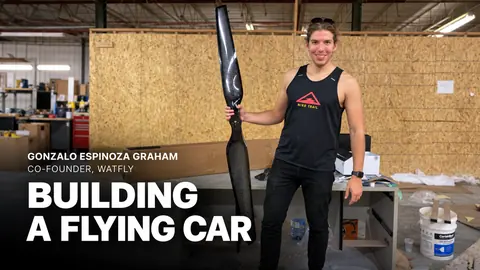 Gonzalo Espinoza Graham — Building a Flying Car at WatflyGonzalo Espinoza Graham outlines Watfly’s approach to a small electric aircraft and its proposed recreational starting market.
 Ro Gupta — Maps, Autonomous Transportation and Urban MobilityRo Gupta explains the maps, road data and practical decisions behind autonomous transportation.
 Jonathon Barkl of AirGarage — The Future of Parking, Cities, and CommunityJonathon Barkl explains how AirGarage’s parking operations could become the foundation for more flexible uses of city space.