

Build the Future Podcast
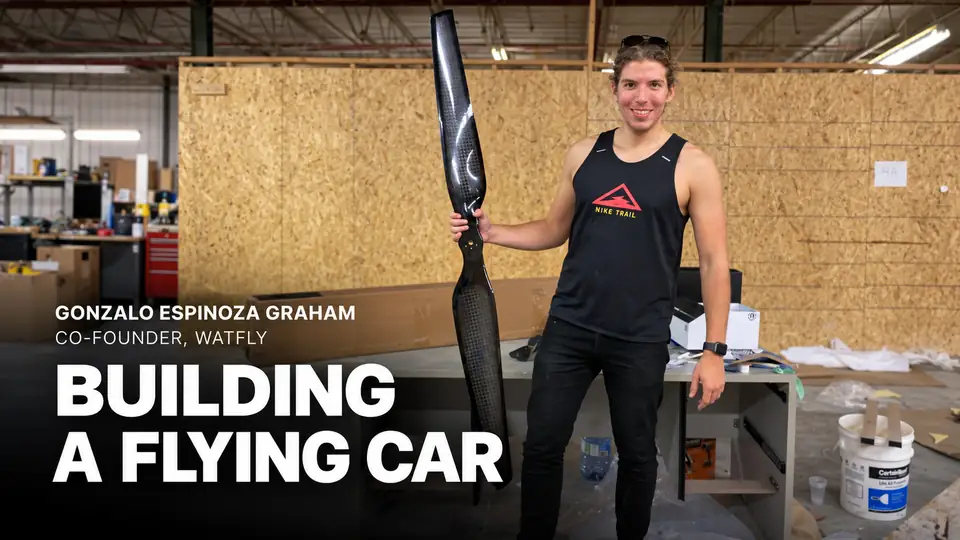
Gonzalo Espinoza Graham — Building a Flying Car at Watfly
Gonzalo Espinoza Graham outlines Watfly’s approach to a small electric aircraft and its proposed recreational starting market.
October 27, 2020 · 36 min



About the episode
In this conversation, we talk with Gonzalo Espinoza Graham, Founder and CEO of Watfly, about the future with flying cars. Gonzalo gives us a behind the scenes view on how the car is being designed and transformed from a recreational vehicle to a multi-passenger air vehicle. We will discuss the difference between an aircraft and an air vehicle and how that changes the licensing requirements as well as no longer needing a runway to launch and return to a location.
If you have ever dreamed about a future with flying cars and feeling the freedom of quicker travel without obstacles, this is the episode for you.
Links
Chapters
Times follow the podcast audio. The video’s timeline may be slightly different.
- 00:00Welcome and introducing Watfly
- 01:29A more practical personal aircraft
- 05:47Starting with recreational flight
- 07:18A roadmap from early customers to wider use
- 08:40How transportation shapes cities
- 17:22Different approaches to electric flight
- 20:20Regulation and adoption
- 23:33Funding a hardware company
- 29:55Building in public and what comes next
Read the conversation
Open the full transcript
CAMERON WIESE: Welcome to the Build the Future Podcast. ! My name is Cameron Wiese, and I'm your host. ! I've always been fascinated by the ideas and the sentiment that drove American culture in the 1960s with the space race. A culture galvanized to dream about the possibilities of tomorrow, whether it's food, transportation, cities, biology, or anything else. It was this cultural mindset rooted in optimism that the world tomorrow would be better than the world today. A mindset where people were compelled to build things and I quote JFK, not because they were easy but because they were hard. It's this desire to build and to dream that seems to have been lost and is something we're here to bring back. With Build the Future, we're here to promote the ideas and stories of those who see how the future can be better and promote their plans to get us there.
CAMERON WIESE: It's our mission to get you to dream about the future that you want to live in and inspire you to go build. Today, we're talking with Gonzalo Graham, the founder and CEO of Wattfly. At Wattfly, they're building fully electric flying cars to help build the future flight. There's not much more that needs to be said, so let's jump right in and talk about a future with flying cars. Thanks for kind of jumping on here today. I'm excited to have you on the Build the Future podcast, talk about all the crazy stuff you're doing.
SPEAKER UNCLEAR: Yeah, I'm super excited to be here. Thank you.
CAMERON WIESE: Let's start with the basics. Tell me about the future of building at WattFly. What's the vision?
GONZALO ESPINOZA GRAHAM: Yeah, so it's very simple. WattFly is working on flying cars. So what's a flying car? It's an analogy for an aircraft that, like a car, most people can afford. It's as simple to pilot as a car is as simple to drive. It's safe and it's practical. So right now, aircrafts are great. They're fast and they can get from point A to point B really quickly, but they're super and practical, and most people don't fly. You need a runway, you need jet fuel, no one has that. You need to have a pilot or a pilot license, no one has time for that. So there are all these barriers around aviation, and that's what we're working on removing with a flying car. Sweet. Let's unpack
CAMERON WIESE: that a little bit. Tell me about each of those components. You got the jet fuel, the pilot's license, there's all these restrictions around flying cars or stuff right now. So let's see. So
GONZALO ESPINOZA GRAHAM: So how do you move jet fuel? The simple solution is making it electric. So that's what we're doing. We're at a point where thanks to what Tesla has done, the whole electric vehicle has done, we can now build electric aircrafts. In fact, you see electric aircrafts popping up left and right on the news, which is great. Not only because you can get rid of jet fuel, you can use random electricity, you can charge anywhere. That's great. Reliability also increases. complexity decreases, which drives the cost down, which is huge in aviation, of course. And then there's other factors like you can have a disputed powertrain, right? So you can have propellers and propulsors throughout your airframe, and you don't have to run drive shafts through it. So you see a lot more freedom from a design point of view when sending an aircraft.
GONZALO ESPINOZA GRAHAM: And that basically allows new configurations, VTOL, vertical takeoff and landing, stuff like that. So that's one, right? So that's how you get rid of Jetfill, for example, and then runways, because now we're talking about vertical takeoff and landing. How do you go to the next step? How do you get rid of the pilot and the pilot license? Well, the obvious solution there is autopilot. Right now we're at a point where drones are already flying themselves. My favorite one, shout out to Skydio. They're awesome. Takes off on its own, follows you around on its own, obstacle avoidance on its own. It really goes to show where the technology is already. And yeah, and then how do you, so it can be autonomous, but as long as there's a person on board, you still need a pilot license technically.
GONZALO ESPINOZA GRAHAM: At least that's what the law says right now. So the way we're getting around that is as long as you're under 254 pounds in the US, you're not an aircraft per se, you're an air vehicle. And air vehicles do not require a pilot license. This also holds true in Canada, in Europe. up. So it's kind of like a nice caveat, which we're using to go to market. And then we can unpack it even further. You can say like, okay, this is so great, but aircrafts are really expensive. So how are you going to make it cheap? And of course, there's different ways of making it cheap. Making it the airframe cheap is one. Making operations, operating costs cheap is another. Operating costs gets cheaper by removing jet fuel on the pilot, which we've already touched.
GONZALO ESPINOZA GRAHAM: and how do you make a cheap airframe? Well, step one is making it small. So we're starting with one passenger. Step two, less complexity. So again, it's electric. And step three, which has not been done before, is volume, right? So Boeing produces less than a thousand aircrafts a year before Corona, right? So now forget it, like maybe a fraction of that. And this is super low. This is peanuts compared to automotive volumes. Now, there's smaller aircrafts that are produced at higher rates, like the Cessnas, kind of like the small airplanes you can picture. Those are still like well below a thousand, right? Yeah, they don't make very many of them. I believe it's been like, they've been 50,000 in the last 50 years. So yeah, no volume there, right?
GONZALO ESPINOZA GRAHAM: The only times you produce aircrafts at high production rates were during war. That's where we hit like the 3,000, 4,000 aircrafts a year per country. And of course, that drives economies of scale and so on. So that's when you start making things affordable. Rights law kind of thing. So yeah, so the goal is to make a small aircraft that people want and people can use. The want comes with there being a practical use, it being safe, stuff like that.
CAMERON WIESE: Yeah, let's talk about what's going to compel someone to buy a flying car right now. What are those practical uses?
GONZALO ESPINOZA GRAHAM: Okay, so I would say that practicality is going to increase over time on our roadmap. So today, our first aircraft, it's called Atlas. Like I said, it's an air vehicle under 254 pounds, only one passenger. So that on its own caps the practicality, no family trips or anything like that. And it also can only fly in Class G aerospace. So no heavily populated areas, no airports, no downtown, which happens to be 80% of North America. So it's kind of all right, but it still kind of restricts it. So why are people buying this aircraft today? Well, it's mostly recreation and fun. Most of our customers, we're already selling this aircraft. You can go on our website, whatfly.ca and buy it. Most of our customers are using it for recreation.
GONZALO ESPINOZA GRAHAM: They kind of want to fly in their property and stuff like that. There's probably also a defense use for it, but that's not what we're focusing on. But yeah, and then that's our first product. Over time, we're adding capacity. And then we're also certifying it as an actual aircraft so you can fly anywhere. Now, the cost of certification is high. That's why we're not doing it from the start. But with certification comes more freedom on where you can fly and also higher speeds, which is a win-win.
CAMERON WIESE: So right now, it's mostly people who are living outside of major metropolitan areas. they may have some land and they just want to fly because you know who doesn't want to fly right
SPEAKER UNCLEAR: so first customer he had a farm he was like i just want to fly around my farm and we hear a lot about that we also hear about people who want to land on their boats stuff like that so yeah right now it's kind of like a a toy for rich people and in that it's our test roadster so to speak exact same start yeah yeah so i think most listeners are probably familiar
CAMERON WIESE: with that because I've talked about that before. But yeah, kind of walk us through your Tesla strategy here. So you have the Atlas as your roadster. And then how are you seeing it evolve
SPEAKER UNCLEAR: from there? Yeah. So what Tesla did was first a roadster, a sports car. So using the money from the sports car. So it's a luxury car, high price tag. Using that revenue, you pour it onto making a kind of like a five-seater sedan that most people can afford and has more uses. And then and pour that to make even a cheaper car for the masses kind of thing. So for us, it's the same. Well, and also to add to that, every single iteration on the roadmap would drive the price down and increase the range. That's the version for electric vehicles. For us, it's pretty much the same thing. Our iterations are not only about price, they're also about adding capacity, passenger capacity, and adding range, bringing the cost down. Yeah, that's basically it. So every iteration, you know, next iteration, we're talking about a two-seater. and then after that we might do four-seater. I do think there's going to be a limit.
CAMERON WIESE: So paint me kind of the longer-term vision of like the flying car space. How does this evolve? Okay, so we have two-seaters, four-seaters. What does the world look like, say, 10, 20 years out when flying cars are commonplace?
GONZALO ESPINOZA GRAHAM: I like to talk about the city of the future as a result of flying cars. So cities, if you think about it, cities are shaped by the transportation technologies, right? Through history, city size has been a function of how fast we can travel, what costs and what densities. And as speed increased, cities can occupy more land, which brings down the cost of living, basically, of housing. So why is speed the unifying principle? Well, the catch here is that people are only willing to travel or commute for one hour a day, back and forth. That's a long trip. So 3,000 years ago when we were only walking around, cities had a radius of like one mile, which is the distance a person can cover walking half an hour.
GONZALO ESPINOZA GRAHAM: And then we, of course, we domesticated, we didn't invent horses. We domesticated horses in the 1830s, a speed increase with our cities. And then you had the trains and the cars and so on. So it was a 20x increase over 2000 years. So after that, we stagnated. Now we're kind of like driving around and we're mostly building up and densifying our urban areas. Our average speed is decaying and commute times are reaching all-time highs, right? So this is kind of like where we are today. So it's like, how do we improve the situation? How do we break the cycle? It's like, well, you need to increase travel speed and hopefully get rid of infrastructure. And I think that's where flying cars come in. So in the future, I'm picturing a city where, well, you can pretty much as an individual travel in any direction at a high speed, much higher than you can do right now.
GONZALO ESPINOZA GRAHAM: We're talking 200, 300 kilometers per hour. So now city centers are going to have a bigger radius or are going to be scattered around. I do think sometimes, you know, if you extrapolate to the future and you think, OK, travel speed was infinite, which is to say teleportation. What would the world look like? And what I think we would be looking at is like every single inch of the world would be populated one way or the other and perhaps a lower density overall. But that would be a function of population. But I think that's where naturally we want to go. We want to kind of like spread throughout. So it's the same idea. I see flying cars as a step towards what eventually will happen.
CAMERON WIESE: Which is that kind of we can ideally, you know, long term, just move place to place instantaneously. I don't want to say, you know, teleportation is happening, but... Right. Because, I mean, it's like there's lots of messy implications with that. It's like, well, are you the same person who stepped on the other side? Like, probably not.
GONZALO ESPINOZA GRAHAM: You know, extrapolating and taking the limit to, you know, maximum travel speed, it just seems that that's, you know, naturally where humans want to go. So, yeah.
CAMERON WIESE: I think that's kind of what we're seeing with COVID right now is everyone's like, oh, I don't need to be in a metropolitan area. So I'm going to go, like, if I can, I'm going to go somewhere else. Does that kind of line up with how you're thinking about the future of cities? People are more distributed, they have a little bit more land, they're maybe not as tightly condensed, and then they kind of go into urban areas to conduct business and socialize?
GONZALO ESPINOZA GRAHAM: Well, maybe. My version of the future is where we have multiple cities and every city is self-sufficient and you have things like indoor agriculture everywhere and stuff like that. And there are power in each city and everything's great. And then you just have to connect between cities from time to time. In a way, it's also shaped by human nature. I think, you know, throughout time, it's like most people are okay with the way things are done. And there's like a 5% of the population who are like, no, no, let's just do this crazy thing instead. And then we end up settling somewhere in between. So I think we wouldn't just have a huge suburb. We're still going to have city centers. There's just going to be more of them and just more scattered around.
CAMERON WIESE: Yeah. Tell me more about how you're viewing cities of the future. that's not directly related to flying cars, but you seem to have done some thinking and have some ideas.
GONZALO ESPINOZA GRAHAM: Yeah, so just to add to the flying car part of it, part of the reason why we thought, oh, flying car, this isn't the same time where people like Elon Musk are saying Hyperloop because we think the no infrastructure part is key. I think during times like these where COVID and even the fires in California to a degree have shown us that we cannot, well, relying too heavily on infrastructure and when it fails can hurt us pretty bad. And also maintaining infrastructure is very expensive and we don't necessarily have the right vehicles to maintain it. But I do often, going back to the citizen future, I do often think about the impact on the cities, flying cars. Back when I was in university, I had these kind of like, I don't want to call it a startup because we didn't have any sales, but with a friend, we were growing lettuce in our basement because the whole idea was like, Oh, indoor agriculture make the food supply for every city self-sufficient.
GONZALO ESPINOZA GRAHAM: So that's where I started thinking about cities of the future. Now, indoor agriculture doesn't work for a number of reasons. And it's basically economics. You kind of have robots here, very expensive robots competing with the cheapest labor in developing nations. And for a number of reasons, that doesn't work. And then there's also an ethical side of it. But we kind of like put that in the freezer.
CAMERON WIESE: Because there's a couple of companies that are working on that indoor agriculture space. But it seems like it's one of those things that will really line up when we do have alternate sources of fuel that are a bit more efficient and less cost effective.
GONZALO ESPINOZA GRAHAM: You know, I think it makes great sense. It's just you would be surprised at how cheap it is to produce crops, transportation and something like the bulk of the cost, which is insane. And even then you're paying not very much. It's pretty crazy. And I think maybe the forcing function there, it's going to be something related with global warming. You know, there's a lot of these developing nations are being hit the hardest. That's going to either drive costs up or even kill production altogether. And then we're going to have to act. Right now, in the agriculture, I think it makes sense for places like Dubai or the desert where, you know, nothing really grows. And that's great. I'm still super interested in that space. Yeah.
CAMERON WIESE: Okay. So actually, I'm curious. I know on Thursday when we synced up, you mentioned that you and Garrett, Scott, who just came on the show, have differing opinions about the way logistics will operate within cities. And I'm wondering if you can kind of shed some light on where you two agree and where you two may have a difference in opinion.
GONZALO ESPINOZA GRAHAM: Yeah. So what Garrett is doing is awesome. So he's building an infrastructure network for basically delivery in a way of what I've never seen before. And it also has this touch of like, well, this seems super simple. Why did I not think of that before? And I kind of love those ideas because it makes you kick yourself. Yeah, no, I think it's the infrastructure versus no infrastructure kind of thing. It just seems like, it just seems that, you know, history says that, you know, history shows that maintaining infrastructure is really hard. And there never seems to be enough infrastructure when we need it the most. And then when we don't need it, we don't maintain it. And then the next day when we do need it, it's not there anymore.
GONZALO ESPINOZA GRAHAM: So it just seems that minimizing infrastructure is the way to go. That's basically it. And also when you minimize infrastructure, you can be more flexible. You can roll out things faster in a way. So this is something that I've been thinking about. But I think that internet networks borrowed a lot from how cities are built to set up their infrastructure. And now we're at a point where software and servers have taken the lead and we should be looking to what they're doing. So you have things like edge computing and stuff like that. It's kind of like breaking apart the Heartlake infrastructure approach. Can you elaborate on that, the Heartlake infrastructure approach? What is that? Basically, the difference of, oh, instead of having a huge data center, they're going to host it scattered around, basically.
GONZALO ESPINOZA GRAHAM: right so yeah basically and then you don't have to build huge infrastructures on your center basically right so again that goes back to distributing your cities uh in a way you can kind of ease the load on your net road networks in this case but if you can just get rid of the road networks all together and just like fly that is especially you know the highest density you will ever be able to support basically you still have physical limitations like if everyone wants to a point not everyone can get to that point uh that's his that's his life yeah because you're
CAMERON WIESE: gonna have that whether it's in the air or on the ground uh yeah basically can you paint a picture for me like so there's there's a lot of companies in this or that are moving into this like electric flying car space you kind of paint me a picture of the landscape and maybe comment on on some of the approaches other people are taking and some of the pros and cons of those things yeah so right
GONZALO ESPINOZA GRAHAM: Right now, there's over 100, we might be at 200 now, companies pursuing some sort of electric aircrafts, whether that is regular electric airplanes, the small ones, again, like the Cessnas, PP-Strells, kind of like two-seater, five-seater, very small airplanes that just take off like regular airplanes. Then you have some companies working on electrifying commercial aircrafts. And as a subgroup of that, you have electric and hydrogen powered aircrafts, just because electric can only drive a motor and motors can only drive a propeller. But hydrogen, you can have a hydrogen turbine. So now you're talking back to high thrust. And then as a subset, you actually have electric helicopters. And then you have electric paragliders and stuff like that in the recreational arena. and then where we are, the electrical vertical takeoff and landing or EV toll, that's also becoming very popular.
GONZALO ESPINOZA GRAHAM: I would break that down into at least three groups. You have the kind of like big aircraft that can only take off and land vertically, like helicopters have no wings. Then the ones that have wings and then as kind of like the super small ones, which are, we're actually not as common. Yeah. So, so wings and no wings, kind of like larger EV toll aircrafts. You have players like Kitty Hawk backed by Larry Page. You have Jovi Aviation backed by, you know, giants and Lillium in Germany. And you have all these resources. I think that's where the money is converging. Kind of like five passengers, somehow autonomous electric aircrafts. Now, I think that's not going to work just because, again, we already have helicopters. So that's too close to a helicopter.
GONZALO ESPINOZA GRAHAM: And if the economics for helicopters worked, we would already be doing that. But to the contrary, we have helicopter charter companies going bankrupt. boom in the Bay Area, shut down operations earlier this year. Blade is scaling down. Same in Brazil, which was the largest helicopter market and in Mexico City. So I'm not convinced that just because you built a better electric aircraft, now you can run a profitable charter business. So I don't see where those fit in. Now, if you can electrify commercial aviation, yeah, sure, that's good. You know, the markets are thin. If you can bring operation costs down, I think you'll do all right. Same for the small, regular airplanes, five passengers, electrifying that, the Cessnas, that's good because a lot of their market is flight schools. And again, they love that stuff. So I could see that. But again, in the EV toll space, I think you do want to be small and that's where we are. That's why we are doing what we're doing.
CAMERON WIESE: Yeah, because the challenge is not necessarily building it. It's getting adoption and getting people to use it and then rolling it out. Because if you start too consumery, then you have you have issues with the pilot's license sort of things you have issues with
SPEAKER UNCLEAR: the cultural adoption yeah well i mean the technology is there that's obvious because you can probably even look up on youtube uh giant drone and someone has built a giant drone on their backyard that can probably carry a person uh not super safely and not super reliably but for the most part it works so yeah i think it's all about customer adoption um and having a a viable path to market so so that's why we start doing things like oh you don't you don't have to get a pilot license, which takes like a hundred hours and thousands of dollars, or hey, it costs as much as a car and our aircraft fits in a car parking space. So it's kind of like, it starts to feel more familiar.
GONZALO ESPINOZA GRAHAM: And when you see it inside, it also feels familiar. The fit and finish is like that of a luxury car. So yeah, I think that's a real battle. And then of course there's regulations, but like I said, we're flowing that down the path just by kind of like being an air vehicle for now.
CAMERON WIESE: So I think we may find ourselves in a situation in the next couple of years where the regulatory environment hopefully lightens up. And so anyone who's trying to battle it right now is going to find themselves just kind of out of resources. So you guys are, I would argue, uniquely positioned to weather that storm and be in a position to take advantage of it when that clears up, hopefully.
GONZALO ESPINOZA GRAHAM: Yeah, well, in a way, if regulations never changed, then I guess we'll be a recreational aircraft company for many, many years. But if they do change, yeah, we'll be in a good spot.
CAMERON WIESE: We will. Yeah, I think that's a different. Yeah, that's another long project is how do we change the regulatory space?
GONZALO ESPINOZA GRAHAM: And I say, well, I say basically, see, I don't want to call it a moonshot because I don't see flying cars as a moonshot anymore. Many of your guests are real moonshots. I hear people are building all kinds of weird things, factories in the moon and so on. I think flying cars, you know, like I said, the tech is already there. You can see it on the news already. So I don't call it a moonshot anymore. I think it's just part of the future. But when you're starting a startup in this area, investors are still not comfortable with it. So it's also very important to have that revenue stream early on, that first aircraft that you can sell without certifying full as a commercial aircraft.
GONZALO ESPINOZA GRAHAM: And even before you build it, you can start selling on your website kind of thing. That helps a lot. But that's also something that I hope it's going to change now, given COVID. I think there's two things at play here. So first of all, we all kind of know that sometime in the future, we don't know when, maybe soon, maybe not so soon. Bad things are coming. And that's just in terms of global warming. We're getting a taste of it. Well, America is getting a taste of it. The rest of the world has been getting a taste of it for a while now. And the other one is like COVID again, like infrastructure not being there when we need it. And what if this happens again? We want to be ready. So now you kind of have to invest in infrastructure heavy projects and kind of like new technologies. And that's very capital intensive. So I hope that we're going to see more, you know, more funding vehicles, more financial vehicles that can fund these kind of projects. And it will also help moonshots at the end of the day.
CAMERON WIESE: Yeah, let's dive into it a little bit more. How are you thinking about, like, if you were an investor, how would you approach funding things like these? Or if you could wave a magic wand and have funding environment be set up to support sort of kind of capital intensive, long term, high risk, high reward projects. What might that look like?
GONZALO ESPINOZA GRAHAM: Yes. So just just being real right now. So so BC venture capital is usually who people go talk to and teach these ideas. I would say venture capitalists, a lot of them talk about wanting to make the world a better place and so on or say like it's time to build and so on. But the truth is that venture capital, let's say, it's an asset class. And so they have LPs, limited partners, who give them money for them to invest. And those LPs are not giving them money saying like, hey, go change the world. No, they're giving them money to get returns. And they have, you know, liquidity terms and they have expected returns and expected timeframes. Whether the VCs go and pitch that they want to change the world or not, that has nothing to do with that.
GONZALO ESPINOZA GRAHAM: So I am not 100% convinced that VC is the way. And we personally have not taken any VC funds. We work only with angels and our customers. That's it. But I think that if, you know, I have seen VCs talking about longer timeframes. It's usually 10 years now. They're talking about 15 years. That's good. I think founders can do some risk management from their side. So any investor understands that, you know, venture capital is risky. and that's why they place a number of bets, right? They don't only invest in one company. And they also understand that moonshots are even more risky. That's why most investors aren't even touching. So as a moonshot founder, you're kind of like against the odds here. So you're against the odds for getting funded and you're also against the odds for your own personal success.
GONZALO ESPINOZA GRAHAM: So I think that adds a barrier. Maybe we're not getting all the best talent we could get if it was slightly easier. So I was thinking that maybe founders could kind of like manage this risk by bundling together. You can have like 10 founders, all have different companies, but they share equity in each other. And then you can invest in the company bundle as one. So as an investor, it's like, oh, okay, my one bed has like kind of better odds now. In a way, it's already diversified in a way. Even if only one of these crazy ideas works, it will probably pay off, right? So that's what I've been thinking lately. That would probably be a good idea.
CAMERON WIESE: Yeah, because the issue is you're all in on one thing. And so if you can diversify that across other investments that are equally as ambitious, equally as challenging, but we'll have the... Because I mean, actually, I mean, if any of these categorically moonshot projects pay off, they're going to be massive businesses. They have the potential to fundamentally change the way the world operates. And like there's plenty of capital upside there.
GONZALO ESPINOZA GRAHAM: I also think if you make it slightly easier for founders, okay, maybe your company didn't work out, but you still have equity in the other company. So now you want them to succeed, so you'll help them or everyone will help amongst each other. I think that would also be huge. In a way, this is what Elon Musk is doing. He's bundling a lot of his companies, right? So he's creating a lot of companies and then he bundles them together in a way. And I think he has Tesla, Neuralink, SpaceX, the Warren company, and maybe some state hall in some AI company. Oh, yeah, open AI. Yeah, and they all benefit from each other. They all share talent. They all share basically access to capital. and this is all because you know kind of elon brings them all together so so that's kind of like the same idea in steroids uh to a lesser degree i think it could still work you know with less experienced founders or less like you know non-elon mask level founders but yeah so i i don't
CAMERON WIESE: know maybe you saw this but the the apollo projects yeah that the altmans are altman brothers or well max and then sam and jack are supporting that's i think that's one of the things they're looking to experiment with is can they can they give the founders the option to swap equity in
SPEAKER UNCLEAR: the other companies yeah i think they were doing like i did see that i think they were doing like two percent three percent i don't think that's enough but i i did like it that like i said like elon elon's bundle works because elon's name is behind it i do like the apollo because it's uh it's the old man's name behind it and so it kind of like validates the whole group yeah i can't wait to see i don't think they have announced who they invested in the but yeah that's that's pretty cool and actually i do love you know it's the oldman brothers but i do love how much uh sam oldman has uh spoken about you know moonshots and just trying crazy things from his time in yc i think after he left yc actually yc changed a lot and i think that they're not taking those risks anymore and you can you can clearly tell like before sam and after sam it's very clear yeah
CAMERON WIESE: it's someone described it well like yeah it's mostly sass focused that's her returns are but But I still think what they're doing is impactful and they're driving people into the space and giving them the resources that they can then... I think the long-term impact is people will go try stuff. They'll start stuff and be like, actually, no, this company I started with is not actually exciting. I want to do something more meaningful. Oh, but now I have connections to investors. I have connections to a bunch of incredible peers. Like I have a network. oh, I can go raise money to go build a particle assembler because now I know everybody or something like that.
SPEAKER UNCLEAR: Yeah, which I think it's something that every founder needs to ask himself or herself. It's like, okay, what do you want to achieve and what's your timeframe, right? Because if you want to achieve something huge, say you want to build a factory in the moon in the next 20, 30 years, then maybe your first 10 or five years are better spent making money and building those connections. so then you're a better spot basically to do it the same way elon first built some payment processing company possibly not the coolest thing maybe back then kind of cool and then got into building rockets right so higher odds of success basically i think would you say it all comes down to kind of taking a long-term view of things i mean in a way yes it's a long-term view that sets your direction i think but there's there's a point where you know long-term view meets practicality meets reality it's like yeah long-term view we we could just build flying cars behind closed doors that might not probably not work that will take a lot of money but we build the future and we'll unveil it on the future or or we can kind of like self-correct in real time uh selling early and that kind of thing yeah so so that's one of the other things i'm really
CAMERON WIESE: excited about what what you're doing how you guys are showing up is you're you're almost working in public where you're trying to get everyone involved can you tell me about a little bit more about how you're thinking about that and what you're doing to keep people looped in and then as a result of that, kind of how people can support.
GONZALO ESPINOZA GRAHAM: Yeah, so for context, for listeners, so if you go on Instagram and look at Wattfly, W-A-T-F-L-Y, we post every single build, every single layout, every single assembly process, timelapse on our Instagram so everyone can see it. And I think this is, there's other companies doing that. Of course, most famously, Boom Aerospace is doing it. I think this is something that every single company should do. This is one of those things where hardware companies have an edge. It's like, well, everyone kind of like wants to see what you're building. It's pretty cool. You don't see kind of like an airplane coming together every day, right? That's pretty unique. And that's how, you know, we're just using what we're going to have to be doing anyways to build a following to drive sales and our message out there, basically. So yeah, it's kind of like a pretension pace for itself in a way. Everyone should be doing this, yeah.
CAMERON WIESE: And then how can people, so they can go to Instagram, they can follow along. How else can people support you guys?
GONZALO ESPINOZA GRAHAM: Well, yeah, you can just go on Instagram. You can find me on Twitter. I am GetMeFlyingCars. You can go on our website today, WadFlying.ca, and you can literally pre-order it right now. You can drop us a line if you like what we're doing or not. I invite you to compare us to all our competitors because we've been doing this for three years and we're pretty sure we have an edge.
SPEAKER UNCLEAR: when you guys plan to ship? Oh, to ship.
GONZALO ESPINOZA GRAHAM: Okay, so we haven't actually flown the full scale yet. So we were going to do that before Halloween, but we're now looking at November, which is still ahead of our December deadline, which is what we set a year back, which is kind of crazy that things are working out even with Corona. And then shipping is next year, so late next year. And this is going to be like the first 10 units. It's going to be handcrafted. And only then we're going to look at more. What's crazy is that, you know, not far from today, maybe five years, we might be the biggest aircraft manufactured by volume in North America. Because like I said, no one really builds aircraft at high volumes. It's a low bar.
CAMERON WIESE: And is that just because of demand for, I mean, Boeing, they only need to produce like a thousand a year because they're however many because that's how many orders there are. And there's so like so many.
GONZALO ESPINOZA GRAHAM: Yeah, of course, the Boeing ones are first of all, they're huge. They're very expensive and their market is capped in a way where even though they have a duopoly, their sales don't go up because they only grow as the market grows, basically. That's what happens when you eat the market.
CAMERON WIESE: Last question for you. Outside of the work you're doing at Wildfly, and I will say also, you know, kind of the future of cities, what excites you the most about the future?
GONZALO ESPINOZA GRAHAM: So there's two things that I do outside of Wildfly that I'm excited for. So first of all, it's a social good one. So I think that wildfire and things like that are great. And they're going to help move humanity forward as a whole. And we're all going to benefit. But it does leave behind the lowest denominator. So there's a lot of people who are not going to benefit from flying cars because they don't have the simplest things. They don't have running water. So one thing that I'm pretty excited for, it's charting water. And that's who I work with right now. but also like just in general, it does excite me to bring all the technology that we enjoy today to the lowest denominator of society, basically.
GONZALO ESPINOZA GRAHAM: And kind of like raise everyone in a way that's still sustainable. I think that's a really exciting challenge. And the other one, it's going to be super cliche, but GPT-3 before, like, I think that just, I think that changed the world or will change our world. It kind of felt like the start of something huge. So I do want to get involved with it at some point, hopefully sooner than later. There's probably going to be a ton of opportunities there.
CAMERON WIESE: Which is, yeah, in Vero, so that's OpenAI's learning model. How would you succinctly describe GPT-3?
GONZALO ESPINOZA GRAHAM: It's basically everything that you would want Siri to be, right? So you can ask these computer questions and it will actually give you real answers. And it's not just kind of like computer answers. They feel very natural and they're creative and they can add like the human flair in a way to a way where, you know, a lot of people are posting content and saying like, oh, and by the way, GPT-3 did all of this. I didn't write this or I didn't paint this and so on. So I think to a lot of people that that is what artificial intelligence is, or at least that's a promise. And it just seems like we're way closer than we first thought. At least, and again, I know a lot of tech people are going to say like, oh, actually, no, it's not that close or it's not that perfect. But I'm talking for, you know, the general public here. This is it. This is good enough and this is huge and it's kind of huge. And it's probably as impactful as the internet was back then, right? So to me, that's it, yeah.
CAMERON WIESE: Yeah, man, it'll be cool to see that play out. If you want to learn more about Wattfly or follow along as they work in public, head on over to wattfly.ca. And if you want to learn more about Gonzalo, you can find him on Twitter at GetMeFlyingCars. Thanks for joining us for another episode of the Build the Future podcast. Lastly, if you're building and want to get support, want to hear about certain topics or from certain people, or just want to get involved in helping build the future, shoot us over an email at hello at buildthefuturepodcast.com or follow me, Cameron, on Twitter at Cam Weesey, and we'll see what we can make happen. That's it from us. Until next time, go build.
More episodes
All episodes Ro Gupta — Maps, Autonomous Transportation and Urban MobilityRo Gupta explains the maps, road data and practical decisions behind autonomous transportation.
 Jonathon Barkl of AirGarage — The Future of Parking, Cities, and CommunityJonathon Barkl explains how AirGarage’s parking operations could become the foundation for more flexible uses of city space.
 Evan Goldin — Parking, Public Space and the Future of CitiesEvan Goldin argues that parking rules and pricing shape housing costs, travel choices and public space.